Tag Archives: science fiction

Review 155: Otherland 4 – Sea of Silver Light

Otherland 4: Sea of Silver Light by Tad Williams

At last we have come to the end of our journey, when all will be explained and all will be resolved.

As the book opens, the Other – the operating system for the Grail Brotherhood’s mysterious plan for immortality – has been defeated, overcome and overpowered by the truly evil assassin Dread. With his mutant ability to manipulate electronics, Dread has taught the Other how to feel true pain, and now has nearly complete control over the Otherland network. With a nearly limitless number of worlds to choose from, Dread allows his sadistic madness to run wild. But no matter how many worlds he rapes and plunders, there are still those he truly wants to destroy – the Otherland explorers sent by the mysterious half-human Sellars.

While they are successful, none of them look this cool.

But those explorers themselves face greater dangers than Dread. Half of them have been thrust back into the twisted realms of Otherland, where the horrors and dangers that had been built into it have mutated into unrecognizable terrors. The other half… they ended up in the heart of the Other’s secret dreams. There they must face the eventual death of the network and survive it, if they can.

Offline, Sellars has brought all of his players into position. Lawyers, children and old women are his army, and together they will uncover the horrible and heartbreaking truth about the nature of the Other and the evil that has been done to it.

I really love this series. As it moves towards its ending, which does involve a lot more explaining than most other books do, it’s easy to get swept up in the sheer scale of the narrative. There’s a lot to take in by the end of the series, a lot of loose ends to tie up, but it all wraps up rather nicely. More or less. There is a rather major revelation that comes near the end that just kind of… gets written off. I have a sneaking suspicion that Williams might have been able to stretch this series into a fifth book, but it probably would have suffered from Rowling Syndrome – a lot of unnecessary padding in between the important bits.

The important thing is that, by the end of the book you really do feel invested in the world that Williams has created. You care about the characters, and you want everything to turn out all right for them. For the good ones, at least. For the bad ones, you want them to get their just desserts, to see them suffer as they have made others suffer. You even find yourself feeling for the Other, which we – and the protagonists – have always believed to be the main villain of the story. It is not, as we find out, and the scope of the villainy that has been done to it is truly astonishing.

Good news, honey! The new Tad Williams book is out!

In his forward to the second book, Williams apologized to his readers about the cliffhanger ending to the first. This isn’t really four books, he said – it’s one giant book that had to, for various reason, be split into four. The main reason, of course, being that no one would print or buy a 3,500 page hardcover, even if the fine folks at DAW Books were willing to try it. He is right, though – it is one very long story, and thus you can extract a great many things from it, if you want to.

There’s no one thing that I can say this book is about. In one sense, it is an exploration of the future of the digital world and what it might mean to people. The virtual net of this story would be as alien to us as the internet would be to our grandparents. It has become the sea in which our characters swim, and their main way of interacting with the world. It is only when their ability to go offline is taken away from them that they truly begin to value the world and the identity they’ve left behind. What’s more, it explores how we connect with each other – looking at both the relationships we build in virtual space and the ones we build in the real world, and finding complete validity in them both.

There are issues of identity, best shown by Orlando, whose towering Thargor the Barbarian character hides a young teenager with a crippling illness that will kill him long before he’s old enough to vote. His best friend has a slightly less unfortunate secret to share – that behind those big, muscular sim bodies, Sam Fredericks is actually a girl.

The story explores issues of family – how Renie deals with her father, Long Joseph Sulaweyo, or how little Christabel Sorenson’s family react when they find out that their young daughter has been drawn deep into Sellars’ conspiracy. And the bonds between mother and child that can never truly be broken.

Not only am I still human - I'm SEXY.

And there are even issues of the very definition of the word “life.” If your mind is perfectly copied into a computer, with all its memories and personality intact, is it still you? Are you still human? Are you even alive, in any real sense? The Grail Brotherhood certainly believed so, or they would never have started this project in the first place. But in a system as broad and complicated as the Otherland network, who knows what else might arise to test our definition?

The story is about heroism and history, about love and hate, about the unshakable bonds of friendship and the tenuous reliance on people you despise. It’s about the lengths to which fear will drive you and the extremes you will encounter when you test that fear. It’s about science and faith and looking at the world in ways you never imagined. It’s about good, it’s about evil.

It’s about life, really, and what it is about life that makes us want more of it.

Now I’m just waxing philosophical. To sum up: this is probably one of my favorite stories in my library. I highly recommend you pick it up, set some time aside, and enjoy it.

———————————————-
Christabel was beginning to learn a scary thing about grown-ups. Sometimes they said things would be all right, but they didn’t know they’d be all right. They just said it. Bad things could happen, even to little kids. Especially to little kids.
– From Sea of Silver Light by Tad Williams
———————————————-

Tad Williams on Wikipedia
Otherland on Wikipedia
Sea of Silver Light on Amazon.com
Tad Williams’ Website

Leave a comment

Filed under adventure, apocalypse, existentialism, family, fantasy, friendship, internet, philosophy, quest, science fiction, Tad Williams, technology, transhumanism, virtual reality

Review 152: The Moon is a Harsh Mistress

The Moon is a Harsh Mistress by Robert Heinlein

What would you do if you had access to the greatest supercomputer ever built? A computer so complex and intricate that it finally gains full consciousness – and only you knew about it? Would you use it for your own nefarious purposes and hack your way to riches? Would you try to teach it how to be human? Would you tell it jokes? Or would you use it to start a revolution that frees your people in the Lunar Colonies from the yoke of Terran oppression?

Manuel Garcia O’Kelly Davis never really meant for that last one to happen. One of Luna’s best computer technicians, Mannie’s philosophy was “Keep mouth shut” when it came to matters political, and never considered the political fate of the Moon to be something he needed to worry about. When he attends a meeting of Lunar dissidents, people protesting against the rule of the Earth-based Lunar Authority, he goes more out of curiosity than cause. An attack by Authority troops drives him together with lifelong revolutionary Wyoming Knott and anarchist professor Bernardo de la Paz, and together they hatch a plan to take down the Lunar Authority and make Luna into a sovereign nation above Earth.

Would he have been as scary if he'd been named Mike? Probably.

To do so, they’ll need the help of Mike, the world’s first – and only – sentient computer. He knows the odds, he can run the scenarios – with Mike on their side, the people of Luna can gain their independence and create a new nation in the grand tradition of old.

A friend of mine said that this was the best political science textbook that she’d ever read, and in many respects she’s right. This book packs a lot of social philosophy into three hundred pages, and Heinlein requires you to be pretty quick on the uptake. From Manny’s clipped way of narrating the story to all the new lingo and concepts that are necessary for Lunar life, the reader needs to pay close attention in order to get the full impact of what’s going on in the book.

In a way, this book is Heinlein asking the question, “How do new nations begin?” Historically, there are two ways: top-down and bottom-up. In the first case, a person or people of strength brings a group of citizens to become a political entity. In the second, the people themselves rise up to overthrow their former masters. Most revolutions are a mix of the two, really, and Luna’s is no exception. The very charismatic Adam Selene (Mike in disguise) and the brilliant Professor manage to bring the people of Luna together in order to rid themselves of the Lunar Authority.

What makes it very interesting is that the book is pretty much a how-to book on insurgency and revolution. They work out an improvement on the traditional cell system of a conspiracy, and how to make it as stable and secret as possible, while still maintaining reliable communications. They figure out how to involve people in the revolution indirectly, harnessing the energies of everyone from children to old people. Working against a better-armed and more powerful enemy, Luna’s revolution is a textbook model of how to overthrow your oppressors and gain your freedom.

Of course, once you have your freedom, then what do you do with it? How do you run your new country, and how do you make sure that your freedom can be maintained? How do you build a government and write a constitution and establish trade and do all the other little things that have to happen if you want a country all your own?

What’s more, Heinlein puts forth a new society that is radically different from the ones we know now, and by necessity. With drastically different demographics and gravity, life on Luna cannot follow the same rules as life on Earth. This new life includes a near reverence for women, marriages that span not only multiple partners but multiple generations, and a spirit of individualism that would make the most grizzled pioneer proud. Life on the moon, as the title implies, is not easy. Many of those who come to Luna do not survive. Those who do, however, become the backbone of a new nation that will one day be the crossroads of the solar system.

It’s a dense read, but fun, once you get used to the narrator’s mode of speech. Manny often leaves off pronouns and articles, making him sound very choppy and direct. And a lot of it is done in speeches and Socratic dialogs between the Prof and whomever is unlucky enough to get in his way. I’d say that the greater part of this book is discussion of how to have a revolution from the point of view of the moon, and a look at how Heinlein thinks a society should be ordered.

Other than being very narrative-heavy, which modern readers might find somewhat tiring, there is one point about the book that didn’t sit right with me. It didn’t ruin the book, necessarily, but it put a big asterisk next to everything that Heinlein was trying to say. That asterisk is Mike.

Mike is a truly marvelous AI. He is not only self-aware and blessed with a rather rudimentary sense of humor, but he is tied into all of Luna’s main systems. His processing speed and memory are exceptional, and while he doesn’t really care one way or the other about rebelling against his owners, he does think that organizing a rebellion might be an entertaining diversion. He’s a good character, really, but he is entirely too powerful.

RTR-9000 would have liberated the Earth while he was at it, just because it was in his way. (via Cracked.com)

All of the problems that traditionally plague conspiracies, undergrounds and rebellions are solved by Mike. He knows the probabilities of success and can run thousands of scenarios in a moment. He is able to set up a moon-wide communications system that is completely secure. He can tap into the Lunar Authority’s database while at the same time keeping the Rebellion’s data secret. What’s more, he can be trusted to know everything about everyone in the group – he cannot be bribed or drugged or forced to name names under interrogation. He can organize the bombardment of Earth with pinpoint accuracy, bring down attacking ships and organize attacks all over the moon.

With Mike at their side, the rebels couldn’t help but win, and I found that a kind of hollow victory, in a narrative sense. I kept waiting for Mike to be compromised – his power disconnected or his actual intelligence uncovered – or for him to change his mind about helping the rebels. One way or another, I wanted the rebels to win Luna without the help of their omniscient computer conspirator. As it is, Mike pretty much delivers the Moon to its people, and then vanishes without a trace. That’s not to say that the human element isn’t necessary – even Mike couldn’t have won independence without them – I would rather have seen a wholly human revolution.

The flag of Luna. Seriously.

Other than that, though, it was a very good read, and it’s a book that ties into a lot of Heinlein’s other works. Many concepts that are key to Heinlein’s vision of the world are in this book – the freedom of the individual to direct his or her own life, the benefits of polygamy over monogamy, and of course the notion of TANSTAAFL – “There Ain’t No Such Thing As A Free Lunch” – which is arguably one of the governing principles of the universe. In this book, Heinlein asks the reader to do more than just enjoy a good story – he demands that the reader think about the message as well. And that’s what makes Heinlein one of the greats.

If you’re looking for some essential science fiction and you like your politics rough-and-tumble, check this book out.

——————————————————–
“At one time kings were anointed by Deity, so the problem was to see to it that Deity chose the right candidate. In this age the myth is ‘the will of the people’ … but the problem changes only superficially.”
– Professor Bernardo de la Paz, The Moon is a Harsh Mistress
——————————————————–

3 Comments

Filed under colonization, economics, futurism, politics, revolution, Robert Heinlein, science fiction, society, space travel, technology

Review 150: Otherland 3 – Mountain of Black Glass

Otherland 3: Mountain of Black Glass by Tad Williams

This is easily my favorite book in the series, short though the series may be.

Otherland is a strange story, really – it’s like a hybrid science fiction/fantasy tale in that you can easily forget which genre you’re in. It’s clearly science fiction, in that the whole thing is taking place in a massive computer simulation, but on the other hand, it owes a lot to fantasy – especially the world-crossing aspects of it.

Our Otherland heroes have been trapped there for some time now, running through the system with very little understanding of where they are or where they’re going. The whole thing is run by a cabal of the world’s richest men and women in an attempt to foil Death itself, and was built as their eternal playground. Thus, there are countless worlds to choose from. There are places where you can re-live entire historical epochs, where you can fly in rivers of air or play in a cartoon kitchen. You can be a cowboy in the Old West or a Knight of the Round Table or anything that your mind can conceive – and your programmers can work out.

Not every virtual god is a good one, of course.

The complexity of this system is such that it is indistinguishable from real life. It is multi-sensory, so you get the full experience of actually being there, with none of the obvious CGI cues that we’ve come to expect from the virtual world. What’s more, the owners of the system have nearly godlike power within it. They plan to not only live forever, but have absolute power while doing so.

Two of these simworlds – one original, one derivative – are the reasons why this is my favorite book of the series. The original simworld (not based on any well-known work or historical event) is the House. After being betrayed by the assassin Dread, who has been masquerading as one of their number, Renie, !Xabbu, Martine, Florimel, T4b and Emily are stuck in a kind of… unfinished world. It’s a place where the programming hasn’t really been settled, and where the unreality of the whole thing can be deadly.

They manage to escape by following Dread to a new simulation – a great House that is, in itself, a world. It goes on as far as anyone knows, but is home to countless tribes and nations. Our heroes meet runaway lovers – a cutlery apprentice and a girl from the linen cabinets. They are aided by the Library monks, whose expertise encompasses everything from House history to the minute details of plasterwork. They are nearly killed by attic bandits and hunted by nomadic bands of steeplejacks.

You get them abducted by aliens, of course.

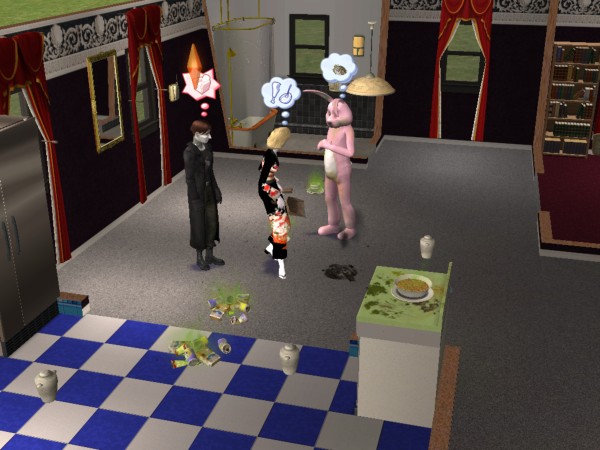
Aside from imbuing the House with a deep sense of history and complexity, Williams raises an important point that anyone who has ever played “The Sims” can recognize: what do you do when you start to empathize with a computer-generated being?

During their time in the House, they meet people who seem to be genuinely good, perceptive, interesting people, qualities that we don’t know how to confidently imbue in real humans, much less coded simulacra. The residents of the House have passions and dreams, they love and hate just as “real” people do. They can’t be written off as “just code,” because they don’t act that way. They help and hinder our heroes just as people out in Real Life might.

I don't know the answer, but this young... man seems interested in finding out.

This brings up an interesting ethical problem: while they can’t be sure what their ultimate goal will be, our heroes are pretty sure that the system will eventually have to be destroyed – as far as they know, it is the Otherland system that is keeping them trapped, and their loved ones in comas. Will doing this be, in essence, genocide? By shutting down the Otherland network to save the children in comas, and to save themselves, will they be condemning thousands – perhaps millions – of coded “people” to extinction? Are these “people” really people? After all, the Grail Brotherhood was planning to become immortal code themselves – would they be any less alive than their meat incarnations?

While this is not a problem that we have to grapple with yet, it’s one that may come up eventually. Tad Williams has done a very nice job in this series of predicting technological advancement, so he may have seen forward on this one, too.

The other simworld that makes this my favorite book is a derivative one. This means that it is based on an extant work, much like the Alice in Wonderland world that Paul Jonas goes to, or the bizarre cartoon kitchen from which Orlando and Fredericks had to escape. This world is one of the oldest stories there is, and was the first simworld to be created when the construction of the Otherworld began.

It is The Iliad.

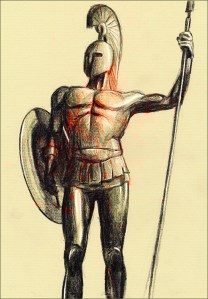
Somehow, I don't have a Sim of Achilles. (Art by NegativeFeedback on DeviantArt)

I’ve read the original poem a few times, and I’m impressed with it every time. It’s a massive story, full of heroes and villains, bravery and treachery, and death. Lots and lots of death. It’s an epic poem, and it deserves the title, as it pits nations, men, and gods against each other in what is ultimately a tragic and terrible ten year war. For Tad Williams to use this as the climax for a novel is nothing short of audacious, but he pulls it off wonderfully.

Not only does he manage to keep hold of the terrible horror of war that Homer put throughout his poem, Williams integrates his characters into the story, putting them in the roles of key figures such as Achilles, Patroclus, Cassandra and Odysseus. They all want to get into Troy so they can find their way to the Black Mountain, but to do so they must go through the war that has served as the archetype for human conflict for the last few millennia. Their choices, freely made, reflect the choices of the characters they inhabit, which are themselves models for heroes of fiction throughout literary history.

In one wonderful scene, Sam Fredericks, who is inhabiting the character of Patroclus, is wondering what to do about her sick friend, Orlando Gardiner, AKA Achilles. He cannot fight, but the Argives need him, and throughout their long friendship as online gamers, it was always Orlando who was the hero. Sam was the sidekick, the buddy, but when you made the movie poster, Orlando’s character would always be in the middle of the shot.

But much like another Sam in another story, Fredericks knows that heroism isn’t just muscles and swords and snappy dialogue. It’s about doing what has to be done, even if you don’t want to do it. Nearly crippled by progeria, a debilitating childhood illness, Orlando has nonetheless continued to fight on in the Otherland. Now the hero cannot fight, and Sam realizes it’s the sidekick who has to pick up the burden. Thus, Sam unknowingly fulfills the destiny of the character she is portraying, puts on the shining armor of Achilles, and goes out to inspire the Argives to fight so that she and her friends might live.

Chocolate! It's full of chocolate!

The entire Troy sequence is amazing, and every time I read this book, I feel compelled to read The Iliad again.

But the series doesn’t end there, of course. Suffice it to say we hit a major climax by the end of this book. People are in danger, secrets are revealed, battles are fought… and one of our brave heroes makes the Ultimate Sacrifice. We are brought to the heart of the operating system, the Black Mountain which entombs the Other. The Grail Brotherhood sets their immortality sequence in motion, and the amoral killer Dread makes his bid for virtual godhood. Setting us up for the final book, we are left with our heroes in disarray – divided and lost, dropped into an entirely new environment that is beyond their understanding and forced to cooperate with their gravest enemies for their survival.

You may look at this book and think, “Holy cow. 924 pages. There is no way I’m reading 924 pages.” But you will, and it’ll go a lot faster than you think. Williams has done a great job of making a multi-layered, fast-paced story that you can enjoy on many levels. You can revel in the action and the mystery, you can ponder deep philosophical problems, or you can comb through the great attention to detail and see how much work he must have done to get the Trojan War sequence right.

Hats off to you, Tad Williams.

—————————————————
“Jesus Mercy. There have to be easier ways than this to save the world.”
– Renie Sulaweyo, Otherland: Mountain of Black Glass
—————————————————

Tad Williams on Wikipedia
Otherland on Wikipedia
Mountain of Black Glass on Amazon.com
Tad Williams’ Website
Leave a comment

Filed under adventure, existentialism, fantasy, friendship, Homer, internet, meta-fiction, quest, science fiction, story, Tad Williams, virtual reality, world-crossing

Review 149: Speaker for the Dead

Speaker for the Dead
by Orson Scott Card

In his introduction to the book, Card says that the main reason he wrote his most famous book – Ender’s Game – was so that he would one day be able to write this. I think this is something that probably happens a lot to authors. They get a Big Idea in their head, something with great depth and complexity and meaning, and quickly discover that they don’t actually know what they’re writing about yet. There’s too much to say, there’s too much that even the author doesn’t know yet, and to go forward from that state of ignorance will result in what is, ultimately, an inferior narrative.

Andrew Wiggin, the Speaker for the Dead, comes to the human colony Lusitania in order to speak the death of a local man, Marcão. While given the same reverence and privileges as priests, Speakers are not the same. Their job is to learn about the dead, to understand who they were and who they wanted to be, and then tell the truth as plainly and as clearly as possible. They do not give eulogies, where they try to paint the dead in as good a light as possible. They reveal who this person was, and in the process try to help those left behind understand them. It’s a calling that requires an insightful mind, great empathy for others, and the ability to tell the truth despite how hard that truth may be to hear.

As a Speaker for the Dead, Andrew Wiggin is very good at his job. It was he who was the first Speaker, who wrote a text that is as revered as the Bible – The Hive Queen and the Hegemon – in order to understand how humankind could kill the only other intelligent species it had ever encountered. The book reveals who the Buggers were and why they attacked humanity. It tells how their understanding of what it means to be intelligent led to a century of warfare and, ultimately, their own destruction. The book also reveals humanity, the dreams and fears that it faced when it met the Buggers. And it tries to understand why humans were so afraid that they took one of their own – a little boy named Ender – and turned him into the greatest monster in human history. The Xenocide. The one who destroyed an entire alien race.

This book changed the way humankind saw the universe, and themselves. With the Buggers gone, but their technology still available, humans expanded out to a hundred worlds. Though their starships could only go just under the speed of light, the ansible provided instant communication between the stars. It formed a communications network that held the Starways Congress together and allowed humanity to become a multi-system species.

Ender – Andrew – is ultimately responsible for all of this, and is therefore the linchpin of this entire universe. In order to write this book, to understand the culture and the history and the politics that would be necessary to write Speaker for the Dead, Card first had to understand who Ender was. So, with the blessing of his publishers, he was able to turn Ender’s Game into a full-length novel. Once that was done, he was able to turn back to this book and craft it into what it has become.

Question: Will the aliens wear hats that are sillier than ours? No? Good.

The colony of Lusitania is a small place, a group of Catholic settlers who live in a small and insular town. They have all the troubles that any new world would have, except for two that make it truly unique. The first is the descolada, a virus that nearly destroyed the colony and, thousands of years before, life on the planet. This illness literally unzips and recombines your DNA, ravaging your body utterly. If not for the dying work of the colony’s two great xenobiologists, everyone would have died. As it turned out, Gusto and Cida were the last to die, leaving their sad, strange daughter Novinha behind.

Even that wouldn’t be enough to make Lusitania a truly remarkable place. No, for that, we must introduce the Piggies – the third intelligent life form known to exist in the universe. They’re small, look like little pig-men, and are indisputably intelligent. They learn quickly, even despite the law forbidding xenologists from influencing their development, and present humanity with an important chance: the last time we encountered an alien intelligence, we obliterated it. Let’s not do that again.

This becomes harder, however, when the Piggies kill two of the xenologists in what appear to be a horrifyingly painful method. Now it looks like humanity may have to revert to type again, and that there truly is no way that humans can share the same space with other intelligences.

Into all this steps Ender. His years of lightspeed travel have kept him young while three thousand years have passed, and he has wandered from world to world to speak for the dead. Now he is on Lusitania to speak for Marcão, an investigation that will lead him to uncover secrets kept for decades, and to once again change the way humans understand their universe.

There’s really so much to say about this book that it’s hard to decide what to leave out and what to keep in. For one thing, Card is trying to write a very different kind of science fiction story. In his introduction, he says that a lot of fiction is adolescent in nature, science fiction especially. It’s about adventure, about people seeing a way out of their conventional lives and going off alone. It’s about being freed from responsibility and living a fast and crazy life. When that loneliness of adventure finally becomes too much, the hero settles down, but that’s usually the last chapter of the book, if ever.

Isolation. Not just for murderous adolescent geniuses.

Card wanted to go the opposite way, to take a lonely adventurer and show him trying desperately to become responsible, to become a member of a community. In class, where I’m teaching Ender’s Game, we’ve identified isolation as being one of the overriding themes of the novel. Ender is constantly taken away from those he loves or held apart from others. In the end, he becomes a solo wanderer. Even more than that, he is made into a monster, a name on par with Lucifer itself. He is virtually thrown out of humanity, and it is only because no one knows who he really is that he can travel unmolested.

So we’re seeing Ender in that stage where the loneliness and the wandering have become an unbearable burden to him, and all he wants is a place to belong. But as a Speaker, as a man speaking a death that could completely upend the lives of everyone in the colony, he has his work cut out for him.

There is also the element of redemption. In his years of travel, Ender has carried a very special package with him – the cocoon of the last Bugger hive queen. In exchange for her story, he promised that he would find a home for her, a place for her to rebuild her vast family. And on Lusitania, there is that chance. But first he has to save the Piggies, to prevent them from suffering the fate of the Buggers at the hand of a fearful and suspicious Humanity. If Ender can do this, perhaps he can make up for the horror that he unknowingly perpetrated.

There’s a lot going on in this book, to say the least. It’s a great book, better in many ways than Ender’s Game. It is more complex and adult and difficult, with moments of true emotion, a well-built socio-political system befitting a species that spans hundreds of worlds, and addressing the needs for changes in culture, politics and even language that would arise from the need to define relationships between worlds and between species.

Ender would have been a natural for the Indigo Tribe. You listening, Geoff Johns?

Fundamentally, though, this book is about what the Speaker for the Dead does best – understanding. It’s about how we deal with The Other, even when that Other is completely alien to us. Humans and Buggers, Humans and Piggies – hell, Humans and Humans, we have a hard time understanding people who are not like us. We find it very difficult to look at the world from their point of view and to see the world through their eyes. Understanding what they love and fear, what they value and honor, or what they abhor – and more importantly, understanding what they see in you and how they understand you – is the best and surest road to making peace with those who are different from yourself. And that’s a lesson that is valuable for all of us.

———————————————
“No human being, when you understand his desires, is worthless. No one’s life is nothing. Even the most evil of men and women, if you understand their hearts, had some generous act that redeems them, at least a little, from their sins.”
– Ender Wiggin, Speaker for the Dead

2 Comments

Filed under children, colonization, death, disease, empathy, family, friendship, morality, murder, Orson Scott Card, science fiction, sins, society, space travel, teenagers, women

Review 146: Otherland 2 – River of Blue Fire

Otherland 2: River of Blue Fire by Tad Williams

When last we left Our Heroes, they were caught in the Otherland – an immense virtual reality program built by people with more money than God – with no idea where to go and no idea what to do. They were lost, confused and had no way out.

Oh yes – back before Neo got his clock punched by Agent Smith, Renie, !Xabbu, Orlando, Fredericks and all the other Otherland explorers discover that they are in more danger than they realize – if they die on the network, then they’ll die in real life. And, almost right out of the gate, people start dying. Whether they’re tiny biologists living among the ants or a lifetime gamer warring against the different factions of a twisted Oz, they die in unpleasant and, ultimately real ways. And it’s up to our heroes to not only avoid death themselves, but also to figure out what the hell they’re supposed to be doing in there.

It's just like this, only different.

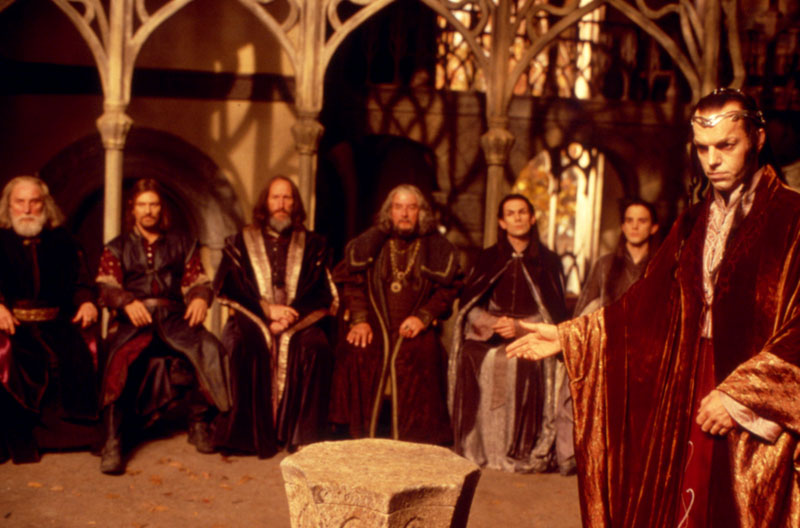
One of the things I like about this series is that Tad Williams openly admits to stealing – er, paying homage to the great writers of the past. At the end of book one, when all the main characters have been gathered together and are being told about the great dangers they will face, and how they are part of a plan to defeat the Grail Brotherhood and their Nefarious Scheme, most of the people there want nothing to do with it. It’s up to Orlando Gardiner, our young barbarian warrior-slash-progeriac teenager to say, “Hey, this the the Council of Elrond! We have a mission here!”

Unfortunately, while the Fellowship of the Ring gets a clear mission before leaving Rivendell, the Otherland explorers are scattered before they know what to do, and their main goal is to run for their lives. As this book progresses, they start to learn more about the vast Otherland network, what its nature is and why it was made. They also learn that it is unstable, and possibly a living thing in its own right.

Almost immediately, the group gets split up. That is, as all ensemble writers know, the best way to really build a meaty story, and it works really well here. Unfortunately, while there are three groups, the strongest and most interesting characters get put into two of them. Orlando and Fredericks get sent off into a world more bizarre than any online gaming ever prepared them for; Renie and !Xabbu end up in a horribly twisted version of The Wizard of OZ, if Oz had invaded Kansas, taken over, and started a three-way fight between the Scarecrow, the Lion and the Tin Man.

No adorable wisecracking robot, though. Can't imagine why.

This leaves us with the third and largest group being somewhat less interesting than the others. Not completely, of course – we have a blind woman who can sense the information flow of the simulation, a teenage net-freak who only speaks in online slang, a campy death-clown named Sweet William, a Chinese grandmother and an abrasive German woman. They’re not bad characters by any means, and each one is special in his or her own right. It’s just that most of them were introduced later in the first book, and so we’ve had less time to get to know them. Putting a more familiar character in that group might have made them more interesting, or it might have overshadowed them. Who knows? The good news is that they do become more interesting and engaging, so there’s really nothing lost by their being new to us.

One thing that the third group has, however, is a secret – one of them is not who he or she appears to be. One of them has been co-opted by the sociopathic assassin, Dread. The only one with the freedom to go on and offline at will, he has nearly godlike power at his fingertips. And he intends to use it.

I can imagine that Tad Williams had a great deal of fun working out these novels, mainly because he created a concept that allowed for incredible freedom in world-building. After all, on a super-powerful VR platform, any conceivable simulation can be created. So whether it is the mythical land of Xanadu, a cartoon kitchen where the groceries come to life at night, a world where people fly like birds, or the legendary land of Ithaca, the settings in these books are only limited to what Williams can think up and work with.

It's like, I'm in the story and I'm reading the story... Woah. Dude.

What’s really interesting is that he seems to take great pleasure in reminding us that we are, in fact, reading a story – he goes so far as to have one character reflect on exactly what kind of character he is. People are reminding themselves that they’re not in a story, even though they are, and at the same time recognizing that the entire structure of their virtual universe is patterned on the rules of fiction. It’s a strange type of meta-fiction that rewards the careful reader.

So, as the book comes to a close, we have some new threads to follow. The Otherland explorers begin to find their purpose and learn about their situation. We’ve met a strange type of character which exists in many worlds at once – the beautiful, birdlike woman who tries to help Paul Jonas and Orlando Gardiner find their way; the horrible Twins, whose only job is to pursue Paul Jonas wherever he may go. These people can be found around any corner, and the outcome of meeting them is always uncertain.

Slightly less complicated than this, but not for lack of trying.

Offline, real-world investigations into the mysterious comas that afflict children begin to bear fruit – a young lawyer named Catur Ramsey is trying to help the parents of Orlando and Fredericks find out what happened to their children, and the search leads him to a strange woman, Olga Pirofski, who may have a vital clue. Renie’s father involves himself with some very dangerous people indeed. The police in Sydney find themselves working on a five year-old murder case that will eventually lead them to the malicious assassin/hacker Dread. A mysterious group called The Circle makes itself known to a select few, and reveals its mission – to oppose the Lords of the Otherland and their relentless pursuit of immortality. All through this, those Lords of the Otherland struggle amongst themselves to see who will ultimately control it.

The tale becomes stranger with the telling, but I can guarantee – you’ll be good and ready to jump right into book three….

—————————————————
“I’ve seen things you people wouldn’t believe. Attack ships on fire off the shores of the Nonastic Ocean. I watched magic blunderbusses flash and glitter in the dark near Glinda’s Palace. All these moments will be lost in time, like tears in the rain. Time… to die.”
– The Scarecrow, Otherland: River of Blue Fire
—————————————————

Tad Williams on Wikipedia
Otherland on Wikipedia
City of Golden Shadow on Amazon.com
Tad Williams’ Website
2 Comments

Filed under adventure, children, corporations, culture, existentialism, family, fantasy, futurism, gender roles, identity, internet, meta-fiction, quest, science fiction, Tad Williams, technology, transhumanism, virtual reality, world-crossing

Review 142: Otherland 1 – City of Golden Shadow

Otherland 1: City of Golden Shadow by Tad Williams

Let me just start by saying this: the first time I finished this series, I immediately went back and started reading it again. I can’t think of any other series that I’ve done that with.

This is one of Tad Williams’ “economy-sized manuscripts,” similar to his fantasy classic Memory, Sorrow and Thorn. Similar in size and scope, anyway – four giant tomes chock full of all things awesome. It’s a series of grand scope, amazing scale and great imagination, well worthy of your time. It’s a complex, interweaving of tales, full of vibrant characters, implacable enemies, and important questions about destiny, identity, consciousness and the very nature of reality itself.

Seriously, top-shelf stuff here, people.

Mind you, Second Life's dreams aren't all that big.

It begins in a near-future world, and it begins with the children. Renie Sulaweyo, a teacher in South Africa, has a brother in the hospital. He, like many other children around the world, has gone into an inexplicable coma, the causes of which defy medical science. The only clue she has is that the outbreaks of these comas coincide with the availability of access to the Net – a virtual reality internet that is what Second Life dreams of becoming. Here, depending on your equipment, you can live in a virtual world that is more vibrant and exciting than anything the real world can offer. And you can do it in full sense-surround 3D.

Renie’s brother, Stephen, engaged in the usual mischief that any kid with access to his own virtual universe might do, and finally got caught. Something shut him down, and Renie was determined to find out what did it. With the assistance of her student, a Bushman named !Xabbu, Renie uncovers an amazing virtual world, something that puts the best virtual reality to shame. It is the Otherland, a playground for the obscenely wealthy. And it may hold the secret to what has afflicted her brother.

And if you think WoW is nuts now? Imagine it fully immersive. Okay, nerds, get back to gold farming...

That’s the short version, and since Renie is the one we’re introduced to first, it would be easy to think of her as the protagonist of the story. That would be highly inaccurate, though. There’s a lot of other storylines going on in there as well. There’s young Orlando Gardiner, who compensates for a crippling illness by being the baddest barbarian on the net. His best friend, Sam Fredericks, has stood by him for many years in an online game that makes World of Warcraft look like pen and paper D&D. They and others are lured into a deadly quest by a vision of a great golden city, more realistic and magical than they ever thought they could find.

Out in the real world, there’s little Christabel Sorenson, upon whose earnest desire to help the funny-looking Mister Sellars the entire future of the Otherland rests. There’s the aptly-named Dread, an assassin extraordinare whose strange “twist” gives him an edge in all things electronic. And, of course, there is Paul Jonas, a man trapped in an imaginary world, whose escape threatens the greatest dreams of the richest men the world has ever known.

All of this, as the series title suggests, centers on the Otherland project, a virtual reality of monumental proportions. It’s a digital world that is more real than the real world is, a world of computer-created, but very deadly, dangers. The slightest misstep could spell disaster and death – die in the Otherland and you die in real life.

This doesn't happen in Otherland, by the way. Lucky them.

And just FYI, Otherland predates The Matrix by three years and, kung-fu aside, is a much better story. So if you’re thinking, “Man, this is just a Matrix rip-off, you’re very, very wrong.

It’s a daunting series to begin. After all, it’s four books, each one clocking in around 800 to 900 pages. There are at least fifteen major characters, and the Otherland itself shows us seven different “worlds” in this book alone. There’s a lot to take in, and on top of all that, there’s a whole world happening outside the story – each chapter is preceded with a small news blurb that tells us about things that are going on in the world. Cops rounding up homeless kids in lethal “snipe hunts,” homicidal artists, legislative representation for the industrial sector of America – this world is both familiar and alien at the same time.

Then again, neither does this. Tad Williams does have his limits.

The good news is that it is a lot of fun to read. The pacing is very good, so you never get too bored watching any one character for a while. What’s more, Williams pays homage to some of the greatest fantasy and science fiction the English-speaking world has to offer. At one point, even the characters admit that they seem to be caught up in a very familiar story. So my advice is to just dive right into it. Once you get going, things clip along at a good pace and you’ll find yourself on page 943 in no time flat.

The really fun part is re-discovering things in this series. There are some things I remember very clearly, but other little details that pop up and make me think, “Oh yeah, I forgot all about that.” I enjoy seeing Williams’ prescience – after all, he wrote this just as the internet was really becoming popular, and a good ten years before things like online gaming and social media took over our lives. His vision of an immersive, VR world may have seemed a little wild and out there back in the mid-nineties, but not anymore.

So, make a sandwich and find a comfortable place to sit. This’ll take a while, but I guarantee – it’ll be worth it.

———————————————-
“If you have found this, then you have escaped. Know this – you were a prisoner. You are not in the world in which you were born. Nothing around you is true, and yet the things you see can hurt you or kill you. You are free, but you will be pursued….”
– Sellars to Paul Jonas, Otherland: City of Golden Shadow
———————————————

Tad Williams on Wikipedia
Otherland on Wikipedia
City of Golden Shadow on Amazon.com
Tad Williams’ Website
Leave a comment

Filed under adventure, brothers, fantasy, fathers, friendship, gender, gender roles, internet, quest, science fiction, sisters, survival, Tad Williams, transhumanism, virtual reality, world-crossing

Review 134: Perdido Street Station

Perdido Street Station by China Miéville

The last time I read this, I wrote: “While this book is remarkably huge, it’s a swift read – well-paced, interesting, creative and clever, which are all good things to have in a book.” At the time, that was true, but this time? Not so much.

I don’t know what changed in the intervening years. The first time I read this book, it gripped me and wouldn’t let me go. I fell into it, into the vast and horrible city of New Crobozon and all the madness that was built into it, and when I came out I was filled with wonder, surprise, and regret that I hadn’t spent a lifetime perfecting my skills at fantasy art.

I would love to read this book, but these naps aren't going to take themselves....

This time was different, and I knew it pretty quickly. I found myself spending more time listening to podcasts while on the train, or playing games on my phone. I ate lunch at my desk and checked my RSS feeds instead of bringing my book up to the cafeteria with me. I actively avoided reading this book and I really wish I hadn’t because it deserves better.

It is the job of every fantasy writer to bring to life not only characters but an entire world. Whether you’re Jim Butcher, creating an alternate Chicago, or Robert Jordan, creating an entire planet, the writer has to know the world inside and out. Every country, every type of people, every custom and culture, climate and weather – everything.

This is because the characters that populate the tale will inevitably be shaped by their environment and its history. Would Tolkien’s fellowship have come together if it were not for the millennia of tensions that existed from having such diverse people living in such a small piece of the world? Probably not. Would the warring princes of Brandon Sanderson’s Stormlight books fight so hard if it were not for the terrifying storms and the power they bring? I doubt it.

Whether the world is built before the story is made or during the process of telling the tale, the author is responsible for it. In the case of Miéville’s New Crobuzon, you know from page one that he has put more time into thinking about his city than almost anything else.

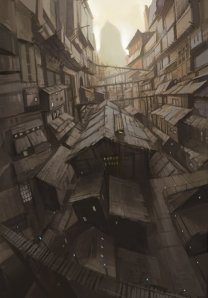
Steampunk. For when you really love brown. (art by gordillo on DeviantArt)

There is almost a palpable feeling of dereliction and disrepair that comes off the page when he describes the city. It’s a dirty place, a wet place, a place that has seen better days. It’s mayor is a tyrant, who uses a secret militia to keep the populace under control and horrifying thaumaturgical techniques to punish those who break the law. It is a great, sprawling metropolis at the confluence of two rivers – the Tar and the Canker – which should tell you a bit about the city they run through. In the tradition of modern urban fantasy, it’s a place of magic and technology, ruined by political greed and social apathy. There are desperate poets and mad scientists, gang bosses and petty criminals, whores and saints and madmen for every occasion.

Independent scientist Isaac der Grimnebulin is looking for the thaumo-physiological secret to flight in order to help a disgraced bird-man regain his wings, and to prove his theory of “crisis energy” that may well change the world. In the process, he accidentally unleashes an unstoppable horror that threatens to slowly destroy the city and everyone in it. He also manages to make enemies of both the city militia and the leader of organized crime in New Crobuzon. He and his friends have only days before the city is overrun, or they are killed, and if they hope to survive they must somehow get the help of two of the most powerful entities the city has ever known.

Miéville has created a new flavor of fantasy here – a kind of steampunk world of brass and wood and gears, analog computers and over-designed firearms that really appeals to all the reader’s senses. He describes the city in unrelenting detail, and if pressed he could probably give you a tour from memory. You get the feeling that New Crobuzon has been sitting in his head for a long time, and all he’s done is finally put it to paper.

For a change of pace, grayish-brown. (art by Trabbold on DeviantArt)

For me, that might have been what changed. The first time I read this, I was swept up by the city, but this time… this time I kept thinking, “Yes, yes, the city is a cesspit, I get it. What about the giant moths?” I wanted the story more than I wanted the setting, and my impatience (combined with a whole lot of backed-up Radiolab episodes) kept me from really settling down, slogging through the descriptions of decaying brickwork, overgrown rooftops and beggars wrapped in filthy rags who crawled through the pestilential streets. In a way, it was kind of like Tolkien, but slightly more restrained.

But perhaps, like Tolkien, that was the point. For all that we’re reading an adventure now about a scientist and the horrors he has unleashed upon the world, about a strange patchwork crime lord, a tyrannical mayor, a sentient clockwork intelligence, a dimension-hopping super-spider and moths that will swallow your soul, this book really isn’t about them. This is just one event in the long and bizarre history of New Crobuzon and the vast and strange world it inhabits, and we’re granted a glimpse into it. When you get to the end of it, whatever else you think of the story, you’ll be stunned by what Miéville has been able to come up with.

I know that a lot of the cognoscenti of science fiction and fantasy just adore Miéville, and I can certainly see why. He’s creative, he’s imaginative, and he’s built a wonderful world for the imagination to play in, populated with some of the most bizarre races and people you could think of. He’s grabbed the trend of Steampunk retro-futurism and made it his own in a way that few other writers can do. He deserves all the credit he can get.

For me, though… Perhaps it was the right book, but not the right time.

—————
“New Corbuzon was a city unconvinced by gravity. Aerostats oozed from cloud to cloud above it like slugs on cabbages. Militia-pods streaked through the heart of the city to its outlands, the cables that held them twanging and vibrating like guitar strings hundreds of feet in the air…”
– China Miéville, Perdido Street Station

Perdido Street Station on Wikipedia
China Miéville on Wikipedia
China Miéville’s blog
Perdido Street Station on Amazon

2 Comments

Filed under adventure, China Miéville, dystopia, engineering, fantasy, science fiction, steampunk, totalitarianism

Review 127: The God Engines

The God Engines by John Scalzi

There is not, to my knowledge, a whole lot of theological science fiction. Madeleine L’Engle’s books may qualify, but to be honest, it’s been years since I read them so I don’t know. The Golden Compass books, too, but they struck me more as fantasy, seeing as how there were no spaceships. My only successful foray into National Novel Writing Month produced some theological sci-fi, but it was questionable at best and is still fermenting on my hard drive somewhere.

In any case, that is what John Scalzi has given us, and if you’re a regular reader of his blog and his other books then you may find this one to be a little… off. You see, like many accomplished writers, Scalzi has a Voice, a way of writing that is immediately identifiable as his own, and which a lot of his fans have gotten used to. There’s no single thing I can point to that really illustrates what this is, but trust me – it’s there. A certain whip-quick sarcasm, a way of looking at old questions from a new angle and the ability to cut through the requisite fuzzy thinking that seems so endemic to the human race.

Not quite like this... but kind of.

In this book, he tries on a new voice, something that sounds kind of like his, but at the same time like he’s trying on something new. It’s as if Jonathan Coulton started doing Manowar cover songs. It’s not bad, it’s just something that takes a little getting used to.

Captain Ean Tephe is the commander of a great starship, the Righteous, one of the many ships in the fleet controlled by the Bishopry Militant. He and the other captains in the fleet are charged with carrying out missions for the Bishopry in the name of their God, a being of immense power who uses the faith of millions to rule them. Their Lord is a powerful and active god, one who brooks no dissent from His followers and who will suffer no challengers to His dominion. Long ago, the Lord battled countless other, smaller gods, and won, chaining them to his will and turning them into the engines of the great starships that carry His people out into the universe.

Some gods are less tractable than others. (art by Evolvana on DeviantArt)

The god that powers the Righteous, however, is not cooperating. Some ships’ gods are quiet and obedient, others chatty, some cowed into good behavior by fear. The god on this ship is defiant, despite the prayers of priests and acolytes, and the horrible whip that the captain wields to compel obedience. This god soon reveals itself to be part of a greater plan, one which enfolds both Tephe and his crew and reveals a truth about their God that is enough to drive men mad. It is a test of faith for the men aboard the Righteous, and if they should fail, their lives will end in short order.

It’s a very cool concept, really, one which I haven’t seen done before. Scalzi has powered a civilization by faith, quite literally, in a God that not only exists, but it quite active in the lives of His worshipers. His high priests exert complete control over a population that rightfully fears for their souls, and manage to channel the God’s power into various science-like applications. Through the use of amulets called Talents, the God facilitates communication over great distances, compels obedience, and opens gateways. He has a civilian population whose faith nourishes Him, and a military arm that travels the galaxy spreading His word and destroying His enemies. And it all makes sense.

As cool as the idea is, though, the book itself felt like a rough sketch rather than a fleshed-out novel. It’s quite short, as novels go, and we are introduced to a lot of concepts and characters in a fairly brief amount of time. The Bishopry Militant, for example, sounds like a great place to see intrigue and double-dealing, lies upon lies that somehow manage to get things done, and we do see a bit of that when Captain Tephe gets a secret mission to a new world. Scalzi showed us in The Last Colony that he can handle this kind of multi-layered politicking, and I think it would be even better in a place like this. Add to that the Rookery, a kind of church-sanctioned brothel/therapy center aboard the ships, where the women who work there have nearly as much power and influence as the Bishopry itself. What would happen if these two institutions came into conflict, and what weapons would they wield?

This god has some opinions he'd like to share.

The chained gods, too, are a wonderful chance to explore a lot of ethical questions. They are undoubtedly sentient beings of great power, enslaved by a God that is stronger than they. Is this kind of slavery justified? Would it be possible for a ship to work with its god-engine, rather than compelling it with whips and prayers. What do these gods know, and how reliable are they? The god powering the Righteous seems to know a lot about how this universe works, including some terrifying tales about the God that Tephe follows, but how much of what it says can be trusted?

And what are the powers and limitations of a faith-powered science? Much in the way that engineers and scientists in our world manipulate a few basic laws of nature to achieve amazing things, what could be done in a world where prayers have power and where a high priest’s whim can decide the outcome of an entire mission? How do you creatively solve problems in a reality like this one, where they deal in belief and faith, rather than wavelengths and mass?

So yeah, there was a lot that I wanted from this book once I figured out what Scalzi was doing with it. After a great opening line (and a third line that just left me confused), the learning curve was a little steep. Once you figure it out, though, the possibilities seem endless. Unfortunately, the book itself ends rather sooner than it should.

The less said about this album, the better.

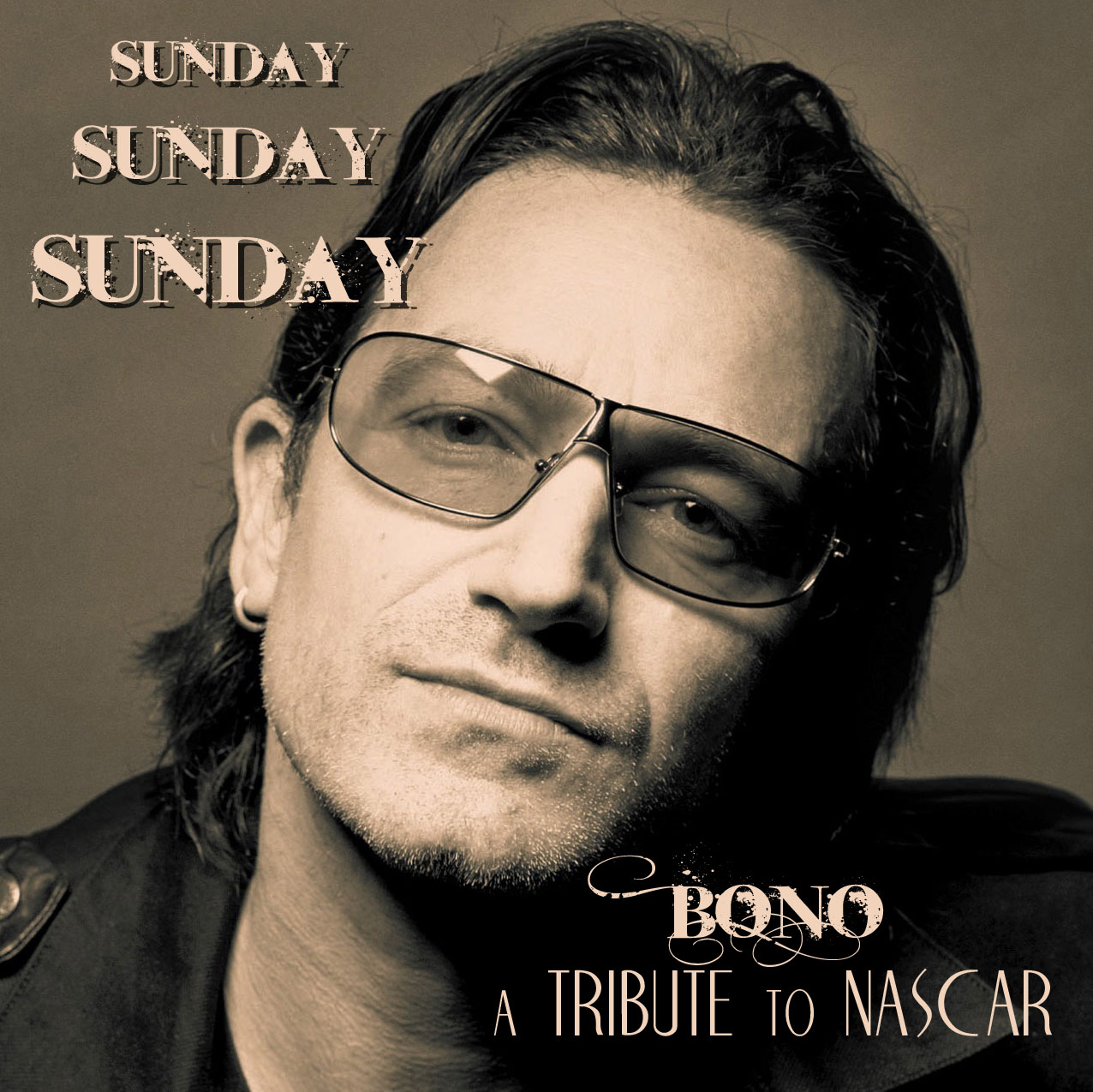
It’s not my favorite book by Scalzi, not by a long run, but since he’s said he’s going to lay off the Old Man’s War universe for a while, I should be thankful that he is willing to experiment and try new things. As many music lovers know, it’s sometimes very hard to accept that an artist you love wants to try to do things that are new and different, rather than keep doing the things that made you love them in the first place. I remember when U2 put out Achtung Baby and my friends who fell in love with The Unforgettable Fire and The Joshua Tree and Rattle and Hum were almost personally offended. Zooropa, of course, was not to be mentioned aloud in their presence.

That kind of experimentation and risk-taking, however, is ultimately what helps an artist grow. You may not like what comes of such experimentation, but that’s tough – it’s not about you.

I don’t know if Scalzi will return to this universe or not, but I hope he does. If he does, I hope he lingers longer than he did in The God Engines, and brings forth another wonderful and complex universe.

————————————————————
“Faith is not for what comes after this life. Faith is for this life alone.”
– A God, The God Engines
————————————————————

John Scalzi on Wikipedia
The God Engines on Wikipedia
The God Engines on Amazon.com
John Scalzi’s Blog

Leave a comment

Filed under gods, good and evil, John Scalzi, morality, religion, science fiction, sins, space travel, theocracy, theology, totalitarianism, war

Review 117: I Will Fear No Evil

I Will Fear No Evil by Robert Heinlein

One of the things I enjoy about Heinlein is that he likes to play with Big Ideas. While he did dip into the well of action and adventure, especially for his juvenile stories, he treated his readers like they were only slightly intellectually inferior to him, and so explored concepts that required a lot of heavy thinking. The need for war, the inevitability of messiahs, revolution, life, death, immortality – he’s not afraid to look at some of the greatest philosophical topics that reside in the human heart, and this book is no exception.

Johann Sebastian Bach Smith is a very old, very sick, very rich man. He built himself up from nothing and rose to financial prominence in what is a little more than a regular human lifetime. Smith had it all – a rich and exciting life, complete financial security, good friends and good memories in a world that had, frankly, gone to hell. He had very nearly everything a person would want to have.

Photo by openDemocracy

What he didn’t have was time. He lived in daily pain, kept alive by only two things: an ever-increasing number of machines and a plan to release himself from the geriatric horror his life had become. He knew that this plan would probably fail. He knew that he was facing death no matter what happened. He knew that it was crazy, and not necessarily crazy enough to work. But it was all that stood between him and suicide.

That plan was, in theory, very simple: transplant his healthy brain into the body of a healthy young person. By doing so, he would gain a whole extra lifetime to enjoy the fruits of his first lifetime’s labor. Not being a monster, he was prepared to do this in a legal and ethical fashion. With his legal, medical, and judicial contacts, he made arrangements with a medical advocacy group to get the body of a healthy young person who died due to some massive brain trauma. And – and this is important – who consented to having their body used for medical experimentation. Everything would be above-board, legally sound and ethically certain. All Smith had to do was stay alive until a body became available.

Now just put the two of them together... IF YOU DARE!

When it did, however, he was in for a double surprise. Not only was the healthy, youthful body that of a female, it was that of his healthy, youthful, beautiful secretary, Eunice Branca. Eunice had been murdered, but her body was in excellent condition. She had the right blood type, and had consented to have her body used for Smith’s experiment. The one doctor in the world who could perform the surgery was brought in to perform it, and against all odds, it worked. Johann Sebastian Bach Smith was reborn as Joan Eunice Smith, and her new life began.

But she was not alone.

By some means, Eunice’s mind survived to live with Joan, and tutor her in all the ways of being a woman. Joan dove happily into her new life, exploring her new femininity and sexuality as best she could.

In that sense, this whole book is an exploration of sexual identity. Here we have a man who is now a woman, even though that was never his intention. He soon finds himself thinking like a woman, though, bringing up the question of whether gender is determined by a person’s mind, or by the body it inhabits. If you put a male mind into a female body, with the vastly different hormones and sensory inputs, will that male mind start to act like a female? And even if it does, should it?

Smith makes a decision to, with Eunice’s help, be the best woman he can be, mostly because he feels that is what is expected of him. After a lifetime of conforming to male societal roles, Smith wholeheartedly embraces the female ones, up to and including seducing his best friend of many decades. Gender identity in this book is a tangled mess of biology and intention, and it looks at being female from a distinctly male point of view.

It was a different time....

Which brings me to my first problem with this book: the casual misogyny. I know it’s a pretty loaded word to throw around, and it’s not entirely accurate, but it was the one that kept coming to my mind. While Heinlein is certainly capable of creating strong and independent female characters, and emphasizes over and over again that both Eunice and Joan are actively choosing the lives they lead, those lives are almost entirely dependent on and revolve around men. One of Smith’s first actions when he goes from Johann to Joan is to latch on to a man – her old friend Jake Saloman. She views her identity as a woman as incomplete without a man to base it on, and spends most of the book trying to figure out who she is in relation to men – Jake, her security guards, Eunice’s widower, and more. She repeatedly mentions how helpless she is without a Big Strong Man in her life, and all of this culminates in what is possibly one of the most misogynist moments I have ever read in sci-fi: a spanking scene.

And not a sexy one, either. In a moment of adolescent pique that Jake won’t sleep with her when she wants him to, Joan throws a fit, disrupting their dinner plans. Jake proceeds to throw her over his knee and give her a spanking because, and I’m quoting here, “You were being difficult… and it is the only thing I know of which will do a woman any good when a man can’t do for her what she needs.” Joan accepts the spanking meekly, not only thanking Jake for his spanking, but also claiming that she had her first orgasm while he did it.

Wow. That’s nearly as bad as the other major female character, Winnie, who talks about a gang rape experience with what can almost be imagined as fondness.

Oddly enough, this is not my biggest problem with the book. I mean, it was written in the late ’60s, and it reflects the thinking of that era. For all his progressive beliefs, Heinlein was still a man of his time, and it really shows here. Legend [1] has it that he was really sick when he wrote this book, and that may have had something to do with the fact that no matter how many complex hot-button issues he touches (gender roles, homosexuality, same-sex marriage, overpopulation, government overreach), the fact remains that there is no story in this book.

This picture contains more conflict than this book

Let me explain. A story needs conflict. It needs not only a protagonist that is trying to achieve something, but obstacles that impede that achievement. There were so many potential goals and obstacles to be explored in this story – a man’s brain in a woman’s body – but Heinlein manages to artfully dodge all of them. The story of Smith’s inner struggle to resolve the gender he grew up with with the gender he now possesses would have been fascinating. But it didn’t happen. Smith pretty much accepts the change right away, with few if any reservations. Even so, he could have struggled with how to live as a woman – should he adopt the identity that a patriarchal society would confer upon him as a woman, or forge his own as a uniquely gendered person who has gone from the privileged to the unprivileged sex? Unfortunately, the conflict doesn’t even occur to Joan. She decided to be the best woman she can be, constantly asking others what that entails, rather than asking herself.

Or how about the concept of Identity itself? Smith is an old brain in a new body, so is he legally the same person he was before the surgery? That would be an amazing story as he tries to prove that Johann has become Joan, and that even though Eunice’s body is still walking around, she’s actually dead. But no – Smith has some powerful legal friends with ironclad arguments, and the legal proceedings are pretty much a foregone conclusion.

Or how about rejection by society? Regular transgendered people have a hard enough time getting society to accept the modification of the body they were born with – what about when someone takes on an entirely new body? Joan could have struggled to get her friends and family to accept who she has become, to stand before the world with her head held high. But no…. She has enough money that she doesn’t really need society’s approval, none of her friends have any trouble with what she’s become, and even Eunice’s widower has only a moment of uncontrollable emotion before accepting that his wife is dead, but still walking around. And he might get to sleep with her again.

Imagine this in your head ALL the TIME.

One last one – the soul. Joan hears Eunice’s voice in her head, but it’s unclear whether it is really Eunice or if it’s just Joan’s imagination. What’s more, they never fight. They never have a serious disagreement and have to resolve their differences so that they can continue to occupy the same skull. Eunice and Joan live together like wisecracking sisters and never have to deal with the problem of living with someone you can’t get rid of, even if you’re not sure if they’re real.

In other words, there’s no there there. It’s a long, talky, philosophical exploration of some fascinating topics, but as a novel, it’s incredibly dull. You keep waiting for the blow-up, for the accident, for the Big Problem that Joan and Jake have to struggle to overcome, and it never arrives. Everything works out either through money or force of will or Heinlein’s trademark Sheer Damn Reasonableness. Between that and the constant thought of, “He did not just say that,” I found this book rather stressful to plow through. It offers up a lot of big ideas to think on, raises some very important questions, and Heinlein’s gift for dialogue makes some fun conversations, but I think I would have liked it more if it had been completely different.

——————————————————
“Sir, if you want to give me a fat lip, I’ll hold still, smile happily, and take it. Oh, Jake darling, it’s going to be such fun to be married to you!”
“I think so too, you dizzy bitch.”
– Joan and Jake, I Will Fear No Evil by Robert Heinlein
——————————————————

[1] Wikipedia

Robert Heinlein on Wikipedia
I Will Fear No Evil on Wikipedia
I Will Fear No Evil on Amazon.com
The Heinlein Society

1 Comment

Filed under afterlife, bad, death, existentialism, friendship, gender, gender roles, ghosts, homosexuality, identity, Robert Heinlein, romance, science fiction, sexuality

Review 114: The Ghost Brigades

The Ghost Brigades by John Scalzi

The book that preceded this one was Old Man’s War. It was Scalzi’s first novel and I loved it. It had everything – high-end science fiction, philosophy, cool battle scenes and a protagonist whose sense of humor reminded me a lot of many of my friends. The book’s premise was very simple – why do we use young people to fight in wars? Because they have the bodies that work best for the task – strong, fast and generally resilient. But young people can also be rash, impulsive and generally ignorant of a whole lot of life’s complexity. If their physical capabilities were not an issue, then who would we want? Why, old people, of course. They have the life experience, the patience and the perspective to be better soldiers.

No.

So, it’s The Future. Mankind has spread out among the stars, and the Colonial Union is the political organization that keeps them together. Any government needs a military, so the Colonial forces make sure they have the best recruits, all brought from Earth. With some pretty high-tech jiggery-pokery, the senior citizens from Earth’s richer nations are made into lean, green fighting machines, capable of performing in ways that make the Marines of our day look like palsey victims. Their minds are transferred from their old, decrepit bodies and put into new ones, grown from their own DNA, but altered to make them better soldiers. It’s all very exciting and cool, but at some point, I suppose Scalzi asked himself a question: what happens when someone signs up at age 65, but doesn’t make it to age 75 when they’re supposed to start their service?

NO!

Well, we have all this DNA just sitting there, right? We can’t let it go to waste, can we?

That brings us to the Ghost Brigades, the rather morbid nickname for the Colonial Union’s Special Forces. Their bodies are grown from DNA whose previous owners have expired, and are modded in more extreme ways than the regular defense force soldiers. Then, when the body is ready, they’re woken up. An amazing piece of biotechnology called, rather whimsically, a BrainPal prepares their brains for consciousness, acting as a kind of bootstrap for the emergent personality. It tells them what they’re supposed to know, so they don’t have to go through the tedious process of learning it all. And, of course, much more. The Special Forces do what the regular Defense Forces can’t, and act in ways that their more “ordinary” soldiers couldn’t understand. In Old Man’s War the Special Forces only came in at the end. In this book, as you might have guessed, they play a much more central role.

I'll show them! I'LL SHOW THEM ALL!!!

Charles Boutin is a traitor to humanity. For reasons known only to him, he has sold out the Colonial Union to its enemies, a troika of alien species that would be more than willing to wipe us off the map. The Defense Forces would love to find him, of course, but he’s hidden himself among the enemy. So they got the next best thing: a copy of his own mind that Boutin had made while researching the BrainPal.

In theory, it should work: put this mental backup copy into a “clean slate,” a body that has no mind of its own. A Special Forces body.

And so, Jared Dirac was born. Decanted. Whatever. It was hoped that when he opened his eyes, he would be Charles Boutin in a new body, and could promptly be interrogated. But it isn’t that easy. Jared Dirac is a normal Special Forces soldier, a blank slate who is ready to do the job he was, literally, born to do: keep humanity safe.

Art by Vincent Chong

He’s sent off to training, with the expectation that he would be just another Special Forces soldier. But he is, of course, much more than that. As his brain matures, the memories and personality of Charles Boutin come with them, and Dirac starts to understand more of what made the man turn traitor to his own species. This information could lead the Defense Forces to their ultimate goal, or to their destruction….

It’s a great book. Tons of fun, although the exposition is a bit heavy-handed in the beginning. There’s a whole lot of reminding about what you learned in Old Man’s War, and I didn’t really need it. That’s the thing about recap, though: if you avoid it altogether, you can confuse people who haven’t picked up the previous book in a while. Slather it on and you bore the people who have good enough memories.

Once you get past that, though, it’s straight on fun, with some pretty serious questions folded into it. One of the major questions raised in this book is that of identity – who is Jared Dirac? How can a being who is brought to full consciousness by an implanted computer be properly called “human?” It’s clear that he is, but a fuller look at the Special Forces – especially the squad known as the Gamerans – really does push the definition of “human” to its limits.

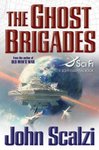
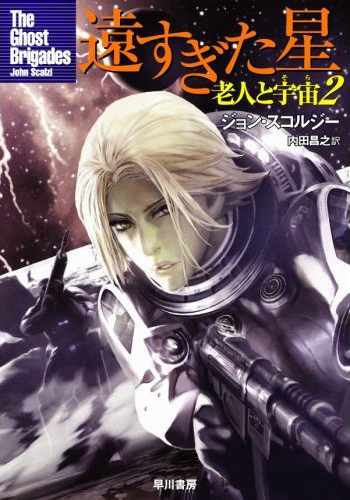
The Japanese cover to Ghost Brigades

It’s a very thoughtful book in many places, exploring the grey areas of not only humanity and “human-ness,” but also of the role of humanity among the stars. Explaining his reason for turning traitor, Boutin asks us to consider the entire purpose of government itself – how it operates, how much power it has and how much it should trust its citizenry. He fundamentally disagrees with how the Colonial Union goes about its business, and will do whatever he has to in order to set it on what he believes is the right path. And in the middle of all this is Jared Dirac, who has to actually start making choices in his life – something that Special Forces soldiers were never bred to do.

As with Old Man’s War, this is a great book to read, and I look forward to the other books set in that universe. You should too.

———————————————-
“We don’t mind when the other guy brings a gun to a knife fight. It just makes it easier for us to cut out his heart. Or whatever it is that he uses to pump blood.”
Lieutenant Jane Sagan, The Ghost Brigades

The Ghost Brigades on Wikipedia
John Scalzi on Wikipedia
The Ghost Brigades on Amazon.com
John Scalzi’s Blog

Leave a comment

Filed under adventure, aliens, ethics, existentialism, fiction, friendship, identity, John Scalzi, military, morality, philosophy, science fiction, technology, transhumanism, truth, war