Tag Archives: book reviews

Review 123: Nineteen Eighty-Four

Nineteen Eighty-four by George Orwell

Gods, where do I even start with this?

As with To Kill a Mockingbird, I read this during Banned Books Week for two reasons. First, it’s on the ALA’s list of top banned or challenged books, and second because it’s really, really good.

As with all the books I read, there’s always a little part of me thinking about what I’m going to say about the book once I finally decide to write about it. Sometimes I start composing in my mind, coming up with the pithy words and phrases that have made me into the international book reviewing superstar that I am.

This time, however, I could barely concentrate for the cacophony in my head. There’s just so much going on in this novel that doing it any sort of justice would probably require writing a book that was longer than the book that it was analyzing. And as much as I love you guys, I’m not about to write a whole book about this. Probably because I reckon better minds than mine already have.

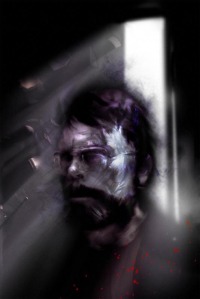
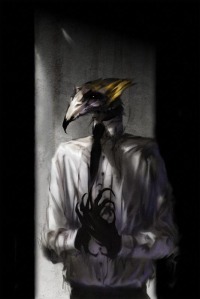
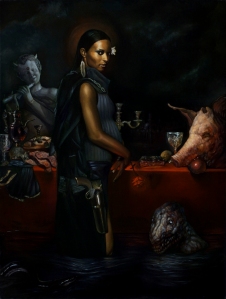
Art by Party9999999 on DeviantArt

Regardless, it’s hard to choose where exactly to go on this one. There are so many political, sociological, psychological and philosophical threads to pick up here that no matter what I write about, I’m pretty sure I’ll get responses about how I didn’t mention the solipistic nature of Ingsoc and its relationship to the philosophy behind modern cable news network reporting strategies. Don’t worry, guys – I got that one.

I suppose two big things came to mind while I was reading it this time, and the first of them was inspired by the previous book I read, To Kill a Mockingbird. In that book, Atticus Finch talks a lot about bravery. To teach his son about what it truly means to be brave, he gets him to take part in an old woman’s struggle to free herself of a morphine addiction before she dies – an excruciating process that is more likely to fail than to succeed. But she does it anyway. Atticus says to his son about bravery, “It’s when you’re licked before you begin but you begin anyway and you see it through no matter what. You rarely win, but sometimes you do.”

The question in my mind, then, was “Is Winston Smith brave?”

I really want to put this on a t-shirt....

It’s a hard question to answer, really. By Atticus’ definition, you could say that he is. A member of the Outer Party that rules the superstate of Oceania, Winston Smith is a part of a greater machine. He works in the records department of the Ministry of Truth, diligently altering and “rectifying” the data of the past to bring it into alignment with what the Party wants to be true. His is a world where there is no such thing as objective truth – the truth is what the Party says it is.

A good member of the Party sublimates his will to that of the Party. What Big Brother wants, she wants. She has no love but love for the Party and no dreams but to do what the Party wants of her. A good Party member doesn’t have plans or hopes or dreams. He doesn’t ask questions or idly wonder if things could be different from what they are. A good Party member doesn’t think. He is born, lives, consumes, and dies.

Winston, however, cannot be a good Party member. He wonders why the world is the way it is, and begins down a road to assert his own identity as a human being. He knows full well that he will fail, that in the end he and the woman he loves will be delivered into the hands of the Thought Police, and he is appropriately terrified. But he goes through with it anyway. He keeps a diary of his thoughts and actively tries to join an underground movement that is determined to overthrow the Party and Big Brother. He declares himself willing to undertake acts of heinous treason, all in the name of resistance against the Party.
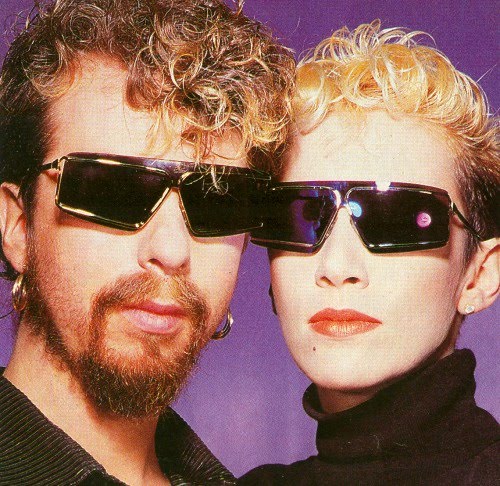
The new faces of the Party. DOUBLEPLUSGOOD!!

And in the end, he fails, just as he knew he would. So does this make Winston, a man who is so far in character from Atticus Finch, a brave person? Well, yes and no.

He does meet Atticus’ definition of bravery – persisting in what you believe to be right, even in the knowledge that you will probably fail. Winston puts his own life on the line multiple times, committing Thoughtcrime of the highest order. But is he doing it for some higher ideal, or is he doing it for more selfish reasons? Flashbacks to his younger days suggest that Winston Smith was an unrepentantly selfish child, who was willing to disregard the dire straits of his own mother and baby sister in order to get what he wanted. Could we not say that the adult Winston does the same? That he is more interested in freedom for himself than for others? Is his rebellion against Big Brother political or personal? He claims that he wants to see the world changed and freedom brought to all people, but how far can we trust a mind that’s been well-trained in Doublethink?

This, of course, gets right back to the Big Question of why people do the right thing, when it might be so much easier and profitable to do otherwise. Atticus Finch could have let Tom Robinson swing, thus saving himself and his family a whole lot of trouble, just as Winston could have just given up and emulated his neighbor, Parsons, becoming as good a Party member as possible. Neither man could do that, though, because is was not in their nature to do so. It was impossible for Winston to continue to live the way the Party wanted to and, given time, he may have been able to reach beyond meeting his own personal needs and seen to the needs of his greater community.

Unfortunately, we never get the chance to find out, as the Thought Police eventually get tired of watching him and take him in. To his credit, he does hold out to the last extreme before he betrays Julia in his heart, so perhaps he is brave after all.

How adorable....

The other thing that came to mind while I read was the modern use of the word “Orwellian,” and how it falls vastly short of what is depicted in this book. It gets thrown about any time a city puts up a few CCTV cameras downtown, or a business decides to put surveillance cameras in their store. It comes up when we put RFID chips in passports and credit cards, or when we think about how much data Google can hold about us. The word brings to mind a sense of constant surveillance, never being able to move or act without some government or corporation knowing what we’re doing.

While the concept of the two-way telescreens in this book certainly are a logical extension of surveillance culture, to call a customer database or red light cameras “Orwellian” is like calling a Bronze-age chariot a Ferrari. It betrays an incredible lack of understanding of what exactly is going on in the world that Orwell has built. We may be watched by these people, but in comparison to the average citizen of Oceanea – prole or Party member – we are still remarkably free.

Freedoms available to us. Not these people.

There are still freedoms available to us that people like Winston never had, and couldn’t understand even if they were offered. We can protest, we can voice our disagreements, we can channel our energies into whatever pursuit we choose, or not channel them at all. We have the freedom to decide who we want to be and how we want to live, at least within the limits of a well-ordered society. We do not live in daily terror that we might be abducted from our beds, our lives ended and our very existence erased from record and memory. Honestly, I think a few security cameras pale in comparison to the horror that is Oceanea and the world of Big Brother.

There is so much more to talk about with this book. I find Newspeak fascinating, and its foundations both amazing and terrifying. The idea that a concept can only truly exist if there’s a word for it brings to mind those “untranslatable” words you find in every language. For example, there’s no equivalent to the English “miss” in Japanese, as in “I miss my mother.” Does that mean that people in Japan are incapable of missing people? Of course not, but the underlying theory of Newspeak suggests otherwise. Once the party reduces the English language to a series of simple words with no nuance or subtlety of meaning, the idea goes, Thoughtcrime will be literally impossible. After all, how can one wish for freedom if the concept itself is impossible to articulate?

Then there’s the idea of the mutability of the past. The way the Party exerts its unbreakable control over the population is by virtue of the fact that they control all media – newspapers, radio, television, publishing of all sorts. If the Party wants to, say, claim that Big Brother invented the airplane, all they have to do is revise all relevant media to reflect their desired past, and then replace and destroy anything that disagrees with them. With no evidence that Big Brother didn’t invent the airplane, all that’s left is fallible human memory, and those who do think they remember the “right” version of the past will eventually die anyway. Whoever controls the present, the Party says, controls the future. And whoever controls the past controls the present. By remaking the past, the Party guarantees that they can never be gainsaid or proven to have erred in any way.

Even Big Brother would crumble before 4chan....

Fortunately for us, Big Brother never had the internet to contend with. As anyone who’s been online for a while knows, nothing on the internet ever goes away. Ever. The words of any leader or influential person are all there, in multiple copies, all of which can themselves be copied and distributed in mere seconds. While it is possible to fake a photograph, the awareness of that possibility, as well as the technology to suss out the fakes, are just as available to anyone who wants them. Even in cases where there are disputes about the past, or re-interpretations of past events, it is impossible for one version to systematically replace all others. While this sometimes results in competing versions of the past, the one with the most evidence tends to prevail.

Continuing in that vein, the understanding that the Party controls all information about itself leads to a very interesting question that’s not addressed in the book – is anything that is not directly witnessed by Winston Smith true? We are led to believe, for example, that there are three world powers – Oceanea, Eastasia and Eurasia – which are locked in a state of perpetual war. The nature of this war and how it serves the interests of these three nations is laid out in Goldstein’s Book, which is the text of the Revolution that Winston and Julia want to join. But here’s the thing – Goldstein’s Book is an admitted fiction, written by the Party as a kind of honeypot to bring suspects through the last stages of their Thoughtcrime. So we have no proof that the world of Nineteen Eighty-four actually is laid out the way it appears.

Is this the real world? GO TO ROOM 101, CITIZEN!

The Party could in fact dominate the world, using the pretext of war to keep the world’s citizens terrified, needy and compliant. On the other extreme, Oceanea could just be Britain, turned in on itself like some super-accelerated North Korea, its borders sealed and its citizens kept in utter ignorance of the world outside. We don’t know. We have no way of knowing, and neither do any of the characters in the book. Even the Inner Party members might not know the truth of their world, and wouldn’t care if they did.

One more thing, and I’ll keep this one short – Doublethink. The ability to hold two contradictory ideas in your mind, believing in both of them simultaneously and yet being unaware that there’s any conflict at all. Knowing, for example, that last week chocolate rations were at thirty grams, and at the same time knowing that this week they had been raised to twenty. All I can say here is to look at the health care debate in the United States. Here’s a fun game: see how often someone says, “We have the best health care in the world,” and then see how long it takes before they tell us that health care in the United States is irrevocably broken. Your average politician and pundit does this kind of thing all the time and, in accordance with the basic principles of Doublethink (also known as Reality Control), they immediately forget that they had done it.

No! Not Obamacare! Do it to Julia! DO IT TO JULIA!!! (Art by Scott Sullivan on Flickr)

This game is much easier if you watch Glenn Beck for half an hour. You’ll be missed, Glenn.

There is just so much to be gleaned from this book. Probably the most important is this – the world depicted in Nineteen Eighty-four is certainly not an impossible one, but it is unlikely. The people of that world allowed the Party to take over for them in a time of crisis, and in that sense this book is a warning to us all. It is a warning to keep the power that we have, and to resist the temptation to let a government decide who we should be.

——————————————-
“I understand HOW: I do not understand WHY.
Winston Smith, Nineteen Eighty-four

George Orwell on Wikipedia
Nineteen Eighty-Four on Wikipedia
Online comic adaptation
Nineteen Eighty-Four on Amazon.com

2 Comments

Filed under classics, dystopia, ethics, existentialism, fiction, futurism, George Orwell, language, made into movies, morality, philosophy, politics, psychology, totalitarianism, truth

Review 122: Anansi Boys

Anansi Boys by Neil Gaiman

When I started in on this book, I knew there were certain things I could expect from Neil Gaiman – insight, clever twists on literary assumptions, a good perspective on the nature of our reality. And, I must say, he delivered in full. This story draws from some of the most ancient of human tales and reflects on the most ancient of human needs – the need to have a story of one’s own. It’s a book about purpose and destiny, and other very deep subjects.

Yes - this man is hilarious.

What I didn’t expect was to spend most of the book laughing out loud and disturbing the people around me.

Seriously, there were some times when the other teachers in the staff room would stop whatever conversation they were having because they’d been interrupted by my cackling. Or the staff would come over and ask what was so funny, and I’d try to explain – which doesn’t really work when you’re trying to cross languages and literary traditions. People in Japan don’t really laugh out loud at their books, and can’t quite understand why I do. But I laugh. I snicker, I giggle, I cackle, and I never expected that from Neil Gaiman.

The book was, needless to say, wonderful. While by no means a sequel to Gaiman’s previous bestseller American Gods, it inhabits the same universe. This is a world where the gods exist – they’ve been called into existence by us and, in turn, shape our lives.

The book follows the unfortunately nicknamed Fat Charlie, whose life has been ruined by his father’s death across the Atlantic. This wasn’t the first time his father had ruined his life – it had happened many times before in many terrible ways. For Fat Charlie, however, dying in the middle of a karaoke hall just seems to be a final slap in Fat Charlie’s face.

Fat Charlie isn’t his real name, of course – his real name is Charlie Nancy, which isn’t much better. Fat Charlie is only a nickname given to him by his father. He tried to shake it in his life, asking people to call him Charlie or Charles or Chaz, and he wasn’t even fat – just a little soft around the edges. But his father gave names that stuck like gum to the underside of a school desk, and no matter where he went, Charlie Nancy inevitably became Fat Charlie.

You would think this would raise eyebrows in the delivery room....

The reason for this phenomenon, of course, is that Fat Charlie’s father is a god. He is Anansi, the Spider, a trickster god who managed to steal all the stories from Tiger back when humanity was young, and who managed to trick, deceive, swindle and humiliate nearly every other god and spirit there ever was. He was good at it, and there was nothing he wanted that he couldn’t get.

Fat Charlie was, in very many ways, a disappointment. Where his father was debonair, Fat Charlie was a klutz. Where his father could command the respect of men and women, Fat Charlie was a doormat. Where his father was the embodiment of confidence, Fat Charlie was a crumbly mess. I suppose it’s normal, really, being the child of a god, and not really his fault, even if he didn’t know it until his father was dead.

He didn’t know about his brother, either. His brother is Spider, a young man who is so cool that he can convince an entire L.A. party that they can walk on water. He can do real magic, step in and out of the world with ease, and carries his own bedroom with him. When Spider comes into the picture, everything goes horribly, horribly wrong. Think The Odd Couple, except that Oscar Madison has divine powers and absolutely no sense of consequence.

The story is a lot more than two brothers who don’t know how to get along. It’s a story – about stories. In the stories of Anansi and Tiger that are laced throughout the book, we learn that once, long ago, all stories were Tiger’s stories, and they were stories of fear and blood and hunger. When Anansi took them, the stories became about cleverness and trickery and resourcefulness. So in a way, the victory of Anansi over Tiger is the story of humankind’s emergence from barbarism.

Speaking of someone whose story has been re-written over and over. Anansi would like Spidey, though....

It’s about personal stories as well, and that’s a theme that’s far more important to us as individuals. We are the stories we tell about ourselves. Fat Charlie didn’t need to be the tightly-wrapped ball of embarrassment that he was. But that’s who he told himself he was, and, so, that’s who he became. Once he starts to accept his heritage and his responsibility to his family, once he starts to re-tell his own story, he changes himself. The same is true for Spider – he’s written his own story as a rake and a charmer, but he finds that that story is lacking. It’s a story that needs some editing, and he’s better off for it.

This is a funny, funny book that reminds me in places of Dave Barry, though that might be a side effect of the Florida settings. There’s also a few footnote jokes, so I suspect that Neil has been hanging out with Terry Pratchett recently. Despite the laugh-out-loud general tone of the book, there’s a lot of Meaning to be found as well – the meaning of story and song, of family, and why you should always be nice to spiders. And birds. Definitely be nice to birds.

The ultimate message of the book, though, is that you can always re-write your story. The weak little spider can become a conquering hero, and the fearsome tiger can be a timid coward. No story is set forever. So if you don’t like the way your story is turning out, get out your red pen and start editing. Anansi would approve.

————————————————
“People respond to the stories. They tell them themselves. The stories spread, and as people tell them, the stories change the tellers.”
Anansi, Anansi Boys

Neil Gaiman on Wikipedia
Anansi Boys on Wikipedia
Anansi Boys on Amazon.com
Neil Gaiman’s homepage

2 Comments

Filed under brothers, childhood, coming of age, death, family, fantasy, fathers, gods, humor, identity, Neil Gaiman, quest, sons, spiders, story

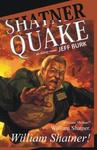
Review 121: Shatnerquake

Shatnerquake by Jeff Burk

In the introduction to this book, the author states that he truly admires William Shatner – he states that Shatner is a man who has made a career out of caricaturing himself, remaking himself over and over again with no looking back, no shame and – as far as we know – no regrets. He finishes by kindly asking William Shatner not to sue him.

I don’t think he has too much to worry about, really. This book is a quick, fun read that, while not necessarily painting William Shatner in the best of lights, certainly pays homage to his long and varied career.

Shatner

The story goes as follows: William Shatner is on his way to the very first ShatnerCon, a convention celebrating his life and works. It is a convention mobbed with fans, devotees who are there to see their idol, whether he caught their hearts as T.J. Hooker, Captain Kirk, or the host of Rescue 911. In the new Cathode-La convention center, tribute can be paid in full to William Shatner, a man who has changed so many lives.

But there are those who do not adore Shatner. They don’t like him or even tolerate him. They are the Campbellians, known by the bloody stumps where their right hands used to be and each known only as Bruce. They hate William Shatner with a passion that borders on madness, and seeing him dead is not nearly enough for them – they want his entire body of work to never have existed. Their weapon is a Fiction Bomb, a metaphysical WMD that can erase stories from existence. No one remembers them, no one knows they ever existed. Should the Fiction Bomb succeed, William Shatner’s entire body of work would cease to be. And so, in short order, would he.

Shatner!

But what if a Fiction Bomb should go wrong? What if that interface between fiction and reality should be breached, spilling its contents into what we commonly call the Real World? In that case, dozens of William Shatners – every character the man had played – would emerge in our world, with only one thought on their minds: Destroy the real William Shatner!

This book is a very quick read – only eighty-three pages – but it certainly packs in a lot of action, and as works of fan-fiction go, it isn’t too bad. Because that is most assuredly what this book is – fanfic. Burk has a very basic concept here – get all of Shatner’s characters out to kill him. Simple. Add lots of blood and gore and guts, because that’s always fun, and you have some entertaining reading. This is the very best kind of fanfic, really – you know it’s just a send-up, never intended to be a serious work of literature. Sit back and enjoy the ride.

It suffers from some serious editing problems, though, and Mr. Burk would have done well to have hired a good proofreader. There are some very basic grammatical mistakes, dropped plurals and a few sentences that just don’t make sense. To a regular reader, it might not be important, but to someone whose bread and butter is the proper use of English, it’s kind of glaring. But then my expectations weren’t all that high – I went into this expecting a rollicking adventure and that’s what I got. Complaining about the grammar in a book like this is like complaining about the quality of the vegetables in your Big Mac.

SHATNEERRRRR!!!!

Still, there are some redeeming points to it, above and beyond the weirdness of the whole thing. The beginning of the book does a very good job at setting up a real dreamlike atmosphere – a building that covers a hundred city blocks and has a parking lot that stretches out as far as the eye can see. Upon reaching the convention center, Shatner finds out that he is already late, and is led through a maze of hallways that result in almost instant disorientation. He has to sign hundreds of photographs for hours on end, and ultimately faces off with his own doppelgangers. Burk has reached into the bag of common nightmares and put together a scenario that is both familiar and disarming, which propels you through the rest of the book. After all, if you’re struggling to keep up with events, think about how Shatner must be feeling?

And of course, one can’t help but wonder if this is a commentary on the very nature of the actor/fan dynamic. Who is William Shatner, after all? Depending on who’s looking at him, he could be Kirk or T.J. Hooker, Denny Crane or Buck Murdock, the guy who saw gremlins on his plane or the guy trying to sell you cheap airplane tickets. On top of that, Shatner has another character to maintain – Shatner as a public figure, the guy who goes to conventions and book signings and does guest spots on TV shows.

Shatners?

Who is the real William Shatner? Who are any of us, really? In this age of online presences, there could be electronic doppelgangers of ourselves all over the internet. The person that your Twitter followers believe is you is not necessarily the same person that the people on your Mad Men slash fic forum know. You present a different face to your Facebook friends than the people you know in your World of Warcraft game, and like Shatner in this story, you ultimately have no control over the different renditions of you that other people see.

The good news, of course, is that those different Yous are unlikely to rise up and try to kill you.

Ultimately, this book has no over-arching message about the nature of identity in a world where different versions walk around without our knowledge or consent. I don’t think that it was ever Burk’s purpose to write a treatise on the modern concept of identity, but rather to write a quick, bloody thriller about William Shatner. So, it has no real lessons to teach us other than that if you see a deranged Captain Kirk approaching with a lightsaber (and how that got in there, I’ll never know – a little artistic license for the sake of awesomeness) you run away. Very fast.

————————————————–
“I’m a… professional. I can deal… with anything.”
– William Shatner, Shatnerquake

Jeff Burk on Wikipedia
Jeff Burk’s website
Shatnerquake on Amazon.com

1 Comment

Filed under adventure, doppelgangers, fans, horror, humor, identity, Jeff Burk, science fiction, William Shatner

Review 120: The Dark Tower

The Dark Tower by Stephen King

Well, here we are. After a long road – longer for some of us than for others – we have finally reached the end of The Dark Tower series. For some of us, it’s been twenty years in coming, so if you’ve only started reading this series recently, count yourself lucky. You don’t know how we waited for this book, the book wherein Roland would finally attain his goal, and we would see if all the sacrifices he made were worth it.

Were they? Kind of.

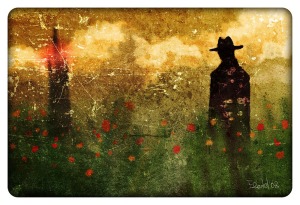
Art by Eredel on DeviantArt

I’ll get into more detail later, after I dutifully put up the “Here Be Spoilers” sign, but this is the book where everything gets resolved, and our heroes are given their reward for the hard work they have done. The bad guy is beaten, the world is saved, and all is well. Although “well” is a very relative term in this sense, and while the bad guy is beaten, it’s not very satisfying, and the reward that many of our heroes get isn’t necessarily the reward they would have chosen.

If I sound like I’m dancing around the story, that’s because I am. I have an aversion to spoiling books in these reviews, mainly because I know how satisfying it is to get into a good book and discover things. To see old characters appear from the past, and to witness the heroism of the characters we have come to love. To look at the journey they take and see their relentless pursuit rewarded. At the same time, I don’t want your experience poisoned by knowing the drawbacks to a book – the soft spots in the plot, the characterization problems, the disappointments and the heartbreaks. [1]

Art by lilbenji25 on DeviantArt

This book contains all of these, and if I avoid talking about them, then this review will be awfully short. So, Constant Reader, I tell you this: you can stop here. You can click away to another page, perhaps to Amazon to buy the book and read it yourself (I recommend the Kindle edition if you can – I have the hardcover and it is quite the doorstop), perhaps to put off the reading of the book for a while longer. You don’t have to learn things that will taint the journey of discovery that is reading , and you can live on with a vision in your head of how The Dark Towerseries should end, instead of how it actually does.

Would you stay, then? Very well. After this point, there is no turning back. What is learned, as they say, cannot be unlearned.

This is not the book I wanted. It is unbalanced, hard to get through, and disappointing in many ways. There are also some beautiful moments, and some interesting ideas which, upon post-reading reflection, make the whole story more meaningful. But my overall feeling was one of great disappointment. Let’s start from afar, shall we?

Art by DiosBoss on DeviantArt

The structure of this book is rather lopsided. The most climactic event in the book, the battle of Algul Siento, is quite exciting and fun in that it is what we readers expect from a climax – gunfire and death and the saving of worlds. By freeing the Breakers from their work on the Beams, Roland and his ka-tetdo indeed save the macroverse from complete dissolution. They have literally saved the world and, as we learn later, have completely thwarted the evil designs of the Crimson King. The story could end there, the characters could go on their separate ways, and all would be well.

The problem is that this occurs in the first half of the book. It’s followed soon after by a minor climax – Roland and Jake saving Stephen King from certain death by drunk driver – but even that is done a little more than halfway through the book. Stephen King is safe, the New York Rose is safe, and we find out later that not only are the last two Beams intact, they are regenerating and will probably regenerate the other four. Reality has been saved.

But the story goes on, because saving reality was never Roland’s goal. It was only, in the parlance of Dungeons and Dragons, a side quest. There’s a larger quest to be resolved.

This wouldn’t be so bad if there were an even bigger climax waiting for us at the end, but there isn’t, and this is where I feel kind of betrayed. When Roland gets to the Dark Tower, we know he will have to face the Crimson King, who has been held up as the incarnation of death, evil and chaos. He has been the main antagonist throughout this whole series. His reach is long, his power vast, and his hate for Roland of Gilead is as focused as a laser and as hot as the sun. He is as close to the Devil as we can get.

Art by morganagod on DeviantArt

So, when Roland finally makes it to Can’-Ka no Rey, the great field of roses within which the Dark Tower stands, who do we see? A “satanic Santa Claus” who throws explosives from the only balcony of the Tower he’s been able to reach. He’s generically ugly, screams like a madman, and talks in villain cliches – “GUNSLINGER! NOW YOU DIE!” or “YOU DON’T DARE MOCK ME! YOU DON’T DARE! EEEEEEEE!” or “EEEEEEEE! EEEEEE! STOP! IT BURNS!” On top of all that, the Crimson King is finally defeated not by Roland’s guns or some great battle on the physical, intellectual or spiritual plains, but by a guy with a sketchpad. He is simply erased from afar. And thus ends the reign of what was supposed to be the greatest horror of all worlds.

What’s more, their meeting at the Tower was not acually the defeat of the Crimson King – he conceded defeat way back during Wolves of the Calla. We find out that, with the defeat of the Wolves, the King foresaw the end of the Breakers and thus his plan to unmake creation. So, he broke his Wizard’s Glasses, killed nearly everyone in his castle. killed himself by – for reasons I still don’t understand – swallowing a sharpened spoon, and then, undead (which I also don’t understand), rode off for the Tower.

Even then, though, he couldn’t win. In order to enter the Tower he needed either Roland’s guns or Mordred’s birthmark, neither of which he had. So he climbed up into one of the Tower balconies with all the weapons he could carry and just waited. If Roland hadn’t come to the Tower, he would have waited there forever and never harmed anyone again. By bringing his guns, Roland raises the possibility that the Crimson King could still triumph. So, by continuing his quest, Roland endangers all existence.

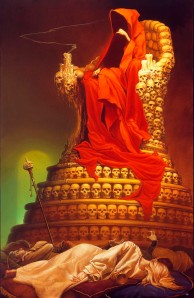
Art by Michael Whelan

As much as I hate to call out authors on what they “should have” done, I feel like I have to here. A hero is only as good as his villain, and the Crimson King, in the end, turns out to be a pretty crappy one. I wish King had made their meeting worthy of the image he had built up. The same goes for one of our favorite characters, Randall Flagg (or whatever name he chooses to use). He has floated through this series and others like a cancer, bringing nothing but death and pain with him. He’s a charismatic madman who revels in chaos and is probably one of the most enjoyable characters King has created. So how does he die? He gets killed by Mordred, the bastard son of Roland and the Crimson King, of Susannah and Mia. He gets killed and eaten without much of a fight. I think a lot of fans would agree that Flagg deserved better.

And while we’re on the topic – Mordred.

One of my measurements of good characterization is a question: If this character did not exist, could the story have ended the way it did? With Jake and Father Callahan, Susannah and Eddie, with Oy and Flagg and Cuthbert and Susan and Cort, the answer is, of course, No. Each of those characters contributed something vital to the story, something that no other character could have done. To reach the same end without one of those characters would have meant a vastly different story.

Art by Michael Whelan

The same cannot be said of Mordred. Of the people he kills, only two matter to us: Flagg and Oy. Flagg should have been the penultimate End Boss, the final challenge for Roland before reaching the Tower and the Crimson King. And there are many ways to kill a Billy-Bumbler – I think King could have thought of one that gave Oy the same honorable and heartbreaking death that he got trying to save Roland from Mordred. Other than that, Mordred had no impact on the story at all. He just followed Roland, Susannah and Oy, shivering and whining and feeling sorry for himself. He kept telling us that he was meant for great things, but never showed even the slightest hint of that potential. He follows Roland like Gollum follows Frodo, but at least Gollum turned out to be important.

The one thing we do get from Mordred is a frustrating bit of knowledge – that the Crimson King and Roland are both descended from the mythical king Arthur Eld. In that way, their battle is between cousins, and Mordred represents a unification of two bloodlines – demon and human. If their conflict had been framed in that context, it could have been so much more interesting when we finally got to the end.

Speaking of the end. We, like Roland, didn’t know what to expect when we finally got into the Dark Tower. And I don’t think anyone expected that the series would loop around to the beginning again, dumping Roland back in the Mohaine Desert to follow the Man in Black once more, unaware that he had already done so so many times before. It was an unsatisfying ending at first, but upon reflection, it does work, and there are two ways to look at it.

The first is that Roland is being taught a lesson, one which he still has not learned. He’s being taught to value life, to reset his priorities. From his youth, he was so focused on the Tower that he let all else fall aside – his friends, the girl he loved, and the sacred artifacts of his forefathers. He brought death with him, and passed it on to all whom he loved, and ended his quest as alone as he began it. And so, despite saving the multiverse, Roland failed his true quest – to learn how to love others and share who he was with them – and had to be sent back to start again. In appreciation of his effort, however, he was granted a change: the horn of Eld, which he had previously neglected on the field of the last battle of civilization. Perhaps it will make a difference.

The other way to look at this ending is a more metafictional one, something that Stephen King himself finds distasteful. Like it or not, though, one of the overriding themes of this series is the impact that fiction has on reality, and vice versa. To readers, a character might be more real than real people. We learn lessons from them, we have kind or unkind memories of them, and in many ways, our fictional characters possess a special reality. To a writer, this is even more true. Ask any writer and they will tell you about how their characters talk to them, sometimes appear in front of them, or even take over their bodies for a little while. A writer will discover things about a character that she never planned, as if the character himself were revealing them. The Dark Tower relies on this kind of ur-reality of fiction, up to and including fictional characters saving the life of their own writer.

So, by connecting the end of the last book with the beginning of the first, perhaps King is implicating us, the Constant Readers, in Roland’s suffering. Roland cannot rest as long as there are readers reading him, and we are all guilty of making him go through it again and again. While King may have created Roland and his quest, we propagate it, and every new reader ensures that it will never, ever end. [2]

Art by Chesheyre on DeviantArt

In the end, we have a series that started off strong, and then kind of careened to an unsatisfying end. Having been written intermittently over the course of thirty years, I suppose that shouldn’t be too surprising. Ideas which seemed like good ones at the time served only to cause trouble later down the road, and loose ends that needed to be tied up took up far more time than they should have. Perhaps with a clearer vision of the journey at the beginning, King could have held it together better. And perhaps without his brush with death in 1999, he wouldn’t have felt compelled to get the last three volumes out as soon as he could.

It does, however, gift us with some wonderful characters, a rich and brilliant world, and a fictional cosmology that holds together all the worlds that King has created thus far. It’s an examination of the importance of fiction in our lives, and the way that stories can reach out and touch so many more people than the storyteller ever intends. If you are a fan of Stephen King, and you haven’t read this series yet, then you should. For all that the last couple of books disappoint, there is still much good to be found in the whole series, and the first five are generally really well done.

Art by Deviata on DeviantArt

There is more to read, if you’re interested. King’s assistant, Robin Furth, has put together an excellent Concordance, detailing pretty much everything you want to know about the series – characters, places, history, language and concepts. She has also written a series of graphic novels for Marvel Comics which detail Roland’s youth, starting with the events told in Wizard and Glass and going up to the terrible battle of Jericho Hill. So if the original series leaves you wanting more, there’s certainly more to be had.

That’s it, then. Long days and pleasant nights to you all.

——————————————————–
“Even when you were in the shadow of death there were lessons to be learned.”
– Jake (narration), The Dark Tower
——————————————————–

——————–
[1] To be fair – this book was published back in 2004. If you haven’t read it by now, I doubt you’re really going to be chuffed by some spoilers, and you have no one to blame but yourself if you haven’t gotten around to reading it yet.

[2] A third option is suggested by his short story, “That Feeling, You Can Only Say What It Is In French” from Everything’s Eventual, wherein a woman riding with her husband in a car on vacation keeps re-living a terrible accident. It is implied that she is dead, and that hell is the eternal repetition of one’s mistakes. It is possible that Roland is dead, and that this series is his Hell.

The Dark Tower on Wikipedia
The Dark Tower Portal on Wikipedia
Stephen King on Wikipedia
The Dark Tower homepage
The Dark Tower on Amazon.com

2 Comments

Filed under adventure, apocalypse, Dark Tower, death, existentialism, fantasy, good and evil, meta-fiction, quest, Stephen King, time travel, world-crossing

Review 119: Wyrd Sisters

Wyrd Sisters by Terry Pratchett

A king is killed, usurped by a weak man and his overbearing wife.

A ghost haunts the castle, waiting for his son to come and avenge him.

On the highlands, three Witches hold their meeting, plotting the future of the kingdom.

I think Granny would not appreciate this image....

Sound familiar? It should. These are some of the most enduring tropes of English literature, and they’re all thanks to a singular playwright. Wyrd Sisters is Terry Pratchett’s tribute to some of the blood and gore and guts, tragedies and twists of Shakespeare’s great plays.

In fact, this book encapsulates my three favorite Shakespearean works – Hamlet, Macbeth, and King Lear. Yes, they’re all tragedies, but that shouldn’t surprise any of you by now. They plumb the depths of humanity to try to find glimmers of hope and bravery and redemption, and everyone usually ends up dead, but dead with a true sense of purpose. In this book we have, respectively, a king murdered by his own family, a woman who pulls the strings of the usurper, and a bloody great storm.

Anyone have some Purell?

Verence, the king of Lancre, has been assassinated. An accident, everyone says. He tripped and fell down the stairs, landing on his own dagger. Funny, that. But the new ruler of Lancre, Felmet, is not so steady in his convictions. He sees the blood on his hands, although he didn’t do it. He’s absolutely sure he didn’t do the deed. Anyone who says he did do it is likely to be shorter by a foot or so by morning. And his wife wasn’t there either. She didn’t hand him the knife. The point is that Verence is dead, long live the King, and now everyone can enjoy the easy life of a royal couple.

However, as so often happens in these things, complications arose. The dead king isn’t allowed to go away. He is confined to unlife as a ghost, unable to contact or interact with the world of the living – except in very small, nearly unnoticeable ways. As his murderers rule over his kingdom, Verence exercises his ectoplasm and plots a way to bring Felmet down. The king’s infant son was stolen after the assassination, you see – brought by a dying man to the home of one of Lancres witches, where he passed the infant to the three women there, and begged them to care for it.

Huh. Actors.

They did what some people would think would be the exact opposite – they gave the child to some traveling actors. As alarming as that might seem, they thought that a traveling troupe would be a much better place for a child to grow up than with three of the greatest witches of Lancre.

And that would seem to be the end of it, really. The king is dead, with no one to contradict the original version of his death. The infant son of the king is stolen, never to be seen again. By all rights, the kingdom should move on. Assassination, of course, is perfectly natural in Royal circles, happens all the time. The kingdom shouldn’t even blink.

But it does. Not only does the kingdom blink, it is furious. Not the people, mind you. The people barely notice a new king, except for the parties and the slight increase in executions. The Kingdom. As a body is an amalgam of cells, a Kingdom is the whole of its people and history. Felmet hates the new kingdom he has acquired, with its gorges and trees and people you couldn’t bully no matter how hard you tried. He hates the Kingdom, and the Kingdom hates him for it. A Kingdom, you see, is like a dog. It doesn’t care if its master is a good man or an evil man, so long as he cares for the dog. Felmet actively detested the land and its people, and in return the larger entity that was The Kingdom hated him right back.

In the meantime, Felmet’s Fool, formerly the Fool to Verence, is showing him how words have power, and how that power could help break the animal kingdom he ruled. Cutting the trees down, for example, might be called “horrible” or “terrible” by the people – and the kingdom – of Lancre. But call it, “Planned deforestation for industry growth,” and that’s a whole new story.

"Senior citizen"

Words have power, Felmet learns. The Fool eventually goes on to demonstrate the true power of words to the king.

Liar. Usurper. Murderer.

Words like that have a wondrous effect.

And then there are the Witches, who are a threat to Flemet, in his own mind. He can’t kill them, he can’t torture them. But he can change how people think about them, and so he decides that a play is the way to go….

It gets a little complicated after that, but rest assured, it’s a kicker. Felmet is insane, and his wife is worse. Their plan to destroy the witches of Lancre goes beyond what the Puritans of Massachusetts could ever have come up with – altering their very natures by altering perceptions. And fate sticks her fingers in all over the place, as the Witches try to restore a true leader to Lancre – even if the true leader doesn’t even know who he is.

Oh, what Shakespeare could have done with Granny....

Not only does this book showcase one of Terry’s best characters – Granny Weatherwax – but it takes an interesting look at the way we can alter our perception of things merely by altering what we call a thing. Words shape the world, whether we want them to or not, and the right word in the right ear can shift the balances of history. As with so many of his other books, Terry gives us a profound philosophical insight and shows it to us as something we knew all along.

————————
“Oh, obvious,” said Granny. “I’ll grant you it’s obvious. Trouble is, just because things are obvious doesn’t mean they’re true.”
Granny Weatherwax, Wyrd Sisters

Wyrd Sisters on Wikipedia
Discworld on Wikipedia
Terry Pratchett on Wikipedia
Wyrd Sisters on Amazon.com
Terry Pratchett’s homepage

1 Comment

Filed under assassinations, death, Discworld, fantasy, ghosts, good and evil, humor, madness, revenge, Terry Pratchett, witches

Review 118: Secret Lives of the First Ladies

Secret Lives of the First Ladies by Cormac O’Brien

This is a follow-up to O’Brien’s previous book, Secret Lives of the U.S. Presidents, which, while a fascinating book, is a topic that has been covered many times. I have, in fact, two books on this topic, and they both illuminate the hidden idiosyncrasies, character flaws, shining moments of virtue and petty humanity of the 43 Commanders-in-Chief.

The "non-Dowdy" version of Abigail Adams

It was Abagail Adams who exhorted her husband to, “Remember the ladies,” and it seems that O’Brien has done just that. He’s given us a nice concise look at the women of the White House, and it’s a hell of a read.

It’s very easy to forget the First Ladies, and kind of pigeonhole them into the space that reads “President’s wife,” but to do so would be a great disservice to an amazing group of women.

A lot of people remember Hillary Clinton as being a political powerhouse, a kind of “co-President.” But she wasn’t the first, by any means. When Woodrow Wilson suffered a debilitating stroke in 1919, all access to him was controlled by his wife, Edith. She would let no-one in to see him, on the grounds that he was very ill and needed absolute peace and quiet. So, when someone needed something signed by the President, Edith would take it, close the door, and come back a few minutes later with the signed document. The question very quickly arose: who’s really the President?

Helen Taft is another forgotten First Lady firebrand. Without her motivation, William Howard Taft might have been perfectly happy to be a judge, but that wasn’t good enough for Helen. From her teenage years, she knew that she wanted to live in the White House, and she pushed her husband to make damn sure that she did. Once there, even her husband called her the “co-Presidentress” for the amount of involvement she had in the day-to-day decision making that went on. She was a woman of boundless energy, who was never willing to sit still. Oh, and if you like the cherry trees that bloom in DC every spring, you can thank Helen Taft for that. Women like these – Eleanor Roosevelt and Jocelyn Carter are part of their ranks as well – left indelible impressions on the country.

No-one messed with Anna Harrison. No one.

Not every First Lady was so ambitious, though. Some were more populist idols, adored by the public not for their works but for their personality. The most recent example would probably be Jacqueline Kennedy, who became a media icon almost as soon as her husband was elected. But there were others before her.

Dolley Madison threw the best parties in Washington, and was vastly more beloved than her dour and stolid husband, James. It was said that she had no enemies, and even the people who loathed her husband adored her. She stayed in the White House right up until the British showed up at its doorstep and managed to save a few precious items. It’s even said that the British commander, Rear Admiral Sir George Cockburn, was more interested in capturing her than the executive mansion, and took her seat cushion from the dining room so that he could come away with something to remember her. Before he had the building torched, of course. After she left the White House and her husband passed away, it was customary for each new President to pay her a visit, gaining a kind of approval from the most loved woman in America.

Ida McKinley's hypnotic powers were well-known in Washington D.C. Only Theodore Roosevelt was able to break her spell....

Or take Frances Cleveland, wife of Grover. Her relationship with her husband would be considered scandalous in this day, and certainly was in hers – she was twenty-seven years younger than her husband, who had been her legal guardian when she was a child. Much to the nation’s surprise, he went from being “Uncle Cleve” to “Beloved Husband.” But that bit of creepiness didn’t stop the nation from loving her. Once in the White House, she became an early proponent of women’s accomplishments, willing to meet and talk to anyone, rich or poor. When Grover ran for re-election in 1892, Frances’ image was the one campaigners used, not his. And why shouldn’t they? In an age before byzantine copyright law, her name and image were already being used to sell all kinds of household goods. Ever eaten a Baby Ruth candy bar? It was named after the Clevelands’ daughter, who was, for her short life, the most popular baby in America.

And then there were the sad stories, the women whose lives in and out of the White House were full of misfortune. Jane Pierce is probably the saddest of these. She never wanted her husband to be President. Every step that he took forward seemed to result in pain for his family. Their first child died after a few days. When Franklin finally got out of national politics and opened up his own law firm, their second child died of typhus. With only one child left to them, Jane held on to him with a manic grip. His death – the only one in a train derailment a short time before Franklin’s inauguration, was the last straw. Jane became convinced that God had killed their children so that Franklin could have more time to devote to his Presidency, and spent her days writing letters to the dead boy, asking his forgiveness. She became known as the “shadow of the White House.”

Julia Dent Grant, who was the only person capable of keeping Ulysses from drinking himself to death.

No less tragic, of course, was the life of Mary Todd Lincoln, who is best known for being the wife of our first assassinated President. Even before that bad night at the theater, however, she had her share of sorrow. The animosity and hatred that was heaped upon her husband, the terrible strife of a civil war, and the untimely death of one of her sons turned a once vibrant, energetic woman into hysterical, morbid harridan. She held séances to try and talk to her deceased boy, harangued the White House staff, and almost had to be forcibly ejected once Andrew Johnson became the President. What’s worse, her own son, Robert, had her declared insane and had her committed. She won her freedom, but the animosity between mother and son after that was white-hot.

There’s so much more. The relationships these amazing women had with their husbands are also well-detailed, and also somewhat surprising. For all that Bill Clinton was a lecher, he was hardly the first.

Pat Nixon, who really must have loved Richard, though none of us knows why....

Hillary joined a group of long-suffering women who put up with blatant and repeated infidelities in and out of the White House. Some relationships were partnerships, like the Carters, the Hoovers and the Tafts. And some couples were just quietly devoted to each other, like the McKinleys and the Clevelands.

The First Lady is not an elected position. There’s nothing in the Constitution about her, what she can and cannot do, so the job, such as it is, is one that each wife makes for herself when her husband takes office. The effects that these women have had on this nation is immense, and should not be overlooked. So, if you’re interested in knowing more about our Presidents, you could do worse than to give a good look at the women who stood by them.

————————————————
“Well, Warren Harding, I have got you the Presidency. What are you going to do with it?”
-Florence Kling Harding

Cormac O’Brien on Wikipedia
Secret Lives of the First Ladies on Amazon.com
First Ladies on Wikipedia

Leave a comment

Filed under american history, biography, Cormac O'Brien, family, history, nonfiction, presidential history, wives, women

Review 117: I Will Fear No Evil

I Will Fear No Evil by Robert Heinlein

One of the things I enjoy about Heinlein is that he likes to play with Big Ideas. While he did dip into the well of action and adventure, especially for his juvenile stories, he treated his readers like they were only slightly intellectually inferior to him, and so explored concepts that required a lot of heavy thinking. The need for war, the inevitability of messiahs, revolution, life, death, immortality – he’s not afraid to look at some of the greatest philosophical topics that reside in the human heart, and this book is no exception.

Johann Sebastian Bach Smith is a very old, very sick, very rich man. He built himself up from nothing and rose to financial prominence in what is a little more than a regular human lifetime. Smith had it all – a rich and exciting life, complete financial security, good friends and good memories in a world that had, frankly, gone to hell. He had very nearly everything a person would want to have.

Photo by openDemocracy

What he didn’t have was time. He lived in daily pain, kept alive by only two things: an ever-increasing number of machines and a plan to release himself from the geriatric horror his life had become. He knew that this plan would probably fail. He knew that he was facing death no matter what happened. He knew that it was crazy, and not necessarily crazy enough to work. But it was all that stood between him and suicide.

That plan was, in theory, very simple: transplant his healthy brain into the body of a healthy young person. By doing so, he would gain a whole extra lifetime to enjoy the fruits of his first lifetime’s labor. Not being a monster, he was prepared to do this in a legal and ethical fashion. With his legal, medical, and judicial contacts, he made arrangements with a medical advocacy group to get the body of a healthy young person who died due to some massive brain trauma. And – and this is important – who consented to having their body used for medical experimentation. Everything would be above-board, legally sound and ethically certain. All Smith had to do was stay alive until a body became available.

Now just put the two of them together... IF YOU DARE!

When it did, however, he was in for a double surprise. Not only was the healthy, youthful body that of a female, it was that of his healthy, youthful, beautiful secretary, Eunice Branca. Eunice had been murdered, but her body was in excellent condition. She had the right blood type, and had consented to have her body used for Smith’s experiment. The one doctor in the world who could perform the surgery was brought in to perform it, and against all odds, it worked. Johann Sebastian Bach Smith was reborn as Joan Eunice Smith, and her new life began.

But she was not alone.

By some means, Eunice’s mind survived to live with Joan, and tutor her in all the ways of being a woman. Joan dove happily into her new life, exploring her new femininity and sexuality as best she could.

In that sense, this whole book is an exploration of sexual identity. Here we have a man who is now a woman, even though that was never his intention. He soon finds himself thinking like a woman, though, bringing up the question of whether gender is determined by a person’s mind, or by the body it inhabits. If you put a male mind into a female body, with the vastly different hormones and sensory inputs, will that male mind start to act like a female? And even if it does, should it?

Smith makes a decision to, with Eunice’s help, be the best woman he can be, mostly because he feels that is what is expected of him. After a lifetime of conforming to male societal roles, Smith wholeheartedly embraces the female ones, up to and including seducing his best friend of many decades. Gender identity in this book is a tangled mess of biology and intention, and it looks at being female from a distinctly male point of view.

It was a different time....

Which brings me to my first problem with this book: the casual misogyny. I know it’s a pretty loaded word to throw around, and it’s not entirely accurate, but it was the one that kept coming to my mind. While Heinlein is certainly capable of creating strong and independent female characters, and emphasizes over and over again that both Eunice and Joan are actively choosing the lives they lead, those lives are almost entirely dependent on and revolve around men. One of Smith’s first actions when he goes from Johann to Joan is to latch on to a man – her old friend Jake Saloman. She views her identity as a woman as incomplete without a man to base it on, and spends most of the book trying to figure out who she is in relation to men – Jake, her security guards, Eunice’s widower, and more. She repeatedly mentions how helpless she is without a Big Strong Man in her life, and all of this culminates in what is possibly one of the most misogynist moments I have ever read in sci-fi: a spanking scene.

And not a sexy one, either. In a moment of adolescent pique that Jake won’t sleep with her when she wants him to, Joan throws a fit, disrupting their dinner plans. Jake proceeds to throw her over his knee and give her a spanking because, and I’m quoting here, “You were being difficult… and it is the only thing I know of which will do a woman any good when a man can’t do for her what she needs.” Joan accepts the spanking meekly, not only thanking Jake for his spanking, but also claiming that she had her first orgasm while he did it.

Wow. That’s nearly as bad as the other major female character, Winnie, who talks about a gang rape experience with what can almost be imagined as fondness.

Oddly enough, this is not my biggest problem with the book. I mean, it was written in the late ’60s, and it reflects the thinking of that era. For all his progressive beliefs, Heinlein was still a man of his time, and it really shows here. Legend [1] has it that he was really sick when he wrote this book, and that may have had something to do with the fact that no matter how many complex hot-button issues he touches (gender roles, homosexuality, same-sex marriage, overpopulation, government overreach), the fact remains that there is no story in this book.

This picture contains more conflict than this book

Let me explain. A story needs conflict. It needs not only a protagonist that is trying to achieve something, but obstacles that impede that achievement. There were so many potential goals and obstacles to be explored in this story – a man’s brain in a woman’s body – but Heinlein manages to artfully dodge all of them. The story of Smith’s inner struggle to resolve the gender he grew up with with the gender he now possesses would have been fascinating. But it didn’t happen. Smith pretty much accepts the change right away, with few if any reservations. Even so, he could have struggled with how to live as a woman – should he adopt the identity that a patriarchal society would confer upon him as a woman, or forge his own as a uniquely gendered person who has gone from the privileged to the unprivileged sex? Unfortunately, the conflict doesn’t even occur to Joan. She decided to be the best woman she can be, constantly asking others what that entails, rather than asking herself.

Or how about the concept of Identity itself? Smith is an old brain in a new body, so is he legally the same person he was before the surgery? That would be an amazing story as he tries to prove that Johann has become Joan, and that even though Eunice’s body is still walking around, she’s actually dead. But no – Smith has some powerful legal friends with ironclad arguments, and the legal proceedings are pretty much a foregone conclusion.

Or how about rejection by society? Regular transgendered people have a hard enough time getting society to accept the modification of the body they were born with – what about when someone takes on an entirely new body? Joan could have struggled to get her friends and family to accept who she has become, to stand before the world with her head held high. But no…. She has enough money that she doesn’t really need society’s approval, none of her friends have any trouble with what she’s become, and even Eunice’s widower has only a moment of uncontrollable emotion before accepting that his wife is dead, but still walking around. And he might get to sleep with her again.

Imagine this in your head ALL the TIME.

One last one – the soul. Joan hears Eunice’s voice in her head, but it’s unclear whether it is really Eunice or if it’s just Joan’s imagination. What’s more, they never fight. They never have a serious disagreement and have to resolve their differences so that they can continue to occupy the same skull. Eunice and Joan live together like wisecracking sisters and never have to deal with the problem of living with someone you can’t get rid of, even if you’re not sure if they’re real.

In other words, there’s no there there. It’s a long, talky, philosophical exploration of some fascinating topics, but as a novel, it’s incredibly dull. You keep waiting for the blow-up, for the accident, for the Big Problem that Joan and Jake have to struggle to overcome, and it never arrives. Everything works out either through money or force of will or Heinlein’s trademark Sheer Damn Reasonableness. Between that and the constant thought of, “He did not just say that,” I found this book rather stressful to plow through. It offers up a lot of big ideas to think on, raises some very important questions, and Heinlein’s gift for dialogue makes some fun conversations, but I think I would have liked it more if it had been completely different.

——————————————————
“Sir, if you want to give me a fat lip, I’ll hold still, smile happily, and take it. Oh, Jake darling, it’s going to be such fun to be married to you!”
“I think so too, you dizzy bitch.”
– Joan and Jake, I Will Fear No Evil by Robert Heinlein
——————————————————

[1] Wikipedia

Robert Heinlein on Wikipedia
I Will Fear No Evil on Wikipedia
I Will Fear No Evil on Amazon.com
The Heinlein Society

1 Comment

Filed under afterlife, bad, death, existentialism, friendship, gender, gender roles, ghosts, homosexuality, identity, Robert Heinlein, romance, science fiction, sexuality

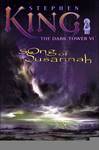
Review 116: Song of Susannah

Song of Susannah by Stephen King

I think that every long series has to eventually include a book like Song of Susannah. It’s the weak book, the one that you have to have, but would rather you didn’t. The one that pretty much exists to get you from Point A to Point B, which resolves some earlier issues and sets up some later conflicts, but which – by itself – isn’t nearly as good or as much fun to read as the books that either preceded or followed it. I call it a “bridge book,” and I suspect that they are somewhat inevitable.

But before getting into all the heady analysis ‘n stuff, let’s see what this book is about.

Book art by Darrel Anderson

Directly following the end of Wolves of the Calla, our ka-tet is split. Susannah, possessed by that strange spirit who calls herself Mia, has taken the supremely powerful Black Thirteen and used it to open a magic door to New York. It is there that she hopes to have her child and have the raising of it, before it grows up to destroy the world. Everyone else, of course, is concerned for her safety, but there is one other thing that needs to be done – the vacant lot in Manhattan and the rose that grows there must be protected. This rose represents one of the two Beams that remain to hold up the Dark Tower (and thus all of existence), so its safety is paramount.

The other Beam just happens to be Stephen King himself. But we’ll get to that….

Roland’s party splits up – Roland and Eddie go to rural Maine to find Calvin Tower and secure proper ownership of the vacant lot. Jake, Oy, and Father Callahan follow hot on Susannah’s heels to New York City to try and save her from the horrible death that no doubt awaits her there. Horrible death awaits all of them, truth be told, but one does what one must in pursuit of the Tower.

Jake, Oy and Callahan’s story is the far more straightforward one. They go to New York and follow Susannah/Mia’s psychic trail to Black Thirteen, which they dispose of in a manner that should bring a grim smile to all 21st-century Americans. They then go on to the Dixie Pig, a restaurant-slash-portal to a dimension of hell and pain, where they expect to be gunned down the moment they go through the doors. Pretty cut and dried, really.

Roland and Eddie, however, have the much more mind-bending task of meeting their maker. Literally.

Book art by Darrel Anderson

As a side-quest to securing legal possession of the vacant lot, they learn that King lives nearby and decide to pop in and pay him a visit. This kind of freaks King out, but rightfully so. To him, Roland is a character who haunted his mind, and a few pages of a manuscript that has languished in storage for years. King had given up on The Dark Tower, and never expected to pick it up again. Until, of course, its main character showed up, insisting that his story be finished.

To me, this was the most interesting conceit of the entire series. The idea of characters breaking through the fourth wall and entering “the real world” is nothing new, nor is having them ask some rather pointed questions of their creators. But it’s another thing for those characters to not only meet their creator, but to do so before he’s actually written about them up to the point where they’re meeting him.

(re-reads that last sentence)

Right.

In short, not only is King the embodiment of one of the last Beams holding up the Dark Tower, he is also an avatar of Gan, the primal force of order and righteousness in the universe. Through King, and the story of Roland and his ka-tet, Gan is trying to keep the Tower up against the forces of Discordia, as embodied by another King, the Crimson King. These two Kings – one unknowing, the other knowing – are locked in a fight to the death, with the universe at stake.

Book art by Darrel Anderson

Throughout all of this, Susannah is having her own troubles in New York. Mia has gained control of her body – to the point where she is able to manifest the legs that Susannah lost long ago – and is determined to have her child. She has an appointment to keep with the agents of the Crimson King, and she believes that she will finally achieve that holy state for which she had gladly given up her immortality – motherhood. Susannah, on the other hand, knows that whatever is brewing in Mia’s belly is a threat to Roland, and will do whatever she can to stop the birth, or at least turn Mia against her chosen destiny.

Depending on the kinds of books you like reading, Song of Susannah will either be tolerably good or downright unpleasant, and this is mainly due to its rather fractured structure. The three plot threads don’t intersect directly once everyone leaves the Calla, and don’t have any kind of resolution once you get to the last page of the book. As a friend of mine put it, “There’s no ‘there’ there.”

The other volumes, like most standard-issue novels, has a resolution at the end. You can close the book and be able to tell people, “The characters achieved this, and it was fairly conclusive and interesting.” Of course, a series always has a greater conflict – the series-level conflict – that won’t be resolved until the last volume, but each individual book needs to have its own setup, conflict and resolution, with enough loose ends to get us into the next book.

Song of Susannah doesn’t really do this. The matter of the vacant lot is a fairly simple legal matter, which is not only easily resolved but also kind of dull, once you compare it to everything that has gone before. The problem of Black Thirteen is done away with pretty easily as well, which doesn’t really befit an artifact that we have been told possesses immense evil power. And while Susannah doesn’t prevent Mia from making her appointment at the Dixie Pig, she does manage to plant the seeds of doubt in the woman’s mind.

Art by Klaimko

In short, what is achieved in this book is not up to the level of what we have come to expect. The dramatic escape from the decaying city of Lud, the horrible tragedy of Roland and Susan in the Mejis, the valiant stand against the Wolves – all of these are proper climaxes and proper resolutions. The sole purpose of this volume is to bridge the gap between Wolves of the Calla and The Dark Tower, and the only reason it ended where it did was because, well, you have to end it somewhere.

Having said all that, I enjoyed reading this book, and tore through it at record speed. I thought Susannah’s chipping away at Mia’s confidence was well-handled and made a lot of sense. Jake, Oy and Callahan preparing for their Last Stand and their likely deaths was great, and the whole meta-fictional issue of characters meeting with their creators is just the kind of thing that really digs into my brain and gets it going. And while the book may have been less carefully focused than the other editions of the series, it must be remembered that I am a long-time veteran of the Wheel of Time series, which has so many sub-plots, side-plots, secondary plots, divided parties, prophecies, histories, secrets, societies, ancient enmities, mythical forces, Artifacts of Unimaginable Power, questionable plot elements and unanswered questions that it makes The Dark Tower look like one of Aesop’s fables.

So I do have an unfair advantage.

———————————————————————-
“I don’t think he needs to be immortal. I think all he needs to do is to write the right story. Because some stories do live forever.”
– Roland (speaking of Stephen King), Song of Susannah
———————————————————————-

Song of Susannah on Wikipedia
The Dark Tower Portal on Wikipedia
Stephen King on Wikipedia
The Dark Tower homepage
Song of Susannah on Amazon.com

Leave a comment

Filed under adventure, Dark Tower, death, fantasy, horror, meta-fiction, quest, Stephen King, survival, vampires, world-crossing

Review 115: A is for Armageddon

A is for Armageddon by Richard Horne

You should know by now that if there’s one thing I’m really looking forward to it’s the end of the world.

At least, I was, up until about two weeks ago when an Earthquake of Unreasonable Size hit northeastern Japan, unleashing a massive tsunami which in turn led to an ongoing disaster at a nuclear power plant in Fukushima. Ever since then, the TV has been nothing but tales of survivors huddled in relief shelters and people all over the country scrambling to help – or to get out. In addition, there is the very real probability that more than ten thousand people have died, their bodies washed out to sea.

It’s one thing to read about the end of the world in a book or a comic, but to see it unfold on live TV is something else entirely. So right now, I’m not all that gung-ho about end of the world stories. Give me time, though, and I’m sure I’ll come back to them.

Like this, but without the leather and the anti-Semitism

I don’t know why, really. Maybe it’s for that feeling that all bets are off, all bonds are broken and you can remake yourself in any image you want. Maybe I really believe that I’ll be one of the heroes of the story, who make it through the End Times not only alive but victorious. Maybe I just long to see the world scythed clean of humanity and restarted so the squid can have a go at running things, I have no idea.

For whatever reason, I have a soft spot for armageddon stories. Whether it’s Good Omens, The Stand, Swan Song, Crisis on Infinite Earths, or any other story that promises the destruction of a world, I’m all over it. I can’t know if they’re good, but I’ll at least be willing to give them a shot. So when I saw this, I thought to myself, “I must have this book.”

The book is based on an organizational system that has gained some popularity in recent years: The Periodic Table of X, wherein X is whatever topic you want to focus on. It was originally designed to accommodate the natural elements, but if you have a hundred or so items, you can probably make your own periodic table to sort through them. You’ve got the Periodic Table of Typefaces, the Periodic Table of Beer Styles, the Periodic Table of Superheroes, and even – prepare to have your mind blown – the Periodic Table of Periodic Tables of Things.

You never had it so good, Mendeleev….

This book is based on the Periodic Catastrophic, a listing of the many, many ways that the world can end. As with the “real” periodic table, this one is well-organized to keep the apocalypses in line. There are the Acts of God, Don’t Mess With Nature, Universally Doomed, and It Was Like That When I Got Here, among other distinctions. Each disaster gets a couple of pages with a succinct explanation and an interesting or humorous illustration. Some of my favorites include:

The End of the World will be accompanied by a speed metal soundtrack

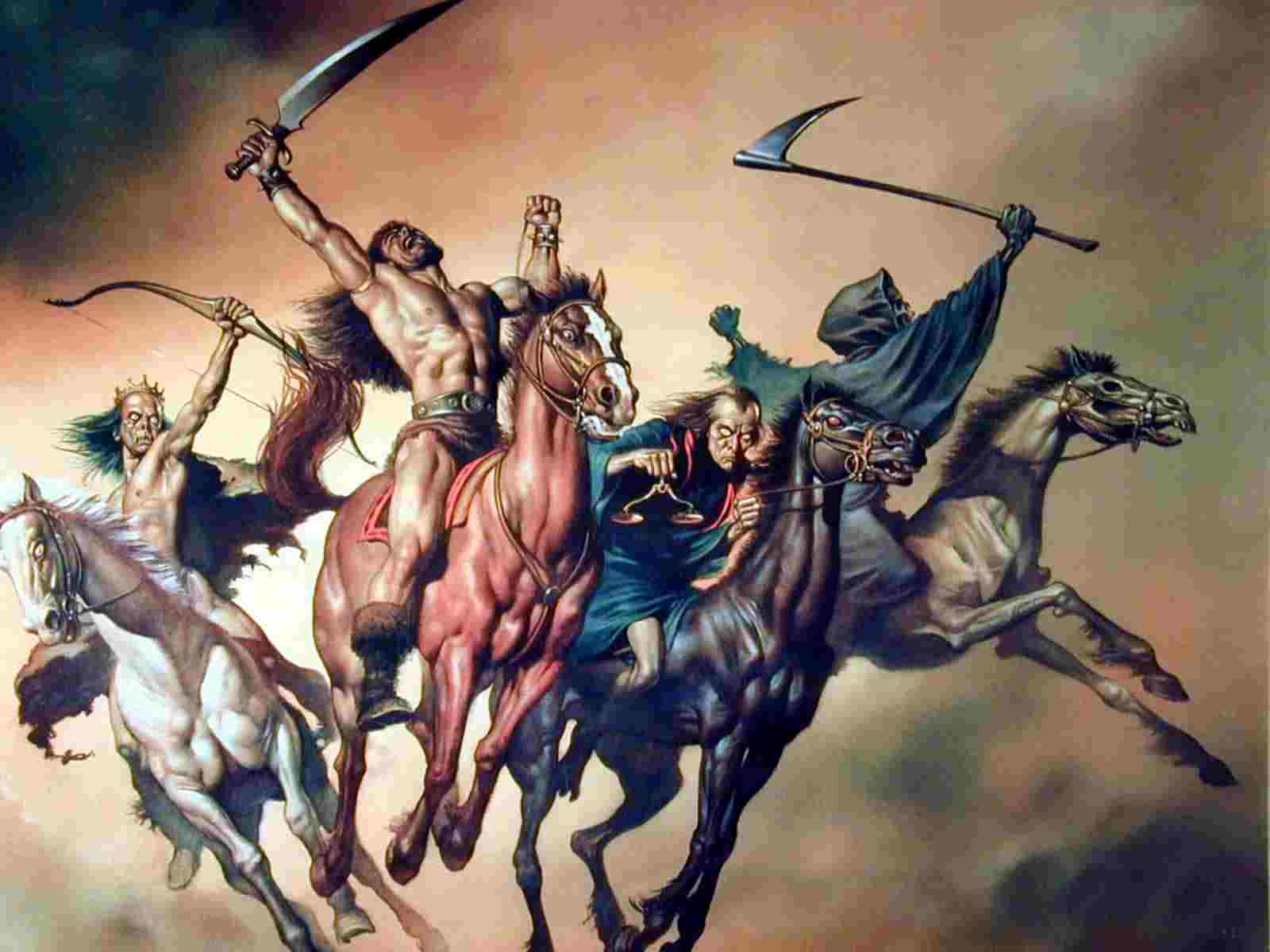
Four Horsemen Motto: Come and have a go if you think you’re hard enough. Direct from the Bible, the Four Horsemen of Conquest, War, Famine and Death will one day roll across the Earth, bringing down everyone in their paths. “Everyone,” of course meaning everyone. You don’t know when they’ll come, but you’ll sure know when they get here. Make sure you have your bags packed.

Ecosystem, if only for the picture of the panda strapped to a knife-throwing target. Those pandas have had a free ride for long enough, if you ask me….

You have no idea how important bees are. Seriously.

Food Chain Collapse – this is one that I find pretty plausible, as far as some of these entries go. We all get mushy and sentimental about the whales and the dolphins, but what about the krill and shrimp and sardines? Without them, we run the very great risk of destroying an entire food chain just to have something to snack on during brunch.

The Gulf Stream Collapse is another one that kind of worries me, and it’s my favorite card to play whenever someone comes out with, “Look at all this snow! So much for global warming!” canard. In a nutshell: The gulf stream brings warm water up from the Caribbean to the North Atlantic, which results in a rise in temperature for most of Europe. As polar freshwater ice caps and glaciers melt, all that cold fresh water will mix with the salt water, which could have the effect of pushing the upper end of the gulf stream south. This would mean a substantial temperature drop in Europe, and a general planetwide climate crisis up to and including a new mini-ice age.

For a brief and shining moment, we will all be T-1000s

Grey Goo is always fun, too. If we manage to build self-replicating nanomachines, which use the atoms around them to build copies of themselves, what’s to stop them from just ripping apart every solid object they see? If they don’t know when to stop eating and replicating, they could devour most of the world in pretty short order. Nasty, huh?

And of course there are sure-fire world-enders like The Death of the Universe, Sun (the death of) and the Collapse of Causality, the inevitable result of the invention of time travel.

It’s an amusing book, with some educational points to make. Strictly speaking, not every one of the scenarios that it depicts has to do with the end of the world. Some of them, like volcanoes, earthquakes, and pandemics, are just natural disasters rather than planet-killers. Others, like obesity and an aging society, are more aimed at problems facing the human race that may inconvenience us, but probably won’t destroy us.

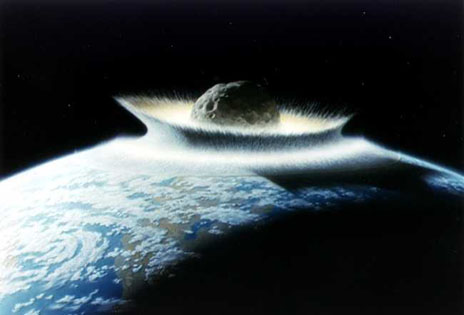
Look, it landed on Bruce Willis! How ironic...

And then there are the ones that I suspect were put in just to fill space – in The Solar System , Horne suggests that Jupiter could one day turn itself into a second sun, with disastrous consequences. But that won’t happen – Jupiter is much too small to initiate fusion in its core. The same with Supernova – he suggests that Betelgeuse could go up (and it will), bathing us in gamma rays after “crossing millions of light years” to get to us. But Betelgeuse is only 640 light years away – much closer than “millions,” but much too far to hurt us when it goes. So it’s not so much that the scenarios are implausible – like Alien Invasion or Paradox or Satan, but that they’re inaccurately implausible. It makes me wonder what other facts he fudged or guessed on just for the sake of making something sound scarier than it is.

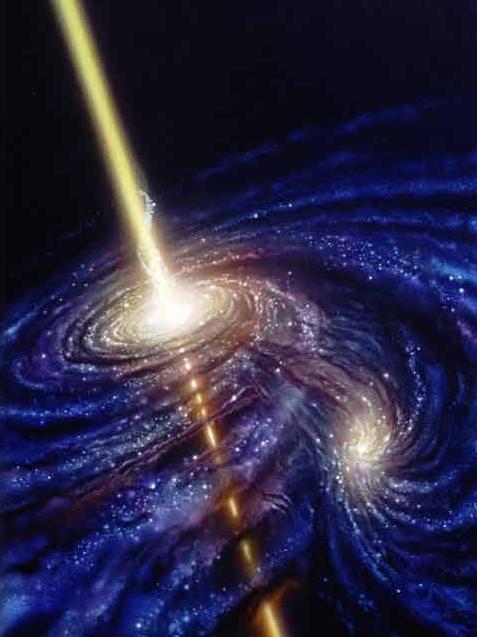
Can't go wrong with a black hole....

It’s got some good tongue-in-cheek humor, and is a clever reminder of all the ways that things can go wrong in this big world of ours. The pictures are very nice, often funny, and good companions to the text, which features helpful hints for surviving each scenario, as well as a guess as to when you should start to panic. All too many of them are labeled “too late.”

An interesting note: there is a lot of British English in the book that may surprise readers of American English, such as myself. I had never encountered the adjective moreish (meaning so tasty that you want more of it) until I read this book and am forced to assume it’s a British coinage. Also, some of the puns only work if you know the British pronunciation of words. Unlike the editors of Harry Potter, though, these guys did not bow to our American prejudices and re-edit the book. Kudos to them.

So, these are the ways the world ends. Now you know.

———————————————————
“The only thing worse than a vengeful God is a fickle one.”
Richard Horne, A is for Armageddon

A is for Armageddon official website
A is for Armageddon on Amazon.com

1 Comment

Filed under apocalypse, death, disaster, humor, Richard Horne, science

Review 113: The Plague Dogs

The Plague Dogs by Richard Adams

I really enjoy Richard Adams. Part of it is his writing – he has an excellent style and a definite gift for description. When he talks about a place, it is immediately obvious that he’s actually been there. He uses multiple senses to tell you what a place looks, sounds and smells like, the feeling of the damp earth and the rolling mists, the tastes that seep through the air…. Not surprising when one is writing a book where a pair of dogs are the primary characters.

And that’s another reason I like Adams. Lots of people write books about animals, personifying them and making them into almost-humans. But most of these writers tend to idealize the animals, put them into the sort of “noble savage” category which places humanity immediately in the wrong.

The fox is almost unintelligible. Enjoy that.

Not Adams. His animals are animals. In Watership Down, which was ostensibly a book for children, the animals live through fear, terror, despair and war. There is blood and death and pain, mostly because there is blood and death and pain in the natural world. He does acknowledge that he over-humanizes his characters, but without that, there would be no story.

This book is about the intersection of animals and man, and asks a very important question: what is humanity’s responsibility towards the animals? While he may not know what the true answer is, Adams definitely knows which answers are wrong. The book begins in a scientific research lab, in the quiet hills of northern England, where any number of experiments are performed on any number of animals. Some of them are paid for by outside interests – cosmetics corporations, for example – while others are performed to, in the mind of the lab’s directors, further the scope of scientific knowledge. Adams’ utter contempt for this kind of activity is immediately evident when you read it, and he spares no detail in describing what happens in these experiments. Animals mutilated, burned, shocked, frozen, exposed to poisons in their air, water and food. Kept awake, asleep, isolated…. all just to see what would happen. And when they die, they are disposed of with no more thought than one might dispose of a burned-out light bulb.

Like this, only worse.

One of the subjects is a large black mongrel dog which is being used to answer the great burning scientific question of, “What would happen if we kept trying to drown a dog but never actually let it die?” Rowf (having never had a master, his name is just the sound he makes) has a single companion in the lab, in the cage next to him – a small terrier who, having had a master before, has a name – Snitter. Snitter has been the subject of a far stranger experiment, and the brain surgery has left a deep scar across his skull and a deeper rift in his mind.

The two dogs manage to escape from the lab into the outside world, where they manage to survive, if only barely.

Poor, crazy Snitter....

And normally, that would be the end of the story. But then Adams reveals his antipathy for bureaucracy and the modern media, for where both of these intersect, terrible phantoms and ghouls can arise. Worried farmers, whose sheep are targets of the two hungry dogs, call their representatives to get answers from the recalcitrant lab. The ministers talk and talk about it, and when word leaks out to a well-known London tabloid, the story explodes.

WAS the lab not working with many kinds of animals the night the dogs escaped, it asked. Among those animals, were there not RATS? And were those rats not the subjects of tests involving the horrible BLACK PLAGUE? CAN the laboratory ASSURE the taxpaying public that there is ABSOLUTELY NO CHANCE, none at all that the dogs are not infected with the virulent PLAGUE?

The newspaper’s answer, the one that will sell more copies, of course, is NO. And so, the two dogs, who were lucky enough to escape and canny enough to survive, become known nationwide as the Plague Dogs, subjects of a hunt which escalates beyond reasonable proportions.

Poor, miserable Rowf....

As much as this is an animal adventure story, a kind of twisted version of Homeward Bound, it is also commentary. There’s a lot of dog philosophy in here, for one of Adams’ gifts is being to get into the heads of the animals he’s writing. The two dogs agree on one thing – it is a dog’s place in the world to serve humanity. But how? Snitter, who’d had a good master once, believes that they are there to make humans happy, to bring love to a home. Rowf, however, having known nothing other than the laboratory, believes that dogs are there to be abused by humans for their unknowable purposes, and that by running away from the lab and the water tank, he has become a Bad Dog.

Also, looking at the world from a dog’s perspective is interesting. Snitter, for example, believes that the newspaper-boy delivers a paper to the Master’s house solely so the Master and Snitter can play a fun game. Isn’t that boy nice? And having known only suburbia, he is shocked that humans have ripped up the world and replaced it with all these green things and mountains and deep holes filled with water – which, of course, Rowf believes are used to drown unthinkably huge animals much as he was drowned. Adams asked himself the question, “How would a dog interpret the world?” and got a lot of great ideas from it.

And, as I mentioned before, there’s a lot of talk about humanity’s responsibility towards the animals. Should we use them for whatever purposes we wish? Of course not. Are we necessarily “better” than the other animals? More skilled, yes, more clever, certainly, but better? No. We are animals, and as such we cannot allow ourselves to place ourselves above the great interconnected web of life. We may never know what our purpose in Nature is, but we can know what our purpose is not.

Not quite the end....

One really interesting part of the book is a wonderful section near the end where the Writer and the Reader argue about the fate of the dogs. It’s a little meta-fictional, but it’s an acknowledgment by Adams that he knows how the story should end, and he knows how his readers want it to end. Reading it, it appears that Adams clearly thinks the dogs should die – not because they were Bad Dogs or anything like that, but because the vision of humanity that he constructed for the book demanded their deaths. Most of the humans in the story want the dogs dead, and letting that inevitable ending take place would be his way of saying, “See? I told you so.”

If I had to guess, though, he showed the original, “Dead Dogs” version to someone – his wife, his editor, his agent – and that person said, “No. Uh-uh, no. No no no. No.” And so Adams grudgingly breaks the fourth wall with a short narrative poem which is essentially him saying, “Fine, have your happy ending….” It’s a wonderful part, and I admit to getting a little choked up every time I read it.

Just a little, mind you.

—————————————————-
“It’s a bad world for the helpless.”
Mr. Ephraim, The Plague Dogs

The Plague Dogs on Wikipedia
Richard Adams on Wikipedia
The Plague Dogs on Amazon.com

1 Comment

Filed under adventure, animals, dogs, England, ethics, fantasy, friendship, media, morality, Richard Adams, society