Review 153: The Walking Dead

The Walking Dead, Compendium One by Robert Kirkman, Charlie Adlard, Tony Moore & Cliff Rathburn

Zombies are boring.

There. I said it. And I’m not ashamed.

They are, though. Zombies have no real motivation, they have no goals other than to kill all humans. They are mindless, a kind of twisted force of nature whose great terror lies in their sheer numbers and their unstoppability. As a concept, zombies are interesting, and as a symbol or a metaphor there’s a lot you can do with them, but the zombies themselves are kind of dull. They lurch about, slowly decaying, looking for people to devour. No one ever made a best-selling book or a hit movie with a zombie protagonist. [1]

Not many people know that zombies make great photographers. Photo courtesy of LaughingSquid.

Think about it: every zombie story rests on the same basic plot. The dead have risen and a small band of living survivors tries to find safety in a world that is actively trying to kill them. That’s it. Sure, the details may vary – fast zombies or slow ones, a cure or no cure, they eat brains or they’ll eat anything, trapped in a mall or a farmhouse – but the foundation of the story is the same, and woe betide the writer who strays too far from the formula. Writing a zombie story means agreeing to adhere to a set of predetermined rules, which allow only a little room for straying.

So what is it that makes zombie stories so popular? Why do people love books like this one, or Pride and Prejudice and Zombies or World War Z? Why do movies like Shaun of the Dead and Night of the Living Dead and even Resident Evil get people so excited? It certainly isn’t because of the zombies, although it is always fun to see the special effects improve.

We read and watch zombie stories because we love the survivors, and it is they who make or break a zombie story. The more closely we can identify or sympathize with a survivor, the more interesting and horrifying the story becomes for us. They are a great demonstration of the variety in the human condition, and illuminate new and interesting aspects of humanity every time. In this case, we are given Rick Grimes as our protagonist, a police officer from a small town in Kentucky who gets shot on duty and wakes up a month later in the hospital to find the world has been given over to the dead.

As he looks for his wife and son, Rick finds himself leading a band of survivors in their search for a place of safety away from both the dead who wish to devour them and the living who wish to kill them.

No, technically it's not. Which doesn't make things any better.

What makes this a really fun – and terrifying – read is that Kirkman carefully paces the plot so that we never really get much time to rest. A pattern quickly starts to emerge in the story, with Rick and his people finding safety, a kind of equilibrium between running for their lives and resting, only to have that equilibrium disrupted. Each time the interval gets longer and longer, both in terms of page count and story-time, but each time you know what’s coming. The hardest moments are the most peaceful ones, when they have found a refuge from the horrors of the world because you know it isn’t going to last, and you know that when the balance is finally undone, it’s going to be worse than before. Kirkman uses this pattern and this expectation to his advantage, creating a tight and tense narrative.

He also provides us with a look at some of the ethical problems that arise from a world where the dead outnumber the living. In nearly every zombie story ever written, the living immediately start killing the zombies, but is that the right choice to make? We don’t know all the facts. We don’t know what caused this outbreak, whether it can be cured, or even whether the people affected might just get better. We just start taking head shots in ignorance, but might it not be worth it to try and learn something about these “monsters?” [2]

There’s also the question of how to organize a post-outbreak society. What kind of person or people should run the survivors’ societies? Is this an opportunity to remake civilization, or should the old ways be adhered to? How much leeway to we have in restarting the world, and what will that look like in the end? The characters in this story have to deal with how to define a family when one’s partner or parents or children could die at any time. They have a chance to redefine what is lawful and illegal, to toy with the notions of what is right and wrong, and to re-evaluate the role religion plays in their lives. It’s a chance to rebuild the world from scratch, and the characters in this story test those limits in interesting and sometimes unsettling ways.

Remember, thou art mortal. Remember, thou art mortal. Remember, thou art mortal...

And that’s assuming that the living will actually survive and thrive in a zombified world. This is a world where death is always only moments away. It is only a matter of time before the living survivors join the ranks of the undead, and the awareness of that fact is the classic existential puzzle with a little extra twist to it: how do you live when you know that you will die, and especially when you know the horror that your death will entail? One of the more heartbreaking moments is when one character gets killed, and Rick has to break the news to his young son, Carl. When he asks his son if he is upset, Carl replies, “No. People die, dad. It happens all the time. I’ll miss [him]… but I knew he was going to die eventually. Everyone will. Everyone.”

That is an observation that, frankly, no child should ever have to make.

The characters in this story make hard choices and sometimes do terrible things in the name of survival. But, with very few exceptions, there are few characters that we cannot truly come to understand and identify with. Their decisions and their reactions make them richer, more interesting, which is what truly makes for a fascinating and engaging story.

The zombies are really incidental to all that.

Pages and pages of this. I feel for you, Adelard.

As this is a comic series, I would be remiss if I didn’t mention the art, which is overall quite good. There were a few times when I had trouble telling some characters apart, but the high rate of attrition generally took care of that problem. The detail in the artwork is very impressive, though I can imagine there were more than a few times that Charlie Adlard cursed Robert Kirkman for setting a large part of the series in a locale with a prominent chain-link fence that couldn’t easily be ignored. As this is a horror comic, the art is sometimes horrifying, very graphic and quite satisfying without being gratuitous. Well, mostly without being gratuitous….

It’s a really excellent book, though I do have one caveat if you’re planning to buy the compendium edition: get a reinforced reading harness, or rest the book on a solid piece of furniture with a low center of gravity. This is one of the densest books I’ve ever read, packing nearly five pounds of book into less physical volume [3] than the last hardcover installment of The Dark Tower, a fairly hefty book. I think the ink may contain uranium or something. So, take measures to prevent back injury and hernias when you read this and you’ll be just fine.

Many thanks to my brother Michael for knowing I would enjoy this, and I look forward to watching the AMC television adaptation.

————————————-
“But honestly… I just don’t know what anyone’s thinking. To me, that’s scarier than any half-rotten ghoul trying to eat my flesh.”
– Rick Grimes, The Walking Dead
————————————-

[1] Cue angry email pointing me towards exactly that book or movie in 3… 2… 1…

[2] Short answer: no.

[3] It comes out to 1.147 grams per cubic centimeter, which isn’t nearly as dense as it feels when it’s making the straps of your bag dig into your shoulder….

2 Comments

Filed under comic books, death, disaster, existentialism, family, graphic novel, horror, made into movies, morality, Robert Kirkman, society, zombies

Review 152: The Moon is a Harsh Mistress

The Moon is a Harsh Mistress by Robert Heinlein

What would you do if you had access to the greatest supercomputer ever built? A computer so complex and intricate that it finally gains full consciousness – and only you knew about it? Would you use it for your own nefarious purposes and hack your way to riches? Would you try to teach it how to be human? Would you tell it jokes? Or would you use it to start a revolution that frees your people in the Lunar Colonies from the yoke of Terran oppression?

Manuel Garcia O’Kelly Davis never really meant for that last one to happen. One of Luna’s best computer technicians, Mannie’s philosophy was “Keep mouth shut” when it came to matters political, and never considered the political fate of the Moon to be something he needed to worry about. When he attends a meeting of Lunar dissidents, people protesting against the rule of the Earth-based Lunar Authority, he goes more out of curiosity than cause. An attack by Authority troops drives him together with lifelong revolutionary Wyoming Knott and anarchist professor Bernardo de la Paz, and together they hatch a plan to take down the Lunar Authority and make Luna into a sovereign nation above Earth.

Would he have been as scary if he'd been named Mike? Probably.

To do so, they’ll need the help of Mike, the world’s first – and only – sentient computer. He knows the odds, he can run the scenarios – with Mike on their side, the people of Luna can gain their independence and create a new nation in the grand tradition of old.

A friend of mine said that this was the best political science textbook that she’d ever read, and in many respects she’s right. This book packs a lot of social philosophy into three hundred pages, and Heinlein requires you to be pretty quick on the uptake. From Manny’s clipped way of narrating the story to all the new lingo and concepts that are necessary for Lunar life, the reader needs to pay close attention in order to get the full impact of what’s going on in the book.

In a way, this book is Heinlein asking the question, “How do new nations begin?” Historically, there are two ways: top-down and bottom-up. In the first case, a person or people of strength brings a group of citizens to become a political entity. In the second, the people themselves rise up to overthrow their former masters. Most revolutions are a mix of the two, really, and Luna’s is no exception. The very charismatic Adam Selene (Mike in disguise) and the brilliant Professor manage to bring the people of Luna together in order to rid themselves of the Lunar Authority.

What makes it very interesting is that the book is pretty much a how-to book on insurgency and revolution. They work out an improvement on the traditional cell system of a conspiracy, and how to make it as stable and secret as possible, while still maintaining reliable communications. They figure out how to involve people in the revolution indirectly, harnessing the energies of everyone from children to old people. Working against a better-armed and more powerful enemy, Luna’s revolution is a textbook model of how to overthrow your oppressors and gain your freedom.

Of course, once you have your freedom, then what do you do with it? How do you run your new country, and how do you make sure that your freedom can be maintained? How do you build a government and write a constitution and establish trade and do all the other little things that have to happen if you want a country all your own?

What’s more, Heinlein puts forth a new society that is radically different from the ones we know now, and by necessity. With drastically different demographics and gravity, life on Luna cannot follow the same rules as life on Earth. This new life includes a near reverence for women, marriages that span not only multiple partners but multiple generations, and a spirit of individualism that would make the most grizzled pioneer proud. Life on the moon, as the title implies, is not easy. Many of those who come to Luna do not survive. Those who do, however, become the backbone of a new nation that will one day be the crossroads of the solar system.

It’s a dense read, but fun, once you get used to the narrator’s mode of speech. Manny often leaves off pronouns and articles, making him sound very choppy and direct. And a lot of it is done in speeches and Socratic dialogs between the Prof and whomever is unlucky enough to get in his way. I’d say that the greater part of this book is discussion of how to have a revolution from the point of view of the moon, and a look at how Heinlein thinks a society should be ordered.

Other than being very narrative-heavy, which modern readers might find somewhat tiring, there is one point about the book that didn’t sit right with me. It didn’t ruin the book, necessarily, but it put a big asterisk next to everything that Heinlein was trying to say. That asterisk is Mike.

Mike is a truly marvelous AI. He is not only self-aware and blessed with a rather rudimentary sense of humor, but he is tied into all of Luna’s main systems. His processing speed and memory are exceptional, and while he doesn’t really care one way or the other about rebelling against his owners, he does think that organizing a rebellion might be an entertaining diversion. He’s a good character, really, but he is entirely too powerful.

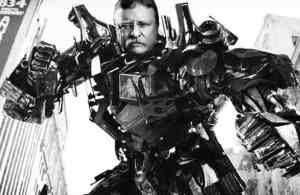
RTR-9000 would have liberated the Earth while he was at it, just because it was in his way. (via Cracked.com)

All of the problems that traditionally plague conspiracies, undergrounds and rebellions are solved by Mike. He knows the probabilities of success and can run thousands of scenarios in a moment. He is able to set up a moon-wide communications system that is completely secure. He can tap into the Lunar Authority’s database while at the same time keeping the Rebellion’s data secret. What’s more, he can be trusted to know everything about everyone in the group – he cannot be bribed or drugged or forced to name names under interrogation. He can organize the bombardment of Earth with pinpoint accuracy, bring down attacking ships and organize attacks all over the moon.

With Mike at their side, the rebels couldn’t help but win, and I found that a kind of hollow victory, in a narrative sense. I kept waiting for Mike to be compromised – his power disconnected or his actual intelligence uncovered – or for him to change his mind about helping the rebels. One way or another, I wanted the rebels to win Luna without the help of their omniscient computer conspirator. As it is, Mike pretty much delivers the Moon to its people, and then vanishes without a trace. That’s not to say that the human element isn’t necessary – even Mike couldn’t have won independence without them – I would rather have seen a wholly human revolution.

The flag of Luna. Seriously.

Other than that, though, it was a very good read, and it’s a book that ties into a lot of Heinlein’s other works. Many concepts that are key to Heinlein’s vision of the world are in this book – the freedom of the individual to direct his or her own life, the benefits of polygamy over monogamy, and of course the notion of TANSTAAFL – “There Ain’t No Such Thing As A Free Lunch” – which is arguably one of the governing principles of the universe. In this book, Heinlein asks the reader to do more than just enjoy a good story – he demands that the reader think about the message as well. And that’s what makes Heinlein one of the greats.

If you’re looking for some essential science fiction and you like your politics rough-and-tumble, check this book out.

——————————————————–
“At one time kings were anointed by Deity, so the problem was to see to it that Deity chose the right candidate. In this age the myth is ‘the will of the people’ … but the problem changes only superficially.”
– Professor Bernardo de la Paz, The Moon is a Harsh Mistress
——————————————————–

3 Comments

Filed under colonization, economics, futurism, politics, revolution, Robert Heinlein, science fiction, society, space travel, technology

Review 151: Ghost Story

Ghost Story by Jim Butcher

Hell’s Bells count: 27

In the acknowledgment section of the book, where Butcher very kindly thanks all the people who helped it come into existence, he clarifies something very important: the end of the last book, Changes, was not a cliffhanger. Absolutely not, no matter that it really, really looked like one, smelled like one and felt like one. After all, in that last scene, Dresden is on a boat, and then shot through the chest by a sniper of some sort. He drops into the cold waters of the lake and sinks and, as far as we know, dies.

Noooo! You've gone too far, Harry!!

In order for it to be a cliffhanger, then, Butcher would have to reveal at the beginning of this book how Dresden got out of such a terrible situation. Maybe he could call on some last reserve of magic or be saved by merpeople or something, but the strictures of the cliffhanger would demand that Dresden, once the next book began, not be dead but saved by some unexpected, yet still believable, means.

So, yes, Butcher is right – it’s not a cliffhanger. Dresden is, indeed, dead. He did not escape, he was not rescued. He is dead.

Now in most series (comic books excluded, of course), the death of the main character would be something of an impediment to continuing the series. But The Dresden Files is not most series, and Harry Dresden is not most main characters. He has done too much and is far too important to be allowed to do a silly little thing like die. Harry Dresden is necessary to a great number of plans and schemes by a great number of people. What’s more, his death wasn’t exactly fair, insofar as such a thing is possible.

And so he is brought back by the Powers That Be in order to balance the scales and set things right, which is ultimately what Harry Dresden has been doing all along. He’s to go back to Chicago and find his murderer, lest terrible things happen to those he loves.

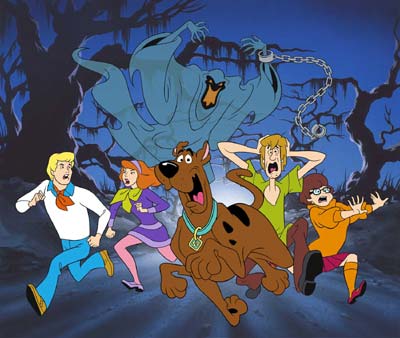
Fortunately, while there are meddling kids, Harry wins them over, and the giant ridiculous dog is on his side.

The catch, of course, is that he has to come back as a ghost. This is a problem for many reasons, not the least of which is that doing a murder investigation is substantially easier when you have, well, substance. It’s hard to punch someone in the face when your fists just go right through them. So Dresden first has to figure out how to make himself known to the living world, in addition to coming to grips with his limitations as an untethered spiritual entity. Once he’s figured that part out, he has to not only solve his own murder, but keep a body-hopping necromancer from becoming indescribably powerful, save the only man who knows how to deal with being a ghost, try to redeem a bunch of street kids who are under the influence of a minor sorcerer, and figure out what to do with the real mess he made when he died.

You see, Harry’s death, and the events that led up to it, created a power vacuum – not only in Chicago, but all over the world. With the destruction of the Red Court of vampires, the magical rulers of the world are fighting tooth and nail over land and resources, and what has mostly resulted from that is bloodshed. Forces all over the world are converging on Red Court territory, each one determined to claim what they can.

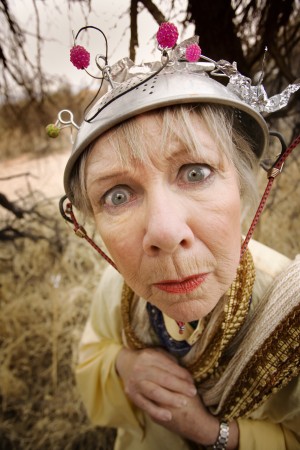
This was the very first Google Image result for "Ragged Lady." The book is forever changed for me...

In Chicago, the news of Harry Dresden’s death invited all sorts of new power players into the city, who were previously smart enough to stay out. Harry never truly understood the reputation he had until he sees what his friends have to do to match it and keep the city safe. Now that the Great and Powerful Harry Dresden is out of the picture, a newer and more terrible protector has emerged to keep away those who would do the city and its inhabitants harm. The Ragged Lady is all that stands in the way of the Chicago that Harry knew being overrun.

Mix in the Faerie, a new group called the Formor, the mob, and a few representatives of the afterlife, and you have a confusing and volatile situation. Which is pretty much where Harry Dresden is most at home.

As with the other Dresden Files books, this is a lot of fun to read, mainly because it looks at Harry and his friends from a new point of view – the outside. In the six months that he’s been “away,” the people he loves have had to go on without him, and even in that short time they have become different. They have had to make choices that they wouldn’t have made while he was there, and they certainly don’t interact with him the same way they once did. Harry has to re-learn who these people are, with the understanding that his decisions did not change their lives for the better.

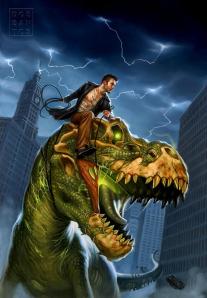
Then again, showy violence can be pretty cool sometimes. (Art by Dan Dos Santos)

In addition, we learn more about Harry’s past and what made him the way he is, and we finally see him start to think about whether being the person he is is really a good thing all the time. He excels in showy violence, hitting first and asking questions later, without taking a more nuanced view of the situation. Well, now he can’t hit, at least not in the ways that he’s used to. He has to look at his old ways in a new light and figure out how to get what he wants through other means.

Really, if you’ve read this far in the series, you’ll enjoy this one. Butcher continues to do a good job in giving us what we want, while at the same time showing us things that are truly unexpected. There are some wonderful moments in the book, a few exposition-heavy moments while Harry is filled in on the situation, and a good mystery to be solved. Enjoy.

——

Death should be a learning experience, after all, or what’s the point?
– Leanansidhe, Ghost Story

The Dresden Files on Wikipedia
Ghost Story on Wikipedia
Ghost Story on Amazon.com
Jim Butcher on Wikipedia
Harry Dresden on Wikipedia
Jim Butcher’s homepage

5 Comments

Filed under afterlife, death, detective fiction, Dresden Files, fairies, fantasy, ghosts, Jim Butcher, murder, mystery, quest, wizardry

Lost in the Stacks 11: The Lessons of NaNoWriMo

This is my pen - THE CREATOR OF WORLDS.

As you may know, I’m doing National Novel Writing Month this year – though it’s nearly over by now. The goal of this activity is to write 50,000 words in the thirty days of November. It’s not easy, and sometimes it’s downright frustrating, but it reveals a lot about being a writer that can help you on your way to joining the ranks of authors that you love to read. The main thing you learn is that being a writer means doing actual work. It’s not backbreaking (unless you have a crappy office chair), but it can be just as frustrating and difficult, or as fulfilling and exciting as any other kind of work out there. Chances are that you’ll go from one to the other from day to day.

In this episode, I talk about what I’ve learned from writing every day for six months, and how it really has helped me appreciate what the professionals had to go through in order to become pros. Whether I will one day be a professional or not isn’t really something I’m thinking about right now, but it’s certainly been fun finding out….

1 Comment

Filed under Lost in the Stacks, writing

Review 150: Otherland 3 – Mountain of Black Glass

Otherland 3: Mountain of Black Glass by Tad Williams

This is easily my favorite book in the series, short though the series may be.

Otherland is a strange story, really – it’s like a hybrid science fiction/fantasy tale in that you can easily forget which genre you’re in. It’s clearly science fiction, in that the whole thing is taking place in a massive computer simulation, but on the other hand, it owes a lot to fantasy – especially the world-crossing aspects of it.

Our Otherland heroes have been trapped there for some time now, running through the system with very little understanding of where they are or where they’re going. The whole thing is run by a cabal of the world’s richest men and women in an attempt to foil Death itself, and was built as their eternal playground. Thus, there are countless worlds to choose from. There are places where you can re-live entire historical epochs, where you can fly in rivers of air or play in a cartoon kitchen. You can be a cowboy in the Old West or a Knight of the Round Table or anything that your mind can conceive – and your programmers can work out.

Not every virtual god is a good one, of course.

The complexity of this system is such that it is indistinguishable from real life. It is multi-sensory, so you get the full experience of actually being there, with none of the obvious CGI cues that we’ve come to expect from the virtual world. What’s more, the owners of the system have nearly godlike power within it. They plan to not only live forever, but have absolute power while doing so.

Two of these simworlds – one original, one derivative – are the reasons why this is my favorite book of the series. The original simworld (not based on any well-known work or historical event) is the House. After being betrayed by the assassin Dread, who has been masquerading as one of their number, Renie, !Xabbu, Martine, Florimel, T4b and Emily are stuck in a kind of… unfinished world. It’s a place where the programming hasn’t really been settled, and where the unreality of the whole thing can be deadly.

They manage to escape by following Dread to a new simulation – a great House that is, in itself, a world. It goes on as far as anyone knows, but is home to countless tribes and nations. Our heroes meet runaway lovers – a cutlery apprentice and a girl from the linen cabinets. They are aided by the Library monks, whose expertise encompasses everything from House history to the minute details of plasterwork. They are nearly killed by attic bandits and hunted by nomadic bands of steeplejacks.

You get them abducted by aliens, of course.

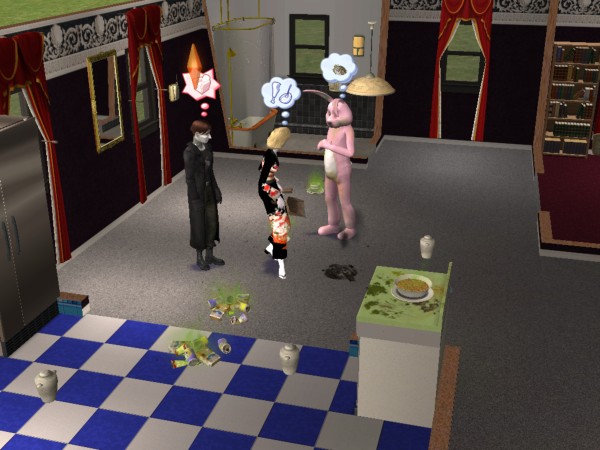
Aside from imbuing the House with a deep sense of history and complexity, Williams raises an important point that anyone who has ever played “The Sims” can recognize: what do you do when you start to empathize with a computer-generated being?

During their time in the House, they meet people who seem to be genuinely good, perceptive, interesting people, qualities that we don’t know how to confidently imbue in real humans, much less coded simulacra. The residents of the House have passions and dreams, they love and hate just as “real” people do. They can’t be written off as “just code,” because they don’t act that way. They help and hinder our heroes just as people out in Real Life might.

I don't know the answer, but this young... man seems interested in finding out.

This brings up an interesting ethical problem: while they can’t be sure what their ultimate goal will be, our heroes are pretty sure that the system will eventually have to be destroyed – as far as they know, it is the Otherland system that is keeping them trapped, and their loved ones in comas. Will doing this be, in essence, genocide? By shutting down the Otherland network to save the children in comas, and to save themselves, will they be condemning thousands – perhaps millions – of coded “people” to extinction? Are these “people” really people? After all, the Grail Brotherhood was planning to become immortal code themselves – would they be any less alive than their meat incarnations?

While this is not a problem that we have to grapple with yet, it’s one that may come up eventually. Tad Williams has done a very nice job in this series of predicting technological advancement, so he may have seen forward on this one, too.

The other simworld that makes this my favorite book is a derivative one. This means that it is based on an extant work, much like the Alice in Wonderland world that Paul Jonas goes to, or the bizarre cartoon kitchen from which Orlando and Fredericks had to escape. This world is one of the oldest stories there is, and was the first simworld to be created when the construction of the Otherworld began.

It is The Iliad.

Somehow, I don't have a Sim of Achilles. (Art by NegativeFeedback on DeviantArt)

I’ve read the original poem a few times, and I’m impressed with it every time. It’s a massive story, full of heroes and villains, bravery and treachery, and death. Lots and lots of death. It’s an epic poem, and it deserves the title, as it pits nations, men, and gods against each other in what is ultimately a tragic and terrible ten year war. For Tad Williams to use this as the climax for a novel is nothing short of audacious, but he pulls it off wonderfully.

Not only does he manage to keep hold of the terrible horror of war that Homer put throughout his poem, Williams integrates his characters into the story, putting them in the roles of key figures such as Achilles, Patroclus, Cassandra and Odysseus. They all want to get into Troy so they can find their way to the Black Mountain, but to do so they must go through the war that has served as the archetype for human conflict for the last few millennia. Their choices, freely made, reflect the choices of the characters they inhabit, which are themselves models for heroes of fiction throughout literary history.

In one wonderful scene, Sam Fredericks, who is inhabiting the character of Patroclus, is wondering what to do about her sick friend, Orlando Gardiner, AKA Achilles. He cannot fight, but the Argives need him, and throughout their long friendship as online gamers, it was always Orlando who was the hero. Sam was the sidekick, the buddy, but when you made the movie poster, Orlando’s character would always be in the middle of the shot.

But much like another Sam in another story, Fredericks knows that heroism isn’t just muscles and swords and snappy dialogue. It’s about doing what has to be done, even if you don’t want to do it. Nearly crippled by progeria, a debilitating childhood illness, Orlando has nonetheless continued to fight on in the Otherland. Now the hero cannot fight, and Sam realizes it’s the sidekick who has to pick up the burden. Thus, Sam unknowingly fulfills the destiny of the character she is portraying, puts on the shining armor of Achilles, and goes out to inspire the Argives to fight so that she and her friends might live.

Chocolate! It's full of chocolate!

The entire Troy sequence is amazing, and every time I read this book, I feel compelled to read The Iliad again.

But the series doesn’t end there, of course. Suffice it to say we hit a major climax by the end of this book. People are in danger, secrets are revealed, battles are fought… and one of our brave heroes makes the Ultimate Sacrifice. We are brought to the heart of the operating system, the Black Mountain which entombs the Other. The Grail Brotherhood sets their immortality sequence in motion, and the amoral killer Dread makes his bid for virtual godhood. Setting us up for the final book, we are left with our heroes in disarray – divided and lost, dropped into an entirely new environment that is beyond their understanding and forced to cooperate with their gravest enemies for their survival.

You may look at this book and think, “Holy cow. 924 pages. There is no way I’m reading 924 pages.” But you will, and it’ll go a lot faster than you think. Williams has done a great job of making a multi-layered, fast-paced story that you can enjoy on many levels. You can revel in the action and the mystery, you can ponder deep philosophical problems, or you can comb through the great attention to detail and see how much work he must have done to get the Trojan War sequence right.

Hats off to you, Tad Williams.

—————————————————
“Jesus Mercy. There have to be easier ways than this to save the world.”
– Renie Sulaweyo, Otherland: Mountain of Black Glass
—————————————————

Tad Williams on Wikipedia
Otherland on Wikipedia
Mountain of Black Glass on Amazon.com
Tad Williams’ Website

Leave a comment

Filed under adventure, existentialism, fantasy, friendship, Homer, internet, meta-fiction, quest, science fiction, story, Tad Williams, virtual reality, world-crossing

Review 149: Speaker for the Dead

Speaker for the Dead
by Orson Scott Card

In his introduction to the book, Card says that the main reason he wrote his most famous book – Ender’s Game – was so that he would one day be able to write this. I think this is something that probably happens a lot to authors. They get a Big Idea in their head, something with great depth and complexity and meaning, and quickly discover that they don’t actually know what they’re writing about yet. There’s too much to say, there’s too much that even the author doesn’t know yet, and to go forward from that state of ignorance will result in what is, ultimately, an inferior narrative.

Andrew Wiggin, the Speaker for the Dead, comes to the human colony Lusitania in order to speak the death of a local man, Marcão. While given the same reverence and privileges as priests, Speakers are not the same. Their job is to learn about the dead, to understand who they were and who they wanted to be, and then tell the truth as plainly and as clearly as possible. They do not give eulogies, where they try to paint the dead in as good a light as possible. They reveal who this person was, and in the process try to help those left behind understand them. It’s a calling that requires an insightful mind, great empathy for others, and the ability to tell the truth despite how hard that truth may be to hear.

As a Speaker for the Dead, Andrew Wiggin is very good at his job. It was he who was the first Speaker, who wrote a text that is as revered as the Bible – The Hive Queen and the Hegemon – in order to understand how humankind could kill the only other intelligent species it had ever encountered. The book reveals who the Buggers were and why they attacked humanity. It tells how their understanding of what it means to be intelligent led to a century of warfare and, ultimately, their own destruction. The book also reveals humanity, the dreams and fears that it faced when it met the Buggers. And it tries to understand why humans were so afraid that they took one of their own – a little boy named Ender – and turned him into the greatest monster in human history. The Xenocide. The one who destroyed an entire alien race.

This book changed the way humankind saw the universe, and themselves. With the Buggers gone, but their technology still available, humans expanded out to a hundred worlds. Though their starships could only go just under the speed of light, the ansible provided instant communication between the stars. It formed a communications network that held the Starways Congress together and allowed humanity to become a multi-system species.

Ender – Andrew – is ultimately responsible for all of this, and is therefore the linchpin of this entire universe. In order to write this book, to understand the culture and the history and the politics that would be necessary to write Speaker for the Dead, Card first had to understand who Ender was. So, with the blessing of his publishers, he was able to turn Ender’s Game into a full-length novel. Once that was done, he was able to turn back to this book and craft it into what it has become.

Question: Will the aliens wear hats that are sillier than ours? No? Good.

The colony of Lusitania is a small place, a group of Catholic settlers who live in a small and insular town. They have all the troubles that any new world would have, except for two that make it truly unique. The first is the descolada, a virus that nearly destroyed the colony and, thousands of years before, life on the planet. This illness literally unzips and recombines your DNA, ravaging your body utterly. If not for the dying work of the colony’s two great xenobiologists, everyone would have died. As it turned out, Gusto and Cida were the last to die, leaving their sad, strange daughter Novinha behind.

Even that wouldn’t be enough to make Lusitania a truly remarkable place. No, for that, we must introduce the Piggies – the third intelligent life form known to exist in the universe. They’re small, look like little pig-men, and are indisputably intelligent. They learn quickly, even despite the law forbidding xenologists from influencing their development, and present humanity with an important chance: the last time we encountered an alien intelligence, we obliterated it. Let’s not do that again.

This becomes harder, however, when the Piggies kill two of the xenologists in what appear to be a horrifyingly painful method. Now it looks like humanity may have to revert to type again, and that there truly is no way that humans can share the same space with other intelligences.

Into all this steps Ender. His years of lightspeed travel have kept him young while three thousand years have passed, and he has wandered from world to world to speak for the dead. Now he is on Lusitania to speak for Marcão, an investigation that will lead him to uncover secrets kept for decades, and to once again change the way humans understand their universe.

There’s really so much to say about this book that it’s hard to decide what to leave out and what to keep in. For one thing, Card is trying to write a very different kind of science fiction story. In his introduction, he says that a lot of fiction is adolescent in nature, science fiction especially. It’s about adventure, about people seeing a way out of their conventional lives and going off alone. It’s about being freed from responsibility and living a fast and crazy life. When that loneliness of adventure finally becomes too much, the hero settles down, but that’s usually the last chapter of the book, if ever.

Isolation. Not just for murderous adolescent geniuses.

Card wanted to go the opposite way, to take a lonely adventurer and show him trying desperately to become responsible, to become a member of a community. In class, where I’m teaching Ender’s Game, we’ve identified isolation as being one of the overriding themes of the novel. Ender is constantly taken away from those he loves or held apart from others. In the end, he becomes a solo wanderer. Even more than that, he is made into a monster, a name on par with Lucifer itself. He is virtually thrown out of humanity, and it is only because no one knows who he really is that he can travel unmolested.

So we’re seeing Ender in that stage where the loneliness and the wandering have become an unbearable burden to him, and all he wants is a place to belong. But as a Speaker, as a man speaking a death that could completely upend the lives of everyone in the colony, he has his work cut out for him.

There is also the element of redemption. In his years of travel, Ender has carried a very special package with him – the cocoon of the last Bugger hive queen. In exchange for her story, he promised that he would find a home for her, a place for her to rebuild her vast family. And on Lusitania, there is that chance. But first he has to save the Piggies, to prevent them from suffering the fate of the Buggers at the hand of a fearful and suspicious Humanity. If Ender can do this, perhaps he can make up for the horror that he unknowingly perpetrated.

There’s a lot going on in this book, to say the least. It’s a great book, better in many ways than Ender’s Game. It is more complex and adult and difficult, with moments of true emotion, a well-built socio-political system befitting a species that spans hundreds of worlds, and addressing the needs for changes in culture, politics and even language that would arise from the need to define relationships between worlds and between species.

Ender would have been a natural for the Indigo Tribe. You listening, Geoff Johns?

Fundamentally, though, this book is about what the Speaker for the Dead does best – understanding. It’s about how we deal with The Other, even when that Other is completely alien to us. Humans and Buggers, Humans and Piggies – hell, Humans and Humans, we have a hard time understanding people who are not like us. We find it very difficult to look at the world from their point of view and to see the world through their eyes. Understanding what they love and fear, what they value and honor, or what they abhor – and more importantly, understanding what they see in you and how they understand you – is the best and surest road to making peace with those who are different from yourself. And that’s a lesson that is valuable for all of us.

———————————————
“No human being, when you understand his desires, is worthless. No one’s life is nothing. Even the most evil of men and women, if you understand their hearts, had some generous act that redeems them, at least a little, from their sins.”
– Ender Wiggin, Speaker for the Dead

2 Comments

Filed under children, colonization, death, disease, empathy, family, friendship, morality, murder, Orson Scott Card, science fiction, sins, society, space travel, teenagers, women

Review 148: Carpe Jugulum

Carpe Jugulum by Terry Pratchett

In this book, we return to the small Ramtop country of Lancre, home to Granny Weatherwax, Gytha Ogg and Magrat Garlick. Picking up from where we left off, which is actually in Maskerade, which I haven’t reviewed here yet, Magrat is Queen now, with no time for witching. So the new Third Witch is Agnes Nitt (also known as Perdita, but only by her), a girl who is sensible, levelheaded and thinks quickly in a crisis. She is also a rather, shall we say, substantial girl (and lest you think I’m trying not to be mean, believe me – Agnes is meaner about her self than I can be), and as we all know there is inside every fat girl a thin girl and lots of chocolate. Well, Perdita is the thin girl, and Agnes is the chocolate.

But that’s not the main point of this tale. The main point is that vampyres have come to Lancre, invited by King Verence to attend the naming of his and Magrat’s daughter, Esmerelda Note Spelling of Lancre (well, when your grandmother managed to name your mother “Magrat” due to an uncertainty in consonant placement, one doesn’t take chances.) But what’s done is done. No doubt we will see little Spelly in future Discworld books.

I'd still rather see this than Twilight.

Once you have invited a vampire in, you are subject to its power. Of course, vampires know this. There are a lot of things that vampires know…. These vampyres have studied, they have prepared. They do not intend to make the mistakes their forefathers did – keeping lots of knick-knacks about that could be turned into holy symbols, leaving up flimsy, easily pulled-aside drapes, that sort of thing. These are modern vampyres, ones who know their place in the food chain – on top of it. They’re ready, and they have every intention of taking over Lancre.

They don’t want a killing floor, though. Indeed not, they simply want a herd. An… arrangement.

But there are the witches to contend with, especially Esme Weatherwax. And everyone knows about Granny Weatherwax….

If you read Lords and Ladies, or even my review of it, you can see there are some similarities. Evil, inhuman force comes to Lancre, wants to subjugate its subjects, and in the end are foiled by the indomitable Granny Weatherwax. And yes, there are similarities. But the differences are worth reading it for.

First of all, we get a better look at Perdita / Agnes Nitt. Yes, she’s the Third Witch, but she’s more at home being a witch than Magrat ever was. Perdita is two witches in one, and they don’t like each other very much – a volatile combination. And as the newcomer, Agnes has the unenviable role of being the stand-in for the reader. She gets a lot of explanation that seems redundant to loyal followers of the Discworld series, but I guess new readers have to come in somewhere.

Art by Zenzzen on DeiantArt

Secondly, we get to play around inside Granny Weatherwax’s head again, which is always fun. We see a reference to her sister, Lily Weatherwax whom we last saw in Witches Abroad, and her grandmother, Alison. It is implied that the Weatherwaxes have a definite dark streak to them, against which Granny must contend constantly. What bugged me about this book is that Granny isn’t quite herself – though I suppose it can be argued that she wasn’t meant to be. Confronted with immensely powerful vampyres in her country, and insulted by seeming not to have been invited to the young princess’ naming ceremony, Granny Weatherwax just… gives up. She believes she can’t beat them, and she doesn’t think anyone wants her around. This is a side of Granny that we haven’t really seen before, and it’s not a nice one.

She does recover, of course – that’s what Granny Weatherwax does. There’s no point in being a witch, really, if you can’t make the grand entrance and pop up just when everyone thinks you’re down.

Another really neat thing about this book is that we finally get to revisit the Omnians, who were introduced as a fanatical theocratic people in Small Gods. Time has tempered the Omnians, who are now the Discworld equivalent of the Jehovah’s Witnesses. An Omnian missionary has come to Lancre, and he gets caught up in the battle against the vampires as well, and it turns out that, well, the Omnians aren’t that bad anymore. Since the Prophet Brutha gave them permission to think for themselves, the Church has schismed so many times that it finally comes down to a schism in one member, Brother Oats. Like Agnes, he’s of two minds about the world, and neither of them really get along.

So yes, there’s not a whole lot that’s really new in this book, but since I’m a hard-core Pratchett addict, I have to recommend it.

————————————————
“There’s no greys, only white that’s got grubby. I’m surprised you don’t know that. And sin, young man, is when you treat people as things. Including yourself. That’s what sin is.”
– Granny Weatherwax, Carpe Jugulum
————————————————

Terry Pratchett on Wikipedia
Carpe Jugulum on Wikipedia
Carpe Jugulum on Amazon.com
Terry Pratchett’s webpage
L-Space Web

Leave a comment

Filed under Discworld, family, fantasy, humor, Terry Pratchett, vampires, witches

Review 147: When Prophecy Fails

When Prophecy Fails by Leon Festinger, Henry W. Riecken and Stanley Schachter

You’re a good person, right? Of course you are, I never doubted it for a moment. We all like to think were good people – fair, honest, generous, all that. Very few people, if asked, would say, “Well, I’m a right bastard and I don’t care who knows it!”

So imagine that you – a good person – do something bad. Genuinely bad. You cheat on your spouse. You lie to a friend. You steal from your boss. You commit an act which, if someone else did it, you would roundly condemn them, forcing them into public shame and ignominy. What kind of heel, what kind of cad, what kind of a bastard would do such a thing?

Well, you, as it turns out.

Now you have a problem. The vision of you that you carry in your head – the good, honest, kind, humble (let’s not forget humble) person – directly conflicts with the nasty, dishonest thing that you have just done. They’re grossly dissonant views, and there is no room for both of them in your head. So what do you do?

Your first option is to reduce your opinion of yourself. Maybe you’re not that good a person. Maybe you are a bit of a dick. Maybe, when it comes right down to it, you’re just a jerk who knows how to hide it. That right there is some painful truth, and very few people are willing to face up to it.

So you turn to your other option: justify what you did. The spouse you cheated on? Well, maybe if they paid a little more attention to you,you wouldn’t have to do it. The friend you lied to? Well, was he honest about that “business trip” that made him miss your annual Memorial Day Meatapalooza Barbecue? Hell, no. He was “in the hospital,” visiting “his sick mother.” As for work, well if your boss actually paid you what you were worth, you wouldn’t need to steal from the register.

You rationalize what just happened, which allows you to not only move on with your life, but paves the way for similar actions in the future, making it that much easier to cheat, lie, and steal the next time.

Welcome to cognitive dissonance.

The classical view of humankind was that we were, ultimately, rational animals. That if you show a person sufficient evidence, that person will alter his opinion accordingly. So, under that model, our Imaginary You ™ would admit to your inherent badness when confronted with the evidence if your misdeeds.

Well, I can't argue with that. Light 'em up!

In the 20th century, however, psychologists were noticing that this wasn’t true at all. In fact, in a lot of cases the direct disconfirmation of a belief merely made that belief stronger. Show a smoker data on how dangerous cigarettes are, and she’ll tell you that they help her relax, or they only take off the bad years at the end. Show a climate change denier data on the warming of the planet, and you know who you’ll hear from only minutes after the first snowfall of the season.

Humans, as it turned out, were a lot less rational than we had suspected. By being able to hold two thoughts in our minds that are mutually incompatible, we set ourselves up for mental disaster, and the only way out is to fool ourselves.

In the mid 1950s, the authors of this book were looking into this phenomenon, especially as it applied to groups and millennialism – the belief that the world is rapidly in danger of ending. They looked at various historical examples, such as the early Christian church, who believed that Jesus’ return was right around the corner, the Anabaptists of the 16th century, the followers of Sabbatai Zevi in the 17th century and the Millerites of the nineteenth. They all believed that the end of the world was at hand, they all collected groups of followers who believed wholeheartedly that they were right, and they were all, without exception, wrong. Despite that, not only were they not swayed from their beliefs, they actually became more convinced that they were, ultimately, right.

What could account for such patently irrational behavior? Festinger and his partners believed they knew what it was, and set out five simple conditions under which the phenomenon could arise. In brief:

The monkeys in my head tell me you're CRAZY!

1. The believer must believe implicitly and that belief must have an effect on how he or she behaves.
2. The believer must have committed him or herself to the belief, performing actions that are difficult or impossible to undo. For example, giving away all their money, quitting their job, etc.
3. The belief must be specific, related to the real world, and able to be proven unequivocally wrong.
4. Evidence disconfirming the belief must occur, must be undeniable, and must be recognized by the believer
5. (and most important) The believer must have social support for his or her belief system.

Under these conditions, Festinger hypothesized, not only would a person persist in their belief, but they would become more convinced, and likely try to convert more followers. After all, if more people believe that you’re right, then maybe you are.

But how to test it out? Their best cases, after all, were at least a hundred years gone, and time travel hadn’t been invented yet. Fortunately, they got wind of a group of UFO believers who held that the earth was going to be ravaged by floods and that aliens would rescue the faithful to make them the new enlightened rulers of the species. Led by a woman out of Chicago who was receiving messages through automatic writing, this group held that the event would take place before dawn on December 21, 1954.

Knowing a good chance when they saw one, Festinger and his colleagues managed to infiltrate the group and observe their progress, attitudes and beliefs up to, during, and after the event that never happened. In the book, they go through the timeline and touch on all the major players – names changed to protect the innocent, of course – and watched to see if their hypothesis would hold. Would the media-shy Mrs. Keech do an about-face once the disaster didn’t show? What would happen to people like Dr. Armstrong, who sacrificed his job and his good name in order to assure that he would be picked up by the aliens? How would the group handle predictions that never came true, follow orders that never worked out, and rationalize this fundamentally irrational behavior?

They're here! They're here! They're... No, wait. They're not.

The study does have some fairly glaring flaws, which the authors themselves point out in the epilogue. For one, they had barely enough time to get involved with the group, and gaining entry was a matter of brute force more than finesse. For another, it was almost impossible not to influence the group. Observers were taken as believers, and expected to act as such. Acting undercover, they couldn’t record meetings or, in many cases, take notes until after the fact. Any meeting with the academics had to be carefully arranged so as not to blow their cover, and the long hours, erratic schedule and generally high tension of the group made being an academic double agent very difficult indeed.

Despite that, Festinger and his group present a textbook case of group cognitive dissonance that follows the pattern they expected it to. Believers who met all five criteria were much more likely to seek out new believers than the ones who, for example, were not with the group when the world didn’t end.

Of course, the reason I picked up the book was because of the May 21, 2011 Rapture prediction by Harold Camping. He had the Rapture scheduled down to the minute, and had attracted followers who met the initial criteria set out by Festinger more than fifty years ago. Sure enough, when the Big Day came and went, Camping and his followers kept to the script. They saw that the Rapture hadn’t come, then revised their predictions and went out looking for people to convince.

More interestingly, though, is how this can apply to other group dynamics. It can be applied to political parties, regional differences, racial differences, bigotry of every flavor and color. It can be connected to celebrity worship and religious fervor, to economic theories, institutional groupthink and scientific biases. Almost any common belief that can gather a crowd is an open invitation to Festinger’s five criteria. Look at people who cling to the belief that organic food is inherently better than conventional food. Adherents to market capitalism, homeopathy, religions of every size and shape. The antivaxxers, conspiracy theorists, Democrats, Republicans, Tea Partiers, Wall Street Occupiers, Klansmen, environmentalists, educators…. I could go on all day.

So what does this do for us, other than make us skeptical of anything that more than five people believe at a time? Just that: it keeps us skeptical. When you know what to look for, you can figure out who is likely to be persuaded by reason and who is not. You know who is a valid source of information and who is not. You know who you want to trust, and who you do not.

Most importantly, it allows you to check yourself, to see if you’re being as skeptical as you should be. None of us are exempt from this little psychological phenomenon, but we are all equipped with the ability to deal with it properly. Let Mrs. Keech and her UFO cult serve as an object lesson.

——————————————————

“When you stop and think of it, it seems rather cruel to drown all these people just to teach them a lesson, doesn’t it? The way to teach people a lesson, or the way to educate people is to educate them slowly; you can’t educate them with one big jolt. And it seems rather silly to drown people and hope to educate them in the astral life. It doesn’t seem very logical, does it?”
“Fred Purden”, in When Prophecy Fails

When Prophecy Fails on Wikipedia
Leon Festinger on Wikipedia
Stanley Schachter on Wikipedia
When Prophecy Fails on Amazon.com

Leave a comment

Filed under apocalypse, cults, disaster, Henry W. Riecken, Leon Festinger, nonfiction, psychology, skepticism, Stanley Schachter, UFOs

Lost in the Stacks 10: The Ends of the Worlds

A lot of the books I really love have something to do with the end of the world. Whether it’s the great plague of The Stand or nuclear holocaust in Swan Song, zombies like in World War Z or flesh-eating plants like in Day of the Triffids, or even irreverent humor like in Good Omens, I love to see the world come to an end, if only to see what comes next.

But what is it about these books that makes them so interesting? And not just books, either – there have been plenty of movies and TV shows that use the end of the world as a plot point, and they’re hugely popular.

What does the End of the World tell us about ourselves and our society? What is it about the end of the world that we find so appealing?

Maybe they have something to say about our relationship with the Eternal and out faith in a God that may one day decide He’s had enough. Perhaps it’s a desire to just start over from scratch and make a new world without making the mistakes of the old. Maybe we feel special, like the rules don’t apply to us. Or maybe we just want to see the world burn.

Whatever the reason, these stories will remain popular for a good long time. Let me know what you think!

Leave a comment

Filed under apocalypse, culture, death, disaster, Lost in the Stacks

Review 146: Otherland 2 – River of Blue Fire

Otherland 2: River of Blue Fire by Tad Williams

When last we left Our Heroes, they were caught in the Otherland – an immense virtual reality program built by people with more money than God – with no idea where to go and no idea what to do. They were lost, confused and had no way out.

Oh yes – back before Neo got his clock punched by Agent Smith, Renie, !Xabbu, Orlando, Fredericks and all the other Otherland explorers discover that they are in more danger than they realize – if they die on the network, then they’ll die in real life. And, almost right out of the gate, people start dying. Whether they’re tiny biologists living among the ants or a lifetime gamer warring against the different factions of a twisted Oz, they die in unpleasant and, ultimately real ways. And it’s up to our heroes to not only avoid death themselves, but also to figure out what the hell they’re supposed to be doing in there.

It's just like this, only different.

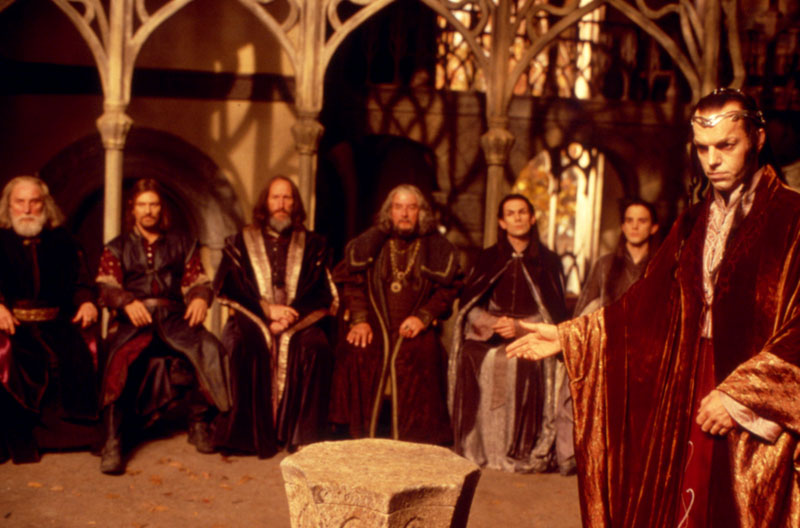
One of the things I like about this series is that Tad Williams openly admits to stealing – er, paying homage to the great writers of the past. At the end of book one, when all the main characters have been gathered together and are being told about the great dangers they will face, and how they are part of a plan to defeat the Grail Brotherhood and their Nefarious Scheme, most of the people there want nothing to do with it. It’s up to Orlando Gardiner, our young barbarian warrior-slash-progeriac teenager to say, “Hey, this the the Council of Elrond! We have a mission here!”

Unfortunately, while the Fellowship of the Ring gets a clear mission before leaving Rivendell, the Otherland explorers are scattered before they know what to do, and their main goal is to run for their lives. As this book progresses, they start to learn more about the vast Otherland network, what its nature is and why it was made. They also learn that it is unstable, and possibly a living thing in its own right.

Almost immediately, the group gets split up. That is, as all ensemble writers know, the best way to really build a meaty story, and it works really well here. Unfortunately, while there are three groups, the strongest and most interesting characters get put into two of them. Orlando and Fredericks get sent off into a world more bizarre than any online gaming ever prepared them for; Renie and !Xabbu end up in a horribly twisted version of The Wizard of OZ, if Oz had invaded Kansas, taken over, and started a three-way fight between the Scarecrow, the Lion and the Tin Man.

No adorable wisecracking robot, though. Can't imagine why.

This leaves us with the third and largest group being somewhat less interesting than the others. Not completely, of course – we have a blind woman who can sense the information flow of the simulation, a teenage net-freak who only speaks in online slang, a campy death-clown named Sweet William, a Chinese grandmother and an abrasive German woman. They’re not bad characters by any means, and each one is special in his or her own right. It’s just that most of them were introduced later in the first book, and so we’ve had less time to get to know them. Putting a more familiar character in that group might have made them more interesting, or it might have overshadowed them. Who knows? The good news is that they do become more interesting and engaging, so there’s really nothing lost by their being new to us.

One thing that the third group has, however, is a secret – one of them is not who he or she appears to be. One of them has been co-opted by the sociopathic assassin, Dread. The only one with the freedom to go on and offline at will, he has nearly godlike power at his fingertips. And he intends to use it.

I can imagine that Tad Williams had a great deal of fun working out these novels, mainly because he created a concept that allowed for incredible freedom in world-building. After all, on a super-powerful VR platform, any conceivable simulation can be created. So whether it is the mythical land of Xanadu, a cartoon kitchen where the groceries come to life at night, a world where people fly like birds, or the legendary land of Ithaca, the settings in these books are only limited to what Williams can think up and work with.

It's like, I'm in the story and I'm reading the story... Woah. Dude.

What’s really interesting is that he seems to take great pleasure in reminding us that we are, in fact, reading a story – he goes so far as to have one character reflect on exactly what kind of character he is. People are reminding themselves that they’re not in a story, even though they are, and at the same time recognizing that the entire structure of their virtual universe is patterned on the rules of fiction. It’s a strange type of meta-fiction that rewards the careful reader.

So, as the book comes to a close, we have some new threads to follow. The Otherland explorers begin to find their purpose and learn about their situation. We’ve met a strange type of character which exists in many worlds at once – the beautiful, birdlike woman who tries to help Paul Jonas and Orlando Gardiner find their way; the horrible Twins, whose only job is to pursue Paul Jonas wherever he may go. These people can be found around any corner, and the outcome of meeting them is always uncertain.

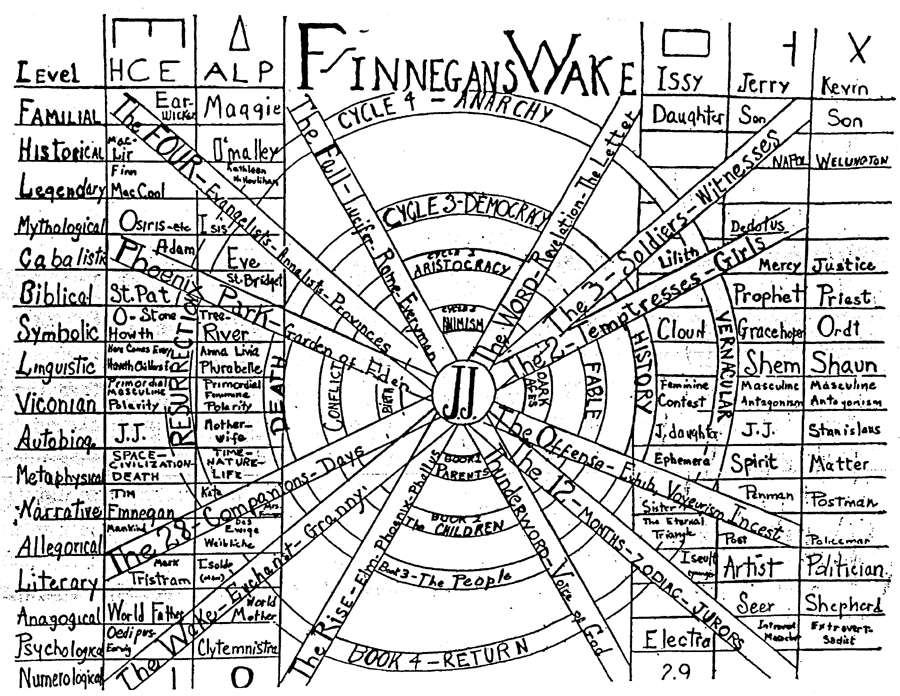
Slightly less complicated than this, but not for lack of trying.

Offline, real-world investigations into the mysterious comas that afflict children begin to bear fruit – a young lawyer named Catur Ramsey is trying to help the parents of Orlando and Fredericks find out what happened to their children, and the search leads him to a strange woman, Olga Pirofski, who may have a vital clue. Renie’s father involves himself with some very dangerous people indeed. The police in Sydney find themselves working on a five year-old murder case that will eventually lead them to the malicious assassin/hacker Dread. A mysterious group called The Circle makes itself known to a select few, and reveals its mission – to oppose the Lords of the Otherland and their relentless pursuit of immortality. All through this, those Lords of the Otherland struggle amongst themselves to see who will ultimately control it.

The tale becomes stranger with the telling, but I can guarantee – you’ll be good and ready to jump right into book three….

—————————————————
“I’ve seen things you people wouldn’t believe. Attack ships on fire off the shores of the Nonastic Ocean. I watched magic blunderbusses flash and glitter in the dark near Glinda’s Palace. All these moments will be lost in time, like tears in the rain. Time… to die.”
– The Scarecrow, Otherland: River of Blue Fire
—————————————————

Tad Williams on Wikipedia
Otherland on Wikipedia
City of Golden Shadow on Amazon.com
Tad Williams’ Website

2 Comments

Filed under adventure, children, corporations, culture, existentialism, family, fantasy, futurism, gender roles, identity, internet, meta-fiction, quest, science fiction, Tad Williams, technology, transhumanism, virtual reality, world-crossing