Review 190: Lord of Chaos (Wheel of Time 06)

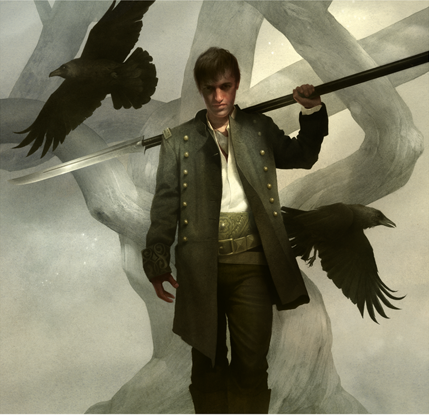
Wheel of Time 06: Lord of Chaos by Robert Jordan

There comes a point, in a thousand page book, where one is just overwhelmed with information. I mentioned this back in The Great Hunt, but the book is so dense that you look at the dwindling number of pages towards the back of the book and think, This can’t possibly be enough to hold all the stuff I remember happening. And yet it does. The storytelling here is solid, and while there may be a lot of fat to trim, the climactic scenes are usually very well paced and keep you hanging on the whole way through.

So, what happens in this book?

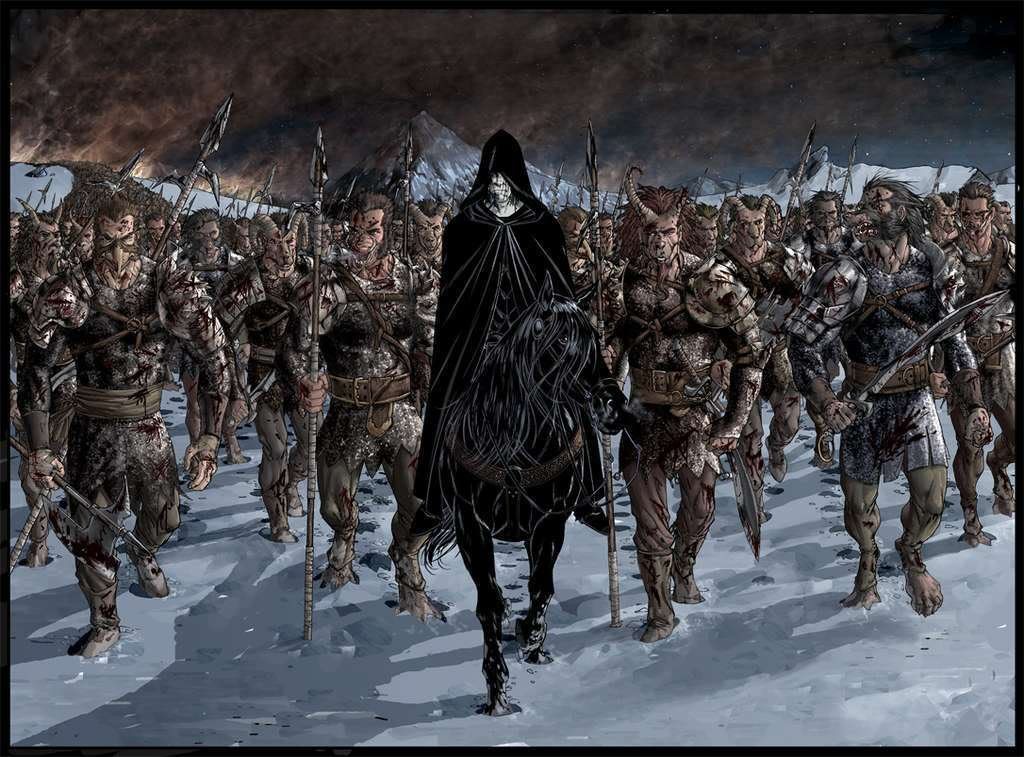
A fair summary of the Aes Sedai Civil War.

As we begin, the rebel Aes Sedai in the tiny village of Salidar are waiting to know what to do. This isn’t something that one would normally say of Aes Sedai, but they are uncertain. The White Tower is the Aes Sedai family, and to think of it splitting down the middle is just as bad as seeing your own family crack in two – you would do anything to save it. While the Salidar Aes Sedai certainly want to stand up against Elaida and her barely legal takeover of the Tower, they also want their family to be whole again. It is becoming increasingly clear, however, that reconciliation is not to be, and so they prepare to take the radical step of naming an Amyrlin Seat of their own. Once that is done, the Tower will truly be split, but perhaps they can bring Elaida to justice in the end.

Rand al’Thor is trying to hold together the lands he’s conquered – Tear, Cairhein and Andor – and prevent them from collapsing into chaos. There are bands of violent looters who call themselves “Dragonsworn,” following their mad prophet and razing all that stands in their path. The Shaido, a clan of Aiel who refuse to accept Rand as their Chief of Chiefs, continues to dog Rand and his allies, and are an ever-present threat. He has Aes Sedai from both the White Tower and Salidar calling on him, each trying to convince him that they are the only ones who are worth allying with. And in Illian, the Forsaken Sammael waits, his greatest ambition being to crush Rand al’Thor and stand at the right hand of the Dark One when his time comes ’round at last.

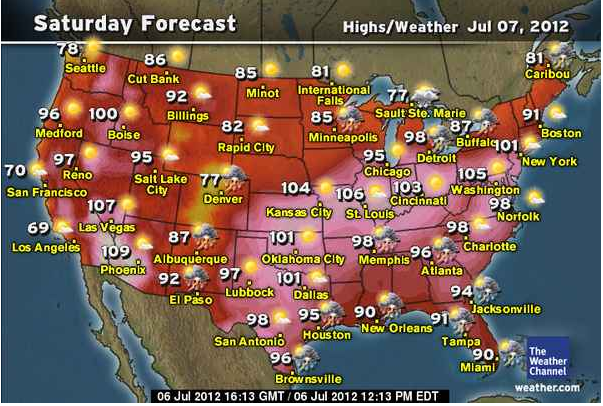
Not unlike summer 2012 in the US. Hmmm…

All over the continent, the weather has gone into perpetual summer – lands are drying up, farms are dying, as the hand of the Dark One touches the world. Elayne and Nynaeve believe they know where they can find an object that will bring the weather back to normal, but they must first get out of Salidar. Once they do that, they have the violent streets of Ebou Dar to contend with. Egwene is with the Aiel Dreamwalkers, learning how to manage the World of Dreams, not prepared for the magnitude of what awaits her with the rebel Aes Sedai in Salidar. Mat, now the leader of his own army, finds himself guarding Elayne and Nynaeve, much to his own dismay.

All around them, the world falls into chaos, and everything that Rand has done is poised to be undone.

As I said, it’s a dense book, and the changes that occur from the first page to the thousandth are pretty serious. But even though all that, my interest was held and I was entertained, not the least because the characters entertained me from beginning to end.

One of the fun tricks that Jordan uses to great effect, in this book and elsewhere, is conflicting viewpoints. In the last review, I talked about how, for some readers, the profusion of point-of-view characters made the book harder to get into (and at my count, this book has 44 POV characters in it). One advantage to that kind of writing, however, is that we get to examine events and situations through the eyes of different characters, which is often informative and always entertaining.

Poor Rand al’Thor…

Take Rand, for example. He’s an interesting character in that while has has to juggle so many different large-scale problems at once (and he’s generally pretty good at it), he’s hopeless on the individual level. In once scene, for example, Egwene comes to visit Rand. She’s determined to talk to him about the Wise Ones’ manipulation of him, but gets sidetracked into the topic of the Salidar Aes Sedai. Realizing that Rand’s nature as a ta’veren (a person whose mere presence can influence chance and fate) is about to cause her to tell him everything, she opens herself to saidar, the female half of the True Source, as a means of self-control.

Rand can sense this, and believes that she is afraid of him, calling on saidar as preparation for some kind of attack. He’s disappointed in her, of course, but this just further cements his distrust of Aes Sedai and deepens his disappointment that he can no longer trust someone with whom he had grown up. He believes that Egwene approached him in order to involve him in the Wise Ones’ plans and to stand against his own plan to give the thrones of Cairhein and Andor to Elayne.

“At least you didn’t let her see you were tired,” he tells himself after she leaves.

Egwene’s first thought upon seeing him? “He looked so tired.”

Obliviousness is a character trait that is always entertaining.

Two people see the same situation from radically different points of view, and it is their inability to reconcile these points of view that cause conflict. Storytelling 101, but done to great effect in these books. There’s another, far funnier scene later on, when Mat finally gets to Salidar and has a humorous misunderstanding as to exactly what Egwene is doing there. Like so many other characters, he’s absolutely sure he knows what’s going on, only to discover that the reality of the situation is nothing like what he expected. The characters’ willingness to make assumptions, unwillingness to say what they’re really thinking, and inability to accurately know what will happen next are a constant throughout these books, and makes them all the more human.

It is these differences of perspective – often leavened with characters who are wonderfully un-self-aware (Rand, Mat, and Nynaeve are my favorite examples) – that makes the Cast of Thousands worthwhile. For all the benefits of a single-POV book or series, there’s always more story that could be told by shifting into the head of another character. What kind of story would Harry Potter have been if we could have watched events unfold through Ron and Hermione’s eyes as well? Longer, that’s for sure, but perhaps it would have been even better.

Milton, the lowly clerk in the basement of the Stone of Tear…

Would I want The Wheel of Time pared down to just Rand al’Thor’s point of view? Not on your life. Not just because Rand is one of the less well-developed characters in the series, but I would miss the others. I would miss being in the funhouse-mirror mind of Elaida do Avriny a’Roihan, or the scary thoughts of the Forsaken. I would miss knowing how Mat feels about finding himself a general, or Perrin becoming the lord of his homeland. I would miss Perrin’s conversations with the wolves (“We come” just gave me shivers. It’s in chapter 54, check it out.) I would regret losing even the minor POV characters – Sulin trying to figure out how to keep Rand safe, whether he wanted it or not. Faile working to make sure her husband becomes all that he should become. Pedron Niall and his visions of a world saved by his Whitecloaks.

While the vast crowd of characters can be overwhelming, it creates a rich world in which I can easily lose myself. Which is exactly what a good book is supposed to accomplish.

—————————————————-
The lions sing and the hills take flight.
The moon by day, and the sun by night.
Blind woman, deaf man, jackdaw fool.
Let the Lord of Chaos rule.
– Children’s chant of the Fourth Age
—————————————————-

Robert Jordan at Wikipedia
Robert Jordan at Tor.com
Lord of Chaos at Wikipedia
Wheel of Time at Wikipedia
Lord of Chaos at Amazon.com

Wheel of Time discussion and resources (spoilers galore):
Theoryland
Dragonmount
The Wheel of Time Re-read at Tor.com
The Wheel of Time FAQ
Wheel of Time at TVTropes.com

Leave a comment

Filed under adventure, epic fantasy, fantasy, good and evil, Robert Jordan, Wheel of Time, wizardry

Review 189: Men at Arms

Men at Arms by Terry Pratchett

When last we left our intrepid Ankh-Morpork Night Watch, things were looking up. This is a nice change from the gutter’s-eye-view we had at the beginning of Guards! Guards!. Things have changed in the time between books. The Watch has a new headquarters, much nicer than its old one, thanks to Lady Sibyl Ramkin, the fiance of Captain Sam Vimes. She comes from an ancient and respectable family, has more money than anyone else in the city, and loves Vimes despite his deep-seated curmudgeonliness, if that is a word.

What’s more, the Watch is taking on new recruits, as ordered by the Patrician. Ankh-Morpork is a city with a very diverse population, and the Patrician believes that the Watch should reflect that diversity. Now we have a Watch open to anyone – trolls, dwarfs, the undead, apes, women – who wants to join, or who doesn’t want to get their heads beaten in. Carrot Ironfoundersson has become a beloved figure in the city – he knows everyone and everyone knows him. All in all, things are looking up.

But there are those who are of a mind that things would be better if only Ankh-Morpork had a king….

Of course, some kings only make things nightmarishly worse…

This is a recurring theme in the early Watch books – the irrational need for royalty. Although, that’s not entirely accurate. Pratchett is a British writer, of course, and he’s got the Queen to look up to, but she doesn’t have all that much real power. Certain people in Ankh-Morpork are looking for a sovereign – not to wave at them and make a Hogswatch speech, but to actually take over their city. They hope, in their hearts, that a king will solve everything. In that way, this recurring theme is not so much about royalty versus populism, but rather the ability to control one’s own life versus allowing someone else to control it for you. The idea that one has responsibility for one’s own actions and well-being is dominant in the Guards books, no more so than in this one.

There is a man named Edward d’Eath, and he has a vision. He is the last of an aristocratic line whose power has declined in this age of guilds and merchants. He looks to the past and sees it as better, brighter than the future. He knows that, if he can just do one little thing, Ankh-Morpork – and he – will be restored to glory. That one little thing, of course, is to put a king on the throne.

Not just any king, of course. The fools who thought to use a dragon to set up a puppet king showed how ineffectual that would be. No, this would only work with a real king, a descendant of the ancient kings of Ankh-Morpork. Find him, put him on the throne, and everything will finally be set straight.

I like to imagine it looks like this.

Of course, that doesn’t work out nearly as well as Edward hopes. He steals a mysterious artifact to set his plan in motion – the Gonne. It is a weapon created by one of the most brilliant minds on the Disc, a man kept peacefully imprisoned by Ankh-Morpork’s Patrician. It is a device that should have been destroyed, but was instead put on display so that the Assassins, the bringers of death, could look at it and say “Beware this thing.”

Like I said, this book is all about making choices in life. Vimes is engaged to be married to Sybil Ramkin, and thus his days as the Captain of the Watch are numbered. He may be in a better position than he was in the last book – having someone try to kill you is always refreshing, after all – but he knows that the life he’s giving up, with all of its pain and trouble and heartache, is the life that he needs to live.

Corporal Carrot needs to choose how best to serve the city of Ankh-Morpork. He is an excellent policeman, probably the only man on the Disc who could get in the middle of an incipient troll/dwarf race riot and shame them out of killing each other. People do what he says – he is, in his own words, “good at being obeyed.” If he wanted to, he could run the city and the city would be glad to let him do it. But is that the best thing for the city?

How could you not trust a chin like that? (art by Simon Lissaman)

The troll Detritus and the dwarf Cuddy both have choices – will they conform to the ancient animosity that stands between their two races, or will they overcome it for the common good?

And then there’s the Gonne itself. As a weapon, it is frighteningly powerful – much more so than the standard-issue crossbow – and as a firearm, however primitive, it represents a vast escalation in the way violence is done. What’s more, since this is a fantasy novel, the Gonne has something of a mind of its own. Its wielders hear it talking to them, convincing them that the only thing standing between them and what they want are a few simple deaths – something the Gonne can easily provide. It even uses the old NRA saw verbatim – Gonnes don’t kill people. People kill people.

But people have a choice, perhaps more of a choice than the characters of these books do. The Gonne controls them, the trigger practically pulls itself, and when you’re holding it, you can easily understand how a simple shot, one simple thing, could change the world. For the better, of course – always for the better.

Pratchett’s views on guns and their efficacy aside, it’s a very gripping book. There’s the mystery of it, of course – who has the Gonne, and why are they using it – but it’s also a story about characters and the choices they make for themselves. My absolute favorites in this are Detritus and Cuddy. Trolls and dwarfs have a famous antagonism, stretching back to the ancient battle of Koom Valley (the only battle in the multiverse where both sides ambushed each other) and it would be very easy for them to fall into simple, culturally conditioned roles.

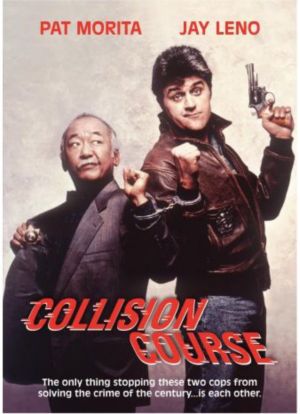
They’re better buddy cops than you’ll likely to see in the movies, anyway.

While it may be a cliche to say that they found common ground, learned to look past their own prejudices and learned to respect – nay, to like one another, that’s exactly what they did. It is due to Pratchett’s skill as a writer and as a creator of characters that we come to deeply care for this relationship, investing a lot of hope in it. We know that if Cuddy and Detritus can become friends, then maybe there’s hope for everyone. This emotional investment pays off, and Pratchett reaches deep into our hearts at the end, showing that just because you start with a cliche, it doesn’t mean it can’t have depth.

Of course, if you’re not quite as analytical as I am, you can still enjoy it as a good murder mystery. Watching Vimes and company piece together the crime is always fun, because there’s always a twist somewhere that you never saw coming. And Vimes really is one of my favorite Discworld characters – he’s cynical and world-weary, but he still has enough idealism within him to carry him through those times that look like they’re trying to kill him.

All in all, a great book and one that’s highly recommended. The earlier Discworld books are largely stand-alone, so if you’ve never read any of the series before, don’t worry – you can pick this one up and you won’t really miss anything. You may, however, find yourself driving back to the bookstore to get as many other Discworld books as you can. I’m just saying….

—————————————————
Generally, I meet people before they’re buried. The ones I meet after they’ve been buried tend to be a bit over-excited and disinclined to discuss things.
– Death, Men at Arms
—————————————————

Terry Pratchett on Wikipedia
Men at Arms on Wikipedia
Men at Arms on Amazon.com
Terry Pratchett’s homepage

Leave a comment

Filed under choices, death, detective fiction, Discworld, fantasy, friendship, guns, humor, murder, mystery, police, revolution, society, Terry Pratchett

Review 188: The Immortal Life of Henrietta Lacks

The Immortal Life of Henrietta Lacks by Rebecca Skloot

Henrietta Lacks has probably saved your life. If not yours, then almost certainly that of someone you know.

And you don’t even know who she is.

Or, rather, who she was. The original Henrietta Lacks was an African-American woman who lived near Baltimore, grew up in poverty, worked hard, and died in 1951, overcome by a cancer that started in her cervix and spread out to take over her whole body. She left behind five children, a husband, and a legacy that would forever change our understanding of biology and medicine.

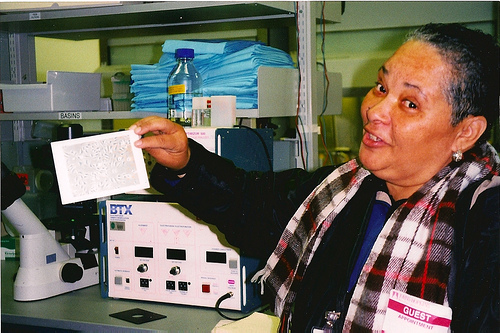
This picture is required to be inserted into any discussion of Henrietta Lacks, for good reason.

When she first went to Johns Hopkins Medical Center and was diagnosed with cancer, her doctor took a small sample of cells from the tumor and sent it to his colleague, George Gey. Gey had long been in the pursuit of what seemed like an impossible dream: to culture human cells and keep them alive in the lab. By doing so, he hoped to create new ways to test medicine and study human biology without all those pesky patients getting in the way. Unfortunately, his work had thus far been a failure. Human cells, no matter how hard he tried, simply would not survive outside the body for very long. Gey tried all kinds of media and methods, inventing some machines that have become invaluable to cell culture research, but he simply watched culture after culture die in the lab.

All of that changed when he got HeLa.

The cells from Henrietta Lacks, which were known as “HeLa,” not only didn’t die – they thrived. They were so robust that Gey and his staff soon had more HeLa cells than they could keep, much less use, so they started sending them off to any researcher who asked. With HeLa, researchers around the world began to make discoveries that would save lives and change the world.

But with this ever-growing cell line – which was baked, boiled, frozen, irradiated, cloned, cut up, and sent into space – it was very easy to forget that there was once a woman named Henrietta Lacks, with a family and a legacy of her own.

Plenty has been written about HeLa in the last fifty years, and any researcher who works with cells is probably well aware of its existence and importance. But very few people know about Henrietta, and it was this oversight that Rebecca Skloot is trying to correct in this book.

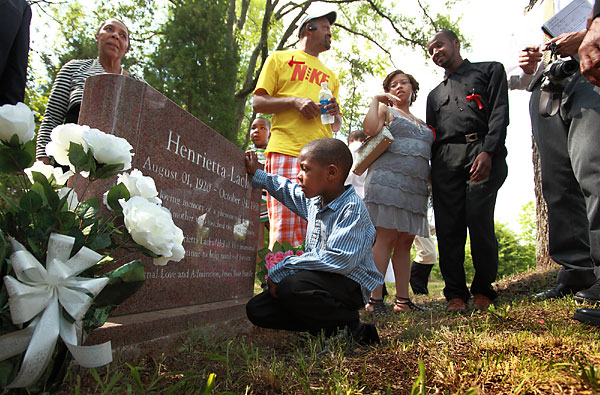
Henrietta finally gets a gravestone

She began her quest with a simple question: “Who was Henrietta Lacks?” The fact that she got the right name was surprising enough, actually. HeLa had previously been identified as Henrietta Lakes, Helen Lane, and Helen Larson in various publications. Skloot believed that there was more to the story than just a bunch of immortal cells, and was determined to find Henrietta’s surviving relatives and learn more about this woman who had somehow become so important to the world.

Skloot wouldn’t be the first, however. A writer for Rolling Stone, a con man, and the BBC had all attempted to look into the life of Henrietta before, and found that the surviving Lackses were not only unaware of what their mother had become, but largely unaware of why it was important.

The children and grandchildren of Henrietta Lacks had grown up in the Baltimore area, mired in the poverty of being black in the end of the twentieth century. Drug abuse, alcoholism, and a lack of education meant that their lives were full of hardship and struggle, and not likely to get any better. When they found out that Henrietta’s cells were not only unique to science but being sold all around the world, this was news that they weren’t all prepared to cope with. Some saw it as a religious visitation, others as a massive conspiracy, and still others as just a way to make money off some poor black folk from the city.

Deborah Lacks

The center of Skloot’s narrative is Deborah, Henrietta’s youngest daughter and the one Lacks who seemed most determined to find out what had happened. Deborah wanted so hard to find out what had happened to her mother that it almost killed her. The stress of not knowing – or, even worse, knowing but not understanding – took a heavy toll on her physical and mental health, and she was reluctant to talk to anyone at all about her mother. But it was Deborah that Rebecca had to convince if she was going to write this book, and in order to do that, she had to promise that the book would be about the woman Henrietta was, not just the cells she was famous for.

That’s probably what makes this book as readable and engaging as it is. While the science is handled well and smoothly, it’s not nearly as fascinating or emotionally gripping as the stories that she tells about the Lacks family. She shows us a family that is held together by the strength of their faith in their God and each other, and who are desperately trying to understand their place in the world and how Henrietta came to be what she was.

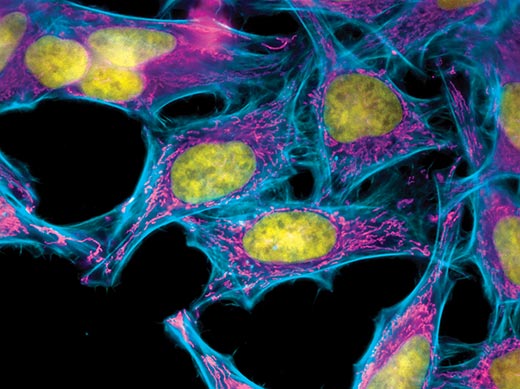
HeLa cells, as seen stained under a microscope

When the original cells were taken from Henrietta, it was done without her consent. She also had no say in what happened to those cells and how they were used, nor did any of her family find out the truth until years later. In an era long before the phrase “informed consent” was even coined, the medical establishment made massive scientific and financial gains, and in the meantime the Lacks were mired in poverty. As several of her children note, Henrietta has changed medicine forever, but her children can’t go see a doctor.

The struggle to understand must have been enormous. One of the moments that was most surprising and illuminating to me was when Henrietta’s son Zakariyya asked Rebecca, “What’s a cell?”

Just like Rebecca, I had to take a moment to absorb that question, and it put into sharp perspective the vast assumptions that I had made, coming from a well-educated white background. I thought that everyone at least knew what a cell was, but that assumption couldn’t have been further from the truth. Deborah and her family are people of minimal formal education who are trying to understand a topic that people study for their entire lives. Their dedication to this quest is so strong, and the struggle is so great that their attempt is nothing less than heroic, to my way of seeing things.

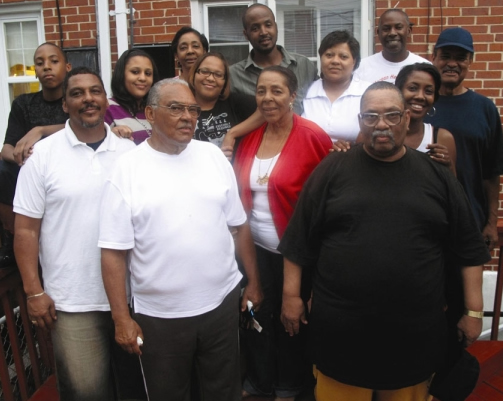
The Lacks Family

The story is still unfinished. HeLa is still out there, making news and causing trouble. The Lacks family is still living in poverty, although the new generation has been able to go to school and are aiming at a brighter future for themselves. And while patients’ rights to control what is done with their bodies and their tissues is improving, the law is still on the side of the doctors and hospitals. Medical ethics is a lot better than it was, but the fight is fierce, especially when there’s money involved.

This book is not just the story of cells or of science. It’s the story of a woman and her family, and how sometimes people get lost in the inexorable movement of scientific progress. Some parts are infuriating, some are heartbreaking, but the book is an illumination into what is sometimes sacrificed in pursuit of a better world.

—–
“When I saw those toenails, I nearly fainted. I thought, Oh jeez, she’s a real person. I started imagining her sitting in her bathroom painting those toenails, and it hit me for the first time that those cells we’d been working with all this time and sending all over the world, they came from a live woman. I’d never thought of it that way.”
– Mary Kubicek, assistant to George Gey

Rebecca Skloot on Wikipedia
Henrietta Lacks on Wikipedia
The Immortal Life of Henrietta Lacks on Wikipedia
The Immortal Life of Henrietta Lacks on Amazon.com
The Henrietta Lacks Foundation website
The Lacks Family website
Rebecca Skloot homepage

Leave a comment

Filed under biology, disease, family, nonfiction, quest, Rebecca Skloot, science

Review 187: The Physics of Superheroes

The Physics of Super-Heroes by James Kakalios

Comics have always had a rough relationship with science. Many comics had their roots in science fiction, so it cannot be said that science is entirely missing from comic books. It’s just that, occasionally, science gets in the way of a good character or a good story. When that happens, one of them has to go. Since comics are a medium for storytelling, it’s easy to guess which one loses out.

As long as you can suspend your disbelief, the egregious abuse of science in comics can be overlooked. Things that we know to be impossible are not only forgiven when reading comics (and many other forms of fiction, be they movies, TV or books) it is truly necessary. I mean, that’s the whole point of fiction – to show us a world that isn’t our own.

And a lot of those nitpickers were overjoyed at this sequence. (World’s Finest #4, 2012)

Still, for the nitpickers, there’s plenty to object to in comics. Gross violations of the square/cube law, impossible particles, anatomical impossibilities, causality problems – you name it. It’s very easy to look at the use of science in comics and point out what they’re doing wrong.

So why has James Kakalios gone to so much trouble to point out what comics get right?

Two reasons, really – he loves comic books and he loves teaching physics. And he found (much to his pleasure, I’d imagine) that he could do both at the same time, using comic book examples to boost the interest of his students, making it the kind of physics class I would have loved to have taken.

In this book, Kakalios gives us a basic physics course in a few brief sittings, starting with the Newtonian Classics and working his way up to quantum physics. By using the popular superheroes of the day, he gives us a way of thinking about physics that is not only interesting, but also makes sense.

We’re right there with you, Kyle. (JLA #19, 1998)

For example, he uses good old f=ma (with a few extra bits of math thrown in here and there) to determine exactly how fast Superman (back in his Golden Age, pre-flight incarnation) was going when he leapt over buildings in a single bound. He looks at The Flash and how he might use quantum tunneling to go through walls, as well as why running on water would not only be possible, but at the speeds the Flash reaches, absolutely necessary. And of course, the Atom gets a lot of page space when it comes time to look at the world of the incredibly small, and the quantum rules that govern it.

Could Spider-Man’s webbing really allow him to swing like that, and why was Gwen Stacy’s death one of the best uses of physics in a comic? How are Iceman and Storm’s powers related, and how do Magneto’s powers really work? Did Krypton have a core of neutron star material? Does Conservation of Energy apply to the Flash, and how does the technology work to make Iron Man’s suit possible?

Two things make this book much more entertaining than The Science of Superheroes. The first is that it focuses solely on science, instead of trying to split its attention between the science, the characters and the history of the comic book industry. This is a real science book, despite the presentations – there are formulas in here, and it does sag a bit in places (especially the quantum physics part, but he does warn us about that).

The Hulk’s pants are a HUGE miracle exception. And I want the number of his tailor.

But that’s okay, because Kakalios isn’t out to debunk these heroes, and that’s the other reason why this book is good. He grants them a “miracle exception” that allows them their powers, and then asks, “Okay, assuming Ant-Man can shrink down to six inches, would he still be able to do what he does?” And then he goes on to show how the hero can (or can’t) do what he’s supposed to be able to do.

One of the biggest problems in science education is keeping students interested. Your average high school (and college) physics class will go on about weights and levers and inclined planes, presenting the laws of the universe in a fairly abstract (and dull) fashion. Like many students, I found myself thinking, “When will I ever actually use any of this?” For most students, the answer is Never. Same goes for a lot of what’s taught in high school – it may broaden your mind, but it’s likely to be impractical knowledge.

But knowledge doesn’t have to be practical to be worthwhile. Knowing how the universe works, what its laws and restrictions are, may not help you in your day-to-day life, but it makes you into a better citizen of the universe. It imbues the physical world with some semblance of rationality, an assurance that while we may not always like what the world throws at us, there is at least a reason for why things happen the way they do. There is consistency, there is order, and in a mixed up, topsy-turvy world like ours, that’s nice to know.

Even my disbelief will only suspend so high, GRANT MORRISON. (Action Comics #12, 2012)

What’s more, this book helps do what I always try to do – bring legitimacy to superhero comics. Even in this day and age, it’s very easy to look at Superman and Spider-Man and the Fantastic Four and say, “That’s just kids’ stuff.” It’s not. Okay, yes, the stories tend towards the simple; they’re flashy and bright and often espouse rather basic moral schemes. But they can be examined in many lights beyond that of simple entertainment, and reveal a wealth of information and understanding about the world in which we live.

———————————-
“If a twisted, evil maniac like the Green Goblin can learn physics, then there’s hope for us all.”
– James Kakalios, The Physics of Superheroes
———————————-

James Kakalios on Wikipedia
The Physics of Superheroes on Wikipedia
The Physics of Superheroes on Amazon.com
James Kakalios’ homepage

Leave a comment

Filed under comic books, education, James Kakalios, science, super-heroes, supervillains

Review 186: Supergods

Supergods by Grant Morrison

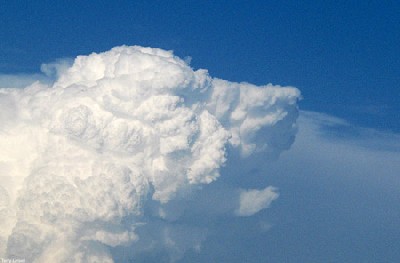
There is this interesting mental phenomenon, which you have probably experienced, called paradoelia. Briefly put, it is when our brains find a pattern where there is no pattern, making us believe that we see something that just isn’t there. It’s why every now and then, someone sees Jesus in a water stain in their basement. Or there’s a cloud that looks almost exactly like a dragon. Or when you wake up at four in the morning, and you’re squinting against the light and the toilet looks like a face and it’s laughing at you STOP LAUGHING AT ME!

Um. Right.

Humans are meaning-seekers. Whether it’s a song or a painting or a piece of toast, we want to find meaning everywhere we can. We are experts at it, world-champions, even when there is no meaning to be found.

ATREYYYUUUU!!!

When we turn these marvelous pattern-seeking brains towards places where there is meaning, well, that’s where things get interesting. Grant Morrison is a master pattern-seeker, which is probably what has helped him become one of the most interesting and important writers of the modern age. His area of interest is not philosophy, however, or literature or world affairs. He does not dissect the works of great masters of classical art or intricate mathematicians. Grant Morrison’s passion is something that many people believe they should give up by the time they leave their teens.

He loves superheroes.

That’s probably the only real point of overlap between me and Morrison, which is a pity because he seems like someone with whom it would be awesome to hang out. In the nearly seventy years since the dawn of the superhero, very few people have done as much thinking about them as Morrison has, nor have they followed the complex interrelationship between the superheroes and the world that brought them to life. Supergods attempts to answer a question that seems simple, but turns out to be mind-bendingly complicated: what do superheroes mean?

Yeah, I can see it…

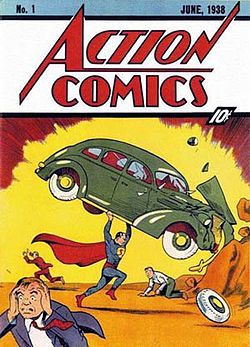
He starts where it all began, with Action Comics #1 in 1938 and the debut of Superman. He spends several pages discussing the iconic cover alone – from its composition to the promises it makes to the reader – and uses that as a guide to all that will come after. The cover “looked like a cave painting waiting to be discovered on a subway wall ten thousand years from now – a powerful, at once futuristic and primitive image of a hunter killing a rogue car.”

Superman, who began his career as a protector of the people against the corrupt and the powerful, would be joined by Batman, who prowled the night looked to avenge a crime that could never be avenged. Together, they embodied the hopes and fears of their readers. They spoke to our nobility and our need to see that justice was done. They spoke to that haunting voice that told us that some things can never be made right. They were us, writ larger than life and yet printed on pulp paper and sold for a dime.

Together, Batman and Superman formed a template that nearly every other superhero would either conform to or react against. Over the next seventy years, superheroes would undergo massive changes – become light and dark, be parodies of the real world and terrible reflections of it. They would be funny, they would be grim. They would explore uncountable hyper-realities that were normally confined to the acid dreams of mystics, and they would face the most mundane and everyday problems that bedevil the man on the street.

Over the course of the book, Morrison looks at the history of superhero comics, charting their changes and mutations and looking for the underlying meaning behind each new iteration of the art. He tracks it from its pulp and populist origins, through the wartime years when the People’s Heroes suddenly became agents of propaganda, the age of the Comics Code, which forced writers to go to more and more ridiculous lengths to come up with stories, and the era of the realistic, where the heroes tried to cope with the problems of the readers’ world.

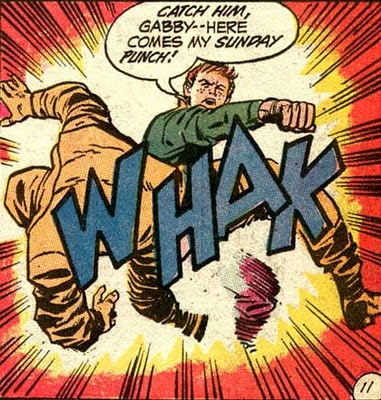
Don’t get punched by a Kirby character if you can help it, no matter what day it is.

He looks at the iconic moments in superhero publishing, such as the explosion of creativity brought about by Stan Lee and Jack Kirby at Marvel Comics, the editorial guidance of visionaries like Julius Schwartz, who sought to make comics a tool of education, and the masterstrokes of creators such as Alan Moore and Frank Miller, whose singular contributions to the genre are still reverberating clearly today.

Interlaced through all of this is Morrison’s own history, both as a reader and a creator of superhero comics. Much like the superheroes that he loves, Morrison gives us his secret origin as a young reader of comics, moving into a creative adolescence that found him searching for his own identity as both a creator and as a person. Like many of his heroes, he changed costumes and modes, went for a grittier, punk look for a little while, and proceeded to reinvent himself as one might reinvent a half-forgotten character from a title that was cancelled years ago.

As the history of superheroes intersects with his, the narrative becomes less a creative examination of how comics have evolved and more a story about how he evolved with comics. Not only did he become the equivalent of a rock star comic book writer, he managed to reach across the boundary between comic books and real life, crossing from one to another as one of the world’s first fictionauts.

The less said about what Deadpool means for us, the better.

It’s hard to overstate how much thinking Morrison has done on this topic, or how far he is willing to go to defend the heroes that he has not only grown up with but who have made his fortune for him. He sees superheroes not as a pleasant diversion or a corrupting force or as an unnecessary fantasy, but rather as in imperishable idea. They are a meme, a reflection of ourselves – both who we think we are and who we wish to be. Over the decades, Superman and Batman and Spider-Man and the X-Men and all of their costumed comrades have raised generations of readers and instilled in them some of the highest values to which we aspire. Despite being derided, dismissed, and very nearly outlawed, there has been something about the superheroes that has called out to us, and we cannot help but respond.

In an age where fiction and reality are nearly interchangeable, and where the imagination can produce something real in almost no time at all, perhaps it’s time to stop thinking about the superheroes as entertainment for nerds and children. Perhaps it’s time to see what the heroes have to teach all of us.

—–
“Superhero science has taught me this: Entire universes fit comfortably inside our skulls. Not just one or two but endless universes can be packed into that dark, wet, and bony hollow without breaking it open from the inside. The space in our heads will stretch to accommodate them all. The real doorway to the fifth dimension was always right here. Inside. That infinite interior space contains all the divine, the alien, and the unworldly we’ll ever need.”
– Grant Morrison, Supergods

Grant Morrison on Wikipedia
Supergods on Amazon.com
Grant Morrison’s homepage

2 Comments

Filed under autobiography, comic books, culture, DC Comics, Grant Morrison, identity, Marvel Comics, media, memoir, nonfiction, super-heroes, supervillains, writing

Review 185: The Fires of Heaven (Wheel of Time 05)

Wheel of Time 05: The Fires of Heaven by Robert Jordan

One of the criticisms often laid at the feet of this series – and not unfairly – is that it is splintered.

Read any epic fantasy, and you’ll see that at some point, the author splits the party up. This is an almost guaranteed way to create more action, more storylines and, if you’re being paid per word, more money for the author. Tolkien, the grandfather of modern fantasy, did a nice job of splitting the Fellowship up into three branches at one time, and then brought them back together at the end. Since then, the technique has been a stock tool of any writer who is dealing with an ensemble cast in her work.

This pretty accurately describes the plot structure from here on out…

Jordan has taken this technique to its extreme. He used the standard method back in The Eye of the World – split the group into three, bring them all back together just in time for the climactic ending. Pretty boilerplate plot construction right there. From The Great Hunt, however, we began to see that having all of our main characters in one place at one time will be more the exception than the rule – while it starts and ends with everyone together, the beginning of The Dragon Rebornstarts us off with the party split again, bringing them all together only at the very last minute.

By my count, there are eighteen different point-of-view characters in this book, occupying four different major plot threads, only two of which actually manage to come together by the end. And it just gets more complicated from here on out. From my research, there is yet to be any point in the series where every plot thread manages to come together in one place at one time.

For some readers, this is supremely annoying, and I can’t say I blame them. You find yourself going back and forth from character to character, keeping up with storylines that are superficially unrelated, all in the hopes that they’ll pay off eventually. The circus interlude in this book is an excellent example. In an attempt to hide from the Forsaken Moghedein (whom Nynaeve seriously pissed off in the last book) and to get safe passage to the rebel Aes Sedai after the breaking of the White Tower, Elayne, Nynaeve, Thom and Juilin find themselves traveling with a circus. The logic behind this is that no one would ever look for them there, and I suppose they’d be right. I certainly didn’t see it coming.

I’m not sure why this never caught on as a dominant fantasy trope.

There’s a lot of good old-fashioned circus wackiness that goes on – Elayne puts on tights (which just scandalizeNynaeve) and learns to walk a tightrope. Nynaeve ends up being the target for Thom’s knife throwing and battles her own distaste at the skimpy clothes she has to wear versus the fact that she thinks they look pretty. Now I’m not saying that nothing important happens during the circus interlude – lots of things do. It’s just that there’s no reason they had to take place in a circus.

And there’s no reason they couldn’t, either. After all, who’s the multiple-bestselling author, Jordan or me?

As opposed to a single POV series, such as Harry Potter, where you know where the important action is and who it’s happening to, Wheel of Time requires its readers to observe a world of characters. And I think that’s the key to how these books are structured. The events that are happening here aren’t just happening to one small group of people, or one kingdom. It’s happening to the entire world, from the edge of the Aiel Waste all the way to the shores of the Aryth Ocean, from Seanchan to Shara. Rand al’Thor may be the Dragon Reborn (or the Car’a’carn or the Cooramoor, depending on whom you talk to), but that doesn’t mean he’s the only one who has things to do. In order for the Last Battle to be won, a whole lot of things have to happen, and not all of them are going to be centered around our main protagonist.

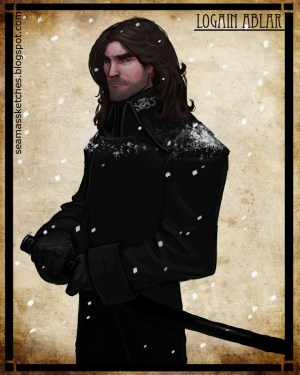
I’d hang out with this guy, no question… (art by Seamus Gallagher)

In this book, for example, we have two groups looking for the Aes Sedai who fled the White Tower when Elaida became Amyrlin (I hope you’ve been keeping up, otherwise that last sentence makes no sense whatsoever). Siuan Sanche and Leane Sharif, the former Amyrlin and her Keeper, are traveling with Min (a young girl who can tell the future from people’s auras) and Logain (a former False Dragon whose ability to channel was severed by the Aes Sedai.) And then there is Elayne and Nynaeve, who were both out of the Tower when the rebellion took place, but who hate Elaida more than Siuan, so they’re trying to find the rebels. These two plot threads eventually merge, but it takes fifty chapters before that happens.

At the same time, there’s Rand, Mat and Egwene, who are leaving the Aiel Waste for Cairhein, hot on the trail of the Shaido Aiel, who are murdering and pillaging everything they can find. The Shaido are a “rebel” clan, who refuse to accept Rand as the Car’a’carn (the Aiel’s Chief of Chiefs) and have decided that the best thing for them to do is to kill everyone who isn’t an Aiel. Rand and friends chase the Shaido all the way to Cairhein, where they engage in a fierce battle to save the city from being ravaged by war for the third time in twenty years. Even within this plot thread, Mat, Rand and Egwene occupy their own strands, staying apart more often than they get together.

The fourth plot thread is a thin one – Queen Morgase of Andor, who has been gulled into complacency by the Forsaken Rahvin (who is posing as “Lord Gaebril,” the queen’s lover) has finally come to her senses, and escapes from her own castle. She doesn’t know where she’s going, or who will help her, but she’s intent on regaining her throne and seeing Gaebril hang. Lucky for her, Rand manages to take care of her little Forsaken problem by the end, although she’s unaware of this.

Meanwhile, the whole world is falling apart. The White Tower has well and truly split, something that the new Amyrlin, Elaida, is desperately trying to keep from the world. There is war and strife across half the continent, men who believe that the existence of the Dragon Reborn means that all bonds are broken, all social contracts annulled. The Prophet Masema – a man from the northern nation of Shienar – is preaching absolute devotion to Rand al’Thor as not only the Dragon Reborn, but as the source of all that is good. The coming of the Dragon brings not only a great battle with the Shadow, but great upheavals in civilization itself.

No, no – Wait! Don’t go! It gets better!

So, to say “there’s a lot going on in these books” is a bit of an understatement, and it’s Jordan’s fondness for creating new plot threads and then following them to see where they lead that has probably led to this series going on as long as it has. Had he just centered on Rand, it all could have been over in half the time. But it would have been far less interesting in the long run.

The characters of this world are fond of using a certain metaphor to describe life – the Great Tapestry. “The Wheel weaves as the Wheel wills,” they like to say, and they believe that each person’s life is a figurative thread in a greater system. Some characters, like Rand, Mat and Perrin, are more important than others, and they tend to bend other threads to follow theirs. But you cannot make a tapestry out of only three threads, and the end of the world in this series is something in which everyone may participate. Without the actions of the myriad minor characters, Rand wouldn’t be able to be the person he needs to be, and the story wouldn’t be able to be as rich and as complex as it needs to be.

So, give this some thought. If you’re the type of reader who prefers to stick with one character or group of characters throughout a series; if you don’t like having to keep notes on who is doing what and where; if you’re not the kind of person who would create a spreadsheet to note all of the different major characters, with color-coding and hand-drawn graphs…. Not that I have, mind you…. If that’s not your kind of read, then you may not enjoy this series. And there’s nothing wrong with that. But it’s good to know what you’re getting into.

——————————————————–
“It would be easier if this was a story.”
– Rand
——————————————————–

Robert Jordan at Wikipedia
Robert Jordan at Tor.com
The Fires of Heaven at Wikipedia
Wheel of Time at Wikipedia
The Fires of Heaven at Amazon.com

Wheel of Time discussion and resources (spoilers galore):
Theoryland
Dragonmount
The Wheel of Time Re-read at Tor.com
The Wheel of Time FAQ
Wheel of Time at TVTropes.com

1 Comment

Filed under adventure, death, epic fantasy, fantasy, good and evil, identity, madness, military, quest, Robert Jordan, survival, travel, Wheel of Time, wizardry, women

Review 184: Ender’s Shadow

Ender’s Shadow by Orson Scott Card

This book made me wish I could forget that I had ever read Ender’s Game.

Not because it was necessarily a better book – though it is longer – but because the two books offer different views of the same events from two distinctly different perspectives.

Ender Wiggin is brilliant and empathetic, a boy torn apart by his own doubts and fears and driven to greatness by a government that sees him simply as a means to an end. It is only his ability to understand and come to love those around him that gets him through his trials, endure his isolation, and which ultimately allows him to put together the team that defeats the Buggers. Ender seems to be more human than human, and not in that ironic Blade Runner sort of way, but in a way which makes us want to see him succeed and do well.

Bean, on the other hand, is about as different from Ender as it’s possible to get. He’s introduced in Ender’s Game as a foil, a character designed to show us how far Ender had come in the short time that he had been in Battle School. When we meet Bean, Ender is using the same techniques of isolation and constructive abuse that were used on him, making us wonder if Ender will turn out to be just a copy of the adults who were tormenting him. We learn that Bean, like Ender, is brilliant, but he is also strong-willed and ambitious and takes well to the atmosphere of Battle School. In the end, Bean shows himself to be a vital part of the team that Ender assembles to stop the Buggers and cement humanity’s place in the cosmos.

Ender’s story is all about empathy and self-understanding and his desire to be the person he wants to be, rather than the person humanity needs him to be. He has to give up some of his essential humanity in order to save the world.

Bean’s story comes from the opposite direction. More brilliant than Ender, Bean learns to find his humanity. He has to learn to see people as people, rather than a means to an end or a puzzle to solve. The hard lessons that he learned on the streets of Rotterdam as a small child were vital in preparing him to become a commander, but they have to be put aside if he’s to become a human.

Bean’s story is much bigger in scope than Ender’s, which gives the book as a whole more depth than Ender’s Game. We start out in Rotterdam, which has become a center of poverty and violence among rival gangs of street children. Bean, tiny and starving, manages to prove his worth to one of these gangs by suggesting strategies by which they can get more food and more respect. He gains the attention of Sister Carlotta, a nun who is working for both God and the International Fleet, and she is the first to see his full potential as a student in Battle School. But in the course of trying to understand Bean, she learns that his origin is one of horror, and that his future is even worse.

As a character, I liked Bean more than I liked Ender, possibly because on a scale of Complete Misanthrope to Bodhisattva, Bean and I are pretty close to the complete misanthrope end of the spectrum. To be fair, though, Bean has a lot more reasons to feel that way, and he’s a lot worse than I am. As we meet him, Bean views people as means to an end or as problems to be solved. He doesn’t reform the street gang culture of Rotterdam because it’s the right thing to do – he does it because he needs to eat. When he does experience attachment or fondness for others, he doesn’t know how to deal with it, and turns it into just another problem to be solved.

That hyper-analytical way of looking at the world makes Bean a much more aware character than Ender as well. While Ender spends most of his book wrapped inside his own head, Bean is constantly testing the world, analyzing it and trying to figure out what’s really going on. So while Ender was exploring the computer fantasy game, Bean was crawling through air ducts in the Battle School. While Ender was researching the battles of the past, Bean was learning how to spy on his teachers.

In the end, just as Ender is learning to put aside his humanity for the common good, Bean discovers a deep well of compassion that he never knew he had. Ender becomes more isolated, and Bean becomes more connected to others. The two characters come at each other from different directions and view the world in vastly different ways, giving us a kind of parallax view of the same events, to use Card’s preferred terminology.

Most interestingly, many of the revelations that were revealed to Ender in his book were discovered by Bean in this one, which creates a whole different reading experience.

And that’s why I wish I could delete my memory of having read Ender’s Game,, or at least put it away for a while. Reading this book, I constantly compare what’s happening to Bean with what happened to Ender, looking for those scenes that are shared between the books and others that we only get to see once. Whether it’s the early days of Battle School or Ender’s fight with Bonzo Madrid or the climactic end, there are enough similarities and differences to make each book worth reading.

But at the same time, I want to read each one for the first time, without knowing what’s going to happen next. I want to share Bean’s ability to see plans unspool before him without already knowing what those plans are. And then I want to read Ender’s Game the way I read Ender’s Shadow and have those wonderful moments of revelation as new light is shed on topics that were only briefly mentioned before – like Locke and Demosthenes, or the true fate of Mazer Rackham.

Card has done a difficult job very well in this book, and I can’t imagine it was easy at all. As he noted in his forward, a dozen years passed between the first book and this one, and a person changes in that much time. He learned new things and gained new perspectives, and that naturally had a great influence on how he chose to write this story.

And then there’s the enormous popularity of his other Ender books. Between Game and Shadow, he wrote Speaker for the Dead in 1986, Xenocide in 1991, and Children of the Mind in 1996. That means he had a much more solid understanding of his world by the time he got around to Ender’s Shadow in 1999, and a much larger fan base as well. Writers will always say that they write for the story, not for the fans, but every writer wants in their heart of hearts to have people love what they write. Revisiting your most famous work and exploring a popular character brings great risks with it.

Fortunately, I think Card succeeded with this book. It both compliments and contrasts with Ender’s Game, offering enough new information and new viewpoints to merit a second novel, while being faithful to the story that fans had come to love over a decade and a half. What’s more, it feels like the work of a more experienced writer. The scale is larger, the characters have more depth, and he takes more chances with the story than he did with Ender’s Game.

All in all, if you were a fan of the first, you’ll like this one. If you haven’t read either, you really should. And if you start with this one, let me know how it goes.

—————————-
“Ender was what Bean only wished to be — the kind of person on whom you could put all your hopes, who could carry all your fears, and he would not let you down, would not betray you. I want to be the kind of boy you are, thought Bean. But I don’t want to go through what you’ve been through to get there.”

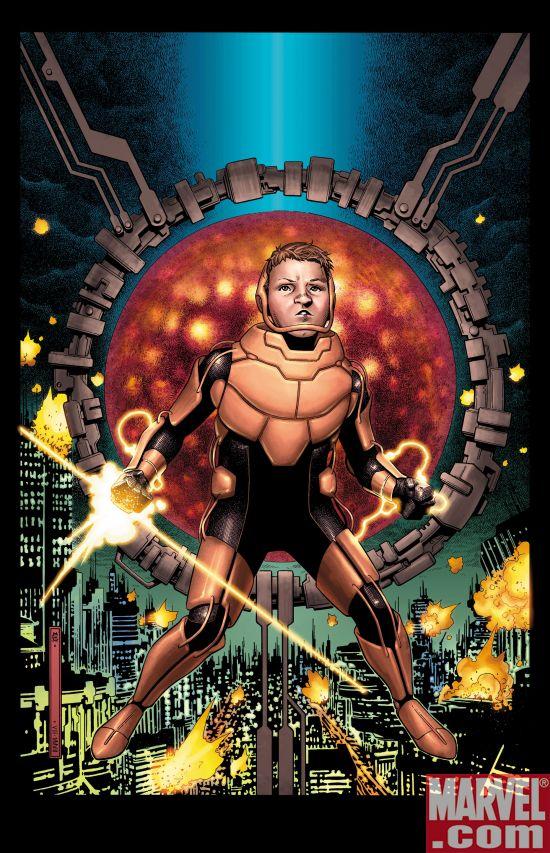
All images are from Marvel Comics.

Ender’s Shadow on Wikipedia
Orson Scott Card on Wikipedia
Ender’s Shadow on Amazon.com

2 Comments

Filed under adventure, aliens, coming of age, identity, military, Orson Scott Card, science fiction, space travel, teenagers, war, young adult

Review 183: Habibi

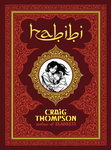
Habibi by Craig Thompson

Here’s the thing about comics, and it’s an unfortunate thing: when you tell people that you read comics, the first thing they’re likely to think about is superheroes. You can’t really blame them, seeing as how superhero comics make up so much of what’s being printed these days, nor can you blame them for thinking that superhero comics are kind of lowbrow entertainment. A lot of it is, but that shouldn’t be surprising when you’re looking at a profit-driven entertainment industry that works on a tight deadline every month. I have a co-worker who can’t believe that I, a man of thirty-[COUGHCOUGH] still reads comics, because her vision of what comic books are and what they can do is stuck in that mode that says, “Comics are for kids.”

There are some superhero comics that exceed our expectations, of course, and show emotionally-charged, well-written stories with deep and interesting characters, masterful writing, and a keen insight into human nature and behavior. They’re more often exceptions than the rule, of course, and if you want the really good stuff then you have to go beyond the monthlies and the Big Two. You need to look at the work of someone who is working not so much because he has an editor or a company that’s directing his work, but because he has a story to tell.

Enter Craig Thompson and Habibi

It’s hard to encapsulate this book in a single sentence, much less a concise review. I can either go on for far too long or find myself lost for words and not say enough. I will say, however, that the moment I laid eyes on it I would say the word that probably best sums up the experience of reading this book: Wow.

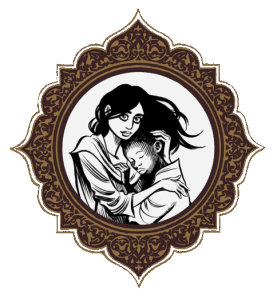
The story takes place in a semi-fictional Middle East, the land of Wanatolia, and it begins the way all comics begin – with a drop of ink and the flow of words. We are introduced to Dodola, a girl of nine at the start of the book, who is married off to a wealthy scribe. Through her, we are introduced to this strange and exotic world and the dangers it holds. She ends up living on a boat in the desert with a young boy named Zam, and together they survive in a world all their own. He finds water and she finds food, and they fall asleep to stories every night.

This continues until Dodala is taken by travelers, leaving Zam to fend for himself. While she is made into a concubine for the rich and powerful Sultan, Zam is looking for her among the poor and the dispossessed of Wanatolia. Over the years, their paths diverge terribly, until good fortune brings them together again, neither of them the same as they were, but at least finally able to be together as adults who have loved each other for a very long time.

In large parts, this is a story about boundaries and borders. For one thing, Wanatolia is a place that seems to straddle ancient and modern, fantastical and real. While we have girls sold into sexual slavery, camel-driven caravans and a sultan in an extravagant palace – harem included – we also have automobiles and motorcycles, garbage-clogged waterways, and a great dam that blocks the river and provides electricity. It’s hard to hold the two truths of this place in your mind, because they’re so completely opposite. Even when they appear in the same panel, it’s still hard to believe they’re the same world.

The last part of the book straddles the boundaries between the developed and developing worlds. Wanatolia has a great river that’s been dammed, and is a city-state that is growing fat on oil money. There are great skyscrapers and modern condos, but they’re built alongside astonishing poverty and filth-clogged waterways. The great and mighty live a scant distance away from people who proudly hunt for garbage in order to stay alive. It’s horrifying to look at, but at the same time you know that places like this are not unknown in our world.

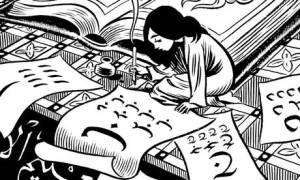
It’s about the boundaries between the mystical and the mundane. Early on in the story, Dodala gives Zam a talisman to wear around his neck. It’s a piece of paper folded into nine squares, on which are written nine Arabic letters. Together, they represent a magic square, and rest on the foundations of the Koran. With this talisman, Zam will be protected from the demons and the djinn – as he goes outside to pee.

The Koran, of course, is hugely important to the story, and Thompson tells some of the most iconic and important stories that feature not only in the holy book of Islam, but in the Torah and the Bible as well. Dodala tells Zam about Abraham and his sacrifices, about Job and his plagues, about Noah and his ark, and about Solomon and his riddles, and those tales go on to inform the larger story. They also tell of cleverness and sacrifice and submission to a God that can barely be understood by such people as they.

It’s about the boundaries between men and women as well. For a while, Dodola and Zam live very comfortably on their desert boat together, seeing as how he’s a boy and she’s a young woman. She treats him more like a son or a little brother than anything else, and it’s adorable. But as he ventures into his teens, their relationship becomes a lot more complicated and confused. Zam’s emergent sexuality provides him with nothing but trouble, and even when he and Dodola are no longer together, she has a great effect on how he views himself as a sexual being.

And of course, there is the Sultan and his harem, which has plenty to say about the man-woman divide. The Sultan is both the master of and a slave to his women, constantly looking for novelty and entertainment from them and constantly being disappointed. In Dodola, he sees not only a woman who can pleasure his flesh, but who can engage his spirit. Alas, he turns out to be just as terrible to her as we might expect from a Sultan, and all of her feminine wiles nearly lead to her death.

That does get us to one point of criticism: while Dodola and Zam are interesting, deep, and complex characters, they are pretty much the only ones. The others – from the Sultan to the trash-fisher – are fairly flat and seem to have been created by an Arab Character Generator. Mind you, the number of authentic Middle Eastern communities I have been to could probably be counted on the fingers of a snake, so I’m really in no position to make many judgments on this. But if I were writing a story and needed an Arab character as either an antagonist or a background character, I might have made some of the ones that are in this book.

There’s nothing inherently wrong with that kind of writing, really. After all, the story isn’t about them – it’s about Dodloa and Zam. They are the two who need to be well-rounded and interesting. But it does open the door to discussions of racism in Thompson’s storytelling. Did he make the Sultan a power-mad misogynist because that’s who the character is, or is it because of Thompson’s own ethnocentric biases? Is Wanatolia full of calligraphers and robed assassins and street vendors with camels because Thompson wanted to instill a feeling of unease in the reader, not being able to reconcile the true nature of the kingdom, or is that his preconceived notion of what life in the Middle East must be like? How much of what he’s included is realistic and how much is assumption?

I have no idea. As I said, my knowledge of the Middle East is frightfully deficient, so I certainly don’t feel like I’m in a position to judge. What’s more, my knowledge of who Thompson is as a person and as a writer is informed pretty much by this book. I have no other way of knowing how susceptible he is to his own biases or how much he tries to subvert his own preconceptions. I will leave that up to people who are better situated than me to do.

What I do know, however, is that he did a ton of research to make this book, and it shows primarily in the art and the stories that are told as the book progresses.

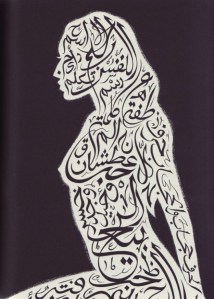
The art is, in a word, stunning. It is full of intricate, byzantine calligraphy, mathematically precise and almost obsessively detailed. Every page is full of brilliantly planned drawings, and where the pages are blank, they call attention to their blankness and to those things that are being left undrawn. There were so many places in the book where I just stopped reading for a while so that I could just look at it and admire the time and the planning that must have gone into drawing something of this scope. The art alone is worth spending a day or two admiring.

It’s a deep and complicated book that rewards multiple reads. The more you know about the story, the more you find out when you read it again, and if you get tired then you can just admire the artwork for a good long while. The work that Thompson has produced here is nothing short of monumental.

On top of that, it’ll look really pretty on your bookshelf.

———-
“If all the trees on Earth were made into pens, and the ocean supplied the ink, augmented by seven more oceans, the words of God would not run out.”
– Koran, 31:27

All illustrations by Craig Thompson

Habibi on Wikipedia
Craig Thompson on Wikipedia
Habibi on Amazon.com
The Habibi homepage
Craig Thompson’s homepage

Leave a comment

Filed under alternate history, art, Craig Thompson, fantasy, friendship, gender, graphic novel, identity, Islam, religion, sexuality

Review 182: One Hundred Years of Solitude

One Hundred Years of Solitude by Gabriel Garcia Marquez

Huh? Oh. Oh, man. Wow.

I just had the weirdest dream.

There was this little town, right? And everybody had, like, the same two names. And there was this guy who lived under a tree and a lady who ate dirt and some other guy who just made little gold fishes all the time. And sometimes it rained and sometimes it didn’t, and… and there were fire ants everywhere, and some girl got carried off into the sky by her laundry…

Wow. That was messed up.

I need some coffee.

That was roughly how I felt after reading this book. This is really the only time I’ve ever read a book and thought, “You know, this book would be awesome if I were stoned.” And I don’t even know if being stoned works on books that way.

Gabriel Garcia Marquez (which is such a fun name to say) is one of those Writers You Should Read. You know the type – they’re the ones that everyone claims to have read, but no one really has. The ones you put in your online dating profile so that people will think you’re smarter than you really are. You get some kind of intellectual bonus points or something, the kind of highbrow cachet that you just don’t get from reading someone like Stephen King or Clive Barker.

Marquez was one of the first writers to use “magical realism,” a style of fantasy wherein the fantastic and the unbelievable are treated as everyday occurrences. While I’m sure it contributed to the modern genre of urban fantasy – which also mixes the fantastic with the real – magical realism doesn’t really go out of its way to point out the weirdness and the bizarrity. These things just happen. A girl floats off into the sky, a man lives far longer than he should, and these things are mentioned in passing as though they were perfectly normal.

This is not a recommended way to read this book. That’s not to say it doesn’t work…

In this case, Colonel Aureliano Buendia has seventeen illegitimate sons, all named Aureliano, by seventeen different women, and they all come to his house on the same day. Remedios the Beauty is a girl so beautiful that men just waste away in front of her, but she doesn’t even notice. The twins Aureliano Segundo and Jose Arcadio Segundo may have, in fact, switched identities when they were children, but no one knows for sure – not even them. In the small town of Macondo, weird things happen all the time, and nobody really notices. Or if they do notice that, for example, the town’s patriarch has been living for the last twenty years tied to a chestnut tree, nobody thinks anything is at all unusual about it.

This, of course, is a great example of Dream Logic – the weird seems normal to a dreamer, and you have no reason to question anything that’s happening around you. Or if you do notice that something is wrong, but no one else seems to be worried about it, then you try to pretend like coming to work dressed only in a pair of spangly stripper briefs and a cowboy hat is perfectly normal.

I’m not saying this happens in the book, but I’m not claiming it COULDN’T.

Another element of dreaminess that pervades this book is that there’s really no story here, at least not in the way that we have come to expect. Reading this book is kind of like a really weird game of The Sims – it’s about a family that keeps getting bigger and bigger, and something happens to everybody. So, the narrator moves around from one character to another, giving them their moment for a little while, and then it moves on to someone else, very smoothly and without much fanfare. There’s very little dialogue, so the story can shift very easily, and it often does.

Each character has their story to tell, but you’re not allowed to linger for very long on any one of them before Garcia shows you what’s happening to someone else. The result is one long, continuous narrative about this large and ultimately doomed family, wherein the Buendia family itself is the main character, and the actual family members are secondary to that.

Colonel Aureliano Buendía could have made his fish from ice and saved a lot of time…

It was certainly an interesting reading experience, but it took a while to get through. I actually kept falling asleep as I read it, which is unusual for me. But perhaps that’s what Garcia would have wanted to happen. By reading his book, I slipped off into that non-world of dreams and illusions, where the fantastic is commonplace and ice is something your father takes you to discover.

——
“[Arcadio] imposed obligatory military service for men over eighteen, declared to be public property any animals walking the streets after six in the evening, and made men who were overage wear red armbands. He sequestered Father Nicanor in the parish house under pain of execution and prohibited him from saying mass or ringing the bells unless it was for a Liberal victory. In order that no one would doubt the severity of his aims, he ordered a firing squad organized in the square and had it shoot a scarecrow. At first no one took him seriously.”
One Hundred Years of Solitude by Gabriel Garcia Marquez
——

Gabriel García Márquez on Wikipedia
One Hundred Years of Solitude on Wikipedia
One Hundred Years of Solitude on Amazon.com

3 Comments

Filed under family, Gabriel Garcia Marquez, magical realism

Review 181: The Shadow Rising (Wheel of Time 04)

Wheel of Time 04: The Shadow Rising

This one is all about history.

One of the things that makes the world of Wheel of Time so attractive is that it is clear from the outset that Robert Jordan put a lot of work into the world of his story before he actually started the story itself. I get the feeling, reading these books, that he could tell you everything that happened here for the last four thousand years, if not more. In detail, with names and dates and places, all off the top of his head. Or at least from his copious sheafs of notes.

Your name is a killing word? Kinda hard to say your name with an arrow in your throat… (art by Jeremy Saliba)

In this book, the emphasis on history is most clear when Rand goes out to meet the Aiel. For those of you with a taste for classic sci-fi, the Aiel resemble the Fremen from Frank Herbert’s Dune books. They’re desert people, and unsurpassed warriors, with a complex system of honor and obligation. There’s where the similarities end, of course – in these books there is no Spice, there are no sandworms, and no one in this would would ever think they could conquer the Aiel. Twenty years prior to the start of the series, four of the twelve Aiel clans crossed the mountainous barrier into the “wetlands” with the singular purpose of killing King Laman of Cairhien. Those four clans alone broke every army that stood against them, and only returned to their desert because they got what they wanted – Laman’s head on a pike.

No one knew why they had done this. Prior to the Aiel War, the nation of Cairhien had exclusive rights of passage through the waste, a gift that they didn’t understand, and ultimately didn’t fully appreciate. But without those rights, and without the offense that King Laman caused, and without the Aiel retaliation, this story never would have begun.

Reading this book, you start to get a better view of the historical context in which it is placed, and nowhere is that clearer than in Rand al’Thor’s trip into Rhuidean, the forbidden city of the Aiel. Any man who wants to become a clan chief, or any woman who wants to become a Wise One, may go there, but only once and twice, respectively. What they learn is their final test – the true history of their people. Those who cannot face the truth do not come back. Stronger men and women go on to become leaders, but never speak of what they saw. In order to fulfill his destiny, Rand must learn the history of the people he was born from, and by doing so, change the world.

It’s a fascinating sequence, actually – it’s the history of the Aiel from the day the hole was bored into the Dark One’s prison, through fifteen generations of the Aiel as refugees until the establishment of the city of Rhuidean itself, only told backwards. We find out why they never touch swords, why they veil their faces, and why they believe they are punished for sinning against the Aes Sedai. We get to see the incredible changes that occurred in only three or four hundred years, and then reflect that the time span we see only covers a small portion of the time that has elapsed since the Breaking of the World. We truly begin to understand how broken the world was and how hard life became, once we compare the hardened warrior Aiel to their Da’shain Aiel ancestors. It’s a fascinating and moving story, and it serves as an excellent centerpiece to the novel.

He’s not all fun and laughs.

History rests in other places as well through the book. Mat gains the memories of two thousand years, in a surprising exchange with otherworldly entities in a land beyond a twisted red doorway. We learn that the Sea Folk are looking for their Chosen One, just like everyone else, and Elayne and Nynaeve are pretty sure it’s Rand. They’re off to Tanchico to look for an artifact that could prove Rand’s undoing if the Black Ajah or the Forsaken get their hands on it first.

In fact, speaking of history, there has been a lot of speculation over the years on how the world of this book is related to our world. There are clues scattered about that suggest it is our extreme future – fairy tales about Anla, the Wise Counselor, Materese, Mother of the Wondrous Ind, and Lenn who rode to the moon in the belly of a fiery eagle (who could be Ann Landers, Mother Theresa and John Glenn, respectively). Jordan never came right out and said whether this is our world’s future or not, but a short passage in this book dropped a pretty big hint. While looking around a palace in Tanchico for the artifact that could harm Rand, Nynaeve travels the Dream World into a museum of antiquities. There, she sees many things that amaze and baffle her – fossils of extinct animals, for example often with some kind of emotional resonance. In her search, she finds this:

A silvery thing in another cabinet, like a three-pointed star inside a circle, was made of no substance she knew; it was softer than metal, scratched and gouged, yet even older than any of the ancient bones. From ten paces, she could sense pride and vanity.

If that ain’t a Mercedes-Benz hood ornament, I’ll eat my library.

Over in the White Tower, history is being made as Siuan Sanche becomes only the third Amyrlin Seat in history to be deposed in a move orchestrated by the hardest of the Red Ajah, Elaida a’Roihan. And all around, the shadow is indeed rising – the Forsaken are out there, building their power and waiting for Rand so that they might defeat him before he battles their master, the Dark One.

But the best part of the book, in my opinion, is none of these. The best part centers around Perrin Aybara, the young blacksmith who was one of the original three young men to travel out of the Two Rivers on that spring night long ago.

Hi. We’re the forces of evil, pleased to meet you. Nice village you have here…

Back in The Great Hunt, the vile Darkfriend Padan Fain challenged Rand to meet him – failure to do so would result in pain and suffering brought down on all those whom he loved. Through circumstances not entirely under his control, Rand never got to meet Fain, though he did manage to cause him great inconvenience nonetheless. Fain meant to keep his promise, though, and in this book that promise is realized. The Two Rivers has been under siege by creatures from the Shadow – Trollocs and Myrddraal – and less Dark, though still not very nice Children of the Light, an army of zealots who sees Darkfriends in everyplace they look. Rand can’t go home to help – his destiny lies in the Aiel Waste – and Mat’s destiny lies with Rand. Egwene has to go to the Waste as well, to learn Dreamwalking from the Wise Ones, and Nynaeve is off to Tanchico to hunt the Black Ajah.

That leaves only Perrin, who goes back to his home to find it a very different place. He and Faile, the Hunter for the Horn whom he loves, along with Loial and three Aiel, travel back to the Two Rivers and Emond’s Field to put paid to the Trollocs and see that the people there are safe. In the process, Perrin the blacksmith’s apprentice finds himself becoming far more than he ever thought he would be.

This sequence is one of my favorites in the series thus far, and I’m including all the books that come after this one. It’s written with such depth of character, and the relationship between Perrin and Faile is built with such care that every scene between them resonates with emotion and meaning. In one book, Jordan has taken a character who had been the least interesting of all the protagonists, and made him into the one you care the most about. It’s not for nothing that Jordan gave Perrin an entire book off in The Fires of Heaven.

No matter which era we’re looking at, no one will be as creepy as Padan Fain. (art by Seamus Gallagher)

The historical insight we have gained here will help us along through the rest of the series, as we take a broader look at the world as it is in the present. Every character, not just Perrin, is changed and moved forward, if not always in likable ways, and we get the real sense that a new history is being made right now. We know that stories will be told of Perrin Goldeneyes for generations to come in the Two Rivers, that Elayne and Nynaeve will become legends among Aes Sedai, though whether as heroes or object lessons we can’t be sure yet, and that the fate of the future rests not on Rand’s back alone. He makes the Aiel face their past, and those who can survive the ordeal will be the shapers of the future.

The thousand or so pages of this volume can drag, if you’re not paying attention to what’s going on. The history of Rhuidean is a good example – the first time I read it, I was really confused and didn’t really see the point of the whole thing – I wished it had focused less on the post-Breaking history and more on the Age of Legends, with its jo-cars and hoverflies, the Nym and the Ogier and the Da’shain Aiel working together. But once you give it thought – why it was vital that the clan chiefs and Wise Ones remember, and how the events of nearly three thousand years ago directly led to the birth of Rand al’Thor and the very story we are reading, it goes from being a slog to an adventure.

Still, I recommend taking notes.

—————————————————-
“Rand al’Thor may be lucky if the next Age remembers his name correctly.”
– Thom Merrilin
—————————————————-

Robert Jordan at Wikipedia
Robert Jordan at Tor.com
The Shadow Rising at Wikipedia
Wheel of Time at Wikipedia
The Shadow Rising at Amazon.com

Wheel of Time discussion and resources (spoilers galore):
Theoryland
Dragonmount
The Wheel of Time Re-read at Tor.com
The Wheel of Time FAQ
Wheel of Time at TVTropes.com

1 Comment

Filed under adventure, epic fantasy, fantasy, good and evil, history, quest, Robert Jordan, war, Wheel of Time