Category Archives: philosophy

Lost in the Stacks 3: Women in Fiction

This week, Scott Adams handed the internet a firebomb and then complained when it went off. In a blog post (deleted from his blog, but kindly reprinted here), he compared women asking for equal pay to children asking for candy. It roused the ire of the ‘net’s feminist population – rightly so – but his reaction of, “You’re just not smart enough to get it” was the icing on the cake.

Yes, ma'am....

But some good did come out of it – I started thinking about female characters in fiction. What difficulties do writers have in creating female characters, and why? How can we go about making sure that more writers do a better job at writing women?

It was an interesting topic to talk about, and I’m sure I made some mistakes or omitted some important details somewhere. After all, from my testiculated point of view, I’m bound to overlook something, so give the show a listen, drop me a comment and let me know!

Some links of interest:

Comics Alliance – ‘Dilbert’ Creator Scott Adams Compares Women Asking for Equal Pay to Children Demanding Candy
Feministe – Scott Adams’ alleged response to criticism
OverthinkingIt.com – The Female Character Flowchart
OverthinkingIt.com – Why Strong Female Characters are Bad for Women
Feminist Frequency – The Bechdel Test for Women in Movies
The Bechdel Test Movie List

2 Comments

Filed under analysis, fantasy, fiction, gender roles, Lost in the Stacks, science fiction, Scott Adams, women, writing

Review 114: The Ghost Brigades

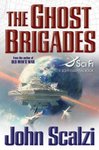
The Ghost Brigades by John Scalzi

The book that preceded this one was Old Man’s War. It was Scalzi’s first novel and I loved it. It had everything – high-end science fiction, philosophy, cool battle scenes and a protagonist whose sense of humor reminded me a lot of many of my friends. The book’s premise was very simple – why do we use young people to fight in wars? Because they have the bodies that work best for the task – strong, fast and generally resilient. But young people can also be rash, impulsive and generally ignorant of a whole lot of life’s complexity. If their physical capabilities were not an issue, then who would we want? Why, old people, of course. They have the life experience, the patience and the perspective to be better soldiers.

No.

So, it’s The Future. Mankind has spread out among the stars, and the Colonial Union is the political organization that keeps them together. Any government needs a military, so the Colonial forces make sure they have the best recruits, all brought from Earth. With some pretty high-tech jiggery-pokery, the senior citizens from Earth’s richer nations are made into lean, green fighting machines, capable of performing in ways that make the Marines of our day look like palsey victims. Their minds are transferred from their old, decrepit bodies and put into new ones, grown from their own DNA, but altered to make them better soldiers. It’s all very exciting and cool, but at some point, I suppose Scalzi asked himself a question: what happens when someone signs up at age 65, but doesn’t make it to age 75 when they’re supposed to start their service?

NO!

Well, we have all this DNA just sitting there, right? We can’t let it go to waste, can we?

That brings us to the Ghost Brigades, the rather morbid nickname for the Colonial Union’s Special Forces. Their bodies are grown from DNA whose previous owners have expired, and are modded in more extreme ways than the regular defense force soldiers. Then, when the body is ready, they’re woken up. An amazing piece of biotechnology called, rather whimsically, a BrainPal prepares their brains for consciousness, acting as a kind of bootstrap for the emergent personality. It tells them what they’re supposed to know, so they don’t have to go through the tedious process of learning it all. And, of course, much more. The Special Forces do what the regular Defense Forces can’t, and act in ways that their more “ordinary” soldiers couldn’t understand. In Old Man’s War the Special Forces only came in at the end. In this book, as you might have guessed, they play a much more central role.

I'll show them! I'LL SHOW THEM ALL!!!

Charles Boutin is a traitor to humanity. For reasons known only to him, he has sold out the Colonial Union to its enemies, a troika of alien species that would be more than willing to wipe us off the map. The Defense Forces would love to find him, of course, but he’s hidden himself among the enemy. So they got the next best thing: a copy of his own mind that Boutin had made while researching the BrainPal.

In theory, it should work: put this mental backup copy into a “clean slate,” a body that has no mind of its own. A Special Forces body.

And so, Jared Dirac was born. Decanted. Whatever. It was hoped that when he opened his eyes, he would be Charles Boutin in a new body, and could promptly be interrogated. But it isn’t that easy. Jared Dirac is a normal Special Forces soldier, a blank slate who is ready to do the job he was, literally, born to do: keep humanity safe.

Art by Vincent Chong

He’s sent off to training, with the expectation that he would be just another Special Forces soldier. But he is, of course, much more than that. As his brain matures, the memories and personality of Charles Boutin come with them, and Dirac starts to understand more of what made the man turn traitor to his own species. This information could lead the Defense Forces to their ultimate goal, or to their destruction….

It’s a great book. Tons of fun, although the exposition is a bit heavy-handed in the beginning. There’s a whole lot of reminding about what you learned in Old Man’s War, and I didn’t really need it. That’s the thing about recap, though: if you avoid it altogether, you can confuse people who haven’t picked up the previous book in a while. Slather it on and you bore the people who have good enough memories.

Once you get past that, though, it’s straight on fun, with some pretty serious questions folded into it. One of the major questions raised in this book is that of identity – who is Jared Dirac? How can a being who is brought to full consciousness by an implanted computer be properly called “human?” It’s clear that he is, but a fuller look at the Special Forces – especially the squad known as the Gamerans – really does push the definition of “human” to its limits.

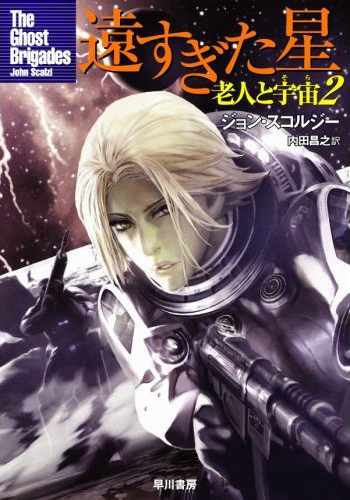
The Japanese cover to Ghost Brigades

It’s a very thoughtful book in many places, exploring the grey areas of not only humanity and “human-ness,” but also of the role of humanity among the stars. Explaining his reason for turning traitor, Boutin asks us to consider the entire purpose of government itself – how it operates, how much power it has and how much it should trust its citizenry. He fundamentally disagrees with how the Colonial Union goes about its business, and will do whatever he has to in order to set it on what he believes is the right path. And in the middle of all this is Jared Dirac, who has to actually start making choices in his life – something that Special Forces soldiers were never bred to do.

As with Old Man’s War, this is a great book to read, and I look forward to the other books set in that universe. You should too.

———————————————-
“We don’t mind when the other guy brings a gun to a knife fight. It just makes it easier for us to cut out his heart. Or whatever it is that he uses to pump blood.”
Lieutenant Jane Sagan, The Ghost Brigades

The Ghost Brigades on Wikipedia
John Scalzi on Wikipedia
The Ghost Brigades on Amazon.com
John Scalzi’s Blog

Leave a comment

Filed under adventure, aliens, ethics, existentialism, fiction, friendship, identity, John Scalzi, military, morality, philosophy, science fiction, technology, transhumanism, truth, war

Review 112: Ender’s Game

Ender’s Game by Orson Scott Card

A little while after I started teaching literature, I thought about what kinds of books I’d like to do with students in the years to come. The texts I did last year – Fahrenheit 451, Things Fall Apart and a collection of Edgar Allan Poe stories – are all well and good, but probably not what I would have chosen to teach. I wanted something that would speak to the students, that would engage with their lives, and which ideally was some good classic science fiction. So I went over to Ask Metafilter and asked them what science fiction they would recommend teaching to high school students studying English as a foreign language.

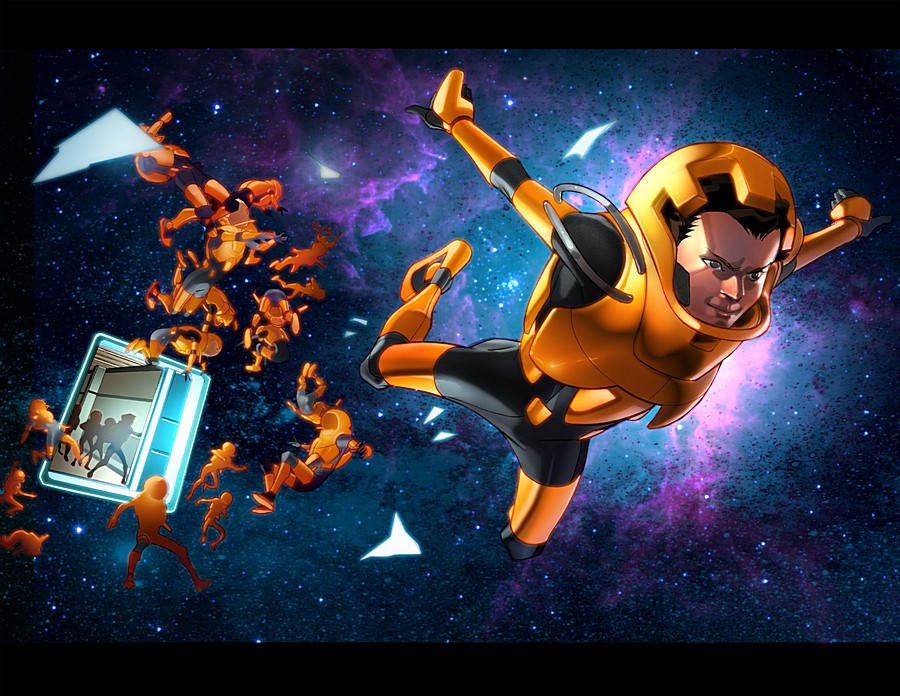
Child soldiers in science fiction are so cute....

Just about everyone mentioned Ender’s Game, and with good reason. It’s a good story, for one, and it addresses a lot of the issues that young people have to deal with that are often left out of the literature they have to read for English class. The adults in the book are like the adults in the students’ lives – slightly removed, seemingly omniscient, and not necessarily acting in their best interests, at least not as they see it. It deals with issues of bullying and isolation, of fitting in and standing out and accepting your place in the grander scheme of things. It’s about critical thinking and moral reflection, all wrapped up in the unending carnival that is youth.

In real life... not so much.

Ender Wiggin is, as our book begins, six years old, and he may be the last, best hope for humanity.

Ender comes from a strange place. In a near-totalitarian America, families are allowed to have only two children, in order to keep the population static. If a good reason exists, however, they might be allowed to have a third. That third is destined from the beginning to have a hard life, no matter what happens, especially if that third has been bred for a very specific reason.

Ender Wiggin is a Third. His parents had two children already – their son, Peter, and daughter, Valentine. Peter is a brilliant young sociopath, and Valentine is an equally brilliant pacifist. In ordinary times, either of them could have been an historical figure, but these were far from ordinary times. Earth is at war with an insectile alien race it has named the Formics (nicknamed “Buggers”), and has survived two invasions. Everyone knows there will be a third, and if they can’t fight it off then humanity will be scythed clean off the planet. The International Fleet needs a commander, one who has enough empathy to understand the enemy, but who also has the killer instinct to be able to wipe them out. Where Peter is too hard and Valentine is too soft, Ender Wiggin could be the one they’re looking for.

Almost makes me want to have my childhood stolen from me....

Young and frightened, Ender is taken off-planet to Battle School, where he and hundreds of other youths will take part in battle games to train them in how best to one day defeat the Buggers. While Ender knows that he’s been chosen, he doesn’t know why, and his experiences in the school lead him to wonder if being a Chosen One is really worth it. In game after game, Ender manages to prove his worth to the International Fleet by defying their expectations of what a battle commander should do. He is pushed to his limits and beyond by the International Fleet, whose motives and methods remain a mystery to him until he has accomplished their goal – one which he never even knew he was aiming for.

It’s a fun book, and a very quick read, and it’s one of those “I should have read this when I was a teenager” books. While I was never put in a position where my action could very possibly save the existence of all humanity, I – like every other teenager ever – had doubts about my place in the world. I saw the conflict between what I wanted for myself and what the adults in my life wanted for me. I was given responsibility that I didn’t want, and had to make a choice about whether or not I would live up to it. In other words, while the scale of Ender’s problems are much bigger than that of the average young person’s, they are essentially the same. I am fortunate in that Ender’s Game can work to explode a pervasive and not entirely accurate belief held by all teenagers everywhere, from the dawn of time until now: the belief that there is no one else in the world who understands what they are going through.

The big question then becomes, How do I teach this? What can I do to not only get my students to read it but to also understand its relationship to their own lives? However I manage to do it, that will hopefully reveal to them the whole point behind reading for pleasure: that you can look at a book or a story and say, “Yes – life is like this.” Not all of it, but you can find that moment, that point of any story that can connect what it is saying to your own life, and thereby learn something from it.

There are also a whole host of other issues that can be brought up with this novel, not the least of which is the systematic indoctrination of young people by their educational system. Perhaps a bit self-defeating, but the anti-authoritarian in me would be vastly entertained if I could somehow encourage these kids to look suspiciously upon the very foundation of the system in which they were currently residing. There is also the greater issues of how a society teaches its children, and the limited value of truth. We tell kids that “honesty is the best policy,” but this book blows that axiom away. If they had told Ender the truth about what he was doing and why, he would have refused, and Earth would likely have been wiped out. In the same way, how do we – adults, and especially teachers – lie to young people in order to achieve a greater goal? What value, then, do these lies have, and are they worth telling?

Even Peter would be helpless against the LOLCats.

We can explore redemption and atonement through Ender’s attempt to make up for the things he has done. Even more interestingly, we can look at Card’s prediction of how the internet would shape political discourse and how citizens can easily be manipulated. Peter and Valentine put on electronic personae through which they gain immense power despite their youth, using their own innate genius to spark debate on the topics that will achieve their own goals.

Outside the text, too, there is an excellent opportunity to discuss the relationship between a work and its author. While Ender’s Game is a brilliant story that is so well-written that it is recommended reading by both Quakers and the U.S. Marine Corps, its author holds some rather despicable views that don’t seem to mesh with the message he has put into his book. I speak here of Card’s public denouncement of gay marriage, including accepting a position on the board of directors of the National Organization for Marriage. This group has made many attempts to block the spread of queer civil rights in the U.S., and it disturbs me that an author whose work I respect is spearheading the effort.

FINE. I didn't want to marry you anyway....

What, then, is my responsibility as a reader? Should I never read his work again, lest it be seen as a show of support for his politics? Can I even read him fairly from now on, or will I always be looking for that anti-gay undercurrent, perhaps where there is none? Or should I simply ignore the author and enjoy the work? There are a great many authors and artists who are in the same position as Card, and it is a worthwhile discussion to have.

There are so many topics to mine from this book that I had to stop myself from time to time and remember to enjoy it, rather than make mental lesson plans.

In any case, if you haven’t read Ender’s Game, I recommend that you do. If you have a young person in your life, see to it that he or she has a chance to read it as well. If you’re really lucky, it’ll foster a lifelong love of reading. If not, at least they might walk away with the understanding that their problems are pretty universal, and that, on the whole, things could be a whole lot worse.

They could be Ender Wiggin.

————————————————————-
“It was just him and me. He fought with honor. If it weren’t for his honor, he and the others would have beaten me together. They might have killed me, then. His sense of honor saved my life. I didn’t fight with honor… I fought to win.”
– Ender Wiggin, Ender’s Game”

Ender’s Game on Wikipedia
Orson Scott Card on Wikipedia
Ender’s Game on Amazon.com

I couldn't NOT put it in....

1 Comment

Filed under brothers, childhood, children, coming of age, ethics, family, friendship, military, morality, Orson Scott Card, science fiction, sisters, teenagers, truth, war, young adult

Review 110: Johnny the Homicidal Manic & SQUEE!

Johnny the Homicidal Maniac and SQUEE’S Big Giant Book of Unspeakable Horrors by Jhonen Vasquez

I’m putting these two together, because they really do form one larger piece – the craft of an artistic mastermind. Although perhaps “mastermind” isn’t the best word to use here. What do you call the person that they lock up when they’re about fifteen because they keep saying things to their teachers like, “The human body has ten thousand miles of blood vessels in it and I can feel my hate for you coursing through every one?” Or the guy who buys a dog, takes care of it, feeds it, loves it, and then one day realizes that the dog has been spying on him for the CIA for years and buries it in his backyard? Or the angry hobo who lurches up to your car as you wait at the stop light, a bucket of dirty, grey water in one hand and a rotten squeegee in the other and proceeds to molest himself with it, afterwards demanding that you gave him change, quote, “For the show.”

You thought I was kidding about the dog....

That kind of guy. What would you call him?

Whatever it is, welcome to the world of Jhonen Vasquez. Strap yourself in.

Johnny the Homicidal Maniac is the story of Johnny C., known to his very few friends simply as Nny. Nny is rail-thin, yet something of a fashion plate, and lives in a broken-down house with two evil Styrofoam doughboys, a dead bunny nailed to a wall, and a gateway to a creature of infinite evil somewhere in one of the many basements of the house.

In his free time, Johnny kills people in horrible and graphically interesting ways.

Not because he’s a bad person, necessarily. He does have the wall to feed, after all – a wall that has to be continually painted with fresh blood, lest the Evil come out of it. But he is, by his own admission, “quite horrendously insane.” He murders for many reasons, the Evil Wall aside. He murders the people who feel superior to others (while at the same time feeling that he is superior to them). The kills the smug and the self-possessed, the materialistic and the bored, the lowbrows and the posers and the jerks who seem to infest every corner of his world. And while he does kill with great glee and abandon, he occasionally takes the time to wonder if what he’s doing is worth it. If murder is all that his life has become. If maybe it would be better off to just end it all and kill himself.

Fortunately – or not – he has The Doughboys to keep him company. Two Styrofoam figures, painted by Nny, which talk to him constantly. One urges him to live and kill to his heart’s content. The other presses him to commit suicide and leave this world behind. Whichever wins will be freed from his plastic prison and reunited with his evil master. As a balance to them is Nailbunny, which is pretty much just what it sounds like – a bunny rabbit that Johnny bought from the pet store and then one day nailed to the wall. Nailbunny (or at least its floating head) is the voice of reason in Johnny’s life, urging him to be suspicious of the Doughboys and all they want. Despite his nihilistic view of the world, Johnny discovers that he does indeed have a purpose in life. Just not a very good one.

Yes, Nny, show us "wacky"

Johnny is, naturally, hard to sympathize with. Part of that comes from his almost cavalier attitude towards killing, but more than that, he’s rather adolescent in his view of the world and how it works. Like so many teenagers, he has yet to grow a buffer between himself and the world, and cannot differentiate malicious acts from merely thoughtless ones. He feels every barb and every sting like hooks in his flesh, and the only way he is able to deal with it is through murderous rage. Reading it as an adult who remembers his teen years, I can certainly see where Johnny is coming from, but at the same time I wish he’d just grow up and learn to live in the world like the rest of us.

Which is a statement for which Johnny would no doubt gleefully murder me.

One of the major themes of these comics is conformity and humanity’s need to follow each other into the abyss. Hypocritical characters dressed in all the latest fashions snub people who are slaves to public opinion. One of the worst offenders, a recurring character named Anne Gwish, embodies the modern Goth poser who shuns everyone while despairing that no one talks to her. Johnny’s world is filled with these people and they all need killing. Even people who don’t deserve death might end up falling to Johnny. In one of my favorite stories, “Goblins,” a man who was chosen at random is strapped to a truly terrible machine, and faces his impending death with enviable conviction.

Johnny the Homicidal Maniac reads like an extended teenage revenge fantasy, if a highly philosophical and entertaining one. Eventually you figure out that, as Vasquez himself says, “He’s not a loser, he’s simply lost.”

No. Don't do it. Life is too... oh, go ahead.

Themes of identity and social connection continue in the book SQUEE’S Big Giant Book of Unspeakable Horrors. Young Squee (whose real name is Todd) is Johnny’s neighbor and is featured in the very first JtHM story. Squee is a pitiful child, with parents who resent his very existence and a school that is constantly trying to crush the spirit out of him. Squee lives a life of unending terror as he’s beset by nightmares, aliens, his cannibalistic grandfather, openly hateful parents, and a world that never seems to make sense. It is his young burden to have to live in a world created by Jhonen Vasquez.

Somehow, though, little Squee manages. Manages to get himself locked into an insane asylum, yes, but manages nonetheless.

The second half of the book features Vasquez’s filler strips – one or two-page stories of pain, heartbreak and horror. Poor Wobbly-Headed Bob tries to convince the rest of the world to accept that he’s smarter than they are, and can’t understand why they want to kill him. True Tales of Human Drama are just that – dramatic, probably human and god I hope they’re not true. Happy Noodle Boy is a free-form anarchistic story, allegedly drawn by Johnny himself, and I can never manage to finish one. My favorite filler strips are the Meanwhile…. strips, one of which features two elementary-school crossing guard children enacting the final battle between two entities of pure evil. Another depicts a first date gone horribly, horribly awry as a case of gastrointestinal distress engenders one of the best attempts to save face I’ve ever seen. A horrible, lying vampire, the revenge of the pinatas, and a case of childhood attachment issues gone horribly wrong, these are some of my favorite works in the whole series.

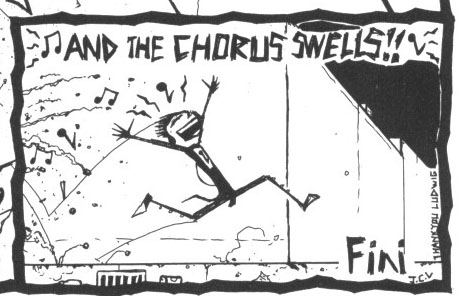
Good old Ludwig van B. Perfect for any occasion - even mass murder.

The work of Jhonen Vasquez certainly isn’t for everyone. Even his famous animated program, Invader Zim, is a little weirder than most people are willing to accept for a children’s show. It rewards patient reading and careful attention to the artwork. Which, I might add, is distinctive and disturbing and wonderful. Vasquez has created a style that’s cartoonish and yet horrible, in which childlike glee can be rendered next to heart-stopping horror, and we can perfectly believe that they exist in the same world.

It’s strange, horrible and funny all at the same time. If you’re interested in something out of the ordinary, I can definitely recommend this.

—————————————————
“I suggest you seek some alternate source of sympathy, Nny. You tried to kill that girl. She liked you, and you tried to kill her. That was impolite.”
– Nailbunny, Johnny the Homicidal Maniac

Johnny the Homicidal Maniac on Wikipedia
Squee! on Wikipedia
Jhonen Vasquez on Wikipedia
Jhonen Vasquez’s website
Johnny the Homicidal Maniac on Amazon.com
SQUEE’S Big Giant Book of Unspeakable Horrors on Amazon.com

2 Comments

Filed under afterlife, childhood, comic books, death, demons, existentialism, good and evil, graphic novel, horror, humor, Jhonen Vasquez, madness, morality, murder, philosophy, sins

Review 109: The Origin of Satan

The Origin of Satan: How Christians Demonized Jews, Pagans, and Heretics by Elaine Pagels

Let me get this out of the way right up front: I can’t think of the title of this book without the Church Lady from the heyday of Saturday Night Live popping into my brain. And now she’s in yours, too. You’re welcome.

Well, isn't that SPECIAL?

So. Who is Satan? A fallen angel? The great adversary of God? Saddam Hussein’s bitch? If nothing else, Satan is the great scapegoat, the one on whom we tend to pile all our troubles. Your church is running out of money? Satan. Your kid is doing drugs and listening to that awful hip-hop music? Satan. Queers getting married? Definitely Satan.

For some, Satan is an actual being, a true agent of evil whose purpose is to ruin all that God has made. For others, Satan is a symbolic representation of the evil inherent in the human condition, an abstract form made real in order to better understand it. In other words, there are as many versions of Satan as there are people who invoke him.

But how did the whole Satan thing get started? Where did he come from and how did we get to the Satan that we all know and loathe today? That’s what Elaine Pagels was determined to find out when she wrote this book.

While most of the book focuses on the New Testament and a history of the early Christian church, it was the ancient history of Satan that I found most interesting, mainly because it concurred with a pet theory that I’ve had for a long time: Satan was never an enemy of God. Satan was God’s quality control guy. It was his job to look for weaknesses in the system, to probe Humanity for its faults and flaws so that it could be made better. Thus the serpent in the garden (which, just as a note, was never actually revealed to be Satan), and especially the story of Job, where God allows Job’s life to be ruined on a bet. My guess was that he won a nice, crisp one-dollar bill.

Employee of the Millennium (photo by Nathan Rupert)

The Satan of Olde was an agent of God, there to make sure that things went the way they were supposed to. He caused trouble, he stirred things up, yes, but that was his job. Much like the office manager that you despise because he always harps on you for checking your Facebook account during company time, even though you both know there’s nothing better to do right now, but he just enjoys watching you suffer and enforcing his stupid little rules…. That guy is, at least in his own mind, working for the greater good of the company. He may be a dick, you may wish great misfortune heaped on him and his progeny, but he’s doing the job he was given to do.

Sounds great, but Satan’s downfall from “annoying but necessary agent of God” to “vile and demonic enemy of god” was planted a long time ago, before Christianity was even on the horizon.

The Jewish religion, from whence our concept of Satan arose, has always been one of Otherness. Israelites and Enemies. Us and Them. From its earliest days, God made sure the Israelites knew that they were a small force against the world, with only Him to protect them. He told Abraham straight out that He would bless him and curse his enemies. Therefore, the descendants of Abraham had to be on constant guard from enemies both from without and within. With a Satan already set in their theology as a tester and troublemaker for God, it was not a far leap to look to him as the cause of the multiple troubles that the Jews had over the years. Around the time of Christ, the Essenes were a distillation of that concept. They were a small Jewish sect – a minority within a minority – which believed that they were the only true Jews and that everyone else had gone soft. The Jewish majority was corrupt, led astray from the true path to God, probably by Satan.

When the Christians showed up, a minority with an even more tenuous existence than the Essenes, they found this concept very useful. Telling their story from the point of view of an embattled minority, they found Satan to be a very useful opponent against whom their Messiah could fight. He was an excellent symbol that stood not only for the earthly conflict that was taking place between the Christians, Romans and Jews, but a greater spiritual conflict that involved all humankind in a battle between good and evil.

Really he just likes to watch

Pagels’ basic thesis is that the concept of Satan, whatever else it may be, was used to not only encourage persecution of The Other – Jews and pagans, to be precise – but to also keep the Christians themselves in line. The book is actually a history of the early Christian movement and how that history was reflected in the writing of the Gospels. In fact, just like in the Bible, Satan doesn’t really appear much in this book. Rather Pagels looks at how the early Christian movement fought for its survival against enemies without and within, and then how Satan became a spiritual catch-all for those who disagreed with them.

It’s a great analysis of the early days of the Church, and just how chaotic and tumultuous it was. There were so many churches with so many different interpretations of Jesus’ life and death, so many Gospels being written and so many opinions on the very nature of God’s universe that it’s surprising the whole thing managed to come together to be the world’s largest religion.

What’s more, it shed some light on something that’s always annoyed me: the persecution complex that so many Christians have. The best time to catch this is in December, when pundits in the States start going off about the War on Christmas as though the last twelve Christians in the country were holed up inside the Topeka Christmas Shanty with shotguns and eggnog. Every time a judge tells a town that they can’t have the Ten Commandments on the lawn of their town hall, or a Wal-Mart tells employees to say “Happy Holidays” instead of “Merry Christmas” there is always a vocal group of Christians who claim that they’re being persecuted and that they’re on the edge of extinction. All this despite the fact that Christianity is the most popular religion in the world, that there are more Christians in Congress than any other religion, and that every single President in US history has been Christian. Despite all that, there seems to be a knee-jerk need to feel persecuted.

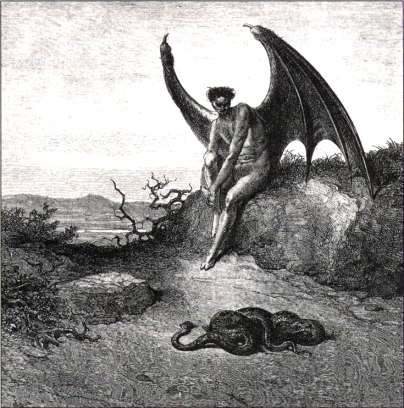
One of the Prince of Darkness

This book offered a very good reason why this is: because that was how the religion was founded, and it is the fundamental narrative of Jesus’ story. If Jesus had been part of the Jewish majority, his story would have ended very differently, no matter how radical his ideas. The early church was born of persecution, first from the Jews and Romans, and when they were no longer a danger, from pagans and heretics. And under all that, the hand that is always set against them, is Satan. As long as Satan is there, the Christians will always have someone there to persecute them. Without that cosmic, deathless opponent, Jesus becomes just another political rabblerouser executed by Rome. Certainly no Messiah would have allowed himself to die unless it was a gambit in a much greater game against a much more powerful opponent. Without Satan and the relentless threat attributed to him (and, by extension, those who are seen to ally with him), Jesus’s sacrifice becomes meaningless, and the whole religion follows with it.

It’s a fascinating book and a great look at the early days of the Church. If you’re into that kind of thing, go pick it up. Many thanks to my mom and stepdad, who pointed my attention towards it.

—————————————————–
“How, after all, could anyone claim that a man betrayed by one of his own followers, and brutally executed on charges of treason against Rome, not only was but still is God’s appointed Messiah, unless his capture and death were, as the gospels insist, not a final defeat but only a preliminary skirmish in a vast cosmic conflict now enveloping the universe?”
– Elaine Pagels, The Origin of Satan
—————————————————–

Elaine Pagels on Wikipedia
The Origin of Satan on Amazon.com

Leave a comment

Filed under Bible, Christianity, Elaine Pagels, good and evil, history, Jesus, Judaism, nonfiction, religion, Satan, theology

Review 105: Reaper Man

Reaper Man by Terry Pratchett

So. What are your thoughts on death?

Or rather, Death?

It’s a weird thing, death. I mean, you’re here one minute and then you’re… not. And while we all know intellectually that we’re going to die, there’s something in us that refuses to believe that the essential Person that we are could possibly cease to exist. We have personalities, unique aggregations of memory and experience and inborn preferences that all display themselves as a Person, as far as we know unique in all the world. Each human being is an entity that will never be seen again in this universe, and as far as we know, the cessation of life brings that entity to an end, reducing the person we knew to a mere insentiate object.

Is it any wonder we come up with stories for what happens… y’know, after?

Just about very culture that’s ever been has come up with some form of afterlife, be it an eternal feast for heroes, a paradise in which we can bask in God’s glory, a place of exquisite pain and torment, or a ticket back to Earth for another go ’round. There is no way of knowing if any of those are actually what happens to us when we die. At least not until we actually do it. So since we cannot know, we make stuff up, if only to make the whole thing easier to bear.

What often goes with that other world is someone to take us over. A ferryman or a guide, someone who knows the territory and knows where we need to go in what is very likely a rather confusing time. It’s another piece of comfort – knowing that there’s Someone out there who knows where we need to go and what we need to do.

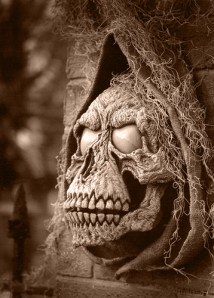
Grim indeed.... (photo by provia_17)

Which brings us to Death.


He’s been portrayed many ways over the years – my favorite is the Death from Neil Gaiman’s Sandman series – a sort of older sister who’s known you all your life and loves you anyway. If she shows up for me when I die, I think I’ll be okay.

I would be just as happy with Pratchett’s Death, even though he is the more traditional robes-scythe-and-skeleton type. Fans of Discworld love Death, which I imagine was somewhat baffling for Pratchett early on. In the first few books, Death was a bit character – he showed up a couple of times to collect the recently deceased, and that was it. But his scenes were so memorable and so good that they sometimes stuck out above the rest of the book. He speaks entirely in capital letters, which lends him a voice that is probably reminiscent of James Earl Jones. He’s aloof, but not uncaring, and seems to take a rather curious interest in humanity. He likes cats, has a house off on the edge of nowhere, and rides a great white steed named Binky. Death has become, in short, an interesting person.

And it seems that’s a problem.

The Universe, you see, is a finely tuned instrument, one which needs monitoring and, occasionally, adjusting. There are… let’s call them Auditors, who make sure that reality stays real – no odd deviations or anomolies such as, for example, anthropomorphic personifications of natural forces. In all honesty, they would eliminate all life if they could, but that is, as yet, beyond their capabilities. So they settle for telling Death that it’s time for him to retire. He gets a little hourglass all his own, and time to kill until the new Death comes into being.

Heya Tom, it's Bob - from the office down the hall... (photo by Scott Beale)

In the interim, this time between Deaths, a new problem arises: nothing is dying. Or, to be more specific, things are dying, but the vital energies that empowered everything, from cabbages to clergymen, aren’t being taken away. Without a Death to handle this very vital – so to speak – function, the life energy is looking for a place to go, an outlet. As a result, things that shouldn’t be alive are up and moving around. In some cases this means objects running along of their own accord, and in others it means that the dead simply have nowhere to go.

Such is the case with the wizard Windle Poons. After 130 years at the Unseen University, he was rather looking forward to a nice rest and then a bit of reincarnation as a woman in a far more liberal society. What he got instead was nothingness. Given that option, he went back to his body and became Undead, much to the consternation of the rest of the UU faculty. Unfortunately for them, they have bigger things to worry about – the buildup of life force is having a rather larger and more dangerous effect on the city of Ankh-Morpork itself. The lack of a Death may well doom the city in a manner that will be horribly familiar to many of Pratchett’s readers.

And where is Death in all this, or at least the person who used to be Death? He has found a small farm below the famous Ramtop Mountains. An old maid, Miss Flitworth, needs a hand and Death needs a way to spend his time – something he’s never had to worry about before. He takes the alias Bill Door and starts to learn what it means to be alive, despite the short time he has left.

"What can the harvest hope for if not the care of the reaper man?" (art by Andrew Mar)

The book, as you might imagine, is all about being alive. What makes life special and precious and ultimately worth living. Windle Poons let life go past while he grew old behind the university walls, and it is only in death that he finds out all that fun he’d missed. Bill Door learns that it is the fragility of life, and its most certain end, which ultimately gives it meaning. In the middle, we see that everything that can live yearns to do so, from the mayflies to the great Counting Pines to cities to ideas.


While the book gives no answers to what may happen after death (the Discworld books rarely do), it does give us another way to look at life. And that, ultimately, is the goal of any great story.

——————————————————
“Huh! Priests! They’re all the same. Always telling you that you’re going to live again after you’re dead, but you just try it and see the look on their faces!”
Reg Shoe, Reaper Man

Discworld on Wikipedia
Reaper Man on Wikipedia
Death on Wikipedia
Terry Pratchett on Wikipedia
Reaper Man on Amazon.com
Terry Pratchett’s official site

1 Comment

Filed under afterlife, death, Discworld, existentialism, fantasy, finitude, humor, Terry Pratchett, wizardry, zombies

Review 100: Machine of Death


Machine of Death, edited by Ryan North, Matthew Bennardo, and David Malki !

How would you live if you knew how you would die?

The premise for this collection of short stories was introduced back in 2005, in an installment of Ryan North’s popular Dinosaur Comics. In it, he presents the following premise: there is a machine which, with only a small sample of your blood, can tell you how you will die. But there are no dates, no details, no explanations. Just a few words, and that’s it. The Machine is never wrong, but it is annoyingly vague and has a decidedly un-machinelike love of irony. So you might get OLD AGE and think you were set, right? Not necessarily. You could be murdered by an octogenarian while trying to steal their TV. Or you might get PLANE CRASH and decide never to fly again. Fine, but that won’t stop the single-engine Cessna from plowing into your house one fine spring afternoon. Pulled GUILLOTINE, did you? Hope you know to stay away from heavy metal concerts.

But it doesn’t matter. The Machine, while perversely misleading at times, is never wrong, and like most prophets, its predictions often only make sense after the event has already happened.

With that premise, hundreds of writers across the internet set to work. How would this Machine affect people? How would it affect society or business or politics? Would we become slaves to its predictions, or simply shrug it off and live our lives as we did before, knowing that we were going to die someday anyway?

In “Flaming Marshmallow” by Camille Alexa, we see how the existence of the Machine has begun to shape youth culture. Carolyn is about to turn sixteen, the legal age at which one can be tested. A milestone equivalent with getting one’s driver’s license or being able to vote, kids monitor each other’s fates with scrupulous detail. Your eventual manner of death brings you together with those of similar fates, and new cliques begin to form. Kids who are going to die violent deaths sit together in the lunch room, far away from the ones who get OLD AGE. The kids with DRUG OVERDOSE and fates like it all mill about with each other, and nobody talks to the ones who get SUICIDE. By finding out one’s manner of death, a teenager gets what teenagers always want: a sense of belonging and inclusion. But will Carolyn’s fate bring her closer to her fellow students or just leave her an outsider?

“After Many Years, Stops Breathing, While Asleep, With Smile On Face,” by William Grallo, continues that idea out into the adult world. Ricky is dragged out on the town to a nightclub where people flaunt their deaths. They wear fake toe tags with MURDER or HEART ATTACK on them. Or, if they’re feeling impish, NEVER, or BOREDOM. But while everyone else is mocking their deaths, Ricky is in the odd position of knowing that he’s got a good end to his life. What he doesn’t know is what will happen between now and then, or with whom he will share it.

David Malki ! explores the darker side of society’s reactions in “Cancer.” James is a young man whose father is dying of cancer. It’s what the Machine had predicted, and it was all coming true. Despite the Machine’s infallibility, however, his father was seeking out a cure, a way out from the fate that had been given to him. And he’s not the only one – a new generation of hucksters and faith healers has sprung up, all claiming to be able to defy the predictions of The Machine. It gives James’ father hope, but whether that hope is worth the price or not is something James is unsure of.

“Nothing,” by Pelotard, is a touching tale of a young woman who discovers a family secret that never would have been revealed before the Machine was invented. “Despair,” by K.M. Lawrence, is an examination of how paralyzed people might become by the ambiguity of the predictions, unable to act lest they inadvertently fulfill them. “Improperly Prepared Blowfish” by Gord Sellar is an entertaining moment of secrets and betrayal among a group of yakuza in Japan, and Ben “Yahtzee” Croshaw has some fun with the politics of Machine predictions by giving us a politician whose fate is to die from EXHAUSTION FROM HAVING SEX WITH A MINOR.

Some stories are funny, others are touching, but they all center around that most existential of questions: how do we live, knowing that we will die?

Without The Machine, we still know we’re going to die. Every one of us has, somewhere in the back of our mind, that constant reminder that our lives are finite, that there is a limit to the amount of time we can spend on this earth. And, for the most part, we choose to ignore it. After all, if you spend your whole life obsessing over your own death, then you can’t have much of a life, now can you? But add to that fundamental knowledge of finitude the extra awareness of the manner of your death. If you get CAR CRASH, what can you do with that knowledge? You know it’s inevitable, that The Machine is never wrong, but you may still struggle with that fate. You may cut up your driver’s license, move out to Amish country and vow never to be within striking distance of a car again. The entire course of your life will shift drastically, based on the two words printed on that card, but the end result will be the same: CAR CRASH. Knowing that, is it better to act on the knowledge you have gained, or to ignore it?

Even worse, sometimes the very act of finding out your fate leads you right to it. In “Suicide” by David Michael Wharton, characters learn about their deaths only moments before experiencing it. Had they not gone to get tested on The Machine – had they not gone to that machine – would they have avoided their fate? The Machine would say no, but you’d have to ask it first. The best expression of this paradox is contained in the book’s shortest tale, “HIV Infection From Machine of Death Needle” by Brian Quinlan, wherein the very act of discovering your fate causes that fate to happen, whereas you would never have had it if you hadn’t gone looking for it. It’s kind of a mind trip, if you think about it.

What if you get something fairly straightforward, like CANCER, and you decide to, say, jump out of an airplane without a parachute? Will that even be possible, or will random events conspire to keep you safe until your proscribed end? And if you get SUICIDE, the one form of death you have absolute control over, do you fight against it or give in, knowing that nothing you do will change the outcome?

And what could this tell you about the future for everyone? In “Heat Death of the Universe,” by Ramon Perez, teenagers who reach the legal testing age start getting NUCLEAR BOMB as their means of death. The government springs into action, testing, re-testing, and vowing to corral all these kids into one place. But if their deaths are inevitably by NUCLEAR BOMB, what does that mean? It means that whether they’re all in one place or dispersed across the country, that is how they will die. Acting on the information doesn’t change its outcome, only what the manner of that outcome will be.

Conversely, it might be impossible to predict anything from the predictions The Machine gives out. As was pointed out in the same story, the 3,000 victims of 9/11 probably wouldn’t have all had TERRORISM printed on their little cards. They might have had FALLING or FIRE or PLANE CRASH – all true, but none of that would have helped anyone prevent that event. Even something as clear and unambiguous as GLOBAL THERMONUCLEAR WAR creates problems, as Cassandra finds out in the story of the same name by T. J. Radcliffe. If you tell people about this future, will they even believe you? Or will the actions they take to prevent it instead be what causes it to happen? There are no easy answers, at least not without electroshock.

It’s a fascinating group of stories, illustrated by some of the internet’s best artists – Adam Koford, Kevin McShane, Aaron Diaz, Kate Beaton, Christopher Hastings, and too many others to mention. It will do what all really good writing should do – make you think. As seductive as it sounds, knowing the means of your death is information that you really can do without. It is the end to your story, whether you know it or not, but everything until then is still up to you. While you may not have any choice over how you die, you still have plenty of control over how you live. You can live in fear or hope, make plans and take risks and hope for the best.

Just like we do now.

I’ll leave you with a joke from Steven Wright, one that was running through my head as I read the book: My girlfriend asked me if I could know how and when I was going to die, would I want to know? I said, “No, not really.” She said, “Okay, forget it, then.”

Thank you, he’ll be here all week.

——————————————————-
“What good is knowing the future if you can’t do anything with the knowledge?”
Dad, from “Friendly Fire” by Douglas J. Lane
——————————————————-

Machine of Death homepage
Machine of Death on Amazon.com

1 Comment

Filed under David Malki !, death, existentialism, humor, Matthew Bennardo, Ryan North, science fiction, short stories

Review 90: The World Without Us


The World Without Us by Alan Weisman

Death is a bummer.

I mean, here’s the thing – we all know we’re going to die. It’s part of the human condition, knowing that sooner or later the only existence that we’ve ever known is going to come to an end. And that’ll be it – no more us. It’s a creepy thought, to be honest, which is why most of us do our everlovin’ best to ignore it. We all know that we’re going to die, but we don’t want to know it, so we ignore it. We eat our Super-Double-CheezyFries, go BASE jumping, vote Republican, willfully ignoring the inevitable truth that these things are going to end up killing us.

Even when we are confronted with our mortality, we still find ways to console ourselves. We look around at our families and our friends and say things like, “No one truly dies so long as they’re remembered.” And we accept that even if we aren’t there, other people are. The things we’ve done in our lives, no matter how tiny, will echo around humanity as long as it lasts. If we are truly lucky, we will have contributed greatly to our species as a whole and gained a very special place in history.

But then we remember that even history is impermanent. The average species only gets to live about four million years, and we’ve already eaten up about a quarter of that. What’s more, we seem to be doing our level best to come in below average. Science tells us one inescapable fact: nothing lasts forever. One day, maybe sooner, maybe later, the last of the humans will die. Perhaps we’ll be replaced by another intelligence, one that can continue our work. Or perhaps we’ll just leave everything behind. All that will be left will be artifacts, objects that tell the story of humanity.

And that cheers you up a bit. We’re good at leaving marks, after all. We built a wall that’s so big it’s practically landscape. We split two continents apart in the name of commerce. We have girded our land masses in iron and asphalt, erected great cities of glass, concrete and steel. We have lowered mountains and raised seas, extracted the blood of the earth and bent the rivers to our will. Even if the human race vanished tomorrow, some far-future alien archaeologist would still be able to come here and know that a brilliant and puissant species once walked this world.

Yeah. About that….

This book was inspired by a very simple question: what would happen if all the humans just… disappeared? How it happened doesn’t really matter. Maybe aliens, maybe Jesus, perhaps some strange, species-specific quantum Critical Existence Failure. Whatever the cause, the sun rises in the morning and humans just aren’t there anymore. How would the world handle our disappearance? Would it even notice? What has humanity wrought that would last?

It’s a simple question with an incredibly complex answer. In order to even begin to know what would happen upon our disappearance, we need to know how the world works. We need to look at the forces that drive evolution and species propagation. What is it that allows life to spread and to flourish, to adapt to changing circumstances and make the best of a hard situation? What do we know from our studies of the unimaginably distant past that will help us foretell the future?

In addition, we need to know what effect humans have already had on the world. We’ve all heard the horror stories about the species driven to extinction by carelessness or ignorance – the passenger pigeon, the moa, the dodo – but our effect has been so much greater. Weisman is willing to categorize humanity as a force of nature thanks to the effect that we’ve had. Our relentless conquest of the Earth has, in small ways and large, unavoidably set evolution on a path that would have been very different had we never arisen in the first place. In a way, our influence can never be truly erased, and will likely survive for as long as biology does.

Finally, we need to know about the things we’re leaving behind. What is our world made of, and how well would it survive the rigors of time? The oceans of concrete that we’ve poured will freeze and thaw over and over again, and, aided by the surprising power of flowers and grass, will split, crack and crumble in time. Our massive steel skyscrapers will be undone by water and creeping vegetation. Our stonework will be worn down by wind and water, our satellites will fall, dams will burst and the wilderness will relentlessly take over the sacred places of the world. In the end, the only testament to our existence will be a handful of bronze statues and gold ornaments, and the impassive visages of the faces on Mt. Rushmore.

And even they will one day fall.

If you’re one of those people who worries about the impact that humanity has had on the earth, this will be a heartening book. As the geologic record shows, there’s pretty much nothing the universe can throw at this planet that can kill it. At least not so far. And the impact that humans are having isn’t anywhere near the great extinctions of the past, in which great swaths of death cut through the biosphere in a matter of decades. Understand this: there is nothing that we can do to the earth that the earth cannot undo, given time.

And that is a comforting thought. We do sometimes get wrapped up in our own awesomeness and assume that our actions have infinite consequences when, in fact, they don’t. We beat our breasts about the ozone hole and the Amazon, the Northwest African Cheetah and the Sharp Snouted Day Frog. We read about garbage gyres in the sea, and irradiated wastes on the land and despair over what we have done to this world.

The truth is that the world will move on after humans, and the future will hardly know that we were here.

That’s where the book got depressing for me, though. You see, I can take or leave individuals. I think The People are, in general, dumber than a Texas schoolbook. But all in all, I like Humanity. In the two hundred thousand years or so that Homo sapiens has been wandering this world, we’ve done some really neat things. We’ve built globe-spanning civilizations, produced unparalleled art, music and architecture, and invented worlds of brilliant fiction. We’ve examined the universe at its largest and peered back in time to the moment it began. We have gazed into the heart of the atom to know how reality works at its smallest levels. We’ve danced and sang and lived. And even with the terrible things that we’ve done, both to each other and to our world, I still think we’re a species worth knowing. We’re a species that deserves better than oblivion.

But the universe doesn’t care about what we deserve.

So if you take anything away from the book, let it be this – our existence here as a species is temporary. There’s no reward for our goodness, nor punishment for our sins. But here and now, we are alive, and capable of amazing things. It is up to us to decide what those things will be, and how to spend the time remaining to us.

Let’s make it wondrous.

——————————————————————–
“Below the surface, the oxidizing metal parts of chemical alley will provide a place for Galveston oysters to attach. Silt and oyster shells will slowly bury them, and will then be buried themselves. Within a few million years, enough layers will amass to compress shells into limestone, which will bear an odd, intermittent rusty streak with sparkling traces of nickel, molybdenum, niobium, and chromium. Millions of years after that, someone or something might have the knowledge and tools to recognize the signal of stainless steel. Nothing, however, will remain to suggest that its original form once stood tall over a place called Texas, and breathed fire into the sky.”
– Alan Weisman, The World Without Us
——————————————————————–

Alan Weisman on Wikipedia
The World Without Us on Wikipedia
The World Without Us on Amazon.com
The World Without Us homepage

And if the sure and certain knowledge of your own eventual cessation has got you low, watch this. It might cheer you up a bit….

Leave a comment

Filed under Alan Weisman, biology, evolution, finitude, geology, science

Review 74: Starship Troopers


Starship Troopers by Robert Heinlein

This book is controversial. Says so right there on the cover – “The Controversial Classic of Military Adventure!” A quick look at its Wikipedia page seems to support this, claiming that the book has been criticized for its literary merit, its support of the military, up to and including fascism, racism, utopianism, and gods know what else. What is certainly true is that it’s a book that is guaranteed to make someone, somewhere very angry.

In the unspecified future, humanity has taken to the stars. In our efforts to colonize planets that are hospitable to us, we have spread as far and as wide as possible. Unfortunately, this has brought us into direct contact with alien races who are not entirely keen on sharing land with us, and, as we have always done, we are willing to fight, bleed and die for every inch of it.

Our main enemy is the Bugs, whose proper name we never actually learn, and they are a vicious enemy indeed. They possess a hive mind, made up of Soldiers, Workers and Brains. The Soldiers are, of course, the most dangerous, not least because they have no individual sense of self-preservation. Unlike the human soldiers, who value their comrades and brothers-in-arms highly, the Bugs will never go back for a fallen comrade and never consider the safety of their own when prosecuting a campaign against the humans. In other words, the Bugs truly are alien to us, and therefore need to be eliminated.

The story follows a young man, Juan Rico, in his journey from enlisted grunt in the Mobile Infantry to Officer in the Terran Federation. Through his eyes, we learn about the technological lengths that we have gone to in order to be able to fight the Bugs. First among these is the powered armor that the Mobile Infantry wears – an all-purpose exoskeletal suit that vastly increases its wearer’s speed and strength, in addition to providing him with instant contact with his squadmates and vital information that he needs to fight the enemy. Humanity in the future has made great strides in terms of warfare, all out of need to defeat the Bugs.

You might be forgiven, then, for thinking that this was a grand military adventure. That we would feel the thrill and terror of a young military recruit as he experiences a universe larger and wilder than he ever could have imagined. You would be wrong.

Not entirely wrong, of course. If you read it right, you can infer the newness and strangeness of the circumstances that Juan Rico finds himself in. But this book isn’t about Juan Rico, even though he is the narrator. In fact, we don’t even learn his proper name until nearly two-thirds of the book is finished. Before then he’s just “Johnnie,” which is one of the most generic soldier names out there. Juan Rico is so irrelevant to the story that we don’t even find out that English isn’t his native tongue until three pages before the end of the book. Juan Rico is nothing more than a cipher in this tale, about as important to the content of Starship Troopers as Glaucon is to The Republic.

In the classic tale of Socrates, the philosopher talks about justice and politics and society, with his wisdom inspired by a question-and-answer session with his students. Somehow, the students always manage to ask just the right questions to allow Socrates to expound on his theories, and they’re usually wrong in just the right ways to make Socrates look smart. So it is with Starship Troopers.

Juan Rico is the means by which Robert Heinlein is able to put forth his opinions on war and society, politics, citizenship, crime, child-rearing and, of course, military service. Instead of writing a series of straightforward essays, unfortunately, he decided to make his readers slog through Starship Troopers.

This book is a love letter to the military and all it stands for. Not just war and death and destruction, of course, but also loyalty, sacrifice and devotion to duty. It is an examination into why people become soldiers, why some succeed and others fail, and about the historical importance of the soldier class in human history. It’s about war as a tool of diplomacy, both in its startling effectiveness and its unfortunate inevitability, as well as the importance of the chain of command and proper military discipline. It’s about the comradeship of veterans and the lessons they learn during the service. There’s a good reason why this book is on the reading lists for both the Navy and the Marines.

What it is not about is any of the characters that are actually involved in the story. The only reason Juan Rico is who he is is because he is not someone else. He could have been Buddy St. Germaine or Phil Waxman or Marvin Crumplebottom and the story would have read exactly the same: son of a rich businessman who enlists in the armed forces just to tweak his father, learns a whole host of Valuable Lessons ™ and eventually discovers his calling. There is absolutely nothing about Juan Rico than makes him any more interesting than any other character except that he happens to be the narrator of the story.

If that were all, I might be able to let this book slide as just thinly-veiled military fetishism. But honestly, there’s no veil there at all. The story stops in several places while Heinlein uses his characters as mouthpieces to tell us how he thinks society should be run. Ancillary characters – students, subordinate soldiers – ask just the right questions or are wrong in just the right ways so that Heinlein, much like Plato speaking through Socrates, can make the points he wants to make.

Juan’s professor, retired Lt. Colonel Dubois, and the other lecturers repeatedly point to the 20th century as a model of how not to govern, happily cherry-picking some of the worst results of our system of government and holding them up as the inevitable result of a society that is not run by veterans. For that is how he sees the best of all possible states – one in which only veterans are full citizens and in which only veterans can run the country. The logic being that only someone who has voluntarily enlisted and served in the military is able to truly put the needs of society before his own, and is therefore the best person to run a country. Heinlein, through his fictional avatars, then goes on to show how much more superior the Terran Federation is to its more democratic predecessors and how stupid we were not to see the obvious truth.

The message, then, is that the reader is stupid if he or she does not agree with Heinlein. The ancillary characters who challenge Heinlein’s thesis are written as obvious idiots and are roundly insulted and abused by their superiors, which effectively becomes Heinlein abusing his readers.

In addition, Heinlein sets up so many straw men to knock down that it gets tiresome. Juan’s father, for example, is almost stereotypical as a foil to Dubois. Mr. Rico is rich and aloof and sees the military as nothing more than a bunch of violent thugs who have outlived their usefulness. The first time we see him, he is a snob and a jerk, and Juan’s decision to piss him off by joining is almost inevitable. The next time we see Mr. Rico, of course, he has joined the Mobile Infantry himself, and has seen the error of his ways.

Other members of the cast are overtly written to embody certain themes in Heinlein’s opinion of military rule, both positive and negative. Private Hendrick, for example, is a constant complainer, one who stands up for himself during boot camp and just barely escapes a hanging. He is not disciplined enough to be a soldier, and by extension a citizen, and therefore serves as a warning to others. Sergeant Zim [1], on the other hand, is the consummate soldier – hard on his charges in boot camp, yet as concerned about them as a father would be to his sons. Zim, along with an array of Lieutenants, Captains and other officers, serve as blatant father-substitutes for Juan Rico, with all of the qualities that one would want in a father and absolutely none of the drawbacks. If anything, their only flaws are that they are too concerned about their soldiers.

While reading, I wondered if maybe Heinlein was being sarcastic. If perhaps he was trying to demonstrate the true folly of military fetishism by taking it to its ultimate extreme. I have to admit, I didn’t disagree with all of his ideas. His thoughts on juvenile delinquency, for example, really struck a chord in me – he maintains that treating young offenders as rational adults who can learn from their crimes is foolishness since, like puppies, young people are not inherently rational and have not yet learned the difference between right and wrong. The term “juvenile delinquent,” he maintains, is an oxymoron, since a juvenile has not yet been able to learn of his duty to others, and therefore cannot be delinquent. To treat him as if he were is to fatally misunderstand human nature.

And I think there is a grain of truth to the idea that someone who willingly puts her or his life and body on the line for his or her fellow citizens might indeed have the perspective necessary to govern a country. I would point out, however, that this argument rests on a flawed assumption – that service automatically confers selflessness. There may be correlation, but causation is not yet proven.

But I don’t think he’s being sarcastic. The themes and ideas in this book resonate with those that permeate his other books. What’s more, Dubois sounds like Jubal Harshaw, Lazarus Long and Professor De la Paz – other characters from other books who all served as mouthpieces for the author’s political and social philosophies. And this is what makes Heinlein’s books so special – he is not afraid to stand up for his ideas and put them right there on the page for the reader to see.

It is not so much Heinlein’s ideas that I object to in this book, even if I do disagree with many of them. It is his presentation of those ideas that bothers me. Flawed logical methods presented as irrefutable discourse, transparent characters with no life beyond their purpose as object lessons, and a dissertation on military supremacy that is just barely disguised as a science fiction novel. It is written from the presumption that the writer is right and the reader is, from the first page, completely and utterly wrong.

I think the ideas that Heinlein presents in this book are important, and they are worthy of discussion. I just wish he had held his readers in a little higher esteem when he decided to discuss them.

—————————————————-
“My mother says that violence never settles anything.”
“So? I’m sure the city fathers of Carthage would be glad to know that.”
– Student to Mr. Dubois
—————————————————-

[1] As a side note, the entire boot camp sequence is much, much more entertaining if you read Sgt. Zim with the voice of Invader Zim. It exponentially improves the book.

Starship Troopers on Wikipedia
Robert Heinlein on Wikipedia
Starship Troopers on Amazon.com
The Heinlein Society

4 Comments

Filed under made into movies, military, philosophy, Robert Heinlein, science fiction, war

Review 64: Lamb


Lamb: The Gospel According to Biff, Christ’s Childhood Pal by Christopher Moore

If you’ve been following my reviews over the last few years, I don’t see any reason why I should have to put a caution into this, but here it is: if you’re not interested in speculative fiction, open to the reinterpretation of the life of Jesus, speculation on the gaps in the gospels and the possibility of pan-religious values having been vital to the formation of Christianity, then you should probably not read this book. Nor should you really be using the internet – there’s just too much nasty “Free Thinking” out there. Take your hands off the keyboard and back away slowly.

Okay, that’ll weed out the wusses. Although, as I think about it, perhaps those are exactly the people who should be reading this book. I’m sorry for all the nasty stuff I said – come on back!

Each time I read this, I love it more. For one thing it’s Moore’s best work, without question. Not only is it blindingly funny, which is a hallmark of Moore’s style, but it’s also thoughtful, philosophical, and is supported by obvious research. Because he’s dealing with real places and real people, Moore has made sure that his depiction of first-century Israel is as accurate as he can make it. It’s all there in the details about the lives of the characters, the struggles they go through and the understandings they come to. Without hours of research as its foundation, the book would have failed almost instantly. Moore didn’t have to do it, but it is a great sign of his character as an author that he did.

This is also by far my favorite interpretation of the life of Jesus. It is the Gospel According to Biff, the best friend of Joshua bar Joseph, the man who would one day be called Jesus Christ. Of course, when Biff met him, the young Son of God was occupying himself by resurrecting lizards after his brother smashed their heads in. But they grew to be fast friends, and everywhere that young Joshua went, so went his buddy Biff.

The best way to describe Biff would be Jesus’ Sidekick. He’s a troublemaker, sarcastic, and far too prone to succumb to temptations of the flesh. But he’s clever and resourceful, and mindful of his friend’s mission on this earth. He’s young Joshua’s best friend in every way, so when Josh goes searching for the three Magi who attended his birth, Biff knows he has to go with him. The way to finding Joshua’s destiny will be long and hard, and Biff knows that his friend needs him.

The main part of the book has to do with Biff and Josh’s search for the Magi, to learn from them how Josh can be the Messiah. On their way they face demons, death and certain temptation, but also wisdom and experience from the wisest men in Asia. From Balthazar in the rugged mountains of Afghanistan, Joshua learns of the Tao, contemplating its Three Jewels – compassion, moderation, and humility. He learns about suffering and mercy and kindness and the effects they bring.

Biff, on the other hand, learns about the ways in which eight Chinese concubines can make life a wonderful place, night after night. He learns how to make potions and explosives, how to cast metal and read Chinese. He learns vital skills that the Messiah cannot – or must not – know.

From there they go to China, to a monastery high in the cold mountains to study with Gaspar, a monk of the Zen school. From Gaspar, Josh learns stillness and mindful breath, compassion for all things and, oddly enough, how to turn invisible. He discovers the divine spark that exists in all things, a holiness that no one can claim or take from you. He also learns what it’s like to be the only one of his kind, and foreshadows the tragic end that can bring.

Biff, of course, is learning kung fu and how to break bricks with his head.

Finally, they go to India to seek out Melchior, an ascetic yogi and the last of the wise men. Joshua here learns about sacrifice and blood, and the horrors that are perpetrated in the name of religion. He discovers the injustice of denying the Kingdom of God to anyone, Jew or Gentile, and the futility of trying to teach yoga to an elephant.

Biff, for his part, manages to put together a truly spectacular version of the Kama Sutra.

Don’t get me wrong – while Biff is certainly more earthly than his friend, he is also devoted to both Joshua and his mission. He is Josh’s anchor to the real world, always reminding him of his mission and making sure he doesn’t take himself too seriously. Biff, in this rendition of Jesus’ story, is a necessary element in the ultimate teachings of Christ.

As he admits in his afterward, Moore has tackled a very tough subject here, one that he knows is likely to rile people up. Jesus is one of those characters that is very set in peoples’ minds – he is the tall, beatific figure with a gentle voice and blue eyes who glides around in robes followed by insightful and worshipful men.

He certainly never ate Chinese food on his birthday, nor did he get hopped up on coffee or learn kung-fu. He’s never had a sarcastic best friend who was willing to risk damnation to describe what sex was like to the young Messiah, who was pretty sure that he wasn’t allowed to Know women. We haven’s seen Jesus get frustrated and yell at his disciples because they didn’t get the message he was trying to send, or be torn between what he has to do and what he wants to do. The Jesus in this book is an excellent meld of the human and the divine. He has the miracles and the powers, but his mind is human. He knows that he’s the son of god, but he feels like just a regular guy who’s been tapped to save humanity from itself. It’s a very difficult situation to be in, and Moore does a really good job of getting us to understand that.

More importantly, the life of Jesus hasn’t been this funny before. This is the kind of book that will piss off your family or co-workers, because you’ll want to read out passages from the book every five minutes, but you won’t get it out right because you’ll be laughing too hard. The way the book is set up, Biff has been resurrected by the angel Raziel in order to write a new gospel. Unfortunately, he’s been resurrected in the modern age, about two thousand years too late to help his friend avoid the awful, horrible sacrifice that he knows he has to undergo. So he writes in the modern American vernacular, assuring us that while the words may not be a direct translation of first-century Hebrew, Latin, Aramaic, Chinese or any of the other languages they encounter, the tone is accurate. And the tone is comedy, all the way through.

Of course, the comedy kind of drops off as the book races towards its unpleasant end, which is where my troubles with Moore as a writer usually lie. He tends to write endings that are abrupt and unfulfilling, as though he just wants to finish writing the book so he can, perhaps, get on with the next one. Even though we know how this story ends, it still feels rushed. Biff’s attempts to save his friend from horrible death make sense, but I would like to have seen them drawn out a bit more. I have a feeling that Moore could have added another hundred pages without breaking a sweat – and I wish he had.

The best thing, though, is that Moore treats his characters with the utmost respect. Nothing that Jesus does in the book is out of character for him, insofar as we know his character. And Biff is more than just a goofy friend of the Messiah – he is the reminder and the anchor of Jesus’ humanity. I’m not a Christian – I don’t claim any religion, in fact – but this version of Jesus would be one that I might be willing to give some time to.

It’s a brilliant book, in my top ten….

—————————————————-
“Josh, faking demonic possession is like a mustard seed.”
“How is it like a mustard seed?”
“You don’t know, do you? Doesn’t seem at all like a mustard seed, does it? Now you see how we all feel when you liken things unto a mustard seed? Huh?”
– Biff and Josh, Lamb
—————————————————-

Christopher Moore on Wikipedia
Lamb on Wikipedia
Lamb on Amazon.com
Christopher Moore’s homepage

Leave a comment

Filed under angels, Christianity, Christopher Moore, coming of age, demons, friendship, good and evil, humor, Jesus, quest, religion, travel