Category Archives: adventure

Books that are generally exciting and would be considered part of the Adventure genre

Review 120: The Dark Tower

The Dark Tower by Stephen King

Well, here we are. After a long road – longer for some of us than for others – we have finally reached the end of The Dark Tower series. For some of us, it’s been twenty years in coming, so if you’ve only started reading this series recently, count yourself lucky. You don’t know how we waited for this book, the book wherein Roland would finally attain his goal, and we would see if all the sacrifices he made were worth it.

Were they? Kind of.
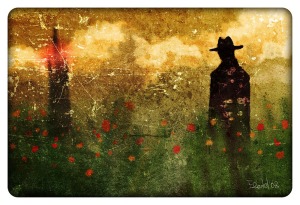
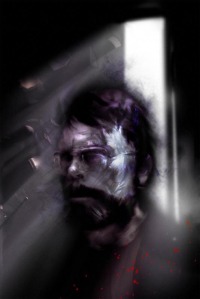
Art by Eredel on DeviantArt

I’ll get into more detail later, after I dutifully put up the “Here Be Spoilers” sign, but this is the book where everything gets resolved, and our heroes are given their reward for the hard work they have done. The bad guy is beaten, the world is saved, and all is well. Although “well” is a very relative term in this sense, and while the bad guy is beaten, it’s not very satisfying, and the reward that many of our heroes get isn’t necessarily the reward they would have chosen.

If I sound like I’m dancing around the story, that’s because I am. I have an aversion to spoiling books in these reviews, mainly because I know how satisfying it is to get into a good book and discover things. To see old characters appear from the past, and to witness the heroism of the characters we have come to love. To look at the journey they take and see their relentless pursuit rewarded. At the same time, I don’t want your experience poisoned by knowing the drawbacks to a book – the soft spots in the plot, the characterization problems, the disappointments and the heartbreaks. [1]

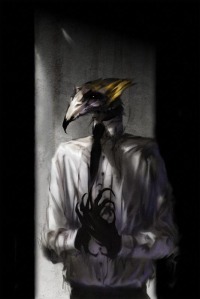
Art by lilbenji25 on DeviantArt

This book contains all of these, and if I avoid talking about them, then this review will be awfully short. So, Constant Reader, I tell you this: you can stop here. You can click away to another page, perhaps to Amazon to buy the book and read it yourself (I recommend the Kindle edition if you can – I have the hardcover and it is quite the doorstop), perhaps to put off the reading of the book for a while longer. You don’t have to learn things that will taint the journey of discovery that is reading , and you can live on with a vision in your head of how The Dark Towerseries should end, instead of how it actually does.

Would you stay, then? Very well. After this point, there is no turning back. What is learned, as they say, cannot be unlearned.

This is not the book I wanted. It is unbalanced, hard to get through, and disappointing in many ways. There are also some beautiful moments, and some interesting ideas which, upon post-reading reflection, make the whole story more meaningful. But my overall feeling was one of great disappointment. Let’s start from afar, shall we?

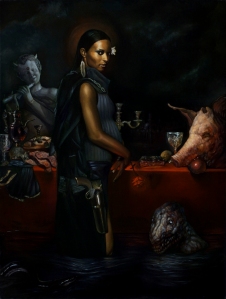
Art by DiosBoss on DeviantArt

The structure of this book is rather lopsided. The most climactic event in the book, the battle of Algul Siento, is quite exciting and fun in that it is what we readers expect from a climax – gunfire and death and the saving of worlds. By freeing the Breakers from their work on the Beams, Roland and his ka-tetdo indeed save the macroverse from complete dissolution. They have literally saved the world and, as we learn later, have completely thwarted the evil designs of the Crimson King. The story could end there, the characters could go on their separate ways, and all would be well.

The problem is that this occurs in the first half of the book. It’s followed soon after by a minor climax – Roland and Jake saving Stephen King from certain death by drunk driver – but even that is done a little more than halfway through the book. Stephen King is safe, the New York Rose is safe, and we find out later that not only are the last two Beams intact, they are regenerating and will probably regenerate the other four. Reality has been saved.

But the story goes on, because saving reality was never Roland’s goal. It was only, in the parlance of Dungeons and Dragons, a side quest. There’s a larger quest to be resolved.

This wouldn’t be so bad if there were an even bigger climax waiting for us at the end, but there isn’t, and this is where I feel kind of betrayed. When Roland gets to the Dark Tower, we know he will have to face the Crimson King, who has been held up as the incarnation of death, evil and chaos. He has been the main antagonist throughout this whole series. His reach is long, his power vast, and his hate for Roland of Gilead is as focused as a laser and as hot as the sun. He is as close to the Devil as we can get.

Art by morganagod on DeviantArt

So, when Roland finally makes it to Can’-Ka no Rey, the great field of roses within which the Dark Tower stands, who do we see? A “satanic Santa Claus” who throws explosives from the only balcony of the Tower he’s been able to reach. He’s generically ugly, screams like a madman, and talks in villain cliches – “GUNSLINGER! NOW YOU DIE!” or “YOU DON’T DARE MOCK ME! YOU DON’T DARE! EEEEEEEE!” or “EEEEEEEE! EEEEEE! STOP! IT BURNS!” On top of all that, the Crimson King is finally defeated not by Roland’s guns or some great battle on the physical, intellectual or spiritual plains, but by a guy with a sketchpad. He is simply erased from afar. And thus ends the reign of what was supposed to be the greatest horror of all worlds.

What’s more, their meeting at the Tower was not acually the defeat of the Crimson King – he conceded defeat way back during Wolves of the Calla. We find out that, with the defeat of the Wolves, the King foresaw the end of the Breakers and thus his plan to unmake creation. So, he broke his Wizard’s Glasses, killed nearly everyone in his castle. killed himself by – for reasons I still don’t understand – swallowing a sharpened spoon, and then, undead (which I also don’t understand), rode off for the Tower.

Even then, though, he couldn’t win. In order to enter the Tower he needed either Roland’s guns or Mordred’s birthmark, neither of which he had. So he climbed up into one of the Tower balconies with all the weapons he could carry and just waited. If Roland hadn’t come to the Tower, he would have waited there forever and never harmed anyone again. By bringing his guns, Roland raises the possibility that the Crimson King could still triumph. So, by continuing his quest, Roland endangers all existence.
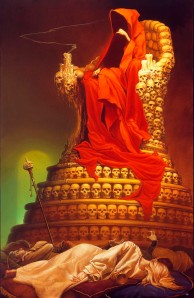
Art by Michael Whelan

As much as I hate to call out authors on what they “should have” done, I feel like I have to here. A hero is only as good as his villain, and the Crimson King, in the end, turns out to be a pretty crappy one. I wish King had made their meeting worthy of the image he had built up. The same goes for one of our favorite characters, Randall Flagg (or whatever name he chooses to use). He has floated through this series and others like a cancer, bringing nothing but death and pain with him. He’s a charismatic madman who revels in chaos and is probably one of the most enjoyable characters King has created. So how does he die? He gets killed by Mordred, the bastard son of Roland and the Crimson King, of Susannah and Mia. He gets killed and eaten without much of a fight. I think a lot of fans would agree that Flagg deserved better.

And while we’re on the topic – Mordred.

One of my measurements of good characterization is a question: If this character did not exist, could the story have ended the way it did? With Jake and Father Callahan, Susannah and Eddie, with Oy and Flagg and Cuthbert and Susan and Cort, the answer is, of course, No. Each of those characters contributed something vital to the story, something that no other character could have done. To reach the same end without one of those characters would have meant a vastly different story.

Art by Michael Whelan

The same cannot be said of Mordred. Of the people he kills, only two matter to us: Flagg and Oy. Flagg should have been the penultimate End Boss, the final challenge for Roland before reaching the Tower and the Crimson King. And there are many ways to kill a Billy-Bumbler – I think King could have thought of one that gave Oy the same honorable and heartbreaking death that he got trying to save Roland from Mordred. Other than that, Mordred had no impact on the story at all. He just followed Roland, Susannah and Oy, shivering and whining and feeling sorry for himself. He kept telling us that he was meant for great things, but never showed even the slightest hint of that potential. He follows Roland like Gollum follows Frodo, but at least Gollum turned out to be important.

The one thing we do get from Mordred is a frustrating bit of knowledge – that the Crimson King and Roland are both descended from the mythical king Arthur Eld. In that way, their battle is between cousins, and Mordred represents a unification of two bloodlines – demon and human. If their conflict had been framed in that context, it could have been so much more interesting when we finally got to the end.

Speaking of the end. We, like Roland, didn’t know what to expect when we finally got into the Dark Tower. And I don’t think anyone expected that the series would loop around to the beginning again, dumping Roland back in the Mohaine Desert to follow the Man in Black once more, unaware that he had already done so so many times before. It was an unsatisfying ending at first, but upon reflection, it does work, and there are two ways to look at it.

The first is that Roland is being taught a lesson, one which he still has not learned. He’s being taught to value life, to reset his priorities. From his youth, he was so focused on the Tower that he let all else fall aside – his friends, the girl he loved, and the sacred artifacts of his forefathers. He brought death with him, and passed it on to all whom he loved, and ended his quest as alone as he began it. And so, despite saving the multiverse, Roland failed his true quest – to learn how to love others and share who he was with them – and had to be sent back to start again. In appreciation of his effort, however, he was granted a change: the horn of Eld, which he had previously neglected on the field of the last battle of civilization. Perhaps it will make a difference.

The other way to look at this ending is a more metafictional one, something that Stephen King himself finds distasteful. Like it or not, though, one of the overriding themes of this series is the impact that fiction has on reality, and vice versa. To readers, a character might be more real than real people. We learn lessons from them, we have kind or unkind memories of them, and in many ways, our fictional characters possess a special reality. To a writer, this is even more true. Ask any writer and they will tell you about how their characters talk to them, sometimes appear in front of them, or even take over their bodies for a little while. A writer will discover things about a character that she never planned, as if the character himself were revealing them. The Dark Tower relies on this kind of ur-reality of fiction, up to and including fictional characters saving the life of their own writer.

So, by connecting the end of the last book with the beginning of the first, perhaps King is implicating us, the Constant Readers, in Roland’s suffering. Roland cannot rest as long as there are readers reading him, and we are all guilty of making him go through it again and again. While King may have created Roland and his quest, we propagate it, and every new reader ensures that it will never, ever end. [2]

Art by Chesheyre on DeviantArt

In the end, we have a series that started off strong, and then kind of careened to an unsatisfying end. Having been written intermittently over the course of thirty years, I suppose that shouldn’t be too surprising. Ideas which seemed like good ones at the time served only to cause trouble later down the road, and loose ends that needed to be tied up took up far more time than they should have. Perhaps with a clearer vision of the journey at the beginning, King could have held it together better. And perhaps without his brush with death in 1999, he wouldn’t have felt compelled to get the last three volumes out as soon as he could.

It does, however, gift us with some wonderful characters, a rich and brilliant world, and a fictional cosmology that holds together all the worlds that King has created thus far. It’s an examination of the importance of fiction in our lives, and the way that stories can reach out and touch so many more people than the storyteller ever intends. If you are a fan of Stephen King, and you haven’t read this series yet, then you should. For all that the last couple of books disappoint, there is still much good to be found in the whole series, and the first five are generally really well done.

Art by Deviata on DeviantArt

There is more to read, if you’re interested. King’s assistant, Robin Furth, has put together an excellent Concordance, detailing pretty much everything you want to know about the series – characters, places, history, language and concepts. She has also written a series of graphic novels for Marvel Comics which detail Roland’s youth, starting with the events told in Wizard and Glass and going up to the terrible battle of Jericho Hill. So if the original series leaves you wanting more, there’s certainly more to be had.

That’s it, then. Long days and pleasant nights to you all.

——————————————————–
“Even when you were in the shadow of death there were lessons to be learned.”
– Jake (narration), The Dark Tower
——————————————————–

——————–
[1] To be fair – this book was published back in 2004. If you haven’t read it by now, I doubt you’re really going to be chuffed by some spoilers, and you have no one to blame but yourself if you haven’t gotten around to reading it yet.

[2] A third option is suggested by his short story, “That Feeling, You Can Only Say What It Is In French” from Everything’s Eventual, wherein a woman riding with her husband in a car on vacation keeps re-living a terrible accident. It is implied that she is dead, and that hell is the eternal repetition of one’s mistakes. It is possible that Roland is dead, and that this series is his Hell.

The Dark Tower on Wikipedia
The Dark Tower Portal on Wikipedia
Stephen King on Wikipedia
The Dark Tower homepage
The Dark Tower on Amazon.com
2 Comments

Filed under adventure, apocalypse, Dark Tower, death, existentialism, fantasy, good and evil, meta-fiction, quest, Stephen King, time travel, world-crossing

Review 116: Song of Susannah

Song of Susannah by Stephen King

I think that every long series has to eventually include a book like Song of Susannah. It’s the weak book, the one that you have to have, but would rather you didn’t. The one that pretty much exists to get you from Point A to Point B, which resolves some earlier issues and sets up some later conflicts, but which – by itself – isn’t nearly as good or as much fun to read as the books that either preceded or followed it. I call it a “bridge book,” and I suspect that they are somewhat inevitable.

But before getting into all the heady analysis ‘n stuff, let’s see what this book is about.

Book art by Darrel Anderson

Directly following the end of Wolves of the Calla, our ka-tet is split. Susannah, possessed by that strange spirit who calls herself Mia, has taken the supremely powerful Black Thirteen and used it to open a magic door to New York. It is there that she hopes to have her child and have the raising of it, before it grows up to destroy the world. Everyone else, of course, is concerned for her safety, but there is one other thing that needs to be done – the vacant lot in Manhattan and the rose that grows there must be protected. This rose represents one of the two Beams that remain to hold up the Dark Tower (and thus all of existence), so its safety is paramount.

The other Beam just happens to be Stephen King himself. But we’ll get to that….

Roland’s party splits up – Roland and Eddie go to rural Maine to find Calvin Tower and secure proper ownership of the vacant lot. Jake, Oy, and Father Callahan follow hot on Susannah’s heels to New York City to try and save her from the horrible death that no doubt awaits her there. Horrible death awaits all of them, truth be told, but one does what one must in pursuit of the Tower.

Jake, Oy and Callahan’s story is the far more straightforward one. They go to New York and follow Susannah/Mia’s psychic trail to Black Thirteen, which they dispose of in a manner that should bring a grim smile to all 21st-century Americans. They then go on to the Dixie Pig, a restaurant-slash-portal to a dimension of hell and pain, where they expect to be gunned down the moment they go through the doors. Pretty cut and dried, really.

Roland and Eddie, however, have the much more mind-bending task of meeting their maker. Literally.

Book art by Darrel Anderson

As a side-quest to securing legal possession of the vacant lot, they learn that King lives nearby and decide to pop in and pay him a visit. This kind of freaks King out, but rightfully so. To him, Roland is a character who haunted his mind, and a few pages of a manuscript that has languished in storage for years. King had given up on The Dark Tower, and never expected to pick it up again. Until, of course, its main character showed up, insisting that his story be finished.

To me, this was the most interesting conceit of the entire series. The idea of characters breaking through the fourth wall and entering “the real world” is nothing new, nor is having them ask some rather pointed questions of their creators. But it’s another thing for those characters to not only meet their creator, but to do so before he’s actually written about them up to the point where they’re meeting him.

(re-reads that last sentence)

Right.

In short, not only is King the embodiment of one of the last Beams holding up the Dark Tower, he is also an avatar of Gan, the primal force of order and righteousness in the universe. Through King, and the story of Roland and his ka-tet, Gan is trying to keep the Tower up against the forces of Discordia, as embodied by another King, the Crimson King. These two Kings – one unknowing, the other knowing – are locked in a fight to the death, with the universe at stake.

Book art by Darrel Anderson

Throughout all of this, Susannah is having her own troubles in New York. Mia has gained control of her body – to the point where she is able to manifest the legs that Susannah lost long ago – and is determined to have her child. She has an appointment to keep with the agents of the Crimson King, and she believes that she will finally achieve that holy state for which she had gladly given up her immortality – motherhood. Susannah, on the other hand, knows that whatever is brewing in Mia’s belly is a threat to Roland, and will do whatever she can to stop the birth, or at least turn Mia against her chosen destiny.

Depending on the kinds of books you like reading, Song of Susannah will either be tolerably good or downright unpleasant, and this is mainly due to its rather fractured structure. The three plot threads don’t intersect directly once everyone leaves the Calla, and don’t have any kind of resolution once you get to the last page of the book. As a friend of mine put it, “There’s no ‘there’ there.”

The other volumes, like most standard-issue novels, has a resolution at the end. You can close the book and be able to tell people, “The characters achieved this, and it was fairly conclusive and interesting.” Of course, a series always has a greater conflict – the series-level conflict – that won’t be resolved until the last volume, but each individual book needs to have its own setup, conflict and resolution, with enough loose ends to get us into the next book.

Song of Susannah doesn’t really do this. The matter of the vacant lot is a fairly simple legal matter, which is not only easily resolved but also kind of dull, once you compare it to everything that has gone before. The problem of Black Thirteen is done away with pretty easily as well, which doesn’t really befit an artifact that we have been told possesses immense evil power. And while Susannah doesn’t prevent Mia from making her appointment at the Dixie Pig, she does manage to plant the seeds of doubt in the woman’s mind.

Art by Klaimko

In short, what is achieved in this book is not up to the level of what we have come to expect. The dramatic escape from the decaying city of Lud, the horrible tragedy of Roland and Susan in the Mejis, the valiant stand against the Wolves – all of these are proper climaxes and proper resolutions. The sole purpose of this volume is to bridge the gap between Wolves of the Calla and The Dark Tower, and the only reason it ended where it did was because, well, you have to end it somewhere.

Having said all that, I enjoyed reading this book, and tore through it at record speed. I thought Susannah’s chipping away at Mia’s confidence was well-handled and made a lot of sense. Jake, Oy and Callahan preparing for their Last Stand and their likely deaths was great, and the whole meta-fictional issue of characters meeting with their creators is just the kind of thing that really digs into my brain and gets it going. And while the book may have been less carefully focused than the other editions of the series, it must be remembered that I am a long-time veteran of the Wheel of Time series, which has so many sub-plots, side-plots, secondary plots, divided parties, prophecies, histories, secrets, societies, ancient enmities, mythical forces, Artifacts of Unimaginable Power, questionable plot elements and unanswered questions that it makes The Dark Tower look like one of Aesop’s fables.

So I do have an unfair advantage.

———————————————————————-
“I don’t think he needs to be immortal. I think all he needs to do is to write the right story. Because some stories do live forever.”
– Roland (speaking of Stephen King), Song of Susannah
———————————————————————-

Song of Susannah on Wikipedia
The Dark Tower Portal on Wikipedia
Stephen King on Wikipedia
The Dark Tower homepage
Song of Susannah on Amazon.com

Leave a comment

Filed under adventure, Dark Tower, death, fantasy, horror, meta-fiction, quest, Stephen King, survival, vampires, world-crossing

Review 114: The Ghost Brigades

The Ghost Brigades by John Scalzi

The book that preceded this one was Old Man’s War. It was Scalzi’s first novel and I loved it. It had everything – high-end science fiction, philosophy, cool battle scenes and a protagonist whose sense of humor reminded me a lot of many of my friends. The book’s premise was very simple – why do we use young people to fight in wars? Because they have the bodies that work best for the task – strong, fast and generally resilient. But young people can also be rash, impulsive and generally ignorant of a whole lot of life’s complexity. If their physical capabilities were not an issue, then who would we want? Why, old people, of course. They have the life experience, the patience and the perspective to be better soldiers.

No.

So, it’s The Future. Mankind has spread out among the stars, and the Colonial Union is the political organization that keeps them together. Any government needs a military, so the Colonial forces make sure they have the best recruits, all brought from Earth. With some pretty high-tech jiggery-pokery, the senior citizens from Earth’s richer nations are made into lean, green fighting machines, capable of performing in ways that make the Marines of our day look like palsey victims. Their minds are transferred from their old, decrepit bodies and put into new ones, grown from their own DNA, but altered to make them better soldiers. It’s all very exciting and cool, but at some point, I suppose Scalzi asked himself a question: what happens when someone signs up at age 65, but doesn’t make it to age 75 when they’re supposed to start their service?

NO!

Well, we have all this DNA just sitting there, right? We can’t let it go to waste, can we?

That brings us to the Ghost Brigades, the rather morbid nickname for the Colonial Union’s Special Forces. Their bodies are grown from DNA whose previous owners have expired, and are modded in more extreme ways than the regular defense force soldiers. Then, when the body is ready, they’re woken up. An amazing piece of biotechnology called, rather whimsically, a BrainPal prepares their brains for consciousness, acting as a kind of bootstrap for the emergent personality. It tells them what they’re supposed to know, so they don’t have to go through the tedious process of learning it all. And, of course, much more. The Special Forces do what the regular Defense Forces can’t, and act in ways that their more “ordinary” soldiers couldn’t understand. In Old Man’s War the Special Forces only came in at the end. In this book, as you might have guessed, they play a much more central role.

I'll show them! I'LL SHOW THEM ALL!!!

Charles Boutin is a traitor to humanity. For reasons known only to him, he has sold out the Colonial Union to its enemies, a troika of alien species that would be more than willing to wipe us off the map. The Defense Forces would love to find him, of course, but he’s hidden himself among the enemy. So they got the next best thing: a copy of his own mind that Boutin had made while researching the BrainPal.

In theory, it should work: put this mental backup copy into a “clean slate,” a body that has no mind of its own. A Special Forces body.

And so, Jared Dirac was born. Decanted. Whatever. It was hoped that when he opened his eyes, he would be Charles Boutin in a new body, and could promptly be interrogated. But it isn’t that easy. Jared Dirac is a normal Special Forces soldier, a blank slate who is ready to do the job he was, literally, born to do: keep humanity safe.

Art by Vincent Chong

He’s sent off to training, with the expectation that he would be just another Special Forces soldier. But he is, of course, much more than that. As his brain matures, the memories and personality of Charles Boutin come with them, and Dirac starts to understand more of what made the man turn traitor to his own species. This information could lead the Defense Forces to their ultimate goal, or to their destruction….

It’s a great book. Tons of fun, although the exposition is a bit heavy-handed in the beginning. There’s a whole lot of reminding about what you learned in Old Man’s War, and I didn’t really need it. That’s the thing about recap, though: if you avoid it altogether, you can confuse people who haven’t picked up the previous book in a while. Slather it on and you bore the people who have good enough memories.

Once you get past that, though, it’s straight on fun, with some pretty serious questions folded into it. One of the major questions raised in this book is that of identity – who is Jared Dirac? How can a being who is brought to full consciousness by an implanted computer be properly called “human?” It’s clear that he is, but a fuller look at the Special Forces – especially the squad known as the Gamerans – really does push the definition of “human” to its limits.

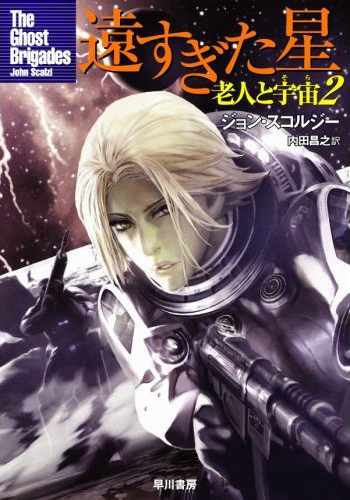
The Japanese cover to Ghost Brigades

It’s a very thoughtful book in many places, exploring the grey areas of not only humanity and “human-ness,” but also of the role of humanity among the stars. Explaining his reason for turning traitor, Boutin asks us to consider the entire purpose of government itself – how it operates, how much power it has and how much it should trust its citizenry. He fundamentally disagrees with how the Colonial Union goes about its business, and will do whatever he has to in order to set it on what he believes is the right path. And in the middle of all this is Jared Dirac, who has to actually start making choices in his life – something that Special Forces soldiers were never bred to do.

As with Old Man’s War, this is a great book to read, and I look forward to the other books set in that universe. You should too.

———————————————-
“We don’t mind when the other guy brings a gun to a knife fight. It just makes it easier for us to cut out his heart. Or whatever it is that he uses to pump blood.”
Lieutenant Jane Sagan, The Ghost Brigades

The Ghost Brigades on Wikipedia
John Scalzi on Wikipedia
The Ghost Brigades on Amazon.com
John Scalzi’s Blog

Leave a comment

Filed under adventure, aliens, ethics, existentialism, fiction, friendship, identity, John Scalzi, military, morality, philosophy, science fiction, technology, transhumanism, truth, war

Review 113: The Plague Dogs

The Plague Dogs by Richard Adams

I really enjoy Richard Adams. Part of it is his writing – he has an excellent style and a definite gift for description. When he talks about a place, it is immediately obvious that he’s actually been there. He uses multiple senses to tell you what a place looks, sounds and smells like, the feeling of the damp earth and the rolling mists, the tastes that seep through the air…. Not surprising when one is writing a book where a pair of dogs are the primary characters.

And that’s another reason I like Adams. Lots of people write books about animals, personifying them and making them into almost-humans. But most of these writers tend to idealize the animals, put them into the sort of “noble savage” category which places humanity immediately in the wrong.

The fox is almost unintelligible. Enjoy that.

Not Adams. His animals are animals. In Watership Down, which was ostensibly a book for children, the animals live through fear, terror, despair and war. There is blood and death and pain, mostly because there is blood and death and pain in the natural world. He does acknowledge that he over-humanizes his characters, but without that, there would be no story.

This book is about the intersection of animals and man, and asks a very important question: what is humanity’s responsibility towards the animals? While he may not know what the true answer is, Adams definitely knows which answers are wrong. The book begins in a scientific research lab, in the quiet hills of northern England, where any number of experiments are performed on any number of animals. Some of them are paid for by outside interests – cosmetics corporations, for example – while others are performed to, in the mind of the lab’s directors, further the scope of scientific knowledge. Adams’ utter contempt for this kind of activity is immediately evident when you read it, and he spares no detail in describing what happens in these experiments. Animals mutilated, burned, shocked, frozen, exposed to poisons in their air, water and food. Kept awake, asleep, isolated…. all just to see what would happen. And when they die, they are disposed of with no more thought than one might dispose of a burned-out light bulb.

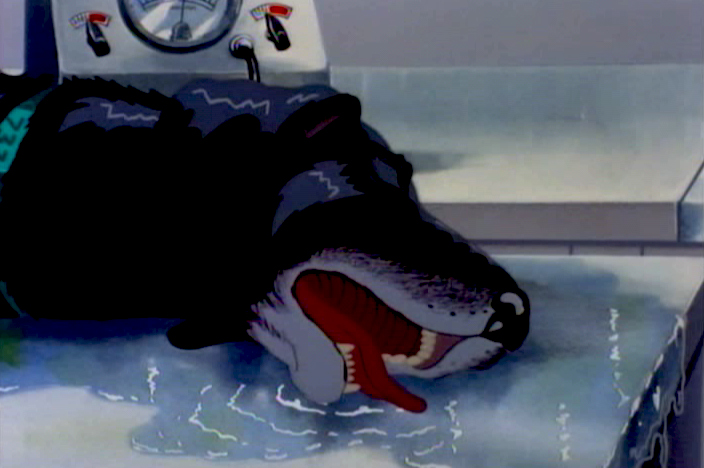
Like this, only worse.

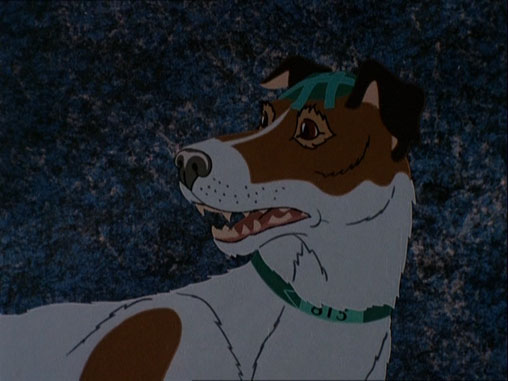
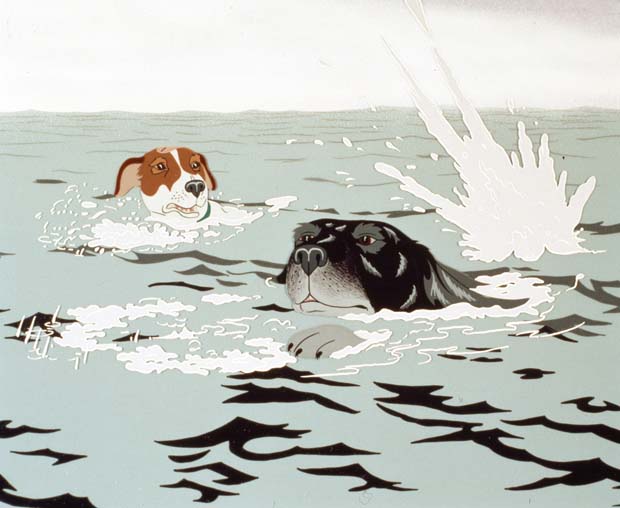
One of the subjects is a large black mongrel dog which is being used to answer the great burning scientific question of, “What would happen if we kept trying to drown a dog but never actually let it die?” Rowf (having never had a master, his name is just the sound he makes) has a single companion in the lab, in the cage next to him – a small terrier who, having had a master before, has a name – Snitter. Snitter has been the subject of a far stranger experiment, and the brain surgery has left a deep scar across his skull and a deeper rift in his mind.

The two dogs manage to escape from the lab into the outside world, where they manage to survive, if only barely.

Poor, crazy Snitter....

And normally, that would be the end of the story. But then Adams reveals his antipathy for bureaucracy and the modern media, for where both of these intersect, terrible phantoms and ghouls can arise. Worried farmers, whose sheep are targets of the two hungry dogs, call their representatives to get answers from the recalcitrant lab. The ministers talk and talk about it, and when word leaks out to a well-known London tabloid, the story explodes.

WAS the lab not working with many kinds of animals the night the dogs escaped, it asked. Among those animals, were there not RATS? And were those rats not the subjects of tests involving the horrible BLACK PLAGUE? CAN the laboratory ASSURE the taxpaying public that there is ABSOLUTELY NO CHANCE, none at all that the dogs are not infected with the virulent PLAGUE?

The newspaper’s answer, the one that will sell more copies, of course, is NO. And so, the two dogs, who were lucky enough to escape and canny enough to survive, become known nationwide as the Plague Dogs, subjects of a hunt which escalates beyond reasonable proportions.

Poor, miserable Rowf....

As much as this is an animal adventure story, a kind of twisted version of Homeward Bound, it is also commentary. There’s a lot of dog philosophy in here, for one of Adams’ gifts is being to get into the heads of the animals he’s writing. The two dogs agree on one thing – it is a dog’s place in the world to serve humanity. But how? Snitter, who’d had a good master once, believes that they are there to make humans happy, to bring love to a home. Rowf, however, having known nothing other than the laboratory, believes that dogs are there to be abused by humans for their unknowable purposes, and that by running away from the lab and the water tank, he has become a Bad Dog.

Also, looking at the world from a dog’s perspective is interesting. Snitter, for example, believes that the newspaper-boy delivers a paper to the Master’s house solely so the Master and Snitter can play a fun game. Isn’t that boy nice? And having known only suburbia, he is shocked that humans have ripped up the world and replaced it with all these green things and mountains and deep holes filled with water – which, of course, Rowf believes are used to drown unthinkably huge animals much as he was drowned. Adams asked himself the question, “How would a dog interpret the world?” and got a lot of great ideas from it.

And, as I mentioned before, there’s a lot of talk about humanity’s responsibility towards the animals. Should we use them for whatever purposes we wish? Of course not. Are we necessarily “better” than the other animals? More skilled, yes, more clever, certainly, but better? No. We are animals, and as such we cannot allow ourselves to place ourselves above the great interconnected web of life. We may never know what our purpose in Nature is, but we can know what our purpose is not.

Not quite the end....

One really interesting part of the book is a wonderful section near the end where the Writer and the Reader argue about the fate of the dogs. It’s a little meta-fictional, but it’s an acknowledgment by Adams that he knows how the story should end, and he knows how his readers want it to end. Reading it, it appears that Adams clearly thinks the dogs should die – not because they were Bad Dogs or anything like that, but because the vision of humanity that he constructed for the book demanded their deaths. Most of the humans in the story want the dogs dead, and letting that inevitable ending take place would be his way of saying, “See? I told you so.”

If I had to guess, though, he showed the original, “Dead Dogs” version to someone – his wife, his editor, his agent – and that person said, “No. Uh-uh, no. No no no. No.” And so Adams grudgingly breaks the fourth wall with a short narrative poem which is essentially him saying, “Fine, have your happy ending….” It’s a wonderful part, and I admit to getting a little choked up every time I read it.

Just a little, mind you.

—————————————————-
“It’s a bad world for the helpless.”
Mr. Ephraim, The Plague Dogs

The Plague Dogs on Wikipedia
Richard Adams on Wikipedia
The Plague Dogs on Amazon.com

1 Comment

Filed under adventure, animals, dogs, England, ethics, fantasy, friendship, media, morality, Richard Adams, society

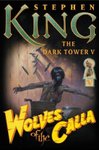
Review 111 – Wolves of the Calla

Wolves of the Calla by Stephen King

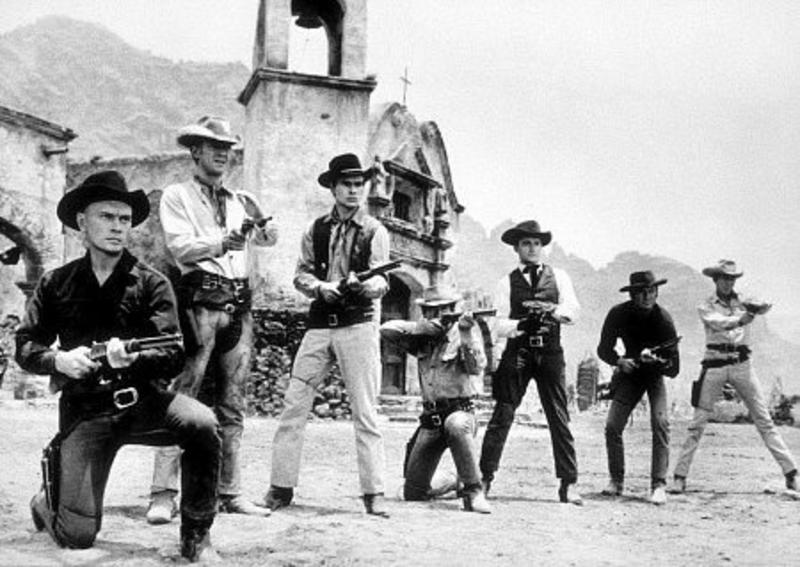
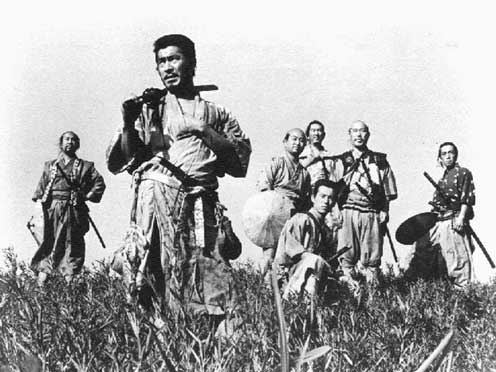
Okay, before we get into this book, let me take a little survey: Have you ever seen The Seven Samurai? How about The Magnificent Seven?

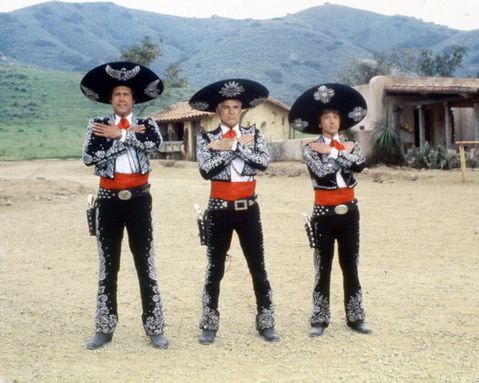
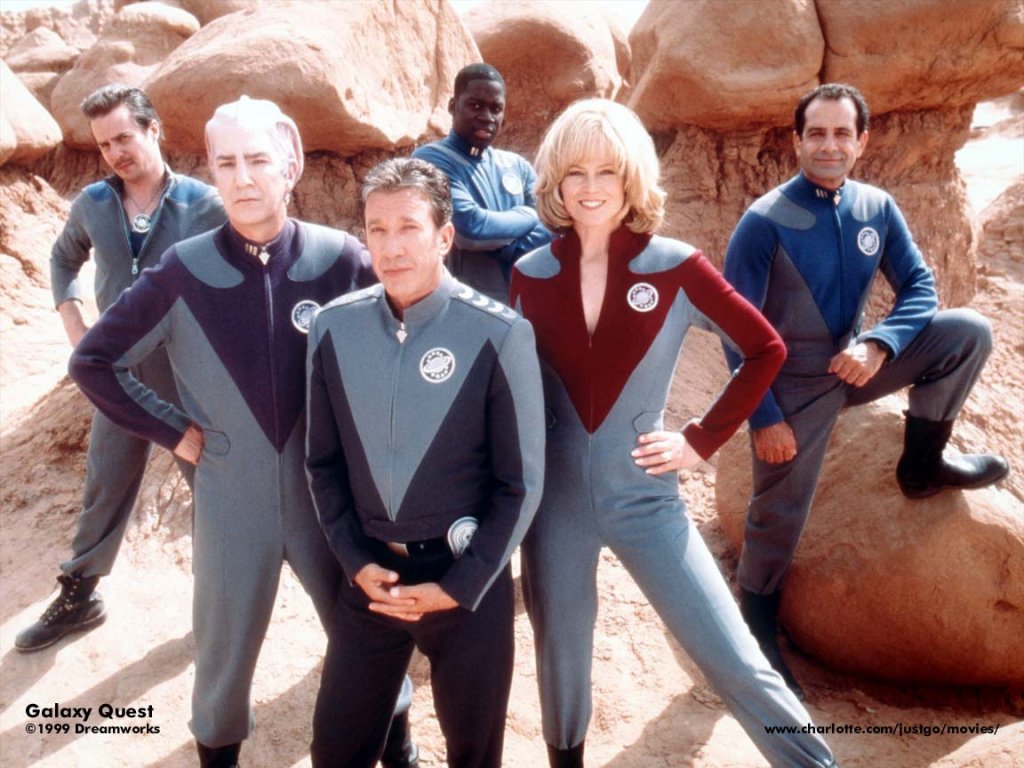
The Three Amigos? GalaxyQuest?

If you’ve seen these movies, and any number of stories like them, then you know the basic outline of this book. Say it along with me now….

'We deal in lead, friend.' - Vin

Calla Bryn Sturgis, a small farming village on the far end of the world, is notable for a few things. Its rice, its peaceful people, and its abundance of twins. The farmers of Calla Bryn Sturgis want nothing more than to live their lives in peace, but their idyllic existence is threatened by invaders from the east.

They come from the evil town of Thunderclap, once a generation – the Wolves. Armored and cloaked in green, riding identical deathless gray steeds and armed with terrible weapons, the Wolves come to Calla Bryn Strugis to steal one child from every set of twins. They take them to their dark city, and when the children come back, they come back as damaged goods. “Roont,” the Calla-folk call them, and it’s an apt word for they are ruined indeed. Over the years, these children, whose minds have lost all of their intelligence and humanity, grow into pain-wracked giants, and then die horrible deaths years before their time.

No one knows why the Wolves come, and no one has ever even considered trying to stop them. Until now.

Word has come that Roland and his ka-tet – Eddie, Susannah, Jake and Oy – are in the area, and if anyone can stop the Wolves, it would be Gunslingers. If the people of Calla Bryn Sturgis can convince them to help, and are willing to fight alongside them, then they have a chance to repel the Wolves once and for all.

If only it were that simple.

'Once more, we have survived.' - Kambei Shimada

Interlaced with this this pretty straightforward tale is, of course, the larger story of the quest for the Dark Tower and the fight against those for whom the Wolves are merely agents. A new warrior in this fight is Father Donald Callahan, whom we last met way back in ‘Salem’s Lot as a broken and ruined priest, damned by a vampire king and sent out into the world to live or die as he pleased. Through his damnation, Callahan has found himself able to see things he shouldn’t be able to see, including the various classes of vampires and the Low Men – agents of the Crimson King who serve His interests in the various levels of the Tower. Callahan discovers a knack for traveling through the Americas along secret highways. In his ramblings from coast to coast, looking for peace – or death – he slips from one version of America to another, never knowing how or why.

In the end, he brings himself to the attention of forces far greater than himself. It leads to his death and reappearance in Roland’s world, but more importantly it puts him in possession of an object of great power and even greater peril – Black Thirteen, an inky sphere that could be the black eye of the Crimson King himself, and which has the power to send its bearer through a door to any point in space or time.

Roland and the others are going to need that door, too. While they’re busy planning their battle against the Wolves in Calla Bryn Sturgis, they have another fight to win, in another world. In New York of 1977, there is a vacant lot, and in this lot is a rose. The rose must be protected at all costs, for it is the other end of the Tower – one axis upon which all the worlds turn. This lot is in great peril, and it is imperative that our heroes keep it safe. By whatever means necessary.

'Oh GREAT!!! REAL bullets!!!' - Lucky Day

It’s a really good tale, and one that is actually better than I remember it being. The first volume after King’s near-fatal accident, it’s all put together very neatly, while getting us set up for events to come, even if some of them aren’t entirely clear, or seem a little random at first glimpse. For example, Roland discovers that he’s beset by the Dread Foe Arthritis. As it is now, it’s making him kind of achy, but should it spread to his precious shooting hand, then it’s all over for him. Why King decided to afflict Roland with something as mundane as arthritis isn’t entirely clear (although to be fair, Roland is technically over a thousand years old and could be considered due for a few of the ravages of old age).

Perhaps it is a sign of Roland’s encroaching humanity. In The Gunslinger, mention is made of his ability to detach himself from his body somewhat so as not to feel thirst. In that book, he is largely mechanical, only showing any kind of real emotion when he finally faces the Man in Black. Over the course of the series, Roland has become more tuned into what it means to be a person and to feel, y’know, feelings and things. This gives him the bond with his ka-tet that he needs, but it also comes with a price. Perhaps the arthritis is the first price he must pay for allowing himself to feel.

Mention must also be made here of poor, beleaguered Susannah. I mean Detta. Odetta. No, wait – Mia.

'Never give up, never surrender!' - Jason Nesmith

Out of the seething cauldron that is this poor woman’s mind, a new personality has emerged. Mia, Daughter of None is still something of a mystery to us. As far as we know, she has only one ambition – to protect the child growing in her belly. This child was not fathered by Eddie Dean, Susannah’s beloved husband, but by the cold and unnatural demon that Susannah held at bay while the two men pulled Jake from his world to theirs. Growing within her now is something horrible, something that Mia was born to protect, even at the expense of the body she inhabits. Right now, that’s all that she is, and her greater purpose is yet to be revealed.

King does a pretty good job of juggling the various plot lines in this book, making sure that we aren’t left hanging for too long on any of them. Of course, they feed into each other as well – Father Callahan’s tale interweaves itself with the story of New York in ’77, and its ultimate conclusion allows the plot to progress through this book and into the next. I actually enjoyed Callahan’s story a great deal, and thought it would have made for a wonderful stand-alone short story. Not a novel, as there’s a whole lot of “I walked around for a few years and did manual labor” in there, but the story that he told to Roland and the others would have stood on its own quite nicely. He’s an interesting, complex character, and I look forward to seeing what awful thing happens to him next.

What’s more, there’s a wonderful meta-fictional element to this book as well, and it introduces that idea of a story that is aware of itself being a story. For example, in the beginning of the book, Eddie notices that time has started up again. While it is true that time, like everything else in this world, is unreliable, I found it interesting that he should make mention of it at that point, right when their story starts up again after a break (from our point of view) of six years. From the characters’ points of view, on the other hand, the time between books is indeterminate, but Eddie notices that they don’t seem to really do anything in that intervening time. It made me wonder about what happens to fictional characters when they’re not being written about, a train of thought for which I am not adequately medicated.

Think about it....

More importantly, the impact of real-world fiction becomes painfully obvious in this book. For one, Stephen King is established as an as-yet-unseen character, which comes right on the heels of a very serious existential crisis for Father Callahan. The Wolves themselves are explicitly noted to be rip-offs – er, homages to fictions ranging from Marvel Comics to Harry Potter. Whatever else Roland’s world is, it has a very close connection with the fiction of our world, and that connection may offer important clues as to the true nature of their quest.

So, what purpose does this book serve in the greater series? Well, there are many out there who see Roland’s quest as being not so much for the Dark Tower as for redemption. After the loss of his love, his friends, his family and his homeland, Roland made himself into something that was only technically human. Over these books, he has had to learn how to re-connect, first with individuals, then as a small group, and now with a community. In this book, Roland has to come to grips with Calla Bryn Sturgis not just as a hired gun but as their leader, if only temporarily. He has to see himself as part of a greater whole, thus becoming – as I mentioned above – more human. Each book forces him to be more and more connected with those around him. The only question is if he can hold on to this new humanity before his quest for the Tower destroys him.

All in all, a good read, which moves ever-so-smoothly into the next book….

————————————————————
“First come smiles, then comes lies. Last is gunfire.”
– Roland, Wolves of the Calla
————————————————————

Wizard and Glass on Wikipedia
The Dark Tower Portal on Wikipedia
Stephen King on Wikipedia
The Dark Tower homepage
Wizard and Glass on Amazon.com

Leave a comment

Filed under adventure, Dark Tower, death, fantasy, fathers, friendship, horror, meta-fiction, murder, quest, revenge, robots, sons, Stephen King, survival

Review 107: Wizard and Glass

Wizard and Glass by Stephen King

So. Now that we’ve put three books behind us, and sit at the pivot of the series, it is time that we settle down and have ourselves a little palaver about Roland, the Gunslinger.

We know little about this man, the protagonist of our epic series. We know he’s a hard man, the kind of man who can cross deserts, brave oceans, and kill entire towns if need be. We know he’s a dedicated man, who will follow his quarry wherever they may flee to. We know he is single-minded, the kind of person who would allow an eleven year-old boy to fall to his death if that meant getting another foot closer to his precious Dark Tower. He is a hard man, Roland Deschain is. He is the Gunslinger.

But who is he really? Who was he before he started on this mad quest for something that may or may not exist? How did he get set on this path that could determine the fate of worlds, this quest that led to the deaths of everyone he ever loved? Who is he?

Blaine the Mono (art by Revenant42)

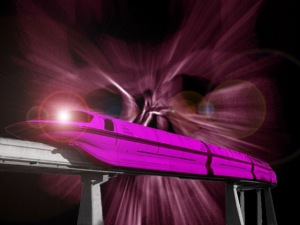
Well settle down, boys and girls, because this is where we get to find out. In between destroying a sentient monorail at a rigged game of riddles and facing off against the darkest Dark Man there is in a mock-up of the Palace of the Emerald City, Roland tells his ka-tet the tale that shaped him and set him on his path. It is a tale that begins with his entry into manhood – a trial by violence where he bested his teacher, Cort, in a duel to the pain, and ends with Roland’s soul nearly destroyed.

Roland and his companions, Alain and Cuthbert, have been sent by their fathers to the most out-of-the-way place they know – a small village called Hambry in the Barony of Meijis. Their alleged purpose is to count things, more as a punishment than a mission. They seem to be three boys who got into trouble, and who now must pay by spending their summer doing menial work. They don’t want any trouble, and they hope that no one will give them any.

They say there is a monster in the Citgo fields. Green, mayhap.... (photo by Cogito Ergo Imago)

That’s the story, anyway. In reality, they’re looking for evidence of the workings of John Farson, also known as The Good Man, who is leading a popular revolution against the established order in Roland’s home country, In-World. Hambry has an oil field, the work of the Great Old Ones, which is known to locals simply as “Citgo” Should Farson get enough oil – and the means to refine it – he will be able to revive ancient war machines and bring death to all of In-World. With Roland, Alain and Cuthbert as spies for the Affiliation, the Gunslingers in Gilead hope that they can stall, if not stop, Farson’s rebellion.

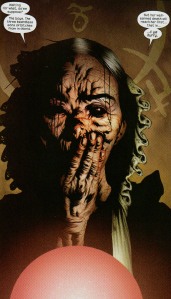
That would have been great if only Roland Deschain hadn’t met Susan Delgado, the daughter of a deceased horse-breeder and soon to be the promised girl of the mayor of Hambry. As soon as they meet, their destiny is clear: it is true love. No more able to stand against their fate than a tree in a whirlwind, Roland and Susan do as all young lovers have done, and risk discovery and death in the process. In every corner there are those who would stand against them: Susan’s spinster aunt, Cordelia, who hopes to make some money selling her niece off to the mayor; the Big Coffin Hunters, three mercenaries who work for Farson and who mean to see every last drop of oil gets in his hands; and Rhea of the Cöos, a horrible witch who possesses a crystal orb that lets her see all the malicious things that people do. Against these arrayed forces, Roland and his friends must not only foil the plans of John Farson, but also escape Meijis with their lives.

With the first, they are successful. With the second, not so much.

Dark Tower fans that I have talked to generally agree that this is the best book of the seven, for many reasons. First, we get to see Roland before he became all tall, gritty and scary. We see him as a callow youth, a boy of fourteen who is in way over his head, tackling responsibilities that would be better handled by a grown man. They’re on the losing side of a terrible war as it is, as they’re up against the combined cunning and guile of some very bad people. In many cases it is luck as much as skill that leads them to their eventual victory.

Roland and Susan (art by Jae Lee)

What’s more, we get to see Roland in love, and this is really where King shines in this book. He says in the afterward that he was dreading writing this book, mainly because he knew that he would have to portray teenage love – first love – in a realistic fashion, which can be hard to do when you’re several decades removed from being a teenager. All the madness that comes with teen love – the longing, the furtive trysts, the absolute certainty in what you are doing and that no one can stop you. The way that the person you’re in love with is all you can think about, and the only thing you want is to be with them again, if only for a moment. The way you freely and willingly lose your mind for love.

It’s something which, thankfully, we grow out of as adults. Frankly, if I ever felt like that again, I’d probably throw myself under a train.

King has done a fantastic job with the relationship between Susan and Roland – it’s as realistic as he can make it, without being mawkish and overly romantic. We are never allowed to forget that, like so many doomed lovers before them, they are risking everything with their love – their mission, their friends, and their lives – and we know that even the slightest misstep can mean disaster. Mixed with the other, more adventure-driven elements of the plot, it’s incredibly tense, and it’s handled very well.

The romance aside, there are some wonderful characters in this book, and as is the case with so many Stephen King novels, the best ones are the bad ones. Susan’s aunt Cordelia is a bundle of jealous paranoia, and you can feel her mainspring winding up every time she shows up on the page. Eldred Jonas is a laid-back killer, an old man who has buried countless young men, and means to bury Roland and his friends. And Rhea is just palpably foul. You can almost smell her when she shows up, which is a great accomplishment – and you can’t wait to see her again.

Rhea of the Cöos (art by Jae Lee)

As an aside, Marvel Comics has been doing comic book stories of Roland’s youth, and the first one re-tells this tale. It’s called The Gunslinger Born, and while it’s not bad, there is a certain emptiness to it. It’s not easy to compress hundreds of pages of character and plot development into a seven-issue comic series. I don’t know how it would read to someone who hasn’t read this book, but to me it looked like it was missing a whole hell of a lot….

As I said, this book is the pivot on which the series turns, and it is essential to understanding Roland. We have to know who he was and how he became who he is. While there are still questions to be answered, and stories to be told, the big story is out. Now he and his ka-tet can continue in their quest for the tower, confident that they know a little more about this man who yanked them from their worlds into his. For us, the character and his world become richer, more full of meaning. Things that we might not have thought about in the first few books become more meaningful, and we can better appreciate the history of his dying world. Most importantly, we can begin to understand why it is so important that he find the Dark Tower, and we pray that he knows what to do when he gets there.

—————————————————–
“I’ll pay ye back. By all the gods that ever were, I’ll pay ye back. When ye least expect it, there Rhea will be, and your screams will break your throats. Do you hear me? Your screams will break your throats!
– Rhea Dubativo of the Cöos, Wizard and Glass

Wizard and Glass on Wikipedia
The Dark Tower Portal on Wikipedia
Stephen King on Wikipedia
The Dark Tower homepage
Wizard and Glass on Amazon.com

2 Comments

Filed under adventure, coming of age, Dark Tower, death, fantasy, friendship, murder, quest, romance, sexuality, Stephen King, teenagers, witches, wizardry, world-crossing

Review 75: The Eyes of the Dragon


The Eyes of the Dragon by Stephen King

Sometimes you are surprised.

Stephen King has long been associated with horror, and deservedly so. His career began with works like Carrie, Christine, Firestarter, The Shining and so on, all designed to scare the everlovin’ out of any poor soul who picked up the book – and usually succeeding. What’s more, the books often became movies, thereby allowing that segment of the population who doesn’t read much to be terrified.

So for years, King has been called one of the scariest authors alive. I’ve seen cartoons attempting to portray Halloween at his house, bedtime stories for his children, and the horrible, dark confines of his imagination. The mind of King is where the terrors dwell, most think – the monsters, demons and vampires.

And Flagg.

But this book is where King really strayed from the image that had been built for him in popular culture. This story isn’t a horror story, no matter what the quotes on the back of the book imply. This is a fantasy story. It has some tense and scary moments, yes, but it’s a fantasy through and through, built with some of the most well-worn elements of fantasy storytelling. We have all of the necessary elements before us:

The King – King Roland (no relation to the Roland of the Dark Tower Series, as far as we know), the fairly capable and mostly well-liked king of Delain. He has served his kingdom well, and grown old and, if not wise, then at least experienced. He’s not the best king, nor is he the worst. The most that can be said of him is that he tried his best and hoped that his son would do a better job than he had. Of course there is also….

The Queen – Queen Sasha, beloved of Roland. She was the light of his life, and the guiding hand on his shoulder. Many in Delain agree that Roland could have been a despot were it not for his beautiful and kindly wife whose compassion and good sense would eventually save the kingdom. She bore two sons, the first of whom was…

The Prince – Prince Peter, the shining star of the family. Wise beyond his years, strong and fair, everyone loved Peter. He won awards and friends, and was all in all a good son, one that any father would be proud to have. Most people, knowing that Peter would be the next king, felt that the future of Delain was safe. Peter had a brother….

The Second Son – Prince Thomas, forever standing in his brother’s shadow. Not only was Peter older and more capable than Thomas in every way, there was an additional burden on his young mind. With the birth of Thomas, his mother, Queen Sasha, had died. And so it was that Thomas grew up the guilty one. He sought the love of his father, who thought the sun rose and set on Peter. And while Peter made every effort to extend the hand of brotherly love, Thomas felt only resentment and jealousy. Little did he know that his destiny had been guided from the beginning by….

The Evil Wizard – Flagg, that undying demon whose black and poisonous presence had been in Delain every time the country fell into ruin, and who intended to do it once again. A master of spells, potions and poisons, to speak his name was to invite horror, pain and death. He stood in Roland’s shadow, quietly twisting his mind over the years. His ultimate goal was a millennium of darkness for Delain, and he knew just how to bring it about. The only thing standing in his way is the possibility that Peter could be king.

I’m not sure whose story this is, which makes it all the more interesting. On one hand, it’s Flagg’s story. In his dark desire to see Delain in chaos, he manipulates the King and his family to bring the kingdom to the brink. A little patient planning, some good preparation, and Flagg manages to frame Peter for the vicious murder of his father, the King.

Suddenly the Golden Boy is a despised murderer, patricide and regicide, and sentenced to spend the rest of his natural life imprisoned at the top of Delain’s tallest tower, the Needle.

But, then, maybe it’s Peter’s story. He is caught, an innocent victim in this web spun by Flagg. But he was well-taught by his father and mother. His father taught him to be strong and kingly, his mother to be kind and human. The combination made him into something that Flagg could not stand – a good person and potentially a good leader.

Even in his lofty prison, Peter isn’t willing to give up. With some clear thinking and a lot of patience, he manages to work out a plan to escape. Because he is a good man, he has friends willing to help him, to do favors, who will perhaps help clear his name and end the less-than-spectacular reign of his brother, Thomas.

Then again, maybe it really is Thomas’ story. The narrator (the presence of whom gives this story a wonderful fairy tale feeling) takes pains to show us that, while Thomas is a sad, confused, and sometimes cruel man, he’s not really bad.

Full of fear and self-loathing, Thomas is the perfect tool for Flagg. Under his dominion, the kingdom starts to slide towards the chaos that Flagg so richly desires. Thomas is a good example of what happens when a weak person, guided by circumstance and cruel greed, takes power. But even Thomas is not irredeemable – despite the mess of his life, he possesses a secret that could ruin everything Flagg has tried so hard to create.

As with so many of King’s really good books, we are presented with not only an excellent cast of characters, but also excellent storytelling. In many of his author’s notes, he refers to us as Steadfast Reader. He never forgets who has given him his fame and his reputation – the readers. By using a storyteller to present this tale, he acknowledges and speaks to us as though he were telling us the story directly.

Much like it can be a story about many people, it’s a story of many messages. It’s about hubris and the belief that one cannot possibly fail in one’s Evil Plans (happens to me all the time). It’s about honor and loyalty and standing by what’s right, even when the whole world is against you. It’s about being able to redeem yourself, no matter what horrible things you might have done in the past. It’s a story about love and hope and faith, one that never gets old no matter how many times you read it.

I’m not sure how many times I’ve read this book by now, and I fully expect I’ll read it again in the future. If you’re not a King fan and you’re not too keen on reading about family dogs that turn into killing machines, insane telekinetic teenage girls, or possessed Plymouths that steal the souls of their owners, then this is the book you want to read.

——————————————–
“In those years, Thomas discovered two things: guilt and secrets, like murdered bones, never rest easy; but the knowledge of all three can be lived with.”
– Stephen King, The Eyes of the Dragon
——————————————–

Stephen King on Wikipedia
The Eyes of the Dragon on Wikipedia
The Eyes of the Dragon on Amazon.com
Stephen King’s homepage

Leave a comment

Filed under adventure, brothers, dragons, family, fantasy, fathers, friendship, murder, revenge, sons, Stephen King, wizardry

Review 73: Old Man’s War


Old Man’s War by John Scalzi

Somewhere in the unspecified future, humanity has reached out beyond the solar system, settling colonies wherever they can find a habitable planet. It’s the inevitable expansion of the Human Race, finally freed from its precarious position on Earth. With the new skip drive, capable of taking people vast distances in only a moment, a whole range of new and interesting worlds are open to hardy settlers willing to make new lives for themselves.

Unfortunately, there are many alien races out there with the same idea, who need worlds with similar climates and resources. And very few of them are keen on sharing with us. So, in order to protect the human race against its competitors, the Colonial Defense Force was set up – a space military whose basic mission is to deal with the alien menace by whatever means necessary.

No one on Earth has ever seen a CDF soldier. Nobody knows anything about them – how they fight, where they fight, or even whom they fight. People do know one thing, however – there’s always an opportunity to join. Protect and serve.

If you’re seventy-five years old, that is.

The CDF isn’t interested in hotheaded youths with no experience. While they have traditionally been the main component of the soldiering class, they are erratic at best, cannon fodder at worst. The CDF is looking for an entirely new type of cannon fodder, hopefully one with a better head on its shoulders. Therefore, the CDF recruits from the elderly. The theory is that once you get to be seventy-five years old, you’ve seen a bit of the world, you know how much you don’t know, and you’re less likely to be infected with the special brand of insanity that comes along with being in your late teens and early twenties.

So, on your sixty-fifth birthday, you go to the recruitment office for a routine physical and a basic description of what you’re in for. Ten years later, if you’re still around, you join up for real. There’s no turning back, though. Join the CDF and your life on Earth is over. You will be declared legally dead, and there will be no coming back to your home planet, ever.

For many people, this might be a somewhat intimidating proposition. After all, the Earth is the only home we have. But once you’re seventy-five and looking your mortality straight in the eyes, it might be a reasonable price to pay.

As for the myriad physical problems that come with being 75, well, there are ways of getting around that.

The book follows John Perry, a widower-turned-soldier as he fights for the safety of people he doesn’t know, in a universe he’s only beginning to understand. Once he begins his new career as a soldier, he discovers that, to paraphrase Sir Arthur Eddington, the universe is stranger than he can imagine. He is taken to new and interesting worlds to meet new and interesting species of intelligent life and, more often than not, to kill them. Along the way, he has to deal with new takes on the old questions that have plagued philosophers for centuries – what is identity, what is duty, and what is the function of war? Even the nature of reality itself pokes its head in to cause a little trouble. All through this, John Perry is just trying to keep his head down and get through his tour of duty – but you know it can never be that simple.

This was Scalzi’s first novel, and as first novels go it was just the kind you want to have. Exciting, funny, nominated for a Hugo and immensely popular. To say nothing of being reminiscent of Heinlein (if Heinlein had had more of a sense of humor). Not only do we have a cracking good military space adventure, but we’re introduced to a far wider universe that Scalzi will later expand upon. The “Old Man’s War Universe” is vast and exciting, and as of this writing, there have been three more books that take place in it.

With that in mind, this book is mostly exposition. While the adventure parts are adventurous, the vast majority of this book is laying down the important concepts that are necessary to understand the book and those that follow. And so we get a lot of explanation about what the CDF is and how it operates, why it needs its soldiers and how they’re prepared for battle. We’re introduced to the BrainPal ™ and SmartBlood ™ and the MP-35 Rifle, truly one of the most useful weapons ever made by man. We meet a variety of alien species – some disturbingly ugly but gentle, others utterly adorable baby-eaters, and still more who believe that murdering other life forms is an act of religious grace for which the murdered should be thankful.

Lucky for us, Scalzi chooses the most logical way to do all of this exposition – the main character is as clueless as we are. He also needs everything explained, sometimes in vivid and gruesome detail, in order to make sense of the universe in which he now works. By following John Perry through basic training and his first year in the CDF, we start to understand the basics. The rest will come in later books, and our learning curve will be somewhat accelerated.

The book manages to hit all the right notes – it’s exciting, it’s poignant and it’s funny. John Perry has been given a quick and sarcastic sense of humor, which reminds me of a lot of my friends, so I felt an immediate kinship with him. We like the people he likes, we care about the things he cares about, and we understand what it is that keeps him going, even when he’s risking his own humanity in the process. In short, John Perry is a character who is at once singularly interesting and at the same time easy to identify with. This, I must say, is a tough feat to pull off.

If you like funny, exciting, universe-scale science fiction, pick this up. If you’re interested in how our eventual coexistence with aliens might one day go, give this a read. And by all means, if you’re a fan of Robert Heinlein – and you know who you are – definitely get this book.

——————————————
“If the universe is bigger and stranger than I can imagine, it’s best to meet it with an empty bladder ”
– John Perry, Old Man’s War
——————————————

John Scalzi on Wikipedia
Old Man’s War on Wikipedia
Old Man’s War on Amazon.com
Whatever – John Scalzi’s blog

Leave a comment

Filed under adventure, John Scalzi, science fiction, war

Review 19: Day of the Triffids


The Day of the Triffids by John Wyndham

I have a long fondness for Apocalyptic novels. The Stand was one of my early favorites from junior high school, and I really enjoyed its cousin by Robert McCammon, Swan Song. There’s something about the End Of The World that just grabs me and won’t let go. Maybe it’s the thought that, should the world end, I would be one of the survivors. The rule of law would break down, all shackles of modern life would be loosed, and I would finally be free to choose my own destiny. Which, knowing me, would probably be very short and end up with me getting shot by some kind of Mad Max pirate tribe.

I can say with some certainty, however, that in this book’s scenario I would not be coming out on top. Because I love astronomy.

Let me explain. This end of the world came in two parts, at least one of which was definitely of our own doing.

It started with a comet. Or a meteor shower. Or something, but whatever it was, it lit up the sky. Green streaks of light brightened the night skies around the world, and everyone who could go and watch them did so. I’m a sucker for a natural light show, so I probably would have spent the night watching the skies and enjoying myself. And I would have woken up stone blind the next day.

That in itself – the vast, vast majority of the human population on Earth being blind – would have been a pretty good apocalypse. Wyndham describes rashes of suicides, accidental deaths and, of course, murder in just the first few days. Without vision, the carefully crafted world we’ve made kind of falls apart. But it would have been survivable. Co-operation groups spring up pretty quickly, both voluntary and otherwise, where sighted people assist the blind in surviving. It would have been tough, yes, but not impossible, for the world to go on. If not for the Triffids.

While we don’t know what caused the green comet, the Triffids were definitely our fault. The product of bioengineering gone haywire, the Triffids are ambulatory carnivorous plants with a poison sting that can kill a grown man from ten feet away. And while they’re not intelligent, they are remarkably… aware. They follow sound, they learn and co-operate in hunting, and are very difficult to eradicate.

But by themselves, they’re manageable. Their stingers can be removed, even though they grow back eventually, and they make interesting garden plants. And they’re immensely profitable – the oil derived from a Triffid outdoes every other kind of vegetable oil available. In normal times, the Triffids are under human control and benefit humanity greatly.

The two problems, when put together, make for a truly terrifying end – an unstoppable, unthinking army of carnivorous plants, finally freed from their shackles. A world in chaos, half-blind and not sure if they have to save themselves, or if someone else will do it for them. And an exciting story.

The message of this book is pretty clear, and Wyndham wastes no time in making sure we get it, lest the adventure part of the book get bogged down. Don’t mess with nature. That’s pretty much it. Don’t mess with nature, because nature will inevitably come ’round and mess right back with you.

Wyndham has created a brave new world for us, with a wide variety of characters who all react to their new situation in different – and realistic – ways. Starting in London, we meet a diverse cast – from the girl who believes that the Americans will save her to the man who believes that polygamy is the way to a brighter future, everyone has an idea on how to survive. The narrator, Bill Masen, knows just enough to get the reader up to speed, but not nearly enough to know if he’s even going to make it out of this alive. With the help of other sighted survivors, he is determined to make a stand, not only for England, but for the human race as a whole.

But first they have to deal with the Triffids….

———————————-
“When a day that you happen to know is Wednesday starts off sounding like Sunday, there is something seriously wrong somewhere. ”
– John Wyndham, Day of the Triffids
———————————-

Day of the Triffids at Wikipedia
John Wyndham at Wikipedia
Day of the Triffids at Amazon.com

1 Comment

Filed under adventure, anarchy, apocalypse, England, John Wyndham, made into movies, science fiction, society, survival

Review 16: Watership Down

Watership Down by Richard Adams

This is one of my top five books. Whenever anyone asks me, “What is your favorite book?” this is at or near the top. It was the first adult-length book I read when I was in Elementary school, and I have every intention of getting my hands on a copy for my goddaughter at some point soon. I remember watching the movie when they used to show it annually on CBS, way back in those days beyond recall….

Why should this book, of all the books I’ve ever read in my life, stay so dear to me? I have no idea. Perhaps because, even though its main characters are rabbits, it isn’t a “talking animals” book. Adams didn’t talk down to his readers, and assumed that they were ready to follow Hazel and Fiver wherever they went. And so, unusually for children’s literature, there is violence and loss and true danger in this book. Characters die. Unpleasantly. The rabbits live in fear of mankind and the Thousand, and accomplish great things despite. They do what no rabbit had done before, and find a new world for themselves. And, of course, are forced to fight for it.

Our heroes, you see, are living an idyllic life in a warren in England. They do what rabbits do – eat, sleep, mate, and entertain themselves. But one rabbit, Fiver, can see more clearly than others. He can sense danger, and grasp the shape of the future, and he knows that any rabbit who stays where they are will certainly die. With his brother, Hazel, Fiver and a small group of rabbits leave their home.

They do what rabbits never do – they explore. They go through dense woods and cross streams. They hide among gardens and search for the best place they can find to set up their new warren – a safe place, high in the hills, where they can see all around and the ground is dry. They seek to build a new society, as so many humans have done in our history.

And what’s more, they try to build the best society that they can. The need leadership, yes, but how much? How much freedom should the ordinary rabbit have to live its life? This question becomes more and more important when they meet the cruel General Woundwort, de facto leader of the warren known as Efrafa.

The battle that they have, choosing between personal liberty and the safety of the warren, is emblematic of so many struggles that have gone on in our world, and continue today. Through a tale about rabbits, Adams manages to tell us about ourselves, which is the mark of a great writer.

As cynical as I have become in my years, I still find this story to be honest and true. Adams isn’t trying to make an allegory or grind an axe. He’s trying to tell a good story about hope and perseverance and triumph over adversity, a story with – as Tolkien put it, “applicability” – that we can overlay onto our own lives and experiences. The fact that the main characters are rabbits is incidental.

Well, not really. Another layer to this story is the culture that Adams has created. The stories of Frith and El-ahrairah (which, I’ve just noticed, is misprinted on the first page of the contents in this edition as “El-ahrairah.” Weird) are sometimes deep and meaningful, sometimes fun and silly, but always relevant and rich, in the tradition of oral storytelling. There is a language to the rabbits, which is regularly used throughout the book (and one complete sentence in lapine – Silflay hraka u embleer rah. Memorable….) Adams did a lot of research into the social structure of rabbits and their lifestyles, making it as accurate is it could be….

Anyway, every young person should read this. Hell, older people should read it too. Every time I read the story, it moves me. I can hear the voices of the characters clearly and see what they see. I am inspired by the steadfastness of Hazel, the strength of Bigwig and the resolve of Blackavar. I find qualities in these characters that I would like to possess, and that’s as good a reason as any to love a book.

As a side note, this book is the reason I got into Magic: The Gathering way back in college. For a long time, I thought it was just a stupid card game, with no cultural or imaginative merit. Then I happened across a “Thunder Spirit” card, which had a quote from Watership Down at the bottom:

“It was full of fire and smoke and light and…it drove between us and the Efrafans like a thousand thunderstorms with lightning.”

Still gives me goosebumps.

Anyway, I thought, “Maybe there’s something to this,” and the rest was (very expensive) history….

——————————————-
“All the world will be your enemy, Prince with a Thousand Enemies. And whenever they catch you, they will kill you. But first, they must catch you, digger, listener, runner. Prince with a swift warning. Be cunning and your people will never be destroyed.”
– Frith, Watership Down
——————————————-

Watership Down at Wikipedia
Richard Adams at Wikipedia
Watership Down at Amazon.com

1 Comment

Filed under adventure, England, fantasy, made into movies, rabbits, Richard Adams, survival, totalitarianism, travel, war, young adult