Category Archives: good and evil

Books about the conflict between good and evil.

Review 144: Soon I Will Be Invincible

Soon I Will Be Invincible by Austin Grossman

It ain’t easy being Super.

You might be a hero, like Fatale. She is the latest in cyborg technology – a woman who was nearly destroyed in a freak accident, rebuilt by a mysterious corporation and made into the perfect living weapon. She is fast, she’s strong, and for a while she was one of the U.S. government’s best operatives. But now she’s on her own, and life is tough as a cyborg. You have parts to deal with, the need to keep your power source going, and of course it’s hard to enjoy a night out when everyone keeps staring at the half-metal woman in the booth near the window. Fatale wants to be a hero, though, and the re-formation of the Champions is just what she needs. If she can prove herself to this team, she can find a new purpose to her life.

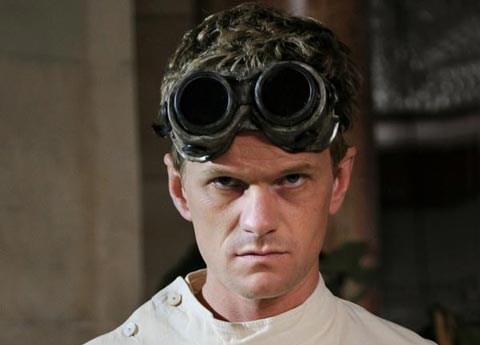
A different, though equally self-aware, Evil Doctor.

If not a hero, you could be a villain. Doctor Impossible has certainly lived up to his name. In his many years of villainy he has come up with just about every nefarious scheme an evil, quasi-invulnerable genius can cook up in his twisted, malevolent brain. He’s been to the past and the future, he’s swapped brains with the greatest heroes of his age, he’s escaped from inescapable prisons more than once. Of all the would-be conquerors on Earth, Impossible is the one who would be voted most likely to succeed. And yet he isn’t happy. His life isn’t what he thought it would be, and it doesn’t take a genius to see that Doctor Impossible has a few problems that even his great genius cannot solve.

When Impossible breaks out of prison – again – the Champions re-form to hunt him down. With old and new members joining together to keep the flame of heroism alive in their world, the Champions are determined to find Impossible and shut him down for good. The only problem is that the person who has always succeeded against Impossible, a hero who calls himself CoreFire, is missing. Without him, their chances are greatly diminished. Against an evil genius like Impossible, who can defeat the team armed with little more than his wits and a false tooth, you want to throw everything you can at him. What’s more, the internal tensions pulling at the Champions may defeat them before Doctor Impossible even gets the chance to try.

This book, like so many other modern renditions of super-heroes, has its roots in Alan Moore’s Watchmen. While he was not the first to make his superheroes less than super, he was certainly the best, and his work is well-remembered for that. After Moore was done, it was hard to think of superheroes as entirely pure, good and noble. We could see the tensions between them, the neuroses that drive them to do what they do, and we began to understand that our heroes were just like us, only moreso. Ever since then, writers have been trying to de-super the superheroes and make them into regular people who just happen to be able to shoot lasers out of their eyes, break the laws of thermodynamics, or bend steel in their bare hands.

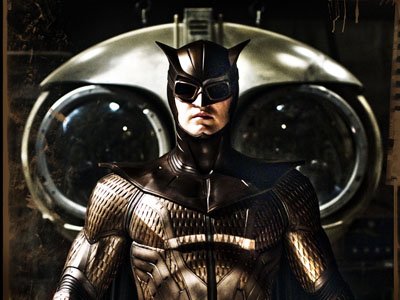
Not pictured: Impotence

Grossman has taken full advantage of the work that has gone before him in this novel. The story is told from the alternating perspectives of Doctor Impossible and Fatale, and proceeds to deconstruct both the heroes and the villains in visceral, raw detail. What is it like to be a cyborg, something halfway between human and superhuman? And how can you join a team like the Champions, a team of legends among legends, and feel up to the task? What happens when you realize that the heroes you looked up to are just as human as you are? Or at least, as you used to be. On the other side, what makes a villain what he is? What happened to Doctor Impossible that put him on the ever-unfulfilled path to world domination? Was he destined for it, or was it a series of choices, insignificant at the time, that led him to where he was? How did his genius get turned to evil, and what, if anything, keeps him going?

The problem with deconstructing superheroes is that once you’ve deconstructed them, there’s really nothing left. Being a superhero is a fundamentally irrational career choice. Watchmen hinted pretty heavily at this, since all the heroes in the story had been pretty well messed up by their days in tights. There are so many problems that crop up once the spandex and mask are put on that you may find it’s not worth the effort. Legal issues, financial problems, time constraints and unstable relationships aside, what does this choice say about your state of mind? What kind of person can take up the job of costumed hero and stay sane? When you come right down to it, even if you have superpowers there are so many other ways you can use them that are less risky and more beneficial to humanity than getting into fistfights that destroy city blocks.

Lex, we... we think you may have a problem.

The same goes for villainy. So often you see bad guys with technology that is honestly amazing in its scope – Captain Cold’s freeze ray, for example, would make him rich if he patented it and licensed derivative technologies. Much richer than if he ever succeeded at using it to rob jewelry stores. Doctor Doom builds machines that are so far beyond current science that he could rule his own country – oh wait, he does – instead of single-mindedly trying to destroy Reed Richards. Lex Luthor would be grinding his teeth in envy over the power that Steve Jobs or Mark Zuckerberg or even Rush Limbaugh have. And none of them have a would-be Kryptonian conqueror to spur them on, either.

That’s the secret heart of superhero stories – they rest on fundamentally irrational choices. Take away those urges to help or harm and you are left with simple absurdity. And that’s kind of where this book falls down.

There’s plenty of navel-gazing and deconstruction going on in this story, from all angles. Between Fatale and Doctor Impossible, they pretty much reason away any good reasons for getting into the game as a hero or villain, and yet – there they are. Impossible is the worse of the two, really. His narration shows him to be an insightful, intelligent, and fairly well-grounded man who probably could become one of the most powerful men on earth through conventional means. And yet, even knowing that it’s probably a waste of time, he continues with his grand scheme – in this case, gravitationally manipulating the distance between the moon and the Earth so as to hold the Earth hostage. He knows he’s going to lose. He knows there are better ways to be effectively evil that don’t involve a metahuman punch to the face. He knows when he’s acting in a stereotypically villainous way. And yet he persists, usually in the most cliched way possible. He spouts comic-book-villain monologues and even has an island fortress from which he operates.

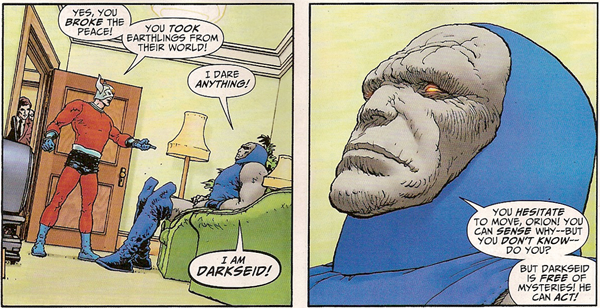
"But right now Darkseid's stories are on."


Neither Fatale nor Impossible – nor any of the other good or bad guys we meet – seem especially happy doing what they’re doing. And what’s more, they know they’re not happy. Doctor Impossible even goes so far as to state it explicitly during his moment of triumph – “For a second, I find myself at the fulcrum point of creation. God I’m so unhappy.”

Well, if you’re such a genius, perhaps you would be able to make better choices than this.

Therein lies the paradox of this book. The more human you try to make these characters, the less believable their story becomes. You can’t be both human and superhuman at the same time – it takes a very skilled writer to pull that trick off, and I don’t think Grossman is there yet. He tells an entertaining story, full of pretty much every comic book trope you can think of, which entertained me to no end. The problem is that by the time you get to the finale the unstable foundation of the story starts to show. How much you’ll enjoy the story depends on how good you are at filtering out the deconstruction that’s going on, which means missing the point of the whole book – that the only way to really enjoy superheroes is to accept them at face value and avoid deconstructing them.

So yeah, good luck with that.

—————————————————-
“When you get your powers, you learn a lot about yourself. My professors called me mad. It was time for me to stop punishing myself, and start punishing everybody else.”
– Dr. Impossible, Soon I Will Be Invincible
—————————————————-

Austin Grossman on Wikipedia
Soon I Will Be Invincible on Wikipedia
Soon I Will Be Invincible homepage
Soon I Will Be Invincible on Amazon.com

Leave a comment

Filed under adventure, Austin Grossman, comic books, futurism, good and evil, science fiction, super-heroes, supervillains

Review 137: The Last Watch

The Last Watch by Sergei Lukyanenko

This review is acceptable to the forces of Light. – The Night Watch

This review is acceptable to the forces of Darkness. – The Day Watch

When I finished The Twilight Watch a couple of years ago, I thought that was it. Night, Day, Twilight, done. But when I announced that I would be doing the Night Watch trilogy as my end-of-month podcast, I got several emails from listeners who were quick to correct me. The series is not a trilogy, they said, but rather a tetralogy (okay, no one actually used this term). There is a fourth book out there, and I had no idea it existed!

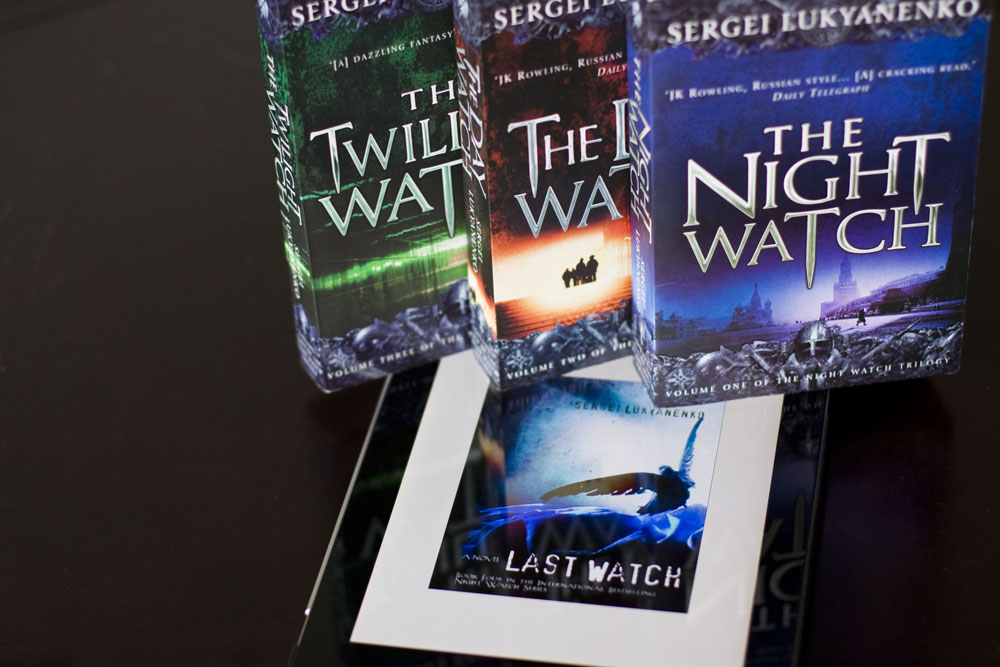
Also thanks to modern technology, I can recycle images! Everybody wins!

Thanks to modern technology, I was able to get the final (as far as I know) book, The Last Watch on my Kindle and get myself up to speed.

Much like the previous volumes, this one is divided into three novellas, which all tie together into a greater plot. In the first, we are once again introduced to Anton Gorodetsky, an agent of the Moscow Night Watch. Due to the events of the last book, Anton is now a Higher Other, having been elevated by the use of the fuaran a mystical book that can create or raise Others. His abilities are far beyond most, and that makes his responsibilities that much greater.

He is assigned by his boss, Gesar, to investigate a mysterious killing in Edinburgh, Scotland. A young man, the son of a Russian magnate, has been murdered, and it looks for all the world like a vampire – a Dark Other – has done the deed. The pact between the Dark and the Light expressly forbids such actions, and the violation of treaty could lead to terrible consequences for all.

You'd think a Scottish vampire wouldn't be so hard to find....

Problem is, the Day Watch has no idea who or what killed the young man, and they’re just as hot to find the killer as Anton is. And of course, the clues don’t add up. The method of the murder doesn’t fit the M.O. of your standard vampire, and the place where the murder occurred – a horror funhouse in the middle of the city – has its own mysterious properties as well. Anton knows he’s on the right track, though, when someone tries to kill him, and he ends up fighting his way through the Twilight to get his answers. What he finds, however, is evidence that the mythical Merlin had left something in Edinburgh for safekeeping. Something truly terrible, no matter whose hands it fell into.

In the second story, Anton is sent out to Uzbekistan to find one of the greatest Others who had ever lived, a man by the name of Rustam. Almost a legend among Others, Rustam is probably the only one who can come even close to figuring out what Merlin hid, and why. But he won’t be easy to find. Anton not only has to deal with the Watches of Samarkand – which are far less efficient and well-staffed as others in Europe – but there’s still someone out to kill him. This time, though, they’re using ensorcelled humans to do the job, something that is also expressly forbidden.

It soon becomes clear that there is a small conspiracy of very powerful Others – one Dark, one Light, and an Inquisitor, who serves neither – who are trying to recover the artifact that Merlin left behind. Their reasons are unknown, but they’re willing to destroy anyone who poses a threat to them. Including, of course, Anton.

It is in the third story where the whole plan finally comes together. That three-person conspiracy is determined to get their hands on Merlin’s power, to collapse the Twilight and fundamentally change the world. If they have to kidnap Anton and threaten Moscow with a nuclear warhead to do it, then so be it. Their ends are, in their minds, wholly justified. It is up to Anton and his allies to avert this tragedy and see to it that the power they seek is never wielded by anyone ever again.

As with the other books, the great supernatural action hides a greater exploration of the fundamental differences between right and wrong, good and evil. As terrible as the Last Watch are, they are doing what they believe to be right, and even Anton can come to understand their motives at one point. But they way they go about it, through dark magic and darker murder, doesn’t nearly justify their aim. And so we see that evil done in the pursuit of good merely produces more evil.

Or how you define "Eeeeeevil."

Depending, of course, on how you define “evil.”

What’s more, there’s quite a bit of metafiction in this book. It’s clear that Lukyanenko is a fan of fantasy – he references Tolkien and Pratchett, just to name a couple of great authors. But he also knows the tropes of fantasy that have survived for so long, and makes sure his characters know them as well. When words are written on the walls, when people go in search of a great object of power or an unwinnable quest, chances are that one of the characters has read something like it in a fantasy book.

Go ahead. Write a 5,000 page epic fantasy about these guys.

At one point, when talking about how there are Others who would like to rule the world, the Inquisitor Edgar notes that it’s what people really want. It’s why fantasy is so much more popular than science fiction, he claims, because everyone dreams of being the magician or wielding the magic sword. It all makes sense, in a way that science fiction doesn’t. Anton, of course, doesn’t buy this, noting that most people who live in a Medieval Thaumocracy would be just like the peasants of long ago – poor, dirty, and dead by forty. So even in a world where magic is very real and very important, the characters know the difference between fantasy and reality in a way that we can relate to. I just find that fascinating.

It’s good fun, and a nice way to close out a very imaginative series. It’s exciting and heartbreaking and funny – with a nice hat-tip to the Night Watch movie thrown in near the beginning. What’s more, it’s a well-built magical system and society that allows for a great variety of stories and characters. Honestly, I would love to see Lukyanenko expand on this universe, or even open it up for others to play in.

————————————————
“There is very much in the world that is bad. But usually the attempt to defeat evil engenders more evil. I advise you to do good; that is the only way to win the victory!”
– Rustam, The Last Watch
————————————————

The Last Watch on Wikipedia
Sergei Lukyanenko on Wikipedia
Sergei Lukyanenko’s website (in English)
The Last Watch on Amazon.com

Leave a comment

Filed under afterlife, apocalypse, death, detective fiction, fantasy, ghosts, good and evil, morality, Russia, Sergei Lukyanenko, vampires, werewolves, witches, wizardry, world-crossing

Review 127: The God Engines

The God Engines by John Scalzi

There is not, to my knowledge, a whole lot of theological science fiction. Madeleine L’Engle’s books may qualify, but to be honest, it’s been years since I read them so I don’t know. The Golden Compass books, too, but they struck me more as fantasy, seeing as how there were no spaceships. My only successful foray into National Novel Writing Month produced some theological sci-fi, but it was questionable at best and is still fermenting on my hard drive somewhere.

In any case, that is what John Scalzi has given us, and if you’re a regular reader of his blog and his other books then you may find this one to be a little… off. You see, like many accomplished writers, Scalzi has a Voice, a way of writing that is immediately identifiable as his own, and which a lot of his fans have gotten used to. There’s no single thing I can point to that really illustrates what this is, but trust me – it’s there. A certain whip-quick sarcasm, a way of looking at old questions from a new angle and the ability to cut through the requisite fuzzy thinking that seems so endemic to the human race.

Not quite like this... but kind of.

In this book, he tries on a new voice, something that sounds kind of like his, but at the same time like he’s trying on something new. It’s as if Jonathan Coulton started doing Manowar cover songs. It’s not bad, it’s just something that takes a little getting used to.

Captain Ean Tephe is the commander of a great starship, the Righteous, one of the many ships in the fleet controlled by the Bishopry Militant. He and the other captains in the fleet are charged with carrying out missions for the Bishopry in the name of their God, a being of immense power who uses the faith of millions to rule them. Their Lord is a powerful and active god, one who brooks no dissent from His followers and who will suffer no challengers to His dominion. Long ago, the Lord battled countless other, smaller gods, and won, chaining them to his will and turning them into the engines of the great starships that carry His people out into the universe.

Some gods are less tractable than others. (art by Evolvana on DeviantArt)

The god that powers the Righteous, however, is not cooperating. Some ships’ gods are quiet and obedient, others chatty, some cowed into good behavior by fear. The god on this ship is defiant, despite the prayers of priests and acolytes, and the horrible whip that the captain wields to compel obedience. This god soon reveals itself to be part of a greater plan, one which enfolds both Tephe and his crew and reveals a truth about their God that is enough to drive men mad. It is a test of faith for the men aboard the Righteous, and if they should fail, their lives will end in short order.

It’s a very cool concept, really, one which I haven’t seen done before. Scalzi has powered a civilization by faith, quite literally, in a God that not only exists, but it quite active in the lives of His worshipers. His high priests exert complete control over a population that rightfully fears for their souls, and manage to channel the God’s power into various science-like applications. Through the use of amulets called Talents, the God facilitates communication over great distances, compels obedience, and opens gateways. He has a civilian population whose faith nourishes Him, and a military arm that travels the galaxy spreading His word and destroying His enemies. And it all makes sense.

As cool as the idea is, though, the book itself felt like a rough sketch rather than a fleshed-out novel. It’s quite short, as novels go, and we are introduced to a lot of concepts and characters in a fairly brief amount of time. The Bishopry Militant, for example, sounds like a great place to see intrigue and double-dealing, lies upon lies that somehow manage to get things done, and we do see a bit of that when Captain Tephe gets a secret mission to a new world. Scalzi showed us in The Last Colony that he can handle this kind of multi-layered politicking, and I think it would be even better in a place like this. Add to that the Rookery, a kind of church-sanctioned brothel/therapy center aboard the ships, where the women who work there have nearly as much power and influence as the Bishopry itself. What would happen if these two institutions came into conflict, and what weapons would they wield?

This god has some opinions he'd like to share.

The chained gods, too, are a wonderful chance to explore a lot of ethical questions. They are undoubtedly sentient beings of great power, enslaved by a God that is stronger than they. Is this kind of slavery justified? Would it be possible for a ship to work with its god-engine, rather than compelling it with whips and prayers. What do these gods know, and how reliable are they? The god powering the Righteous seems to know a lot about how this universe works, including some terrifying tales about the God that Tephe follows, but how much of what it says can be trusted?

And what are the powers and limitations of a faith-powered science? Much in the way that engineers and scientists in our world manipulate a few basic laws of nature to achieve amazing things, what could be done in a world where prayers have power and where a high priest’s whim can decide the outcome of an entire mission? How do you creatively solve problems in a reality like this one, where they deal in belief and faith, rather than wavelengths and mass?

So yeah, there was a lot that I wanted from this book once I figured out what Scalzi was doing with it. After a great opening line (and a third line that just left me confused), the learning curve was a little steep. Once you figure it out, though, the possibilities seem endless. Unfortunately, the book itself ends rather sooner than it should.

The less said about this album, the better.

It’s not my favorite book by Scalzi, not by a long run, but since he’s said he’s going to lay off the Old Man’s War universe for a while, I should be thankful that he is willing to experiment and try new things. As many music lovers know, it’s sometimes very hard to accept that an artist you love wants to try to do things that are new and different, rather than keep doing the things that made you love them in the first place. I remember when U2 put out Achtung Baby and my friends who fell in love with The Unforgettable Fire and The Joshua Tree and Rattle and Hum were almost personally offended. Zooropa, of course, was not to be mentioned aloud in their presence.

That kind of experimentation and risk-taking, however, is ultimately what helps an artist grow. You may not like what comes of such experimentation, but that’s tough – it’s not about you.

I don’t know if Scalzi will return to this universe or not, but I hope he does. If he does, I hope he lingers longer than he did in The God Engines, and brings forth another wonderful and complex universe.

————————————————————
“Faith is not for what comes after this life. Faith is for this life alone.”
– A God, The God Engines
————————————————————

John Scalzi on Wikipedia
The God Engines on Wikipedia
The God Engines on Amazon.com
John Scalzi’s Blog

Leave a comment

Filed under gods, good and evil, John Scalzi, morality, religion, science fiction, sins, space travel, theocracy, theology, totalitarianism, war

Review 124: The Night Watch

The Night Watch by Sergei Lukyanenko

This review has been approved for distribution as conducive to the cause of the Light. – The Night Watch

This review has been approved for distribution as conducive to the cause of the Dark. – The Day Watch

Imagine a world where magic is real. A place where people known as Others are born with powers they don’t understand. Their destinies are unwritten until that fateful day when they first become an Other – when they discover the strange, shadowy and powerful world known as the Twilight – and have to make a choice: will they stand with the Light or with the Dark. Will they dedicate their lives to Good or Evil?

Maybe it ain't what it used to be, but it's still dramatic.... (art by mirerror on DeviantArt)

It’s not an easy decision to make, by any means. Joining either side has its limitations and its rules, for the battle between Good and Evil isn’t what it used to be.

Long ago, it was simple – Good fought Evil, Dark fought Light, and blood was shed on both sides. It was a vicious, unending war that threatened to decimate the world. Finally, the two sides reached an agreement. A Treaty, well deserving of the capital letter. There would be a truce between the two sides, a balance that would be maintained at all costs. Any act of evil would be balanced by an act of goodness, and vice versa. Neither side is to have an advantage.

Part of the Day Watch Auxiliary Brigade

Making sure the peace is kept is the job of the Watches – the Night Watch, staffed by elites of the Light to guard against advances by the Dark, and a Day Watch, staffed by the elites of the Dark to guard against excesses of the Light. We begin our look at the Others of Moscow with a young adept named Anton Sergeeivich Gorodetsky, a wielder of magic and an analyst forced into the more exciting realm of field work. His job is to find out who a pair of vampires are illegally attempting to seduce and stop them. In the process of doing that, and saving the soul of a young Other named Egor, he stumbles upon something that threatens the entire city of Moscow, if not all of Russia. A young woman has a curse upon her head, so horrible and so powerful that the forces of the Light may have no chance to disperse it. If she dies, the city will die with her. If she lives, even worse may befall the world.

There are three stories in this book, somewhat independent but entirely connected. The first details the discovery of Egor and the cursed Svetlana. In the second, an Other of the Light, a maverick who doesn’t know about the rest of the Others, or the Treaty between Light and Dark, is murdering Dark adepts. Somewhat alarmingly, Anton is being framed for the murders. In the third book, Moscow is gripped in a heat wave. In the midst of this, the leaders of the Light are attempting to change the world. Whether it ends up being for the better or the worse, no one can know. But Anton is convinced that it must not come to pass….

Team ANTON!!!!!

It’s a gripping fantasy, in a very complex world. It’s compared to Rowling’s work, and justly so (although I don’t think there’s much of a case to be made for an attempt to ride on Rowling’s coattails – Night Watch was originally published in 1998, only a year after the release of Harry Potter and the Sorcerer’s Stone). There are substantial differences, of course, making Night Watch a much more adult book than the Potter series. There are very few children, and the few that are there are not in very substantial roles. There’s far more drinking, smoking and sex in this, of course. But the world that Lukyanenko has created is every bit as deep and complex as the one Rowling has made. There are any number of roles that could be played, and an almost infinite number of situations that could be built on the fairly simple rules that are set up by the Light-Dark Treaty.

The biggest difference, of course, is in the complexity of the world. Rowling’s world is fairly definitive in its divisions between good and evil – there is good, there is evil, and there is no question of which is which. The evil characters are definitively evil, and the good characters are definitively good, and the reader doesn’t have to worry too much about who’s on which side, Snape notwithstanding.

The Others of Moscow, however, are not nearly so clear-cut. Yes, the Light is trying to do the work of the Good, to make the world a better place. But their machinations and their plots don’t always go as planned. See the Russian Revolution and World War II for examples why. They ignore the Law of Unintended Consequences and the horrors it can unleash. By trying to do Good, they unleash great evil upon the world.

He's just a big softie, really....

And how about the Dark? Yes, they’re populated by werewolves, witches and vampires, but they are advocates of utter and total freedom. They do not destroy for the sheer joy of destruction, but because they want to increase the personal freedom of the world. They’re not interested in making humanity “better,” or making a better world. They simply want to live in the world as it is, free from restraints – both internal and external.

While it may be pretty clear who is on the Light and Dark side, it’s not entirely clear who is doing Good or Evil at any given time. And, more importantly, it is almost impossible to know who is actually right.

It’s a great read – full of anguish and self-doubt and torture, like any good Russian novel should be. Anton knows that the Light doesn’t live up to the standards that it preaches, but he knows that he needs to be on the right side. He picks apart the intricate, decades-long plot of the Night Watch and very nearly figures out how to foil it. But even in revealing the truth, he does not manage to save the world from the doom of the Light.

Or does he?

We’ll have to read the next book and find out….

————————————————
“You accuse us of cruelty, and not entirely without reason, but what’s one child killed in a black mass compared with any fascist children’s concentration camp?”
– Zabulon, of the Day Watch, The Night Watch
————————————————

The Night Watch on Wikipedia
Sergei Lukyanenko on Wikipedia
Sergei Lukyanenko’s website (in English)
The Night Watch at Amazon.com

2 Comments

Filed under ethics, fantasy, good and evil, horror, identity, made into movies, morality, philosophy, politics, Russia, Sergei Lukyanenko, short stories, society, USSR, vampires, werewolves, witches, wizardry

Review 120: The Dark Tower

The Dark Tower by Stephen King

Well, here we are. After a long road – longer for some of us than for others – we have finally reached the end of The Dark Tower series. For some of us, it’s been twenty years in coming, so if you’ve only started reading this series recently, count yourself lucky. You don’t know how we waited for this book, the book wherein Roland would finally attain his goal, and we would see if all the sacrifices he made were worth it.

Were they? Kind of.
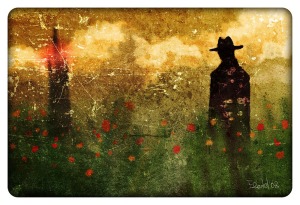
Art by Eredel on DeviantArt

I’ll get into more detail later, after I dutifully put up the “Here Be Spoilers” sign, but this is the book where everything gets resolved, and our heroes are given their reward for the hard work they have done. The bad guy is beaten, the world is saved, and all is well. Although “well” is a very relative term in this sense, and while the bad guy is beaten, it’s not very satisfying, and the reward that many of our heroes get isn’t necessarily the reward they would have chosen.

If I sound like I’m dancing around the story, that’s because I am. I have an aversion to spoiling books in these reviews, mainly because I know how satisfying it is to get into a good book and discover things. To see old characters appear from the past, and to witness the heroism of the characters we have come to love. To look at the journey they take and see their relentless pursuit rewarded. At the same time, I don’t want your experience poisoned by knowing the drawbacks to a book – the soft spots in the plot, the characterization problems, the disappointments and the heartbreaks. [1]

Art by lilbenji25 on DeviantArt

This book contains all of these, and if I avoid talking about them, then this review will be awfully short. So, Constant Reader, I tell you this: you can stop here. You can click away to another page, perhaps to Amazon to buy the book and read it yourself (I recommend the Kindle edition if you can – I have the hardcover and it is quite the doorstop), perhaps to put off the reading of the book for a while longer. You don’t have to learn things that will taint the journey of discovery that is reading , and you can live on with a vision in your head of how The Dark Towerseries should end, instead of how it actually does.

Would you stay, then? Very well. After this point, there is no turning back. What is learned, as they say, cannot be unlearned.

This is not the book I wanted. It is unbalanced, hard to get through, and disappointing in many ways. There are also some beautiful moments, and some interesting ideas which, upon post-reading reflection, make the whole story more meaningful. But my overall feeling was one of great disappointment. Let’s start from afar, shall we?

Art by DiosBoss on DeviantArt

The structure of this book is rather lopsided. The most climactic event in the book, the battle of Algul Siento, is quite exciting and fun in that it is what we readers expect from a climax – gunfire and death and the saving of worlds. By freeing the Breakers from their work on the Beams, Roland and his ka-tetdo indeed save the macroverse from complete dissolution. They have literally saved the world and, as we learn later, have completely thwarted the evil designs of the Crimson King. The story could end there, the characters could go on their separate ways, and all would be well.

The problem is that this occurs in the first half of the book. It’s followed soon after by a minor climax – Roland and Jake saving Stephen King from certain death by drunk driver – but even that is done a little more than halfway through the book. Stephen King is safe, the New York Rose is safe, and we find out later that not only are the last two Beams intact, they are regenerating and will probably regenerate the other four. Reality has been saved.

But the story goes on, because saving reality was never Roland’s goal. It was only, in the parlance of Dungeons and Dragons, a side quest. There’s a larger quest to be resolved.

This wouldn’t be so bad if there were an even bigger climax waiting for us at the end, but there isn’t, and this is where I feel kind of betrayed. When Roland gets to the Dark Tower, we know he will have to face the Crimson King, who has been held up as the incarnation of death, evil and chaos. He has been the main antagonist throughout this whole series. His reach is long, his power vast, and his hate for Roland of Gilead is as focused as a laser and as hot as the sun. He is as close to the Devil as we can get.

Art by morganagod on DeviantArt

So, when Roland finally makes it to Can’-Ka no Rey, the great field of roses within which the Dark Tower stands, who do we see? A “satanic Santa Claus” who throws explosives from the only balcony of the Tower he’s been able to reach. He’s generically ugly, screams like a madman, and talks in villain cliches – “GUNSLINGER! NOW YOU DIE!” or “YOU DON’T DARE MOCK ME! YOU DON’T DARE! EEEEEEEE!” or “EEEEEEEE! EEEEEE! STOP! IT BURNS!” On top of all that, the Crimson King is finally defeated not by Roland’s guns or some great battle on the physical, intellectual or spiritual plains, but by a guy with a sketchpad. He is simply erased from afar. And thus ends the reign of what was supposed to be the greatest horror of all worlds.

What’s more, their meeting at the Tower was not acually the defeat of the Crimson King – he conceded defeat way back during Wolves of the Calla. We find out that, with the defeat of the Wolves, the King foresaw the end of the Breakers and thus his plan to unmake creation. So, he broke his Wizard’s Glasses, killed nearly everyone in his castle. killed himself by – for reasons I still don’t understand – swallowing a sharpened spoon, and then, undead (which I also don’t understand), rode off for the Tower.

Even then, though, he couldn’t win. In order to enter the Tower he needed either Roland’s guns or Mordred’s birthmark, neither of which he had. So he climbed up into one of the Tower balconies with all the weapons he could carry and just waited. If Roland hadn’t come to the Tower, he would have waited there forever and never harmed anyone again. By bringing his guns, Roland raises the possibility that the Crimson King could still triumph. So, by continuing his quest, Roland endangers all existence.
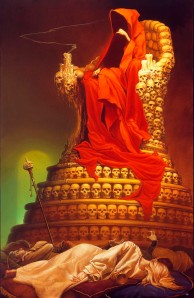
Art by Michael Whelan

As much as I hate to call out authors on what they “should have” done, I feel like I have to here. A hero is only as good as his villain, and the Crimson King, in the end, turns out to be a pretty crappy one. I wish King had made their meeting worthy of the image he had built up. The same goes for one of our favorite characters, Randall Flagg (or whatever name he chooses to use). He has floated through this series and others like a cancer, bringing nothing but death and pain with him. He’s a charismatic madman who revels in chaos and is probably one of the most enjoyable characters King has created. So how does he die? He gets killed by Mordred, the bastard son of Roland and the Crimson King, of Susannah and Mia. He gets killed and eaten without much of a fight. I think a lot of fans would agree that Flagg deserved better.

And while we’re on the topic – Mordred.

One of my measurements of good characterization is a question: If this character did not exist, could the story have ended the way it did? With Jake and Father Callahan, Susannah and Eddie, with Oy and Flagg and Cuthbert and Susan and Cort, the answer is, of course, No. Each of those characters contributed something vital to the story, something that no other character could have done. To reach the same end without one of those characters would have meant a vastly different story.

Art by Michael Whelan

The same cannot be said of Mordred. Of the people he kills, only two matter to us: Flagg and Oy. Flagg should have been the penultimate End Boss, the final challenge for Roland before reaching the Tower and the Crimson King. And there are many ways to kill a Billy-Bumbler – I think King could have thought of one that gave Oy the same honorable and heartbreaking death that he got trying to save Roland from Mordred. Other than that, Mordred had no impact on the story at all. He just followed Roland, Susannah and Oy, shivering and whining and feeling sorry for himself. He kept telling us that he was meant for great things, but never showed even the slightest hint of that potential. He follows Roland like Gollum follows Frodo, but at least Gollum turned out to be important.

The one thing we do get from Mordred is a frustrating bit of knowledge – that the Crimson King and Roland are both descended from the mythical king Arthur Eld. In that way, their battle is between cousins, and Mordred represents a unification of two bloodlines – demon and human. If their conflict had been framed in that context, it could have been so much more interesting when we finally got to the end.

Speaking of the end. We, like Roland, didn’t know what to expect when we finally got into the Dark Tower. And I don’t think anyone expected that the series would loop around to the beginning again, dumping Roland back in the Mohaine Desert to follow the Man in Black once more, unaware that he had already done so so many times before. It was an unsatisfying ending at first, but upon reflection, it does work, and there are two ways to look at it.
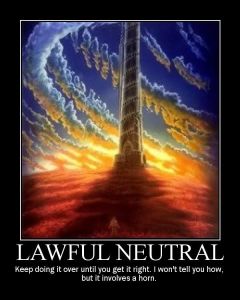
The first is that Roland is being taught a lesson, one which he still has not learned. He’s being taught to value life, to reset his priorities. From his youth, he was so focused on the Tower that he let all else fall aside – his friends, the girl he loved, and the sacred artifacts of his forefathers. He brought death with him, and passed it on to all whom he loved, and ended his quest as alone as he began it. And so, despite saving the multiverse, Roland failed his true quest – to learn how to love others and share who he was with them – and had to be sent back to start again. In appreciation of his effort, however, he was granted a change: the horn of Eld, which he had previously neglected on the field of the last battle of civilization. Perhaps it will make a difference.

The other way to look at this ending is a more metafictional one, something that Stephen King himself finds distasteful. Like it or not, though, one of the overriding themes of this series is the impact that fiction has on reality, and vice versa. To readers, a character might be more real than real people. We learn lessons from them, we have kind or unkind memories of them, and in many ways, our fictional characters possess a special reality. To a writer, this is even more true. Ask any writer and they will tell you about how their characters talk to them, sometimes appear in front of them, or even take over their bodies for a little while. A writer will discover things about a character that she never planned, as if the character himself were revealing them. The Dark Tower relies on this kind of ur-reality of fiction, up to and including fictional characters saving the life of their own writer.

So, by connecting the end of the last book with the beginning of the first, perhaps King is implicating us, the Constant Readers, in Roland’s suffering. Roland cannot rest as long as there are readers reading him, and we are all guilty of making him go through it again and again. While King may have created Roland and his quest, we propagate it, and every new reader ensures that it will never, ever end. [2]

Art by Chesheyre on DeviantArt

In the end, we have a series that started off strong, and then kind of careened to an unsatisfying end. Having been written intermittently over the course of thirty years, I suppose that shouldn’t be too surprising. Ideas which seemed like good ones at the time served only to cause trouble later down the road, and loose ends that needed to be tied up took up far more time than they should have. Perhaps with a clearer vision of the journey at the beginning, King could have held it together better. And perhaps without his brush with death in 1999, he wouldn’t have felt compelled to get the last three volumes out as soon as he could.

It does, however, gift us with some wonderful characters, a rich and brilliant world, and a fictional cosmology that holds together all the worlds that King has created thus far. It’s an examination of the importance of fiction in our lives, and the way that stories can reach out and touch so many more people than the storyteller ever intends. If you are a fan of Stephen King, and you haven’t read this series yet, then you should. For all that the last couple of books disappoint, there is still much good to be found in the whole series, and the first five are generally really well done.

Art by Deviata on DeviantArt

There is more to read, if you’re interested. King’s assistant, Robin Furth, has put together an excellent Concordance, detailing pretty much everything you want to know about the series – characters, places, history, language and concepts. She has also written a series of graphic novels for Marvel Comics which detail Roland’s youth, starting with the events told in Wizard and Glass and going up to the terrible battle of Jericho Hill. So if the original series leaves you wanting more, there’s certainly more to be had.

That’s it, then. Long days and pleasant nights to you all.

——————————————————–
“Even when you were in the shadow of death there were lessons to be learned.”
– Jake (narration), The Dark Tower
——————————————————–

——————–
[1] To be fair – this book was published back in 2004. If you haven’t read it by now, I doubt you’re really going to be chuffed by some spoilers, and you have no one to blame but yourself if you haven’t gotten around to reading it yet.

[2] A third option is suggested by his short story, “That Feeling, You Can Only Say What It Is In French” from Everything’s Eventual, wherein a woman riding with her husband in a car on vacation keeps re-living a terrible accident. It is implied that she is dead, and that hell is the eternal repetition of one’s mistakes. It is possible that Roland is dead, and that this series is his Hell.

The Dark Tower on Wikipedia
The Dark Tower Portal on Wikipedia
Stephen King on Wikipedia
The Dark Tower homepage
The Dark Tower on Amazon.com

2 Comments

Filed under adventure, apocalypse, Dark Tower, death, existentialism, fantasy, good and evil, meta-fiction, quest, Stephen King, time travel, world-crossing

Review 119: Wyrd Sisters

Wyrd Sisters by Terry Pratchett

A king is killed, usurped by a weak man and his overbearing wife.

A ghost haunts the castle, waiting for his son to come and avenge him.

On the highlands, three Witches hold their meeting, plotting the future of the kingdom.

I think Granny would not appreciate this image....

Sound familiar? It should. These are some of the most enduring tropes of English literature, and they’re all thanks to a singular playwright. Wyrd Sisters is Terry Pratchett’s tribute to some of the blood and gore and guts, tragedies and twists of Shakespeare’s great plays.

In fact, this book encapsulates my three favorite Shakespearean works – Hamlet, Macbeth, and King Lear. Yes, they’re all tragedies, but that shouldn’t surprise any of you by now. They plumb the depths of humanity to try to find glimmers of hope and bravery and redemption, and everyone usually ends up dead, but dead with a true sense of purpose. In this book we have, respectively, a king murdered by his own family, a woman who pulls the strings of the usurper, and a bloody great storm.

Anyone have some Purell?

Verence, the king of Lancre, has been assassinated. An accident, everyone says. He tripped and fell down the stairs, landing on his own dagger. Funny, that. But the new ruler of Lancre, Felmet, is not so steady in his convictions. He sees the blood on his hands, although he didn’t do it. He’s absolutely sure he didn’t do the deed. Anyone who says he did do it is likely to be shorter by a foot or so by morning. And his wife wasn’t there either. She didn’t hand him the knife. The point is that Verence is dead, long live the King, and now everyone can enjoy the easy life of a royal couple.

However, as so often happens in these things, complications arose. The dead king isn’t allowed to go away. He is confined to unlife as a ghost, unable to contact or interact with the world of the living – except in very small, nearly unnoticeable ways. As his murderers rule over his kingdom, Verence exercises his ectoplasm and plots a way to bring Felmet down. The king’s infant son was stolen after the assassination, you see – brought by a dying man to the home of one of Lancres witches, where he passed the infant to the three women there, and begged them to care for it.

Huh. Actors.

They did what some people would think would be the exact opposite – they gave the child to some traveling actors. As alarming as that might seem, they thought that a traveling troupe would be a much better place for a child to grow up than with three of the greatest witches of Lancre.

And that would seem to be the end of it, really. The king is dead, with no one to contradict the original version of his death. The infant son of the king is stolen, never to be seen again. By all rights, the kingdom should move on. Assassination, of course, is perfectly natural in Royal circles, happens all the time. The kingdom shouldn’t even blink.

But it does. Not only does the kingdom blink, it is furious. Not the people, mind you. The people barely notice a new king, except for the parties and the slight increase in executions. The Kingdom. As a body is an amalgam of cells, a Kingdom is the whole of its people and history. Felmet hates the new kingdom he has acquired, with its gorges and trees and people you couldn’t bully no matter how hard you tried. He hates the Kingdom, and the Kingdom hates him for it. A Kingdom, you see, is like a dog. It doesn’t care if its master is a good man or an evil man, so long as he cares for the dog. Felmet actively detested the land and its people, and in return the larger entity that was The Kingdom hated him right back.

In the meantime, Felmet’s Fool, formerly the Fool to Verence, is showing him how words have power, and how that power could help break the animal kingdom he ruled. Cutting the trees down, for example, might be called “horrible” or “terrible” by the people – and the kingdom – of Lancre. But call it, “Planned deforestation for industry growth,” and that’s a whole new story.

"Senior citizen"

Words have power, Felmet learns. The Fool eventually goes on to demonstrate the true power of words to the king.

Liar. Usurper. Murderer.

Words like that have a wondrous effect.

And then there are the Witches, who are a threat to Flemet, in his own mind. He can’t kill them, he can’t torture them. But he can change how people think about them, and so he decides that a play is the way to go….

It gets a little complicated after that, but rest assured, it’s a kicker. Felmet is insane, and his wife is worse. Their plan to destroy the witches of Lancre goes beyond what the Puritans of Massachusetts could ever have come up with – altering their very natures by altering perceptions. And fate sticks her fingers in all over the place, as the Witches try to restore a true leader to Lancre – even if the true leader doesn’t even know who he is.

Oh, what Shakespeare could have done with Granny....

Not only does this book showcase one of Terry’s best characters – Granny Weatherwax – but it takes an interesting look at the way we can alter our perception of things merely by altering what we call a thing. Words shape the world, whether we want them to or not, and the right word in the right ear can shift the balances of history. As with so many of his other books, Terry gives us a profound philosophical insight and shows it to us as something we knew all along.

————————
“Oh, obvious,” said Granny. “I’ll grant you it’s obvious. Trouble is, just because things are obvious doesn’t mean they’re true.”
Granny Weatherwax, Wyrd Sisters

Wyrd Sisters on Wikipedia
Discworld on Wikipedia
Terry Pratchett on Wikipedia
Wyrd Sisters on Amazon.com
Terry Pratchett’s homepage

1 Comment

Filed under assassinations, death, Discworld, fantasy, ghosts, good and evil, humor, madness, revenge, Terry Pratchett, witches

Review 110: Johnny the Homicidal Manic & SQUEE!

Johnny the Homicidal Maniac and SQUEE’S Big Giant Book of Unspeakable Horrors by Jhonen Vasquez

I’m putting these two together, because they really do form one larger piece – the craft of an artistic mastermind. Although perhaps “mastermind” isn’t the best word to use here. What do you call the person that they lock up when they’re about fifteen because they keep saying things to their teachers like, “The human body has ten thousand miles of blood vessels in it and I can feel my hate for you coursing through every one?” Or the guy who buys a dog, takes care of it, feeds it, loves it, and then one day realizes that the dog has been spying on him for the CIA for years and buries it in his backyard? Or the angry hobo who lurches up to your car as you wait at the stop light, a bucket of dirty, grey water in one hand and a rotten squeegee in the other and proceeds to molest himself with it, afterwards demanding that you gave him change, quote, “For the show.”

You thought I was kidding about the dog....

That kind of guy. What would you call him?

Whatever it is, welcome to the world of Jhonen Vasquez. Strap yourself in.

Johnny the Homicidal Maniac is the story of Johnny C., known to his very few friends simply as Nny. Nny is rail-thin, yet something of a fashion plate, and lives in a broken-down house with two evil Styrofoam doughboys, a dead bunny nailed to a wall, and a gateway to a creature of infinite evil somewhere in one of the many basements of the house.

In his free time, Johnny kills people in horrible and graphically interesting ways.

Not because he’s a bad person, necessarily. He does have the wall to feed, after all – a wall that has to be continually painted with fresh blood, lest the Evil come out of it. But he is, by his own admission, “quite horrendously insane.” He murders for many reasons, the Evil Wall aside. He murders the people who feel superior to others (while at the same time feeling that he is superior to them). The kills the smug and the self-possessed, the materialistic and the bored, the lowbrows and the posers and the jerks who seem to infest every corner of his world. And while he does kill with great glee and abandon, he occasionally takes the time to wonder if what he’s doing is worth it. If murder is all that his life has become. If maybe it would be better off to just end it all and kill himself.

Fortunately – or not – he has The Doughboys to keep him company. Two Styrofoam figures, painted by Nny, which talk to him constantly. One urges him to live and kill to his heart’s content. The other presses him to commit suicide and leave this world behind. Whichever wins will be freed from his plastic prison and reunited with his evil master. As a balance to them is Nailbunny, which is pretty much just what it sounds like – a bunny rabbit that Johnny bought from the pet store and then one day nailed to the wall. Nailbunny (or at least its floating head) is the voice of reason in Johnny’s life, urging him to be suspicious of the Doughboys and all they want. Despite his nihilistic view of the world, Johnny discovers that he does indeed have a purpose in life. Just not a very good one.

Yes, Nny, show us "wacky"

Johnny is, naturally, hard to sympathize with. Part of that comes from his almost cavalier attitude towards killing, but more than that, he’s rather adolescent in his view of the world and how it works. Like so many teenagers, he has yet to grow a buffer between himself and the world, and cannot differentiate malicious acts from merely thoughtless ones. He feels every barb and every sting like hooks in his flesh, and the only way he is able to deal with it is through murderous rage. Reading it as an adult who remembers his teen years, I can certainly see where Johnny is coming from, but at the same time I wish he’d just grow up and learn to live in the world like the rest of us.

Which is a statement for which Johnny would no doubt gleefully murder me.

One of the major themes of these comics is conformity and humanity’s need to follow each other into the abyss. Hypocritical characters dressed in all the latest fashions snub people who are slaves to public opinion. One of the worst offenders, a recurring character named Anne Gwish, embodies the modern Goth poser who shuns everyone while despairing that no one talks to her. Johnny’s world is filled with these people and they all need killing. Even people who don’t deserve death might end up falling to Johnny. In one of my favorite stories, “Goblins,” a man who was chosen at random is strapped to a truly terrible machine, and faces his impending death with enviable conviction.

Johnny the Homicidal Maniac reads like an extended teenage revenge fantasy, if a highly philosophical and entertaining one. Eventually you figure out that, as Vasquez himself says, “He’s not a loser, he’s simply lost.”

No. Don't do it. Life is too... oh, go ahead.

Themes of identity and social connection continue in the book SQUEE’S Big Giant Book of Unspeakable Horrors. Young Squee (whose real name is Todd) is Johnny’s neighbor and is featured in the very first JtHM story. Squee is a pitiful child, with parents who resent his very existence and a school that is constantly trying to crush the spirit out of him. Squee lives a life of unending terror as he’s beset by nightmares, aliens, his cannibalistic grandfather, openly hateful parents, and a world that never seems to make sense. It is his young burden to have to live in a world created by Jhonen Vasquez.

Somehow, though, little Squee manages. Manages to get himself locked into an insane asylum, yes, but manages nonetheless.

The second half of the book features Vasquez’s filler strips – one or two-page stories of pain, heartbreak and horror. Poor Wobbly-Headed Bob tries to convince the rest of the world to accept that he’s smarter than they are, and can’t understand why they want to kill him. True Tales of Human Drama are just that – dramatic, probably human and god I hope they’re not true. Happy Noodle Boy is a free-form anarchistic story, allegedly drawn by Johnny himself, and I can never manage to finish one. My favorite filler strips are the Meanwhile…. strips, one of which features two elementary-school crossing guard children enacting the final battle between two entities of pure evil. Another depicts a first date gone horribly, horribly awry as a case of gastrointestinal distress engenders one of the best attempts to save face I’ve ever seen. A horrible, lying vampire, the revenge of the pinatas, and a case of childhood attachment issues gone horribly wrong, these are some of my favorite works in the whole series.

Good old Ludwig van B. Perfect for any occasion - even mass murder.

The work of Jhonen Vasquez certainly isn’t for everyone. Even his famous animated program, Invader Zim, is a little weirder than most people are willing to accept for a children’s show. It rewards patient reading and careful attention to the artwork. Which, I might add, is distinctive and disturbing and wonderful. Vasquez has created a style that’s cartoonish and yet horrible, in which childlike glee can be rendered next to heart-stopping horror, and we can perfectly believe that they exist in the same world.

It’s strange, horrible and funny all at the same time. If you’re interested in something out of the ordinary, I can definitely recommend this.

—————————————————
“I suggest you seek some alternate source of sympathy, Nny. You tried to kill that girl. She liked you, and you tried to kill her. That was impolite.”
– Nailbunny, Johnny the Homicidal Maniac

Johnny the Homicidal Maniac on Wikipedia
Squee! on Wikipedia
Jhonen Vasquez on Wikipedia
Jhonen Vasquez’s website
Johnny the Homicidal Maniac on Amazon.com
SQUEE’S Big Giant Book of Unspeakable Horrors on Amazon.com

2 Comments

Filed under afterlife, childhood, comic books, death, demons, existentialism, good and evil, graphic novel, horror, humor, Jhonen Vasquez, madness, morality, murder, philosophy, sins

Review 109: The Origin of Satan

The Origin of Satan: How Christians Demonized Jews, Pagans, and Heretics by Elaine Pagels

Let me get this out of the way right up front: I can’t think of the title of this book without the Church Lady from the heyday of Saturday Night Live popping into my brain. And now she’s in yours, too. You’re welcome.

Well, isn't that SPECIAL?

So. Who is Satan? A fallen angel? The great adversary of God? Saddam Hussein’s bitch? If nothing else, Satan is the great scapegoat, the one on whom we tend to pile all our troubles. Your church is running out of money? Satan. Your kid is doing drugs and listening to that awful hip-hop music? Satan. Queers getting married? Definitely Satan.

For some, Satan is an actual being, a true agent of evil whose purpose is to ruin all that God has made. For others, Satan is a symbolic representation of the evil inherent in the human condition, an abstract form made real in order to better understand it. In other words, there are as many versions of Satan as there are people who invoke him.

But how did the whole Satan thing get started? Where did he come from and how did we get to the Satan that we all know and loathe today? That’s what Elaine Pagels was determined to find out when she wrote this book.

While most of the book focuses on the New Testament and a history of the early Christian church, it was the ancient history of Satan that I found most interesting, mainly because it concurred with a pet theory that I’ve had for a long time: Satan was never an enemy of God. Satan was God’s quality control guy. It was his job to look for weaknesses in the system, to probe Humanity for its faults and flaws so that it could be made better. Thus the serpent in the garden (which, just as a note, was never actually revealed to be Satan), and especially the story of Job, where God allows Job’s life to be ruined on a bet. My guess was that he won a nice, crisp one-dollar bill.

Employee of the Millennium (photo by Nathan Rupert)

The Satan of Olde was an agent of God, there to make sure that things went the way they were supposed to. He caused trouble, he stirred things up, yes, but that was his job. Much like the office manager that you despise because he always harps on you for checking your Facebook account during company time, even though you both know there’s nothing better to do right now, but he just enjoys watching you suffer and enforcing his stupid little rules…. That guy is, at least in his own mind, working for the greater good of the company. He may be a dick, you may wish great misfortune heaped on him and his progeny, but he’s doing the job he was given to do.

Sounds great, but Satan’s downfall from “annoying but necessary agent of God” to “vile and demonic enemy of god” was planted a long time ago, before Christianity was even on the horizon.

The Jewish religion, from whence our concept of Satan arose, has always been one of Otherness. Israelites and Enemies. Us and Them. From its earliest days, God made sure the Israelites knew that they were a small force against the world, with only Him to protect them. He told Abraham straight out that He would bless him and curse his enemies. Therefore, the descendants of Abraham had to be on constant guard from enemies both from without and within. With a Satan already set in their theology as a tester and troublemaker for God, it was not a far leap to look to him as the cause of the multiple troubles that the Jews had over the years. Around the time of Christ, the Essenes were a distillation of that concept. They were a small Jewish sect – a minority within a minority – which believed that they were the only true Jews and that everyone else had gone soft. The Jewish majority was corrupt, led astray from the true path to God, probably by Satan.

When the Christians showed up, a minority with an even more tenuous existence than the Essenes, they found this concept very useful. Telling their story from the point of view of an embattled minority, they found Satan to be a very useful opponent against whom their Messiah could fight. He was an excellent symbol that stood not only for the earthly conflict that was taking place between the Christians, Romans and Jews, but a greater spiritual conflict that involved all humankind in a battle between good and evil.

Really he just likes to watch

Pagels’ basic thesis is that the concept of Satan, whatever else it may be, was used to not only encourage persecution of The Other – Jews and pagans, to be precise – but to also keep the Christians themselves in line. The book is actually a history of the early Christian movement and how that history was reflected in the writing of the Gospels. In fact, just like in the Bible, Satan doesn’t really appear much in this book. Rather Pagels looks at how the early Christian movement fought for its survival against enemies without and within, and then how Satan became a spiritual catch-all for those who disagreed with them.

It’s a great analysis of the early days of the Church, and just how chaotic and tumultuous it was. There were so many churches with so many different interpretations of Jesus’ life and death, so many Gospels being written and so many opinions on the very nature of God’s universe that it’s surprising the whole thing managed to come together to be the world’s largest religion.

What’s more, it shed some light on something that’s always annoyed me: the persecution complex that so many Christians have. The best time to catch this is in December, when pundits in the States start going off about the War on Christmas as though the last twelve Christians in the country were holed up inside the Topeka Christmas Shanty with shotguns and eggnog. Every time a judge tells a town that they can’t have the Ten Commandments on the lawn of their town hall, or a Wal-Mart tells employees to say “Happy Holidays” instead of “Merry Christmas” there is always a vocal group of Christians who claim that they’re being persecuted and that they’re on the edge of extinction. All this despite the fact that Christianity is the most popular religion in the world, that there are more Christians in Congress than any other religion, and that every single President in US history has been Christian. Despite all that, there seems to be a knee-jerk need to feel persecuted.

One of the Prince of Darkness

This book offered a very good reason why this is: because that was how the religion was founded, and it is the fundamental narrative of Jesus’ story. If Jesus had been part of the Jewish majority, his story would have ended very differently, no matter how radical his ideas. The early church was born of persecution, first from the Jews and Romans, and when they were no longer a danger, from pagans and heretics. And under all that, the hand that is always set against them, is Satan. As long as Satan is there, the Christians will always have someone there to persecute them. Without that cosmic, deathless opponent, Jesus becomes just another political rabblerouser executed by Rome. Certainly no Messiah would have allowed himself to die unless it was a gambit in a much greater game against a much more powerful opponent. Without Satan and the relentless threat attributed to him (and, by extension, those who are seen to ally with him), Jesus’s sacrifice becomes meaningless, and the whole religion follows with it.

It’s a fascinating book and a great look at the early days of the Church. If you’re into that kind of thing, go pick it up. Many thanks to my mom and stepdad, who pointed my attention towards it.

—————————————————–
“How, after all, could anyone claim that a man betrayed by one of his own followers, and brutally executed on charges of treason against Rome, not only was but still is God’s appointed Messiah, unless his capture and death were, as the gospels insist, not a final defeat but only a preliminary skirmish in a vast cosmic conflict now enveloping the universe?”
– Elaine Pagels, The Origin of Satan
—————————————————–

Elaine Pagels on Wikipedia
The Origin of Satan on Amazon.com

Leave a comment

Filed under Bible, Christianity, Elaine Pagels, good and evil, history, Jesus, Judaism, nonfiction, religion, Satan, theology

Review 64: Lamb


Lamb: The Gospel According to Biff, Christ’s Childhood Pal by Christopher Moore

If you’ve been following my reviews over the last few years, I don’t see any reason why I should have to put a caution into this, but here it is: if you’re not interested in speculative fiction, open to the reinterpretation of the life of Jesus, speculation on the gaps in the gospels and the possibility of pan-religious values having been vital to the formation of Christianity, then you should probably not read this book. Nor should you really be using the internet – there’s just too much nasty “Free Thinking” out there. Take your hands off the keyboard and back away slowly.

Okay, that’ll weed out the wusses. Although, as I think about it, perhaps those are exactly the people who should be reading this book. I’m sorry for all the nasty stuff I said – come on back!

Each time I read this, I love it more. For one thing it’s Moore’s best work, without question. Not only is it blindingly funny, which is a hallmark of Moore’s style, but it’s also thoughtful, philosophical, and is supported by obvious research. Because he’s dealing with real places and real people, Moore has made sure that his depiction of first-century Israel is as accurate as he can make it. It’s all there in the details about the lives of the characters, the struggles they go through and the understandings they come to. Without hours of research as its foundation, the book would have failed almost instantly. Moore didn’t have to do it, but it is a great sign of his character as an author that he did.

This is also by far my favorite interpretation of the life of Jesus. It is the Gospel According to Biff, the best friend of Joshua bar Joseph, the man who would one day be called Jesus Christ. Of course, when Biff met him, the young Son of God was occupying himself by resurrecting lizards after his brother smashed their heads in. But they grew to be fast friends, and everywhere that young Joshua went, so went his buddy Biff.

The best way to describe Biff would be Jesus’ Sidekick. He’s a troublemaker, sarcastic, and far too prone to succumb to temptations of the flesh. But he’s clever and resourceful, and mindful of his friend’s mission on this earth. He’s young Joshua’s best friend in every way, so when Josh goes searching for the three Magi who attended his birth, Biff knows he has to go with him. The way to finding Joshua’s destiny will be long and hard, and Biff knows that his friend needs him.

The main part of the book has to do with Biff and Josh’s search for the Magi, to learn from them how Josh can be the Messiah. On their way they face demons, death and certain temptation, but also wisdom and experience from the wisest men in Asia. From Balthazar in the rugged mountains of Afghanistan, Joshua learns of the Tao, contemplating its Three Jewels – compassion, moderation, and humility. He learns about suffering and mercy and kindness and the effects they bring.

Biff, on the other hand, learns about the ways in which eight Chinese concubines can make life a wonderful place, night after night. He learns how to make potions and explosives, how to cast metal and read Chinese. He learns vital skills that the Messiah cannot – or must not – know.

From there they go to China, to a monastery high in the cold mountains to study with Gaspar, a monk of the Zen school. From Gaspar, Josh learns stillness and mindful breath, compassion for all things and, oddly enough, how to turn invisible. He discovers the divine spark that exists in all things, a holiness that no one can claim or take from you. He also learns what it’s like to be the only one of his kind, and foreshadows the tragic end that can bring.

Biff, of course, is learning kung fu and how to break bricks with his head.

Finally, they go to India to seek out Melchior, an ascetic yogi and the last of the wise men. Joshua here learns about sacrifice and blood, and the horrors that are perpetrated in the name of religion. He discovers the injustice of denying the Kingdom of God to anyone, Jew or Gentile, and the futility of trying to teach yoga to an elephant.

Biff, for his part, manages to put together a truly spectacular version of the Kama Sutra.

Don’t get me wrong – while Biff is certainly more earthly than his friend, he is also devoted to both Joshua and his mission. He is Josh’s anchor to the real world, always reminding him of his mission and making sure he doesn’t take himself too seriously. Biff, in this rendition of Jesus’ story, is a necessary element in the ultimate teachings of Christ.

As he admits in his afterward, Moore has tackled a very tough subject here, one that he knows is likely to rile people up. Jesus is one of those characters that is very set in peoples’ minds – he is the tall, beatific figure with a gentle voice and blue eyes who glides around in robes followed by insightful and worshipful men.

He certainly never ate Chinese food on his birthday, nor did he get hopped up on coffee or learn kung-fu. He’s never had a sarcastic best friend who was willing to risk damnation to describe what sex was like to the young Messiah, who was pretty sure that he wasn’t allowed to Know women. We haven’s seen Jesus get frustrated and yell at his disciples because they didn’t get the message he was trying to send, or be torn between what he has to do and what he wants to do. The Jesus in this book is an excellent meld of the human and the divine. He has the miracles and the powers, but his mind is human. He knows that he’s the son of god, but he feels like just a regular guy who’s been tapped to save humanity from itself. It’s a very difficult situation to be in, and Moore does a really good job of getting us to understand that.

More importantly, the life of Jesus hasn’t been this funny before. This is the kind of book that will piss off your family or co-workers, because you’ll want to read out passages from the book every five minutes, but you won’t get it out right because you’ll be laughing too hard. The way the book is set up, Biff has been resurrected by the angel Raziel in order to write a new gospel. Unfortunately, he’s been resurrected in the modern age, about two thousand years too late to help his friend avoid the awful, horrible sacrifice that he knows he has to undergo. So he writes in the modern American vernacular, assuring us that while the words may not be a direct translation of first-century Hebrew, Latin, Aramaic, Chinese or any of the other languages they encounter, the tone is accurate. And the tone is comedy, all the way through.

Of course, the comedy kind of drops off as the book races towards its unpleasant end, which is where my troubles with Moore as a writer usually lie. He tends to write endings that are abrupt and unfulfilling, as though he just wants to finish writing the book so he can, perhaps, get on with the next one. Even though we know how this story ends, it still feels rushed. Biff’s attempts to save his friend from horrible death make sense, but I would like to have seen them drawn out a bit more. I have a feeling that Moore could have added another hundred pages without breaking a sweat – and I wish he had.

The best thing, though, is that Moore treats his characters with the utmost respect. Nothing that Jesus does in the book is out of character for him, insofar as we know his character. And Biff is more than just a goofy friend of the Messiah – he is the reminder and the anchor of Jesus’ humanity. I’m not a Christian – I don’t claim any religion, in fact – but this version of Jesus would be one that I might be willing to give some time to.

It’s a brilliant book, in my top ten….

—————————————————-
“Josh, faking demonic possession is like a mustard seed.”
“How is it like a mustard seed?”
“You don’t know, do you? Doesn’t seem at all like a mustard seed, does it? Now you see how we all feel when you liken things unto a mustard seed? Huh?”
– Biff and Josh, Lamb
—————————————————-

Christopher Moore on Wikipedia
Lamb on Wikipedia
Lamb on Amazon.com
Christopher Moore’s homepage

Leave a comment

Filed under angels, Christianity, Christopher Moore, coming of age, demons, friendship, good and evil, humor, Jesus, quest, religion, travel

Review 18: Swan Song

Swan Song by Robert McCammon

Okay, have you read The Stand? Humanity being wiped out by a short-sighted government, small groups of people struggling to survive in an America laid low? A dramatic escape from New York through a dark and scary tunnel? An evil adversary from an unknown place whose only dream is the end of the world?

Yeah, that’s Swan Song, too. Only with nukes instead of a virus.

It really is an alarmingly similar story, published about ten years after The Stand, but – and this is important – it’s still a really good book. Derivative? Sure. But it’s still good, which is a neat trick.

The story starts in an alternate world, one that seemed all-too-probable in 1987, when this book was published. The US and the Soviet Union are toe-to-toe, fighting proxy wars all over the world. Nuclear exchanges have already happened between smaller nations. The world is inches away from war, and there seems to be no going back.

Domestically, things aren’t much better. In New York City, the city has fallen to crime and decay – drugs, trash and whores are all that can be found, and if any city deserves destruction it’s this one. It’s the worst projections of New York come true, and its eventual destruction is almost like a blessing.

In the western mountains, a group of survivalists have hollowed out a shelter against the possibility of The End, and Earth House is full to bursting. Young Ronald Croninger and his parents are there, but the boy is not impressed by what he sees. Colonel Macklin,the ex-soldier who is the public face of Earth House, seems to have gone to seed, and the shelter itself is falling apart, just like everything else.

The world is going straight to Hell, and it’s all too easy for the US and the Soviets to send it all the way there.

The book has an epic scope and a massive cast, lined up pretty equally on the sides of Good and Evil. As the book progresses, the disparate groups finally come together in a final confrontation that will decide the fate of the world.

In the midst of all that, a certain mystical quality has arisen. There’s a… being, a creature of demonic countenance who can change his face and travel freely throughout the wasted land. His sole desire is to see the end of humanity – he revels in destruction and despair and wants nothing more than to see the end of Our Heroes. On the other hand is the title character, Swan. As a girl, she loved plants and flowers, and had a strange affinity for the natural world. As she grew up, however, her powers matured, and that affinity became a full-on partnership. They each collect a following, through fear and hope respectively, and they each know that there’s only one way this can all end.

There’s an element of mysticism to this as well, though why it should be there is not explained. For example, the burned-out rubble of Tiffany’s on Fifth Avenue creates a shining glass ring, filled with strands of precious metals and valuable stones. This ring becomes the guide for Sister, a woman who was once mad but becomes the sanest one of the survivors. With the ring, she is able to perform miracles. There’s a magic mirror that shows the future, prophetic dreams and other elements of mysticism. It seems that when the world as we know it ends, the world as we don’t know it steps in. And then there’s the Job’s Masks – a mysterious growth that covers a person’s head in an impenetrable shell, only to crack open years later and…. Well, I’ll let you find out.

The appeal of apocalyptic fiction is an interesting one, and easily understandable. Humans have been interested in how the world will end since about the same time we figured out that the world could end. And there are many ways for it to go, whether it’s the nuclear fire of this book, the insidious virus of The Stand, the near-miss religious apocalypse of Good Omens, the various meteor impacts and climatological disasters that Hollywood loves to show us…. The ways in which the world ends are countless, but they all share one distinct feature – when the end comes, you’ll find out who you really are.

It’s tempting, then, to give it some thought and wonder, “Who would I be, when all was gone?”

This book has some excellent role models to choose from – and to avoid. The characters are compelling, and the world is vividly drawn, so as long as you’re not thinking, “But this is just like The Stand!” you should greatly enjoy it. I highly recommend it.

————————————————-
“Once upon a time, we had a love affair with fire.”
– Robert McCammon, Swan Song
————————————————-

Swan Song at Wikipedia
Robert McCammon at Wikipedia
Swan Song at Amazon.com
Robert McCammon on Swan Song
Robert McCammon’s homepage

BONUS! The Boyfriend decided that there needs to be pictures of me recording the podcast. So he took some….

Doing the Podcast

Doing the Podcast
Listening to the playback. I’ve had a haircut since then….

2 Comments

Filed under apocalypse, death, fantasy, good and evil, horror, nuclear war, Robert McCammon, society, survival, totalitarianism, war