Tag Archives: fantasy

Review 163: New Spring (Wheel of Time 00)

Wheel of Time 00: New Spring by Robert Jordan

If you’re new to the Wheel of Time series, don’t start with this book.

Okay, technically it is Book Zero, as it takes place about twenty years before the events of the first book, Eye of the World, and it provides an enormous amount of backstory which a reader would only otherwise get later on. I mean, if you read this, and then go on to EotW, everything that happens in the first few chapters is so much more heavily weighted. Things that Moiraine says and does, knowing what we know about her, are completely different. I’m not saying that they’re better or worse – they’re just different. And perhaps because I treasure my experiences with books, I cannot imagine the story being as good if we knew so much.

"Honey, put the coffee on. This'll be a while."

The Wheel of Time is an immense example of Epic Fantasy. The first book was published in 1990, and it still hasn’t found its way to a conclusion. The end is in sight, of course – following the death of author Robert Jordan, the series is being finished by Brandon Sanderson and the final volume is expected to come out at the beginning of 2013. Still, that’s a long, long time for the faithful to stick with a series. More than a few people have dropped out halfway through, and I can’t blame them. The series so far consists of nearly three point eight million words (that’s nearly five Bibles), more than 11,000 pages and 635 chapters so far (thank you, Wikipedia). There are more characters than I think anyone can accurately count, over three thousand years of history, prophecies, politics, religion, love, hate, magic, mystery….

It’s not for the faint of heart. But if you stick with it, the series will pay off. It’ll take up a piece of real estate in your head that you keep coming back to – questions, wonders, worries. It’s no surprise that a fan community has built up around this series that has devoted itself to knowing and cataloging every detail, right down to the chapter icons and their relationship to the content of that chapter. If you’re not wondering what Ajah you would be in by the end of the first book, then you need to slow down and enjoy it a little more because something’s not sinking in.

If I sound kind of evangelistic, it’s because I am. I have devoted nearly two-thirds of my life as a reader to it, sticking it out even when other readers got bored or frustrated, and I want other people to love it too. That is, after all, the entire reason I do these reviews – to share the books I love.

Anyway, on to this actual book.

She's small, but she will END YOU.

As I said, it’s prequel to the series proper. Its first incarnation was as a short story in the “Legends” collection back in 1999, and was published as a novel between books ten and eleven of the series proper. It focuses on two of the prime movers of the early books – Moiraine Damodred, Aes Sedai of the Blue Ajah, and Lan Mandragoran, the uncrowned king of Malkier, a land that was swallowed by the Blight when he was but an infant.

See, that sentence right there would require pages of back story just by themselves if I were to try and explain them properly.

Moiraine and her best friend Siuan are Accepted in the White Tower, home of the Aes Sedai – a society of women who can channel a powerful force called saidar. For thousands of years, the Aes Sedai have used their powers to try and protect the world. Soon, Moiraine and Siuan will become full-fledged Aes Sedai, with all the power and responsibility that involves. At the moment, that looks like taking part in a great war – the mysterious Aiel have come out of their desert to attack and destroy everything they can find, and no one knows why. The war has come to the very shores of Tar Valon itself, the home of the White Tower.

Amidst all this, Gitara Moroso, an Aes Sedai of high rank and power, has a Foretelling: The Dragon is reborn. He who broke the world has come again, and the Last Battle is upon us. She Foretells the end of the world, and that foretelling kills her.

With that, a search begins for the boy who would one day grow up to be The Dragon, and Moiraine and Siuan are at the forefront of it. But they aren’t alone. The Amyrlin Seat, leader of all Aes Sedai, sent out her best to find the boy. Unknown to them, the Black Ajah, Aes Sedai dedicated to the primacy of The Dark One (and I shouldn’t have to tell you who he is), are also looking for the Dragon Reborn. Without him, their master will emerge from his prison and remake the world in his image. It is up to Moiraine and Siuan to find the boy before the Black Ajah do, and not get themselves killed in the process.

Confused yet? I would be, if I hadn’t read this series prior to this book. Damn near everything I’ve said up there requires a ton of explanation and back-story, pages and pages of it. Which is, of course, what the series proper is all about. When this novel was released, readers of WoT had already gone through ten books, so there wasn’t a lot of pressure on Jordan to explain everything in absolute detail. For a devoted fan, it’s an excellent nugget of series history and an illuminating look at some of the most important and mysterious characters in the series. For a new reader, it’s probably somewhat confusing.

The island of Tar Valon

This book gives us a good, strong look at the White Tower and the life inside it – the intricacies of the Ajahs, the trials that are required of the Novices and Accepted, and the history that surrounds it all. It’s a lot of information, but it’s wrapped inside a good story, so you don’t really mind. Well, I don’t really mind – very little of this is new to me.

In all honesty, I could be wrong. I first read this with years of the series under my belt and breezed through concepts and references that I didn’t need explained. But even if it is accessible to the new reader, I still recommend holding off until you get to a point where you’re pretty sure you know everything you need to know.

Why? Because it’s not how the series was written. A new reader, cracking open Eye of the World for the first time, knows nothing, which puts you pretty much at the same level as the series protagonist, Rand al’Thor. With Rand, you learn about the world at a steady pace. It’s a little overwhelming, sure, but it’s manageable, and what’s more – it’s interesting. This world (nicknamed “Randland” by fans) has an intricate and mysterious history, as do many of the characters. To have so much information before starting the series feels to me like… cheating.

I'm guessing the series is somewhere in the blue-green area...

If I could, I would remove my memory of the rest of the series and read this one as if it were all new. I would love to come at this story from a different angle and then compare the two experiences – kind of like with Ender’s Game and Ender’s Shadow. Alas, I cannot, so I go into this book not knowing what I’m not supposed to know.

If you’re new to the series, though, it’s ultimately up to you. I think holding off on this book will make it better, but I can’t tell you what to do, right? All I know is that it’s where I start when I re-read the series, and it’s not a bad beginning. And I know that I started the series a long time before this book came out, and that was fine too.

———————————————
“He is born again! I feel him! The Dragon takes his first breath on the slope of Dragonmount! He is coming! He is coming! Light help us! Light help the world! He lies in the snow and cries like the thunder! He burns like the sun!”
– Gitara Moroso, New Spring
——————————————-

Robert Jordan at Wikipedia
Robert Jordan at Tor.com
New Spring at Wikipedia
Wheel of Time at Wikipedia
New Spring at Amazon.com

Wheel of Time discussion and resources (spoilers galore):
Theoryland
Dragonmount
The Wheel of Time Re-read at Tor.com
The Wheel of Time FAQ
Wheel of Time at TVTropes.com
1 Comment

Filed under epic fantasy, fantasy, quest, Robert Jordan, Wheel of Time, wizardry

Review 151: Ghost Story

Ghost Story by Jim Butcher

Hell’s Bells count: 27

In the acknowledgment section of the book, where Butcher very kindly thanks all the people who helped it come into existence, he clarifies something very important: the end of the last book, Changes, was not a cliffhanger. Absolutely not, no matter that it really, really looked like one, smelled like one and felt like one. After all, in that last scene, Dresden is on a boat, and then shot through the chest by a sniper of some sort. He drops into the cold waters of the lake and sinks and, as far as we know, dies.

Noooo! You've gone too far, Harry!!

In order for it to be a cliffhanger, then, Butcher would have to reveal at the beginning of this book how Dresden got out of such a terrible situation. Maybe he could call on some last reserve of magic or be saved by merpeople or something, but the strictures of the cliffhanger would demand that Dresden, once the next book began, not be dead but saved by some unexpected, yet still believable, means.

So, yes, Butcher is right – it’s not a cliffhanger. Dresden is, indeed, dead. He did not escape, he was not rescued. He is dead.

Now in most series (comic books excluded, of course), the death of the main character would be something of an impediment to continuing the series. But The Dresden Files is not most series, and Harry Dresden is not most main characters. He has done too much and is far too important to be allowed to do a silly little thing like die. Harry Dresden is necessary to a great number of plans and schemes by a great number of people. What’s more, his death wasn’t exactly fair, insofar as such a thing is possible.

And so he is brought back by the Powers That Be in order to balance the scales and set things right, which is ultimately what Harry Dresden has been doing all along. He’s to go back to Chicago and find his murderer, lest terrible things happen to those he loves.

Fortunately, while there are meddling kids, Harry wins them over, and the giant ridiculous dog is on his side.

The catch, of course, is that he has to come back as a ghost. This is a problem for many reasons, not the least of which is that doing a murder investigation is substantially easier when you have, well, substance. It’s hard to punch someone in the face when your fists just go right through them. So Dresden first has to figure out how to make himself known to the living world, in addition to coming to grips with his limitations as an untethered spiritual entity. Once he’s figured that part out, he has to not only solve his own murder, but keep a body-hopping necromancer from becoming indescribably powerful, save the only man who knows how to deal with being a ghost, try to redeem a bunch of street kids who are under the influence of a minor sorcerer, and figure out what to do with the real mess he made when he died.

You see, Harry’s death, and the events that led up to it, created a power vacuum – not only in Chicago, but all over the world. With the destruction of the Red Court of vampires, the magical rulers of the world are fighting tooth and nail over land and resources, and what has mostly resulted from that is bloodshed. Forces all over the world are converging on Red Court territory, each one determined to claim what they can.

This was the very first Google Image result for "Ragged Lady." The book is forever changed for me...

In Chicago, the news of Harry Dresden’s death invited all sorts of new power players into the city, who were previously smart enough to stay out. Harry never truly understood the reputation he had until he sees what his friends have to do to match it and keep the city safe. Now that the Great and Powerful Harry Dresden is out of the picture, a newer and more terrible protector has emerged to keep away those who would do the city and its inhabitants harm. The Ragged Lady is all that stands in the way of the Chicago that Harry knew being overrun.

Mix in the Faerie, a new group called the Formor, the mob, and a few representatives of the afterlife, and you have a confusing and volatile situation. Which is pretty much where Harry Dresden is most at home.

As with the other Dresden Files books, this is a lot of fun to read, mainly because it looks at Harry and his friends from a new point of view – the outside. In the six months that he’s been “away,” the people he loves have had to go on without him, and even in that short time they have become different. They have had to make choices that they wouldn’t have made while he was there, and they certainly don’t interact with him the same way they once did. Harry has to re-learn who these people are, with the understanding that his decisions did not change their lives for the better.

Then again, showy violence can be pretty cool sometimes. (Art by Dan Dos Santos)

In addition, we learn more about Harry’s past and what made him the way he is, and we finally see him start to think about whether being the person he is is really a good thing all the time. He excels in showy violence, hitting first and asking questions later, without taking a more nuanced view of the situation. Well, now he can’t hit, at least not in the ways that he’s used to. He has to look at his old ways in a new light and figure out how to get what he wants through other means.

Really, if you’ve read this far in the series, you’ll enjoy this one. Butcher continues to do a good job in giving us what we want, while at the same time showing us things that are truly unexpected. There are some wonderful moments in the book, a few exposition-heavy moments while Harry is filled in on the situation, and a good mystery to be solved. Enjoy.

——

Death should be a learning experience, after all, or what’s the point?
– Leanansidhe, Ghost Story

The Dresden Files on Wikipedia
Ghost Story on Wikipedia
Ghost Story on Amazon.com
Jim Butcher on Wikipedia
Harry Dresden on Wikipedia
Jim Butcher’s homepage

5 Comments

Filed under afterlife, death, detective fiction, Dresden Files, fairies, fantasy, ghosts, Jim Butcher, murder, mystery, quest, wizardry

Review 150: Otherland 3 – Mountain of Black Glass

Otherland 3: Mountain of Black Glass by Tad Williams

This is easily my favorite book in the series, short though the series may be.

Otherland is a strange story, really – it’s like a hybrid science fiction/fantasy tale in that you can easily forget which genre you’re in. It’s clearly science fiction, in that the whole thing is taking place in a massive computer simulation, but on the other hand, it owes a lot to fantasy – especially the world-crossing aspects of it.

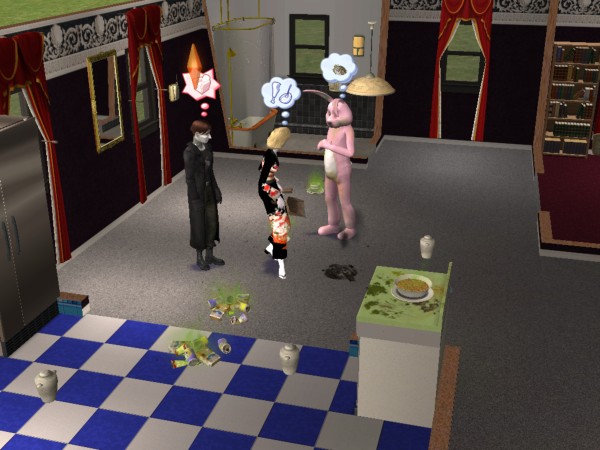
Our Otherland heroes have been trapped there for some time now, running through the system with very little understanding of where they are or where they’re going. The whole thing is run by a cabal of the world’s richest men and women in an attempt to foil Death itself, and was built as their eternal playground. Thus, there are countless worlds to choose from. There are places where you can re-live entire historical epochs, where you can fly in rivers of air or play in a cartoon kitchen. You can be a cowboy in the Old West or a Knight of the Round Table or anything that your mind can conceive – and your programmers can work out.

Not every virtual god is a good one, of course.

The complexity of this system is such that it is indistinguishable from real life. It is multi-sensory, so you get the full experience of actually being there, with none of the obvious CGI cues that we’ve come to expect from the virtual world. What’s more, the owners of the system have nearly godlike power within it. They plan to not only live forever, but have absolute power while doing so.

Two of these simworlds – one original, one derivative – are the reasons why this is my favorite book of the series. The original simworld (not based on any well-known work or historical event) is the House. After being betrayed by the assassin Dread, who has been masquerading as one of their number, Renie, !Xabbu, Martine, Florimel, T4b and Emily are stuck in a kind of… unfinished world. It’s a place where the programming hasn’t really been settled, and where the unreality of the whole thing can be deadly.

They manage to escape by following Dread to a new simulation – a great House that is, in itself, a world. It goes on as far as anyone knows, but is home to countless tribes and nations. Our heroes meet runaway lovers – a cutlery apprentice and a girl from the linen cabinets. They are aided by the Library monks, whose expertise encompasses everything from House history to the minute details of plasterwork. They are nearly killed by attic bandits and hunted by nomadic bands of steeplejacks.

You get them abducted by aliens, of course.

Aside from imbuing the House with a deep sense of history and complexity, Williams raises an important point that anyone who has ever played “The Sims” can recognize: what do you do when you start to empathize with a computer-generated being?

During their time in the House, they meet people who seem to be genuinely good, perceptive, interesting people, qualities that we don’t know how to confidently imbue in real humans, much less coded simulacra. The residents of the House have passions and dreams, they love and hate just as “real” people do. They can’t be written off as “just code,” because they don’t act that way. They help and hinder our heroes just as people out in Real Life might.

I don't know the answer, but this young... man seems interested in finding out.

This brings up an interesting ethical problem: while they can’t be sure what their ultimate goal will be, our heroes are pretty sure that the system will eventually have to be destroyed – as far as they know, it is the Otherland system that is keeping them trapped, and their loved ones in comas. Will doing this be, in essence, genocide? By shutting down the Otherland network to save the children in comas, and to save themselves, will they be condemning thousands – perhaps millions – of coded “people” to extinction? Are these “people” really people? After all, the Grail Brotherhood was planning to become immortal code themselves – would they be any less alive than their meat incarnations?

While this is not a problem that we have to grapple with yet, it’s one that may come up eventually. Tad Williams has done a very nice job in this series of predicting technological advancement, so he may have seen forward on this one, too.

The other simworld that makes this my favorite book is a derivative one. This means that it is based on an extant work, much like the Alice in Wonderland world that Paul Jonas goes to, or the bizarre cartoon kitchen from which Orlando and Fredericks had to escape. This world is one of the oldest stories there is, and was the first simworld to be created when the construction of the Otherworld began.

It is The Iliad.

Somehow, I don't have a Sim of Achilles. (Art by NegativeFeedback on DeviantArt)

I’ve read the original poem a few times, and I’m impressed with it every time. It’s a massive story, full of heroes and villains, bravery and treachery, and death. Lots and lots of death. It’s an epic poem, and it deserves the title, as it pits nations, men, and gods against each other in what is ultimately a tragic and terrible ten year war. For Tad Williams to use this as the climax for a novel is nothing short of audacious, but he pulls it off wonderfully.

Not only does he manage to keep hold of the terrible horror of war that Homer put throughout his poem, Williams integrates his characters into the story, putting them in the roles of key figures such as Achilles, Patroclus, Cassandra and Odysseus. They all want to get into Troy so they can find their way to the Black Mountain, but to do so they must go through the war that has served as the archetype for human conflict for the last few millennia. Their choices, freely made, reflect the choices of the characters they inhabit, which are themselves models for heroes of fiction throughout literary history.

In one wonderful scene, Sam Fredericks, who is inhabiting the character of Patroclus, is wondering what to do about her sick friend, Orlando Gardiner, AKA Achilles. He cannot fight, but the Argives need him, and throughout their long friendship as online gamers, it was always Orlando who was the hero. Sam was the sidekick, the buddy, but when you made the movie poster, Orlando’s character would always be in the middle of the shot.

But much like another Sam in another story, Fredericks knows that heroism isn’t just muscles and swords and snappy dialogue. It’s about doing what has to be done, even if you don’t want to do it. Nearly crippled by progeria, a debilitating childhood illness, Orlando has nonetheless continued to fight on in the Otherland. Now the hero cannot fight, and Sam realizes it’s the sidekick who has to pick up the burden. Thus, Sam unknowingly fulfills the destiny of the character she is portraying, puts on the shining armor of Achilles, and goes out to inspire the Argives to fight so that she and her friends might live.

Chocolate! It's full of chocolate!

The entire Troy sequence is amazing, and every time I read this book, I feel compelled to read The Iliad again.

But the series doesn’t end there, of course. Suffice it to say we hit a major climax by the end of this book. People are in danger, secrets are revealed, battles are fought… and one of our brave heroes makes the Ultimate Sacrifice. We are brought to the heart of the operating system, the Black Mountain which entombs the Other. The Grail Brotherhood sets their immortality sequence in motion, and the amoral killer Dread makes his bid for virtual godhood. Setting us up for the final book, we are left with our heroes in disarray – divided and lost, dropped into an entirely new environment that is beyond their understanding and forced to cooperate with their gravest enemies for their survival.

You may look at this book and think, “Holy cow. 924 pages. There is no way I’m reading 924 pages.” But you will, and it’ll go a lot faster than you think. Williams has done a great job of making a multi-layered, fast-paced story that you can enjoy on many levels. You can revel in the action and the mystery, you can ponder deep philosophical problems, or you can comb through the great attention to detail and see how much work he must have done to get the Trojan War sequence right.

Hats off to you, Tad Williams.

—————————————————
“Jesus Mercy. There have to be easier ways than this to save the world.”
– Renie Sulaweyo, Otherland: Mountain of Black Glass
—————————————————

Tad Williams on Wikipedia
Otherland on Wikipedia
Mountain of Black Glass on Amazon.com
Tad Williams’ Website

Leave a comment

Filed under adventure, existentialism, fantasy, friendship, Homer, internet, meta-fiction, quest, science fiction, story, Tad Williams, virtual reality, world-crossing

Review 148: Carpe Jugulum

Carpe Jugulum by Terry Pratchett

In this book, we return to the small Ramtop country of Lancre, home to Granny Weatherwax, Gytha Ogg and Magrat Garlick. Picking up from where we left off, which is actually in Maskerade, which I haven’t reviewed here yet, Magrat is Queen now, with no time for witching. So the new Third Witch is Agnes Nitt (also known as Perdita, but only by her), a girl who is sensible, levelheaded and thinks quickly in a crisis. She is also a rather, shall we say, substantial girl (and lest you think I’m trying not to be mean, believe me – Agnes is meaner about her self than I can be), and as we all know there is inside every fat girl a thin girl and lots of chocolate. Well, Perdita is the thin girl, and Agnes is the chocolate.

But that’s not the main point of this tale. The main point is that vampyres have come to Lancre, invited by King Verence to attend the naming of his and Magrat’s daughter, Esmerelda Note Spelling of Lancre (well, when your grandmother managed to name your mother “Magrat” due to an uncertainty in consonant placement, one doesn’t take chances.) But what’s done is done. No doubt we will see little Spelly in future Discworld books.

I'd still rather see this than Twilight.

Once you have invited a vampire in, you are subject to its power. Of course, vampires know this. There are a lot of things that vampires know…. These vampyres have studied, they have prepared. They do not intend to make the mistakes their forefathers did – keeping lots of knick-knacks about that could be turned into holy symbols, leaving up flimsy, easily pulled-aside drapes, that sort of thing. These are modern vampyres, ones who know their place in the food chain – on top of it. They’re ready, and they have every intention of taking over Lancre.

They don’t want a killing floor, though. Indeed not, they simply want a herd. An… arrangement.

But there are the witches to contend with, especially Esme Weatherwax. And everyone knows about Granny Weatherwax….

If you read Lords and Ladies, or even my review of it, you can see there are some similarities. Evil, inhuman force comes to Lancre, wants to subjugate its subjects, and in the end are foiled by the indomitable Granny Weatherwax. And yes, there are similarities. But the differences are worth reading it for.

First of all, we get a better look at Perdita / Agnes Nitt. Yes, she’s the Third Witch, but she’s more at home being a witch than Magrat ever was. Perdita is two witches in one, and they don’t like each other very much – a volatile combination. And as the newcomer, Agnes has the unenviable role of being the stand-in for the reader. She gets a lot of explanation that seems redundant to loyal followers of the Discworld series, but I guess new readers have to come in somewhere.

Art by Zenzzen on DeiantArt

Secondly, we get to play around inside Granny Weatherwax’s head again, which is always fun. We see a reference to her sister, Lily Weatherwax whom we last saw in Witches Abroad, and her grandmother, Alison. It is implied that the Weatherwaxes have a definite dark streak to them, against which Granny must contend constantly. What bugged me about this book is that Granny isn’t quite herself – though I suppose it can be argued that she wasn’t meant to be. Confronted with immensely powerful vampyres in her country, and insulted by seeming not to have been invited to the young princess’ naming ceremony, Granny Weatherwax just… gives up. She believes she can’t beat them, and she doesn’t think anyone wants her around. This is a side of Granny that we haven’t really seen before, and it’s not a nice one.

She does recover, of course – that’s what Granny Weatherwax does. There’s no point in being a witch, really, if you can’t make the grand entrance and pop up just when everyone thinks you’re down.

Another really neat thing about this book is that we finally get to revisit the Omnians, who were introduced as a fanatical theocratic people in Small Gods. Time has tempered the Omnians, who are now the Discworld equivalent of the Jehovah’s Witnesses. An Omnian missionary has come to Lancre, and he gets caught up in the battle against the vampires as well, and it turns out that, well, the Omnians aren’t that bad anymore. Since the Prophet Brutha gave them permission to think for themselves, the Church has schismed so many times that it finally comes down to a schism in one member, Brother Oats. Like Agnes, he’s of two minds about the world, and neither of them really get along.

So yes, there’s not a whole lot that’s really new in this book, but since I’m a hard-core Pratchett addict, I have to recommend it.

————————————————
“There’s no greys, only white that’s got grubby. I’m surprised you don’t know that. And sin, young man, is when you treat people as things. Including yourself. That’s what sin is.”
– Granny Weatherwax, Carpe Jugulum
————————————————

Terry Pratchett on Wikipedia
Carpe Jugulum on Wikipedia
Carpe Jugulum on Amazon.com
Terry Pratchett’s webpage
L-Space Web

Leave a comment

Filed under Discworld, family, fantasy, humor, Terry Pratchett, vampires, witches

Review 146: Otherland 2 – River of Blue Fire

Otherland 2: River of Blue Fire by Tad Williams

When last we left Our Heroes, they were caught in the Otherland – an immense virtual reality program built by people with more money than God – with no idea where to go and no idea what to do. They were lost, confused and had no way out.

Oh yes – back before Neo got his clock punched by Agent Smith, Renie, !Xabbu, Orlando, Fredericks and all the other Otherland explorers discover that they are in more danger than they realize – if they die on the network, then they’ll die in real life. And, almost right out of the gate, people start dying. Whether they’re tiny biologists living among the ants or a lifetime gamer warring against the different factions of a twisted Oz, they die in unpleasant and, ultimately real ways. And it’s up to our heroes to not only avoid death themselves, but also to figure out what the hell they’re supposed to be doing in there.

It's just like this, only different.

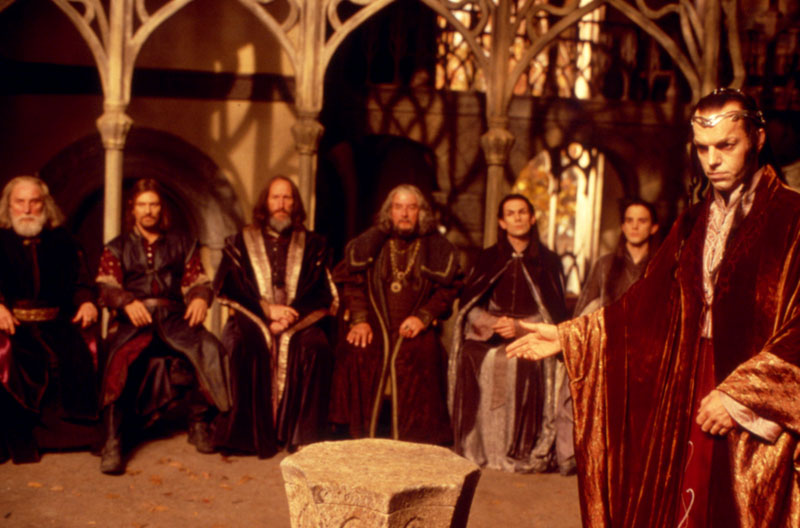
One of the things I like about this series is that Tad Williams openly admits to stealing – er, paying homage to the great writers of the past. At the end of book one, when all the main characters have been gathered together and are being told about the great dangers they will face, and how they are part of a plan to defeat the Grail Brotherhood and their Nefarious Scheme, most of the people there want nothing to do with it. It’s up to Orlando Gardiner, our young barbarian warrior-slash-progeriac teenager to say, “Hey, this the the Council of Elrond! We have a mission here!”

Unfortunately, while the Fellowship of the Ring gets a clear mission before leaving Rivendell, the Otherland explorers are scattered before they know what to do, and their main goal is to run for their lives. As this book progresses, they start to learn more about the vast Otherland network, what its nature is and why it was made. They also learn that it is unstable, and possibly a living thing in its own right.

Almost immediately, the group gets split up. That is, as all ensemble writers know, the best way to really build a meaty story, and it works really well here. Unfortunately, while there are three groups, the strongest and most interesting characters get put into two of them. Orlando and Fredericks get sent off into a world more bizarre than any online gaming ever prepared them for; Renie and !Xabbu end up in a horribly twisted version of The Wizard of OZ, if Oz had invaded Kansas, taken over, and started a three-way fight between the Scarecrow, the Lion and the Tin Man.

No adorable wisecracking robot, though. Can't imagine why.

This leaves us with the third and largest group being somewhat less interesting than the others. Not completely, of course – we have a blind woman who can sense the information flow of the simulation, a teenage net-freak who only speaks in online slang, a campy death-clown named Sweet William, a Chinese grandmother and an abrasive German woman. They’re not bad characters by any means, and each one is special in his or her own right. It’s just that most of them were introduced later in the first book, and so we’ve had less time to get to know them. Putting a more familiar character in that group might have made them more interesting, or it might have overshadowed them. Who knows? The good news is that they do become more interesting and engaging, so there’s really nothing lost by their being new to us.

One thing that the third group has, however, is a secret – one of them is not who he or she appears to be. One of them has been co-opted by the sociopathic assassin, Dread. The only one with the freedom to go on and offline at will, he has nearly godlike power at his fingertips. And he intends to use it.

I can imagine that Tad Williams had a great deal of fun working out these novels, mainly because he created a concept that allowed for incredible freedom in world-building. After all, on a super-powerful VR platform, any conceivable simulation can be created. So whether it is the mythical land of Xanadu, a cartoon kitchen where the groceries come to life at night, a world where people fly like birds, or the legendary land of Ithaca, the settings in these books are only limited to what Williams can think up and work with.

It's like, I'm in the story and I'm reading the story... Woah. Dude.

What’s really interesting is that he seems to take great pleasure in reminding us that we are, in fact, reading a story – he goes so far as to have one character reflect on exactly what kind of character he is. People are reminding themselves that they’re not in a story, even though they are, and at the same time recognizing that the entire structure of their virtual universe is patterned on the rules of fiction. It’s a strange type of meta-fiction that rewards the careful reader.

So, as the book comes to a close, we have some new threads to follow. The Otherland explorers begin to find their purpose and learn about their situation. We’ve met a strange type of character which exists in many worlds at once – the beautiful, birdlike woman who tries to help Paul Jonas and Orlando Gardiner find their way; the horrible Twins, whose only job is to pursue Paul Jonas wherever he may go. These people can be found around any corner, and the outcome of meeting them is always uncertain.

Slightly less complicated than this, but not for lack of trying.

Offline, real-world investigations into the mysterious comas that afflict children begin to bear fruit – a young lawyer named Catur Ramsey is trying to help the parents of Orlando and Fredericks find out what happened to their children, and the search leads him to a strange woman, Olga Pirofski, who may have a vital clue. Renie’s father involves himself with some very dangerous people indeed. The police in Sydney find themselves working on a five year-old murder case that will eventually lead them to the malicious assassin/hacker Dread. A mysterious group called The Circle makes itself known to a select few, and reveals its mission – to oppose the Lords of the Otherland and their relentless pursuit of immortality. All through this, those Lords of the Otherland struggle amongst themselves to see who will ultimately control it.

The tale becomes stranger with the telling, but I can guarantee – you’ll be good and ready to jump right into book three….

—————————————————
“I’ve seen things you people wouldn’t believe. Attack ships on fire off the shores of the Nonastic Ocean. I watched magic blunderbusses flash and glitter in the dark near Glinda’s Palace. All these moments will be lost in time, like tears in the rain. Time… to die.”
– The Scarecrow, Otherland: River of Blue Fire
—————————————————

Tad Williams on Wikipedia
Otherland on Wikipedia
City of Golden Shadow on Amazon.com
Tad Williams’ Website

2 Comments

Filed under adventure, children, corporations, culture, existentialism, family, fantasy, futurism, gender roles, identity, internet, meta-fiction, quest, science fiction, Tad Williams, technology, transhumanism, virtual reality, world-crossing

Review 142: Otherland 1 – City of Golden Shadow

Otherland 1: City of Golden Shadow by Tad Williams

Let me just start by saying this: the first time I finished this series, I immediately went back and started reading it again. I can’t think of any other series that I’ve done that with.

This is one of Tad Williams’ “economy-sized manuscripts,” similar to his fantasy classic Memory, Sorrow and Thorn. Similar in size and scope, anyway – four giant tomes chock full of all things awesome. It’s a series of grand scope, amazing scale and great imagination, well worthy of your time. It’s a complex, interweaving of tales, full of vibrant characters, implacable enemies, and important questions about destiny, identity, consciousness and the very nature of reality itself.

Seriously, top-shelf stuff here, people.

Mind you, Second Life's dreams aren't all that big.

It begins in a near-future world, and it begins with the children. Renie Sulaweyo, a teacher in South Africa, has a brother in the hospital. He, like many other children around the world, has gone into an inexplicable coma, the causes of which defy medical science. The only clue she has is that the outbreaks of these comas coincide with the availability of access to the Net – a virtual reality internet that is what Second Life dreams of becoming. Here, depending on your equipment, you can live in a virtual world that is more vibrant and exciting than anything the real world can offer. And you can do it in full sense-surround 3D.

Renie’s brother, Stephen, engaged in the usual mischief that any kid with access to his own virtual universe might do, and finally got caught. Something shut him down, and Renie was determined to find out what did it. With the assistance of her student, a Bushman named !Xabbu, Renie uncovers an amazing virtual world, something that puts the best virtual reality to shame. It is the Otherland, a playground for the obscenely wealthy. And it may hold the secret to what has afflicted her brother.

And if you think WoW is nuts now? Imagine it fully immersive. Okay, nerds, get back to gold farming...

That’s the short version, and since Renie is the one we’re introduced to first, it would be easy to think of her as the protagonist of the story. That would be highly inaccurate, though. There’s a lot of other storylines going on in there as well. There’s young Orlando Gardiner, who compensates for a crippling illness by being the baddest barbarian on the net. His best friend, Sam Fredericks, has stood by him for many years in an online game that makes World of Warcraft look like pen and paper D&D. They and others are lured into a deadly quest by a vision of a great golden city, more realistic and magical than they ever thought they could find.

Out in the real world, there’s little Christabel Sorenson, upon whose earnest desire to help the funny-looking Mister Sellars the entire future of the Otherland rests. There’s the aptly-named Dread, an assassin extraordinare whose strange “twist” gives him an edge in all things electronic. And, of course, there is Paul Jonas, a man trapped in an imaginary world, whose escape threatens the greatest dreams of the richest men the world has ever known.

All of this, as the series title suggests, centers on the Otherland project, a virtual reality of monumental proportions. It’s a digital world that is more real than the real world is, a world of computer-created, but very deadly, dangers. The slightest misstep could spell disaster and death – die in the Otherland and you die in real life.

This doesn't happen in Otherland, by the way. Lucky them.

And just FYI, Otherland predates The Matrix by three years and, kung-fu aside, is a much better story. So if you’re thinking, “Man, this is just a Matrix rip-off, you’re very, very wrong.

It’s a daunting series to begin. After all, it’s four books, each one clocking in around 800 to 900 pages. There are at least fifteen major characters, and the Otherland itself shows us seven different “worlds” in this book alone. There’s a lot to take in, and on top of all that, there’s a whole world happening outside the story – each chapter is preceded with a small news blurb that tells us about things that are going on in the world. Cops rounding up homeless kids in lethal “snipe hunts,” homicidal artists, legislative representation for the industrial sector of America – this world is both familiar and alien at the same time.

Then again, neither does this. Tad Williams does have his limits.

The good news is that it is a lot of fun to read. The pacing is very good, so you never get too bored watching any one character for a while. What’s more, Williams pays homage to some of the greatest fantasy and science fiction the English-speaking world has to offer. At one point, even the characters admit that they seem to be caught up in a very familiar story. So my advice is to just dive right into it. Once you get going, things clip along at a good pace and you’ll find yourself on page 943 in no time flat.

The really fun part is re-discovering things in this series. There are some things I remember very clearly, but other little details that pop up and make me think, “Oh yeah, I forgot all about that.” I enjoy seeing Williams’ prescience – after all, he wrote this just as the internet was really becoming popular, and a good ten years before things like online gaming and social media took over our lives. His vision of an immersive, VR world may have seemed a little wild and out there back in the mid-nineties, but not anymore.

So, make a sandwich and find a comfortable place to sit. This’ll take a while, but I guarantee – it’ll be worth it.

———————————————-
“If you have found this, then you have escaped. Know this – you were a prisoner. You are not in the world in which you were born. Nothing around you is true, and yet the things you see can hurt you or kill you. You are free, but you will be pursued….”
– Sellars to Paul Jonas, Otherland: City of Golden Shadow
———————————————

Tad Williams on Wikipedia
Otherland on Wikipedia
City of Golden Shadow on Amazon.com
Tad Williams’ Website

Leave a comment

Filed under adventure, brothers, fantasy, fathers, friendship, gender, gender roles, internet, quest, science fiction, sisters, survival, Tad Williams, transhumanism, virtual reality, world-crossing

Review 137: The Last Watch

The Last Watch by Sergei Lukyanenko

This review is acceptable to the forces of Light. – The Night Watch

This review is acceptable to the forces of Darkness. – The Day Watch

When I finished The Twilight Watch a couple of years ago, I thought that was it. Night, Day, Twilight, done. But when I announced that I would be doing the Night Watch trilogy as my end-of-month podcast, I got several emails from listeners who were quick to correct me. The series is not a trilogy, they said, but rather a tetralogy (okay, no one actually used this term). There is a fourth book out there, and I had no idea it existed!

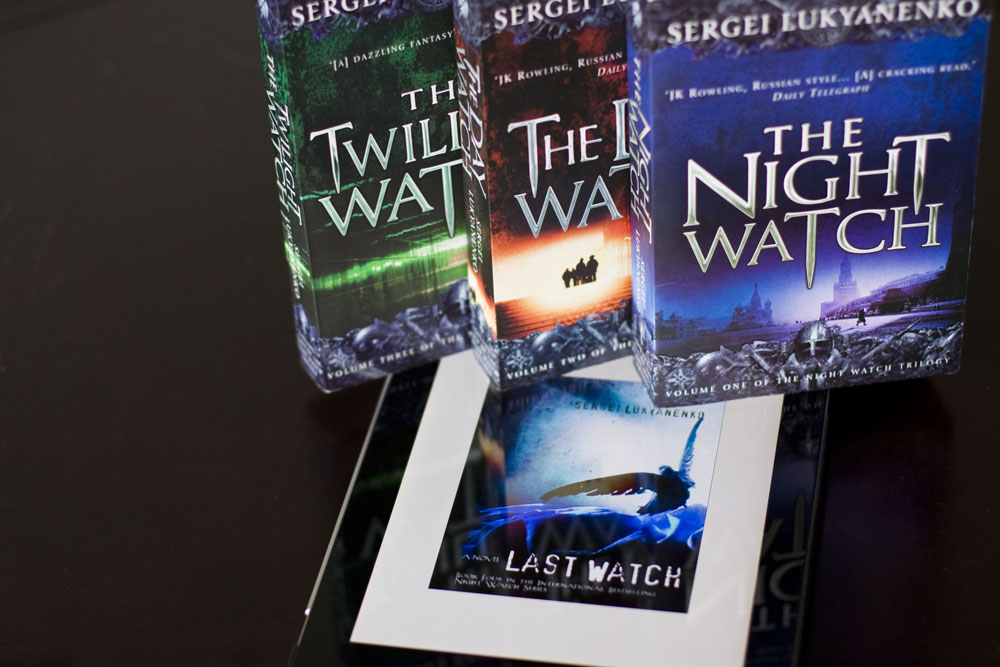
Also thanks to modern technology, I can recycle images! Everybody wins!

Thanks to modern technology, I was able to get the final (as far as I know) book, The Last Watch on my Kindle and get myself up to speed.

Much like the previous volumes, this one is divided into three novellas, which all tie together into a greater plot. In the first, we are once again introduced to Anton Gorodetsky, an agent of the Moscow Night Watch. Due to the events of the last book, Anton is now a Higher Other, having been elevated by the use of the fuaran a mystical book that can create or raise Others. His abilities are far beyond most, and that makes his responsibilities that much greater.

He is assigned by his boss, Gesar, to investigate a mysterious killing in Edinburgh, Scotland. A young man, the son of a Russian magnate, has been murdered, and it looks for all the world like a vampire – a Dark Other – has done the deed. The pact between the Dark and the Light expressly forbids such actions, and the violation of treaty could lead to terrible consequences for all.

You'd think a Scottish vampire wouldn't be so hard to find....

Problem is, the Day Watch has no idea who or what killed the young man, and they’re just as hot to find the killer as Anton is. And of course, the clues don’t add up. The method of the murder doesn’t fit the M.O. of your standard vampire, and the place where the murder occurred – a horror funhouse in the middle of the city – has its own mysterious properties as well. Anton knows he’s on the right track, though, when someone tries to kill him, and he ends up fighting his way through the Twilight to get his answers. What he finds, however, is evidence that the mythical Merlin had left something in Edinburgh for safekeeping. Something truly terrible, no matter whose hands it fell into.

In the second story, Anton is sent out to Uzbekistan to find one of the greatest Others who had ever lived, a man by the name of Rustam. Almost a legend among Others, Rustam is probably the only one who can come even close to figuring out what Merlin hid, and why. But he won’t be easy to find. Anton not only has to deal with the Watches of Samarkand – which are far less efficient and well-staffed as others in Europe – but there’s still someone out to kill him. This time, though, they’re using ensorcelled humans to do the job, something that is also expressly forbidden.

It soon becomes clear that there is a small conspiracy of very powerful Others – one Dark, one Light, and an Inquisitor, who serves neither – who are trying to recover the artifact that Merlin left behind. Their reasons are unknown, but they’re willing to destroy anyone who poses a threat to them. Including, of course, Anton.

It is in the third story where the whole plan finally comes together. That three-person conspiracy is determined to get their hands on Merlin’s power, to collapse the Twilight and fundamentally change the world. If they have to kidnap Anton and threaten Moscow with a nuclear warhead to do it, then so be it. Their ends are, in their minds, wholly justified. It is up to Anton and his allies to avert this tragedy and see to it that the power they seek is never wielded by anyone ever again.

As with the other books, the great supernatural action hides a greater exploration of the fundamental differences between right and wrong, good and evil. As terrible as the Last Watch are, they are doing what they believe to be right, and even Anton can come to understand their motives at one point. But they way they go about it, through dark magic and darker murder, doesn’t nearly justify their aim. And so we see that evil done in the pursuit of good merely produces more evil.

Or how you define "Eeeeeevil."

Depending, of course, on how you define “evil.”

What’s more, there’s quite a bit of metafiction in this book. It’s clear that Lukyanenko is a fan of fantasy – he references Tolkien and Pratchett, just to name a couple of great authors. But he also knows the tropes of fantasy that have survived for so long, and makes sure his characters know them as well. When words are written on the walls, when people go in search of a great object of power or an unwinnable quest, chances are that one of the characters has read something like it in a fantasy book.

Go ahead. Write a 5,000 page epic fantasy about these guys.

At one point, when talking about how there are Others who would like to rule the world, the Inquisitor Edgar notes that it’s what people really want. It’s why fantasy is so much more popular than science fiction, he claims, because everyone dreams of being the magician or wielding the magic sword. It all makes sense, in a way that science fiction doesn’t. Anton, of course, doesn’t buy this, noting that most people who live in a Medieval Thaumocracy would be just like the peasants of long ago – poor, dirty, and dead by forty. So even in a world where magic is very real and very important, the characters know the difference between fantasy and reality in a way that we can relate to. I just find that fascinating.

It’s good fun, and a nice way to close out a very imaginative series. It’s exciting and heartbreaking and funny – with a nice hat-tip to the Night Watch movie thrown in near the beginning. What’s more, it’s a well-built magical system and society that allows for a great variety of stories and characters. Honestly, I would love to see Lukyanenko expand on this universe, or even open it up for others to play in.

————————————————
“There is very much in the world that is bad. But usually the attempt to defeat evil engenders more evil. I advise you to do good; that is the only way to win the victory!”
– Rustam, The Last Watch
————————————————

The Last Watch on Wikipedia
Sergei Lukyanenko on Wikipedia
Sergei Lukyanenko’s website (in English)
The Last Watch on Amazon.com

Leave a comment

Filed under afterlife, apocalypse, death, detective fiction, fantasy, ghosts, good and evil, morality, Russia, Sergei Lukyanenko, vampires, werewolves, witches, wizardry, world-crossing

Review 136: Side Jobs

Side Jobs by Jim Butcher

“Hell’s Bells” count: 14

There’s a reason that clichés become clichés. That’s because, no matter how much we may hate them, they concisely describe some feature of human existence that is common to us all. The reason everyone uses them is because they’re just so… right, and there’s really no need for us to come up with something else. It’s like saying, “Yes, I could use a screwdriver to put together my new IKEA desk, but everyone does that. I’m going to invent my own, completely new tool instead.” So we use clichés, no matter how much we don’t want to, because there’s no reason not to.

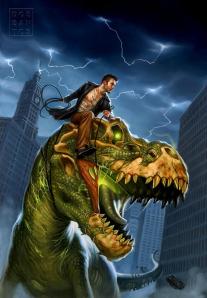
A wizard with a gun riding a zombie tyrranosaur in the middle of a lightning storm? Puh-LEEZ. Not that old thing again... (Art by Dan Dos Santos)

Having said that: Reading this collection of Dresden Files stories is like visiting with an old friend. One of those people you’ve known for ages, never get to see often enough, and always know you’ll spend a good time with. From the moment you start reading, you know where you are, you know who you’re dealing with, and you’re ready to jump right into the story without a whole lot of character building, exposition, and the nuisance of trying to decide if this is something you’ll like to read. If you’re picking up Side Jobs, odds are that you already know The Dresden Files, and odds are that you’ll really enjoy these stories.

Most of them have been published before, in one form or another, but if you don’t follow the various anthologies that are put out from time to time, these’ll be new to you. They’re not especially necessary to understand the overall series plot, but they do help to flesh out some characters and ideas that have already been presented – and hand us a few new ones as well..

The first story, “A Restoration of Faith,” is a little rough, as Butcher himself admits. In the introduction to the story, he tells us that it was written when he was still in school, before he had really built up his writing chops and figured out his voice. And it does show, but in a kind of amusing way. As if, to continue on with our cliché of the day, you got to see the high school photos and videos of a friend you’ve only known in adulthood. It’s a little awkward and a bit weird, but you can see the person he would one day become. In the same way, we get a glimpse of the young Harry Dresden, just getting his start as a private investigator. Working with Ragged Angel Investigations to get his license, Harry finds himself in one of his classic intractable positions: find a little girl whose parents don’t particularly want her found. To make it more fun, she doesn’t really want to be found either.

The story looks at what Harry does and why he does it, and how no matter how dark the world gets, he sees himself as a person born to hold a light in the darkness. He saves the girl, of course, with his classic nick-of-time timing, and the story ends with the introduction of Karrin Murphy and a rather punny ending. It’s not really the Harry Dresden that we know, but we can see the Harry Dresden that he will become.

LARPing is like this, only moreso.

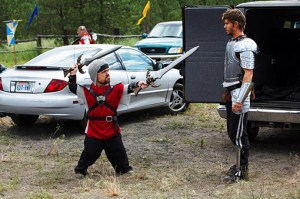
The other stories are good fun, too. In “It’s My Birthday, Too,” a story written for an anthology with a birthday theme, Harry sees the worlds of fantasy and reality collide. Violently, as usual. His brother Thomas has a birthday, and Harry has so few opportunities to do “normal” things – like celebrate birthdays – that he’s determined to see that his brother gets his present. He tracks Thomas down to a shopping mall which, after hours, plays host to a LARP club. For those of you not in the know, LARP is Live-Action Role-Playing, wherein people like I was a decade ago dress up in costumes and pretend to be vampires and werewolves and wizards and things. When done well, it’s good fun, and it’s a great way to put on another personality for a few hours. Unfortunately for this group, their session gets interrupted by some real vampires. Drulinda, of the Black Court, is out for some social revenge against her former peers, and she’s willing to kill everyone she finds in order to get it. Harry and Thomas work to bring her down, of course, while also bringing the rest of the mall down at the same time.

In “Day Off,” Harry tries to take a little bit of time for himself. With no cases to work, no calls from the Chicago police, and no official duties with the White Council, he is intent on having just one day to be somewhat normal – sleep late, go out with a girl, that kind of thing. Of course, things don’t work out that way, because he’s Harry Dresden. Instead, he ends up with a group of wannabe wizards who think they can take him on, a couple of bespelled, amorous werewolves, and an apprentice who is only moments away from blowing herself up. It’s good fun, and reminiscent of Dante in Clerks, who laments that he’s not even supposed to be there.

Of course, Michael isn't nearly this adorable.

“The Warrior” is, in many ways, a response to the readers who thought that Michael Carpenter got kind of a raw deal at the end of Small Favor. Michael had been a Knight of the Cross, a literal warrior of God, who had helped Harry fight the forces of evil many, many times. He’s very different from Harry in many ways, but their differences work well together. What’s more, Michael is a genuinely good man, of the Atticus Finch variety. He is honest, dedicated, and devoted to his friends, his family and his duty. That’s why, when he was nearly killed at the end of Small Favor and forced to give up his position as a Knight, a lot of readers were upset.

Why? Well, because horrible things aren’t supposed to happen to people as good as Michael, and yet they had. What’s more, without his strength and his sword, it was hard to see how he could continue the work that he so obviously loved. This story, then, is all about how the battle to make the world a better place isn’t always about the big fights and battles against entities of indescribable evil. It’s also about small gestures, about stopping to talk to someone when no one else will. It’s about a word or a gesture or a joke, and the way that these little things can have huge effects later. Michael may not be swinging a sword around anymore, but we know that he is still part of the fight.

Two stories that really stood out were “Backup” and “Aftermath,” mainly because they were told from the point of view of someone who wasn’t Harry Dresden. In “Backup,” we get a story told by his brother, Thomas. A vampire of the White Court, Thomas feeds off emotion, rather than blood. This doesn’t make him any less dangerous, of course. More dangerous, actually, in that so many of his potential victims give themselves to him willingly. but Thomas is trying his best to stay on the side of Good. Through his eyes, we not only get to see Harry from a new point of view, but we also get to see a lot more of a world that Harry never gets to see. Because of who he is, Harry will never really get a good look at the inner workings of the White Court and the Oblivion War – a concept that is fascinating and frustrating, because we know that Harry can never get involved in it. By telling a story through Thomas, Butcher expands the universe of The Dresden Files and makes it even more interesting.

Don't say I didn't warn you....

The other non-Harry story is “Aftermath,” which takes place after the most recent novel, Changes. Told from the point of view of Harry’s oldest friend, Karrin Murphy, it’s a look at what’s happened in Chicago in the hours after Harry’s disappearance (and presumed death). Without him (and without the now-destroyed Red Court of vampires), there is a huge power vacuum just waiting to be filled. Whether it’s the mafia or mermen, the absence of Harry Dresden is an opportunity for many. Murphy gets involved in the hunt for special people, anyone with a trace of magical nature, who are to be used for their power. Without Harry to rely on, she has to use her own knowledge and resources to save her friends. At the same time, she has to face the reality that Harry is gone, maybe dead, and that is more terrifying than all the monsters that might try to take over the city.

It’s a great collection of tales, one that’s quick to get through. If you’re just itching for the new book to come out, this should hold you over for a little while.

——————————————————
Harry Dresden. Saving the world, one act of random destruction at a time.”
– Jim Butcher, “The Warrior”
——————————————————

The Dresden Files on Wikipedia
Side Jobs on Wikipedia
Side Jobs on Amazon.com
Jim Butcher on Wikipedia
Harry Dresden on Wikipedia
Jim Butcher’s homepage

2 Comments

Filed under adventure, anthology, brothers, children, death, detective fiction, Dresden Files, family, fantasy, friendship, Jim Butcher, mystery, police, short stories, vampires, werewolves, wizardry

Review 134: Perdido Street Station

Perdido Street Station by China Miéville

The last time I read this, I wrote: “While this book is remarkably huge, it’s a swift read – well-paced, interesting, creative and clever, which are all good things to have in a book.” At the time, that was true, but this time? Not so much.

I don’t know what changed in the intervening years. The first time I read this book, it gripped me and wouldn’t let me go. I fell into it, into the vast and horrible city of New Crobozon and all the madness that was built into it, and when I came out I was filled with wonder, surprise, and regret that I hadn’t spent a lifetime perfecting my skills at fantasy art.

I would love to read this book, but these naps aren't going to take themselves....

This time was different, and I knew it pretty quickly. I found myself spending more time listening to podcasts while on the train, or playing games on my phone. I ate lunch at my desk and checked my RSS feeds instead of bringing my book up to the cafeteria with me. I actively avoided reading this book and I really wish I hadn’t because it deserves better.

It is the job of every fantasy writer to bring to life not only characters but an entire world. Whether you’re Jim Butcher, creating an alternate Chicago, or Robert Jordan, creating an entire planet, the writer has to know the world inside and out. Every country, every type of people, every custom and culture, climate and weather – everything.

This is because the characters that populate the tale will inevitably be shaped by their environment and its history. Would Tolkien’s fellowship have come together if it were not for the millennia of tensions that existed from having such diverse people living in such a small piece of the world? Probably not. Would the warring princes of Brandon Sanderson’s Stormlight books fight so hard if it were not for the terrifying storms and the power they bring? I doubt it.

Whether the world is built before the story is made or during the process of telling the tale, the author is responsible for it. In the case of Miéville’s New Crobuzon, you know from page one that he has put more time into thinking about his city than almost anything else.

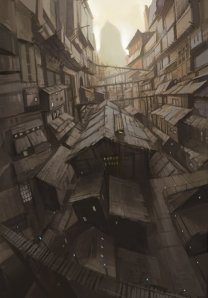
Steampunk. For when you really love brown. (art by gordillo on DeviantArt)

There is almost a palpable feeling of dereliction and disrepair that comes off the page when he describes the city. It’s a dirty place, a wet place, a place that has seen better days. It’s mayor is a tyrant, who uses a secret militia to keep the populace under control and horrifying thaumaturgical techniques to punish those who break the law. It is a great, sprawling metropolis at the confluence of two rivers – the Tar and the Canker – which should tell you a bit about the city they run through. In the tradition of modern urban fantasy, it’s a place of magic and technology, ruined by political greed and social apathy. There are desperate poets and mad scientists, gang bosses and petty criminals, whores and saints and madmen for every occasion.

Independent scientist Isaac der Grimnebulin is looking for the thaumo-physiological secret to flight in order to help a disgraced bird-man regain his wings, and to prove his theory of “crisis energy” that may well change the world. In the process, he accidentally unleashes an unstoppable horror that threatens to slowly destroy the city and everyone in it. He also manages to make enemies of both the city militia and the leader of organized crime in New Crobuzon. He and his friends have only days before the city is overrun, or they are killed, and if they hope to survive they must somehow get the help of two of the most powerful entities the city has ever known.

Miéville has created a new flavor of fantasy here – a kind of steampunk world of brass and wood and gears, analog computers and over-designed firearms that really appeals to all the reader’s senses. He describes the city in unrelenting detail, and if pressed he could probably give you a tour from memory. You get the feeling that New Crobuzon has been sitting in his head for a long time, and all he’s done is finally put it to paper.

For a change of pace, grayish-brown. (art by Trabbold on DeviantArt)

For me, that might have been what changed. The first time I read this, I was swept up by the city, but this time… this time I kept thinking, “Yes, yes, the city is a cesspit, I get it. What about the giant moths?” I wanted the story more than I wanted the setting, and my impatience (combined with a whole lot of backed-up Radiolab episodes) kept me from really settling down, slogging through the descriptions of decaying brickwork, overgrown rooftops and beggars wrapped in filthy rags who crawled through the pestilential streets. In a way, it was kind of like Tolkien, but slightly more restrained.

But perhaps, like Tolkien, that was the point. For all that we’re reading an adventure now about a scientist and the horrors he has unleashed upon the world, about a strange patchwork crime lord, a tyrannical mayor, a sentient clockwork intelligence, a dimension-hopping super-spider and moths that will swallow your soul, this book really isn’t about them. This is just one event in the long and bizarre history of New Crobuzon and the vast and strange world it inhabits, and we’re granted a glimpse into it. When you get to the end of it, whatever else you think of the story, you’ll be stunned by what Miéville has been able to come up with.

I know that a lot of the cognoscenti of science fiction and fantasy just adore Miéville, and I can certainly see why. He’s creative, he’s imaginative, and he’s built a wonderful world for the imagination to play in, populated with some of the most bizarre races and people you could think of. He’s grabbed the trend of Steampunk retro-futurism and made it his own in a way that few other writers can do. He deserves all the credit he can get.

For me, though… Perhaps it was the right book, but not the right time.

—————
“New Corbuzon was a city unconvinced by gravity. Aerostats oozed from cloud to cloud above it like slugs on cabbages. Militia-pods streaked through the heart of the city to its outlands, the cables that held them twanging and vibrating like guitar strings hundreds of feet in the air…”
– China Miéville, Perdido Street Station

Perdido Street Station on Wikipedia
China Miéville on Wikipedia
China Miéville’s blog
Perdido Street Station on Amazon

2 Comments

Filed under adventure, China Miéville, dystopia, engineering, fantasy, science fiction, steampunk, totalitarianism

Review 133: The Twilight Watch

The Twilight Watch by Sergei Lukyanenko

This review is of no relevance to the cause of the Light. – The Night Watch

This review is of no relevance to the cause of the Dark. – The Day Watch

This world is one that is riddled with possibilities. Even though Lukyanenko has been pretty single-minded in his themes throughout the trilogy, there’s a lot to work with here. We have two distinct groups of Others, the Light and the Dark, with different character classes, powers, abilities, levels and ambitions. If anyone wanted to write fan fiction or even a role-playing game based on the world of the Night Watch series, they would be able to let their imaginations roam free. It’s an open-ended universe, rife with possibility.

So why isn’t it is popular worldwide as, say, Harry Potter? Probably because it’s more grown-up than the Potter series, and is therefore less attractive.

Sure, Draco turned out to be faintly ambiguous, but Crabbe and Goyle? They're just bad apples.

Don’t get me wrong – I liked Harry Potter. But for all its merits, it deals with human-level issues: friendship, family, duty, loyalty. And those are all well and good, and many a great story has been told from those elements. The Night Watch series, on the other hand, deals with harder, less everyday topics, such as the nature of freedom, and the fundamental differences between Good and Evil, if there is any difference at all. The themes in these books are headier, and it’s not as easy to look at a Light Other like Anton Gorodetsky and say, “I want to be like him.” It’s also hard to look at a Dark Other like the vampire Kostya and say, “Oooh, I hate him.”

This is because these characters are, more or less, human. The problem with humans is that their motives aren’t always clear, and Lukyanenko doesn’t tell us everything we need to know to judge them properly. With the exception of Anton, who is a first-person narrator, we don’t get into their heads, and so can’t completely understand why they do what they do.

In this volume we are introduced to some new players, some grand plots and some terrible secrets. There is an Other out there who has knowledge that everyone thought was merely a myth: how to turn an ordinary human into an Other. The ramifications of such power are immense – there are few Others in the world as it is, and they hardly get along. To create new Others at will would mean chaos, death and destruction. All the Others’ forces are sent out to find this mysterious person. The Night Watch, the Day Watch and the Inquisition are in search of the impossible.

Anton Gorodetsky, of course, is on the front lines of this, searching for leads in a Moscow apartment complex. What he finds there isn’t quite the secret he thought it was, but it is something he never expected.

How about some free-market capitalism, Scarecrow?

In the second story of the volume, he meets an ancient witch, Arina, who may have single-handedly destroyed the Soviet Union’s potential for greatness. In his search to defeat her, he learns the true nature of the Others, what gives them their power and how they truly interact with the world around them.

And in the third story, the Fuaran has been found – the mythological text with the spell to convert humans to Others – and it will be used in a truly novel manner. But the Other behind the plan that could tip the world into supernatural anarchy is the last person Anton would have ever expected….

As with the other volumes, this one blurs the line between good and evil. It tells us what we already know, but don’t really want to admit: that good people can do evil things – start a bloody revolution, for example, or try to brainwash thousands of people – and that evil people can do good – save children from wolves, or avert a chaotic and terrible future. People do things for reasons that are sometimes known only to themselves, not out of a higher allegiance to the abstract concepts of “good” and “evil,” but for reasons that are intensely personal.

There are, however, times when labels work just fine.

It is something to be remembered. We have a habit of idolizing and demonizing people in this world, elevating them to paragons of virtue or sin, and ascribing motives to them that we think they acted by. But that doesn’t work. Even to the end, Anton believes he knows why the holder of the Fuaran wants to convert people into Others – to raise an army and control the world – but he’s so very, very wrong. The true reason is much more personal and, oddly, much more human than that.

That is probably the best lesson to be taken from these books. “Good” and “Evil” are tags that we affix to people because it saves us the effort of thinking about them. Behind every act, however, is a personal reason that defies such simplistic labeling. Every saint, every monster, is only human. Just like us. I don’t know if knowing that makes the world better or worse, but it at least makes it a little more familiar.

————————————————-
“We weren’t meant to fly.
All we can do is try not to fall.”
– from The Twilight Watch

The Twilight Watch on Wikipedia
Sergei Lukyanenko on Wikipedia
Sergei Lukyanenko’s website (in English)
The Twilight Watch on Amazon.com

Leave a comment

Filed under apocalypse, detective fiction, disaster, fantasy, morality, mystery, Russia, Sergei Lukyanenko, vampires, war, werewolves, witches, wizardry