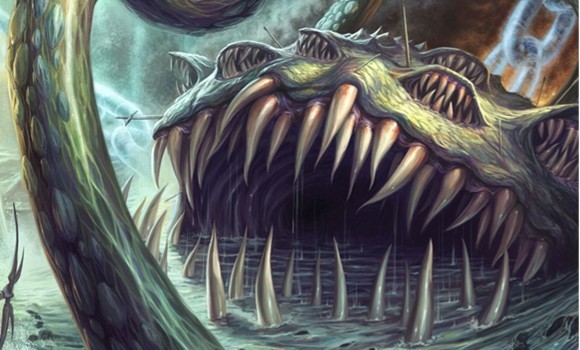
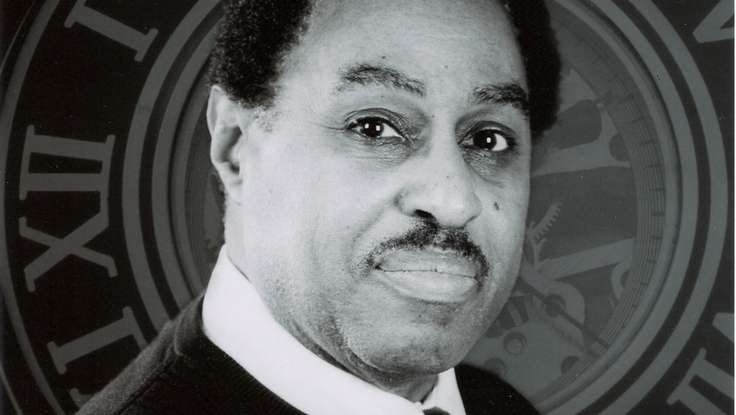
Tag Archives: book reviews

Review 206: Cold Days

LL 206 - Dresden 14 - Cold DaysCold Days by Jim Butcher

Hells Bells count: 35

Be Warned: This is a new volume, so if you’re not up to date then you might want to save this one for later!

Sometimes I wonder how much Jim Butcher had planned in advance. I mean, this is book number fourteen of a series that’s been going for twelve years. Whether he’s got a giant, intricate plot map pinned up along the walls of his writing office or he’s making things up as they go along, I’m impressed. As we get further into the exciting life and times of Harry Dresden, one thing that is clear is that the series has always been moving in a very clear direction, and that the things that came before are what inform the things that come later. Jim Butcher is not a wasteful author, and that gives him the ability to do a lot of really impressive things.

As we open this story, Harry Dresden is no longer dead. He was, sort of, and had all kinds of grand fun as a ghost, but now he’s alive and it’s time for him to start paying off the debts that he incurred in the process of dying. The first of these debts is to Mab, the great and terrible queen of the Winter Faerie.

Not this kind of Winter Knight, but it'll do.

Not this kind of Winter Knight, but it’ll do.

Many, many books ago, Mab offered Harry the position of the Winter Knight – a mortal who would be the strong arm of the queen. He would be her sword, to strike where she pointed. Harry refused until he could refuse no longer, taking on that mantle in exchange for the power that would allow him to rid the world of the Red Court of vampires. And as much fun as vampire genocide is, that’s not really his job anymore. Now that he’s alive again and under no other obligations, Mab has a purpose for him. At its face, it is a terrible purpose, one that makes no sense and yet which Harry is obligated to fulfill.

On the other hand, there is Demonreach. Mab’s partner in keeping Harry Dresden’s body… let’s say viable while he was away as a ghost, Demonreach is the spirit of an island in the middle of Lake Michigan. This island isn’t on any maps, and it’s devilishly hard to find, but it represents a huge well of magical and spiritual power. This island needs Harry Dresden in order to do its duty. Demonreach is not just an obscure Brigadoon that enjoys hiding from the eyes of the unworthy – it is a guardian against powers that would ravage the world. If it is going to maintain its control and keep the peace, it needs Harry Dresden.

While all this is going on, we learn of a new force that is at play in the world. This is rather in keeping with the way the Dresden Files books have worked thus far. Every so often, our point of view is changed, and our field of vision is expanded. Way back in Storm Front, Harry Dresden was a small-time wizard investigator, not well-loved in the wizarding community but good at what he did, and that was pretty much all we saw. As the series progressed, we discovered more about the White Council of Wizards, the three Courts of Vampires, about the ever-feuding faerie realms of Winter and Summer. We went on to discover angels and demons and things that walked between them, ghosts and goblins and creatures that were just barely understandable by our mortal minds.

"KNOCK KNOCK"

“KNOCK KNOCK”

Now we take another step back, out beyond the borders of our reality as we know it. Outside our universe, there are… things. And those things want in. Why they want in is not really understood. Maybe this universe is more hospitable, maybe they’re just bored. All we know is that to let them in is to let reality as we know it die. That’s bad enough, but what is worse is the knowledge that some of them are already here. They’ve snuck under the walls, so to speak, and are carefully and busily undermining our defenses. In a game that is so intricate and dangerous, these things use great powers as pawns – including Harry Dresden – and look forward to their inevitable victory.

As with so many of the other Dresden Files books, this is a solid read, and you’ll fly right through it. Despite being vast in scope, encompassing the fate of the world as we know it, the book is still very personal, letting us follow Harry along the strange, winding path he has to walk whether he likes it or not. Harry has always been a dangerous guy to know, but now that he’s the Winter Knight, that danger is even greater. There are forces arrayed against him that he wouldn’t be able to understand even if he knew what they were, and simply being the Winter Knight is a challenge unto itself. Taking up that position doesn’t just come with awesome new powers and a direct line to some of the most powerful creatures in creation – not without a price. There are obligations as well. Rules and requirements. And, of course, dangers.

When he’s done, he’ll have more answers, and he’ll have more problems. Whatever comes next, we can be sure it will be even bigger and scarier than what has come before, and it’ll be a treat to see how he manages to beat it.

——
“I kept a straight face while my inner Neanderthal spluttered and then went on a mental rampage through a hypothetical produce section, knocking over shelves and spattering fruit everywhere in sheer frustration, screaming, ‘JUST TELL ME WHOSE SKULL TO CRACK WITH MY CLUB, DAMMIT!'”
– Harry Dresden

The Dresden Files on Wikipedia
Cold Days on Wikipedia
Cold Days on Amazon.com
Jim Butcher on Wikipedia
Harry Dresden on Wikipedia
Jim Butcher’s homepage

Leave a comment

Filed under Dresden Files, fairies, fantasy, Jim Butcher, magical realism, murder, wizardry

Review 204: Blackout & All Clear

LL 204 - Blackout-All Clear 1LL 204 - Blackout-All Clear 2Blackout and All Clear by Connie Willis

Reading one of Connie Willis’ time travel novels is like watching a master paper-folder perform a particularly difficult feat of origami. It seems simple at first, but then there are a few folds and twists, edges are forced together and bent apart, there’s a few points where you can’t even see exactly what her hands are doing, but when she’s finished, you have the pleasure of seeing something intricate and beautiful come into being right before your eyes.

The basic premise of her time travel works is pretty simple: in the future, we have time travel (but not cell phones, as you may recall from The Doomsday Book). The exact means by which it works is not revealed to us, which makes sense – the books aren’t about the mechanics of time travel but rather the results. On the other hand, the rules of time travel are vividly clear:

  1. You can only go to the past.
  2. You can’t bring back any souvenirs.
  3. You can’t change anything.

You just can't keep a good cathedral down...

No, you can’t bring back cathedrals either.

That last part is really important, and it is held as gospel by the historians who use the mechanism to go visit various eras in history. The space-time continuum will do its damnedest to keep a traveler from altering the natural flow of events. For example, in order to even get the machine to work, you have to be able to blend in – that means proper clothes and appearance, no hidden wristwatches or things like that. If you’re carrying a disease that the locals might not be prepared for, if you don’t know the language – hell, maybe if you’re just the wrong skin color, the system won’t open up and let you through.

Once you’re ready to go and fit in, there’s still the matter of being able to change events. Now it is true that simply by existing you have already changed things. You move air molecules that were moved differently before. You’re pouring heat into the environment that wasn’t there before. You’re making contact with the surfaces around you, shedding skin cells, making noises – and that’s before you even meet anyone. Once you’re out on the street (or country lane or agora or whatever), you’re interacting with people no matter what you do. They see you, you register in their consciousness to one degree or another – you’re changing things just by your very existence.

The continuum, it seems, is only concerned about big changes. You can’t get anywhere near Hitler, for example, or Kennedy on the day of his assassination. No matter how hard you try or how precisely you set the controls, you will end up displaced either in time or in space or both, unable to do a damned thing. The continuum protects itself, and historians can be assured that their actions in the past have no real consequence.

Or do they?

Dangerous? Nonsense. Now out of my way, I've milk to deliver.

Dangerous? Nonsense. Now out of my way, I’ve milk to deliver.

Three British historians have gone back in time to one of the most dramatic and dangerous eras in recent history – the Blitz of World War 2. This was a period of about eight months between 1940 and 1941 when German bombers tried to reduce England to a smoking pile of rubble. They dropped a hundred tons of bombs, cause immeasurable property damage, and killed thousands of people. Life in this time was dangerous, terrifying, and uncertain, and anyone who lived through it was aware that they could die on any one of the raids.

Despite this, the English showed a solidarity and a steadfastness that won the respect of the world (or at least the parts of the world that weren’t trying to bomb it). Everyone – soldiers and civilians – were encouraged to do their part during the war, and every action you took had to be considered in the greater scheme of keeping people safe and keeping London alive. A popular sentiment about the time is that there really were no civilians. Everyone played a hand in getting England through the Blitz, from the Prime Minister to the milkman. If you were an historian looking to see how ordinary people coped in extraordinary times, the Blitz would be the perfect scenario to observe.

Polly Sebastian is in the thick of it. She has traveled to London, September 1940, with the intention of getting a job in a department store in the middle of town. She arrives during a bombing raid and is ushered into a shelter full of people who will change her life.

Mike Davis wanted to see some true citizen-heroes, so he posed as an American reporter in order to witness the Dunkirk Rescue in May of 1940. He ends up far from Dunkirk, however, and his efforts to get there end up in him becoming part of the action.

"Oy dinn't do nuffin'"

“Oy dinn’t do nuffin'”

Eileen O’Reilly has gone to witness the children’s evacuation of 1939-1940. She poses as a maid in a manor house in the country, there to watch over children who had been sent from London to keep them safe from the war. Eileen has to not only contend with dozens of city children, an outbreak of the measles, and learning to drive an ancient Bentley, but she also has two of the most terrible children in England under her care – Alf and Binnie Hodbin.

All of these assignments would be a major task for any historian, but these three soon discover that they are not in an ordinary situation. It becomes clear to them that their actions are having consequences – Mike saves a soldier who in turn helps hundreds more. Polly says a few words that changes a young woman’s life. Eileen gives medicine to a young girl that no one living at that time would have given, thus keeping her alive. The unbreakable rule about historians not being able to affect the continuum seems to be bending.

What’s worse, none of them are able to access their “drop points” to return to 2060. They’re stuck in a strange and dangerous time, and are now just as at risk as any contemporary person is.

This was originally meant to be only one book – All Clear – but it kept growing and expanding so much that Willis split it into two volumes. This allowed her to not only show off what must have been an immeasurable amount of research over the eight years it took to write the novels, but gave us more time to become immersed and invested in a story that is both funny and heart-wrenching in turns. Our time-travelers are in very real danger, of more than one sort, and you really do feel their desperation and hope for their success.

There, there now. Train tracks are much safer than what's going on up there.

There, there now. Train tracks are much safer than what’s going on up there.

It would be so hard to sum up this book, except to say that it reminds us that everything – and everyone – is significant. The fate of the future rests on the backs of not only generals and prime ministers, but on shopkeepers and children. Words can change the world just as much as bombs, and every action you take contributes to the vast, infinitely complex unfolding of history. As our characters learn, there is no such thing as a passive observer. We are all part of the history, the society, and the world around us, whether we like it or not.

We may not know how it’s all going to unfold in the end, for good or ill, and that’s unfortunate. So all we can do when faced with an uncertain future is what the British did when oblivion came flying over the Channel to their shores. Stand firm and do your bit, and let history take care of itself.

—————————————-
“TO ALL THE
ambulance drivers
firewatchers
air-raid wardens
nurses
canteen workers
airplane spotters
rescue workers
mathematicians
vicars
vergers
shopgirls
chorus girls
librarians
debutantes
spinsters
fishermen
retired sailors
servants
evacuees
Shakespearean actors
and mystery novelists
WHO WON THE WAR.”
― Connie Willis, All Clear – dedication

Connie Willis on Wikipedia
Blackout and All Clear on Wikipedia
Blackout and All Clear on Amazon.com
The Connie Willis Blog

1 Comment

Filed under Connie Willis, England, history, science fiction, time travel, war

Review 203: Winter’s Heart (Wheel of Time 09)

Wheel of Time 09: Winter’s Heart by Robert Jordan

Just a note – you may consider this spoilery. Continue at your own risk.

We are continuing on with the series, and once again there’s a lot going on in the Westlands (which is the much better alternative name to “Randland.”). In Caemlyn, Elayne Trakand is busy preparing to become the Queen of Andor, as the world still believes that her mother, Morgase, is dead. She’s not, of course. She became a refugee after the Seanchan attack on Amador, became a Lady’s maid to Faile and Perrin, and subsequently became a captive of the Shaido Aiel, along with Faile and Alliandre, the Queen of Ghealdan. Not a good day for them, seeing as how the Shaido have become the worst that everyone expects of Aiel – murderous, thieving and vicious. Perrin is trying to rescue his wife, of course, but that rescue is not certain. Faile and Morgase will have to figure it out for themselves.

But getting back to Elayne – in Andor, she undergoes the ceremony to become first-sister to Aviendha, the Aiel woman with whom she must eventually share Rand al’Thor’s affections. It’s a great scene, that – a very simple procedure, but deep and meaningful as well. And it suggests a custom that I appreciate very much, having had friends that I consider on par with family. Under the direction of the Wise Ones of the Aiel, you become bonded with your friend and re-born, in a way. Forever after that, you are considered siblings, just as if you had come from the same mother.

Not all sisters want to make your life better.

Having a new sister isn’t going to make things all work out, though – Elayne has to cement her claim to the throne, and deal with an army of Borderlanders who really want to know where Rand is. Why, we don’t know yet. But from the looks of it, it can’t be all that good.

Meanwhile, in Ebou Dar, Mat has reappeared after the injuries he took during the Seanchan invasion. Still wrapped around Queen Tylin’s finger, Mat is looking for a way to get himself out of the city without getting himself or anyone else killed. What this ends up meaning is that he has to escape the city with three Aes Sedai who have been leashed and collared to serve as living weapons for the Seanchan – a crime punishable by death.

The Seanchan are still an interesting player in this series, even if the battle scenes in the last book were kind of dull. They are the descendants of Artur Hawkwing’s armies, vanished across the sea a thousand years ago. Through a millennium of fighting both men and monsters, they have become a formidable military force, held together by the damane – women who can channel, but who are considered less than human for all that. Controlled by other women, sul’dam, the damane are the heart of Seanchan power. No conventional army can stand up to them, and if it weren’t for Rand and his Asha’man, they would have overrun the Westlands already.

(art by minniearts on DeviantArt)

They control Ebou Dar, of course, but they do it in a manner similar to the Romans. They don’t try to change the conquered people, or break them. All they require is an understanding that they are now living under Seanchan rule. Respect the new rulers, obey the laws, pay your taxes and life need not go on any differently. Cause trouble, though, and the hammer will come down on you. Hard.

Even though their military advances are being slowed down, though, their cultural invasion is proceeding. This is not a mission of conquest for them – it’s a homecoming. With the soldiers and damane are also coming farmers and weavers and blacksmiths – normal people who want to make a new life for themselves. With the Westlands practically empty as they are, the Seanchan will have no trouble finding places to live. Right in time for the Last Battle against the Dark One, of course, but they don’t know about that yet. Regardless of how things turn out, the Westlands will never be the same after this.

Rand al’Thor is on a mission of his own, one which involves a great deal of misdirection. After the attack on his person by renegade Asha’man – in which a chunk of the Sun Palace in Cairhien was destroyed and a lot of people died – Rand has decided that enough is enough. This whole “doomed to go mad” thing that comes part and parcel with being a male channeler of the Source has got to go. So yes, he’s decided to cleanse saidin of the Dark One’s taint, but not before taking a detour into the island city-state of Far Madding, to hunt down the men who nearly killed him.

What can I say – the story advances. The plotlines being what they are, we do miss out a bit in this book. Perrin’s hunt for his wife gets cut short, narrative-wise, and we hardly see anything at all of Egwene and the rebel Aes Sedai. This was, if I remember, really annoying when the book first came out. Reading them all at once, however, it’s easier to deal with, knowing that the next book will refocus on people who’ve been out of the spotlight for a while. The parts that did get the most page-time, however, were interesting and, for the most part, exciting to read. So, a step up from Path of Daggers.

—————————————————
“You can never know everything, and part of what you know is always wrong. Perhaps even the most important part. A portion of wisdom lies in knowing that. A portion of courage lies in going on anyway.”
– Lan Mandragoran, Winter’s Heart
————————————————–

Robert Jordan at Wikipedia
Robert Jordan at Tor.com
Winter’s Heart at Wikipedia
Wheel of Time at Wikipedia
Winter’s Heart at Amazon.com

Wheel of Time discussion and resources (spoilers galore):
Theoryland
Dragonmount
The Wheel of Time Re-read at Tor.com
The Wheel of Time FAQ
Wheel of Time at TVTropes.com

Leave a comment

Filed under adventure, epic fantasy, fantasy, Robert Jordan, war, Wheel of Time, wizardry

Review 202: Time Traveler

Time Traveler by Ronald Mallett, with Bruce Henderson

There are a lot of reasons to want to build a time machine. To learn the truth about historical places and events, to see creatures that have been extinct for millions of years, to kill Hitler – always a favorite. You could go to the Library of Alexandria and save the works of great scientists and philosophers that have been lost to history. You could document the Crucifixion or watch the fall of Rome first-hand. You could see Jimi or Elvis or Janice or Kurt in their heyday, watch the original performances of Shakespeare’s plays, or talk engineering with DaVinci. With a time machine, the whole of history is open to you, and your options are just about limitless.

All Ron Mallett wanted to do with his time machine was see his dad.

Mastering time travel is easier if you have several lifetimes.

This book is not just about how one man went about figuring out how to travel through time. That in itself would be interesting, since time travel has been a dream of mankind ever since we figured out that time was a thing. There’s a lot of complicated science that goes into not just manipulating time, but figuring out that it can be manipulated, and it takes half a lifetime to master. A lot of popular science books focus on the science, unsurprisingly, and talk about how certain things were discovered and what can be done with them in the future.

That’s all well and good, but this book adds an extra element that’s often missing from other popular science texts. It talks about why.

When Ron Mallett was ten years old, his father died of a heart attack brought about by a combination of smoking, poor dietary choices, and a genetic inclination towards heart problems. Overnight, the man that young Ron loved and idolized was gone, leaving him directionless at an age when having a father can be so very important. With the loss of a beloved parent, it’s entirely possible that Ron could have seen his life crippled from that day onward.

It might have been, if not for H.G. Wells and his famous book, The Time Machine.

After he read this book, the notion that time could be navigated became the center of his life. His first attempt at a time machine – built of pipes and wires in his basement – was unsuccessful, of course. But he was undeterred, and realized that if he was going to make this dream come true, he would have to buckle down and start learning some science. Just the idea that he might one day build a machine to travel through time was enough to give him direction and purpose, and it set him on a course that would go on to define his life.

If he manages to make this work, the UCONN Velociraptors will be unstoppable!

The book is a memoir of his own travels through the world of physics and relativity, moving from one point to another as new ideas and discoveries signposted his route towards a theory of time travel. Initially guided by Einstein, Mallett went from being a young academic to programming computers for the Air Force, to becoming a full-fledged academic at the University of Connecticut. He makes sure that the reader can not only follow all the steps that he took, but that we can also see why he took them. What chance encounters and lucky finds pushed him forward, or what unfortunate incidents slowed him down. He reminds us all throughout the book of why he has chosen to do science, and never lets us forget this motivation.

At the same time, he is sure to tell us about two rather significant obstacles to his progress. The first, of course, was that he felt he couldn’t be honest about why he was studying what he was studying – relativity, black holes, lasers, that kind of thing. For fear that he would be labeled a crackpot and denied the opportunities he would need, he revealed his ambition to build a time machine only to those he felt he could absolutely trust. As far as anyone else was concerned, of course, he was just another theoretical physicist trying to figure out how the universe worked.

The other challenge he faced was that he was African-American in a field that was very, very white at the time. He had to deal with racism in both its overt and covert forms, and work even harder to prove himself to those who couldn’t – or wouldn’t – see past his skin color. He doesn’t dwell on it in this book, since that’s not what this book is about. But I’m sure if he wanted to write about what it was like trying to break into physics academia as an African-American in the 60s and 70s, he probably could.

Ladies and gentlemen, the father of time travel.

What’s most important, though, is that he continually reminds us of why he’s doing what he’s doing. He talks about his father, and the memories he had of him. He keeps his non-academic life in view, letting us in on his personal triumphs and failures, his struggles with depression and his joys at advancing towards his goal. The end result is a book that is not only about science, but about a person. The emotional thread that runs through this book is strong, and even if you can’t quite follow the science, you can still follow the passion that Ron Mallett has for this project.

The book, while fascinating, is technically unfinished. He has yet to build his time machine, and there’s no proof that the ideas he’s come forward with will actually work, even if the math says they should. As the book finishes, he has a plan, and he lays out the way he thinks his machine should work, but we’ll have to wait to see how that works out. Whether he succeeds or fails, though, he has built up a lifetime of research that has expanded our understanding of space and time in such a way that Einstein – and Ron Mallett’s father – would no doubt be proud of.

——————
“Time stopped for me in the middle of the night on May 22, 1955.”
– Ron Mallett, “Time Traveler”
——————

Ron Mallett on Wikipedia
Time Traveler on Amazon.com
Ron Mallett’s UCONN homepage

Leave a comment

Filed under autobiography, nonfiction, physics, quest, Ron Mallett, school, time travel

Review 201: Unseen Academicals

Unseen Academicals by Terry Pratchett

Contrary to popular belief, I don’t hate sports.

I know this may come as a surprise, since I studiously avoid all but the most cursory acknowledgment of current sporting events. I finish the paper when I hit the sports section, and the sport report on the news is, for me, time to wash the dishes. I have no favorite teams of any kind, no players I look up to, and no interest in following play-offs, bowl games, championships or derbys. Hell, even with the Olympics my interest plummets after the opening ceremonies.

But I don’t hate sports.

You see, in order to hate something, you have to actually care about it. And that’s the thing about sports – I just don’t care.

There but for the grace of god go I…

I wasn’t always like this, of course. When I was a kid, I tried all kinds of sports. I tried (deep breath) baseball, basketball, skiing, swimming, sailing, soccer, tennis, golf and judo. And those were after school. In PE class we had all the usual PE things – volleyball, softball, track and field, running, archery, field hockey, dodgeball…. What it came down to was that I had no natural talent for sports [1] and, more importantly, I never had fun. I never saw the point of the whole thing, so I pretty much said “Bugger this,” and turned to other areas of entertainment, thereby sealing off the sporting world from my interest forever.

A lot of my friends do love their sports, though, so I try to keep a cursory understanding of things – you know, how many touchdowns there are in an inning, that kind of thing. I mean, there’s nothing more disappointing than trying to talk about something you love, something for which you have great passion and enthusiasm and having someone just ignore you, right?

RIGHT??

Anyway, I’m telling you all this so that you can correct for it when I tell you about Unseen Academicals, one of the latest of the Discworld books. If my attitude seems kind of lackluster or disinterested, keep in mind that it’s probably not Sir Terry’s fault.

The book, you see, is about football. Not the sissy-pants American kind where the guys are so afraid of grievous bodily harm that they wear protective armor all the time, but the good, old-fashioned British kind, wherein people get their heads cracked open by cobblestones and die on the streets. You know, fun for the whole family.
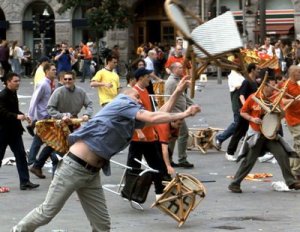
I believe the English refer to this as “a jolly good time.”

In the great and exciting city of Ankh-Morpork, footy is a tradition. It’s a lifestyle, in fact. Where you live determines who your team is, and who your team is tells you with whom you can associate and mingle. A supporter of one team wandering into the territory of another is a person asking to be beaten to death by enthusiastic and drunk hooligans. “Suicide,” I believe the police refer to it as. It’s a game that goes beyond the simple description of “rough and tumble.” It’s a substitute for war in a time where war is neither profitable nor productive. It’s a channel for long-standing feuds and grudges and aggressions, and is practiced religiously in the streets of the city every weekend.

So obviously what this grand, injurious tradition needs, then, is the introduction of wizardry.

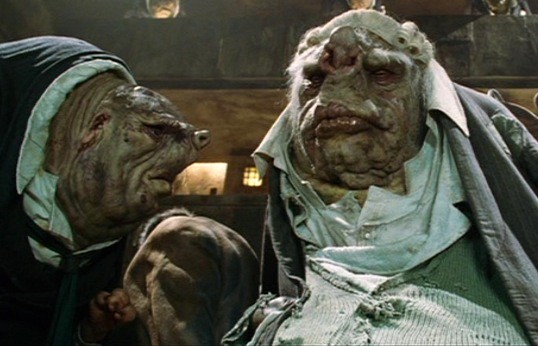
The wizards of the Unseen University are forced, through a clause in a long-forgotten honorarium, to put together a football team and play a match. Despite most wizards having the athletic ability of an overstuffed beanbag chair, it’s either play the game or lose so much money that they’ll have to cut down to only three meals a day. So, with the help of the son of one of the greatest footballers in the city’s history, two cooks from the Night Kitchen and a young Orc who is trying to find value in his life, they put together a team and oh gods, I’m bored already.

Seriously, I couldn’t care less about football. The book’s not really even about football, to be honest. It’s about identity and self-image, two things that are inextricably tied up in sports and sports fandom. The book is a lot less subtle than usual, pretty much hitting you over the head with a mallet and saying, “You are who you choose to be!!” over and over again.

Actually, what gets said over and over again is a variation on “A leopard can’t change its shorts,” a kind of humorous eggcorn that loses its humorous value after about the fifth time it gets used in the book. But it’s pretty much the theme of the book – what is identity, and can it be changed?

How… romantic?

To explore this, we have, for example, Trevor Likely, the son of a famous (dead) footballer who has sworn to his (also dead) mother that he will never play football again after what happened to his father. He’s introduced as a young layabout, a lazy grifter who works very hard at not having to work, and desperately doesn’t want to live up to his responsibilities. Unfortunately for him , he falls in love with young Juliet, a beautiful – if somewhat dim – young woman who works in the Night Kitchen. Standing in the way of their love, however, is the fact that they support opposing teams, and her family would never allow her to see the young man if they knew.

Hmmm. Trev and Juliet. Doesn’t have the same ring, does it?

Also mixed up in this is Glenda, the head of the Night Kitchen, whose identity as a below-the-stairs cook is so ingrained into her head that trying to become something else is almost unthinkable. The wizards themselves face an identity crisis as well – the Dean has gone off and accepted the Archchancellor’s position at another university, and has now come back to try and stand as an equal to Ridcully, the head of the Unseen University.

At the center of the book is Nutt, a strange young person who possesses a mysterious past. He looks a little odd, has an enormous intelligence, and harbors an unshakable desire to acquire self-worth, even if he’s not entirely sure what that means.

All of these people are trying to figure out the same thing – who they are. Some of them are surprised by what they find, others dismayed. Nutt discovers that he is an Orc, a race of creatures so hated and reviled that he could be killed on sight. Juliet discovers that her beauty is her path out of the kitchens, Glenda that her desire to control others can be focused into something productive, and Trevor that the destiny he has avoided for so long is what he always should have been.

Threaded throughout all this is the love of the game, the dedication of these people to their football. Indeed, the identity of the game itself comes into play here as well – will it remain a violent street game, wherein the only rule is that there are no rules, or will it gain a sense of purpose and order? How will the old-school, bare-knuckle footy fans deal with the changes imposed upon their game by Lord Vetinari and the Wizards?

He’s really just misunderstood.

It’s hard for me to filter through the sports aspect of this book, which is disappointing because it’s something that a lot of people will probably enjoy. There’s something about the devotion to a sport or to a team that is very important to most people that I just don’t get, and so my general lack of interest in this book is entirely my fault, and not Terry’s. I enjoyed the identity theme, of course – that’s always a rich seam of storytelling material. Watching Nutt come to grips with his identity as an Orc, or Glenda realize that her entire sense of self has been culturally imposed upon her, well, that was fascinating. It’s just that there was a whole thematic element to the book that I couldn’t identify with and didn’t care about.

It’s kind of like listening to Mozart and wishing someone would just shut all those bloody violins up.

So, if you’re a fan of Discworld, pick this up. If you like sports, pick this up. If you don’t like sports, well, you take your chances. As a Pratchett completist, there was no question about reading this book. But I don’t think it’ll be one that I come back to very often.

It’s not you, Terry. It’s me.

——————————————————————
“It seems to me that we have a challenge. University against university. City, as it were, against city. Warfare, as it were, without the tedious necessity of picking up all those heads and limbs afterwards.”
– Lord Vetinari, Unseen Academicals
——————————————————————

Now give me one of these…

[1] I think I made it to first base once in my Little League career, and actually got hit on the head by a fly ball – which, I am given to understand, are the easiest to catch. I nearly drowned myself repeatedly trying to learn how to sail. I used to knock myself over trying to kick goals in soccer, my trick ankles pretty much meant that tennis and basketball and any other activity involving quick stops and starts were out, and I got tired of being thrown to the ground real fast in judo. If there was ever such thing as an anti-athlete, I was it. I feared to shake hands with the jocks because I thought we’d both vanish in a cloud of photons.

1 Comment

Filed under Discworld, fantasy, identity, sports, Terry Pratchett

Review 199: The Killing Moon

The Killing Moon by N.K. Jemisin

I have two words for you: Ninja. Priests.

There you go, that should really be enough for you to go out and buy this book. I suppose if you need more, though, there is a whole “plot” and “world” and “characters” and stuff. But even Jemisin says that the initial idea that got her started writing was ninja priests, and everything else just kind of built up from there.

Welcome, then, to the great land of Gujaareh, a land not entirely unlike our own ancient Egypt. It rests alongside a great river that floods periodically and brings great wealth and prosperity to the land. The whole world lives in the shadow of their great, striated Dreaming Moon, the perpetual manifestation of their goddess, Hananja. In this city, people live healthy, productive lives, and it is all thanks to Hananja’s devoted priesthood and their arts of narcomancy.
Not this kind of ninja priest, though…

The Gatherers of Hananja are able to take dreamstuff from sleeping people, either willingly or otherwise, and their most honored task is to take from those whom their governing council have decided need to die. The terminally ill, perhaps, or the corrupt – these are the ones whom the Gatherers visit, giving them a final dream before sending their soul into the dreaming world embodied by their goddess.

Ehiru is the best of these Gatherers, a man with a deft touch and absolute devotion to his cause. He is told to gather and he gathers, bringing back the various dreamstuffs to the temple, where the Sharers can use it to heal the afflicted of Gujaareh. Indeed, until now, Ehiru has never questioned his place in the world. But he soon finds himself wrapped in a terrible conspiracy that threatens to upend everything he’s ever believed in, and may turn him into that which he has always despised.

It’s a really neat idea, with some very powerful characters and a well-built world. Clearly, Jemesin holds this world clearly in her mind when she writes, because the detail she gives, down to the smells and the surfaces, paint a wonderful picture. That said, though, this book didn’t really come together for me until about two hundred pages in.

Or a Magic Eye picture. I hate those things. Stupid sailboat…

I’m not sure why that was. Maybe I’m so deeply mired in the Alternate Europe mode of fantasy fiction that my brain had trouble adjusting to the deliberately different world that Jemesin built. Maybe she knows the world so well that she made certain assumptions about it that the reader – or at least this reader – couldn’t readily put together. All I know is that I spent a good portion of the book trying to keep everything in order in my head. It was like doing one of those sliding-piece puzzles: immensely frustrating until you finally get a good idea of how it all works.

Before you despair, however, note that number again: 200 pages. You would think that if a book baffled me for a while, I would probably put it down, but the fact that I was willing to keep going that far through my bafflement really does say a lot about the work that Jemesin did. The characters are interesting, and their relationships are intense – none more so than that between Ehiru and his apprentice Nijiri. While Jemesin states clearly that the people of her world aren’t really concerned with labeling and compartmentalizing sexuality, Nijiri is definitely gay, and he is madly in love with his mentor, to the point where he is willing to give up his life to save him.

The Prince is another good example of an interesting and complicated character. The Sunset Prince, avatar of Hananja, gives off Bad Guy Vibes from the moment we meet him. There’s something about him as soon as he appears on the page that says he’s going to be trouble by the end of the book. Despite that, you can kind of see where he’s coming from, and you see the logic he’s working from. It’s deranged, yes, but in a very specific sort of way it makes sense.

Another fascinating aspect of this book is that it presents contrasting and incompatible cultural values with a sense of honesty and truth. The formalized execution/euthanasia that the Gatherers of Gujaareh perform is considered by their own people to be the best way to handle things. After all, why suffer in agony when Ehiru can come along and drop you into a pleasant dream for all eternity?

Not unlike the Cola Wars, but with less moral ambiguity… (photo by caycowa on DeviantArt)

On the other hand, Sunandi Jeh Kalawe is of the Kisuati, and they view the Gatherer’s narcomancy as a horrible power and their “gifts” as nothing short of institutionalized murder. The characters argue over this repeatedly in the book, and the best that comes of it is a certain mutual understanding. Not an agreement, mind you – neither viewpoint is either affirmed or torn down, but they eventually get to a point where they can start to see through the other’s eyes.

So as I said, it took about 200 pages for things to really click for me, but it was worth it when they did. Also, there’s a very funny author interview at the end where Jemesin is given the rare opportunity to interview herself. Definitely not to be missed. This is a really interesting world built on unique and fantastic concepts. There are more, too, which I’ll be looking forward to reading at some point in the future.

—————–
“You kill, priest. You do it for mercy and a whole host of other reasons that you claim are good, but at the heart of it you sneak into people’s homes in the dead of night and kill them in their sleep. This is why we think you strange – you do this and you see nothing wrong with it.
– Sunandi, The Killing Moon

N.K. Jemesin on Wikipedia
The Killing Moon on Wikipedia
The Killing Moon on Amazon.com
N.K. Jemesin’s homepage

Leave a comment

Filed under fantasy, murder, N.K. Jemesin, religion, war

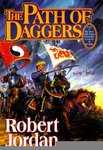
Review 198: The Path of Daggers (Wheel of Time 08)

Wheel of Time 08: The Path of Daggers by Robert Jordan

Again, spoilers. Just putting that out there.

I knew I shouldn’t have left off reviewing this for a few days. I have almost forgotten what happened in this book.

Oh, I know the events that transpired – Borderland kings and queens assembling to deal with Rand in some mysterious way; the using of the Bowl of the Winds to finally change the weather – and the terrible bargain that it fulfills between the Sea Folk and the Aes Sedai; the second invasion of the Seanchan from across the sea, this time into Ebou Dar; Perrin building his army to bring the violent Dragonsworn who follow The Prophet back to Rand….

And that’s all just in the first ten chapters.

It’s not a matter of, as is so often complained about, “nothing happening” – plenty happens in this book. In fact, a lot of what happens in this book directly sets up the rest of the series, and marks some major changes not only in the plot but in the world of the story itself. The problem is that the format of the first half of the series – a reasonably self-contained book that has a clear story climax and some sense of closure by the end – has completely fallen by the wayside. At this point, Jordan is writing for the series as a whole, and has only divided it up into separate volumes because TOR can’t sell it any other way.

Yes, more on political machinations and formalwear. Please.

This does have its advantages, but the disadvantages are greater. So of all the books thus far, I’d have to say that The Path of Daggers is my least favorite. Again – and I want to keep stressing this – not because there’s nothing going on. There’s plenty going on. It’s just not all that easy to keep track of, nor is it necessarily interesting to read.

The worst example of this, I think, is the Seanchan invasion. To catch you up, the Seanchan are an empire that lives in the land across the sea. Descended from the greatest king in history, Artur Hawkwing, they have returned to reclaim their ancestral lands. To do it, they have brought an army that has been trained by a thousand years of battle, creatures that seem like monsters to do their bidding, and leashed women who can wield the One Power as a weapon. Even under normal circumstances, this would be a problem. For Rand, circumstances are far from normal. The Seanchan mark a serious complication in his quest to bring all the nations under his rule in time for the Last Battle, so he has to show them who’s boss.

Surprisingly, with a massive army and a corps of Asha’man – men who can wield the One Power to destructive ends – dealing with the Seanchan becomes a tedious chore to read. Perhaps in an attempt to capture “the fog of war,” Jordan has us jumping from place to place and time to time, from a variety of points of view. What could have been an awesome clash of armies, men and women really going all-out with the One Power in battle for the first time becomes a trial to read. Not least because Rand al’Thor has become a thoroughly unlikable character.

In the middle of the book, Sorilea, the most senior and powerful of the Aiel Wise Ones meets with Cadsuane, an Aes Sedai so formidable that she has become a legend in her own lifetime, and they agree that Rand has become too hard. “Strong endures,” Sorilea says. “Hard shatters.” They vow to teach Rand and the Asha’man to remember laughter and tears, and if you ask me they’re not doing it a minute too soon.

I’m ignoring you for your own good, baby.

Rand is doing his best to harden his heart by this point, and not without reason. He’s got armies at his fingertips, and his decisions will kill a lot of men. He’s got these Asha’man to deal with – men who will inevitably go mad from using the One Power – and he can only bring himself to think of them as weapons. There’s his issue with allowing women to come to harm. Instead of being an endearing (if somewhat chauvinistic) character trait, it just becomes tedious and repetitive. Thankfully, the Maidens of the Spear will later beat the hell out of him for trying to treat them so delicately. In this book, it is almost impossible for me to actually like Rand, and makes me wish that Mat hadn’t been given one book off to recover from having a building dropped on him.

Other than the complete mess that is Rand’s storyline, the rest of the book is actually quite interesting. Elayne has finally come home to Caemlyn and is preparing to take her mother’s place as Queen of Andor. We have the rebel Aes Sedai preparing for all-out war with the White Tower, and Egwene consolidating her hold on the rebels. In the White Tower itself, a hunt for the Black Ajah has begun as Elaida does what little she can to free herself of the influence of her Keeper, Alviarin.

Tell me Joan Crawford wouldn’t be a perfect Elaida.

A word about Elaida do Avriny a’Roihan, as an aside. No one likes her, and I can understand why. I don’t like her either, as a person. She’s arrogant to the bone, impatient, self-absorbed, power-hungry, and completely disregards anything that doesn’t conform to what she already believes is true. This mode of thinking leads the White Tower towards utter disaster, from the botched abduction of Rand to the loss of fifty sisters to the Black Tower. Elaida risks being stilled and deposed should the Hall of the Tower find out about her bungling, and she would deserve it, if not more. The only thing keeping her from that fate is the machinations of her Keeper of the Chronicles, who is more than happy to put Elaida under her thumb.

Having said that, it was this book that made her into one of my favorite characters. I still wouldn’t want to sit next to her on a long airplane ride, but what happens to her in this book made me utterly devoted to finding out her ultimate fate in this series.

That pretty much sums it up, actually – taken as a whole, this book is pretty tough to get through and probably the low point in the series, despite having some of the most interesting and pivotal events take place within its pages. How Jordan managed to do this, I’ll never know. All we can do is take the long view – all of this will benefit the series as a whole, if not necessarily the book that contains it.

——————————————-
“On the heights, all paths are paved with daggers.”
– Old Seanchan saying
——————————————-

Robert Jordan at Wikipedia
Robert Jordan at Tor.com
The Path of Daggers at Wikipedia
Wheel of Time at Wikipedia
The Path of Daggers at Amazon.com

Wheel of Time discussion and resources (spoilers galore):
Theoryland
Dragonmount
The Wheel of Time Re-read at Tor.com
The Wheel of Time FAQ
Wheel of Time at TVTropes.com

2 Comments

Filed under adventure, epic fantasy, fantasy, Robert Jordan, war, Wheel of Time

Review 197: The Long Earth

The Long Earth by Terry Pratchett and Stephen Baxter

It is said that the population of the whole world, if packed together into a city of the same density as New York City, would fit into the current boundaries of Texas. This Texan mega-city wouldn’t be a pleasant place to live, and there’s the challenge of infrastructure and living space and waste management, but the point is clear: there’s a lot more space on Earth than we think there is.

True, a lot of it is unfriendly to us – ocean, desert, ice, mountains, New Jersey – but still, despite our habit of packing ourselves into tightly-bound metropoli, there’s a lot of room on this earth to spread out.

Now imagine there was another Earth just a step away. A simple exertion of will, perhaps aided by a small device that anyone could make at home with a potato and some spare parts, and you’re in a new world, untouched by human hands. You’d be standing in the same place you left from, but on another Earth. And if you don’t like that one, well, there’s another Earth just a step away. And another. And another. An infinity of Earths, each one so very slightly different from the one you left, each with its own story to tell.

I’ll take the fifth Earth on the left. It’ll go well with my living room.

With the potential for an entire planet per person, what would that do to the world? Who would go and who would stay? What would happen to the “original” Earth, or Datum Earth as it’s called in this book? The ramifications of the Long Earth are far-reaching and unsettling indeed, as is the quest to map it.

Of the people on Datum Earth, most are able to step with the aid of a Stepper, a small box that they can build from freely available parts using plans that were posted to the internet by a mysterious engineer named Willis Linsay. As long as you follow the instructions properly and to the letter, you should be able to step from Earth to Earth with ease and only a minimum of discomfort.

The first wave of devices were built by kids, prompting an initial missing-children panic as kids popped out of this universe with hastily-built Steppers, completely unprepared for what they were getting into. Soon, though, more and more people were stepping out, eager to explore these strange new worlds.

At the forefront of this wave of colonization were the rare few who could step from world to world without a Stepper. One of these is Joshua Valienté, who was propelled to fame when he rescued children from their first journeys on Step Day. Joshua is hired by the Black Corporation to explore the Long Earth. With the support of Lobsang – formerly of Tibet and now an artificial intelligence – Joshua is going to step as far as he can go and see what there is to see at the distant ends of the Long Earth.

And for every one of you, there is another one with a goatee.

This is a genus of book that I really enjoy – one that takes a simple, straightforward idea and tries to find all the angles of it. To that end, Pratchett and Baxter look at how the people, governments, and businesses of Datum Earth adjust to this new reality. And some of the questions are decidedly thorny. Is America still America on all Earths? If someone commits a crime in an alternate New York, could they be prosecuted by the NYPD? What happens to the value of commodities such as wood or gold when you have a nigh-infinite supply of it? And what happens to a nation when its people start stepping out en masse?

There is a sub-plot in the book, following police Lieutenant Monica Jansson, who becomes the law’s expert on stepping, with all the challenges that come with it. For example, what can you do to stop someone from stepping one world over, taking a few steps to where a bank vault should be, and then stepping back? How do you make a space step-proof against intruders? And what do you do with the increasingly disgruntled percent of people who can’t step at all? That’s to say nothing of the scam artists, the escapees, and the people who just abandon their lives to walk the Long Earth. It’s a concept rife with possibilities.

Each Earth is slightly different, representing an Earth that could have been. Some are steaming jungle, others arid wasteland and still others are lush and perfect for agriculture. There are animals that claim descent from the megafauna of North America, from our own ape-like ancestors, and from dinosaurs, and others still that are unlike anything on the Earth we know. On none of them, however, are there humans – only the Datum Earth has those.

You can have my gun when you pry it from Anton Checkhov’s cold, dead hands!

As great as the concept is, though, I found myself disappointed by the end of it. It seemed like Pratchett and Baxter missed a lot of good opportunities for the story, failed to fire at least one of Chekhov’s guns, and let the Datum Earth plot line with Monica Jansson go woefully under-explored. Furthermore, while the Big Bad at the end was certainly big, it wasn’t that bad, and it was dealt with in a rather perfunctory and, in my opinion, unfulfilling manner. The ending was flat, with a bunch of loose ends that really should have been tied up, and there was even one question that came to mind that seemed so painfully obvious that I was shocked none of the characters thought of it: the Stepper boxes refer to the alternate Earths as being “west” or “east” of Datum Earth, and are built with a three-point toggle switch.

If there’s a west and an east, how about a north and south? What if you had four choices from any given Earth instead of two? I can understand leaving that option out for reasons of narrative simplicity, but it seems like such an obvious question that I’m surprised it wasn’t even raised.

Overall, I think the book fell under the same curse as so many of Neal Stephenson’s works: an amazing idea, done really well until the authors had to figure out how to end the book. There’s no real climax to it, no sense of fulfillment and achievement. Just a feeling like they had to stop somewhere, so they did.

That said, if they’re clever, they’ll make this a shared world project. I would love to see lots of different authors take a crack at some Tales of the Long Earth, precisely because it’s such a useful idea. There are so many stories that can be told, including the ones that got short shrift in this novel. Let’s hope we get to see that.

———-
[Jansson] opined, ‘Oh.’ This response seemed inadequate in itself. After some consideration, she added, ‘My.’ And she concluded, although in the process she was denying a lifelong belief system of agnosticism shading to outright atheism, ‘God.’
– from The Long Earth by Terry Pratchett and Stephen Baxter

Leave a comment

Filed under adventure, alternate earth, colonization, quest, revolution, science fiction, Stephen Baxter, Terry Pratchett, travel, world-crossing

Review 196: And Another Thing

And Another Thing… by Eoin Colfer

If you pay close attention, Colfer tells you exactly what you can expect from this book right at the beginning, using a well-chosen quote from Douglas Adams: “The storm had now definitely abated, and what thunder there was now grumbled over more distant hills, like a man saying ‘And another thing…’ twenty minutes after admitting he’d lost the argument.” (So Long and Thanks for All the Fish)

As Adams well knew, the phrase “And another thing…” is superfluous. It is said by the person who just can’t let things go. It’s a sullen, resentful phrase that doesn’t add anything to the discussion that came before. In other words, Colfer is telling us, this book didn’t need to happen and you probably don’t need to read it. Which is very kind of him, I think, warning us in advance that way. But still, after a long time where I refused to give in, I finally, well, gave in and read the book.

Vogon Sociology is considered a fallback major in most schools.

It’s not as bad as I expected it to be, certainly, but it lives up to its title. If you haven’t read it, you don’t really need to. It doesn’t add very much to the overall mythos of the Hitchhiker’s Guide universe, or to its characters, and while it has some entertaining moments in it, a few places where I genuinely laughed out loud, and some interesting explorations of Vogon sociology, if you give it a miss then you’re probably not missing a whole lot.

If you’ll recall, at the end of Mostly Harmless, the fifth book in the trilogy, the Earth – all of the Earths – were destroyed by the Vogons once and for all. The galactic conspiracy of psychiatrists had won, with the omnipresent Guide Mark Two as their weapon of choice, and the whole business about the Ultimate Question of Life, the Universe, and Everything was finally at an end. With the exception of Zaphod Beeblebrox, all of the main characters were vaporized, much to Arthur Dent’s own relief. If ever there was a conclusive ending to a series, that would be it, although allegedly Adams had a couple of ways in his back pocket to bring everyone back, should he need to do so.

Alas, Adams left us far too soon. In 2008, however, it was announced that there would indeed be a sixth book, penned by Eoin Colfer, of the hugely popular Artemis Fowl books. Fans across the world were both excited and apprehensive to see what would be done with the characters we had grown to love over so many years.

To his credit, Colfer wrote a very funny book. I was laughing by the first page, and he really did a fine job of capturing the tone and cadence of the Guide entries and the way that Adams would narrate the story. His depictions of some characters – especially Zaphod and Random – were spot-on, and you could see a lot of elements in the book that were nods to some of Adams’ favorite themes.

If this is how your book begins, you really need to live up to it…

In essence, what happens is this: Our Heroes are introduced to us in a stasis hallucination, held between ticks of the clock by the Guide Mark Two as the planet-destroying beams of the Grebulons descend towards Earth. They are rescued by the Heart of Gold and Zaphod Beeblebrox, who has detached his left head and is using it as the ship’s computer. Unfortunately, Ford causes Left Brain to freeze up, so they need to be rescued again – this time by one of the most popular bit players in the series, Wowbagger the Infinitely Prolonged, an immortal being who has decided to spend eternity insulting everyone in the universe in alphabetical order. Wowbagger reluctantly takes them aboard, and in doing so insults Zaphod to the point where Zaphod promises to find a way to kill him, a proposition that Wowbagger has no problem with. Zaphod’s weapon of choice? A down-on-his-luck thunder god who’s been slumming it around Asgard.

Meanwhile, there is a planet of human refugees that is undergoing some rather entertaining class warfare, and the solution to this is, apparently, to find just the right kind of god to run the place. And even more meanwhile, a young Vogon is having second thoughts about his Vogonity and whether or not it’s okay to destroy inhabited planets just because there is a work order on hand that says they should.

I want to criticize the book for being directionless and unfocused, but let’s be fair – that describes the first book as well. Given its genesis as a radio drama, Adams never really had a grand plan for what would happen in the beginning of the series, and wrote in an episodic fashion that had (as far as I could tell) no real end point in mind. The difference, however, is that while those books had no real direction to them, they were charged with a kind of chaotic energy that made you want to keep reading just to find out what happens next. Arthur Dent, our avatar in this universe, never got a chance to rest or even change out of his dressing-gown, and so we were dragged along with him. It was exciting and confusing and weird in all the right ways, and we didn’t mind not knowing where we were going because the trip to get there really was just that much fun.

To be fair, though, Arthur NEVER wanted to be involved…

In this book, however, Arthur really doesn’t want to be involved. He’s had an imaginary lifetime of living in peace and quiet, and seems to have outgrown the antics of Ford and Zaphod. He’s the reasonable adult in this book, and not all that much fun anymore. As I read, I was disappointed that Colfer didn’t seem to have captured Arthur’s character very well, but perhaps I was wrong – Arthur didn’t belong in this story, and he wanted nothing more than to not be in it anymore. And it showed.

Another telling moment comes near the end of the book. The narrative takes a moment to remind us that, “There is no such thing as a happy ending.” And a few lines later, it quotes a certain pole-sitting philosopher who says, “There is no such thing as an ending, or a beginning, for that matter, everything is middle.” That certainly is true of life, and you can imagine it being true of the lives of fictional characters. Louis and Rick will walk off the tarmac in Casablanca and go on to do other things, perhaps help the resistance fight the Nazis. The lives of Luke and Han and Leia have been extended far beyond their original showing on film, thanks to the Extended Universe of Star Wars. Scout Finch and her brother Jem will grow up and have children of their own; the rabbits at Watership Down will live and breed and die; Guy Montag will help rebuild the intellectual society that he was originally trying to destroy…

We know that these worlds have lives beyond the last page, no matter how thoroughly they’re destroyed at the end. There’s always going to be some thread hanging loose that can be picked up and used to continue the story beyond where it left off.

But that doesn’t mean that we should.

I applaud Colfer for taking on the project, knowing that it is better for the series to be continued by someone who knew it and loved it and who was influenced by it, rather than by someone who couldn’t show it all the love it deserves. As I said, I laughed while I read this book, a lot more than I expected to. But as the title implies, this feels like an attempt to continue a story that has been finished for a long time. Rather than breathe new life into the Hitchhiker’s franchise, it simply reminds us all the more sharply of what we once had and will never have again.

——————————–
“I do not hate myself. In many ways, I am not altogether too bad.”
– Constant Mown (Vogon)

Leave a comment

Filed under adventure, aliens, Douglas Adams, Eoin Colfer, gods, humor, robots, science fiction, UFOs, war

Review 195: Redshirts

Redshirts by John Scalzi

The philosopher Jean-Paul Sartre once said, on the meaning of life, “Man is nothing else but what he makes of himself.” Frederich Nietzche said, “If we possess a why of life, we can put up with almost any how.” And Stephen King wrote, “Life sucks, then you die.”

It’ll take a far better philosopher than I to really look at this book from an existentialist viewpoint, but I strongly suspect that it would be a lot of fun to do. After all, one of the major questions that philosophy – and existentialism in particular – tries to address is that of why we are here. What is our purpose in life? What, in the end, does it all mean? For us out here, that’s a question we can’t really know the answer to, and thus a whole branch of philosophy exists to tell us that it doesn’t really matter. That maybe we don’t have a purpose imposed upon us from outside, but that’s okay. We can create our own. We can contribute our own verses to the powerful play of life, as Whitman would have it, and in the end we are responsible for our own lives.

For this guy, going out of existence is probably more important…

But what if we weren’t? What if there was a being that orchestrated our lives, willing them into – and more importantly out of – existence? What would you do with the realization that your life is not entirely your own? And even worse, the realization that the person in control of it doesn’t really care all that much about you?

That is the problem faced by Ensign Andrew Dahl of the Universal Union flagship Intrepid. It is the 25th century, and things couldn’t be better. He has a chance to see new worlds and new civilizations, to boldly go… Well, you know the rest. Dahl is at the frontier of science and exploration, and is determined to make the most of it.

If he survives.

Alone among the ships of the UU, the Intrepid loses crew at an alarming rate. Dahl soon discovers a fact that has been known for years by those crew members who are bright enough to spot the pattern: people who go on away missions with the command staff will, almost inevitably, die. Toxic gasses, killer machines, Borgovian land worms – these are just a tiny sampling of dangers that have done in ensigns and miscellaneous crew for years, and no one seems to know why. All they can do is make sure they’re not in the room when the Captain comes in, looking for someone who’ll pop down to a planet’s surface to find out why that mining colony hasn’t reported in recently.

Nope, he’s going to die too.

Dahl, of course, just can’t let himself and his friends die, so he begins digging into the true nature of their lives on the starship Intrepid. What he discovers is a truth almost too mad to be believed: their lives are not their own. A greater power is directing events on the Intrepid, dictating who lives and who dies, and that greater power doesn’t seem to be very good at what it does. So Dahl and his friends have to bet everything on the power of the Narrative, meet their makers and try to find a way to secure their freedom. Or, failing that, a way to see to it that their lives have more meaning than they had before.

As always with John Scalzi, I recommend picking this up. It’s a very fast read – I finished it in under a day – and it has the tight combination of humor, thoughtfulness, and genuine emotion that I have come to expect from his work. From a premise that is incredibly simple – “The crew of a starship realize they’re doomed if they go on away missions and try to change their fate” – he’s built up a multi-layered exploration into the meaning of life and death. The universe he’s given to us is one where people are denied the ability to give meaning to their own lives, and have to rely on an unseen force to do it for them. The fight, then, is to acquire that ability to decide. To gain agency, as it were. They want to be able to control their own existence so badly that they risk their existence entirely.

The corollary, then, is very simple: what are you doing with your life? We, the readers, have that agency. We can make decisions for our own lives and our own purposes. If we succeed or fail, we can do so knowing that we made those successes or failures possible. [1] In a sense, we don’t know how good we have it, something that is brought up in the second of three codas to the main novel. We can choose. We can create meaning in our lives without hoping that some higher power will do it for us. So why don’t we?

For a book that presents itself as a quick, fun read, there are certainly layers upon layers of meaning in it that could be a lot of fun to explore. The only complaint, really, is that it wasn’t long enough. And I don’t mean that he skipped essential scenes, or that he should have opted for a Tolkien/Jordan/Martin-esque style of describing every goddamn thing that showed up on the page, but there were points where I just wanted him to slow down a bit and let us appreciate the moments for what they were. There’s a scene in chapter 21, for example, that should be really emotional and meaningful, but it’s almost entirely dialogue. Good dialogue, yes, but I wanted to linger over it a bit, and that’s true for a lot of scenes in the book. Scalzi writes wonderful banter, and makes his characters sound real, but I want to see things as well as hear them.

Also, to be honest, I expected the last page to just be a picture of Scalzi at his computer, turning to the camera and winking. It would have been hilariously meta, but I guess he’s not as gimmicky as that.

Buy the book and enjoy it. If you’re a fan of Star Trek – which was, given the title, a huge inspiration for the story – you’ll no doubt appreciate it more than most. Even if you haven’t watched every episode of the original series, though, the Red Shirt character is one that has permeated all levels of fiction, and has died many times in order to advance the plots that you love so well. He even has one poor guy who’s not only a Red Shirt, but nearly at the end of his tour and about to get married. There was no way he’d survive. Take some time out for these poor, expendable bastards and give them a chance to shine.

In conclusion, I’ll leave you with the song that Jonathan Coulton wrote for the book. Quiet, poignant, and touching. But also really funny.

—-
“The [Borgovian Land Worms] were in a frenzy. Somebody was now likely to die. It was likely to be ensign Davis.”
– from Redshirts by John Scalzi
—-
[1] There are plenty of external, uncontrollable factors, of course, which can all be lumped together under the term “luck,” but you know what I mean.

Leave a comment

Filed under existentialism, humor, John Scalzi, meta-fiction, quest, science fiction, space travel, story