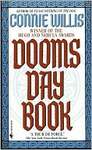
Review 20: The Doomsday Book

The Doomsday Book by Connie Willis

I honestly can’t count the number of times I’ve read this book. I think this is the fifth time. Or maybe the sixth, I don’t know. It doesn’t really matter, because it’s just as enjoyable, touching and heartbreaking as it was the first time I read it, and that’s a hell of an accomplishment.

It is the middle of the 21st century and time travel has finally been worked out. A reliable there-and-back-again way to go into the past and come back to the present. Unfortunately, there are limitations. The computer that makes time travel happen, through means I’m not sure even Ms. Willis understands, will not allow for a paradox. This means if you try to go to the past with anachronistic technology, or carrying a disease that could wreak havoc on the population, the interface simply won’t open. If you try to place a traveler somewhere where their appearance could cause a paradox, the machine will put them in another place or time – a factor called “slippage” which can put you anywhere from five minutes and a few feet off your mark to years and miles. The machine won’t allow you to get anywhere near events of importance.

Secondly, the machine won’t allow you to take anything through the net. So if you travel to, say, Napoleon’s palace and try to rob him blind, the interface won’t open until you’ve got rid of all your booty.

Those two factors alone made the time machine economically useless. If you can’t profit off it – or change it – what good must it be?

A lot of good, as it turns out, if you’re an historian. While the machine may not allow you to get anywhere near Hitler, it will allow you to see what life was like in the ghetto in the 30s. The whole of history suddenly became open to real discovery, and places like Oxford were at the forefront of the research.

One student, a young lady named Kivrin, has a dream to see the Middle Ages. Despite all the warnings that it was full of filth, disease, superstition, danger and death, she still wants to see it more than anything in the world. The sheer force of her will finds her in the machine, ready to go to the year 1320 to see firsthand what life was like for the average English citizen. She has prepared herself as best she could, but nothing could possibly prepare her for the time and place she ends up in….

And in the present, a new plague has spread around Oxford. It’s a new type of flu that seems to have come from nowhere, and it’s started to kill. Kivrin’s teachers and friends have to race the disease, time and sheer bloody-minded bureaucracy to try and find her and bring her back safely.

What is remarkable about the book is the detail. Willis has obviously done a lot of research into not only Medieval Oxford but modern Oxford as well. Since one of the themes of the book is that we don’t know nearly as much about the past as we think we do, Willis has gone to great lengths to make sure that we – through the eyes of Kivrin – never know what to expect because our expectations are all totally wrong. And as is so often true about history, the more we know about it, the more interesting it becomes.

The Oxford of the future, by contrast, isn’t all that futuristic. It looks a lot like the modern world, probably because it’s only a couple of decades removed from us. Sure, there have been advances in technology, but the lives of the people aren’t much different from ours.

Interesting note: the book was published in 1992, well before the age of cell phones, instant messaging and the internet. Because of this, one of the greatest hindrances to getting anything done in this far-future Oxford is that no one can get anyone on the phone. It’s a videophone, yes, but most of the characters spend time waiting for phone calls to come through or trying to place calls to people who aren’t near a terminal. It’s a bit strange, from my modern perspective, to see a world that has pretty much conquered disease and mastered time yet never figured out a means of personal communication better than a land-line.

That’s just a small thing, though, and as long as you accept that particular bit of alternate-future, you’ll be okay. It’s a fantastic book, one which I recommend without reservation. The characters are deep and interesting, and the writing really puts you in their world. Seriously. Go get it.

———————————————-
“Mr. Dunworthy, ad adjuvandum me festina.”
(“Mr. Dunworthy, make haste to help me.”)
– Kivrin, The Doomsday Book
———————————————-

The Doomsday Book on Wikipedia
Connie Willis on Wikipedia
The Doomsday Book on Amazon.com
The 11th-Century Domesday Book at Wikipedia
The Domesday Book online

1 Comment

Filed under Christmas, Connie Willis, death, disease, England, science fiction, survival, time travel

Review 19: Day of the Triffids


The Day of the Triffids by John Wyndham

I have a long fondness for Apocalyptic novels. The Stand was one of my early favorites from junior high school, and I really enjoyed its cousin by Robert McCammon, Swan Song. There’s something about the End Of The World that just grabs me and won’t let go. Maybe it’s the thought that, should the world end, I would be one of the survivors. The rule of law would break down, all shackles of modern life would be loosed, and I would finally be free to choose my own destiny. Which, knowing me, would probably be very short and end up with me getting shot by some kind of Mad Max pirate tribe.

I can say with some certainty, however, that in this book’s scenario I would not be coming out on top. Because I love astronomy.

Let me explain. This end of the world came in two parts, at least one of which was definitely of our own doing.

It started with a comet. Or a meteor shower. Or something, but whatever it was, it lit up the sky. Green streaks of light brightened the night skies around the world, and everyone who could go and watch them did so. I’m a sucker for a natural light show, so I probably would have spent the night watching the skies and enjoying myself. And I would have woken up stone blind the next day.

That in itself – the vast, vast majority of the human population on Earth being blind – would have been a pretty good apocalypse. Wyndham describes rashes of suicides, accidental deaths and, of course, murder in just the first few days. Without vision, the carefully crafted world we’ve made kind of falls apart. But it would have been survivable. Co-operation groups spring up pretty quickly, both voluntary and otherwise, where sighted people assist the blind in surviving. It would have been tough, yes, but not impossible, for the world to go on. If not for the Triffids.

While we don’t know what caused the green comet, the Triffids were definitely our fault. The product of bioengineering gone haywire, the Triffids are ambulatory carnivorous plants with a poison sting that can kill a grown man from ten feet away. And while they’re not intelligent, they are remarkably… aware. They follow sound, they learn and co-operate in hunting, and are very difficult to eradicate.

But by themselves, they’re manageable. Their stingers can be removed, even though they grow back eventually, and they make interesting garden plants. And they’re immensely profitable – the oil derived from a Triffid outdoes every other kind of vegetable oil available. In normal times, the Triffids are under human control and benefit humanity greatly.

The two problems, when put together, make for a truly terrifying end – an unstoppable, unthinking army of carnivorous plants, finally freed from their shackles. A world in chaos, half-blind and not sure if they have to save themselves, or if someone else will do it for them. And an exciting story.

The message of this book is pretty clear, and Wyndham wastes no time in making sure we get it, lest the adventure part of the book get bogged down. Don’t mess with nature. That’s pretty much it. Don’t mess with nature, because nature will inevitably come ’round and mess right back with you.

Wyndham has created a brave new world for us, with a wide variety of characters who all react to their new situation in different – and realistic – ways. Starting in London, we meet a diverse cast – from the girl who believes that the Americans will save her to the man who believes that polygamy is the way to a brighter future, everyone has an idea on how to survive. The narrator, Bill Masen, knows just enough to get the reader up to speed, but not nearly enough to know if he’s even going to make it out of this alive. With the help of other sighted survivors, he is determined to make a stand, not only for England, but for the human race as a whole.

But first they have to deal with the Triffids….

———————————-
“When a day that you happen to know is Wednesday starts off sounding like Sunday, there is something seriously wrong somewhere. ”
– John Wyndham, Day of the Triffids
———————————-

Day of the Triffids at Wikipedia
John Wyndham at Wikipedia
Day of the Triffids at Amazon.com

1 Comment

Filed under adventure, anarchy, apocalypse, England, John Wyndham, made into movies, science fiction, society, survival

Review 18: Swan Song

Swan Song by Robert McCammon

Okay, have you read The Stand? Humanity being wiped out by a short-sighted government, small groups of people struggling to survive in an America laid low? A dramatic escape from New York through a dark and scary tunnel? An evil adversary from an unknown place whose only dream is the end of the world?

Yeah, that’s Swan Song, too. Only with nukes instead of a virus.

It really is an alarmingly similar story, published about ten years after The Stand, but – and this is important – it’s still a really good book. Derivative? Sure. But it’s still good, which is a neat trick.

The story starts in an alternate world, one that seemed all-too-probable in 1987, when this book was published. The US and the Soviet Union are toe-to-toe, fighting proxy wars all over the world. Nuclear exchanges have already happened between smaller nations. The world is inches away from war, and there seems to be no going back.

Domestically, things aren’t much better. In New York City, the city has fallen to crime and decay – drugs, trash and whores are all that can be found, and if any city deserves destruction it’s this one. It’s the worst projections of New York come true, and its eventual destruction is almost like a blessing.

In the western mountains, a group of survivalists have hollowed out a shelter against the possibility of The End, and Earth House is full to bursting. Young Ronald Croninger and his parents are there, but the boy is not impressed by what he sees. Colonel Macklin,the ex-soldier who is the public face of Earth House, seems to have gone to seed, and the shelter itself is falling apart, just like everything else.

The world is going straight to Hell, and it’s all too easy for the US and the Soviets to send it all the way there.

The book has an epic scope and a massive cast, lined up pretty equally on the sides of Good and Evil. As the book progresses, the disparate groups finally come together in a final confrontation that will decide the fate of the world.

In the midst of all that, a certain mystical quality has arisen. There’s a… being, a creature of demonic countenance who can change his face and travel freely throughout the wasted land. His sole desire is to see the end of humanity – he revels in destruction and despair and wants nothing more than to see the end of Our Heroes. On the other hand is the title character, Swan. As a girl, she loved plants and flowers, and had a strange affinity for the natural world. As she grew up, however, her powers matured, and that affinity became a full-on partnership. They each collect a following, through fear and hope respectively, and they each know that there’s only one way this can all end.

There’s an element of mysticism to this as well, though why it should be there is not explained. For example, the burned-out rubble of Tiffany’s on Fifth Avenue creates a shining glass ring, filled with strands of precious metals and valuable stones. This ring becomes the guide for Sister, a woman who was once mad but becomes the sanest one of the survivors. With the ring, she is able to perform miracles. There’s a magic mirror that shows the future, prophetic dreams and other elements of mysticism. It seems that when the world as we know it ends, the world as we don’t know it steps in. And then there’s the Job’s Masks – a mysterious growth that covers a person’s head in an impenetrable shell, only to crack open years later and…. Well, I’ll let you find out.

The appeal of apocalyptic fiction is an interesting one, and easily understandable. Humans have been interested in how the world will end since about the same time we figured out that the world could end. And there are many ways for it to go, whether it’s the nuclear fire of this book, the insidious virus of The Stand, the near-miss religious apocalypse of Good Omens, the various meteor impacts and climatological disasters that Hollywood loves to show us…. The ways in which the world ends are countless, but they all share one distinct feature – when the end comes, you’ll find out who you really are.

It’s tempting, then, to give it some thought and wonder, “Who would I be, when all was gone?”

This book has some excellent role models to choose from – and to avoid. The characters are compelling, and the world is vividly drawn, so as long as you’re not thinking, “But this is just like The Stand!” you should greatly enjoy it. I highly recommend it.

————————————————-
“Once upon a time, we had a love affair with fire.”
– Robert McCammon, Swan Song
————————————————-

Swan Song at Wikipedia
Robert McCammon at Wikipedia
Swan Song at Amazon.com
Robert McCammon on Swan Song
Robert McCammon’s homepage

BONUS! The Boyfriend decided that there needs to be pictures of me recording the podcast. So he took some….

Doing the Podcast

Doing the Podcast
Listening to the playback. I’ve had a haircut since then….

2 Comments

Filed under apocalypse, death, fantasy, good and evil, horror, nuclear war, Robert McCammon, society, survival, totalitarianism, war

Review 17: The Stand

The Stand by Stephen King

It’s hard to know where to begin when writing about this book, probably because I work under the assumption that everyone has read it. I mean,. I’ve probably owned at least four different copies over the years, and it occupies a permanent place on my bookshelf. I can’t imagine anyone not having read it. But I guess that’s what everyone thinks about their favorite books, so I’ll fill in those of you who haven’t.

It’s the end of the world. Not in the horrible confluence of blindness and carnivorous plants, or in the fiery desolation of nuclear war. The world dies in a more unpleasant way than that, and it all begins in Project Blue – a US military lab in the southwest. There they’ve built the greatest plague mankind has ever known, a shapeshifting flu virus that is 99.4% communicable and 100% lethal. Its intended use was probably against the Soviets or some other enemy state, but… Things fall apart, the center cannot hold, as Yeats said. And on June 13th, 1990, the superflu got out.

It was carried by Charles Campion and his family, spread throughout the southwest until Campion died in a gas station in Arnette, Texas. From there it hopped into the men gathered at the station, who passed it on to nearly everyone they met.

By June 27th, most of America was dead. And thanks to the final command of the man in charge of Project Blue, the virus was spread around the world as well. By Independence Day, the population of the world – that which by some strange genetic luck was immune – was reduced to less than the pre-plague population of California.

Of course, not everyone who was immune escaped unscathed. There were accidents, mishaps and murders that probably brought the number down, but not by much. Scattered survivors struggled to understand why they lived when so many had died, and started to seek out others like them.

And then came the dreams. An ancient woman, living in a cornfield. She radiates goodness and compassion (and still makes her own biscuits). Mother Abagail is the beacon of hope for those who see her in their dreams. And then there’s the other, the Dark Man, the Walkin’ Dude, whose shadow brings madness and whose gaze brings death. He is Randall Flagg, a man whose time has come ’round at last. Just as Mother Abagail attracts the good and strong, so does Flagg attract the weak and frightened. Around these two do the remains of America come together. And neither one can let the other exist without a fight….

What keeps bringing me back to this book? Well, a lot of things. For one, the writing. King has said that he’s a little disturbed about The Stand being the fans’ favorite – it means he did his best work thirty years ago. Not entirely true, I think, although I am hard pressed to say which of his other books exceeds it. King’s sense of scale as a writer is outstanding. We get into our characters dreams, in their innermost secret thoughts, and then a few pages later are presented with an overview of what’s happening around the nation. It’s like being able to go, in Google Maps, from someone’s bedroom all the way out into space. He dances between characters smoothly, so just when you get to the point where you’re thinking, ‘Yeah, but what’s Flagg doing?” he brings you there.

And speaking of the characters, they’re people who will stay with you long after you finish the book. The quiet confidence of Stu Redman, the single-minded madness of the Trashcan Man, Larry Underwood’s late maturity, Lloyd Henreid’s devotion, Fran Goldsmith’s determination…. Each character rings true. Even the ones who really shouldn’t have ended up the way they did – and I’m thinking of Harold and Nadine here – you can’t help but find bits of them to love. Had they been strong enough, Harold and Nadine never would have gone as bad as they did, and I think even King kind of had a hard time making them do what he wanted.

Underlying all this, of course, is a kind of Old Testament religiosity. The God of Mother Abigail is not the kind and friendly God of the New Testament, He is the angry one of the Old. He is the God who will gladly wipe out nearly all of mankind to prove a point, and will make a 108 year-old woman walk into the desert by herself because she’s getting a little too uppity. In this world, at least, God is most definitely real, even though His purpose is hard to understand.

I could go on. Thesis papers could probably be written about this book, and I reckon they already have been. But that’s not why I do these reviews. I do them because I want y’all to know what’s worth reading.

This book is worth reading.

——————————————-
“Show me a man or a woman alone and I’ll show you a saint. Give me two and they’ll fall in love. Give me three and they’ll invent the charming thing we call ‘society’. Give me four and they’ll build a pyramid. Give me five and they’ll make one an outcast. Give me six and they’ll reinvent prejudice. Give me seven and in seven years they’ll reinvent warfare. Man may have been made in the image of God, but human society was made in the image of His opposite number, and is always trying to get back home.”
– Glen Bateman, The Stand
——————————————-

The Stand at Wikipedia
Stephen King at Wikipedia
The Stand at Amazon.com

1 Comment

Filed under apocalypse, death, disease, fantasy, good and evil, horror, made into movies, society, Stephen King, survival, war

Review 16: Watership Down

Watership Down by Richard Adams

This is one of my top five books. Whenever anyone asks me, “What is your favorite book?” this is at or near the top. It was the first adult-length book I read when I was in Elementary school, and I have every intention of getting my hands on a copy for my goddaughter at some point soon. I remember watching the movie when they used to show it annually on CBS, way back in those days beyond recall….

Why should this book, of all the books I’ve ever read in my life, stay so dear to me? I have no idea. Perhaps because, even though its main characters are rabbits, it isn’t a “talking animals” book. Adams didn’t talk down to his readers, and assumed that they were ready to follow Hazel and Fiver wherever they went. And so, unusually for children’s literature, there is violence and loss and true danger in this book. Characters die. Unpleasantly. The rabbits live in fear of mankind and the Thousand, and accomplish great things despite. They do what no rabbit had done before, and find a new world for themselves. And, of course, are forced to fight for it.

Our heroes, you see, are living an idyllic life in a warren in England. They do what rabbits do – eat, sleep, mate, and entertain themselves. But one rabbit, Fiver, can see more clearly than others. He can sense danger, and grasp the shape of the future, and he knows that any rabbit who stays where they are will certainly die. With his brother, Hazel, Fiver and a small group of rabbits leave their home.

They do what rabbits never do – they explore. They go through dense woods and cross streams. They hide among gardens and search for the best place they can find to set up their new warren – a safe place, high in the hills, where they can see all around and the ground is dry. They seek to build a new society, as so many humans have done in our history.

And what’s more, they try to build the best society that they can. The need leadership, yes, but how much? How much freedom should the ordinary rabbit have to live its life? This question becomes more and more important when they meet the cruel General Woundwort, de facto leader of the warren known as Efrafa.

The battle that they have, choosing between personal liberty and the safety of the warren, is emblematic of so many struggles that have gone on in our world, and continue today. Through a tale about rabbits, Adams manages to tell us about ourselves, which is the mark of a great writer.

As cynical as I have become in my years, I still find this story to be honest and true. Adams isn’t trying to make an allegory or grind an axe. He’s trying to tell a good story about hope and perseverance and triumph over adversity, a story with – as Tolkien put it, “applicability” – that we can overlay onto our own lives and experiences. The fact that the main characters are rabbits is incidental.

Well, not really. Another layer to this story is the culture that Adams has created. The stories of Frith and El-ahrairah (which, I’ve just noticed, is misprinted on the first page of the contents in this edition as “El-ahrairah.” Weird) are sometimes deep and meaningful, sometimes fun and silly, but always relevant and rich, in the tradition of oral storytelling. There is a language to the rabbits, which is regularly used throughout the book (and one complete sentence in lapine – Silflay hraka u embleer rah. Memorable….) Adams did a lot of research into the social structure of rabbits and their lifestyles, making it as accurate is it could be….

Anyway, every young person should read this. Hell, older people should read it too. Every time I read the story, it moves me. I can hear the voices of the characters clearly and see what they see. I am inspired by the steadfastness of Hazel, the strength of Bigwig and the resolve of Blackavar. I find qualities in these characters that I would like to possess, and that’s as good a reason as any to love a book.

As a side note, this book is the reason I got into Magic: The Gathering way back in college. For a long time, I thought it was just a stupid card game, with no cultural or imaginative merit. Then I happened across a “Thunder Spirit” card, which had a quote from Watership Down at the bottom:

“It was full of fire and smoke and light and…it drove between us and the Efrafans like a thousand thunderstorms with lightning.”

Still gives me goosebumps.

Anyway, I thought, “Maybe there’s something to this,” and the rest was (very expensive) history….

——————————————-
“All the world will be your enemy, Prince with a Thousand Enemies. And whenever they catch you, they will kill you. But first, they must catch you, digger, listener, runner. Prince with a swift warning. Be cunning and your people will never be destroyed.”
– Frith, Watership Down
——————————————-

Watership Down at Wikipedia
Richard Adams at Wikipedia
Watership Down at Amazon.com

1 Comment

Filed under adventure, England, fantasy, made into movies, rabbits, Richard Adams, survival, totalitarianism, travel, war, young adult

Review 15: Confessions of a Mask


Confessions of a Mask by Yukio Mishima

From what I can tell, Yukio Mishima was not a very happy man.

Granted, the only works that I have read of this very prolific author are this and Kinkakuji, but I’m seeing a pattern already, and it doesn’t point towards Mishima being a cheerful, laid-back guy. Of course, his suicide by seppuku is also a good indicator that he took things way too seriously.

Published in 1948, Confessions of a Mask addresses a subject that would have been taboo anywhere, not just Japan. The main character, whose name is only given as Kochan, is a young man dealing with the fact that he is homosexual. He begins with one of his earliest memories, seeing a night-soil man and finding him beautiful, which he believes is what set his preferences for life. As he gets older, he doesn’t yet realize that he’s different from other boys, except in that he’s small and thin and gets sick a lot more often. He finds himself entranced by men, especially laborers, and not knowing if this is what he’s supposed to be feeling.

His sexual maturity is a sad and stunted thing. The pleasure and rapture that he sees in paintings of St. Sebastian hide dark urges of violence and despair. His boyhood love of a classmate is a secret that gnaws at him until he finally convinces himself that he was never actually in love at all. And his attempts to become “normal” end with nothing by emptiness and sorrow. Kochan has no friends to talk to, no family to lean on, and no way to know if what he’s feeling is good or bad. All he knows is that the other boys are fascinated by women, and he’s fascinated by other boys. In darkness and isolation, Kochan grows. What he grows into, however, is a pale, lonely and barren man.

Like many gay kids, especially in the pre-internet era, Kochan believes that he is unique. An aberration, a deviation from the norm. As far as he knows, no other boy has felt the way he did, and the only other one he hears of – Oscar Wilde – is long dead. His desire to fit in with the rest of the world leads him to play an elaborate game, to wear a mask so convincing that it nearly convinces himself. Being able to hide who he really is and what he really wants becomes a matter of hiding from himself. And as anyone who’s tried that will know, hiding from yourself only works for so long….

Such is the life of a young gay man in wartime Japan. While I’m sure what Mishima has presented here is not the average, it is a depressing picture of what it’s like to live in a society where such a deviation from the norm is punishable by societal exile. While I can’t claim to know what would have happened to a young man in that era who came out of the closet, the narrator doesn’t even seem to consider that as an option, good or bad. Thus I can only assume that the consequences would be dire.

There’s no doubt that this book is at least semi-autobiographical. A look at Mishima’s life shows a number of parallels, especially in the early days. Both he and Kochan were raised by grandparents and separated from their families. Mishima stared writing as a boy, an activity that his father deplored and which earned him beatings by other students in school. He knew what it was like to be different, and that probably fed into this novel.

Whether or not Mishima was actually gay is, it seems, debatable. He did marry, and had two children, which would seem to indicate against it, but if, like the character in this book, he fought against his own nature, such an arrangement could be understandable.

One of the things that I found difficult about this book – and Kinkakuji – was how very introspective it was. The narrator tells the story of his life from his older point of view, and dissects every thought and every memory in exacting detail. It creates a picture of a person who lives entirely in his own head, and attributes modes of thinking that one wouldn’t normally associate with, say, a twelve-year old. He appears to be very analytical, even from his earliest days. Though he tells us that he is not letting his adult mind get in the way of his memories of childhood, this great attention to detail proves him wrong.

The depiction of Kochan’s attempts to hide himself is yet another mask – the mask of purposefulness. The narrator would like us to believe that he made every decision with purpose, as part of a plan. That he really did choose this life of self-deception. Perhaps because the idea that all of this was beyond his control is just too terrible to contemplate. Perhaps because it is better to own a bad decision than to admit that it was an accident. The narrator shows us quite clearly how adept he is at hiding from himself, and so he cannot be trusted to tell us truthfully about how he thought when he was a young man.

This makes reading the book a challenge – the reader must evaluate every statement and judge every event for its possible veracity. Unfortunately, we have no way of knowing how much is true and how much is falsehood. In the end, we just have to take Kochan at his word, all the while accepting that he’s probably lying – and doing it without being aware of what he’s doing.

Reading Confessions of a Mask today, sixty years after it was first published, is illuminating. In the US, we’re involved in a great societal discussion over whether or not gays should get married, and while being homosexual certainly isn’t something that is universally accepted, the prospects for young gays and lesbians in the modern age are much better than they would have been for someone coming of age in the 1940s. Even in Japan, where coming out to one’s family is still as hard as it ever was, there are gays and lesbians on television and the matter is open to discussion. A homosexual in Japan may not be as willing to kick down the closet door as his or her American counterparts, but the abject horror of being utterly rejected by society is probably much less than it was.

When you consider what happens in this book, the horrible mental contortions that the main character must make in order to hide his true nature from the world – and himself – you can appreciate how far we’ve come.

—————————————————
“I had long since insisted upon interpreting the things that Fate forced me to do as victories of my own will and intelligence, and now this bad habit had grown into a sort of frenzied arrogance. In the nature of what I was calling my intelligence there was a touch of something illegitimate, a touch of the sham pretender who has been placed on the throne by some freak chance. This dolt of a usurper could not foresee the revenge that would inevitably be wreaked upon his stupid despotism.”
-Yukio Mishima, Confessions of a Mask
—————————————————

Yukio Mishima at Wikipedia
Confessions of a Mask at Wikipedia
Confessions of a Mask at Amazon.com
Homosexuality in Japan at Wikipedia

Leave a comment

Filed under coming of age, homosexuality, Japan, memoir, morality, sexuality, Yukio Mishima

Review 14: V for Vendetta

V for Vendetta by Alan Moore and David Lloyd

There are people who think that comic books are just for kids. They see Superman and Batman and Spider-Man, with their bright costumes and their rather simplistic moral codes and think, “Well, that’s all well and good for children, but as a thinking adult, I need something more.” Some of these folks are lit-snobs, who view any kind of book with pictures as immature. Perhaps they were told that they need to grow up, and have distanced themselves with comics as they have done with their own childhoods. Or perhaps they simply don’t know better….

The point is that while there certainly is a lot of childish dross in comics, there’s also a lot of gold. In the right hands, a great story can be told in any medium, be it print, painting, film, stage, or yes – even comics. In this case, the right hands are those of Alan Moore and David Lloyd.

Moore is considered one of the giants of modern comic books, having penned many a dark and strange tale, ignoring the accepted norms of comic book storytelling in order to tell the weird and off-kilter stories that he wants to tell. In the famous Watchmen, Moore told us about the flaws and imperfections inherent in the heroic ideal. In V for Vendetta, he looks at the flaws and imperfections in our societies and ourselves.

The book is set in an alternate London, a place that Could Have Been. In this world, the worst of our modern nightmares has happened – a nuclear war that ravaged many parts of the world. Europe, Africa, these places were, as the characters put it, “gone.” England survived the turmoil by the skin of its teeth, pulling itself up from chaos and disorder thorough the strength of the new government party, Norsefire.

This government is unapologetically fascist. In the turmoil following the war, they saw the only solution to England’s survival in absolute obedience. And so they built a new England – an England of strict rules and laws, with ears and eyes everywhere. Minorities of all kinds were systematically wiped out from the country. Blacks, Muslims, homosexuals – anyone who didn’t fit into the world view of the new leadership was eliminated, and in many cases just disappeared. The government espouses a doctrine of absolute control over its citizenry, seeing that as the only defense against the horrors that the world had just barely survived.

But, for all that, England prevailed. People were safe in their homes, as long as they followed the rules. They were entertained with radio and television, given plenty of amusements and a healthy dose of fear to keep them in line. The government of England seemed almighty, governed by their fascist ideology and a massive supercomputer, known simply as Fate. Nothing, they thought, could challenge their supremacy.

Until V arrived.

With no name, and no face besides the Guy Fawkes mask he wore, the terrorist known as V began to cut a swathe through the ruling elite. All that is known of him is that he had been a prisoner in one of the concentration camps set up by the government. In that place, terrible experiments were done on the human detritus of society – experiments with truly horrific results. Whether V’s incredible mind and physical ability were because of those experiments or despite them, we will never know. All we do know is that he survived, and with a single-minded determination bordering on madness, he sought revenge.

With public demonstrations of terrorism and pyrotechnics, he took it upon himself to wrest control of the city from those who had locked it down. His goal is freedom for everyone, anarchy in its truest sense, and he will not be stopped.

As the title suggests, this is a vendetta on many levels. It is revenge for what was done to V in the prison camps where they took all the “undesirables,” and for what was done to England by its new rulers. V is a man with nothing to lose, and everything to gain – not just for himself, but for his country.

This is a book about freedom on many levels. It’s about political freedom, which makes it especially relevant today, and it’s no coincidence that the film emerged during the headiest days of the Bush administration. Following the attacks of September 11th, Americans were afraid, and the government – like the government of this book – was all too willing to harness that fear in exchange for control. People were told to watch what they say about the President, the government or the troops. Television pundits and spokespeople demanded that criticism be shut down, and that those who disagreed with what the country was doing were branded traitors.

Fortunately, we got through those frightened times, but even today, those who would stay in power use fear to keep people in line. Fear of death, fear of immigrants, fear of gays – fear of The Other – are the first weapons they use to command obedience from their citizenry.

And most people fall in line very easily. It’s not surprising, really. Most people, when they’re afraid, look to someone to take care of them, to protect them and to tell them what to do. It’s a natural impulse, a natural need of human beings. But V exhorts us to move past that. He reminds us that, in a quote from the film, “People should not be afraid of their governments – governments should be afraid of their people.” While our government never reached the depths of the one in this book, it is something that all citizens of all countries should remember.

The book is also about personal freedom. We are all of us prisoners, really – prisoners of our societies and prisoners of ourselves. We are held down by our preconceptions , our doubts and our illusions; our own minds and our beliefs about what others expect of us are what keep us locked into a prison whose bars we cannot even see. V freed himself from his own literal and spiritual confinement to go from prisoner to a societal force, bursting free in an explosion of flame and destruction. He meets a young woman, Evey Hammond, and brings her into his world – partly to be his accomplice, but also to show her how to be free. Her freedom comes at a cost too, enduring the greatest nightmare of a citizen of a fascist society. But she survives, and finds her freedom in the rain and the dark.

The lesson that V teaches us, whether as individuals or societies, is twofold: we hold ourselves prisoner, and there is no more vicious or cruel jailer than ourselves. And that freedom is frightening – it is wild and uncontrolled, and never comes without a price. But that price is well worth paying.

To be honest, it took me a long time to finally enjoy this book. When it came out originally, I was big into super-hero books, and V struck me as just goofy. Why would someone wear such a dumb mask? I thought. And that hat? The cloak is okay, but…. Of course, I knew nothing of Guy Fawkes at the time, so perhaps my ignorance of British history held me back, but still, I was very impatient with it. Also, the art was much rougher and darker than I was used to. The usual four-color palette and clean inks of super-hero comics are not to be found in this book. Instead there are washes of pale purple and yellow and green, with heavy inks and faces full of sorrow and pain.

In other words, it was not what I expected from a comic, and so I gave it a wide berth. And that was probably for the best, since I think that having a better idea of politics and society makes the story that much more interesting. It’s a complex and multi-leveled tale that deserves a thoughtful read, and asks a lot from its reader, and if you expect to get through it without doing some thinking of your own, then you’ll be sorely disappointed.

That is, however, the mark of a great work – does it make you think? Does it come back to you later, when you’re watching the news or reading the newspaper? When you see a story about the pervasiveness of security cameras and think, “I wish V were here,” then Alan Moore and David Lloyd have truly done their jobs.

V isn’t the hero we expect from comics. He isn’t the hero we’d necessarily want, either. But a person like V is necessary sometimes – someone who values freedom above all else. Let us hope that we never need him.

——————————————-
“Noise is relative to the silence preceding it. The more absolute the hush, the more shocking the thunderclap.
Our masters have not heard the people’s voice for generations, Evey… and it is much, much louder than they care to remember.”
– V, V for Vendetta
——————————————-

V for Vendetta on Wikipedia
V for Vendetta on Wikiquote
V for Vendetta at DC Comics
Alan Moore on Wikipedia
David Lloyd on Wikipedia
V for Vendetta on Amazon.com
Guy Fawkes on Wikipedia

2 Comments

Filed under Alan Moore, anarchy, comic books, David Lloyd, DC Comics, England, made into movies, murder, politics, terrorism, totalitarianism

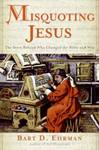
Review 13: Misquoting Jesus


Misquoting Jesus by Bart D. Ehrman

I saw this guy on The Daily Show a few years ago, and his book sounded like a really interesting idea – study the ways in which, over the last two thousand years, the text of the Bible has been altered. Sometimes it has been altered by mistake and sometimes on purpose, but it has been altered nonetheless.

Now this is a claim that angers a certain section of Christianity – often known as the Biblical Literalists – who believe that every word of the Bible is true, the revealed Word of God. Unfortunately for them, once the text is analyzed, once source texts and translations are looked at carefully, there are too many discrepancies for that to be true.

What makes this book interesting is the author’s background, which he explains in detail in the introduction. Bart Ehrman is not an angry atheist, looking to tear down the New Testament. Quite the contrary – in his teens, Ehrman became Born Again, filling the void in his life with 100% Jesus. He threw his heart and soul into Bible study, convinced that the book was the inerrant, incontrovertible Word Of God. It was only when he began really studying the Bible that he started to get the feeling that something wasn’t quite right.

And when I say “studying the Bible,” I don’t mean just reading a few passages before he went to bed at night. Ehrman is the kind of person who learned Latin and ancient Greek and Aramaic so that he could read the oldest known manuscripts for the Gospels and the Epistles. He immersed himself in Biblical history, arming himself with every tool he would need for textual criticism and a better understanding of the text that meant so much to him.

An explanation of textual criticism takes up a great deal of the book, since it’s a branch of academia that most people aren’t all that familiar with. Textual criticism is the analyses of ancient manuscripts in an attempt to determine what the original text was. This is done by comparing manuscripts. It attempts to determine what changes were made and when. It’s very difficult, even worse so the older the work is, but it’s a task that has absorbed Biblical scholars for centuries. This brings up two questions: why is that difficult to do, and why is it important?

As to the first, it’s difficult because these manuscripts were, before the printing press got into full swing, copied by hand. By humans, to be specific and if you’re a human – and there’s a very good chance that you are – you know how hard it is for us to do things without making errors. A pen might slip, your eye might skip a line, or you just might be tired and misread a word. That error then gets around, and someone else copies it, probably adding their own errors as well. Many of the original copyists of the New Testament weren’t professional scribes, and even some of the pros were barely capable of actually reading the text they were copying.

What’s worse, there’s no guarantee that the “correct” text is the one that gets the most exposure. You might have fifty copies of, say, the Gospel of Luke that say one thing and five that say something else, but those fifty copies might all be wrong. It’s kind of counter-intuitive, but there you go. And age isn’t always reliable either. You might think that an 8th century text is more “correct” than one from the 10th century, but not if that 10th century text had been copied from a 4th century manuscript. You can see how problems emerge.

Ehrman lays out, as simply as he can, the criteria by which textual critics judge a manuscript. It can’t be called scientific, as there are a lot of judgment calls to be made, but within the field there are a lot of very good guidelines, and the peer review process is relentless.

The bigger question, then – why is it important? Well, the biggest reason is because there are over a billion people on the planet who live their lives, to one degree or another, by the words of the New Testament. They look at the Gospels and see the stories of Jesus and his miracles, they read the letters of John and his instructions to the newly-birthed churches of the first century to try and find out what Jesus would have wanted. And because Jesus himself never left us any notes, the words in the New Testament are all they have to go on. Isn’t it vital, therefore, to know what the writers originally wrote? If you’re basing your faith off of inaccurate writings, does that mean your faith is flawed? If you’re living your life based on ideas that were not inspired by Jesus, but by a third-century scribe who, for example, had certain ideas about a woman’s place in the church, does that mean you’re living wrong?

And if you are one of those who believe that God transmitted His words to the writers of the New Testament, what does the fact that we no longer have those original words mean to your faith?

That’s the big thing here – we don’t have Paul’s original letters to the early churches. We don’t have the notes that Matthew, Mark, Luke and John used when they were writing their Gospels. We don’t even have copies of copies of those notes. What we do have, and what Ehrman demonstrates in detail, are many manuscripts over many centuries that have thousands of points of divergence. Sometimes those differences are minor, but some of them affect the very foundations upon which Christianity is built.

Like the famous story of the adulteress, where Jesus gave his “Let he who is without sin” speech. It doesn’t show up in the earliest and best texts, but gets wedged in a few centuries later. Or the bit in Luke where Jesus sweats blood? That, too, appears to have been a later addition to an otherwise well-constructed section of that Gospel. Even the famous King James Bible is not immune – it was based off a Greek New Testament that was written earlier, parts of which were constructed by a man named Erasmus, who did it not by using original Greek writings, but by translating later Latin translations back into Greek. Why? Because those original Greek writings were lost, but they had to have something….

Ehrman tries to look at the possible motivations for these changes, and they are necessarily speculative. The early Church was a turbulent and unstable entity, with many different groups pushing their rendition of who Jesus was and what he wanted of his followers.

Was Jesus an emotionally turbulent rabblerouser or was he a calm and serene figure of peace? Was he the begotten son of God or just adopted? Did he die with quiet dignity, willingly surrendering his spirit up to God, or did he die in torment, forsaken? Was he entirely human, entirely divine, both or neither? Christians of the early Church knew these to be vital questions – with a variety of answers. The New Testament we have today is the result of who had the most power to enforce their interpretations of Jesus’ life, times and teachings.

This book covers a whole lot of ground in 218 pages – Biblical history, Christian history, textual criticism, politics, sociology…. The history of how the New Testament came to be the way it is today is a complicated and fascinating one, and Ehrman casts it in an interesting light.

You see, rather than spend 200 pages noting the history of alterations in the book, he doesn’t say, “And that’s why we should just throw it the hell out!” Rather, he encourages readers to look at the New Testament as an ornate human creation, a text (or, more accurately, a collection of texts) that has survived the millennia by being complex enough to survive interpretation after interpretation. The inerrant Word Of God? Sorry, but no. But it is still key to understanding human history in the last two thousand years, and is therefore worthy of study.

—————————————–
“What if God didn’t say it? What if the book you take as giving you God’s words instead contains human words? What if the Bible doesn’t give a foolproof answer to the questions of the modern age – abortion, women’s rights, gay rights, religious supremacy, Western-style democracy and the like? What if we have to figure out how to live and what to believe on our own, without setting up the Bible as a false idol – or an oracle that gives us a direct line of communication with the Almighty?”
– Brad Ehrman, Misquoting Jesus
———————————————

Misquoting Jesus at Wikipedia
Bart Ehrman at Wikipedia
Bart Ehrman’s homepage
Textual criticism at Wikipedia

1 Comment

Filed under Bart Ehrman, Bible, Christianity, criticism, history, Jesus, nonfiction, religion, textual criticism, theology

Review 12: The Areas of My Expertise


The Areas of my Expertise by John Hodgman

FACT: Yale University enforces its will on the world via a capella singing groups.

FACT: There as been only one murder on the space shuttle, and Sally Ride used her deductive prowess to determine that only the Indian fakir could have performed the deed.

FACT: President Herbert Hoover built a pneumatic army, designed by Nikolas Tesla. to defeat the Hobo Uprising of 1932

FACT: Oregon seethes in its confinement, inflicted on it by President Polk’s geographimancers after it threatened to take over land as far east as Illinois.

WERE YOU AWARE OF IT?

Probably not.

You should feel grateful that we have John Hodgman and his compendium of World Knowledge to shed some light on the secret history of the United States, the habits of werewolves, the hidden horrors of the Mall of America and many other educational and illuminating topics.

The book is set up in the manner of an almanac of old, but whereas books such as “Poor Richard’s Almanacs” dealt mostly with mundane things such as harvest times and moon cycles, this book addresses so much more. There is Information You Will Find Useful in the Present, such as the best places to find crabs, how to build a snow fort, and the fifty-five dramatic situations. There is Information Concerning the Future, with a full chart of Omens and Portents so that you may be prepared for the inevitable merman attacks, roving cocktail gangs, and, of course, Ragnarok.

If you’re fond of United States trivia, there’s a section in there for you, and if you’ve ever wondered about the secret societies of actuaries, you will be illuminated by this book. You can learn how to win a fight, short words used on submarines to preserve oxygen and, of course, which presidents had hooks for hands (hint: it’s not who you think.)

Of course, the most famous and important section of this book is the section entitled “What You Did Not Know About Hoboes,” and I can guarantee that the information in this section will come as a surprise to most people not versed in Hobo history. There you will find out how the Hobo kings and queens come to power, what the secret agenda of these rail-riding, lint-collecting itinerants is, and learn the all-important 700 Hobo Names – invaluable for Hobo hunting or, should you be seduced into a life of riding the rails, choosing a proper name for yourself.

I first saw John Hodgman on The Daily Show, where he was promoting this book, and nearly soiled myself laughing. He has a completely guileless face, and delivers his words with a tone that conveys the innocent delivery of common sense wisdom, like he cannot conceive of anyone disbelieving what he’s telling us.

As with any writing, it’s far easier to show than to tell. Here’s the clip from The Daily Show archives:

.cc_box a:hover .cc_home{background:url(‘http://www.comedycentral.com/comedycentral/video/assets/syndicated-logo-over.png’) !important;}.cc_links a{color:#b9b9b9;text-decoration:none;}.cc_show a{color:#707070;text-decoration:none;}.cc_title a{color:#868686;text-decoration:none;}.cc_links a:hover{color:#67bee2;text-decoration:underline;}

Hodgman soon went on to become the show’s Resident Expert, where he brings his prodigious intellect to matters concerning net neutrality, elections, army recruiting and many other diverse subjects.

It really is a terribly funny book. It’s the kind of book that will make you laugh out loud and then wait for someone to ask, “What’s so funny?” so you can start reading the really good bits aloud to them. It’s a strange and wonderful history of the United States that actually ties itself together very well. While the information may not actually be useful, it it probably more entertaining than actually useful information would be. In this way, Hodgman says, it “allows each entry to contain many more truths than if it were merely factual.”

Very true.

————————————————
“Truth may be stranger than fiction, goes the old saw, but it is never as strange as lies. (Or, for that matter, as true.)”
– John Hodgman
————————————————

John Hodgman on Wikipedia
The Areas of My Expertise on Wikipedia
The Areas of My Expertise on Amazon.com
The 700 Hoboes Project

Leave a comment

Filed under almanac, humor, John Hodgman

Review 11: Plato and a Platypus Walk Into a Bar

Plato and a Platypus Walk into a Bar – Understanding Philosophy through Jokes by Thomas Cathcart and Daniel Klein

Like most Liberal Arts undergrads, I took a few philosophy courses while I was in college. In fact, my sophomore philosophy final has the distinction of being the only one I have ever actually slept through. My roommate woke me up at 11:30 and said, “Didn’t you have a final this morning?” I don’t remember anything between that moment and arriving in the professor’s office, apologizing profusely.

The point is, philosophy never really made an impact on me. I mean, I get it – Philosophy is supposed to be the essence of what makes us human, the ability to think about the way we think about the world. Dolphins and monkeys may be clever, but do they sit around and ponder whether there’s actually a real world out there or if it is only a product of our senses? I doubt it, as it seem like they’re more preoccupied with frolicking around and having sex, which means that Douglas Adams really was on to something.

I don’t quite get the kick out of philosophy that I feel like I’m “supposed” to, being an educated, intelligent, un-American Elitist and all that, so I’m glad that someone has boiled down four millennia of human thought into a 200-page joke book. Definitely more my speed.

The book begins with Aristotle and his belief in a telos, an ultimate purpose for everything, and continues on through ethics, political philosophy, and religious philosophy, as well as existentialism, logic, epistemology and much, much more. Be warned – if you already know a lot about philosophy, then there’s really nothing new in this book for you except the gags. It’s written as a kind of Philo 101, for people who’ve always wanted to know about the different branches of philosophy, but always fell asleep fifteen minutes into the lecture.

By using jokes, the authors make complex philosophical and logical ideas much more immediate and understandable. Take post hoc ergo propter hoc, for example. I know what the Latin means – “After this, therefore because of this,” which is a definition that never struck me as being any clearer than the original Latin. As a logical fallacy, I never really convinced myself that I understood what it meant, until I read this joke. (warning: high bawdiness content follows):

An older man marries a younger lady, and they’re truly in love. However, no matter what the old man does, he is unable to satisfy his young bride sexually. He tries everything, but cannot finish the deed, so to speak. 

So, they go to a sexual therapist, who makes a rather unusual suggestion. “Hire a handsome young man,” the therapist says, “and have him stand over the bed and wave a towel over you while you make love. This will help your wife fantasize, and should help her have an orgasm.” So they follow the therapist’s advice, hire a handsome young man, and try it out. But still, no success.

They return to the therapist, who thinks for a moment and says, “Okay, why not reverse it? Have the young man make love to your wife while you wave a towel over them?” They return home, and the young man climbs into bed with the young wife, while her husband waves a towel vigorously. Within minutes, the wife has an amazing, ear-splitting orgasm.

The husband smiles, looks at the young man and says, “There, you idiot – that’s how you wave a towel!

See? Now I get it! Post hoc is where you assume that because event B happened after event A, event A caused event B. No amount of hypotheticals or dull as dirt lectures have ever explained that to me quite as well as this one ribald joke.

I think these guys are on to something, too. Philosophy has always been the pursuit of the super-intellectual, and anyone who tells you, “I’m a philosopher” is assumed to say next, “And would you like fries with that?” Being an intellectual in America is hard enough as it is, but once you start trying to deconstruct the very essence of what “good” means, much less whether it is actually worth being good, people start to look at you funny.

But tell folks a joke, and all that erudite navel-gazing becomes crystal clear. Of course the GOP is run by Utilitarians – this joke makes perfect sense:

A young widow belongs to a country club, where she enjoys sunning herself by the pool. One day, she sees a handsome stranger poolside, so she sits next to him and says, “I don’t think I’ve seen you here before.” 

“You wouldn’t have,” he said. “I’ve been in prison for the last twenty years.”

“Good heavens,” she said. “What did you do?”

“I murdered my wife,” he replies.

“Ah,” she says. “So you’re single!”

Just replace the young widow with Dick Cheney and the handsome man with, say, Halliburton and you have yourself the GOP in a nutshell!

If you’re an old hand at philosophy, check it out for the jokes – there are plenty of good ones in there. If you’re new to philosophy, or you were put off by the classes you took in college, check it out. You’re not as dumb as your philo teacher made you feel. All you needed was the right sort of explanation.

————————————————
“A blind man, a lesbian and a frog walk into a bar. The barkeep looks at them and says, “What is this – some kind of joke?”
– from Plato and a Platypus Walk into a Bar
————————————————

Plato and a Platypus Walk Into a Bar at Wikipedia
Plato and a Platypus Walk Into a Bar at Amazon.com
The Internet Encyclopedia of Philosophy
Philosophical Humor compiled by David Chalmers

4 Comments

Filed under Daniel Klein, humor, jokes, philosophy, Thomas Cathcart