Category Archives: humor

Review 128: Soul Music

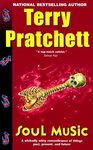
Soul Music by Terry Pratchett

“Music is my life.”

How many times have you heard that? From bona fide rock stars to teenage wannabes, there’s something about music that occupies us, that possesses us and just won’t let go. Even if you’re not a big music lover, there are probably songs which can ease your mind, pull you out of a dark mood, or set your heart to racing. There’s music that’ll lift your heart and make you think the world is a better place than it really is, and songs that will convince you that the dark heart of the world is just as decayed and corrupt as you always thought it was. Music has a kind of magic in it that can reach to the very core of who we are as thinking – and more importantly, feeling – beings.

That magic is dangerous enough on our world, where magic doesn’t actually exist. Imagine how powerful it would be on one where magic really was real. Like, say, to pick one out of thin air, the Discworld.

Sometimes, even more horrible things would emerge....

Of course, the Discworld has had its share of trouble with popular entertainment before. Acting troupes brought about an Elf invasion in Lords and Ladies and the Horrible Betentacled Things of the Dungeon Dimension nearly escaped thanks to the Disc’s proto-cinema in Moving Pictures. There’s just something about the arts in Discworld that leads to trouble – usually the world-ending kind.

In this case, though, the introduction of rock and roll – better known in Ankh-Morpork as “Music with Rocks In” – is only really dangerous to one person, the young Imp y Celyn. Just eighteen years old and already one of the best bards of Llamados, he wants to make something of his life. He wants to be more than just another bard, and in a mysterious shop that has only recently always been where it was, he finds his chance. Or rather, his chance finds him. A guitar-like instrument that does what no guitar should do – it whines, it growls, it sends out noises that run straight down your spine and make your nerves run with fire. It’s clearly not of this world, and it wants nothing more than to live. For that, it needs to change Imp’s fate, and by extension the fate of hundreds in Ankh-Morpork.

Soon, Imp and his band – The Band With Rocks In – are the most famous thing in the city, and the strange magic of this music is being felt everywhere. Even the wizards are helpless against it. Normally this would result in the aforementioned Horrible Betentacled Things, but in this case it’s more of a reversion to teenage years that never were. Still, Archchancellor Ridcully knows that there’s some force acting on people that shouldn’t be there, and nothing good ever comes of that.

Keith Death (art by Soulstripper on DeviantArt)

As if that weren’t enough, Death has decided to get existential and tries to figure out how he can make himself forget for a while. Why he decides to do this is not clearly explored, but it results in him leaving his duty. In his place comes his young Granddaughter, Susan, who would be great for the job if she didn’t think the whole idea of personifying a force of nature was just romantic woolly thinking. And it would be even better if she knew what her connection was to the doomed musician Imp y Celyn.

This book can be seen as a companion to the earlier Moving Pictures as an examination of and homage to popular culture. By transplanting it to the Discworld, Pratchett is able to look at rock music from the point of view of people who’ve never even thought about such a thing before, and who can more easily see the magic of it. And of course, it’s his big chance to make as many music jokes, puns and references as humanly possible, from the translation of Imp’s name (“Imp” meaning “small bud” and “Celyn” meaning ‘of the holly”) to some proto-heavy metal musicians trying to make leopard skin pants from a cat that has some severe hearing difficulties.

It’s a sort of love letter to rock and roll and all that it has brought us. From teenyboppers to punk to the horrible misuses of leather and spandex, it holds a mirror up to the way that rock music has influenced our modern culture. But it does not mock, oh no. It shows great attention to and reverence for this young art form that has done so much to change the world. To list all the references made in this book would be nearly impossible, but the amount of work and thought that went into making it is quite clear.
We're not here to judge.

More importantly, though, the book addresses some questions that are a little deeper than the simple rock and roll jokes. Like Death’s question: “WHAT’S IT ALL ABOUT? SERIOUSLY? WHEN YOU GET RIGHT DOWN TO IT?” Probably since the beginning of music, people have tried to find meaning in it. People have connected to music and to musicians in ways that they could never connect to other people, even family and friends. People find meaning in music, which then gives meaning to their lives, and the more you give your life to something, the harder the crash when that thing goes away. Imp discovers this in a very literal sense, but out here in the real world that is just as true.

People mourned for Michael Jackson, Elvis Presley, Kurt Cobain and other superstars as if they knew them. And in a way, I’m sure they thought they did. Like so much else in the world, though, music doesn’t have any meaning but what we give to it. The truly great musicians, the ones we always lose too soon, give everything they have. They manage to say to us what we’ve been saying to ourselves, but could never really figure out how to put into words. Music is the voice our emotions could use if our brains didn’t get in the way so often, and the best people lucky enough to be able to create it gain a kind of immortality.

Not the literal kind, unfortunately.

If you love music – especially rock music – then this is a book you should pick up and read. Even if you’re not a Discworld fan, you’ll probably enjoy it.

————————————————————–
This was music that had not only escaped, but had robbed a bank on the way out. It was music with its sleeves rolled up and its top button undone, raising its hat and grinning and stealing the silver…. It made you want to kick down walls and ascend the sky on steps of fire. It made you want to pull all the switches and throw all the levers and stick your fingers in the electric socket of the Universe to see what happened next. It made you want to paint your bedroom wall black and cover it with posters.
– from Soul Music by Terry Pratchett
————————————————————–

Soul Music on Wikipedia
Terry Pratchett on Wikipedia
Soul Music on Amazon.com
Terry Pratchett’s Homepage
L-Space Annotations on Soul Music

Leave a comment

Filed under death, Discworld, fantasy, humor, identity, music, rock and roll, satire, Terry Pratchett, wizardry

Review 122: Anansi Boys

Anansi Boys by Neil Gaiman

When I started in on this book, I knew there were certain things I could expect from Neil Gaiman – insight, clever twists on literary assumptions, a good perspective on the nature of our reality. And, I must say, he delivered in full. This story draws from some of the most ancient of human tales and reflects on the most ancient of human needs – the need to have a story of one’s own. It’s a book about purpose and destiny, and other very deep subjects.

Yes - this man is hilarious.

What I didn’t expect was to spend most of the book laughing out loud and disturbing the people around me.

Seriously, there were some times when the other teachers in the staff room would stop whatever conversation they were having because they’d been interrupted by my cackling. Or the staff would come over and ask what was so funny, and I’d try to explain – which doesn’t really work when you’re trying to cross languages and literary traditions. People in Japan don’t really laugh out loud at their books, and can’t quite understand why I do. But I laugh. I snicker, I giggle, I cackle, and I never expected that from Neil Gaiman.

The book was, needless to say, wonderful. While by no means a sequel to Gaiman’s previous bestseller American Gods, it inhabits the same universe. This is a world where the gods exist – they’ve been called into existence by us and, in turn, shape our lives.

The book follows the unfortunately nicknamed Fat Charlie, whose life has been ruined by his father’s death across the Atlantic. This wasn’t the first time his father had ruined his life – it had happened many times before in many terrible ways. For Fat Charlie, however, dying in the middle of a karaoke hall just seems to be a final slap in Fat Charlie’s face.

Fat Charlie isn’t his real name, of course – his real name is Charlie Nancy, which isn’t much better. Fat Charlie is only a nickname given to him by his father. He tried to shake it in his life, asking people to call him Charlie or Charles or Chaz, and he wasn’t even fat – just a little soft around the edges. But his father gave names that stuck like gum to the underside of a school desk, and no matter where he went, Charlie Nancy inevitably became Fat Charlie.

You would think this would raise eyebrows in the delivery room....

The reason for this phenomenon, of course, is that Fat Charlie’s father is a god. He is Anansi, the Spider, a trickster god who managed to steal all the stories from Tiger back when humanity was young, and who managed to trick, deceive, swindle and humiliate nearly every other god and spirit there ever was. He was good at it, and there was nothing he wanted that he couldn’t get.

Fat Charlie was, in very many ways, a disappointment. Where his father was debonair, Fat Charlie was a klutz. Where his father could command the respect of men and women, Fat Charlie was a doormat. Where his father was the embodiment of confidence, Fat Charlie was a crumbly mess. I suppose it’s normal, really, being the child of a god, and not really his fault, even if he didn’t know it until his father was dead.

He didn’t know about his brother, either. His brother is Spider, a young man who is so cool that he can convince an entire L.A. party that they can walk on water. He can do real magic, step in and out of the world with ease, and carries his own bedroom with him. When Spider comes into the picture, everything goes horribly, horribly wrong. Think The Odd Couple, except that Oscar Madison has divine powers and absolutely no sense of consequence.

The story is a lot more than two brothers who don’t know how to get along. It’s a story – about stories. In the stories of Anansi and Tiger that are laced throughout the book, we learn that once, long ago, all stories were Tiger’s stories, and they were stories of fear and blood and hunger. When Anansi took them, the stories became about cleverness and trickery and resourcefulness. So in a way, the victory of Anansi over Tiger is the story of humankind’s emergence from barbarism.

Speaking of someone whose story has been re-written over and over. Anansi would like Spidey, though....

It’s about personal stories as well, and that’s a theme that’s far more important to us as individuals. We are the stories we tell about ourselves. Fat Charlie didn’t need to be the tightly-wrapped ball of embarrassment that he was. But that’s who he told himself he was, and, so, that’s who he became. Once he starts to accept his heritage and his responsibility to his family, once he starts to re-tell his own story, he changes himself. The same is true for Spider – he’s written his own story as a rake and a charmer, but he finds that that story is lacking. It’s a story that needs some editing, and he’s better off for it.

This is a funny, funny book that reminds me in places of Dave Barry, though that might be a side effect of the Florida settings. There’s also a few footnote jokes, so I suspect that Neil has been hanging out with Terry Pratchett recently. Despite the laugh-out-loud general tone of the book, there’s a lot of Meaning to be found as well – the meaning of story and song, of family, and why you should always be nice to spiders. And birds. Definitely be nice to birds.

The ultimate message of the book, though, is that you can always re-write your story. The weak little spider can become a conquering hero, and the fearsome tiger can be a timid coward. No story is set forever. So if you don’t like the way your story is turning out, get out your red pen and start editing. Anansi would approve.

————————————————
“People respond to the stories. They tell them themselves. The stories spread, and as people tell them, the stories change the tellers.”
Anansi, Anansi Boys

Neil Gaiman on Wikipedia
Anansi Boys on Wikipedia
Anansi Boys on Amazon.com
Neil Gaiman’s homepage

2 Comments

Filed under brothers, childhood, coming of age, death, family, fantasy, fathers, gods, humor, identity, Neil Gaiman, quest, sons, spiders, story

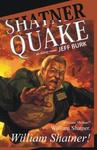
Review 121: Shatnerquake

Shatnerquake by Jeff Burk

In the introduction to this book, the author states that he truly admires William Shatner – he states that Shatner is a man who has made a career out of caricaturing himself, remaking himself over and over again with no looking back, no shame and – as far as we know – no regrets. He finishes by kindly asking William Shatner not to sue him.

I don’t think he has too much to worry about, really. This book is a quick, fun read that, while not necessarily painting William Shatner in the best of lights, certainly pays homage to his long and varied career.

Shatner

The story goes as follows: William Shatner is on his way to the very first ShatnerCon, a convention celebrating his life and works. It is a convention mobbed with fans, devotees who are there to see their idol, whether he caught their hearts as T.J. Hooker, Captain Kirk, or the host of Rescue 911. In the new Cathode-La convention center, tribute can be paid in full to William Shatner, a man who has changed so many lives.

But there are those who do not adore Shatner. They don’t like him or even tolerate him. They are the Campbellians, known by the bloody stumps where their right hands used to be and each known only as Bruce. They hate William Shatner with a passion that borders on madness, and seeing him dead is not nearly enough for them – they want his entire body of work to never have existed. Their weapon is a Fiction Bomb, a metaphysical WMD that can erase stories from existence. No one remembers them, no one knows they ever existed. Should the Fiction Bomb succeed, William Shatner’s entire body of work would cease to be. And so, in short order, would he.

Shatner!

But what if a Fiction Bomb should go wrong? What if that interface between fiction and reality should be breached, spilling its contents into what we commonly call the Real World? In that case, dozens of William Shatners – every character the man had played – would emerge in our world, with only one thought on their minds: Destroy the real William Shatner!

This book is a very quick read – only eighty-three pages – but it certainly packs in a lot of action, and as works of fan-fiction go, it isn’t too bad. Because that is most assuredly what this book is – fanfic. Burk has a very basic concept here – get all of Shatner’s characters out to kill him. Simple. Add lots of blood and gore and guts, because that’s always fun, and you have some entertaining reading. This is the very best kind of fanfic, really – you know it’s just a send-up, never intended to be a serious work of literature. Sit back and enjoy the ride.

It suffers from some serious editing problems, though, and Mr. Burk would have done well to have hired a good proofreader. There are some very basic grammatical mistakes, dropped plurals and a few sentences that just don’t make sense. To a regular reader, it might not be important, but to someone whose bread and butter is the proper use of English, it’s kind of glaring. But then my expectations weren’t all that high – I went into this expecting a rollicking adventure and that’s what I got. Complaining about the grammar in a book like this is like complaining about the quality of the vegetables in your Big Mac.

SHATNEERRRRR!!!!

Still, there are some redeeming points to it, above and beyond the weirdness of the whole thing. The beginning of the book does a very good job at setting up a real dreamlike atmosphere – a building that covers a hundred city blocks and has a parking lot that stretches out as far as the eye can see. Upon reaching the convention center, Shatner finds out that he is already late, and is led through a maze of hallways that result in almost instant disorientation. He has to sign hundreds of photographs for hours on end, and ultimately faces off with his own doppelgangers. Burk has reached into the bag of common nightmares and put together a scenario that is both familiar and disarming, which propels you through the rest of the book. After all, if you’re struggling to keep up with events, think about how Shatner must be feeling?

And of course, one can’t help but wonder if this is a commentary on the very nature of the actor/fan dynamic. Who is William Shatner, after all? Depending on who’s looking at him, he could be Kirk or T.J. Hooker, Denny Crane or Buck Murdock, the guy who saw gremlins on his plane or the guy trying to sell you cheap airplane tickets. On top of that, Shatner has another character to maintain – Shatner as a public figure, the guy who goes to conventions and book signings and does guest spots on TV shows.

Shatners?

Who is the real William Shatner? Who are any of us, really? In this age of online presences, there could be electronic doppelgangers of ourselves all over the internet. The person that your Twitter followers believe is you is not necessarily the same person that the people on your Mad Men slash fic forum know. You present a different face to your Facebook friends than the people you know in your World of Warcraft game, and like Shatner in this story, you ultimately have no control over the different renditions of you that other people see.

The good news, of course, is that those different Yous are unlikely to rise up and try to kill you.

Ultimately, this book has no over-arching message about the nature of identity in a world where different versions walk around without our knowledge or consent. I don’t think that it was ever Burk’s purpose to write a treatise on the modern concept of identity, but rather to write a quick, bloody thriller about William Shatner. So, it has no real lessons to teach us other than that if you see a deranged Captain Kirk approaching with a lightsaber (and how that got in there, I’ll never know – a little artistic license for the sake of awesomeness) you run away. Very fast.

————————————————–
“I’m a… professional. I can deal… with anything.”
– William Shatner, Shatnerquake

Jeff Burk on Wikipedia
Jeff Burk’s website
Shatnerquake on Amazon.com

1 Comment

Filed under adventure, doppelgangers, fans, horror, humor, identity, Jeff Burk, science fiction, William Shatner

Review 119: Wyrd Sisters

Wyrd Sisters by Terry Pratchett

A king is killed, usurped by a weak man and his overbearing wife.

A ghost haunts the castle, waiting for his son to come and avenge him.

On the highlands, three Witches hold their meeting, plotting the future of the kingdom.

I think Granny would not appreciate this image....

Sound familiar? It should. These are some of the most enduring tropes of English literature, and they’re all thanks to a singular playwright. Wyrd Sisters is Terry Pratchett’s tribute to some of the blood and gore and guts, tragedies and twists of Shakespeare’s great plays.

In fact, this book encapsulates my three favorite Shakespearean works – Hamlet, Macbeth, and King Lear. Yes, they’re all tragedies, but that shouldn’t surprise any of you by now. They plumb the depths of humanity to try to find glimmers of hope and bravery and redemption, and everyone usually ends up dead, but dead with a true sense of purpose. In this book we have, respectively, a king murdered by his own family, a woman who pulls the strings of the usurper, and a bloody great storm.

Anyone have some Purell?

Verence, the king of Lancre, has been assassinated. An accident, everyone says. He tripped and fell down the stairs, landing on his own dagger. Funny, that. But the new ruler of Lancre, Felmet, is not so steady in his convictions. He sees the blood on his hands, although he didn’t do it. He’s absolutely sure he didn’t do the deed. Anyone who says he did do it is likely to be shorter by a foot or so by morning. And his wife wasn’t there either. She didn’t hand him the knife. The point is that Verence is dead, long live the King, and now everyone can enjoy the easy life of a royal couple.

However, as so often happens in these things, complications arose. The dead king isn’t allowed to go away. He is confined to unlife as a ghost, unable to contact or interact with the world of the living – except in very small, nearly unnoticeable ways. As his murderers rule over his kingdom, Verence exercises his ectoplasm and plots a way to bring Felmet down. The king’s infant son was stolen after the assassination, you see – brought by a dying man to the home of one of Lancres witches, where he passed the infant to the three women there, and begged them to care for it.

Huh. Actors.

They did what some people would think would be the exact opposite – they gave the child to some traveling actors. As alarming as that might seem, they thought that a traveling troupe would be a much better place for a child to grow up than with three of the greatest witches of Lancre.

And that would seem to be the end of it, really. The king is dead, with no one to contradict the original version of his death. The infant son of the king is stolen, never to be seen again. By all rights, the kingdom should move on. Assassination, of course, is perfectly natural in Royal circles, happens all the time. The kingdom shouldn’t even blink.

But it does. Not only does the kingdom blink, it is furious. Not the people, mind you. The people barely notice a new king, except for the parties and the slight increase in executions. The Kingdom. As a body is an amalgam of cells, a Kingdom is the whole of its people and history. Felmet hates the new kingdom he has acquired, with its gorges and trees and people you couldn’t bully no matter how hard you tried. He hates the Kingdom, and the Kingdom hates him for it. A Kingdom, you see, is like a dog. It doesn’t care if its master is a good man or an evil man, so long as he cares for the dog. Felmet actively detested the land and its people, and in return the larger entity that was The Kingdom hated him right back.

In the meantime, Felmet’s Fool, formerly the Fool to Verence, is showing him how words have power, and how that power could help break the animal kingdom he ruled. Cutting the trees down, for example, might be called “horrible” or “terrible” by the people – and the kingdom – of Lancre. But call it, “Planned deforestation for industry growth,” and that’s a whole new story.

"Senior citizen"

Words have power, Felmet learns. The Fool eventually goes on to demonstrate the true power of words to the king.

Liar. Usurper. Murderer.

Words like that have a wondrous effect.

And then there are the Witches, who are a threat to Flemet, in his own mind. He can’t kill them, he can’t torture them. But he can change how people think about them, and so he decides that a play is the way to go….

It gets a little complicated after that, but rest assured, it’s a kicker. Felmet is insane, and his wife is worse. Their plan to destroy the witches of Lancre goes beyond what the Puritans of Massachusetts could ever have come up with – altering their very natures by altering perceptions. And fate sticks her fingers in all over the place, as the Witches try to restore a true leader to Lancre – even if the true leader doesn’t even know who he is.

Oh, what Shakespeare could have done with Granny....

Not only does this book showcase one of Terry’s best characters – Granny Weatherwax – but it takes an interesting look at the way we can alter our perception of things merely by altering what we call a thing. Words shape the world, whether we want them to or not, and the right word in the right ear can shift the balances of history. As with so many of his other books, Terry gives us a profound philosophical insight and shows it to us as something we knew all along.

————————
“Oh, obvious,” said Granny. “I’ll grant you it’s obvious. Trouble is, just because things are obvious doesn’t mean they’re true.”
Granny Weatherwax, Wyrd Sisters

Wyrd Sisters on Wikipedia
Discworld on Wikipedia
Terry Pratchett on Wikipedia
Wyrd Sisters on Amazon.com
Terry Pratchett’s homepage

1 Comment

Filed under assassinations, death, Discworld, fantasy, ghosts, good and evil, humor, madness, revenge, Terry Pratchett, witches

Review 115: A is for Armageddon

A is for Armageddon by Richard Horne

You should know by now that if there’s one thing I’m really looking forward to it’s the end of the world.

At least, I was, up until about two weeks ago when an Earthquake of Unreasonable Size hit northeastern Japan, unleashing a massive tsunami which in turn led to an ongoing disaster at a nuclear power plant in Fukushima. Ever since then, the TV has been nothing but tales of survivors huddled in relief shelters and people all over the country scrambling to help – or to get out. In addition, there is the very real probability that more than ten thousand people have died, their bodies washed out to sea.

It’s one thing to read about the end of the world in a book or a comic, but to see it unfold on live TV is something else entirely. So right now, I’m not all that gung-ho about end of the world stories. Give me time, though, and I’m sure I’ll come back to them.

Like this, but without the leather and the anti-Semitism

I don’t know why, really. Maybe it’s for that feeling that all bets are off, all bonds are broken and you can remake yourself in any image you want. Maybe I really believe that I’ll be one of the heroes of the story, who make it through the End Times not only alive but victorious. Maybe I just long to see the world scythed clean of humanity and restarted so the squid can have a go at running things, I have no idea.

For whatever reason, I have a soft spot for armageddon stories. Whether it’s Good Omens, The Stand, Swan Song, Crisis on Infinite Earths, or any other story that promises the destruction of a world, I’m all over it. I can’t know if they’re good, but I’ll at least be willing to give them a shot. So when I saw this, I thought to myself, “I must have this book.”

The book is based on an organizational system that has gained some popularity in recent years: The Periodic Table of X, wherein X is whatever topic you want to focus on. It was originally designed to accommodate the natural elements, but if you have a hundred or so items, you can probably make your own periodic table to sort through them. You’ve got the Periodic Table of Typefaces, the Periodic Table of Beer Styles, the Periodic Table of Superheroes, and even – prepare to have your mind blown – the Periodic Table of Periodic Tables of Things.

You never had it so good, Mendeleev….

This book is based on the Periodic Catastrophic, a listing of the many, many ways that the world can end. As with the “real” periodic table, this one is well-organized to keep the apocalypses in line. There are the Acts of God, Don’t Mess With Nature, Universally Doomed, and It Was Like That When I Got Here, among other distinctions. Each disaster gets a couple of pages with a succinct explanation and an interesting or humorous illustration. Some of my favorites include:

The End of the World will be accompanied by a speed metal soundtrack

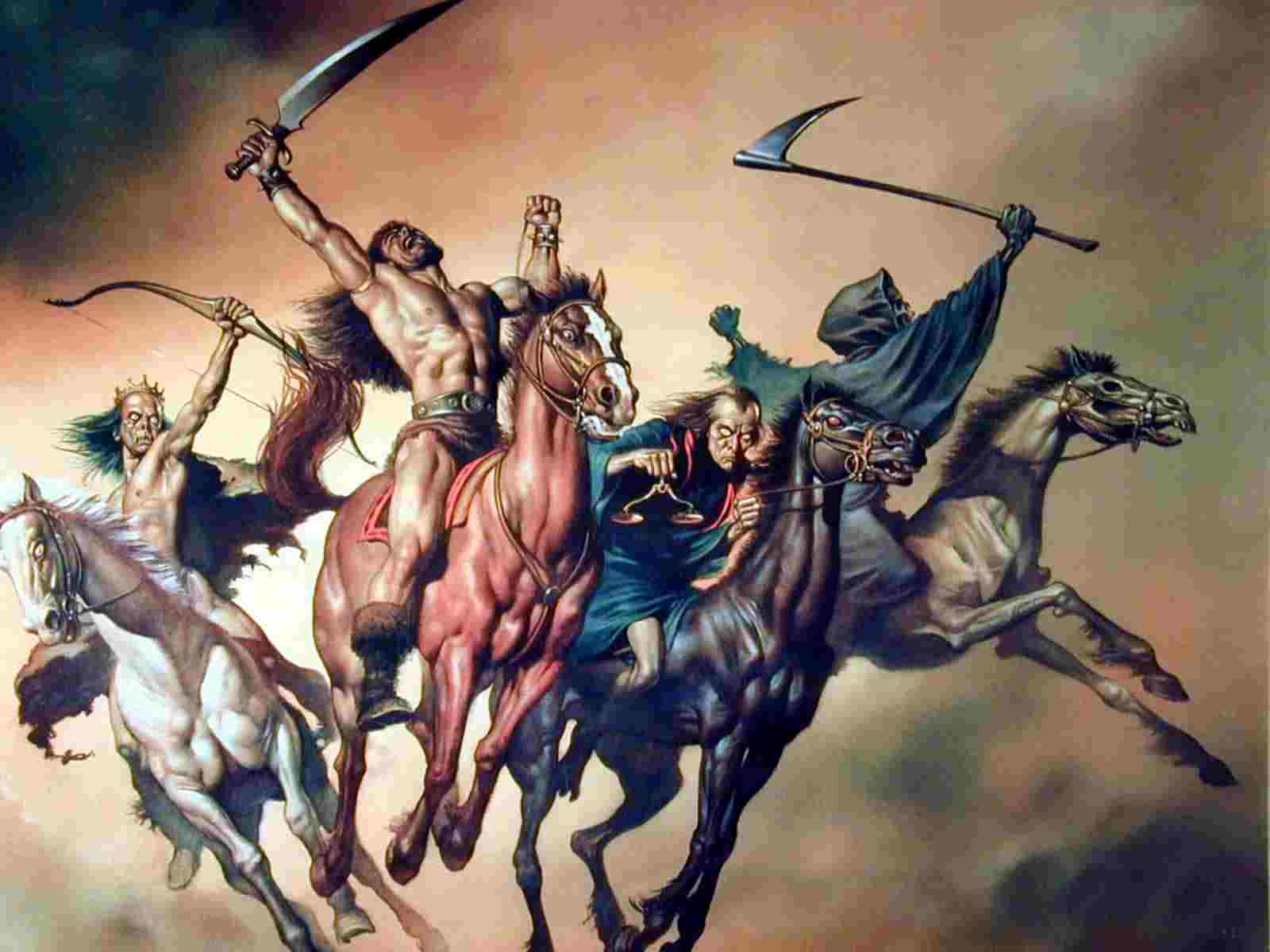
Four Horsemen Motto: Come and have a go if you think you’re hard enough. Direct from the Bible, the Four Horsemen of Conquest, War, Famine and Death will one day roll across the Earth, bringing down everyone in their paths. “Everyone,” of course meaning everyone. You don’t know when they’ll come, but you’ll sure know when they get here. Make sure you have your bags packed.

Ecosystem, if only for the picture of the panda strapped to a knife-throwing target. Those pandas have had a free ride for long enough, if you ask me….

You have no idea how important bees are. Seriously.

Food Chain Collapse – this is one that I find pretty plausible, as far as some of these entries go. We all get mushy and sentimental about the whales and the dolphins, but what about the krill and shrimp and sardines? Without them, we run the very great risk of destroying an entire food chain just to have something to snack on during brunch.

The Gulf Stream Collapse is another one that kind of worries me, and it’s my favorite card to play whenever someone comes out with, “Look at all this snow! So much for global warming!” canard. In a nutshell: The gulf stream brings warm water up from the Caribbean to the North Atlantic, which results in a rise in temperature for most of Europe. As polar freshwater ice caps and glaciers melt, all that cold fresh water will mix with the salt water, which could have the effect of pushing the upper end of the gulf stream south. This would mean a substantial temperature drop in Europe, and a general planetwide climate crisis up to and including a new mini-ice age.

For a brief and shining moment, we will all be T-1000s

Grey Goo is always fun, too. If we manage to build self-replicating nanomachines, which use the atoms around them to build copies of themselves, what’s to stop them from just ripping apart every solid object they see? If they don’t know when to stop eating and replicating, they could devour most of the world in pretty short order. Nasty, huh?

And of course there are sure-fire world-enders like The Death of the Universe, Sun (the death of) and the Collapse of Causality, the inevitable result of the invention of time travel.

It’s an amusing book, with some educational points to make. Strictly speaking, not every one of the scenarios that it depicts has to do with the end of the world. Some of them, like volcanoes, earthquakes, and pandemics, are just natural disasters rather than planet-killers. Others, like obesity and an aging society, are more aimed at problems facing the human race that may inconvenience us, but probably won’t destroy us.

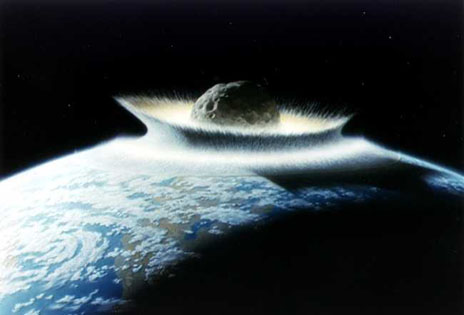
Look, it landed on Bruce Willis! How ironic...

And then there are the ones that I suspect were put in just to fill space – in The Solar System , Horne suggests that Jupiter could one day turn itself into a second sun, with disastrous consequences. But that won’t happen – Jupiter is much too small to initiate fusion in its core. The same with Supernova – he suggests that Betelgeuse could go up (and it will), bathing us in gamma rays after “crossing millions of light years” to get to us. But Betelgeuse is only 640 light years away – much closer than “millions,” but much too far to hurt us when it goes. So it’s not so much that the scenarios are implausible – like Alien Invasion or Paradox or Satan, but that they’re inaccurately implausible. It makes me wonder what other facts he fudged or guessed on just for the sake of making something sound scarier than it is.

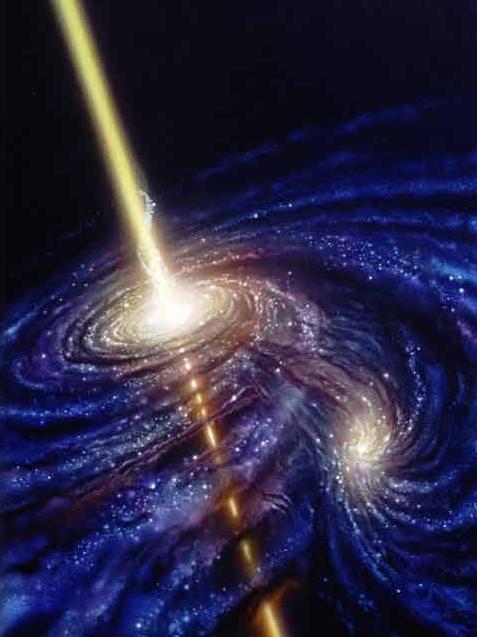
Can't go wrong with a black hole....

It’s got some good tongue-in-cheek humor, and is a clever reminder of all the ways that things can go wrong in this big world of ours. The pictures are very nice, often funny, and good companions to the text, which features helpful hints for surviving each scenario, as well as a guess as to when you should start to panic. All too many of them are labeled “too late.”

An interesting note: there is a lot of British English in the book that may surprise readers of American English, such as myself. I had never encountered the adjective moreish (meaning so tasty that you want more of it) until I read this book and am forced to assume it’s a British coinage. Also, some of the puns only work if you know the British pronunciation of words. Unlike the editors of Harry Potter, though, these guys did not bow to our American prejudices and re-edit the book. Kudos to them.

So, these are the ways the world ends. Now you know.

———————————————————
“The only thing worse than a vengeful God is a fickle one.”
Richard Horne, A is for Armageddon

A is for Armageddon official website
A is for Armageddon on Amazon.com

1 Comment

Filed under apocalypse, death, disaster, humor, Richard Horne, science

Review 110: Johnny the Homicidal Manic & SQUEE!

Johnny the Homicidal Maniac and SQUEE’S Big Giant Book of Unspeakable Horrors by Jhonen Vasquez

I’m putting these two together, because they really do form one larger piece – the craft of an artistic mastermind. Although perhaps “mastermind” isn’t the best word to use here. What do you call the person that they lock up when they’re about fifteen because they keep saying things to their teachers like, “The human body has ten thousand miles of blood vessels in it and I can feel my hate for you coursing through every one?” Or the guy who buys a dog, takes care of it, feeds it, loves it, and then one day realizes that the dog has been spying on him for the CIA for years and buries it in his backyard? Or the angry hobo who lurches up to your car as you wait at the stop light, a bucket of dirty, grey water in one hand and a rotten squeegee in the other and proceeds to molest himself with it, afterwards demanding that you gave him change, quote, “For the show.”

You thought I was kidding about the dog....

That kind of guy. What would you call him?

Whatever it is, welcome to the world of Jhonen Vasquez. Strap yourself in.

Johnny the Homicidal Maniac is the story of Johnny C., known to his very few friends simply as Nny. Nny is rail-thin, yet something of a fashion plate, and lives in a broken-down house with two evil Styrofoam doughboys, a dead bunny nailed to a wall, and a gateway to a creature of infinite evil somewhere in one of the many basements of the house.

In his free time, Johnny kills people in horrible and graphically interesting ways.

Not because he’s a bad person, necessarily. He does have the wall to feed, after all – a wall that has to be continually painted with fresh blood, lest the Evil come out of it. But he is, by his own admission, “quite horrendously insane.” He murders for many reasons, the Evil Wall aside. He murders the people who feel superior to others (while at the same time feeling that he is superior to them). The kills the smug and the self-possessed, the materialistic and the bored, the lowbrows and the posers and the jerks who seem to infest every corner of his world. And while he does kill with great glee and abandon, he occasionally takes the time to wonder if what he’s doing is worth it. If murder is all that his life has become. If maybe it would be better off to just end it all and kill himself.

Fortunately – or not – he has The Doughboys to keep him company. Two Styrofoam figures, painted by Nny, which talk to him constantly. One urges him to live and kill to his heart’s content. The other presses him to commit suicide and leave this world behind. Whichever wins will be freed from his plastic prison and reunited with his evil master. As a balance to them is Nailbunny, which is pretty much just what it sounds like – a bunny rabbit that Johnny bought from the pet store and then one day nailed to the wall. Nailbunny (or at least its floating head) is the voice of reason in Johnny’s life, urging him to be suspicious of the Doughboys and all they want. Despite his nihilistic view of the world, Johnny discovers that he does indeed have a purpose in life. Just not a very good one.

Yes, Nny, show us "wacky"

Johnny is, naturally, hard to sympathize with. Part of that comes from his almost cavalier attitude towards killing, but more than that, he’s rather adolescent in his view of the world and how it works. Like so many teenagers, he has yet to grow a buffer between himself and the world, and cannot differentiate malicious acts from merely thoughtless ones. He feels every barb and every sting like hooks in his flesh, and the only way he is able to deal with it is through murderous rage. Reading it as an adult who remembers his teen years, I can certainly see where Johnny is coming from, but at the same time I wish he’d just grow up and learn to live in the world like the rest of us.

Which is a statement for which Johnny would no doubt gleefully murder me.

One of the major themes of these comics is conformity and humanity’s need to follow each other into the abyss. Hypocritical characters dressed in all the latest fashions snub people who are slaves to public opinion. One of the worst offenders, a recurring character named Anne Gwish, embodies the modern Goth poser who shuns everyone while despairing that no one talks to her. Johnny’s world is filled with these people and they all need killing. Even people who don’t deserve death might end up falling to Johnny. In one of my favorite stories, “Goblins,” a man who was chosen at random is strapped to a truly terrible machine, and faces his impending death with enviable conviction.

Johnny the Homicidal Maniac reads like an extended teenage revenge fantasy, if a highly philosophical and entertaining one. Eventually you figure out that, as Vasquez himself says, “He’s not a loser, he’s simply lost.”

No. Don't do it. Life is too... oh, go ahead.

Themes of identity and social connection continue in the book SQUEE’S Big Giant Book of Unspeakable Horrors. Young Squee (whose real name is Todd) is Johnny’s neighbor and is featured in the very first JtHM story. Squee is a pitiful child, with parents who resent his very existence and a school that is constantly trying to crush the spirit out of him. Squee lives a life of unending terror as he’s beset by nightmares, aliens, his cannibalistic grandfather, openly hateful parents, and a world that never seems to make sense. It is his young burden to have to live in a world created by Jhonen Vasquez.

Somehow, though, little Squee manages. Manages to get himself locked into an insane asylum, yes, but manages nonetheless.

The second half of the book features Vasquez’s filler strips – one or two-page stories of pain, heartbreak and horror. Poor Wobbly-Headed Bob tries to convince the rest of the world to accept that he’s smarter than they are, and can’t understand why they want to kill him. True Tales of Human Drama are just that – dramatic, probably human and god I hope they’re not true. Happy Noodle Boy is a free-form anarchistic story, allegedly drawn by Johnny himself, and I can never manage to finish one. My favorite filler strips are the Meanwhile…. strips, one of which features two elementary-school crossing guard children enacting the final battle between two entities of pure evil. Another depicts a first date gone horribly, horribly awry as a case of gastrointestinal distress engenders one of the best attempts to save face I’ve ever seen. A horrible, lying vampire, the revenge of the pinatas, and a case of childhood attachment issues gone horribly wrong, these are some of my favorite works in the whole series.

Good old Ludwig van B. Perfect for any occasion - even mass murder.

The work of Jhonen Vasquez certainly isn’t for everyone. Even his famous animated program, Invader Zim, is a little weirder than most people are willing to accept for a children’s show. It rewards patient reading and careful attention to the artwork. Which, I might add, is distinctive and disturbing and wonderful. Vasquez has created a style that’s cartoonish and yet horrible, in which childlike glee can be rendered next to heart-stopping horror, and we can perfectly believe that they exist in the same world.

It’s strange, horrible and funny all at the same time. If you’re interested in something out of the ordinary, I can definitely recommend this.

—————————————————
“I suggest you seek some alternate source of sympathy, Nny. You tried to kill that girl. She liked you, and you tried to kill her. That was impolite.”
– Nailbunny, Johnny the Homicidal Maniac

Johnny the Homicidal Maniac on Wikipedia
Squee! on Wikipedia
Jhonen Vasquez on Wikipedia
Jhonen Vasquez’s website
Johnny the Homicidal Maniac on Amazon.com
SQUEE’S Big Giant Book of Unspeakable Horrors on Amazon.com

2 Comments

Filed under afterlife, childhood, comic books, death, demons, existentialism, good and evil, graphic novel, horror, humor, Jhonen Vasquez, madness, morality, murder, philosophy, sins

Review 106: Eats, Shoots & Leaves


Eats, Shoots & Leaves by Lynne Truss

This is how I know I’m a real English teacher – I have a shelf dedicated to books just about English. The history of English, the uses and misuses of English, and even the history of the alphabet we use. This is something I never expected to have in my personal library, that’s for sure.

So has my brain. (photo by Nathan Harrison)

But that’s all to be expected; I’m an English teacher, and people like me are supposed to read books like this. It’s professional development, or something. The weird thing about this book, a book dedicated to punctuation, of all things, is that it was popular with people who weren’t English teachers. Everyone was shocked by how well it sold, the author included. A book written as kind of a primal stickler scream somehow struck a chord with the general reading population. Perhaps there is some hope for our species after all….

The reason it sold well, of course, is that it’s well-written and entertaining to read. Far too many books about language are written by dusty intellectual Linguists who exude smugness with their impenetrable jargon and are completely inaccessible to the general public. I have those books on my shelves as well, and nothing this side of a double shot of NyQuil is as good at getting me off into slumberland. Ms. Truss, however, writes like one of us. She’s an ordinary person who loves her language and who just snaps every time she sees a sign like, “Apple’s – $1”. I share her pain.

Can't use white-out on neon, can you? (photo by James McNally)

The book is a well-mixed combination of history, usage and style. The tiny marks that make the written English word behave the way it does have come to us along a remarkable number of paths. In the last millennium or so, marks have been added, changed and removed over time as necessity dictated. One of her fears (and the impetus to write this book) is that we may be changing English to a new form that requires less of that rigid, form-fixing punctuation.

Or people just haven’t bothered to learn.

As she notes throughout the book, punctuation is one of those things that few people ever really get to learn. Our English teachers give it a once-over in elementary school, and then we never get a review of it, so we spend most of our lives just throwing around commas and apostrophes and hoping we get it right. More often than not, we don’t. And we’re afraid to ask anyone, lest we look like ignorant yobs.

But to master punctuation means more than just being a pedant and a nerd. Heavens, no. Mastering punctuation means controlling your language, which is controlling your thoughts. The vast difference between a sentence like, “The convict said the judge is mad” and “The convict, said the judge, is mad” should be enough by itself to illustrate how important proper punctuation is. In a language like English, so dependent on rhythm, timing and stress, punctuation is the substitute for our voice. It tells us when to speed up and slow down, which points need to be stressed and given special attention, and which points (like this one) can be safely disregarded, if one so chooses.

Only one member, mind you.... (photo by Lobstar28)

It would be very easy for Ms. Truss’ obvious frustration with the misuse of punctuation to overwhelm her and poison the book. Admittedly, she does at one point put together a kit for those who would be punctuation guerrillas and risk prison to set the world straight, but by and large she stops short at advocating actual lawlessness.

Ms. Truss understands that punctuation abuse isn’t something that people do intentionally – it’s largely a matter of ignorance, and she wants to help. What’s more, she’s funny. For example:

In the family of punctuation, where the full stop is daddy and the comma is mummy, and the semicolon quietly practises the piano with crossed hands, the exclamation mark is the big attention-deficit brother who gets over-excited and breaks things and laughs too loudly.

Every section in the book has sharp and clever humor, a description of something as simple as a comma made in such a way that you find yourself laughing out loud on the train.

Of course, whenever you get into this topic, you run the risk of finding yourself forced to one side or the other of the “proscriptive” versus “descriptive” debate. You know, the people who want to tell everyone else how to use language versus the people who want the speakers to decide for themselves how it is used. The latter smacks of classical democracy, and as both an English Professional and a person with a healthy distrust of The People, I’m hesitant to sign up for it. I like rules in language. I like having a common set of guidelines we can turn to in order to make sure we’re all getting the meaning that the speaker or writer is trying to convey.

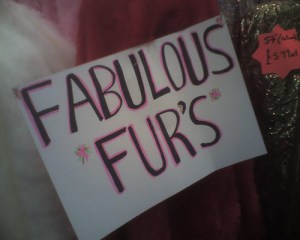
WHAT? The fabulous fur's WHAT?? (photo by Trevor Coultart)

Unfortunately, for people like Truss or myself, it’s all too easy to cross that line from being the person who appreciates a bit of order to that person who writes letters to the editor because some headline writer used a colon where a semicolon would do. And I’ve seen internet flame wars go wild over this pro- or de- divide. People who could politely disagree with each other about Sarah Palin’s international policy experience will find themselves screaming bloody murder over whether or not you should put two spaces after a period.

What has to be remembered is this: there are rules to language, like it or not. Those rules, however, change, and no single one of us has any power to impel or obstruct that change. The best we can do is to make sure we are writing with clarity and precision so that our intended audience understands our thoughts with the least amount of effort on their part. Regardless of what you think of the rules, if the reader has to stop and ask herself, “Wait, what did he say?” then you have failed. So learn the rules. Once you’ve learned them, you’re free to do what you wish, but make sure you have them down cold.

So, if you’ve always wanted to know about how to use a semicolon, or you’re not sure if your commas are in the right place, or if you’ve ever driven someone to madness by dropping an apostrophe into a possessive “its” – and you know who you are – then this book is the one you need. Enjoy.

——————————————
“Using the apostrophe correctly is a mere negative proof: it tells the world you are not a thicko.”
Lynne Truss, Eats, Shoots and Leaves

Lynne Truss on Wikipedia
Eats, Shoots & Leaves on Wikipedia
Eats, Shoots & Leaves on Amazon.com
Lynne Truss’ homepage

24 Comments

Filed under humor, language, Lynne Truss, nonfiction, punctuation

Review 105: Reaper Man

Reaper Man by Terry Pratchett

So. What are your thoughts on death?

Or rather, Death?

It’s a weird thing, death. I mean, you’re here one minute and then you’re… not. And while we all know intellectually that we’re going to die, there’s something in us that refuses to believe that the essential Person that we are could possibly cease to exist. We have personalities, unique aggregations of memory and experience and inborn preferences that all display themselves as a Person, as far as we know unique in all the world. Each human being is an entity that will never be seen again in this universe, and as far as we know, the cessation of life brings that entity to an end, reducing the person we knew to a mere insentiate object.

Is it any wonder we come up with stories for what happens… y’know, after?

Just about very culture that’s ever been has come up with some form of afterlife, be it an eternal feast for heroes, a paradise in which we can bask in God’s glory, a place of exquisite pain and torment, or a ticket back to Earth for another go ’round. There is no way of knowing if any of those are actually what happens to us when we die. At least not until we actually do it. So since we cannot know, we make stuff up, if only to make the whole thing easier to bear.

What often goes with that other world is someone to take us over. A ferryman or a guide, someone who knows the territory and knows where we need to go in what is very likely a rather confusing time. It’s another piece of comfort – knowing that there’s Someone out there who knows where we need to go and what we need to do.

Grim indeed.... (photo by provia_17)

Which brings us to Death.


He’s been portrayed many ways over the years – my favorite is the Death from Neil Gaiman’s Sandman series – a sort of older sister who’s known you all your life and loves you anyway. If she shows up for me when I die, I think I’ll be okay.

I would be just as happy with Pratchett’s Death, even though he is the more traditional robes-scythe-and-skeleton type. Fans of Discworld love Death, which I imagine was somewhat baffling for Pratchett early on. In the first few books, Death was a bit character – he showed up a couple of times to collect the recently deceased, and that was it. But his scenes were so memorable and so good that they sometimes stuck out above the rest of the book. He speaks entirely in capital letters, which lends him a voice that is probably reminiscent of James Earl Jones. He’s aloof, but not uncaring, and seems to take a rather curious interest in humanity. He likes cats, has a house off on the edge of nowhere, and rides a great white steed named Binky. Death has become, in short, an interesting person.

And it seems that’s a problem.

The Universe, you see, is a finely tuned instrument, one which needs monitoring and, occasionally, adjusting. There are… let’s call them Auditors, who make sure that reality stays real – no odd deviations or anomolies such as, for example, anthropomorphic personifications of natural forces. In all honesty, they would eliminate all life if they could, but that is, as yet, beyond their capabilities. So they settle for telling Death that it’s time for him to retire. He gets a little hourglass all his own, and time to kill until the new Death comes into being.

Heya Tom, it's Bob - from the office down the hall... (photo by Scott Beale)

In the interim, this time between Deaths, a new problem arises: nothing is dying. Or, to be more specific, things are dying, but the vital energies that empowered everything, from cabbages to clergymen, aren’t being taken away. Without a Death to handle this very vital – so to speak – function, the life energy is looking for a place to go, an outlet. As a result, things that shouldn’t be alive are up and moving around. In some cases this means objects running along of their own accord, and in others it means that the dead simply have nowhere to go.

Such is the case with the wizard Windle Poons. After 130 years at the Unseen University, he was rather looking forward to a nice rest and then a bit of reincarnation as a woman in a far more liberal society. What he got instead was nothingness. Given that option, he went back to his body and became Undead, much to the consternation of the rest of the UU faculty. Unfortunately for them, they have bigger things to worry about – the buildup of life force is having a rather larger and more dangerous effect on the city of Ankh-Morpork itself. The lack of a Death may well doom the city in a manner that will be horribly familiar to many of Pratchett’s readers.

And where is Death in all this, or at least the person who used to be Death? He has found a small farm below the famous Ramtop Mountains. An old maid, Miss Flitworth, needs a hand and Death needs a way to spend his time – something he’s never had to worry about before. He takes the alias Bill Door and starts to learn what it means to be alive, despite the short time he has left.

"What can the harvest hope for if not the care of the reaper man?" (art by Andrew Mar)

The book, as you might imagine, is all about being alive. What makes life special and precious and ultimately worth living. Windle Poons let life go past while he grew old behind the university walls, and it is only in death that he finds out all that fun he’d missed. Bill Door learns that it is the fragility of life, and its most certain end, which ultimately gives it meaning. In the middle, we see that everything that can live yearns to do so, from the mayflies to the great Counting Pines to cities to ideas.


While the book gives no answers to what may happen after death (the Discworld books rarely do), it does give us another way to look at life. And that, ultimately, is the goal of any great story.

——————————————————
“Huh! Priests! They’re all the same. Always telling you that you’re going to live again after you’re dead, but you just try it and see the look on their faces!”
Reg Shoe, Reaper Man

Discworld on Wikipedia
Reaper Man on Wikipedia
Death on Wikipedia
Terry Pratchett on Wikipedia
Reaper Man on Amazon.com
Terry Pratchett’s official site

1 Comment

Filed under afterlife, death, Discworld, existentialism, fantasy, finitude, humor, Terry Pratchett, wizardry, zombies

Review 104: The Long Dark Tea-Time of the Soul

Remember – go and take the listener survey! The gods command you!)

The Long Dark Tea-Time of the Soul by Douglas Adams

This is the second of the Dirk Gently books – and the final one – and is no easier to explain than the first. But I’ll try.

Ah, just like college.... (photo by Gene Han)

In this story, Dirk is contracted to meet a client one morning at 6 AM, and play bodyguard. The time is vital. The client has made it a point that Dirk absolutely, positively has to be there by six, and he’s willing to pay handsomely for it. So when Dirk wakes up at 11 AM, he suspects that he’s screwed up royally.

His suspicions are confirmed when he arrives at the home of his client, who is sitting quite comfortably in an armchair while his head is rotating slowly on a nearby turntable. The only clues to his grisly demise are his ravings about a green, scythe-wielding monster and a mysterious packet of papers, written in a language that Dirk cannot begin to understand. But he does know their shape – they’re a bill. But for what services, and rendered by whom? So now Dirk has to figure out who, or what, did this to his client and why.

But there’s more to this story (isn’t there always?) An American woman, Kate Schechter, is one of the survivors of the explosion of an airline ticket counter, something that everyone who knows about explosions is calling an “act of god.” But which god would do such a thing, and why? Lucky for her, Kate is about to find out, and she’s also about to find out why gods aren’t quite all they’re cracked up to be.

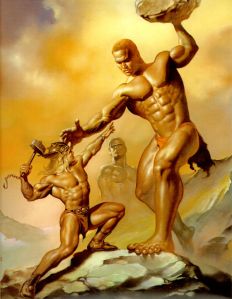
This, of course, does not happen in the book. I needed a picture of Thor that wasn't the super-hero.... (art by Boris Vallejo)

There aren’t a lot of greater themes in this book – it’s an adventure, of sorts, but as far as overarching messages go, it’s pretty thin other than watch out for eagles and be nice to homeless people. It’s entertainment as only Douglas Adams can deliver it. There is some thought given to gods, however, which is a topic I always enjoy. In Small Gods, Terry Pratchett asks where gods come from, and what sustains them. In American Gods, Neil Gaiman asked the question of what happened to gods who were brought to America by their believers. Adams asks what happens to gods once we don’t actually need them anymore.

We made them, after all, and most of the time we made them immortal. We needed gods to be bigger than we, stronger than we, and generally everything we weren’t. And then we went around infusing them with humanity – with jealousy, courage, rage and fear. When we were done with them, we let them go. But that didn’t mean they went away. An immortal is an immortal, and without work to do or followers to deal with, what is a god to do? In the case of Odin, the father of gods and the ruler of the Norse pantheon, the solution is very simple. What’s more, it keeps him pampered and cared for, which is all he ever really wanted.

While I love Hitchhiker’s Guide first and foremost among Adams’ works, I really wish he could have lived to write more Dirk Gently books. The character is a person of reprehensible ethics and somewhat tarnished morals, but you can’t help but love him. Lurking refrigerators, coffee-thievery and all, you find yourself wishing that you could hang out with Dirk, while at the same time knowing that he’d probably invite you out for lunch and somehow make you pay for the meal. He’s a bad person, but an excellent detective – and a great character.

So pick this one up and give it a read. It’s fast, it’s fun – you won’t regret it.

————————————————
“Nobleness was one word for making a fuss about the trivial inevitabilities of life, but there were others.”
Douglas Adams, The Long Dark Tea-Time of the Soul

The Long Dark Tea-Time of the Soul on Wikipedia
Douglas Adams on Wikipedia
The Long Dark Tea-Time of the Soul on Amazon.com
The Douglas Adams Homepage

1 Comment

Filed under detective fiction, Douglas Adams, fantasy, fiction, gods, humor

Review 102: Dave Barry Does Japan

(Just a reminder – take the listener survey! Or I will be forced to do the honorable thing and disembowel myself to rid my family of the shame….)

Dave Barry Does Japan by Dave Barry

In September of 2008, I went to Hiroshima with The Boyfriend. I knew it would be a more serious place to visit than a lot of the other places I’ve been to in Japan, for obvious reasons, and as I thought about it, I remembered this book. You see, while Dave Barry is enormously funny, and I always have a hard time holding in my laughter when he writes, he also knows exactly when to turn off the funny and talk seriously about a topic. Such was the case with this book, and the chapter on visiting Hiroshima.

Oh, how I wish he were.... (photo by me)

But I’ll get to that later. Let me start by saying that yes, this is a very funny book, as so many of his books are. I can only imagine, though, how funny it is to someone who’s never been to Japan, much less lived there. I’ll bet that, while reading some of the more ridiculous examples of how different Japan is from the US, a lot of readers were thinking, “No, it can’t be that weird. He must be exaggerating for comic effect.”


No, no he’s not. Not in the least. Well, some, yes, because that’s his job, but all of the things that he points out as being “strange” about Japan – the ubiquitous vending machines, rockabillies dancing very seriously in a circle, kids practicing their English with strangers, plastic food shops, all of it is absolutely true. He is not, in fact, making this up.

Literacy is not vital to eating (photo by xeeliz)

He says at the beginning of the book, “So this book is not authoritative. If you want authoritative, go buy a real book.” At no point does he claim to be an expert on Japan, or that spending three weeks here would make him one. In fact, the main aspect he plays on is his eternal cluelessness. As he points out, Japan is like one big, very exclusive club into which you must be born if you want to become a member. There are rules that no outsider can ever really learn, much less on a three week whirlwind tour. There are people who try – there are a lot of foreign-born residents in this country who do their best to live according to the rules, but no matter how hard we try, we’ll never really become members of Club Japan. So, Barry just decides to do his best and try not to make himself look completely stupid.

He marginally succeeds, which is good – otherwise there would be no book.

Kneel-down comedy. (photo by Norimutsu Nogami)

With his family, Barry goes from Tokyo to Kyoto to Kyushu and back again, stopping to see temples and shrines, sumo, ceremonies, kabuki, rakugo and car factories, among other things. Through it all, they do their best to adapt to the strangeness of Japanese life and Japanese food, and he comes out with some wonderful stories that had me cackling on the bus ride down to Hiroshima.

Which I believe I mentioned before.

It’s an interesting chapter in the book. The chapter itself is flanked by two grey pages – a signal to the reader that this is a no-funny zone. There will be no jokes between these pages, and rightfully so. Barry and his family went there on the anniversary of the bombing, August 6th, and observed the Peace Ceremony. They looked at the statues and the monuments and the dome, and went to the museum, and came out with an enormous sense of… conflict.

There is no question in anyone’s mind that what happened in Hiroshima – and Nagasaki – was horrific. All you have to do is read the testimonials, look at the photos and the drawings in the museum, look at the charred and burned school uniforms, pieces of flesh on display, dioramas of the flattened city and you know that the nuclear bomb is nothing that you can really joke about. Hundreds of thousands of people died because of those bombs, and not all of them died right away. Soldiers, yes -Hiroshima has a history as a military city – but babies, students, innocent men and women also perished in fire, blast, trauma and, of course, the long, lingering death of radiation sickness.

No city deserves that. Ever.

Not all that funny, really.... (photo by me)

At the same time, Barry feels that the bombing is presented without context, and he’s not the only one to think so. From what he could see, it looks like America just decided to do this horrible thing, and there’s not sufficient explanation to visitors as to why this was done. What would make a supposedly civilized nation do such a patently evil thing to so many people?

It’s very hard to justify what was done. I know the arguments – that Japan was training civilians to defend the home islands to the death, that millions more might have died in a long, drawn-out battle, that the Soviets were ready to swoop in and take over – but all those justifications kind of sound hollow when you see the photographs of people with fifth-degree burns, and read about the thousands of children who were orphaned in a fraction of a second. To those leaders, however, at that time, the dropping of those bombs was a necessary option, and I don’t think even they knew how bad the effects would be.

Regardless, the bombs were not dropped capriciously. They were dropped following a long chain of events, decisions and ambitions that reached back decades. And I think I agree with Barry that more attention should be paid not only to the aftermath of the bombing, but also to what led up to it. Maybe just because I don’t want my country to look like a monster.

This country is even weirder than he thinks. (photo by me)

Anyway, the Hiroshima chapter aside, it really is a very funny book. Even funnier if you’ve ever been to or lived in Japan. It’s not the kind of book you buy if you’re actually interested in learning about Japan, but if you want some good laughs, go for it.

————————————-
“Compared with the Japanese, the average American displays in communication all the subtlety of Harpo hitting Zeppo with a dead chicken.”
-Dave Barry, Dave Barry Does Japan

Dave Barry on Wikipedia
The Dave Barry Website
Dave Barry Does Japan on Amazon.com

Leave a comment

Filed under Dave Barry, Hiroshima, humor, Japan, travel, war