Category Archives: fantasy

Books that are in the “fantasy” genre.

Review 17: The Stand

The Stand by Stephen King

It’s hard to know where to begin when writing about this book, probably because I work under the assumption that everyone has read it. I mean,. I’ve probably owned at least four different copies over the years, and it occupies a permanent place on my bookshelf. I can’t imagine anyone not having read it. But I guess that’s what everyone thinks about their favorite books, so I’ll fill in those of you who haven’t.

It’s the end of the world. Not in the horrible confluence of blindness and carnivorous plants, or in the fiery desolation of nuclear war. The world dies in a more unpleasant way than that, and it all begins in Project Blue – a US military lab in the southwest. There they’ve built the greatest plague mankind has ever known, a shapeshifting flu virus that is 99.4% communicable and 100% lethal. Its intended use was probably against the Soviets or some other enemy state, but… Things fall apart, the center cannot hold, as Yeats said. And on June 13th, 1990, the superflu got out.

It was carried by Charles Campion and his family, spread throughout the southwest until Campion died in a gas station in Arnette, Texas. From there it hopped into the men gathered at the station, who passed it on to nearly everyone they met.

By June 27th, most of America was dead. And thanks to the final command of the man in charge of Project Blue, the virus was spread around the world as well. By Independence Day, the population of the world – that which by some strange genetic luck was immune – was reduced to less than the pre-plague population of California.

Of course, not everyone who was immune escaped unscathed. There were accidents, mishaps and murders that probably brought the number down, but not by much. Scattered survivors struggled to understand why they lived when so many had died, and started to seek out others like them.

And then came the dreams. An ancient woman, living in a cornfield. She radiates goodness and compassion (and still makes her own biscuits). Mother Abagail is the beacon of hope for those who see her in their dreams. And then there’s the other, the Dark Man, the Walkin’ Dude, whose shadow brings madness and whose gaze brings death. He is Randall Flagg, a man whose time has come ’round at last. Just as Mother Abagail attracts the good and strong, so does Flagg attract the weak and frightened. Around these two do the remains of America come together. And neither one can let the other exist without a fight….

What keeps bringing me back to this book? Well, a lot of things. For one, the writing. King has said that he’s a little disturbed about The Stand being the fans’ favorite – it means he did his best work thirty years ago. Not entirely true, I think, although I am hard pressed to say which of his other books exceeds it. King’s sense of scale as a writer is outstanding. We get into our characters dreams, in their innermost secret thoughts, and then a few pages later are presented with an overview of what’s happening around the nation. It’s like being able to go, in Google Maps, from someone’s bedroom all the way out into space. He dances between characters smoothly, so just when you get to the point where you’re thinking, ‘Yeah, but what’s Flagg doing?” he brings you there.

And speaking of the characters, they’re people who will stay with you long after you finish the book. The quiet confidence of Stu Redman, the single-minded madness of the Trashcan Man, Larry Underwood’s late maturity, Lloyd Henreid’s devotion, Fran Goldsmith’s determination…. Each character rings true. Even the ones who really shouldn’t have ended up the way they did – and I’m thinking of Harold and Nadine here – you can’t help but find bits of them to love. Had they been strong enough, Harold and Nadine never would have gone as bad as they did, and I think even King kind of had a hard time making them do what he wanted.

Underlying all this, of course, is a kind of Old Testament religiosity. The God of Mother Abigail is not the kind and friendly God of the New Testament, He is the angry one of the Old. He is the God who will gladly wipe out nearly all of mankind to prove a point, and will make a 108 year-old woman walk into the desert by herself because she’s getting a little too uppity. In this world, at least, God is most definitely real, even though His purpose is hard to understand.

I could go on. Thesis papers could probably be written about this book, and I reckon they already have been. But that’s not why I do these reviews. I do them because I want y’all to know what’s worth reading.

This book is worth reading.

——————————————-
“Show me a man or a woman alone and I’ll show you a saint. Give me two and they’ll fall in love. Give me three and they’ll invent the charming thing we call ‘society’. Give me four and they’ll build a pyramid. Give me five and they’ll make one an outcast. Give me six and they’ll reinvent prejudice. Give me seven and in seven years they’ll reinvent warfare. Man may have been made in the image of God, but human society was made in the image of His opposite number, and is always trying to get back home.”
– Glen Bateman, The Stand
——————————————-

The Stand at Wikipedia
Stephen King at Wikipedia
The Stand at Amazon.com

1 Comment

Filed under apocalypse, death, disease, fantasy, good and evil, horror, made into movies, society, Stephen King, survival, war

Review 16: Watership Down

Watership Down by Richard Adams

This is one of my top five books. Whenever anyone asks me, “What is your favorite book?” this is at or near the top. It was the first adult-length book I read when I was in Elementary school, and I have every intention of getting my hands on a copy for my goddaughter at some point soon. I remember watching the movie when they used to show it annually on CBS, way back in those days beyond recall….

Why should this book, of all the books I’ve ever read in my life, stay so dear to me? I have no idea. Perhaps because, even though its main characters are rabbits, it isn’t a “talking animals” book. Adams didn’t talk down to his readers, and assumed that they were ready to follow Hazel and Fiver wherever they went. And so, unusually for children’s literature, there is violence and loss and true danger in this book. Characters die. Unpleasantly. The rabbits live in fear of mankind and the Thousand, and accomplish great things despite. They do what no rabbit had done before, and find a new world for themselves. And, of course, are forced to fight for it.

Our heroes, you see, are living an idyllic life in a warren in England. They do what rabbits do – eat, sleep, mate, and entertain themselves. But one rabbit, Fiver, can see more clearly than others. He can sense danger, and grasp the shape of the future, and he knows that any rabbit who stays where they are will certainly die. With his brother, Hazel, Fiver and a small group of rabbits leave their home.

They do what rabbits never do – they explore. They go through dense woods and cross streams. They hide among gardens and search for the best place they can find to set up their new warren – a safe place, high in the hills, where they can see all around and the ground is dry. They seek to build a new society, as so many humans have done in our history.

And what’s more, they try to build the best society that they can. The need leadership, yes, but how much? How much freedom should the ordinary rabbit have to live its life? This question becomes more and more important when they meet the cruel General Woundwort, de facto leader of the warren known as Efrafa.

The battle that they have, choosing between personal liberty and the safety of the warren, is emblematic of so many struggles that have gone on in our world, and continue today. Through a tale about rabbits, Adams manages to tell us about ourselves, which is the mark of a great writer.

As cynical as I have become in my years, I still find this story to be honest and true. Adams isn’t trying to make an allegory or grind an axe. He’s trying to tell a good story about hope and perseverance and triumph over adversity, a story with – as Tolkien put it, “applicability” – that we can overlay onto our own lives and experiences. The fact that the main characters are rabbits is incidental.

Well, not really. Another layer to this story is the culture that Adams has created. The stories of Frith and El-ahrairah (which, I’ve just noticed, is misprinted on the first page of the contents in this edition as “El-ahrairah.” Weird) are sometimes deep and meaningful, sometimes fun and silly, but always relevant and rich, in the tradition of oral storytelling. There is a language to the rabbits, which is regularly used throughout the book (and one complete sentence in lapine – Silflay hraka u embleer rah. Memorable….) Adams did a lot of research into the social structure of rabbits and their lifestyles, making it as accurate is it could be….

Anyway, every young person should read this. Hell, older people should read it too. Every time I read the story, it moves me. I can hear the voices of the characters clearly and see what they see. I am inspired by the steadfastness of Hazel, the strength of Bigwig and the resolve of Blackavar. I find qualities in these characters that I would like to possess, and that’s as good a reason as any to love a book.

As a side note, this book is the reason I got into Magic: The Gathering way back in college. For a long time, I thought it was just a stupid card game, with no cultural or imaginative merit. Then I happened across a “Thunder Spirit” card, which had a quote from Watership Down at the bottom:

“It was full of fire and smoke and light and…it drove between us and the Efrafans like a thousand thunderstorms with lightning.”

Still gives me goosebumps.

Anyway, I thought, “Maybe there’s something to this,” and the rest was (very expensive) history….

——————————————-
“All the world will be your enemy, Prince with a Thousand Enemies. And whenever they catch you, they will kill you. But first, they must catch you, digger, listener, runner. Prince with a swift warning. Be cunning and your people will never be destroyed.”
– Frith, Watership Down
——————————————-

Watership Down at Wikipedia
Richard Adams at Wikipedia
Watership Down at Amazon.com

1 Comment

Filed under adventure, England, fantasy, made into movies, rabbits, Richard Adams, survival, totalitarianism, travel, war, young adult

Review 09: The Man Who was Thursday


The Man Who was Thursday by G.K. Chesterton

I lost my backpack thanks to this book.

It was years and years ago, probably my first winter in Japan, and I’d picked up this book at Maruzen. I had heard about Chesterton, mainly from the dedication page of Pratchett and Gaiman’s Good Omens (“The authors would like to join the demon Crowley in dedicating this book to the memory of G.K. Chesterton. A man who knew what was going on.”) and the title looked weird enough to be entertaining. So, I was reading the book on the train, as I often do, and I had my backpack on the floor between my feet. When the train got to my station, I stood up, still reading, and walked off.

It wasn’t until I had to put the book down again to eat that I realized I no longer had my backpack.

This was no small problem, either – the bag had a lot of important stuff in it, not the least of which was my Palm Pilot with all my friends’ addresses on it. There were also about two dozen Christmas cards in there, along with other various and sundry things. And it was a good bag, too.

Long story short (too late), I never got the bag back. The staff at my school, and even one of the students, were kind enough to call the Keihan lost & found a few times to see if anyone had turned it in, but with no luck. And whoever got it didn’t do the obvious thing and look at the return address on every single one of those Christmas cards, nooo….

Ahem. I’m over it. Really.

My point is this: beware the seductive power of this book. Beware the enchantments laid upon it, and the dreamlike web that it weaves. For if you let it, this book will enrapture you, and gods help you if that happens.

The story is one that sucks you in almost from the first page, when two passionate poets argue the worth and detriment of society. Should it be torn down, and let chaos reign in the world? Is order the true glory of humanity, the crowning jewel of mankind? Should the existing paradigm be praised or destroyed, and is he who advocates the path of anarchy true to that path?

From that moment, that confrontation of poet-philosophers, we are drawn into a dark heart of true anarchy, where no one can be trusted to be who he appears to be. And not even the protagonist himself can be absolutely sure where his path will end.

Needless to say, I think this book was awesome on many levels. The whole thing reads like a dream, moving in and out of locales with odd fluidity, and it’s honestly hard to put it down. It has a great cast of characters, each one distinct and interesting and worth your attention, and a great ending that, while not making a whole lot of sense, is entirely fitting.

What’s really interesting is the modern applicability of this story. Its major theme is that of law versus anarchy, and when Chesterton wrote this back one hundred years ago in 1908 the anarchist movement was seen as a real threat. These people were not the angry kids, spray-painting Anarchy signs all over the place and listening to punk rock. The fringe radicals of the Anarchist movement advocated violence. They liked dynamite and struck terror in the hearts of the citizenry, much in the way that terrorists still do today. And like modern terrorists, they were driven by a twisted and dark ideology which placed their own motivations above society. In the world that Chesterton has made, the Law is in a perpetual battle with the forces of chaos, the dark and shadowy enemies who are always out to destroy us.

Sound familiar?

The hunt for terrorists is a great plot for any writer, and hundreds of them – good and bad – have used this trope as a way of telling a story. Chesterton, however, reached into the heart of that idea and found the uneasy twist that we are not always willing to deal with. He found the Nietzschean paradox about what happens when you battle monsters, and saw that it could very well be true. He has shown us that it is dangerous to act without knowing the truth, even if the truth isn’t what you want it to be.

Neil and Terry were right – Chesterton knew what was going on. This book is just as relevant today as it was a century ago, even if Chesterton never meant it to be. No matter what the subtitle to the book may be, and no matter how he may have meant it, the book is still valuable to us. Well worth reading.

——————————————-
“Blessed are they who did not see,
But, being blind, believed.”
– from the Dedication, The Man Who was Thursday
——————————————-

G.K. Chesterton at Wikipedia
The Man Who was Thursday full text at Wikisource
The Man Who was Thursday at Wikipedia
The Man Who was Thursday at Wikiquote
Mercury Radio dramatization of The Man Who was Thursday (direct mp3 link)
The Man Who was Thursday at Librivox
The Man Who was Thursday at Amazon.com

Leave a comment

Filed under anarchy, classics, fantasy, fiction, G.K. Chesterton

Review 06: Small Gods

Small Gods by Terry Pratchett

This was the first Pratchett book I read, and I’m glad of it. While it has the humor and satire that is inherent in all of the Discworld books, it also has something else – something to say. It was evident, even from the first time I read this book, that Pratchett had put some real heavy thinking into it.

This book is, as the title suggests, about gods. Where do they come from? Where do they go? What keeps them moving? Ordinarily, gods don’t like this sort of question. People who think are not what gods look for in followers. Gods want people who believe. That’s where their power comes from. Gods with many believers are strong, great gods. Armies of priests and worshipers attend to their every needs, the sacrifices are plentiful and their dominion is vast. A great God wants for nothing.

A god with no believers, however, is a small god, a mindless thought blistering through the firmament, searching with single-minded fervor for one thing: a believer.

What happens, then, when a Great God finds out that, while he wasn’t looking, he lost all of his believers? That’s the thrust of this tale, the story of the Great God Om and how he became a tortoise for three years. It’s about the difference between what is real and what is believed in, and how much difference that can make at times. It’s about fundamental and trivial truths, and how to tell them apart. It’s about eagles and tortoises and how much they need each other.

Above all, it’s something of, in my opinion, a statement of faith. Many people ask me if I am religious, and I tell them no. That’s partly due to this book and the thinking that it made me do. Spiritual? Sure. Religious? No.

This is, as I said, the story of the Great God Om, who discovered, about 300 feet above the ground, that he had been a tortoise for the last three years. Before this mid-air revelation he had been just chewing at melons and wondering where the next lettuce patch was. Suddenly, all the self-awareness of a Great God was put into his head, as well as the knowledge that he was probably about to die. Om had intended to manifest as a bull or a pillar of fire – something much more majestic and Godly – but for some reason, that hadn’t worked. He had become a tortoise.

Now, in the presence of Brutha, a novice in the Church of the Great God Om, the god remembers who he was, and discovers that he’s in a lot of trouble.

The Church of the Great God Om. There’s something to talk about. Many people believe, upon reading it, that it’s an allegory for the Catholic Church in the Middle Ages. The Omnian Church permits no heresy. It permits no sin, no disbelief. Violating the precepts of Om and His Prophets can lead to death, in a lingering and painful manner. The Quisition cannot be wrong, for was it not Om Himself who put suspicion into their minds? It’s a tactic that has been used by many religions over the years, often to justify acts that they know their god would not approve of.

I don’t believe that Pratchett was trying to take a stab at the Catholics in this book. It’s just an unfortunate coincidence that the Omnians and the Catholics bear a few points of similarity. A rigid hierarchy, for example. A penchant at one point or another for extracting confessions by any means necessary is another. It’s all very efficient and effective.

There’s a problem, though, as is pointed out by Brutha late in the book: if you beat a donkey with a stick long enough, the stick becomes all that the donkey believes in. At that point, neither gods nor believers benefit. The only people benefiting are those wielding the stick. Instead of becoming a tool for inspiration, the church becomes a tool for terror. People do not obey their god out of love – they obey their church out of fear.

This is the kind of church that could produce the Deacon Vorbis, head of the Exquisitors. He is one of those men who would turn the world on its back, just to see what would happen. He is everything that is wrong with the Church and, unfortunately, it seems that he is in line to be the Eighth Prophet.

In other words, Omnia is not a nice place to live. Its church is vast, its god is small, and neighboring nations want to take it down a few pegs. It’s up to Brutha and his God to change the course of history.

As I said, there was a lot of thought put into this novel, as well as Pratchett’s usual hidden research. For example, Brutha is called a “Great dumb ox” by his classmates, due to his size and apparent lack of intellect. The same epithet was thrown at Thomas Aquinas by his classmates, and he was canonized less than a century after his death. Like Aquinas, Brutha is not dumb. He is simply slow and careful in how he thinks, and his measured pace leads him far more surely to the truth than the hot-headed and passionate men who march with him.

Some people read this book as an attack on religion. Others see it as a defense of personal faith. I think Terry had a story to tell, and perhaps a point to make. The beauty of books such as these is that they can be whatever you want them to be. For me, it came as a kind of defense of gods. Humans, the book suggests, need gods. Now there is a growing atheist community out there who disagree with that idea, and I can definitely see where they’re coming from. As I’ve said many times, I’m not entirely sold on the god idea yet. But the gods that are rampant in the Discworld aren’t the kinds of gods that the atheists and the true believers fight over – the omnipotent creator of Everything. They are gods who are controlled by humans, who exist with humans in a kind of co-dependent relationship. Humans need gods, and gods need humans. In its way, this kind of theology makes gods more… realistic to me. I can’t say for sure whether a god or gods exist, but if they did, I think I could live with this kind of arrangement.

What this book definitely is, in any case, is good. Very good. If you haven’t read it, do so. If you have read it, do yourself a favor and read it again.

—————————————————
“Around the Godde there forms a Shelle of prayers and Ceremonies and Buildings and Priestes and Authority, until at Laste the Godde Dies.
Ande this maye notte be noticed.”
– from the writings of the philosopher Abraxis, Small Gods
—————————————————

Annotations for Small Gods
Small Gods at Wikipedia
Terry Pratchett’s page at HarperCollins
Terry Pratchett at Wikipedia
Small Gods at Wikiquote
Small Gods at Amazon.com

2 Comments

Filed under Discworld, fantasy, gods, humor, morality, religion, sins, Terry Pratchett, theology

Review 05: The Princess Bride


The Princess Bride by William Goldman

If you haven’t read this book, then all I can tell you is to go out, get it, and read it. Now. Don’t bother with the rest of this review, you’ll thank me later. It has:

Fencing.
Fighting.
Torture.
Poison.
True Love.
Hate.
Revenge.
Giants.
Hunters.
Good men.
Bad men.
Beautifulest ladies.
Snakes.
Spiders.
Beasts of all natures and descriptions.
Pain.
Death.
Brave men.
Coward men.
Strongest men.
Chases.
Escapes.
Lies.
Truths.
Passion.
Miracles.

For a start.

It’s one of the greatest love/action/revenge stories ever abridged by a modern author. Well, it seems that Mr. Goldman felt that the original story, as written by the immortal S. Morganstern, was a little too dry for public consumption, as well as damaging to treasured childhood memories, so he went through it and put together this “good parts” version, and the world is a better place for it. [1]

Of course, the big gag is that there never was an original version of the book. There never was an S. Morganstern, the greatest of the Florinese writers. Goldman’s father may have read books to him as a child, but he never read this book to him. The entire thing is a fiction, beginning to end, but Goldman sells it really well. He tells the tale of how he blossomed as a boy – going from being a sports-obsessed disappointment to a ravenous bookworm, all thanks to this book. He talks about trying to give the same gift to his son, who manages to make it through one chapter before giving up in exhaustion. He talks about the great shock of discovering that his father had done something utterly brilliant – he had skipped the dull bits and left the exciting parts intact.

Knowing that all of this is false certainly doesn’t detract from the story. It’s a story about a story, and the effect that a story can have on a young mind. Or any mind, for that matter. It’s about how stories can teach us lessons that only later we understand – such as how life is not fair – and how stories can change us in ways that we never expected. It’s about our relationship with fiction, and with the world around us. In his fictional childhood, Goldman learned more about the world from the process of watching the story unfold than he did from the story itself. And so this book is a story about stories. The actual story is just bonus.

Which brings me, of course, to the film. Let me say that this is one of the very, very few instances where I will put the movie up on par with the book. 99.9999 repeating percent of the time, the book is better than the movie. This is one instance where they are equal in nearly every measure. I’m sure a lot of this has to do with the fact that Goldman wrote the screenplay for the film, so not only is the story intact, but a great deal of the dialogue is almost verbatim from the book. It was gold in print and gold on the screen. The hardest part about reading the book is trying not to hear Andre the Giant, Christopher Guest, Robin Wright and all the other fine actors and actresses in your head as you read.

So, whether you read the book or see the movie, you’re in for a treat. And as you read, just remember the books that molded you into who you are today. Think about the stories that taught you life’s lessons before life got around to doing it. Think about them and appreciate them, and remember that every book is a lesson, one way or another….

————————————————
“I’m so stupid. Inigo has not lost to the man in black, he has defeated him. And to prove it he has put on all the man in black’s clothes and masks and hoods and boots and gained eighty pounds.”
– Fezzik, The Princess Bride
————————————————

[1] This is a fun type of meta-fiction, writers writing autobiographically about writing about books that never existed. I find it interesting that The Princess Bride can sit comfortably shoulder-to-shoulder with House of Leaves.

The Princess Bride at Wikipedia
William Goldman at Wikipedia
The Princess Bride at Wikiquote
The Princess Bride at Amazon.com

Leave a comment

Filed under adventure, fantasy, humor, made into movies, meta-fiction, romance, William Goldman

Review 04: Superman: Red Son


Superman: Red Son by Mark Millar, Dave Johnson, Kilian Plunkett, Andrew Robinson and Walden Wong

Every culture has its icons. Characters or figures that are recognizable by anybody who lives there, figures that are almost impossible not to know. And America is very good at producing those icons and spreading them worldwide. I remember reading somewhere – I don’t remember where at the moment – that the United States’ chief export is dreams, and I think there’s definitely something to that.

Of all the dreams to emerge from the American subconscious over the last century, Superman is one of the most enduring. Show that “S” shield to almost anyone on the planet and they’ll probably know what it is. For most of his lifetime, he has stood for Truth, Justice and the American Way, with the third element to that tag line slowly vanishing as writers with a more global perspective take over the character.

Regardless of his jingoistic past, Superman still remains a popular American figure. He represents what we would like to be, as a country. Powerful and just, upright and honest, but at the same time kind and generous and, at heart, good. Superman has the power to control the world, but he doesn’t – he chooses not to – and we like to believe that it was his small-town, American upbringing that instilled such humility in him.

This book examines how things might have gone.

In the late ’80s, DC Comics introduced their “Elseworlds” imprint, with a pretty simple mandate: take canon DC characters and place them in new situations or environments. This way you could see how Batman might have turned out in an America that had never gained its independence, or what would have happened to the JLA without Superman, or if The Flash had taken the bullet meant for JFK. It opened creative doors, allowing writers to tell new stories about familiar characters without disrupting the regular continuity of the DC Comics line.

Of these, Superman: Red Son is one of the best. Mark Millar poses a simple question with a very complex answer: What if young Kal-L’s rocket had landed in Soviet Ukraine instead of Kansas?

What emerges is a fascinating tale of a Superman brought up under Stalinist philosophy. Still the good man that we know him to be, Superman nonetheless chooses a very different means of interacting with the world. We see from the first few pages that the man cannot stand still – he is constantly in motion trying to save people, not just in the Soviet Union, but anywhere in the world. It is his responsibility, he believes, to keep people safe, much in the manner of Soviet philosophy where the government controls nearly every aspect of its citizens’ lives.

Taken in by Stalin, Superman eventually rises to lead the Soviet Union to nearly world-wide dominance. Under his rule there are no accidents, no wars and no conflicts. Crime is nearly non-existent, and those who do not mesh well in this well ordered world are mentally reprogrammed until they do. There are dissidents, of course, like the mysterious Batman, a singular force of chaos in Superman’s perfectly ordered world, but in the end, even he falls. The only true challenge to Superman’s worldwide reign is the brilliant American scientist Lex Luthor, who has devoted his life to freeing mankind from alien tyranny.

It’s a brilliant take on the myth, with a lot of very familiar characters worked in. The art is gorgeous, with a style and a color palette that evokes thoughts of Soviet-era propaganda posters, yet never fails to be dynamic and fascinating.

More important, however, is the message of the story. The idea that comics can have a message is something that a lot of people seem to ignore, fueling the idea that comics are just for kids. The message in Red Son is very important and very, very timely.

The story was published in 2003, a time when America was in great pain. We had been badly hurt and wanted to set things right. By doing so, however, we caused far more damage to the world than we had ourselves endured. By trying to fix other people’s problems, we created even more, and the harder we pushed, the more the world pushed back. And this was not a new trend – one of the negative labels often affixed to the United States is that of “world policeman.” We have a long, long habit of trying to help everyone, whether that is the right thing to do or not.

In that vein, the Superman of Red Son, despite being a Soviet, is a reflection of ourselves. He is a man of immense power, who decides to help everybody. His intentions are good, but good intentions are not always rewarded with good results. His world is orderly, yes – crime and violence are nearly unheard-of – but it comes at the price of individual freedom. People are no longer in control of their own destinies with Superman in charge, and while that may be a safe life, it is not one that I would like to live.

The political message of this book is subtle, but it’s there. More interestingly, it’s a message that can be enjoyed by a broad spectrum of political views. If you’re a liberal, then it’s taking a stance against imperialism, against the imposition of one country’s values and politics over others’, all in the name of making the world a better place. If you’re a conservative, it’s a call for individual liberty. A government that provides everything for its people is just another form of oppression – without the freedom to make their own choices, for good or for ill, people are not truly free.

In the end it’s a complex tale, with no real good guys and no real bad guys. Except for Brainiac, who will probably never be anything but a bad guy. It’s a story about the choices we make, both as citizens and as societies, and the understanding that we must have the freedom to make those choices. They may sometimes be the wrong ones, but making mistakes is part of the package. In the end, there can be no Superman to save us. We must save ourselves.

————————————————
“I care about everybody.
– Superman, Superman: Red Son
————————————————

DC Comics.com
Mark Millar on Wikipedia
Superman: Red Son on Wikipedia
Superman: Red Son on Amazon.com
Soviet Posters: Revolution by Design

Leave a comment

Filed under Batman, comic books, Dave Johnson, DC Comics, Elseworlds, ethics, fantasy, graphic novel, Mark Millar, morality, peace, super-heroes, Superman, totalitarianism, USSR

Review 02: A Series of Unfortunate Events 1 – The Bad Beginning


A Series of Unfortunate Events 1: The Bad Beginning by Lemony Snicket

I am not a violent man. In my lifetime, I have never been in a fight. I’ve never seriously threatened anyone with violence, never made anyone feel afraid by my physical presence, never even really seriously considered doing violence to another person.

Having said that, the feelings this book evoked in me were… violent.

Not because Lemony Snicket has written a book where terribly unfortunate things happen to small children – I have no problems with that and in fact encourage it; it builds character. I want to do violence towards Lemony Snicket because he’s a terrible writer who should never have been allowed to have his words put to paper. His pens should be broken, his notes burned, his hard drive wiped and, if possible, his writings should banned by an Act of Congress. The First Amendment can only go so far.

You may be wondering what has roused this level of bibliorage in me. By all accounts, this series is extremely popular, loved by many. On various book review websites, this book routinely gets at least four stars and high praise. It was even made into a movie starring Jim Carry, and if that’s not the Seal of Public Approval then I don’t know what is. It would seem that one of two things is true: Either I’m seriously overreacting to a tiny aspect of Snicket’s (AKA Daniel Handler’s) writing style or the rest of the world is full of blind ignoramuses who wouldn’t know decent writing if they woke up in bed with it after a bender in Vegas.

As a reviewer, I, of course, choose to believe the latter.

Snicket has taken what should be an entertaining story, filled with untimely death, physical violence, extortion, deception, and pedophilic overtones, and corrupted it by treating its audience like a bunch of drooling idiots.

I am, of course, referring to his habit of defining “difficult” words within the text, with no regard for the flow of the story or the necessity of the definition. For example:

Page 2: “…occasionally their parents gave them permission to take a rickety trolley – the word ‘rickety,’ you probably know, here means ‘unsteady’ or ‘likely to collapse’ – alone to the seashore….”

Page 13: “…over a dull dinner of boiled chicken, boiled potatoes and blanched – the word ‘blanched’ here means ‘boiled’ – string beans.”

Page 18: “‘Please get out of bed and get dressed,’ he said briskly. The word ‘briskly’ here means ‘quickly, so as to get the Baudelaire children to leave the house.'”

Page 44: “…the kitchen grew cozy as the sauce simmered, a culinary term which means ‘cooked over a low heat.'”

And so on.

There are a few occasions where a word is defined well, in context and occasionally in character, and I don’t mind those. But the constant shoehorning in of definitions made me want to take a sharpened number two pencil and work it under Mr. Snicket’s fingernails until he apologized sufficiently for being a hack.

I’ve gotten feedback from people who like this style, especially parents, who say that it saves them from having to put down the book and explain to the child what “blanched” means. Full disclosure: I am not a parent, nor am I likely to ever be one, but I think that teaching a child to figure things out for him or herself – or, god forbid, learn to use a dictionary – is part of what will make her or him grow up to be an inquisitive, intelligent adult. In my real job, teaching English as a foreign language, I find that my students are more likely to remember a word if I make them work for it, rather than if I just tell them what it means.

Let’s face it – if this book is written for adults, then the author should treat his readers like adults. If the book is written for children, which this ostensibly is, then the author has to choose whether to talk up or down to them. In a book where the main characters’ parents die before the first page and where the eldest daughter nearly becomes a child bride to her blood uncle, one would think the author has judged his audience mature enough to deal with these themes. If that’s so, then overtly defining “difficult” words is an insult to his readers, and that is unacceptable to me.

I am reminded of a passage in Terry Pratchett’s book, Wee Free Men, where the main character, a nine year old girl named Tiffany, asks an itinerant teacher about zoology:

“Zoology, eh? That’s a big word, isn’t it.”

“No, actually it isn’t,” said Tiffany. “Patronizing is a big word. Zoology is really quite short.”

I think Mr. Pratchett may have read Mr. Snicket’s book as well.

———————————————————-
“If you enjoy books with happy endings than you are better off reading some other book.”
– Lemony Snicket
———————————————————-

Lemony Snicket homepage
Lemony Snicket on Wikipedia
The Bad Beginning on Amazon.com

4 Comments

Filed under bad, children, death, fantasy, Lemony Snicket, made into movies, murder

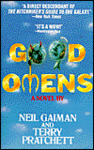
Review 01: Good Omens


Good Omens by Terry Pratchett and Neil Gaiman

For lovers of modern fantasy, there are two names that are on most people’s must-read lists: Terry Pratchett and Neil Gaiman.

At first glance, there doesn’t seem to be much in common with this pair. Terry Pratchett writes the world-renowned Discworld series, a fantasy epic set on a flat world, which is supported by four elephants, who in turn are standing on a great turtle which swims through the emptiness of space. What started as a parody of the “sword and sandals” genre of fantasy, Discworld has become a mirror for our world, taking familiar ideas and giving them a sharp twist.

Neil Gaiman, on the other hand, gained fame with his groundbreaking comic book – sorry, graphic novel – series, Sandman. Over seventy-five issues, packed with mythological retellings, Shakespearian inspiration, love, Death, family, heartbreak and redemption, Sandman is still considered to be one of the most literary comics of the modern age.

Despite these superficial differences, however, their shared love of a good story makes them perfect for each other. Like chocolate and peanut butter, steak and eggs, hydrogen and oxygen, when you put two great things together, you get something that’s even better.

This book is about the End of the World. It begins with a birth, that of the Adversary, Destroyer of Kings, Angel of the Bottomless Pit, Great Beast that is called Dragon, Prince of This World, Father of Lies, Spawn of Satan and Lord of Darkness.

Also known as Adam Young.

With his birth, the inexorable wheels of Revelation begin to turn, the Horsemen start their long ride, and two immortals – a demon named Crowley and an angel named Aziraphael – find themselves in the unenviable position of having to make sure everything works out the way their respective sides want. Rivers of blood, skies of fire and the scything clean of all life in the world, that kind of thing.

Crowley and Aziraphael, for their parts, really don’t want the world to end. They’ve been walking it since it began about 6,000 years ago, and found that they quite like it, for all its flaws and problems. And despite their innate loyalty to their masters, they’ll do their best to try and stop its end.

It’s an outstanding book, one of my top five of all time. Not only is it roaringly funny, with outstanding characters and witty dialogue, but it has the kind of razor-sharp insight into human nature that can only come from Gaiman and Pratchett. Ostensibly good people act like utter bastards, and people we know to be bad by their very natures end up doing the right thing. There’s no clear-cut line between good and evil here, which is perhaps a lot more realistic than most end-of-the-world stories go. Also, very few end-of-the-world stories are quite as funny as this one.

Humor can be used for many purposes, but the most noble use of humor is to illuminate truths that we routinely ignore. When you read this book, you think about God and the Devil and everything in between – namely, us. What is the purpose of humanity in this benighted world, and what is our responsibility towards it? These are all questions that the characters have to deal with, and, of course, so do we.

While neither Gaiman nor Pratchett would claim to have an answer to that, they have a great ability to point us towards the question.

As I said, this is one of my top five of all time. I think I own three copies by now – one that’s been read to death, a hardcover edition with that weird M-25 illustration on the front, and a softcover signed by both Neil and Terry. This is my Precious, and I hope it’s buried with me someday.

So, as you may have guessed, I can’t recommend this book enough.

And now, a quote from the book:

———————————————————-
“It may help to understand human affairs to be clear that most of the great triumphs and tragedies of history are caused, not by people being fundamentally good or fundamentally bad, but by people being fundamentally people. ”
– Terry Pratchett and Neil Gaiman, Good Omens
———————————————————-

Neil Gaiman’s homepage
Terry Pratchett’s page at HarperCollins
Terry Pratchett at Wikipedia
Neil Gaiman at Wikipedia
Good Omens at WikiQuote
Good Omens at Amazon.com

3 Comments

Filed under angels, antichrist, apocalypse, Christianity, demons, fantasy, humor, Neil Gaiman, Terry Pratchett