Monthly Archives: November 2012

Review 203: Winter’s Heart (Wheel of Time 09)

Wheel of Time 09: Winter’s Heart by Robert Jordan

Just a note – you may consider this spoilery. Continue at your own risk.

We are continuing on with the series, and once again there’s a lot going on in the Westlands (which is the much better alternative name to “Randland.”). In Caemlyn, Elayne Trakand is busy preparing to become the Queen of Andor, as the world still believes that her mother, Morgase, is dead. She’s not, of course. She became a refugee after the Seanchan attack on Amador, became a Lady’s maid to Faile and Perrin, and subsequently became a captive of the Shaido Aiel, along with Faile and Alliandre, the Queen of Ghealdan. Not a good day for them, seeing as how the Shaido have become the worst that everyone expects of Aiel – murderous, thieving and vicious. Perrin is trying to rescue his wife, of course, but that rescue is not certain. Faile and Morgase will have to figure it out for themselves.

But getting back to Elayne – in Andor, she undergoes the ceremony to become first-sister to Aviendha, the Aiel woman with whom she must eventually share Rand al’Thor’s affections. It’s a great scene, that – a very simple procedure, but deep and meaningful as well. And it suggests a custom that I appreciate very much, having had friends that I consider on par with family. Under the direction of the Wise Ones of the Aiel, you become bonded with your friend and re-born, in a way. Forever after that, you are considered siblings, just as if you had come from the same mother.

Not all sisters want to make your life better.

Having a new sister isn’t going to make things all work out, though – Elayne has to cement her claim to the throne, and deal with an army of Borderlanders who really want to know where Rand is. Why, we don’t know yet. But from the looks of it, it can’t be all that good.

Meanwhile, in Ebou Dar, Mat has reappeared after the injuries he took during the Seanchan invasion. Still wrapped around Queen Tylin’s finger, Mat is looking for a way to get himself out of the city without getting himself or anyone else killed. What this ends up meaning is that he has to escape the city with three Aes Sedai who have been leashed and collared to serve as living weapons for the Seanchan – a crime punishable by death.

The Seanchan are still an interesting player in this series, even if the battle scenes in the last book were kind of dull. They are the descendants of Artur Hawkwing’s armies, vanished across the sea a thousand years ago. Through a millennium of fighting both men and monsters, they have become a formidable military force, held together by the damane – women who can channel, but who are considered less than human for all that. Controlled by other women, sul’dam, the damane are the heart of Seanchan power. No conventional army can stand up to them, and if it weren’t for Rand and his Asha’man, they would have overrun the Westlands already.

(art by minniearts on DeviantArt)

They control Ebou Dar, of course, but they do it in a manner similar to the Romans. They don’t try to change the conquered people, or break them. All they require is an understanding that they are now living under Seanchan rule. Respect the new rulers, obey the laws, pay your taxes and life need not go on any differently. Cause trouble, though, and the hammer will come down on you. Hard.

Even though their military advances are being slowed down, though, their cultural invasion is proceeding. This is not a mission of conquest for them – it’s a homecoming. With the soldiers and damane are also coming farmers and weavers and blacksmiths – normal people who want to make a new life for themselves. With the Westlands practically empty as they are, the Seanchan will have no trouble finding places to live. Right in time for the Last Battle against the Dark One, of course, but they don’t know about that yet. Regardless of how things turn out, the Westlands will never be the same after this.

Rand al’Thor is on a mission of his own, one which involves a great deal of misdirection. After the attack on his person by renegade Asha’man – in which a chunk of the Sun Palace in Cairhien was destroyed and a lot of people died – Rand has decided that enough is enough. This whole “doomed to go mad” thing that comes part and parcel with being a male channeler of the Source has got to go. So yes, he’s decided to cleanse saidin of the Dark One’s taint, but not before taking a detour into the island city-state of Far Madding, to hunt down the men who nearly killed him.

What can I say – the story advances. The plotlines being what they are, we do miss out a bit in this book. Perrin’s hunt for his wife gets cut short, narrative-wise, and we hardly see anything at all of Egwene and the rebel Aes Sedai. This was, if I remember, really annoying when the book first came out. Reading them all at once, however, it’s easier to deal with, knowing that the next book will refocus on people who’ve been out of the spotlight for a while. The parts that did get the most page-time, however, were interesting and, for the most part, exciting to read. So, a step up from Path of Daggers.

—————————————————
“You can never know everything, and part of what you know is always wrong. Perhaps even the most important part. A portion of wisdom lies in knowing that. A portion of courage lies in going on anyway.”
– Lan Mandragoran, Winter’s Heart
————————————————–

Robert Jordan at Wikipedia
Robert Jordan at Tor.com
Winter’s Heart at Wikipedia
Wheel of Time at Wikipedia
Winter’s Heart at Amazon.com

Wheel of Time discussion and resources (spoilers galore):
Theoryland
Dragonmount
The Wheel of Time Re-read at Tor.com
The Wheel of Time FAQ
Wheel of Time at TVTropes.com


Leave a comment

Filed under adventure, epic fantasy, fantasy, Robert Jordan, war, Wheel of Time, wizardry

Review 202: Time Traveler

Time Traveler by Ronald Mallett, with Bruce Henderson

There are a lot of reasons to want to build a time machine. To learn the truth about historical places and events, to see creatures that have been extinct for millions of years, to kill Hitler – always a favorite. You could go to the Library of Alexandria and save the works of great scientists and philosophers that have been lost to history. You could document the Crucifixion or watch the fall of Rome first-hand. You could see Jimi or Elvis or Janice or Kurt in their heyday, watch the original performances of Shakespeare’s plays, or talk engineering with DaVinci. With a time machine, the whole of history is open to you, and your options are just about limitless.

All Ron Mallett wanted to do with his time machine was see his dad.

Mastering time travel is easier if you have several lifetimes.

This book is not just about how one man went about figuring out how to travel through time. That in itself would be interesting, since time travel has been a dream of mankind ever since we figured out that time was a thing. There’s a lot of complicated science that goes into not just manipulating time, but figuring out that it can be manipulated, and it takes half a lifetime to master. A lot of popular science books focus on the science, unsurprisingly, and talk about how certain things were discovered and what can be done with them in the future.

That’s all well and good, but this book adds an extra element that’s often missing from other popular science texts. It talks about why.

When Ron Mallett was ten years old, his father died of a heart attack brought about by a combination of smoking, poor dietary choices, and a genetic inclination towards heart problems. Overnight, the man that young Ron loved and idolized was gone, leaving him directionless at an age when having a father can be so very important. With the loss of a beloved parent, it’s entirely possible that Ron could have seen his life crippled from that day onward.

It might have been, if not for H.G. Wells and his famous book, The Time Machine.

After he read this book, the notion that time could be navigated became the center of his life. His first attempt at a time machine – built of pipes and wires in his basement – was unsuccessful, of course. But he was undeterred, and realized that if he was going to make this dream come true, he would have to buckle down and start learning some science. Just the idea that he might one day build a machine to travel through time was enough to give him direction and purpose, and it set him on a course that would go on to define his life.

If he manages to make this work, the UCONN Velociraptors will be unstoppable!

The book is a memoir of his own travels through the world of physics and relativity, moving from one point to another as new ideas and discoveries signposted his route towards a theory of time travel. Initially guided by Einstein, Mallett went from being a young academic to programming computers for the Air Force, to becoming a full-fledged academic at the University of Connecticut. He makes sure that the reader can not only follow all the steps that he took, but that we can also see why he took them. What chance encounters and lucky finds pushed him forward, or what unfortunate incidents slowed him down. He reminds us all throughout the book of why he has chosen to do science, and never lets us forget this motivation.

At the same time, he is sure to tell us about two rather significant obstacles to his progress. The first, of course, was that he felt he couldn’t be honest about why he was studying what he was studying – relativity, black holes, lasers, that kind of thing. For fear that he would be labeled a crackpot and denied the opportunities he would need, he revealed his ambition to build a time machine only to those he felt he could absolutely trust. As far as anyone else was concerned, of course, he was just another theoretical physicist trying to figure out how the universe worked.

The other challenge he faced was that he was African-American in a field that was very, very white at the time. He had to deal with racism in both its overt and covert forms, and work even harder to prove himself to those who couldn’t – or wouldn’t – see past his skin color. He doesn’t dwell on it in this book, since that’s not what this book is about. But I’m sure if he wanted to write about what it was like trying to break into physics academia as an African-American in the 60s and 70s, he probably could.

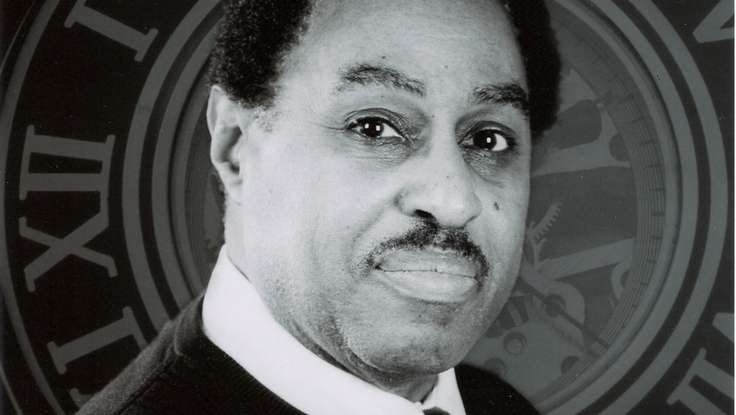
Ladies and gentlemen, the father of time travel.

What’s most important, though, is that he continually reminds us of why he’s doing what he’s doing. He talks about his father, and the memories he had of him. He keeps his non-academic life in view, letting us in on his personal triumphs and failures, his struggles with depression and his joys at advancing towards his goal. The end result is a book that is not only about science, but about a person. The emotional thread that runs through this book is strong, and even if you can’t quite follow the science, you can still follow the passion that Ron Mallett has for this project.

The book, while fascinating, is technically unfinished. He has yet to build his time machine, and there’s no proof that the ideas he’s come forward with will actually work, even if the math says they should. As the book finishes, he has a plan, and he lays out the way he thinks his machine should work, but we’ll have to wait to see how that works out. Whether he succeeds or fails, though, he has built up a lifetime of research that has expanded our understanding of space and time in such a way that Einstein – and Ron Mallett’s father – would no doubt be proud of.

——————
“Time stopped for me in the middle of the night on May 22, 1955.”
– Ron Mallett, “Time Traveler”
——————

Ron Mallett on Wikipedia
Time Traveler on Amazon.com
Ron Mallett’s UCONN homepage

Leave a comment

Filed under autobiography, nonfiction, physics, quest, Ron Mallett, school, time travel

Review 201: Unseen Academicals

Unseen Academicals by Terry Pratchett

Contrary to popular belief, I don’t hate sports.

I know this may come as a surprise, since I studiously avoid all but the most cursory acknowledgment of current sporting events. I finish the paper when I hit the sports section, and the sport report on the news is, for me, time to wash the dishes. I have no favorite teams of any kind, no players I look up to, and no interest in following play-offs, bowl games, championships or derbys. Hell, even with the Olympics my interest plummets after the opening ceremonies.

But I don’t hate sports.

You see, in order to hate something, you have to actually care about it. And that’s the thing about sports – I just don’t care.

There but for the grace of god go I…

I wasn’t always like this, of course. When I was a kid, I tried all kinds of sports. I tried (deep breath) baseball, basketball, skiing, swimming, sailing, soccer, tennis, golf and judo. And those were after school. In PE class we had all the usual PE things – volleyball, softball, track and field, running, archery, field hockey, dodgeball…. What it came down to was that I had no natural talent for sports [1] and, more importantly, I never had fun. I never saw the point of the whole thing, so I pretty much said “Bugger this,” and turned to other areas of entertainment, thereby sealing off the sporting world from my interest forever.

A lot of my friends do love their sports, though, so I try to keep a cursory understanding of things – you know, how many touchdowns there are in an inning, that kind of thing. I mean, there’s nothing more disappointing than trying to talk about something you love, something for which you have great passion and enthusiasm and having someone just ignore you, right?

RIGHT??

Anyway, I’m telling you all this so that you can correct for it when I tell you about Unseen Academicals, one of the latest of the Discworld books. If my attitude seems kind of lackluster or disinterested, keep in mind that it’s probably not Sir Terry’s fault.

The book, you see, is about football. Not the sissy-pants American kind where the guys are so afraid of grievous bodily harm that they wear protective armor all the time, but the good, old-fashioned British kind, wherein people get their heads cracked open by cobblestones and die on the streets. You know, fun for the whole family.

I believe the English refer to this as “a jolly good time.”

In the great and exciting city of Ankh-Morpork, footy is a tradition. It’s a lifestyle, in fact. Where you live determines who your team is, and who your team is tells you with whom you can associate and mingle. A supporter of one team wandering into the territory of another is a person asking to be beaten to death by enthusiastic and drunk hooligans. “Suicide,” I believe the police refer to it as. It’s a game that goes beyond the simple description of “rough and tumble.” It’s a substitute for war in a time where war is neither profitable nor productive. It’s a channel for long-standing feuds and grudges and aggressions, and is practiced religiously in the streets of the city every weekend.

So obviously what this grand, injurious tradition needs, then, is the introduction of wizardry.

The wizards of the Unseen University are forced, through a clause in a long-forgotten honorarium, to put together a football team and play a match. Despite most wizards having the athletic ability of an overstuffed beanbag chair, it’s either play the game or lose so much money that they’ll have to cut down to only three meals a day. So, with the help of the son of one of the greatest footballers in the city’s history, two cooks from the Night Kitchen and a young Orc who is trying to find value in his life, they put together a team and oh gods, I’m bored already.

Seriously, I couldn’t care less about football. The book’s not really even about football, to be honest. It’s about identity and self-image, two things that are inextricably tied up in sports and sports fandom. The book is a lot less subtle than usual, pretty much hitting you over the head with a mallet and saying, “You are who you choose to be!!” over and over again.

Actually, what gets said over and over again is a variation on “A leopard can’t change its shorts,” a kind of humorous eggcorn that loses its humorous value after about the fifth time it gets used in the book. But it’s pretty much the theme of the book – what is identity, and can it be changed?

How… romantic?

To explore this, we have, for example, Trevor Likely, the son of a famous (dead) footballer who has sworn to his (also dead) mother that he will never play football again after what happened to his father. He’s introduced as a young layabout, a lazy grifter who works very hard at not having to work, and desperately doesn’t want to live up to his responsibilities. Unfortunately for him , he falls in love with young Juliet, a beautiful – if somewhat dim – young woman who works in the Night Kitchen. Standing in the way of their love, however, is the fact that they support opposing teams, and her family would never allow her to see the young man if they knew.

Hmmm. Trev and Juliet. Doesn’t have the same ring, does it?

Also mixed up in this is Glenda, the head of the Night Kitchen, whose identity as a below-the-stairs cook is so ingrained into her head that trying to become something else is almost unthinkable. The wizards themselves face an identity crisis as well – the Dean has gone off and accepted the Archchancellor’s position at another university, and has now come back to try and stand as an equal to Ridcully, the head of the Unseen University.

At the center of the book is Nutt, a strange young person who possesses a mysterious past. He looks a little odd, has an enormous intelligence, and harbors an unshakable desire to acquire self-worth, even if he’s not entirely sure what that means.

All of these people are trying to figure out the same thing – who they are. Some of them are surprised by what they find, others dismayed. Nutt discovers that he is an Orc, a race of creatures so hated and reviled that he could be killed on sight. Juliet discovers that her beauty is her path out of the kitchens, Glenda that her desire to control others can be focused into something productive, and Trevor that the destiny he has avoided for so long is what he always should have been.

Threaded throughout all this is the love of the game, the dedication of these people to their football. Indeed, the identity of the game itself comes into play here as well – will it remain a violent street game, wherein the only rule is that there are no rules, or will it gain a sense of purpose and order? How will the old-school, bare-knuckle footy fans deal with the changes imposed upon their game by Lord Vetinari and the Wizards?

He’s really just misunderstood.

It’s hard for me to filter through the sports aspect of this book, which is disappointing because it’s something that a lot of people will probably enjoy. There’s something about the devotion to a sport or to a team that is very important to most people that I just don’t get, and so my general lack of interest in this book is entirely my fault, and not Terry’s. I enjoyed the identity theme, of course – that’s always a rich seam of storytelling material. Watching Nutt come to grips with his identity as an Orc, or Glenda realize that her entire sense of self has been culturally imposed upon her, well, that was fascinating. It’s just that there was a whole thematic element to the book that I couldn’t identify with and didn’t care about.

It’s kind of like listening to Mozart and wishing someone would just shut all those bloody violins up.

So, if you’re a fan of Discworld, pick this up. If you like sports, pick this up. If you don’t like sports, well, you take your chances. As a Pratchett completist, there was no question about reading this book. But I don’t think it’ll be one that I come back to very often.

It’s not you, Terry. It’s me.

——————————————————————
“It seems to me that we have a challenge. University against university. City, as it were, against city. Warfare, as it were, without the tedious necessity of picking up all those heads and limbs afterwards.”
– Lord Vetinari, Unseen Academicals
——————————————————————

Now give me one of these…

[1] I think I made it to first base once in my Little League career, and actually got hit on the head by a fly ball – which, I am given to understand, are the easiest to catch. I nearly drowned myself repeatedly trying to learn how to sail. I used to knock myself over trying to kick goals in soccer, my trick ankles pretty much meant that tennis and basketball and any other activity involving quick stops and starts were out, and I got tired of being thrown to the ground real fast in judo. If there was ever such thing as an anti-athlete, I was it. I feared to shake hands with the jocks because I thought we’d both vanish in a cloud of photons.

1 Comment

Filed under Discworld, fantasy, identity, sports, Terry Pratchett

Review 200: I’d Like to Apologize to Every Teacher I Ever Had

I’d Like to Apologize to Every Teacher I Ever Had: My Year as a Rookie Teacher at Northeast High by Tony Danza

If you’re my age [1], the first thing you think about when you hear Tony Danza’s name is the show Who’s The Boss? Honestly, I remember nearly nothing about that show except that it was set in Connecticut (which I only remember because that’s where I was living when it was on) and that Danza played some kind of live-in… servant? Housekeeper? For a divorced career woman?

Hold on, let me check Wikipedia to see if I even got that much right.

I did? Oh, good.

I really have no memory of this show. That might not be a bad thing.

Anyway, Danza kind of slipped out of my cultural viewfinder for a long while, so I was surprised to hear that he had not only written a book, but had done a stint as a teacher in a Philadelphia high school. Being a teacher myself, I was interested to see what his impressions were. He was, after all, coming to it from a very different background than most teachers, and with a different set of perspectives. On top of that, he had been convinced to do it as part of an A&E reality show – something I certainly don’t approve of. Not just because the business of running a reality show would interfere with the class, or because they take work away from actors like my brother [2], but because I think reality shows are a scourge upon modern television.

After going through training and orientation, Danza was put in charge of a double-period English class in Northeast High School in Philadelphia. It’s a huge public school – about 3,600 students – and is made up of kids from radically diverse backgrounds. Some kids were motivated and hard-working, others saw school as an imposition on their lives. Some kids had stable, supportive families, some kids were being bounced from foster home to foster home. To say that Danza had his work cut out for him would be an understatement. He not only had to find ways to engage the students (a buzz-phrase that he – and every other teacher – would come to resent at some level) and make sure they were all committed to their education, but also handle the byzantine bureaucracy that comes with running a school, the politics of the teachers’ office, union issues, getting parents involved, and negotiating the complex moods and interrelationships of hundreds of teenagers. He very quickly learned that being a teacher not only involves a significant investment of time and energy, but also of emotion.

And this is all I remember about “Of Mice and Men.”

Reading through the book, there were a lot of moments where I nodded in complete understanding. Like Danza, I teach literature in a couple of my classes. He was working on making Of Mice and Men and To Kill a Mockingbird relatable to his students through constant activities and lecture sessions. I do the same with the books I teach. I might have the kids work on a timeline, or produce a short skit based on the story. They might make a poster or even a movie, if we have the time and the ideas for it.

He often runs afoul of the basic principles of being a teacher in such a large community. For example, there’s a section where he takes the students on a field trip to Washington D.C. It’s a wonderful excursion and the kids have a great time, but when he returns he gets a wrist-slapping because he hadn’t notified any of the kids’ other teachers that they would be gone. As far as the rest of the school was concerned, the kids had skipped class. Danza’s response was, “Well, I just assumed…” And that’s where I felt very close kinship with him. One of the things I learned very, very fast when I started this job was to assume nothing. And that’s hard to do, because the school assumes everything.

In another section, the school is practicing for the big achievement tests that will basically determine the school’s status as a failing or a successful school. During one of the tests he’s proctoring, Danza goes out to get more calculators, and is immediately ripped into by the teacher who’s running the test. This teacher says that if it had been the real test, Danza’s carelessness could have invalidated the whole thing, costing the school time and money, and running the risk of making it a “Renaissance School” (a nice euphemism for a school that’s failing so hard it has to be gutted and re-staffed from top to bottom.) My first thought when I read that was that the teacher in charge clearly didn’t communicate the testing protocols clearly enough – he just assumed every teacher would know what to do.

Oh. An apple. Thanks, that makes everything better.

I think a large reason for this is because of the incredible investment in mental and emotional energy that every teacher must make if they’re going to do their jobs properly. As human beings with puny human meat brains, there are only so many things we can keep track of at any given time, and for most teachers their students occupy the largest chunk of that attention. When you’re thinking about a hundred kids or more, invested in the success or failure of each and every one of them, remembering who does and who doesn’t know about some administrative detail is pretty far down on your list of things to care about. Near the end of the book, when Danza was asked if he would be interested in coming back the next year, he said, “At my age, I’m not sure I want to care this much about anything.” And the teacher he’s talking to just smiles and says, “That’s what it takes.”

And it’s true, that is what it takes. No one else would do it otherwise. Throughout the book, Danza looks at the reality of his colleagues’ lives and compares it to the public perception of teachers in the media of the day. The fact is that teachers are in incredible positions of responsibility, yet they don’t gain nearly as much respect and admiration (and money) as they deserve. When the students succeed, people praise their parents and their homes. When they fail, they blame the teachers, or call them “glorified babysitters.” Programs like No Child Left Behind added to the already unbearable burdens of teachers by creating the constant threat of unemployment should the schools not pass a set of standardized tests that may or may not have anything to do with what the kids are already learning.

You forgot your homework? I can’t work like this! I’ll be in my trailer!!

I could go on, but I won’t, since I have another blog where I bitch and moan about things that make me angry. What I will leave with is this – Danza did this as part of a reality show, one that was just as massaged, ordered, and manipulated as any other, though perhaps a little less than most. He was luckier than most at Northeast – only two classes a day instead of five, and he got the room with air conditioning, thanks to the influence of his network. His kids were chosen for the class, and he did the job without the threat of his career being brought to an ignominious end by some bureaucratic federal process. His experience was in no way representative of the other teachers at Northeast High or in fact many other teachers around the world.

All that said, however, it is clear on every page of this book that he cared deeply about the kids in his class and their progress. He cared about how the school worked, about how the other teachers viewed him, and about how the parents were – or were not – involved in their children’s lives. He almost immediately identifies and begins to struggle with one of the hardest problems in teaching – how to make the kids understand that they must be invested in their education. As easy as it is to tell a teacher that he or she must “engage the students,” it is just as important that the students engage themselves. Throughout the book, Danza looks for ways to do this, and it’s a constant theme.

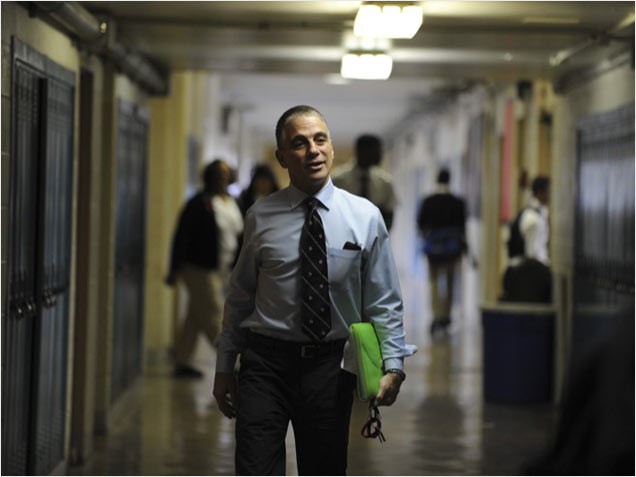
I also don’t wear a tie – but I do wear a cardigan, so it balances out.

I finished the book with no doubt in my mind that Danza did the project in good faith and with full devotion to duty, just as any other first-year teacher would have done. He struggled and triumphed just as any teacher would do, and his sincerity comes across on every page. The title, too, resonated with me immediately, since that’s exactly what I thought when I started teaching. On top of all that, he cries almost constantly, something I’ve never done in my career, so he’s one up on me.

It’s a fast read, and very familiar to anyone who’s become a teacher or knows a teacher, no matter where you are. Plus, there are a ton of ideas to steal, which is a tradition amongst teachers around the world, so I’m grateful for that.

——
“Teachers and students need help, not accusations and pay cuts. They need to be a national priority, not an experiment stuck into a late time slot and then canceled for underperforming.”
– Tony Danza, I’d Like to Apologize to Every Teacher I Ever Had

—-
[1] ThirtyCOUGHCOUGHCOUGH
[2] What, me? Oversensitive? Never…

—-
Tony Danza on Wikipedia
I’d Like to Apologize to Every Teacher I Ever Had on Amazon.com
Tony Danza’s homepage

1 Comment

Filed under education, memoir, nonfiction, school, teaching, teenagers, television, Tony Danza

Review 199: The Killing Moon

The Killing Moon by N.K. Jemisin

I have two words for you: Ninja. Priests.

There you go, that should really be enough for you to go out and buy this book. I suppose if you need more, though, there is a whole “plot” and “world” and “characters” and stuff. But even Jemisin says that the initial idea that got her started writing was ninja priests, and everything else just kind of built up from there.

Welcome, then, to the great land of Gujaareh, a land not entirely unlike our own ancient Egypt. It rests alongside a great river that floods periodically and brings great wealth and prosperity to the land. The whole world lives in the shadow of their great, striated Dreaming Moon, the perpetual manifestation of their goddess, Hananja. In this city, people live healthy, productive lives, and it is all thanks to Hananja’s devoted priesthood and their arts of narcomancy.

Not this kind of ninja priest, though…

The Gatherers of Hananja are able to take dreamstuff from sleeping people, either willingly or otherwise, and their most honored task is to take from those whom their governing council have decided need to die. The terminally ill, perhaps, or the corrupt – these are the ones whom the Gatherers visit, giving them a final dream before sending their soul into the dreaming world embodied by their goddess.

Ehiru is the best of these Gatherers, a man with a deft touch and absolute devotion to his cause. He is told to gather and he gathers, bringing back the various dreamstuffs to the temple, where the Sharers can use it to heal the afflicted of Gujaareh. Indeed, until now, Ehiru has never questioned his place in the world. But he soon finds himself wrapped in a terrible conspiracy that threatens to upend everything he’s ever believed in, and may turn him into that which he has always despised.

It’s a really neat idea, with some very powerful characters and a well-built world. Clearly, Jemesin holds this world clearly in her mind when she writes, because the detail she gives, down to the smells and the surfaces, paint a wonderful picture. That said, though, this book didn’t really come together for me until about two hundred pages in.

Or a Magic Eye picture. I hate those things. Stupid sailboat…

I’m not sure why that was. Maybe I’m so deeply mired in the Alternate Europe mode of fantasy fiction that my brain had trouble adjusting to the deliberately different world that Jemesin built. Maybe she knows the world so well that she made certain assumptions about it that the reader – or at least this reader – couldn’t readily put together. All I know is that I spent a good portion of the book trying to keep everything in order in my head. It was like doing one of those sliding-piece puzzles: immensely frustrating until you finally get a good idea of how it all works.

Before you despair, however, note that number again: 200 pages. You would think that if a book baffled me for a while, I would probably put it down, but the fact that I was willing to keep going that far through my bafflement really does say a lot about the work that Jemesin did. The characters are interesting, and their relationships are intense – none more so than that between Ehiru and his apprentice Nijiri. While Jemesin states clearly that the people of her world aren’t really concerned with labeling and compartmentalizing sexuality, Nijiri is definitely gay, and he is madly in love with his mentor, to the point where he is willing to give up his life to save him.

The Prince is another good example of an interesting and complicated character. The Sunset Prince, avatar of Hananja, gives off Bad Guy Vibes from the moment we meet him. There’s something about him as soon as he appears on the page that says he’s going to be trouble by the end of the book. Despite that, you can kind of see where he’s coming from, and you see the logic he’s working from. It’s deranged, yes, but in a very specific sort of way it makes sense.

Another fascinating aspect of this book is that it presents contrasting and incompatible cultural values with a sense of honesty and truth. The formalized execution/euthanasia that the Gatherers of Gujaareh perform is considered by their own people to be the best way to handle things. After all, why suffer in agony when Ehiru can come along and drop you into a pleasant dream for all eternity?

Not unlike the Cola Wars, but with less moral ambiguity… (photo by caycowa on DeviantArt)

On the other hand, Sunandi Jeh Kalawe is of the Kisuati, and they view the Gatherer’s narcomancy as a horrible power and their “gifts” as nothing short of institutionalized murder. The characters argue over this repeatedly in the book, and the best that comes of it is a certain mutual understanding. Not an agreement, mind you – neither viewpoint is either affirmed or torn down, but they eventually get to a point where they can start to see through the other’s eyes.

So as I said, it took about 200 pages for things to really click for me, but it was worth it when they did. Also, there’s a very funny author interview at the end where Jemesin is given the rare opportunity to interview herself. Definitely not to be missed. This is a really interesting world built on unique and fantastic concepts. There are more, too, which I’ll be looking forward to reading at some point in the future.

—————–
“You kill, priest. You do it for mercy and a whole host of other reasons that you claim are good, but at the heart of it you sneak into people’s homes in the dead of night and kill them in their sleep. This is why we think you strange – you do this and you see nothing wrong with it.
– Sunandi, The Killing Moon

N.K. Jemesin on Wikipedia
The Killing Moon on Wikipedia
The Killing Moon on Amazon.com
N.K. Jemesin’s homepage

Leave a comment

Filed under fantasy, murder, N.K. Jemesin, religion, war