Tag Archives: book reviews

Review 228: The Rise and Fall of the Galactic Empire

The Rise and Fall of the Galactic Empire by Chris Kempshall

The best fictional worlds invite you to lose yourself in them. They get into your head, makes you wonder what else is there, between the words on the page and beyond the beginning and the end.

Star Wars, of course, is exactly that kind of fiction. What started with a fairly simple space adventure nearly fifty years ago has blossomed into an expansive, living universe, where every new story carries within it the seeds for another story and another one after that. Through the media of film and television, animation and comic books, novels and short stories, Star Wars has built up a world and a history that you could spend your entire life exploring.

Kempshall reflects in the afterward that, for the time he was working on it, it became his whole life. And I certainly can’t blame him for it.

The Rise and Fall of the Galactic Empire is a thorough, insightful history of the Empire from inside the Star Wars universe. Written by historian Beaumont Kin soon after the fall of the New Republic, the Battle of Exegol, and the (probably) final death of Emperor Palpatine, this book attempts to understand how the Empire arose, what its means and methods were, and why, even after the Battle of Endor, its ideology persisted and became the First Order.

It begins with an examination of Sheeve Palpatine and how he rose to power. With the advantage of time, and the testimony of people like Luke Skywalker and Leia Organa, Kin is able to see the Senator from Naboo for who he really was – a master of the Dark Side of the Force, apprentice to a terrible Sith lord, who had decided from his early years that he wanted only one thing: complete mastery of the Galaxy. It follows his career through the Clone Wars, a conflict in which Palpatine, acting as both the Supreme Chancellor and the malicious Darth Sidious, was controlling both sides.

With his power assured, the history then goes on to explore how the Empire functioned, how it expanded, and how it devoured everything in its way. An Empire which rewarded cruelty, blind loyalty, and rampant consumption was everything that Palpatine wanted, and its apotheosis was the Death Star.

Nevertheless, there was resistance, and the history explores that as well. How even with an Empire so comfortable with conflict and aggression might still miss the signs of organized rebellion and even encourage it with its unrepentant use of force and terror.

From there, the book chronicles the assumptions and errors that the Empire made in dealing with the Rebellion, how the loss of figures like Grand Moff Tarkin crippled the Empire’s efforts, and how even though battles like those at Hoth looked like Imperial victories, they did more damage to the Empire than to the Rebellion.

This book is a well-written, detailed, and satisfying look at the history of the stories that we know so well. It draws from not only the films, but also comics, books, and television – any source available that explains the events surrounding the rise of the Empire, the Galactic Civil War, and the Empire’s fall and rebirth.

What makes this book believable is not only that it was written with the full help of the lorekeepers and writers of the Star Wars universe, but that it was written by an actual historian. Kempshall has been writing on war, especially World War One, and found himself in the very enviable position of being able to write a history of one of the most popular fictional universes of our time.

One aspect of this book that is truly fascinating is to see the places where the narrator, Beaumont Kin, lacks information that we, fans of the stories, absolutely have. For example, we all saw the fateful meeting at the beginning of A New Hope where Vader nearly force-chokes Admiral Motti to death. Kin, however, relies only on Motti’s own paperwork, referring to “an almost entirely redacted incident report within the Imperial Archives submitted by Admiral Motti immediately after that summit took place, presumably about something that happened to him during it.”

There are plenty of other places and references that Kempshall includes where he knows that fans of Star Wars will be able o fill in the gaps, having read the books and watched the cartoons, movies, and TV shows. Even more interesting is what he leaves out. There is no mention, for example, of Obi-Wan Kenobi and his role in the rescue of Vader’s children, or Yoda’s training of Luke. Ahsoka Tano, despite her role as the mysterious Fulcrum, is barely mentioned. Dr. Aphra, despite her strange and constant relationship with Darth Vader, only shows up a couple of times, usually in footnotes.

If there is one point of irritation that I have with this book, it’s the way that citations are handled.

It is great that this book is heavily cited – a proper history book should reveal its sources, allowing a reader to go and investigate for themselves, should they want to. The problem is, all of these are in-universe citations. So you might be directed to “New Republic Archives, Section: Adelphi Base, File: Requisition Form #1837p—Subcontract for fulfillment of refuse collection” if you want to know more about how New Republic officers used bounty hunters to go after Imperial remnants.

Now I appreciate kayfabe as much as the next guy, but a lot of these footnotes seemed like they should be pointing at specific literary sources – a show or a comic or something like that – and I really wanted to know what those were. I was hoping that, at the end of the book, there might be a listing of all the sources that Kempshall went to, but alas, there is none. This is a great, but missed opportunity.

The most striking thing, though, was not so much how well it recontextualized the Star Wars universe (and brought more sense to the Sequel Trilogy), but how relevant it was to our world. The rise of fascism, cruelty disguised as order, the seduction of ideology are all familiar to us. The book’s exploration of power and its misuse is painfully on-point, from the terrors of Fascist Europe all the way to the present day. It holds up the grand, sweeping tale of Star Wars as not only an allegory for past conflicts, but as a mirror to our own lives, our own willingness, perhaps, to allow wickedness to be done in our names.

Where the fictional historian narrator becomes angry or sad or frustrated with the terrible works that the Empire performed, you can easily understand how perhaps Kempshall is feeling the same way about our world.

We may not have a Sith Lord running things out here, but we do have petty, power-hungry tyrants; we have people willing to do terrible things because they were told to do them; we have leaders willing to ignore tragedy after tragedy because doing something about it is inconvenient.

This book would be an excellent addition to the collection of any Star Wars fan, and is the perfect answer to those people online who wish, against all available evidence, that Star Wars hadn’t suddenly gotten “all political.” It hasn’t gotten political – it always has been.


“The role of a historian—my role as a historian—is to try to tell you not just how but why these things happened. To try to make you understand the importance of these past events and what they mean for us today and tomorrow.”

Chris Kempshall at Penguin Random House
The Rise and Fall of the Galactic Empire on Goodreads
Leave a comment

Filed under Chris Kempshall, history, politics, science fiction, Star Wars

Review 227: Red Sonja – Consumed

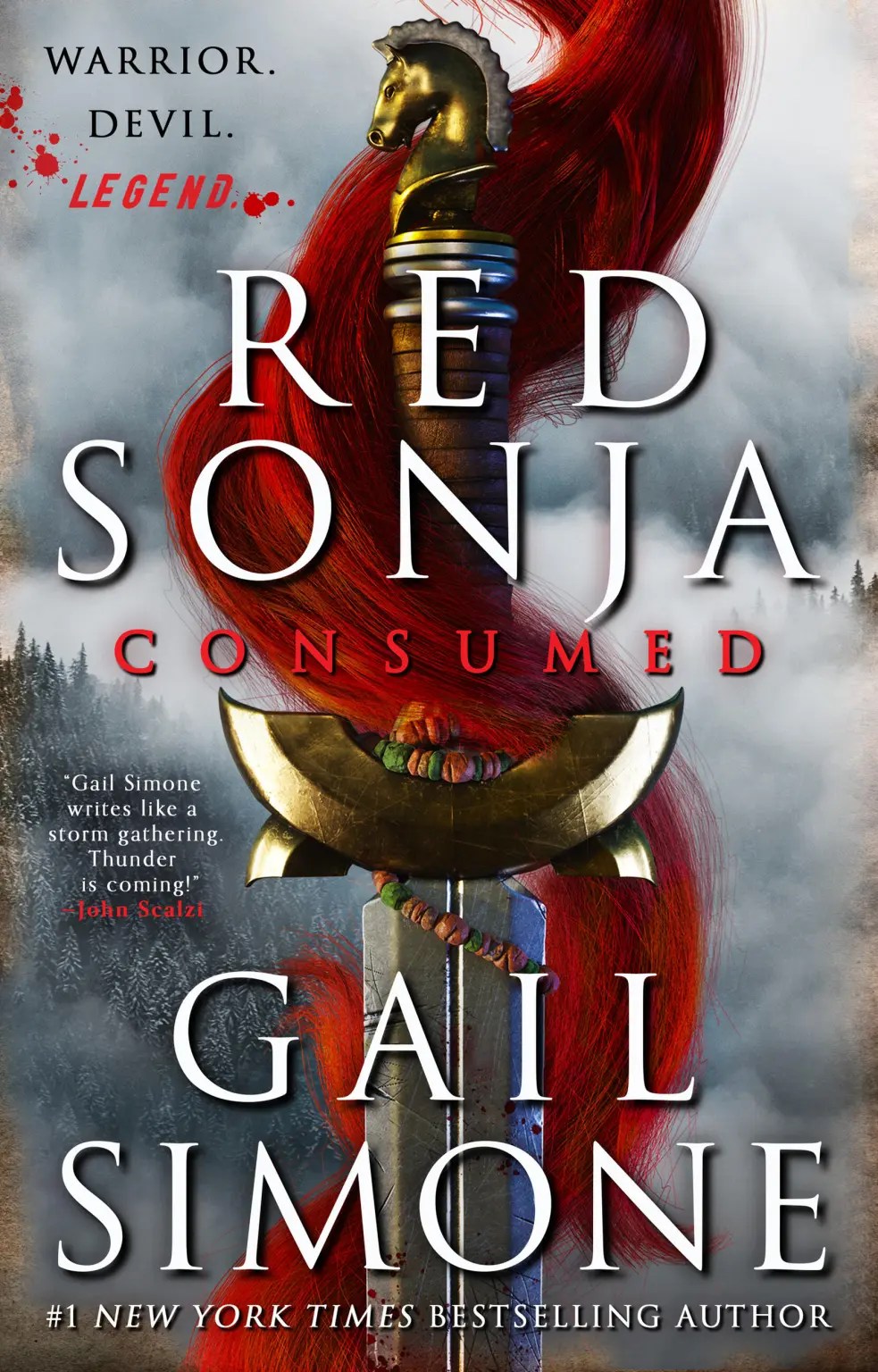
Red Sonja: Consumed by Gail Simone

It must be tough to write about a legend. Both within her own world and ours, Red Sonja is a name to be reckoned with, and Gail Simone more than does her justice in her debut novel.

The She-Devil with a Sword, Sonja is one of the greatest heroes of her age, a woman who goes toe-to-toe with any enemy, no matter how terrible or undefeatable. And when her victory comes, she is the first to quaff some ale and take to bed the prettiest people she can find. There is a reason she is known as the She-Devil, amongst other, more terrifying epithets that run before her, allowing the wiser people in her path to know that they would do well not to trifle with her. Do not try to contain Red Sonja, and do not attempt to bar her way.

This story follows Sonja as she enjoys her life as a thief, aiming to steal a precious gold armband known as the Asp from the beautiful queen that she has taken to her bed, and possibly to love. She finds herself pursued by her spurned lover, hunted by a hired assassin, and an unwelcome visitor in lands who despise her own people, the Hyrkanians. With only her loyal steed, Sunder, she takes charge of her own life, lives by her own rules, and takes who and what she wants. No one has a hold over Red Sonja, and that’s the way she likes it.

However, not even Sonja can escape her past, no matter how far she may go. Her homeland is under attack by terrible creatures that travel through the earth, bursting forth when you least expect it, and pulling you down to join their ranks of undead horrors. For reasons of their own, these terrible beings wish nothing but complete destruction of the Hyrkanians, and fully expect that there is nothing the Hyrkanians can possibly do to stop them.

And they would be right, of course, if Sonja was not compelled by necessity and honor to step in and shut them down.

Of the various genres of fantasy that I read, I don’t often step into the world of Swords and Sandals. Historically, Red Sonja occupies the literary landscape opened up by Conan the Barbarian, traveling through a world that is magical, but in a way that is more or less beyond our hero. Magic is subtle and terrible, used by people who have pushed past the veil of what should be known, and it is usually up to people like Sonja to stop whatever unnatural horrors have been unleashed.

Red Sonja in this book is human in a way that so many fantasy heroes are not – she drinks a lot, takes both men and women to bed when she wants to, fights dirty and fights to win, gets hurt, regrets, and dreads becoming the legend that she already is. She is not a Chosen One or a Fate-Touched or whatever other thing you might expect from Fantasy. She’s a woman who Gets Things Done.

Gail Simone

This humanity clearly comes from Simone’s love of the character. She’s been writing Sonja in the comics for a long time, and talks about her with great joy and love when discussions come up online, and knows the forces that push and pull at the character, creating conflict that can be explored in countless ways.

Sonja’s backstory is certainly tragic. Having lost her family and her village when she was a child, she was forced to survive on her own and use the skills she had been taught in order to just not die. She grew up without a people to rely on, and, like anyone in that situation, found herself doing her best not to be in situations where she had to rely on people.

However, as so many stories have told us, relying on people is the way to get things done, and that’s just as true here. Sonja has to make peace with enemies, allow friends to help and, most importantly, allow herself to do what must be done in order to stop the horrifying entities that are threatening her people. And this is where her humanity shines. She struggles greatly with letting others get close to her, convinced both that she doesn’t need them, and even if she did need them, they’d just get hurt. Simone does a great job of illustrating this conflict within Sonja and giving her the room to really figure out how she’s going to relate to other people.

It might be tempting not to explore what this book is about, thematically, because it’s not the kind of book that usually gets explored that way. Stories about fantastic warriors, strange zombie mole-people, cursed jewelry usually doesn’t get the kind of close literary attention that other, more “serious” books do. But to ignore the meaning in a book like this is to do it a grave disservice.

Among her many great qualities as a writer, Gail Simone is fantastic at finding the emotional core of a character. Just as she has done with characters like Wonder Woman and Batgirl and yes, even Deadpool, Simone knows the emotional core of Red Sonja.

For all of her bravery and bravado, and despite a reputation that runs before her like a shadow at sunset, Red Sonja feels unworthy of love and connection. She knows the danger that her life brings and has made the decision that she can’t involve others in that, and I suppose that makes a kind of pragmatic sense.

Red Sonja absolutely has her priorities.

But for all that, Sonja loves. She loves her people and her ideals and her home despite herself, and for all that it doesn’t make pragmatic sense she can’t stop loving people.

And now we know Sonja’s tragedy. For all her fantastic setting and tragic backstory, it’s that push and pull of relationships and closeness that brings her to life and speaks to all of us. For while very few readers of Red Sonja have commanded their warhorse to put its hooves through a man’s skull while the invincible armies of undead vengeance wreak havoc in their city, we have all been pulled and torn between the twin forces of wanting to be loved and not wanting to be hurt.

That is what allows Gail Simone to bring Red Sonja fully to life, and what makes this story such a good read.


“The great truth of Red Sonja, in her own hidden heart, was that leaving the people she loved was the best gift she could give them, she was certain.”

Gail Simone on Wikipedia
Red Sonja on Wikipedia
Red Sonja: Consumed on Goodreads
Leave a comment

Filed under adventure, fantasy, Gail Simone, Sword and sorcery

Review 226: The Road

The Road by Cormac McCarthy

There should be a name, I think, for the type of book that you’ve absolutely heard of, that pretty much everyone has read, but that you have, somehow, managed to miss.

Well, now I have no choice but to read it, since I’ve decided to teach it this year. I know – a bold move to choose to teach a book that I haven’t actually read to impressionable youngsters. I’m a risk-taker, as the IB would have it.

As you recall from your encyclopedic knowledge of this blog and my many reviews, I have a soft spot in my heart for end-of-the-world fiction. I grew up reading The Stand by Stephen King, I’ve read Swan Song multiple times, and even enjoyed tongue-in-cheek apocalypses like Good Omens. Before going into this book, I would have considered myself an authority on all the various ends of the world.

You see, most apocalypse stories share basic qualities. They have secrets and prophecies, they have good guys and bad guys and hope for a better world after they’re over. We can easily look at the problems of our own times and extrapolate them, see how they could be so much worse, and we need to be able to hope that goodness and civilization will win out against even the most terrible of times.

Cormac McCarthy has decided not to do any of this.

In this story there is a man and a boy. They’re traveling through the ruined, ash-strewn ruins of America, looking for a place that is safe. They freeze and starve and hide from the cannibals and slavers that rove the land. They travel through ruined cities and desolate forests, never sure if the next day will bring them a respite from their misery or the finality of death.

They are moving south, down the titular road. They have a busted shopping cart and some knapsacks full of whatever they’ve managed to scrounge, some rags and remnants of clothes, and that’s about it.

Oh, and a gun. With – briefly – two bullets in it. The Man might need it to kill The Boy and himself with it. Or The Boy can use it on himself, if worse comes to worse. Dying of hunger or hypothermia is bad, sure, but there are so many things worse than dying, a final bullet doesn’t even break the top ten.

The Man, The Boy, the Cart and the Gun.

That’s pretty much all McCarthy gives us, at least as far as the plot goes. We don’t know how the world ended, or why. There is no one in charge of this post-apocalyptic hellscape. The man and the boy are not special in any real way – there is no prophecy of greatness or some hidden store of old world knowledge that can be used to bring back the golden years from before the world ended. The Man and The Boy are not trying to accomplish anything other than not dying, even though that seems to be what their entire world really wants them to do.

So if this book isn’t about un-ending the world, like so many other apocalypse stories are about, what is McCarthy doing here?

The essence of the book is the greatest existential question there is: why should we choose to live when we could choose to die instead?

In our world, of course, there are plenty of reasons to continue to live. We have cats and sunsets and taco trucks and at least another season of Wheel of Time to look forward to. We have music and dancing, true love and juicy gossip and good books and friends and family.

The Man and The Boy have absolutely none of this. They have the opposite of all this.

They have a gun. And two bullets.

When you step back and look at it, they’re in an objectively horrible situation and yet they continue to move forward. They continue to survive – to “carry the fire” as they put it – in the hope that maybe somewhere in this blasted land there will be good people that they can finally survive with. Even that hope is thin and tenuous, though, as there is very little indication that such good people exist anymore.

What’s keeping The Man going is The Boy. He’s the last thing The Man can hold on to that keeps him human, reminds him of what good can look like in the world. His purpose is to protect The Boy, and he carries out that purpose like a holy oath. Without it, he has nothing.

What’s keeping The Boy going is The Man. The Man is, of course, stronger, more knowledgeable and more capable, able to do the tasks that need doing in order to survive. The Man is his protector in a world that can be very, very unkind to little boys. And, more importantly, The Boy knows how much The Man needs him. He knows what The Man would become without him, and he can’t bear to see that happen.

The book isn’t about the world or how it ended. The book is about the two of them, and that’s it. It’s about how they survive for each other, carry each other’s fire through a cold and indifferent land.

It’s about love.

The reason to live is simply to live. To endure in the world even when things go bad. Life itself should be appreciated and protected, and that’s all the reason you need to keep going.

For all the grimness, it’s a surprisingly comforting message from the man that brought us Blood Meridian, of all things, and should lead us to ask ourselves if we truly understand the value and preciousness of the lives we lead. Life itself has value, simply by existing, and we’ll miss it when it’s gone.

Especially the cats.


“Once there were brook trouts in the streams in the mountains. You could see them standing in the amber current where the white edges of their fins wimpled softly in the flow. They smelled of moss in your hand. Polished and muscular and torsional. On their backs were vermiculate patterns that were maps of the world in its becoming. Maps and mazes. Of a thing which could not be put back. Not be made right again. In the deep glens where they lived all things were older than man and they hummed of mystery.”

Cormac McCarthy on Wikipedia
The Road on Wikipedia
The Cormac McCarthy Society

Leave a comment

Filed under apocalypse, fathers, fiction, sons

Review 225: The Power Broker

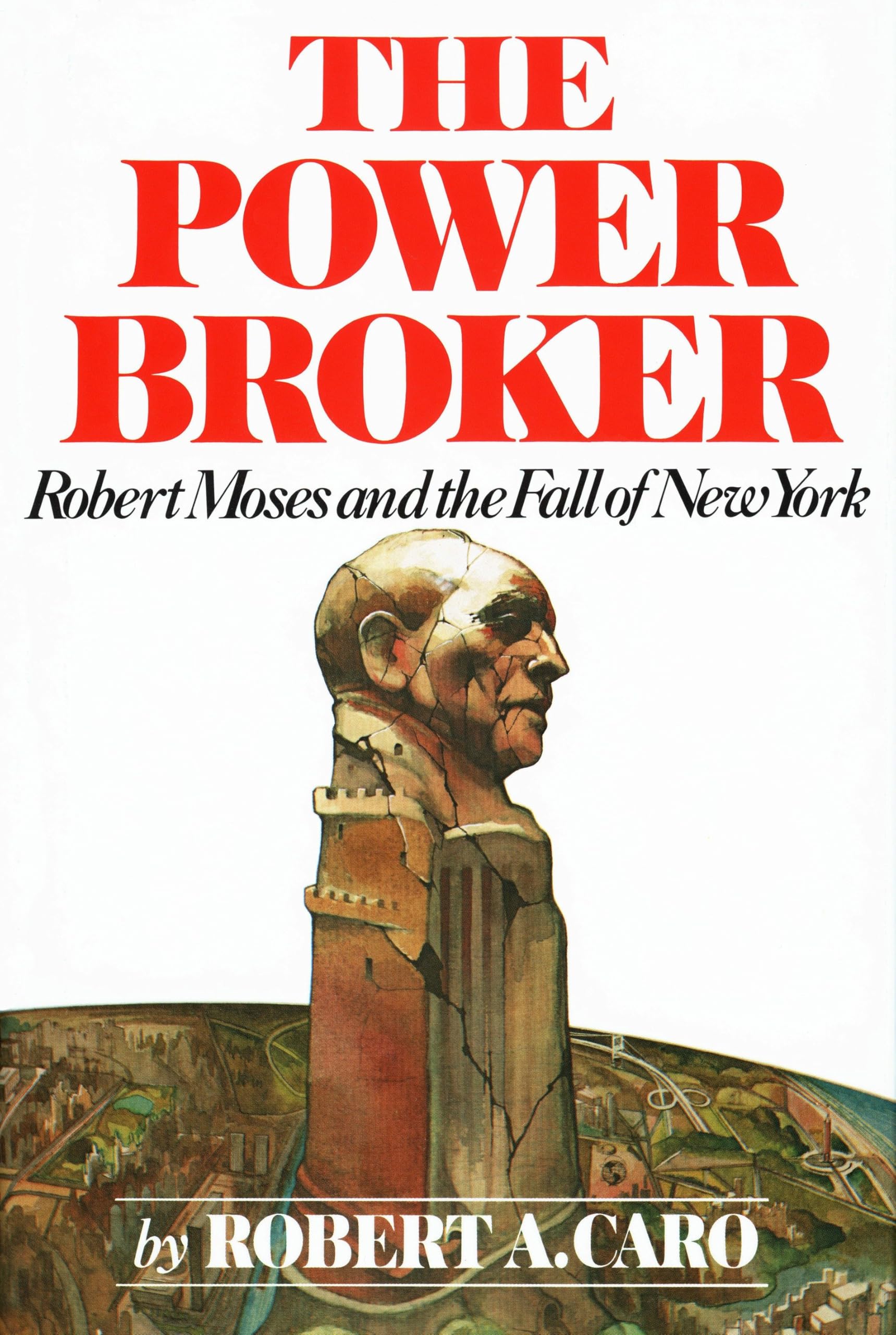
The Power Broker: Robert Moses and the Fall of New York by Robert Caro

Yes, it’s been a little while. Thank you for your patience.

I decided to read The Power Broker mainly because of the series “The Unsleeping City” over on Dropout, an actual play D&D game that’s set in a version of New York City that is steeped in magic and the supernatural, hidden from its normal inhabitants by an Umbral Arcana. In this game, the Big Bad Guy was a man named Robert Moses, a lich who tries to carve out New York as a magical realm all his own. On top of that, he tries to re-define the American Dream into something which fits his particular vision of what the ideal American should be: rich, male, and white.

Imagine my surprise when I found out the not only was Moses a real guy, but that he was just as bad – if not worse – than Brennan Lee Mulligan’s lich.

That’s an oversimplification, of course. If you want it in detail, read all 1300 pages or so of Caro’s book, and you’ll see that while yes, there were improvements done to New York City that were undoubtedly good in the long run, there were just as many that were harmful. And not just harmful in the moment, like tearing down neighborhoods to make room for expressways, but harmful for generations. Moses himself very likely believed that he was doing what was best for New York City. Unfortunately, he never allowed anyone to ever even suggest that he might be wrong.

Caro’s book starts with an understanding of where Moses came from – an affluent Northeast family with a fondness for civic matters and a certain patrician attitude towards helping poor Jewish immigrants from Eastern Europe learn how to be good Americans. Moses went to Yale and Oxford, and came back with a desire to get into civil service, with a focus on city improvement. What’s more, he wanted to break the hold that moneyed and special interest groups, such as the infamous Tammany Hall, had on city government by placing people not according to their connections, but according to how well-suited they were for the job.

Ironically, it was through strong personal connections that he had through people such as Governor Al Smith that Moses got a job that he had no experience in: managing parks. To be fair, I don’t think anyone had experience with this in the 1920s and 30s, so I can’t really fault him for that.

Moses turned out to be a man possessed of an amazing mind.

He was imaginative – he could look at a stretch of undeveloped land or a bend in a river or a set of hills and know immediately not only what he wanted to do with it, but how it could be done. To hear tell of it, it was like the vision of a finished improvement or project would simply spring to his mind, and he would be ready to go.

He was intelligent – he had an excellent memory for people and legislation, and was considered one of the best bill drafters in New York. He knew how to craft legislation in such a way that seemingly unrelated, yet wholly interlocked, pieces came together to allow him to get the result that he wanted.

He knew people – he was able to create almost cultlike loyalty in his “Moses Men,” the army of engineers, aides, secretaries and other professionals who worked for him over the years. These people were at his beck and call, obeying every order he gave, affirming every vision he had, and acting as his eyes, ears, and hands throughout the government and civil society of New York.

He was relentless – what Robert Moses wanted, he got. Full stop. Whether he used flattery and kickbacks and “gifts” to get it, or whether he utterly destroyed someone’s reputation in the press or in their industry, there were no lengths that Moses would not go to in order to accomplish his goals. He was almost incapable of taking “no” for an answer when it came to his projects.

And therein, I think, lies Moses’ real tragedy, and the reason why (to me) Caro’s book comes across as spectacularly angry.

With the skills and resources available to Robert Moses, he could have built a New York City that would have been a model for a humane, livable city for the ages. He could have built a place that would inspire better communities, better living, a model of how to make a city a place of growth and humanity.

He did not want that, though. Robert Moses loved parks and cars, and that was pretty much it. His answer to most problems of the city was either to build a park (whether or not one was needed) or to build a road. In his time with the city, he built more than a dozen major bridges and hundreds of miles of highways. He built out the highways that turned Long Island into a major New York suburb. He built the expressways that bracket Manhattan, and would have built more if he had been able to.

Unfortunately, a growing city does not need more roads. In fact, as Caro’s book points out, more roads actually make traffic problems worse. It is public transportation – busses and subways – which make a city really work, allowing so many people to live and work in such a densely packed place. But Moses hated public transportation.

Public transportation, you see, would allow poor people to get to his pretty parks. And he wanted none of that.

A very famous anecdote from the book is that, in designing the roads to his beloved Jones Beach, Moses had the overpasses designed at a height that would be too low for busses to access. So, if you had a car (i.e. money), then welcome to the beach! If you were a poor person, though, you’re out of luck. No busses for you. And Moses much later said that he knew he didn’t need to try and get legislation passed to ban busses and The Poor. Laws and regulations, after all, could be changed.

It’s really tough to rebuild a bridge. Or, more to the point, several hundred bridges.

Later, when he got himself involved in other areas of civic improvement, he tore down perfectly good neighborhoods in order to make room for his roads and public housing. These neighborhoods, like Tremont or Third Avenue might not have been wealthy neighborhoods, but they were good ones. Places where people knew each other, had businesses, raised families. Some of them were perfect places for new residents to prepare for living in a city such as New York – they could learn basic city living in Tremont, for example, and then, when ready, move elsewhere.

But Moses wanted that land. He wanted it to build his precious roads and bridges. He wanted it to build public housing that would enrich his political allies. He wanted it so that he could exert power over the city and over the people who made the city work. He, like the Robert Moses of “The Unsleeping City,” wanted to reshape New York in his image, to make it the place he felt it should be rather than the place its citizens needed.

All throughout this book, I could feel Caro walking a thin line. As a biographer, he clearly wanted to be as fair as he could to Moses, but with each passing chapter, I could see that being harder and harder to accomplish. In the chapter “One Mile,” which describes the destruction of Tremont for the Cross-Bronx Expressway, you can imagine Caro begging us, or someone, to tell him what the point of all this was. Why good people had to lose their homes and their lives just so a few other people could get stuck in a traffic jam in the Bronx.

The answer, of course, is because that’s what Robert Moses wanted. And what Moses wanted, he got.

Ultimately, as the title suggests, this is a book about power. About how power is wielded and how it reveals the true nature of people. Young Moses believed himself to be an anti-corruption reformer, the champion of good government and the people. But power revealed that he was anything but.

It’s a chillingly relevant book to read here in the Age of Trump, where we have another ambitious man who is very good at attaining and wielding power in order to fulfill his own selfish dreams of what the nation should be. I don’t think Moses and Trump are really comparable, though. Moses’ dreams for New York were ambitious and grand, and he had an encyclopedic knowledge of politics, infrastructure, and geography.

Trump barely pays attention to the world or facts or anything like that, and doesn’t have any interest in actually learning anything. But, just like Moses, he has power. And he knows very well how to gain and hold on to power.

So what do we do about it? Caro’s book won’t really make you feel any better about this – the only real reason Moses fell from grace is that he went up against someone who wasn’t awed or intimidated by him, and that was Governor Nelson Rockefeller. When Moses used one of his classic techniques to get what he wanted – threaten to resign and thereby throw all his public authorities and projects into disarray, where previous governors had caved, Rockefeller said, “Okay. Have your resignation on my desk in the morning.” That was the first real, substantial crack in Moses’ power and his ability to wield it in New York, and within a decade, he was out.

Maybe that’s the way to deal with people like him and Trump. Call their bluffs. Make them put up or shut up. Expose them for who they are, rather than who they pretend to be. Be willing to tell them that they’re wrong, and stand up for that.

If there’s any real, practical lesson to be taken from this book, I think that’s it. There will always be people who are good at moving the levers of power, and it’s up to the rest of us to watch them very closely. And, if necessary, have the courage to take them down.


“An idea was no good without power behind it, power to make people adopt it, power to reward them when they did, power to crush them when they didn’t.”

Robert Caro on Wikipedia
The Power Broker on Wikipedia
Robert Caro’s website
The Power Broker Book Club

Leave a comment

Filed under american history, history

Review 223: The Amazing Adventures of Kavalier and Clay

LL 223 - Kavalier and ClayThe Amazing Adventures of Kavalier and Clay by Michael Chabon

I have long been a reader of comic books, as you probably know by now if you’ve been following my reviews. Ever since I was a kid, comic books have been there, reliably giving me my costumed heroes and world-beating wonders, storylines that wrapped themselves up in a few issues or less. I could – and still can – recite the secret origins and backstories for hundreds of characters at the drop of a hat. [1] The comics universe was a place where I would gladly live, assuming the powers and physique came with it.

What I didn’t know anything about, during those formative years, was the actual creators of comics. It wasn’t until I started to really pay attention that I noticed who the writers and artists were, and names like John Byrne, George Perez, Dick Giordiano, John Ostrander and their colleagues came to have meaning for me. I was soon able to see a little better the work that went into making comics, and the art that doing so required.

Jack "King" Kirby (art by Jonathan Edwards)

Jack "King" Kirby (art by Jonathan Edwards)

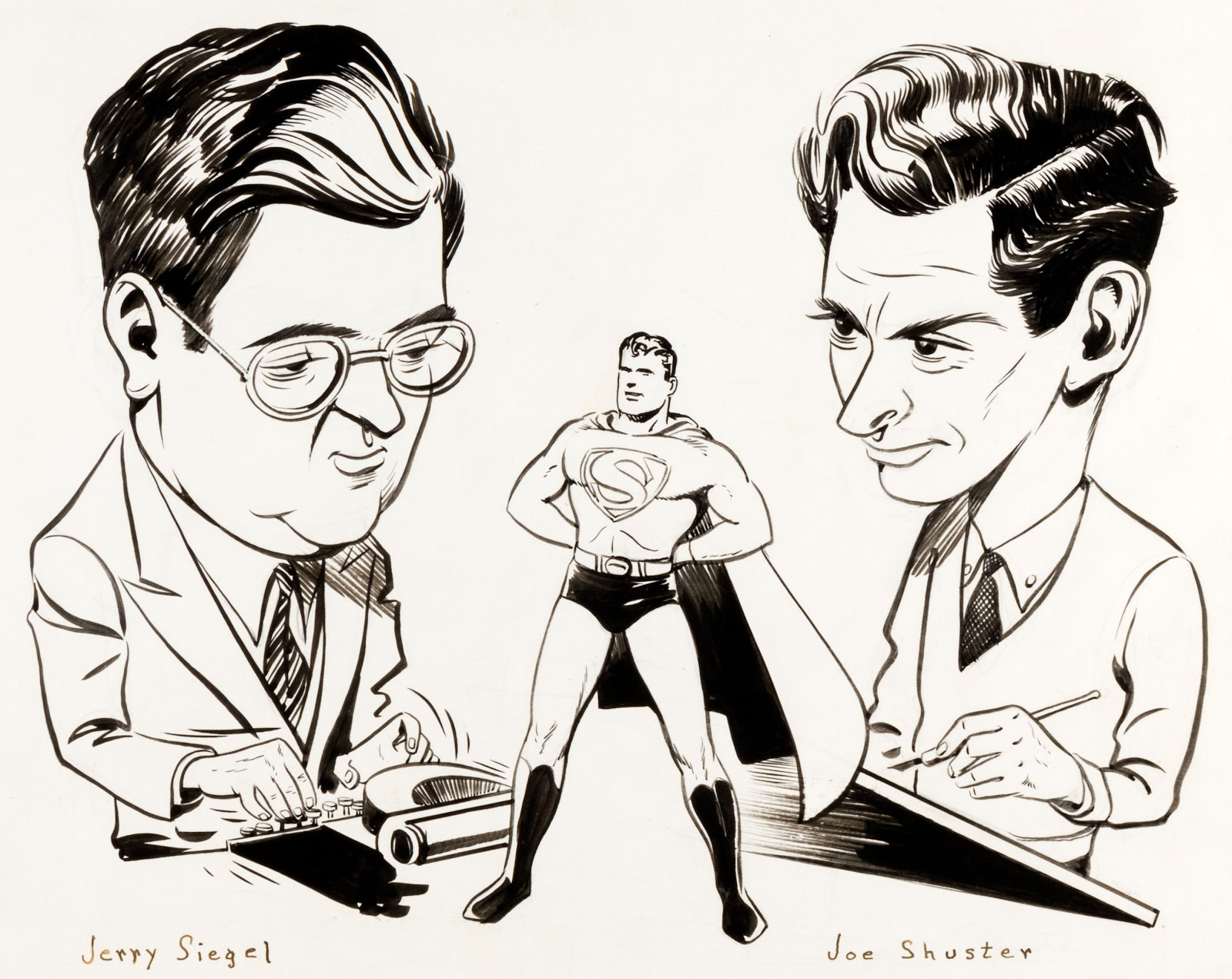
What took me longer to learn, however, was the history of comic books, and how all of these wonderful worlds came to be. The history of comics, as it turned out, is a fascinating story full of brilliant characters, amazing achievements, jaw-dropping betrayals, and vast shifts in cultural and literary attitudes. Names like Stan Lee, Jack Kirby, Jerry Siegel, Joe Shuster – these were not the names I grew up with, but they are the ones who made my childhood possible.

Michael Chabon has managed to give us a glimpse into that history through his book, The Amazing Adventures of Kavalier and Clay, a history of comic books from a slightly different point of view.

The titular characters, Joseph Kavalier and Sam Clay, are cousins from opposite ends of the world. Kavalier, a young Jew from Czechoslovakia, has escaped certain death at the hands of the Nazis and come to America to seek his fortune. Sam Clay is a young man of great ambition, but few means. Apart, they are lost and wandering, but together they become a force that changes culture as they know it.

Stan "The Man" Lee

Stan “The Man” Lee

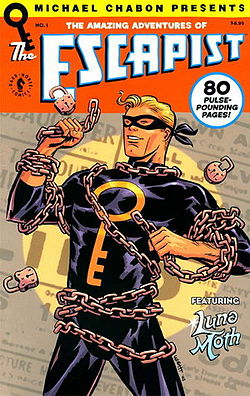
Armed only with a few ideas, bravado, and a good helping of talent, Sam and Joseph break into the newborn world of superhero comic books, creating a character that catches the imagination of readers all over the country. Soon, the Escapist – a master of the art of escapology – is popular enough to rival Superman, and has the potential to make Sam and Joe very rich men.

What follows is a complex, interwoven dual biography as the team of Kavalier and Clay find fame, break up, find love, risk death, and eventually settle into something resembling happiness over the course of several decades. Along the way, the complicated and adventurous history of comic books is a constant in their lives, from the heady days of wartime superheroes to the dark era of Senate hearings and Frederic Wertham’s crusade against the comics.

As one might expect from Chabon, it’s a narrative that covers a lot of ground. It wanders and moves about, going off into places that the reader might not expect, from an Antarctic military base to a men’s retreat on a posh Long Island estate. In that sense, you would think it would be heard to pin down what this book is actually about. It’s about family and friendship, it’s about art and creativity and risking everything for the one big chance at success. It’s about facing your fears and accepting your choices. It’s about so many things, all at once.

Jerry Siegel and Joe Shuster (art by Shuster)

Jerry Siegel and Joe Shuster (art by Shuster)

But what it’s most about is freedom. With the character of the Escapist as the book’s central metaphor, we watch a cast of characters search for freedom. It might be political freedom as Joe tries to get his family out of Europe, or creative freedom as Sam looks for a way to make the ideas in his head into real things. It’s freedom from the restraints of a publisher, and from the responsibilities that come with being a friend and a partner. Everyone in this book is searching for freedom at one time or another, and those searches are neither easy nor short.

There is a certain quality to Chabon’s writing that I wish I could emulate, and the problem is that I can’t say exactly what that quality is. Perhaps it is the way he selects details that so perfectly illustrate a character. Perhaps it’s turns of phrase that linger in the mind, or moments of natural emotion that might have you smiling or worried or – if there’s some dust in the room perhaps – wondering where you put your handkerchief. The characters are vivid and real and interesting, as is the world they live in. His use of detail, his manipulation of both time and space through the use of flashback scenes, make the book great entertainment.

250px-Michael_Chabon_Presents_the_Amazing_Adventures_of_the_Escapist_01It’s not perfect, certainly – there are places where the book slows down, and you want the focus to return to one of the other characters, to examine a new question, but those moments of clear beauty make it all worth it to me. What it all amounts to is a group of wonderful characters who are all looking to find a place where they can settle down and stop escaping from themselves.

—-
“Forget about what you are escaping from. Reserve your anxiety for what you are escaping to.”
– Kornblum, The Amazing Adventures of Kavalier & Clay
—-
[1] The Boyfriend has learned to be wary of asking me about comics. If I’m not careful and very, very succinct, he’ll just walk away while I’m still talking…

1 Comment

Filed under adventure, alternate history, comic books, family, friendship, Michael Chabon, super-heroes

Review 222: Sourcery

LL 222 - SourcerySourcery by Terry Pratchett

Yes, I know – I’ve gone on a Discworld bender. Just one, I thought to myself – I’ll just read Lords and Ladies and that’ll be it. But then I saw Small Gods just sitting there… looking at me. Next thing you know I’m halfway through Sourcery and I don’t know how I got there. I may need professional help…. What am I supposed to do, though? They’re quick, they’re easy, they’re entertaining! I promise, though – after this, I’ll leave the Discworld alone for a little while.

If I can.

The Discworld, being a flat world that is carried through space on the backs of four elephants, who in turn are standing – rather patiently, I think – on the back of a great turtle, is, understandably, a world awash in magic. There are magical creatures on the Disc – trolls and dwarfs and elves – and people who know how to use the magic that infuses the world. People like wizards.

There are other ways to be a wizard, but they're not recommended.

There are other ways to be a wizard, but they’re not recommended.

If you want to be a wizard, there are ways to get there. The best thing you can do is to be the eighth son of an eighth son – that type is almost certainly destined for the more arcane arts. Once you’ve become a wizard, you dedicate yourself to one thing: magic. And late lunches, comfortable robes and your pointy hat, but mainly to magic. Wizards don’t marry. Wizards certainly don’t have children.

Except for one wizard. Ipsalore the Red, the eighth son of an eighth son, broke this law of wizardry. He fell in love, ran away from the University, and had sons of his own. Eight of them. His youngest son, Coin, was the carrier of a great power. He was the eighth son of the eighth son of an eighth son. Wizardry squared.

A Sourcerer.

Back in the old days, when the magic on the disc was much wilder, there were sourcerers everywhere. They built great castles and fought horrible wars of magic, the effects of which still scar the Disc to this day. Modern wizardry is a pale reflection of those days, and for good reason. If wizards continued to battle as the sourcerers did, the disc would be broken beyond recognition. Every wizard knows this.

And yet, when young Coin comes to the Unseen University of Ankh-Morpork, bristling with power and holding a staff possessed by the ghost of his father, the wizards are more interested in the power he can give them than the responsibility they have. A sourcerer has arisen, and a new age of magic has come, with all of the terror that implies. Coin reminds them of what wizards used to be, and the power they used to have. Through him, old men who could barely manage a simple illusion are now able to re-shape the world with their wills. With a sourcerer behind them, there is nothing these wizards cannot accomplish.

Not quite Hogwarts material.

Not quite Hogwarts material.

Only one man can stop them. His name is Rincewind, and he really, really doesn’t want to get involved.

Rincewind is a wizard (or, if you go by his pointy hat, a “Wizzard”), although he is so deficient in magical talent that it is believed that the average magical ability of the human population will actually goup once he dies. He wants nothing more than to be left alone to live a boring, mundane life. The universe, it seems, has different ideas. Together with Conina – the daughter of Cohen the Barbarian – and Nijel the Destroyer, Rincewind has to figure out how to stop a sourcerer from destroying the world.

This book is one of the early volumes of the Discworld series, and so it doesn’t quite have the depth that later books do. Oh, there’s certainly a message to be found in it – mainly on the subject of identity. Rincewind identifies himself as a wizard, despite having all the magical talent of a lump of silly putty, and cannot conceive of being anything else. The sourcerer Coin, on the other hand, has been told who he is to become, mainly by the spirit of his dead (and rather monomaniacal) father. Conina has the blood of heroes in her veins, but her dream is to wield nothing sharper than a pair of beautician’s scissors. And Nijel the Destroyer – who looks almost exactly the way his name sounds – desperately wants to be a barbarian hero, despite being about as muscular as a wet noodle.

Yes indeed. Be yourself. Whatever that may be.

Yes indeed. Be yourself. Whatever that may be.

Despite all of this, however, the characters succeed when they decide for themselves who they want to be. The ones who suffer the most are the other wizards – the ones who allow Coin to tell them who they are. They invest their entire sense of self in the inflated image fed to them by the sourcerer – an image of power and strength – and when it all comes crashing down around them, they are only left with shame and disappointment. In the end, they remain who they always were, and that is the tragedy of their downfall.

So if there’s a lesson to be had in this book, that’s it: know who you are and be it, as hard and as loud as you can. Other than that, it’s a rollicking little adventure. Enjoy.

—————————————————
“It’s vital to remember who you really are. It’s very important. It isn’t a good idea to rely on other people or things to do it for you, you see. They always get it wrong.”
-Rincewind, Sourcery
—————————————————

3 Comments

Filed under Discworld, fantasy, identity, Terry Pratchett, wizardry

Review 221: We Learn Nothing

LL 221 - We Learn NothingWe Learn Nothing by Tim Kreider

While I was reading this book – in a faculty meeting, I have to confess – my colleague looked over, looked at the title and remarked something along the lines of, “That’s completely against what we do here.” I just shrugged, flicked to the next page, and went on reading, as it would have taken too long to explain right there, to say nothing of outing me as someone who wasn’t paying what might be called “strict attention” to what was being presented at the time.

Book Release InvitationIt is true that, as teachers, we might recoil from the idea that we learn nothing. After all, if that is true, then what are we even doing here? It might seem that some of our students have chosen this motto as the guiding principle for their years of secondary education, but still and all, we like to believe that they come out of this school having learned something – if only how to bullshit the teacher into thinking you’re smarter than you really are.

Kreider isn’t talking about book learnin’ here, though. He’s not talking about learning how to do math or why the sun shines or how to make a delicious pie. Those are indeed things we can learn, and should learn. What he’s talking about are the things we fail to learn in life, the big-scale decisions about love and family and politics, where no matter how badly we screw up, we always seem ready – eager, even – to stand up, brush ourselves off, and screw up again.

He begins the book with a statement that not many of us can make: “Fourteen years ago, I was stabbed in the throat. This is kind of a long story and less interesting than it sounds.”

Past TimKreider goes on to say that there is an expectation that getting stabbed in the neck and nearly dying is the kind of thing that should make a person re-evaluate his life. Perhaps gain some perspective on the things that are important and those that are merely trivial. And while there was a time where he looked at the world anew, eventually he reset back to where he was before his brush with death. Yelling in traffic, getting impatient with other people, fixating on things that were in no way good to fixate upon.

In short, after the ephemeral nature of life was made clear, he eventually went back to living as though nothing had changed, simply because one cannot live in a constant state of gosh-wow bliss all the time.

Through this collection of funny, touching, and thoughtful essays, Kreider looks at the lessons he just doesn’t seem to want to learn. He talks about the women who have broken his heart, and how given the chance, he’d let them do it again. He reminisces lovingly over his extended youth of drunkenness and adventure, knowing that it wasn’t the best way to spend so many years, but at the same time knowing he wouldn’t trade them in for a more conventional life. He lets us in on the dark secret of the crazy, pathological uncle that he tried to help despite his mother’s insistence that he stay as far away as he can, about his attempts to infiltrate the Tea Party just to find out if it was crazy as we all thought it was, and about letting his anger and frustration have free rein as he drew cartoons during the Bush Years.

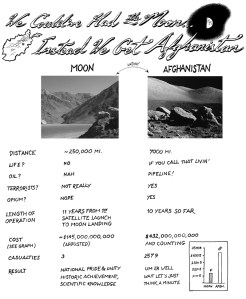
We Could've Had the MoonIn short, Kreider is just as aware of his flaws as he is unable to correct them. But it’s not his fault, really, as these are flaws that we all have. They’re glitches in our reasoning and gaps in our self-knowledge that we couldn’t fix even if we wanted to. They’re part of the human drive towards self-destruction – potent in some, less so in others – that cause us to make irrational decisions that we know we’ll regret in the fullness of time. While my life may not have been quite as exciting and turbulent as Kreider’s, I could still see in his stories the same kind of willful ignorance of shortcomings that has sabotaged many a good thing in my own life.

But as bad as all that sounds, they make us who we are. Kreider wouldn’t be who he is and do the things he does if it weren’t for the events that shaped him. The decisions he made throughout his life – the bad and the good – molded his personality, gave him purpose, and made him the person that he is. The same can be said for all of us. We have our weaknesses, our foibles, our neuroses, many of which are prime impediments to having what we imagine to be a good life. What we can change, we should. But those things that we cannot change about ourselves are perhaps the things we should embrace. They are the things that keep us humble and human, and as long as we know they’re there, well… maybe they won’t do too much damage.

——-
“The Soul Toupee is that thing about ourselves we are most deeply embarrassed by and like to think we have cunningly concealed from the world, but which is, in fact, pitifully obvious to everybody who knows us.”
– Tim Kreider, We Learn Nothing

The Pain Comics (not entirely work-safe)
We Learn Nothing on Amazon.com

Leave a comment

Filed under essays, humor, memoir, Tim Kreider

Review 220: Towers of Midnight (Wheel of Time 13)

LL 220 - WoT 13 - Towers of MidnightWheel of Time 13: Towers of Midnight by Robert Jordan and Brandon Sanderson

This is it, folks. We’re nearly done. Hang in there….

I’m finding this book tough to review for a few reasons. Firstly, reviewing it is kind of like preaching to the choir – if you’ve read this far into Wheel of Time then you really don’t need me to tell you that you ought to read this book. You probably already have, maybe more than once. If you haven’t started the series, there’s so much information you need to know in order for this book to make sense that this review will have no real significance for you. So I’ll just have to tell you what I thought and hope that’s enough.

Be warned: Spoilers ahead. I’ll try to keep them to a minimum, but they’re there.

As with all the Wheel of Time books, a lot happens in this volume. Some of the events have been anticipated by the fans for more than a decade, others are wonderful surprises. Either way, they’re setting us up for what I expect to be the Mother of All Finales when A Memory of Light comes out.

They do say Two Rivers folk could give lessons to mules in stubbornness, so...

They do say Two Rivers folk could give lessons to mules in stubbornness, so…

Let’s begin with Perrin, since he gets the most page time in this book. He has rescued his wife from the Shaido Aiel, along with a city full of refugees and former prisoners. Despite what he wants, these people look to him to be their leader, something he wants no part of. He just wants to send everybody home, forget that he was ever called the Lord of the Two Rivers, and go back to leading a normal life. But the Wheel won’t let that happen. Perrin Aybara is ta’veren, one of those individuals who both shape and are shaped by the Pattern, and what he wants doesn’t much figure into it.

One of the issues I’ve had with Perrin, actually, is this steadfast, stubborn ignorance of what and who he truly is. For many books now, he’s been going through this whole “I just want to be normal” phase, when it’s obvious to everyone else – his wife, the people traveling with him, the dead wolves he talks to, to say nothing of the readers – that Perrin can never lead a normal life again. As with real people, it’s frustrating to see them deny what’s so clearly true, and that was one of the reasons why Perrin has never been my favorite character.

He turns around on that in this book, however. He does finally start to make peace with who and what he is, and understands his duties to the people who follow him. With that understanding comes strength – the strength to win over his greatest enemies and to master the abilities available to him in the World of Dreams. Perrin is finally coming into his own as both a leader and a warrior, and it will be good to see him look forward to the future instead of long for a past he can’t have anymore.

At this point, Mat would probably say, "It's all part of the plan!!"

At this point, Mat would probably say, “It’s all part of the plan!!”

Mat is another who has been getting under my skin. While I love the way that Sanderson writes him – much funnier, more sarcastic, more modern than Jordan wrote him – he also wants nothing more than to opt out of the role that fate has decreed for him. Through his travels, he has been granted centuries of knowledge about battle and war, he has gone toe-to-toe against creatures that literally defy human understanding, and has a power over luck and fortune that has saved him more times than he can count. Yet he still resists the destiny that is clear to everyone else – to be a leader in the Last Battle.

And that battle is definitely coming soon. Vast armies of Shadowspawn are overwhelming the northern defenses, turning whole cities into killing grounds. Food is rotting at a rapid rate, sometimes as soon as it is prepared. The very fabric of space and time is twisting, moving things around randomly. Rooms, streets, entire villages might shift and vanish in the night. The Dark One is nearly free, and there are very few options open when it comes to stopping him.

Rand al’Thor, the Dragon Reborn, has one idea – to break the seals of the Dark One’s prison so that it may be re-sealed. Rand’s opinion, however, is not very well regarded at the moment. Despite being the prophesied warrior on whose shoulders the fate of the world rests, he’s been kind of an unpredictable nutjob of late. In an attempt to be ready to save the world, Rand tried to distance himself from all emotion, all ties to the world, so that he could be hard enough to do what must be done when the End Times come. He has done terrible things in the name of What Must Be Done, which has led some to fear that the world would be doomed regardless of who won the final battle.

He’s feeling much better now, though. He has come to a state of understanding that should allow him not only victory against the Dark One but also peace. Unfortunately, it’s going to take some time to convince others of that, especially Egwene – formerly the Girl Next Door, now the Amyrlin Seat, leader of all Aes Sedai.

This is gonna be AWESOME! (art by dem888 on DeviantArt)

This is gonna be AWESOME! (art by dem888 on DeviantArt)

Having ended the internecine feud within the White Tower and begun the process of reconciliation, Egwene finds herself at odds against Rand and those who follow him. She agrees with his ends – victory over the Dark One – but not his means. If necessary, she will stand against the Dragon Reborn all the way to the end of the world.

There’s so much more, too. There are action scenes between Mat and the vicious gholam that made me wish I had an animation studio at my disposal. A heartbreaking reunion between father and son. A terrible vision of the future of the Aiel, should things continue the way they are. Ragtag armies barely holding their own, people who we thought were dead revealed to be alive, sons reunited with their mother, battles against the forces of darkness, mislaid messages, a daring rescue, a growing army, and so, so much more.

The complexity of Wheel of Time is understandably off-putting for a lot of new readers, but I think Sanderson is doing a very good job at putting all the pieces together. We are now on the brink of the end, ready to dive into the Last Battle and the much-anticipated Fourth Age. Questions will be answered, people will live, nations will die, and the Wheel of Time will turn.

Stick with me folks, it’s only going to get better.

——————————————————————-
“After what we went through together, it turns out that she’s Morgase Trakand. Not just a queen – the Queen. The woman’s a legend. And she was here, with us, serving us tea. Poorly.”
– Alliandre, Towers of Midnight
——————————————————————-

Robert Jordan at Wikipedia
Robert Jordan at Tor.com
Towers of Midnight at Wikipedia
Wheel of Time at Wikipedia
Towers of Midnight at Amazon.com

Wheel of Time discussion and resources (spoilers galore):
Theoryland
Dragonmount
The Wheel of Time Re-read at Tor.com
The Wheel of Time FAQ
Wheel of Time at TVTropes.com

Leave a comment

Filed under adventure, Brandon Sanderson, epic fantasy, fantasy, Robert Jordan, war, Wheel of Time, wizardry

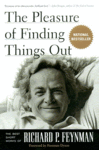
Review 219: The Pleasure of Finding Things Out

LL 219 - The Pleasure of Finding Things OutThe Pleasure of Finding Things Out by Richard Feynman

Here’s the problem with having high expectations: they’re so often dashed.

In my years trawling the web and being a science nerd, I heard a lot about Richard Feynman. There are legends about him, that he was the Puck of physics – brilliant, untamed, and really, really funny. I read another book of his, Surely You’re Joking, Mister Feynman, and enjoyed it thoroughly. I thought that this book, with a title that appealed to me and by an author-scientist whom I respected, would be as much fun.

When I got the book, I was expecting to read a lightning-quick volley of ideas that would set my mind alight with the wonder and infinite possibilities contained within a lifetime’s pursuit of science.

Yeah, that didn’t quite happen.

"Robert Oppenheimer kept formulas in this watch, son. And do you know where he put it?"

“Robert Oppenheimer kept formulas in this watch, son. And let me tell you – Feynman never found it”

Don’t get me wrong – Feynman is indisputably brilliant, and far from the classic mold of the physicist. He had no patience for titles or honors, and in fact couldn’t give a damn about them as long as he had science to do. He would tell Nobel laureates – men whose names were bywords for scientific brilliance – that they were wrong, without hedging or worrying about their egos. He liked to play the bongos, loved a good party, and delighted in playing tricks. One of his more irritating hobbies was safe-cracking, and by the time he left Los Alamos labs after the Manhattan Project there were no places left to hide secrets from Feynman.

So Feynman was no doubt a really cool guy, the kind of scientist you would want to invite to your party without hesitation. His first interest was science, and as scientist go, he was one of the best.

That doesn’t mean that reading him is always entirely entertaining.

The book is, for me, not very readable for two reasons. The first is that it goes get terribly technical at times, and while I love science, I am not educated enough in it to grasp a lot of the technical details. Indeed, it broke my heart when Feynman said that, when it comes to physics, if you don’t know the math, you don’t know the science. True, yes. Humbling, yes. But still….

Were I editing a collection of Feynman’s work, I would have started with the Big Ideas, defenses of science as an integral function of humanity’s ultimate progress. Then, having made the reader comfortable with how Feynman thought, they could have gotten into what Feynman thought.

The pitcher of ice water was an integral demonstration item, by the way.

The pitcher of ice water was an integral demonstration item, by the way.

But no, the book starts off with highly technical lectures on quantum electrodynamics and the difficulties in getting parallel computers to work. If you don’t know a lot about how computers work, or you don’t have a detailed awareness of atomic theory, you’re going to be a little lost. Or a lot lost. Even his minority opinion on the Challenger accident, something I was especially keen to read, was far too dry to be as enjoyable as I wanted it to be.

The second reason why I didn’t really enjoy this book is because a lot of it is transcripts of speeches and interviews. Very few people are able to speak in a readable manner, and someone with a mind like Feynman’s – always moving, always active – isn’t one of them. There are a lot of asides and false starts, wandering thoughts and truncated paragraphs. Even his more structured speeches aren’t structured very well for the reader.
I think it would be different to listen to him, to sit in the audience and watch the man speak. Indeed, if you go to YouTube and look around, there are a lot of videos from interviews that he gave, and he’s great fun to watch. He had the kind of infectious energy and enthusiasm that would make it easy to gloss over structural problems and really enjoy the speech. When you listen, you easily get the passion that he has for science and for physics in particular. Turning speech into print is always dangerous, however, and here I think it fails.

The first image in a search for "Feynman Acolytes." Tell me this man couldn't have been a cult leader.

The first image in a search for “Feynman Acolytes.” Tell me this man couldn’t have been a cult leader.

For different people – people who are deeply involved in physics or who are Feynman acolytes – this book is probably a fascinating look into the mind of one of the 20th century’s greatest scientists. For the rest of us, we’re going to have to find other things to enjoy from the text, and it is there. One of those is, indeed, the title of the book – the pleasure of finding things out.

For Feynman, science wasn’t a rigor or a job, it was a joy. He attributes a lot of that attitude to his father, an unlikely fan of science. As a uniform salesman, Feynman’s father was not a scientist and had no scientific training. But he raised his son to think about the world. Rather than tell him why, for example, a bird picked at its feathers with its beak, encouraged Richard to observe the bird, to form a hypothesis and then see if observations confirmed it. His father taught him to question everything, to form his own opinions about the world, and by doing so, made him into a scientist from an early age.

It is that attitude which should be the dominant theme of this book, rather than Feynman’s technical genius. He says, over and over, to doubt everything. Ask yourself why things are the way they are, rather than just relying on what other people tell you. Observe, experiment and test, and you’re doing science.

He has some disdain for social sciences, and a pretty healthy dose of misogyny in a couple of places, but if he is arrogant, then it is probably deserved. Feynman was a man fascinated with how the universe worked, all the way down to its smallest components, and that was his passion. Not awards, not titles, not praise – just the work, the discovery and the pleasure.

————————————————
“I don’t know anything, but I do know that everything is interesting if you go into it deeply enough.”
– Richard Feynman, The Pleasure of Finding Things Out
————————————————

Leave a comment

Filed under essays, memoir, physics, Richard Feynman, science

Review 218: Why does E=MC2?

LL 218 - Why Does EMC2Why Does E=mc2? by Brian Cox and Jeff Forshaw

Way back in the mists of ancient time, when I was a college drama student, we all went down to New York City to see Tom Stoppard’s Arcadia. I don’t remember much of it now, but I remember it had to do with math and fractals, time and space, and that when the play was over and we all went outside for a smoke, I had a moment of what could only be called sublime clarity. I stood out there with my cigarette, staring off into the middle distance, and – for just an ever-so-brief time – I understood everything.

Not the play, mind you. Everything. It all made sense. It was nothing I could have put into words or explained in any period of time shorter than a lifetime, but it all worked. It all fit together, and I knew what the universe was and what my place in it was. It’s probably how Fenchurch felt in The Hitchhiker’s Guide right before the Earth was demolished.

It... it all makes sense now.

It… it all makes sense now.

And that feeling was wonderful.

It passed, though, because no one can be allowed to hold on to that kind of clarity of understanding. We’d never get anything done. By the time I got on the bus, I was trying to claw my way back to it, understanding but not caring that this was a place you couldn’t find the same way twice. The fine, crystalline perfection of the universe had once again been hidden from my mind, and all that was left was the memory of what it had felt like to know that everything was as it should be.

Reading this book was kind of the opposite of that experience. On every page, I knew that if I would be able to hold on to these ideas just a moment longer, if I could just put the pieces together a little faster, then I would have true understanding of the elegant beauty of creation. But I couldn’t, and I was left with the feeling that it was my own shortcomings that were at fault, rather than those of the authors.

Cox and Forshaw have set a very interesting challenge for themselves in this book. They want to explain one of the most famous equations in human history, and to do it in such a way that the non-scientist reader can understand not only what it means, but where it came from and what its implications are. This is no mean feat, of course, on any front. For all its simplicity, E=mc2 contains within it some of the most important and fundamental understandings about how the universe works. To truly understand this equation is to understand time and space, matter and energy, existence in four dimensions and at scales both vast and tiny.

They begin with what looks like a very simple question: where are we? Galileo pondered this question for a while, and came up with an answer that was probably both enlightening and horrifying for his time.

We don’t know.

Very helpful, thank you.

Very helpful, thank you.

Oh sure, we can know where we are in relation to something else – between a pair of arbitrarily numbered latitude and longitude lines, for example, or at a position around the star that we orbit. But a moment’s thought reveals that we still need to explain where the reference point is, and that we can only explain that in relation to something else, which can only be positioned by yet another relative measurement. In other words, there is no such things as an absolute location in space. There is no universal “there” there by which we can understand the position of anything.

Man, that must’ve freaked him out.

The next insight is that if there is no absolute place, then there also cannot be any absolute motion. As I type this, I am sitting in my comfy chair. As far as I’m concerned, I’m motionless. But I’m not. To an alien on the moon, I’m moving with the Earth’s rotation, whipping past at a breakneck pace of about 1,600 kilometers per hour. On top of that, the Earth is moving around the sun at over 100,000 km/h. which is in turn dragging the whole solar system around the center of the galaxy at roughly 220 kilometers per second, and the galaxy itself is moving through intergalactic space at over 600 km/s, and space itself is expanding at what can only be Ludicrous Speed.

So questions that seem like they should be simple turn out to be really hard to answer. But what comes next is even worse: if there is no absolute place or motion, then what about time? How can we have an immutable, fixed time if there is no such thing as an immutable, fixed place?

Look, I don't know how to make it any simpler than this.

Look, I don’t know how to make it any simpler than this.

Cox and Forshaw proceed to lead us by the hand through the discoveries and realizations of scientists such as Faraday and Maxwell, with a little bit of Pythagoras and Galileo, before bringing us to Einstein and beyond. Through the use of lightspeed trains, mirror-clocks, and a whole variety of illustrative analogies, they take us step-by-step through the process of moving from our understanding of three-dimensional semi-Euclidean space to a four-dimensional spacetime. They guide us through physics and geometry, on scales both large and small, and show not just what E=mc2 means, but how Einstein got to it, and how we’ve proven it so far.

In that sense, this book is a great success. The popular vision of Einstein is that he came up with Relativity because he was bored at work, and that it popped into his head fully formed. But without the work of countless scientists before him, Einstein wouldn’t have had a place to start. E=mc2 is built on the foundations of meticulous science, and is supported by a logical structure that is both elegant and simple. What’s more, his theories of relativity have been tested again and again in all kinds of ways, and they have stood up to those tests. And not for lack of trying, mind you – there isn’t a physicist alive who wouldn’t be thrilled to prove Einstein wrong and propose a more accurate version of reality. But so far, it seems to be the best explanation there is.

For all their care and meticulousness, however, the book is still a bit tough to get through. One of the things that got in my way was how they constantly apologized for using math. I understand why they did it – a lot of adults have a hate-fear relationship with math, and especially equations that start using letters. Math still has an element of mystery and wizardry about it, at least if you’re not very proficient in it, and I get that they didn’t want to scare off any math-phobics from their book.

Wau!

Wau!

But at the same time, I think I would rather they had said, “Okay, follow along with us – it’s about to get MATHTASTIC!” Well, maybe not those words, but I started to get a little tired of being talked to like a timid child as the book went on. They said over and over that I could skip the math parts if I wanted to, and sure enough that’s what I ended up doing. But I think I would have come out of this book with a much better sense of understanding and accomplishment if Cox and Forshaw had said, “We’re going to do math and you’re going to understand it.” As it is, they talked to me like I was a slightly dim child, and I still didn’t fully understand. So what, then, does that say about me?

That I seriously overthink things, for a start.

In any case, even if I didn’t get the math, and didn’t see where all their conclusions came from – especially when they started going over the Master Equation of particle physics near the end – I at least came away with a better understanding of both the chain of reasoning that led to E=mc2 and the ramifications it has on our understanding of the universe. I don’t understand everything this time, at least not yet, but I know more. And that will have to do.

—————————–
“Science at its best is driven by inquiring minds afforded the freedom to dream, coupled with the technical ability and discipline to think.”
– Brian Cox & Jeff Forshaw, Why Does E=mc2?

Leave a comment

Filed under astronomy, astrophysics, Brian Cox, Jeff Forshaw, mathematics, physics, science