Category Archives: society

Review 30: Fight Club


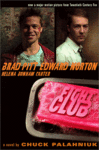
Fight Club by Chuck Palahniuk

Well, now I reckon y’all have seen the movie, so there’s probably not a whole lot that you need to know about this book.

You know Tyler Durden.

He’s the Id, the unchained spirit that wants what he wants and he wants it now. He’s the voice in your head that tells you that everything is worthless, that chaos, death and the end of civilization would be better than anything our so-called “society” could ever create. He’s the one standing over your left shoulder, whispering “Burn it all down. It’ll be fun.” He acts in secret, he has an army of minions, and he has a plan.

Oh yes, you know Tyler Durden.

The narrator of this dark and strange cautionary tale knows Tyler all too well, and tells us of how he and Tyler tried to change the world. It all started very simply – with basement fight clubs where men could let out their rage and frustration on each other. There were very few rules to fight club, but that was okay. Rules were, in fact, the problem. The regimented society in which we live imposes constant rules on us – social rules, cultural rules, corporate rules – that tell us who to be and what to think. The rules of our society have sapped us of our strength and purpose, making us soft. Pliable. Weak.

But Tyler’s plan doesn’t end there – the fight clubs morph into Project Mayhem, a well-oiled anarchist movement, determined to bring down the very fundamentals of our society. With an army at his beck and call, Tyler is sure that his plan will succeed.

It’s a book with a couple of very powerful messages, one overt and incorrect, the other subtle and accurate. The overt message is Tyler’s message – we are a generation with no cause, no purpose. Our lives are governed by what we buy and what we wear, and none of us will die having done anything with our lives. In order to be Real Men, we need to strip away the veneer of civilization – our Ikea furniture, our make-work jobs and our cornflower blue neckties – and rediscover the inner core of ourselves. The brutal, unafraid, unapologetic beast that is Man.

This, to no one’s surprise, appealed to a lot of people when the film came out because it’s a very believable world view. Those of Gen X and beyond are reminded over and over again that the generations before us were the ones who actually did things. The Baby Boomers got herded into the slaughterhouse that was Vietnam, toppled a President, faced down the chaos of the Sixties and fought to change the world. Their parents, of course, were the Greatest Generation – a label that I have come to despise – who fought Hitler and freed Europe. Their parents struggled through the Depression, and their parents fought in the trenches of World War One.

What have we done? Until the beginning of the 21st Century, how had we suffered? What had we sacrificed? Not a whole lot, and I think a lot of us secretly believe that we’re not only not pulling our weight in the world, but that since we have not suffered, we’re not really adult. Our miseries have not been those born of chaos, war and destruction. Ours have been tiny, personal tragedies that are, in their way, insignificant.

I can see where Tyler Durden is coming from on this point – I do sometimes look around me and ask, “Where are our great challenges, our Normandy or our moon landing?” And I fear that without these milestones, my generation will never really be taken seriously.

Unfortunately, this is about where most folks stopped thinking and decided, “Shit, man, he’s right! I wanna start a fight club!” And short-lived fight clubs sprang up all over the country, lasting about as long as it took for people to realize that while Brad Pitt on the movie screen can get beaten within an inch of his life and still look cool, a normal human cannot. They missed the subtle message because it wasn’t one that they really wanted to hear.

The book is not about the triumph of nihilism over a consumer-driven culture. It’s not about being a Real Man. It’s not about being a unique snowflake or a space monkey.

It’s about overcoming both the desire to destroy society and the desire to be completely subsumed by it. It’s about the need for purpose, and the need for connection with other people, and what can happen when one is deprived of those things. Tyler doesn’t show up because the narrator is rootless or bored – Tyler shows up because the narrator has forsaken people for things. He has replaced personal achievement with material gain, and that’s not a very fulfilling way to live.

It is a cautionary tale for our generation – you are not your tragedies. You are not the club you belong to. You are not your scars. You are neither worthless nor undeserving.

You are what you make yourself to be, no matter what Tyler Durden wants.

—————————————————-
“If you could either be God’s worst enemy or nothing, which would you choose?”
– The Narrator, Fight Club
—————————————————-

Fight Club on Wikipedia
Chuck Palahniuk on Wikipedia
Fight Club on Amazon.com
Official Chuck Palahniuk Fan Site

Leave a comment

Filed under anarchy, Chuck Palahniuk, fiction, identity, made into movies, satire, society, terrorism

Review 19: Day of the Triffids


The Day of the Triffids by John Wyndham

I have a long fondness for Apocalyptic novels. The Stand was one of my early favorites from junior high school, and I really enjoyed its cousin by Robert McCammon, Swan Song. There’s something about the End Of The World that just grabs me and won’t let go. Maybe it’s the thought that, should the world end, I would be one of the survivors. The rule of law would break down, all shackles of modern life would be loosed, and I would finally be free to choose my own destiny. Which, knowing me, would probably be very short and end up with me getting shot by some kind of Mad Max pirate tribe.

I can say with some certainty, however, that in this book’s scenario I would not be coming out on top. Because I love astronomy.

Let me explain. This end of the world came in two parts, at least one of which was definitely of our own doing.

It started with a comet. Or a meteor shower. Or something, but whatever it was, it lit up the sky. Green streaks of light brightened the night skies around the world, and everyone who could go and watch them did so. I’m a sucker for a natural light show, so I probably would have spent the night watching the skies and enjoying myself. And I would have woken up stone blind the next day.

That in itself – the vast, vast majority of the human population on Earth being blind – would have been a pretty good apocalypse. Wyndham describes rashes of suicides, accidental deaths and, of course, murder in just the first few days. Without vision, the carefully crafted world we’ve made kind of falls apart. But it would have been survivable. Co-operation groups spring up pretty quickly, both voluntary and otherwise, where sighted people assist the blind in surviving. It would have been tough, yes, but not impossible, for the world to go on. If not for the Triffids.

While we don’t know what caused the green comet, the Triffids were definitely our fault. The product of bioengineering gone haywire, the Triffids are ambulatory carnivorous plants with a poison sting that can kill a grown man from ten feet away. And while they’re not intelligent, they are remarkably… aware. They follow sound, they learn and co-operate in hunting, and are very difficult to eradicate.

But by themselves, they’re manageable. Their stingers can be removed, even though they grow back eventually, and they make interesting garden plants. And they’re immensely profitable – the oil derived from a Triffid outdoes every other kind of vegetable oil available. In normal times, the Triffids are under human control and benefit humanity greatly.

The two problems, when put together, make for a truly terrifying end – an unstoppable, unthinking army of carnivorous plants, finally freed from their shackles. A world in chaos, half-blind and not sure if they have to save themselves, or if someone else will do it for them. And an exciting story.

The message of this book is pretty clear, and Wyndham wastes no time in making sure we get it, lest the adventure part of the book get bogged down. Don’t mess with nature. That’s pretty much it. Don’t mess with nature, because nature will inevitably come ’round and mess right back with you.

Wyndham has created a brave new world for us, with a wide variety of characters who all react to their new situation in different – and realistic – ways. Starting in London, we meet a diverse cast – from the girl who believes that the Americans will save her to the man who believes that polygamy is the way to a brighter future, everyone has an idea on how to survive. The narrator, Bill Masen, knows just enough to get the reader up to speed, but not nearly enough to know if he’s even going to make it out of this alive. With the help of other sighted survivors, he is determined to make a stand, not only for England, but for the human race as a whole.

But first they have to deal with the Triffids….

———————————-
“When a day that you happen to know is Wednesday starts off sounding like Sunday, there is something seriously wrong somewhere. ”
– John Wyndham, Day of the Triffids
———————————-

Day of the Triffids at Wikipedia
John Wyndham at Wikipedia
Day of the Triffids at Amazon.com

1 Comment

Filed under adventure, anarchy, apocalypse, England, John Wyndham, made into movies, science fiction, society, survival

Review 18: Swan Song

Swan Song by Robert McCammon

Okay, have you read The Stand? Humanity being wiped out by a short-sighted government, small groups of people struggling to survive in an America laid low? A dramatic escape from New York through a dark and scary tunnel? An evil adversary from an unknown place whose only dream is the end of the world?

Yeah, that’s Swan Song, too. Only with nukes instead of a virus.

It really is an alarmingly similar story, published about ten years after The Stand, but – and this is important – it’s still a really good book. Derivative? Sure. But it’s still good, which is a neat trick.

The story starts in an alternate world, one that seemed all-too-probable in 1987, when this book was published. The US and the Soviet Union are toe-to-toe, fighting proxy wars all over the world. Nuclear exchanges have already happened between smaller nations. The world is inches away from war, and there seems to be no going back.

Domestically, things aren’t much better. In New York City, the city has fallen to crime and decay – drugs, trash and whores are all that can be found, and if any city deserves destruction it’s this one. It’s the worst projections of New York come true, and its eventual destruction is almost like a blessing.

In the western mountains, a group of survivalists have hollowed out a shelter against the possibility of The End, and Earth House is full to bursting. Young Ronald Croninger and his parents are there, but the boy is not impressed by what he sees. Colonel Macklin,the ex-soldier who is the public face of Earth House, seems to have gone to seed, and the shelter itself is falling apart, just like everything else.

The world is going straight to Hell, and it’s all too easy for the US and the Soviets to send it all the way there.

The book has an epic scope and a massive cast, lined up pretty equally on the sides of Good and Evil. As the book progresses, the disparate groups finally come together in a final confrontation that will decide the fate of the world.

In the midst of all that, a certain mystical quality has arisen. There’s a… being, a creature of demonic countenance who can change his face and travel freely throughout the wasted land. His sole desire is to see the end of humanity – he revels in destruction and despair and wants nothing more than to see the end of Our Heroes. On the other hand is the title character, Swan. As a girl, she loved plants and flowers, and had a strange affinity for the natural world. As she grew up, however, her powers matured, and that affinity became a full-on partnership. They each collect a following, through fear and hope respectively, and they each know that there’s only one way this can all end.

There’s an element of mysticism to this as well, though why it should be there is not explained. For example, the burned-out rubble of Tiffany’s on Fifth Avenue creates a shining glass ring, filled with strands of precious metals and valuable stones. This ring becomes the guide for Sister, a woman who was once mad but becomes the sanest one of the survivors. With the ring, she is able to perform miracles. There’s a magic mirror that shows the future, prophetic dreams and other elements of mysticism. It seems that when the world as we know it ends, the world as we don’t know it steps in. And then there’s the Job’s Masks – a mysterious growth that covers a person’s head in an impenetrable shell, only to crack open years later and…. Well, I’ll let you find out.

The appeal of apocalyptic fiction is an interesting one, and easily understandable. Humans have been interested in how the world will end since about the same time we figured out that the world could end. And there are many ways for it to go, whether it’s the nuclear fire of this book, the insidious virus of The Stand, the near-miss religious apocalypse of Good Omens, the various meteor impacts and climatological disasters that Hollywood loves to show us…. The ways in which the world ends are countless, but they all share one distinct feature – when the end comes, you’ll find out who you really are.

It’s tempting, then, to give it some thought and wonder, “Who would I be, when all was gone?”

This book has some excellent role models to choose from – and to avoid. The characters are compelling, and the world is vividly drawn, so as long as you’re not thinking, “But this is just like The Stand!” you should greatly enjoy it. I highly recommend it.

————————————————-
“Once upon a time, we had a love affair with fire.”
– Robert McCammon, Swan Song
————————————————-

Swan Song at Wikipedia
Robert McCammon at Wikipedia
Swan Song at Amazon.com
Robert McCammon on Swan Song
Robert McCammon’s homepage

BONUS! The Boyfriend decided that there needs to be pictures of me recording the podcast. So he took some….

Doing the Podcast

Doing the Podcast
Listening to the playback. I’ve had a haircut since then….

2 Comments

Filed under apocalypse, death, fantasy, good and evil, horror, nuclear war, Robert McCammon, society, survival, totalitarianism, war

Review 17: The Stand

The Stand by Stephen King

It’s hard to know where to begin when writing about this book, probably because I work under the assumption that everyone has read it. I mean,. I’ve probably owned at least four different copies over the years, and it occupies a permanent place on my bookshelf. I can’t imagine anyone not having read it. But I guess that’s what everyone thinks about their favorite books, so I’ll fill in those of you who haven’t.

It’s the end of the world. Not in the horrible confluence of blindness and carnivorous plants, or in the fiery desolation of nuclear war. The world dies in a more unpleasant way than that, and it all begins in Project Blue – a US military lab in the southwest. There they’ve built the greatest plague mankind has ever known, a shapeshifting flu virus that is 99.4% communicable and 100% lethal. Its intended use was probably against the Soviets or some other enemy state, but… Things fall apart, the center cannot hold, as Yeats said. And on June 13th, 1990, the superflu got out.

It was carried by Charles Campion and his family, spread throughout the southwest until Campion died in a gas station in Arnette, Texas. From there it hopped into the men gathered at the station, who passed it on to nearly everyone they met.

By June 27th, most of America was dead. And thanks to the final command of the man in charge of Project Blue, the virus was spread around the world as well. By Independence Day, the population of the world – that which by some strange genetic luck was immune – was reduced to less than the pre-plague population of California.

Of course, not everyone who was immune escaped unscathed. There were accidents, mishaps and murders that probably brought the number down, but not by much. Scattered survivors struggled to understand why they lived when so many had died, and started to seek out others like them.

And then came the dreams. An ancient woman, living in a cornfield. She radiates goodness and compassion (and still makes her own biscuits). Mother Abagail is the beacon of hope for those who see her in their dreams. And then there’s the other, the Dark Man, the Walkin’ Dude, whose shadow brings madness and whose gaze brings death. He is Randall Flagg, a man whose time has come ’round at last. Just as Mother Abagail attracts the good and strong, so does Flagg attract the weak and frightened. Around these two do the remains of America come together. And neither one can let the other exist without a fight….

What keeps bringing me back to this book? Well, a lot of things. For one, the writing. King has said that he’s a little disturbed about The Stand being the fans’ favorite – it means he did his best work thirty years ago. Not entirely true, I think, although I am hard pressed to say which of his other books exceeds it. King’s sense of scale as a writer is outstanding. We get into our characters dreams, in their innermost secret thoughts, and then a few pages later are presented with an overview of what’s happening around the nation. It’s like being able to go, in Google Maps, from someone’s bedroom all the way out into space. He dances between characters smoothly, so just when you get to the point where you’re thinking, ‘Yeah, but what’s Flagg doing?” he brings you there.

And speaking of the characters, they’re people who will stay with you long after you finish the book. The quiet confidence of Stu Redman, the single-minded madness of the Trashcan Man, Larry Underwood’s late maturity, Lloyd Henreid’s devotion, Fran Goldsmith’s determination…. Each character rings true. Even the ones who really shouldn’t have ended up the way they did – and I’m thinking of Harold and Nadine here – you can’t help but find bits of them to love. Had they been strong enough, Harold and Nadine never would have gone as bad as they did, and I think even King kind of had a hard time making them do what he wanted.

Underlying all this, of course, is a kind of Old Testament religiosity. The God of Mother Abigail is not the kind and friendly God of the New Testament, He is the angry one of the Old. He is the God who will gladly wipe out nearly all of mankind to prove a point, and will make a 108 year-old woman walk into the desert by herself because she’s getting a little too uppity. In this world, at least, God is most definitely real, even though His purpose is hard to understand.

I could go on. Thesis papers could probably be written about this book, and I reckon they already have been. But that’s not why I do these reviews. I do them because I want y’all to know what’s worth reading.

This book is worth reading.

——————————————-
“Show me a man or a woman alone and I’ll show you a saint. Give me two and they’ll fall in love. Give me three and they’ll invent the charming thing we call ‘society’. Give me four and they’ll build a pyramid. Give me five and they’ll make one an outcast. Give me six and they’ll reinvent prejudice. Give me seven and in seven years they’ll reinvent warfare. Man may have been made in the image of God, but human society was made in the image of His opposite number, and is always trying to get back home.”
– Glen Bateman, The Stand
——————————————-

The Stand at Wikipedia
Stephen King at Wikipedia
The Stand at Amazon.com

1 Comment

Filed under apocalypse, death, disease, fantasy, good and evil, horror, made into movies, society, Stephen King, survival, war