Monthly Archives: September 2011

Review 142: Otherland 1 – City of Golden Shadow

Otherland 1: City of Golden Shadow by Tad Williams

Let me just start by saying this: the first time I finished this series, I immediately went back and started reading it again. I can’t think of any other series that I’ve done that with.

This is one of Tad Williams’ “economy-sized manuscripts,” similar to his fantasy classic Memory, Sorrow and Thorn. Similar in size and scope, anyway – four giant tomes chock full of all things awesome. It’s a series of grand scope, amazing scale and great imagination, well worthy of your time. It’s a complex, interweaving of tales, full of vibrant characters, implacable enemies, and important questions about destiny, identity, consciousness and the very nature of reality itself.

Seriously, top-shelf stuff here, people.

Mind you, Second Life's dreams aren't all that big.

It begins in a near-future world, and it begins with the children. Renie Sulaweyo, a teacher in South Africa, has a brother in the hospital. He, like many other children around the world, has gone into an inexplicable coma, the causes of which defy medical science. The only clue she has is that the outbreaks of these comas coincide with the availability of access to the Net – a virtual reality internet that is what Second Life dreams of becoming. Here, depending on your equipment, you can live in a virtual world that is more vibrant and exciting than anything the real world can offer. And you can do it in full sense-surround 3D.

Renie’s brother, Stephen, engaged in the usual mischief that any kid with access to his own virtual universe might do, and finally got caught. Something shut him down, and Renie was determined to find out what did it. With the assistance of her student, a Bushman named !Xabbu, Renie uncovers an amazing virtual world, something that puts the best virtual reality to shame. It is the Otherland, a playground for the obscenely wealthy. And it may hold the secret to what has afflicted her brother.

And if you think WoW is nuts now? Imagine it fully immersive. Okay, nerds, get back to gold farming...

That’s the short version, and since Renie is the one we’re introduced to first, it would be easy to think of her as the protagonist of the story. That would be highly inaccurate, though. There’s a lot of other storylines going on in there as well. There’s young Orlando Gardiner, who compensates for a crippling illness by being the baddest barbarian on the net. His best friend, Sam Fredericks, has stood by him for many years in an online game that makes World of Warcraft look like pen and paper D&D. They and others are lured into a deadly quest by a vision of a great golden city, more realistic and magical than they ever thought they could find.

Out in the real world, there’s little Christabel Sorenson, upon whose earnest desire to help the funny-looking Mister Sellars the entire future of the Otherland rests. There’s the aptly-named Dread, an assassin extraordinare whose strange “twist” gives him an edge in all things electronic. And, of course, there is Paul Jonas, a man trapped in an imaginary world, whose escape threatens the greatest dreams of the richest men the world has ever known.

All of this, as the series title suggests, centers on the Otherland project, a virtual reality of monumental proportions. It’s a digital world that is more real than the real world is, a world of computer-created, but very deadly, dangers. The slightest misstep could spell disaster and death – die in the Otherland and you die in real life.

This doesn't happen in Otherland, by the way. Lucky them.

And just FYI, Otherland predates The Matrix by three years and, kung-fu aside, is a much better story. So if you’re thinking, “Man, this is just a Matrix rip-off, you’re very, very wrong.

It’s a daunting series to begin. After all, it’s four books, each one clocking in around 800 to 900 pages. There are at least fifteen major characters, and the Otherland itself shows us seven different “worlds” in this book alone. There’s a lot to take in, and on top of all that, there’s a whole world happening outside the story – each chapter is preceded with a small news blurb that tells us about things that are going on in the world. Cops rounding up homeless kids in lethal “snipe hunts,” homicidal artists, legislative representation for the industrial sector of America – this world is both familiar and alien at the same time.

Then again, neither does this. Tad Williams does have his limits.

The good news is that it is a lot of fun to read. The pacing is very good, so you never get too bored watching any one character for a while. What’s more, Williams pays homage to some of the greatest fantasy and science fiction the English-speaking world has to offer. At one point, even the characters admit that they seem to be caught up in a very familiar story. So my advice is to just dive right into it. Once you get going, things clip along at a good pace and you’ll find yourself on page 943 in no time flat.

The really fun part is re-discovering things in this series. There are some things I remember very clearly, but other little details that pop up and make me think, “Oh yeah, I forgot all about that.” I enjoy seeing Williams’ prescience – after all, he wrote this just as the internet was really becoming popular, and a good ten years before things like online gaming and social media took over our lives. His vision of an immersive, VR world may have seemed a little wild and out there back in the mid-nineties, but not anymore.

So, make a sandwich and find a comfortable place to sit. This’ll take a while, but I guarantee – it’ll be worth it.

———————————————-
“If you have found this, then you have escaped. Know this – you were a prisoner. You are not in the world in which you were born. Nothing around you is true, and yet the things you see can hurt you or kill you. You are free, but you will be pursued….”
– Sellars to Paul Jonas, Otherland: City of Golden Shadow
———————————————

Tad Williams on Wikipedia
Otherland on Wikipedia
City of Golden Shadow on Amazon.com
Tad Williams’ Website

Leave a comment

Filed under adventure, brothers, fantasy, fathers, friendship, gender, gender roles, internet, quest, science fiction, sisters, survival, Tad Williams, transhumanism, virtual reality, world-crossing

Review 141: One Flew Over the Cuckoo’s Nest

One Flew Over the Cuckoo’s Nest by Ken Kesey

As all dedicated readers out there know, there is a rule when it comes to books that are made into movies: the book is always better. [1] With a book, you have more time to really savor the story, to think and consider the plot and the characters and the motivations. You can go back and re-read, stop and give the story some thought and, most importantly, let the characters come to life in your own mind. This is key, and part of what makes reading so much fun. The author gives you a basic outline of who each character is, but the details of that character will vary from reader to reader, and I guarantee – my Randle Patrick McMurphy is different from your Randle Patrick McMurphy.

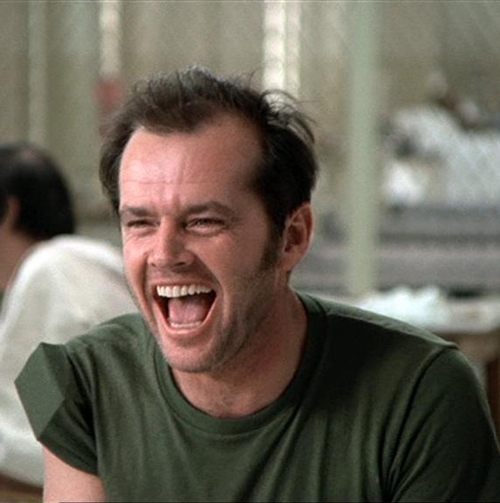
And my Randle Patrick McMurphy is most certainly not Jack Nicholson. I know there’s a lot of love out there for Jack, but let’s face it – Jack Nicholson was the non-comedy equivalent of Jim Carrey in his day. The same way Carrey is the default choice for “Wacky” these days, I’m pretty sure producers back in the 70s and 80s said, “We need someone who can play nuts – get Nicholson!” And he’d come out and give That Nicholson Look which made you think that he was liable to tear your throat out at any second and that’s it. I’m not saying he’s bad at what he does – he plays one note, but he plays it well.

This is a face you can trust.

The problem is that McMurphy isn’t actually nuts. He’s brash, temperamental, insolent, contrary, but not crazy. And, to borrow from the perspective of the narrator, Chief Bromden, I don’t think that Nicholson was big enough to be McMurphy. I’m not sure if I know who would have been.

So after all this about who McMurphy isn’t, let’s take a look at who he is.

There is a mental institution up in Oregon, which caters to all kinds of mentally ill patients. They care for them as best they can, keeping a close eye on the men in their care and making sure they stay in a rehabilitative state. Through the use of regular counseling sessions and the occasional narcotic therapy, they are trying to make these men back into functioning members of society, if that is at all possible. Not all of the patients can be helped – some suffer so badly that they will live out their remaining years in the institution. But there are others who have a chance, some self-admitted, even, who are looking to move towards the path to wellness. The hospital, and especially the Head Nurse of the ward, Nurse Ratched, are devoted to their tasks and do whatever they can. This being the middle of the twentieth century, their methods are, by our standards, barbaric at times – the liberal use of electroshock, for example, or even occasionally resorting to lobotomies. But mostly Nurse Ratched uses her own innate ability to cajole, nudge, scare and shame these men into line so that her ward operates as a smoothly-running machine.

No, THIS is a face you can trust...

Until the appearance of McMurphy, a man who is not ill but is rather facing madness to get out of working on a prison farm. As soon as he appears on the ward, he becomes a threat to the Big Nurse’s clockwork kingdom. He has no patience for her rules, and indeed sees her as a challenge – how soon can he get that perfect, porcelain facade to crack and show what’s really underneath? He’s sure he can, and he’s willing to sacrifice his own freedom to do it. In doing so, he shows the other patients on the ward that they don’t have to be afraid – of her or of the world.

The book is a cracking good read, and well worth your time, just as a story of a perfectly ordered world tipped upside-down. As an allegory, of course (and a very clear one, at that) it’s even better. This is a story about order and chaos, about freedom and security. Nurse Ratched has a very well-ordered world over which she exerts perfect control. The men in her ward are taken care of, if not exactly helped, by her and her crew. There is no freedom for them, but no danger either, and for many of the men, that’s a life they can live with, if not enjoy.

McMurphy, then, is chaos. He’s the sand in the gears, the hair that won’t go where you want it to go no matter what kind of salon goop you put in it. He’s the rebel who will break the rules just because they’re rules and who prizes freedom above all else. This isn’t to say that he’s a saint – McMurphy spreads his own brand of freedom mainly by manipulating the other patients. In that way, he’s very much like Nurse Ratched, though I think he’d strangle anyone who said that to his face. But whereas the Big Nurse gets her pleasure from watching men get cut down and made docile, McMurphy gets pleasure from men finding their strength. And if he manages to make some money or have some fun of his own while he’s doing it, then all the better.

Or "freedom"

It’s a novel of freedom, naturally. It’s about people choosing their own destinies (even if the people in this book are mostly men – with the exception of Nurse Ratched, women don’t come off so well in this book.) It’s also about freedom as a society. The Nurse and her minions represent a culture that insists on conformity, that finds comfort in rules, regulations and regularity. Called “The Combine” by the book’s narrator, it would rather cut people down to size, because that’s the only way it can exert control. McMurphy shows us that we are the ones who should be in control of our lives. It’s hard, it requires risk, but the rewards are far, far greater than blind, sheeplike obedience.

The book is narrated to us by one of the more far-gone patients, a half-Native American man named Chief Bromden. He has been in the hospital for many years, and as far as the others are concerned, he’s a deaf-mute. McMurphy catches on that he’s faking pretty quickly, though, and manages to make Bromden feel like the big man he used to be. But as a narrator, it must be remembered that Bromden is unreliable – he occasionally drifts off into hallucinatory visions, and his interpretation of events is filtered through the strange, paranoid reality he’s constructed where the world is run by an Illuminati-esque “Combine” that replaces people with machines. In fact there’s a line in the very first chapter that made me wonder about the whole story: “It’s still hard for me to have a clear mind thinking on it. And it’s the truth, even if it didn’t happen.”

Two guys playing chess under an oddly-shaped chandelier. What?

So how much of the story is real? We have no idea. The Chief tells us everything he can in the best detail he can, and is an excellent relater of the tale. But knowing that he’s rather biased, we have to wonder if the heroism of McMurphy and the wickedness of Ratched are as bad as they’re made out to be, or if Bromden’s mind has changed them, made them into the avatars of freedom and control that he feels represent the way the world works. We can never know, and if you assume that he is reliable, the story is excellent.

A small confession, though: I feel kind of sorry for Nurse Ratched. I know, I know, it’s like saying, “Yeah, Hitler was bad, but I see where he was coming from.” She is undoubtedly one of the best villains in modern American fiction – frankly, between her and Darth Vader, I think she’d have him sobbing like a little baby within ten minutes (“Mister Skywalker, do you really think that this habit of choking people is beneficial to you? Would it not be more mature to discuss your feelings of disappointment? What would your mother say if she could see you like this?”) But I am a fan of order in general. I know how it feels to have a well-ordered routine get screwed up, and I think it sucks. So, putting myself in her shoes, I can see how she’d view McMurphy as a threat, and try to beat him in the only manner she knew how.

And she does beat him. But she has to cheat to do it, so I can’t really say that she wins.

—————————————
“All I know is this: nobody’s very big in the first place, and it looks to me like everybody spends their whole life tearing everybody else down.”
– R. P. McMurphy, One Flew Over the Cuckoo’s Nest
—————————————

[1] The exceptions are Lord of the Rings, where I like the movies better, and Watership Down and The Princess Bride, both of which I hold equal to the books.

Ken Kesey on Wikipedia
One Flew Over the Cuckoo’s Nest on Wikipedia
One Flew Over the Cuckoo’s Nest on Amazon.com

Leave a comment

Filed under fiction, humor, Ken Kesey, made into movies, psychology, therapy

Review 140: The Shining

The Shining by Stephen King

I’m going to have pick on Jack Nicholson here, but I’m pretty sure he can take it. If I get an angry email from him, I’ll let you know. I’m also going to take a couple of shots at Staley Kubrick, who is dead and can’t defend himself, although I can probably count on some of his loyal followers doing so in his stead. Basically my goal in writing this review is to encourage you to completely ignore the film version of The Shining and appreciate the book.

Thankfully, the original line - "DY-NO-MITE!" - was cut.

To be fair, though, the film and the book really are two different beasts. They share a basic story line, yes, and some characters, but they’re looking at the story from different points of view. The film did create some iconic moments – Danny running his bigwheel down the hallway, the elevator vomiting blood, and “Heeeeere’s JOHNNY!” which isn’t outdated at all, of course. Note to filmmakers, no matter how brilliant you think you are: pop culture references have a short shelf life. Avoid them. But I think that Kubrick’s film kind of misses the point, which disappointed me greatly.

Anyway, this isn’t a movie review. So let’s shut up about that for a while, shall we?

The book is one of King’s earliest, written in 1977, and like so many of his early works it’s one of his best. It’s a tale of a hotel that’s more than just haunted – it’s possessed. It’s a place that has been a witness to all kinds of evil, inhumanity, and malice, and the spirits that inhabit it are always looking for company. So allow me to present Jack Torrance. A once-promising writer, former teacher, and an alcoholic, Jack is man whose life is on the edge of collapsing. After being fired for beating the daylights out of one of his students, the job as caretaker for the Overlook Hotel is, as far as he’s concerned, the only thing keeping him and his family from complete destitution and shame.

And let’s be clear about this right up front – Jack loves his family. He loves his wife, Wendy, even if she does get under his skin from time to time, and he is utterly devoted to their son, Danny. He knows that his own upbringing, with an abusive, alcoholic father, didn’t prepare him to be a good head of household. He knows that his own drinking problems led to the breaking of his son’s arm, an incident which very nearly destroyed his marriage. He also knows – or at least believes – that he can change. That’s why he took the job at the Overlook, in order to have some time to reset. Spend sober time with the family, finish the play he’s been working on – take a breather and get ready to rebuild their lives.

See? A cozy, family-friendly place.

The Overlook is one of the premiere hotels in Colorado. It’s a place that just exudes luxury, with a history stretching back to the early 1900s and everything a person vacationing in the Rockies could want. But because it’s perched in the mountains, it has to close down for the winter. No sane person would drive up there when the snow really got started, and so the need arose for a live-in caretaker to make sure the place doesn’t succumb to the elements. It’s a lonely and perilous job, miles away from help and civilization, but the right kind of person can probably do it.

Jack might have been able to manage, if the hotel weren’t the vessel for some evil, malevolent entity that thrived on the horrible things that men do to each other. For lack of a better phrase, the hotel is psychically charged – memories permeate it, making it haunted on nearly every level. Normal people can’t perceive this – they might feel uneasy in a certain room, or hear some strange sounds at night, but if you’re a garden-variety person, you won’t notice a thing.

Any kid who talks to his own finger has gotta be watched.

Five year-old Danny Torrance is not a normal person. He has the Shine, as it is called – a psychic ability of great and wondrous strength. He can read his parents’ emotions, he can predict the future and see the past. While his power isn’t fully under his control, he knows that he’s not like other children. His is a unique mind, and it is this power, this shine, that both dooms and saves him. (As a note to Dark Tower fans – don’t you think Danny would have made a great Breaker? I wish King had hit on that….)

The hotel knows it too. It wants to use Danny to power itself, to perpetuate its evil. But it can’t get to Danny – so it gets to Jack. It preys on his weaknesses (and Jack Torrance has oh so many weaknesses) and uses him as a tool to destroy his own family.

Truly this is a creepy book. The descriptions are careful and evocative, and when King wants you to be scared, you can be damn sure that you’ll be scared. It’s cabin fever in book form, and the longer you read it, the more you can feel the hotel pressing in on you from the pages. It’s a terrible, terrible tragedy, the slow destruction of what could have been a good and happy family, had they not come to this place. To be fair, Jack Torrance was not a very good human being to begin with, and the odds are good that he would have ruined his family eventually. Under the roof of the Overlook, though, he never even had a chance. As you read, you realize that while it’s hard to like Jack, you can certainly understand him.

Ladies and Gentlemen - Shelley Duvall!

And that’s why I like the book better than the movie. The film makes Jack the villain. It makes him into a guy who snaps under the pressure of not drinking, not being able to write and having a wife played by Shelley Duvall, who could have been replaced with Munch’s “The Scream” on a stick to as much effect. In the end, it’s Jack who betrays his family, Jack who tries to murder his wife and son, and Jack who dies frozen in the hedge maze.

The thing is, that’s not how King wrote it. While Jack certainly isn’t redeemed by the end of the book, it is clear that the person who was chasing Danny through the halls with a roque mallet, the person who nearly bludgeoned Wendy and Hallorann to death was not Jack Torrance. He may have looked like him, but what was doing all the evil was the thing that had defeated Jack – it was the thing that had killed him. And I think that story, about a man who was just not strong enough to resist a far greater power, is more interesting than a story about a guy who just goes nuts. Jack’s character in the book is far more nuanced and deep than I thought he was in the film, and it saddened me to see him pressed into two dimensions. And again, I think Jack Nicholson – while perhaps adequate for the role as Kubrick saw it, was not the Jack Torrance that I saw in this book.

As an aside, I thought the TV miniseries was much closer to the book and, thusly, better. True, it lacked a lot of Kubrick’s more famous directorial panache, but since a) Kubrick ruined the movie and b) I’m not a big fan of his anyway, I didn’t hold that against ABC.

Jack is not that far from Homer Simpson, really....

The book wasn’t written, I think, with a lot of Deeper Meaning in mind. I’m sure King would be the first to admit that. It’s a kind of psychological study of how to turn a weak person into a bad person, and how much pushing it would require to make a man turn to evil. It looks at the bad choices we make, and how we fool ourselves into making them. Jack Torrance is a cautionary tale against self-pity and self-delusion. Jack views himself as a perpetual victim, held back by his upbringing, his wife, his alcoholism – nothing that goes wrong in his life is actually his fault (according to Jack). Had he taken responsibility for his actions and his errors, he might have withstood the Overlook’s attacks.

The big question for this book is this: was any other outcome possible? Did the Torrance family have any choice in what happened to them, or were they doomed from the moment they set foot in the hotel? I vote for the latter. While they certainly had their chances – many chances – to get out and escape the horrible future that was bearing down on them, it was clear that was never going to happen. Jack was a man who was far too weak, too selfish and too self-absorbed to let himself leave the Overlook. And so they were doomed. The fact that anyone got out of there at all was a miracle.

This is part of the Stephen King Required Reading set – if you’re going to read any King at all, you need to read this one. It’s a horror book that’ll stay with you for a long, long time.

———————————————
“The boiler’s okay and I haven’t even gotten around to murdering my wife yet. I’m saving that until after the holidays, when things get dull.”
– Jack Torrance, The Shining
———————————————

Stephen King on Wikipedia
The Shining on Wikipedia
The Shining on Amazon.com
Stephen King’s homepage

2 Comments

Filed under children, death, family, fathers, fear, horror, made into movies, madness, murder, sons, Stephen King, wives

Review 139: The Science of Fear

The Science of Fear by Daniel Gardner

Imagine, for a moment, one of our early human ancestors. A first-generation Homo sapiens, exploring his world with an amazing brain that would be the envy of the animal kingdom. If they understood envy. He, and his children, and their children and grandchildren will spread across the Earth as hunter-gatherers, the first beings (so far as we know) who can look at the world and attempt to pass on what it knows and learns. Their threats were simple: survive or don’t. Find food or starve. Hunt or be hunted. And those fantastic brains did such a bang-up job that their descendants are still walking around, thousands of generations later.

Now, take that Paleolithic man – swift of foot, sharp of eye, strong of hand – and drop him in the middle of modern-day Times Square. And, as his minder, give him a bored, easily distracted teenager – one who knows the world, but can’t be bothered to do the work to make decisions.

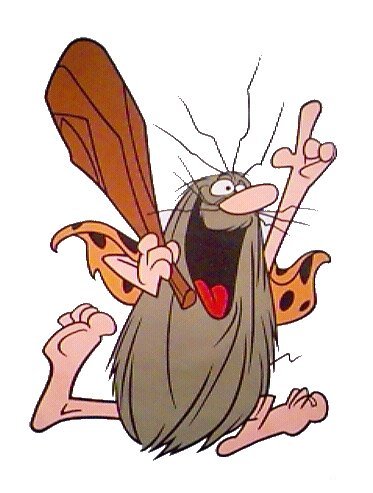
We are all of us Captain Caveman.

Congratulations. According to Daniel Gardner, we have just constructed a fine metaphor for how the human brain works. Part of it is very old, able to make decisions in an instant based on the slimmest of clues. The other is newer, more rational and savvy, able to put together reasoned, logical arguments, but doesn’t have the sheer speed and force that is prehistoric partner has. And as much as we want it to be true that the rational, modern part of our mind is in charge,the sad fact is that out inner caveman has far more influence over us than we care to admit.

Gardner begins the book with an interesting story about the most terrifying thing to happen in the last decade – the attacks of September 11th in the United States. By the time the towers fell, people around the world were watching, and anyone who didn’t see it live would surely see it soon enough as it was replayed over and over again. It was truly terrifying to watch, unlike anything Americans had seen before in their country, and it scared the ever-loving hell out of people. Many people, as a result, chose to forgo air travel in favor of driving.

Now, as Superman famously told Lois Lane, flying is statistically the safest way to travel. In fact, the most dangerous part of any trip that involves flying is usually the drive to the airport. But, in those days and months after the attacks, people were scared to fly. So they drove instead. And, according to a five year study of traffic fatalities in the U. S. after 9/11 by German psychologist Gerd Gigerenzer, 1,595 people died on the roads who otherwise would not have.

They were afraid, and that’s understandable. But they were afraid of the wrong thing. So they died.

Gardner sets out in this book to figure out why it is that people in the healthiest, safest, most prosperous nations on Earth – in the healthiest, safest, most prosperous era of human history – live in a state of near-constant fear.

As long as he doesn't insist on eating children halal, I don't care...

A lot of it, as the intro implies, comes down to the fact that our brains, which evolved over millions of years to be very good at judging risks that might be found on the savannah, are simply not prepared to do the same in a modern technological world. Our brains can’t tell the difference between risk in fiction and reality, between something that happened to us and something we saw on the news. When it comes to risk, our brains play it very safe, which is great out in nature. Is that shadow in the bushes a tiger? Maybe, maybe not, but either way it’s probably a good idea to get the hell away from it. We can’t say the same thing of that guy sitting on the bus who looks like maybe he might be a Muslim.

We also tend to assume that if we’ve heard of something recently, then it must be more common. Again if you’re out in nature and you saw a bear yesterday, there’s a decent chance that the bear is still around today and you might want to be wary of that. But what if you see constant news coverage of a high-profile child abduction? It’s on every show, being talked about on every blog – does that mean that the chance of your child being abducted has increased? Of course not, but your brain doesn’t see it that way. Your brain thinks that your child will be taken from you the moment you look away, and all the reasoning in the world won’t change its mind.

One more thing: we don’t get numbers. The news tells us that the rate of certain risks is up by 10%, but they don’t tell us what the original figure was. We hear about millions of starving children in Africa, but don’t do anything unless we get a personal story of one. We don’t understand probability at all, we can’t deal with randomness, and this lack of innate numeracy (compounded by an educational culture that makes it hard to teach kids to become numerate) costs us billions. Or more, as the recent economic Clusterthing has shown, when you have people who are good with numbers deliberately exploiting this flaw in order to profit.

Numeracy is also useful for getting certain kinds of jokes.

We think that correlation equals causation. We believe stories over facts. We think we don’t have biases that we clearly possess. We assign high risk to things we don’t like and low risk to things we do, regardless of how risky they actually are. And on top of all that, we know how to exploit others’ fears in order to gain money and power for ourselves. It’s easy to do, and it works like a charm.

Reading this book won’t make you into a magically unflappable person, mainly because all of this stuff is pretty well hard-wired in our brains. Even Gardner, who should have known better, tells a story about hunting through the slums of Lagos in the middle of the night to retrieve a photo of his children from the wallet that had been stolen from him. He had plenty more, but at that moment, his brain was convinced that losing the photo meant losing his children. Irrational, yes, and it nearly got him killed, but that’s just one example of what a powerful force this primitive brain is.

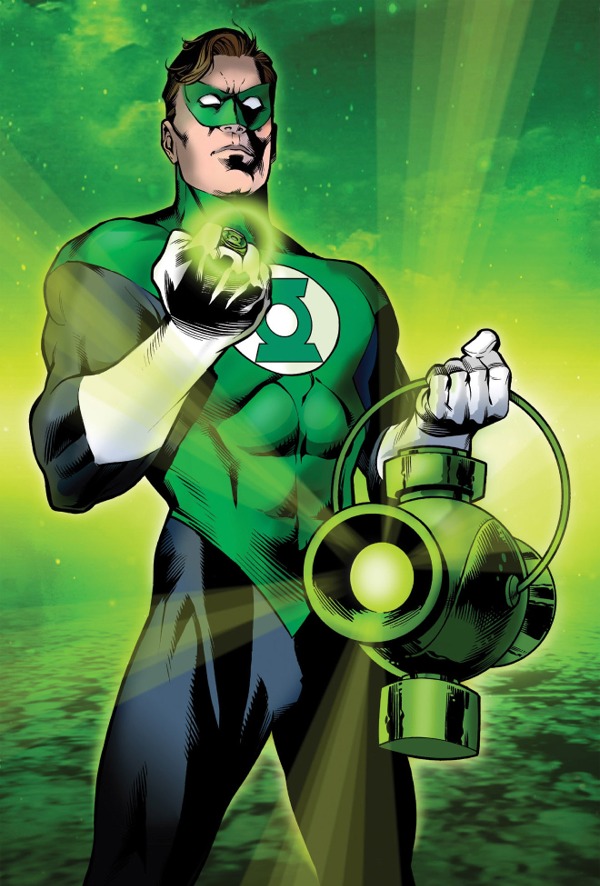
Never overlook an opportunity for a Green Lantern reference.

The good news, though, is that you can strengthen the newer, more recent brain – the lazy teenager from the initial example. By knowing how you make mistakes, how you can be fooled into fearing things that you don’t need to fear, you can better understand your own reactions to events and make better decisions. You can educate yourself about the things that are actually dangerous, and stop losing sleep over the things that are not a threat. Being afraid is not your fault – it’s an ingrained biological feature. Staying afraid, on the other hand, is something over which you have control. With enough will power, even you can overcome great fear.

Sorry. Nerd moment there.

Are there terrorists who want to destroy the United States? Sure. But they won’t, because doing so is indescribably harder than certain politicians would have you believe. Are there creepy child molesters who want to abduct and defile your children? Yup. But the chances of that actually happening are so low that the odds of any specific child becoming such a victim are nil. Are there angry teens who want to come to their school and kill everyone they see? Of course. But when you look at the incidence of school shooting compared to how many kids go to school every day, you can see that the odds of your children being caught in a school shooting are slim to none. In fact, there are many parts of the country where your children are probably safer in school than out of it.

There are real risks in our modern world, but they’re not spectacular and they’re not viscerally terrifying. A car accident, a heart attack, a diabetic death – these things don’t make the news. Imagine a 9/11-style attack happening every three days, 3,000 dead each time. It would be an outrage, a national disgrace, and people would be scared to their bones. But it would take just about 233 attacks to equal the number of deaths in 2001 that occurred from cardiovascular disease in the United States.

The nearly nonexistent chance of being killed by terrorists is enough to get people to submit to any number of indignities and intrusions on their persons and liberties when they travel, but the very real risk of death from a heart attack isn’t enough to get people to go take a walk once in a while or stop eating junk food. So enjoy that delicious moment of irony the next time you go through the TSA molest-a-thon and get a seriously overweight screener taking liberties with your person.

The fact is that we have it damn good compared to our ancestors. We live longer, we live better, even in parts of the world that are still developing, and it looks like the future will progress that way. But we still insist on needing to be afraid, even as we have less and less to actually fear. So put down the newspaper, turn off the 24-hour news, and take some time to figure out what is actually a threat. Give that bored teenager something to do with his time and let the caveman go back to his cave.

————————————————–

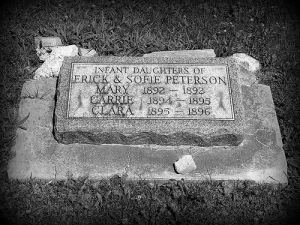
You don't see a lot of these anymore. There's a reason for that. (photo by Steve Cornelius on Flickr)

“Anyone who has spent time in a Victorian cemetery knows that gratitude, not fear, should be the defining feeling of our age. And yet it is fear that defines us. We worry. We cringe. It seems the less we have to fear, the more we fear.”
– Daniel Gardner, The Science of Fear

1 Comment

Filed under culture, Daniel Gardner, fear, media, nonfiction, psychology, science, security, society, terrorism, The United States

Review 138: JLA/Avengers

JLA/Avengers by Kurt Busiek and George Pérez

Everybody loves a good team-up. No matter who your favorite hero is, whether in the realm of sports, music, science, writing, art – you get a secret thrill from the idea of what they could achieve if they worked together. Sometimes it’s brilliant, like when Neil Gaiman and Terry Pratchett teamed up to do Good Omens. Sometimes it’s inspiring, like the pop music wonder that was “We Are the World.” Sometimes it’s overwhelming, like the 1992 Olympic basketball Dream Team. Sometimes it’s Damn Yankees, and the less said about that, the better.

Regardless, we all love to play that game of “What if,” pairing together not only the greatest talents we know, but sometimes the greatest talents in history. What if Albert Einstein and Isaac Newton could have studied the universe together? What if we could get Abraham Lincoln, Franklin Roosevelt and John F. Kennedy together to work on the problems facing the nation? What if Kurt Kobain and Jimi Hendrix were able to cut an album together? The team-ups are endless, and most of the time they’re impossible.

Some team-ups, however, are best left unimagined.

Fortunately, that’s where fiction steps in. The Justice League was created by Gardner Fox and Mike Sekowsky over at DC Comics back in 1960. The idea was to take the greatest heroes the company had in their library and team them up to fight battles that no one hero could face alone – Starro the Conquerer being the first among them, and thereafter many more. Aliens, mad scientists, evil kings, vengeful gods, all those who attempted to conquer, destroy, or devour the Earth were stopped by the League. Though the membership roster has changed many times over the years, as has the style of the books, the League has been a fixture in the DC Comics universe for more than forty years.

As Stan Lee tells the story, the publisher of DC Comics, Jack Liebowitz, bragged over a round of golf to the owner of Marvel, Martin Goodman, about how well his new Justice League title was selling. After the game, Goodman called Lee and told him to create a hero team to compete. Stan’s imagination provided him with the Fantastic Four, and a comic book arms race had begun. Lee produced hero after hero for Marvel, conveniently housing most of them in New York City. From there, it made sense to have them get together to fight even greater menaces. With the pencils of comic book legend Jack Kirby, Lee created The Avengers, the mightiest hero team of the Marvel universe. They too have undergone a lot of changes in the last four decades, but they remain the elite team of heroes to which every costumed adventurer aspires.

Damn, they're cool.

Superman, Batman, Aquaman, Wonder Woman, Green Lantern, Flash, Martian Manhunter….

Captain America, Thor, Iron Man, Ant-Man, Hulk [1], the Wasp, Hawkeye….

These are names that every comic book fan should know, and deep down inside we all wonder: what would it be like if they could get together? What’s more, what kind of foe would require the combined might of two of the greatest hero teams in comic book history? It could only be something on a monumental scale, something that endangers the existences of both universes. Something like… Krona.

If you’re a long-time reader, you might remember that name. Krona was the reason for the Crisis on Infinite Earths – his obsession with seeing the beginning of the universe led to the fissioning of that universe into a nigh-infinite number of parallel ones. It was only after a titanic series of battles that the singular universe was put right, and Krona was transformed into pure energy and banished for his crimes. Or so we thought.

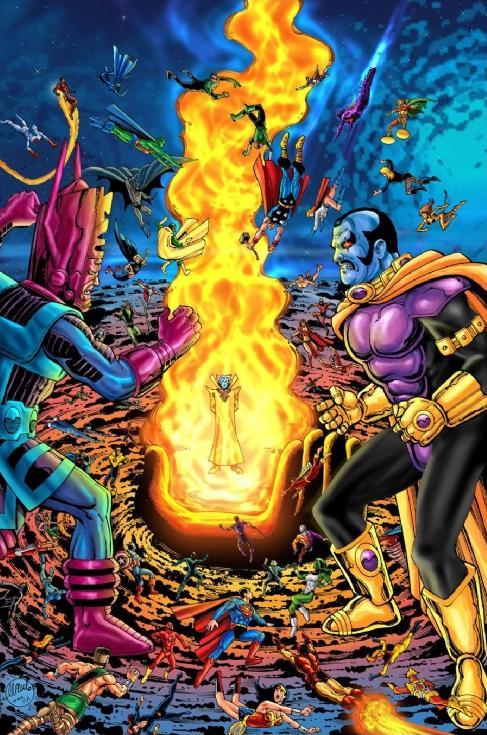
Obsessive to the core, Krona figured out how to escape his universe and started again on his quest to understand the beginning of all things, even if it meant destroying every single universe that defied him. Eventually he came to meet the Grandmaster, an immortal on the Marvel side whose limitless existence drove him to play cosmic games of chance with whatever other great powers he encountered. He knew someone who could possibly answer Krona’s questions – the planet-devourer Galactus – and challenged him to a contest: the greatest heroes of each universe would compete to gather items of power. If the DC team won, Krona would leave and search elsewhere. If Marvel’s team won, it would bring ultimate destruction to both cosmoses.

I dunno. I was hoping for something... well, cosmic.

And so the teams met, and like all good superhero team-ups, it started with a fight. Something about the two worlds put the visitors on edge, and both Superman and Captain America were willing to pound their opposite numbers into the dirt if need be. Fortunately, as in all good hero team-ups, their differences were put aside in favor of battling Krona and saving both of their universes from utter annihilation.

It’s a vast story, both in time and space, and manages to bring together pretty much everyone who has ever been part of the two teams, both in terms of the heroes that made them up and the villains they fought. Yet it feels fairly intimate – these aren’t two whole universes that are battling for survival, but two teams, who manage to mesh together surprisingly well. A lot of the credit for this, of course, has to go to the writer, Kurt Busiek, who had the unenviable task of penning a story that made the best – and fairest – use of both teams. After all, never underestimate the partisan fans, the ones who would be utterly incensed by Superman beating Thor, or the idea that Captain America could possibly be Batman’s equal in hand-to-hand combat. I’m sure there were people on both sides of the publishing divide who were keeping very careful account of which team came off “better” in this fight, but that’s not the way this book was meant to be read. Busiek’s mission was to create a threat that could only be contained by both teams together, which means that neither team by itself was enough to win, which means that you should shut up already about whether or not Superman should have been able to use Thor’s hammer, dammit.

Only - ONLY - George Perez could pull this off....

Even for all the care that went into writing this story, it never would have worked without an artist capable of handling that many characters and making sure they all looked their best. When you have a universe-spanning epic with a cast of far-too-many, there’s only one person you can call: George Pérez. Not only can he handle a chaotic battle scene, making every hero look… well… heroic, hes just as good at the casualness of a Christmas party, or the masks-off teamwork that is involved in trying to build a reality-piercing spaceship. Whether facing off against great cosmic powers or chatting next to the coffee urn, Pérez knows how to make these people look damn good. There’s just no one else like him. With outstanding colors by Tom Smith, I could just read this book for the artwork alone.

What I also found interesting was a look at how the two worlds are fundamentally different in not only their stories but their very makeup. The Flash can’t run in the Marvel Universe because the Speed Force doesn’t exist, while the Scarlet Witch’s powers are multiplied to dangerous levels in the DC Universe thanks to the strength of the Lords of Chaos. The differences in the geography and the sizes of the Earths, the type of energy they receive from their suns, the fundamental forces that hold their universes together are a huge obstacle to getting the teams to work together, and as far as I know it is the first attempt to “scientifically” delineate how they are different.

This is the part where you lose. Hard.

There is also a bit of sociological analysis, too. Each team first notices how differently heroes are treated in their opposite worlds. The heroes of the Marvel Universe are tolerated, but not entirely trusted. The non-powered citizenry tend to be more afraid of superheroes, especially the mutants, and so the ability of groups like the Avengers to effect positive change on their world is limited. To Superman, this looks like Marvel’s heroes aren’t bothering to make their world better, but only remaining satisfied to hold the status quo.

On the DC side, heroes are beloved. Superman is a planet-wide hero, Wonder Woman is an ambassador of peace, and the people of Central City have built an entire museum to honor the Flash. These people revere their heroes as both celebrities and saviors, something that Captain America views as a step towards fascism – costumed gods with their pet people ready to do what they say.

Neither viewpoint is entirely right, but they do reflect a fundamental difference in the way each company approaches its storytelling. To put that editorial decision in front of the characters was an interesting choice, and allowing them to come to their own judgments was fun – if a little unnerving – to read.

All in all, JLA/Avengers is a truly great team-up story, one that should make the fans on both sides happy for a while.

——————————————————
“Neural chaff. Hypnotic lights. Pre-programmed skills. Try fighting the Wehrmacht, mister – it teaches you focus!”
Captain America to Prometheus, JLA/Avengers

[1] Hulk gets almost no screen time in the story, which is very disappointing. I’m sure there are reasons for this….

Leave a comment

Filed under apocalypse, Avengers, comic books, DC Comics, disaster, George Perez, JLA, Kurt Busiek, Marvel Comics, quest, super-heroes, supervillains, world-crossing