Category Archives: adventure

Review 05: The Princess Bride


The Princess Bride by William Goldman

If you haven’t read this book, then all I can tell you is to go out, get it, and read it. Now. Don’t bother with the rest of this review, you’ll thank me later. It has:

Fencing.
Fighting.
Torture.
Poison.
True Love.
Hate.
Revenge.
Giants.
Hunters.
Good men.
Bad men.
Beautifulest ladies.
Snakes.
Spiders.
Beasts of all natures and descriptions.
Pain.
Death.
Brave men.
Coward men.
Strongest men.
Chases.
Escapes.
Lies.
Truths.
Passion.
Miracles.

For a start.

It’s one of the greatest love/action/revenge stories ever abridged by a modern author. Well, it seems that Mr. Goldman felt that the original story, as written by the immortal S. Morganstern, was a little too dry for public consumption, as well as damaging to treasured childhood memories, so he went through it and put together this “good parts” version, and the world is a better place for it. [1]

Of course, the big gag is that there never was an original version of the book. There never was an S. Morganstern, the greatest of the Florinese writers. Goldman’s father may have read books to him as a child, but he never read this book to him. The entire thing is a fiction, beginning to end, but Goldman sells it really well. He tells the tale of how he blossomed as a boy – going from being a sports-obsessed disappointment to a ravenous bookworm, all thanks to this book. He talks about trying to give the same gift to his son, who manages to make it through one chapter before giving up in exhaustion. He talks about the great shock of discovering that his father had done something utterly brilliant – he had skipped the dull bits and left the exciting parts intact.

Knowing that all of this is false certainly doesn’t detract from the story. It’s a story about a story, and the effect that a story can have on a young mind. Or any mind, for that matter. It’s about how stories can teach us lessons that only later we understand – such as how life is not fair – and how stories can change us in ways that we never expected. It’s about our relationship with fiction, and with the world around us. In his fictional childhood, Goldman learned more about the world from the process of watching the story unfold than he did from the story itself. And so this book is a story about stories. The actual story is just bonus.

Which brings me, of course, to the film. Let me say that this is one of the very, very few instances where I will put the movie up on par with the book. 99.9999 repeating percent of the time, the book is better than the movie. This is one instance where they are equal in nearly every measure. I’m sure a lot of this has to do with the fact that Goldman wrote the screenplay for the film, so not only is the story intact, but a great deal of the dialogue is almost verbatim from the book. It was gold in print and gold on the screen. The hardest part about reading the book is trying not to hear Andre the Giant, Christopher Guest, Robin Wright and all the other fine actors and actresses in your head as you read.

So, whether you read the book or see the movie, you’re in for a treat. And as you read, just remember the books that molded you into who you are today. Think about the stories that taught you life’s lessons before life got around to doing it. Think about them and appreciate them, and remember that every book is a lesson, one way or another….

————————————————
“I’m so stupid. Inigo has not lost to the man in black, he has defeated him. And to prove it he has put on all the man in black’s clothes and masks and hoods and boots and gained eighty pounds.”
– Fezzik, The Princess Bride
————————————————

[1] This is a fun type of meta-fiction, writers writing autobiographically about writing about books that never existed. I find it interesting that The Princess Bride can sit comfortably shoulder-to-shoulder with House of Leaves.

The Princess Bride at Wikipedia
William Goldman at Wikipedia
The Princess Bride at Wikiquote
The Princess Bride at Amazon.com
Leave a comment

Filed under adventure, fantasy, humor, made into movies, meta-fiction, romance, William Goldman

Review 03: The Android’s Dream


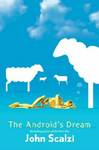
The Android’s Dream by John Scalzi

What do you get when you combine aliens, diplomacy, artificial intelligences, religion and sheep together? Well, for most people, the answer would be a horrible mess. For John Scalzi, however, it’s a fantastic read. Nothing too complex, no greater statements about the nature of humanity and the necessity of war that holds together the stories in his Old Man’s War universe, just a good old-fashioned espionage romp. With sheep. Or at least a sheep. Kind of.

The story begins with, as so many stories do, a murder. Not an intentional murder, really, but one that was born of shame and revenge, as so many murders are. Under normal circumstances, this wouldn’t rate much, except that the death of an alien trade ambassador is never a convenient thing. When said diplomat may just possibly have been killed by his human counterpart, that’s even more difficult to deal with. Instead of a nice, tidy trade agreement cementing the relations between the United Nations of Earth and the Nidu, an alien race with an extraordinary sense of smell and hair-trigger tempers, we have what the State Department might just call “a challenge.”

The only thing that can heal this little rift between the two planets is a sheep. But not just any sheep – a special breed, created just for the Nidu called the Android’s Dream. Without this sheep, the ruling family cannot hold on to power, and the Nidu will be plunged into a catastrophic civil war that will, in all likelihood, take Earth with it. In order to find the sheep, avert catastrophe and, most importantly, avoid calling shame down upon the government, State Department employee – and veteran of the Earth’s greatest military failure – Harry Creek will have to use every skill at his disposal. And then some.

It’s a great read, this book. Telling any more about the plot would ruin it, so I’ll just exhort you to pick up the book and get reading. In all honesty, you could probably finish it pretty quickly. But I can’t just stop here, so let me tell you more about why I liked it as much as I did.

What made it so good, what always makes good sci-fi good, is the reality of the world the author creates. It’s great to come up with high-concept scientific ideas, or intricately-planned space battles, but for the reader to really immerse him-or-herself in the book, it has to have a world in which the reader can easily imagine her-or-himself existing.

I thought of this during one scene early in the book. A character was riding the Washington, D.C. Metro and the narrator was describing the various aliens who were riding with him. There was an explanation of how various species had integrated themselves into the city, overcoming prejudice and discrimination, but what really got me was the description of a young woman reading the paper, the only other human in the car. Amidst all the different bodies, tongues, smells, and appearances, she didn’t even notice.

“If her great-great-grandmother were on the train,” Scalzi writes, “she would have thought she was on commuter train heading toward the fifth circle of Hell. This woman didn’t even look up. The human capacity for being jaded was a remarkable thing.”

It was at that point that I really accepted the reality of the book. It wasn’t a perfect world, it wasn’t one that had been ripped apart or perfected by alien contact. What had happened was what happens here any time cultures interact – after a brief period of unpleasantness, cultures start to mingle until it gets to a point where no one can remember when things were at all different. This book has all those little details that help sell the world, things that blend our world with theirs. Bored mall employees, amoral hit men, political jockeying, all of those things are familiar. Actual ghosts in machines, planet-cracking bombs, aliens that are almost entirely mouth and digestive systems, those are not. But they’re believable, because Scalzi is one hell of a writer.

I do have one little nit to pick, however. It’s not a big nit, but a nit nonetheless.

The book is an adventure, plain and simple. It’s a plot-driven story that pulls you along from one event to the other with nary a chance to catch your breath, and I never complain about that. It has some great characters… who remain almost entirely static throughout the story. I can’t say there’s no character development in the book, because the big hairy guy who eats people does have a change of heart about it, but other than that…. Harry Creek begins the book as a reluctant hero who is hiding his super-hacker, ass-kicker light under a bushel, and he’s happy to continue to be that at the close of the book. Robin Baker is a sassy, independent young woman who holds up under pressure – though not necessarily happy about it – throughout the book, and the Nidu ambassador Narf-win-Getag is untrustable the moment he walks on the page, and he remains so up through his sudden and inevitable betrayal near the end.

Like I said, this isn’t a huge complaint, because the book that Scalzi has written isn’t a character book. It’s an adventure, and adventure books usually don’t require a whole lot of character development. That doesn’t mean the characters aren’t believable – they certainly are – and it doesn’t mean they’re not interesting – they absolutely are. They just don’t grow. Fortunately I know from having read Old Man’s War and its related books that Scalzi has no problem with character development, and so I can assume that keeping his characters reasonably static in this book was a deliberate choice.

As a tangential comment on characters in the book, there was one character that drove me nuts. This character is not central to the story, and only appears a few times. What makes this person interesting are the following two things: first that the character is named Sam, and second that Sam’s gender is never established. Maybe it’s me and I missed something, but I have no idea if Sam was a man or a woman.

I caught it mainly because Tad Williams used the same name to pull a similar trick in his Otherland series, but in that story he was hiding Sam’s gender from another character, not the reader, so we eventually found out what was what. In this story, Sam’s gender remains a mystery for no other reason than I figure it amused Scalzi. It has no bearing on the story, and it doesn’t make the fate of Sam’s lover any less tragic, but I found it fascinating.

In any case, it’s a great read and – as a bonus – very funny. The opening line alone lets you know that, no matter what you think you’ve read before, you haven’t read anything quite like this. But I’m not telling you what that line is – I can’t give away everything….

——————————————————-
“If there’s one thing that distinguishes the human species, it is a pathological need to stay connected.”
-John Scalzi, The Android’s Dream
——————————————————

John Scalzi’s homepage
John Scalzi at Wikipedia
John Scalzi at AMC.com
The Android’s Dream on Amazon.com

1 Comment

Filed under adventure, aliens, John Scalzi, science fiction