Review 70: Bad Astronomy


Bad Astronomy by Phil Plait

What do you think you know about astronomy? For example, what causes us to have seasons? If you said that it’s our distance from the sun – sorry, you’re wrong. Or how about why the sky is blue? If you think it’s that the sky reflects the sea, nope. Wrong again. Or perhaps you think that the moon’s tidal effect makes people crazy, or that an egg can only stand on end if it’s the Vernal Equinox or that an alignment of the planets will cause a terrible buildup of gravity that will kill us all!

All wrong. But you would not be alone. For a society as technologically advance as ours (and if you’re reading this, then chances are good that you live in a technologically advanced society), the general public has a big problem with science. People see it as being too hard to understand, or too removed from their daily lives. Politicians bemoan the fact that American schoolchildren are falling behind in science, but science funding is almost always on the list of cuts that can be made to save money. We love technology, but hate science, and that is a path to certain doom.

Of all the sciences, though, astronomy is perhaps the worst understood. A lot of people still confuse it with astrology, which is probably a huge part of the problem right there. For millennia, we have thought about the planets and stars as celestial things, unknown and unknowable by such base creatures as ourselves. It’s only in the last hundred years or so that we’ve been able to rapidly improve our understanding of the universe, and popular knowledge hasn’t caught up with that yet.

And so bad misconceptions of astronomy persist in the public imagination.

Fortunately, we have people like Phil Plait to set the record straight, and that is indeed what he does in this book.

While there are many educators out there who believe that a wrong idea, once implanted, is impossible to eradicate, Plait sees it as a teachable opportunity. Take, for example, the commonly held belief that on the Vernal Equinox – and only on the Vernal Equinox – you can balance an egg on its end. Many people believe this, and it’s an experiment that’s carried out in classrooms around the country every March. Teachers tell their students, and the local news media tell their viewers, but no one stops to ask Why. Why would this day, of all the days in the year, be so special? More importantly, how can we test that assertion?

Fortunately, that’s within the powers of any thinking individual, and it should be the first thing teachers do once they’ve finished having fun balancing eggs: try and do it again the next day. If you can balance an egg on April 3rd, or May 22nd or August 30th, or September 4th or any other day of the year, then you have successfully proven the Equinox Egg Hypothesis wrong. Congratulations! You’re doing science!!

Or perhaps you’ve heard the story that you can see stars from the bottom of a well, or a tall smokestack. This is because, the idea goes, the restricted amount of light will not wash out the stars so much, giving you a chance to do some daytime astronomy. Well, there’s an easy way to test this one too, if you have an old factory or something of that nature nearby. What you’ll discover is that no matter how much you try to restrict your view of the sky, it’ll still be washed out and you won’t see any stars at all.

One more good one that a lot of people believe – the moon is larger in the sky when it’s near the horizon than when it’s at its zenith. Again, this is something that’s very easy to test. Go out as the full moon is rising, looming large in the sky, and hold up an object at arm’s length – a pencil is usually recommended. Make a note of the moon’s apparent size as compared to the eraser. Then go out again when the moon is high in the sky and repeat your observation. The moon appears to be the same size, no matter how it may look to you.

Of course, there’s a lot of science into why these things are the way they are. The chicken egg thing is because there’s no singular force that is only acting on chicken eggs and only doing so on one day of the year (which is not even universally regarded as the first day of spring). As for the inability to see stars in the daytime, that’s because our pesky atmosphere scatters a lot of the light coming from the sun, so light appears to come from everywhere in the sky. The only thing you’re likely to see in a blue sky is the moon, and MAYBE Venus, if you’re really sharp-eyed and lucky.

The Moon Illusion is not well-understood, actually. It’s probably not the brain comparing the moon with objects on the horizon – the effect works at sea, too. It’s probably a combination of competing psychological effects that deal with distance, none of which can accurately deal with how far away the moon is.

Regardless, all of these things are easily testable by anyone. The problem is that so few people take that extra time to actually test them, or even think that they should.

There are some myths and misconceptions that take a little more expertise to explain, such as why tides and eclipses happen, how seasons occur and why the moon goes through phases. But these explanations aren’t very difficult and are well within the understanding of any intelligent adult. Unfortunately, there are a lot of myths that are stubborn, entrenched into the heads of people everywhere and very hard to get out. Not the least of these are the beliefs that UFOs are alien spacecraft and that we never went to the Moon.

Interestingly enough, both of these rest on the same basic problem: we can’t rely on our own brains to accurately interpret the data that we see. Plait recounts a story where he was mesmerized by some strange lights in the night sky while watching a 3 AM shuttle launch. They seemed to hover in place, making strange noises, and it wasn’t until they got much closer that he was able to see them for what they were: a group of ducks that were reflecting spotlights off their feathers.

Our brains believe things, and interpret the observations to fit those beliefs. So when the dust on the moon doesn’t behave the way we expect dust to behave, some people believe that to be evidence of fraud, rather than the natural behavior of dust on the moon. We are creatures of story, which is why we like conspiracy theories and astrology. We want the world to make a kind of narrative sense, so often the first explanation we come up with is a story that sounds good. Unfortunately, just because the story sounds good, that doesn’t make it true.

He also takes a swipe at bad movie science, but in a good-natured manner. Even he admits that movies are more likely to favor story over science, but there are some common errors that make it into so many science fiction films – sound in space, people dodging lasers, deadly asteroid fields – these things may be dramatically interesting, but they’re all bad science. And while it would be annoying and pedantic to pick out every example of how the rules are bent for sci-fi (“Please. Why would the aliens come all the way to Earth to steal water when it exists in abundance out in the Kuiper Belt? I scoff at your attempt!”), they do offer an excellent opportunity to teach people about how science works.

One of the things I’ve always liked about Plait is his obvious enthusiasm for not just astronomy but for science in general. Here we have this excellent system to cut through the lies our brains tell us and get closer to knowing what’s actually going on. Science forces us to question our assumptions, look at things from many points of view, and arrive at a conclusion that best describes the phenomenon we’re observing. When Plait talks about science, he is not condescending or dry or super-intellectual, the way so many people imagine scientists to be. He’s excited that he gets to use this amazing tool for understanding the universe, and he wants other people to use it.

If you’re an astronomy buff, like myself, you probably won’t learn much new information from this book. But hopefully you’ll be re-invigorated to go out there and look at the world through a scientific, skeptical eye, and you’ll be willing to confront these misconceptions when next you come across them. Even better, you might start thinking about what else you think you know, and how you can go about testing it.

—————————————————
“If a little kid ever asks you just why the sky is blue, you look him or her right in the eye and say, ‘It’s because of quantum effects involving Rayleigh scattering combined with a lack of violet photon receptors in our retinae.'”
– Phil Plait, Bad Astronomy
—————————————————

Phil Plait on Wikipedia
Bad Astronomy on Wikipedia
Bad Astronomy on Amazon.com
The Bad Astronomy Blog

Leave a comment

Filed under astronomy, education, media, nonfiction, Phil Plait, pseudoscience, science, skepticism

Review 69: Skipping Towards Gomorrah


Skipping Towards Gomorrah by Dan Savage

America. Here and now, in the first decade of the 21st century, there are those who say that America is on the decline. It’s a nation awash in sin and degradation, vice and immorality. Pot smokers, gamblers, homosexuals, feminists, Liberals – oh, those damned Liberals – they’re all conspiring to destroy everything that is good and moral about the United States of America, and you – yes, you are letting them do it! Soon this nation that we all love and cherish will be nothing but an opium orgy den for a bunch of homosexual atheist abortion doctors.

This is what they believe, those whom Dan Savage refers to as the Scolds, the Virtuecrats and the Naysayers. We know who they are – usually Republican conservatives, often of the evangelical Christian variety. They are men (and occasionally women) such as Robert Bork, Bill O’Reilly, Ann Coulter, Pat Buchanan, and of all the things they have in common, the most glaring is that they believe that The United States is in a state of utter moral decay. Americans who choose sex for any function other than making babies, who choose to put drugs into their bodies, who allow themselves to be fat and indolent – SHAME on you! It is your sinning that is destroying America! Jerry Falwell himself said as much after the attacks on 9/11:

I really believe that the pagans, and the abortionists, and the feminists, and the gays and the lesbians who are actively trying to make that an alternative lifestyle, the ACLU, People For the American Way — all of them who have tried to secularize America — I point the finger in their face and say “you helped this happen.” 

And, it would seem – given the naysayers’ ubiquity and volume – they are right.

Or maybe not.

Dan Savage is an acclaimed advice columnist, specializing in relationship and sex advice. He started with a newspaper column nearly twenty years ago, and he’s gained international attention, mainly by being very good at his job. He doesn’t sugar-coat his advice, often telling people instead to DTMFA (Dump the mother-f*cker already!) if it’s clear they’re in a bad relationship. He helped coin a new meaning for the word santorum as well as pegging (Google them – I’m trying to keep this clean). He’s abrasive, contrarian, direct – and an outspoken advocate of the pursuit of happiness. Most of his advice can be boiled down to a simple question: Are you happy?

What Savage is exploring in this book is all the ways people try to make themselves happy, and why those are all the things that the Virtuecrats believe are sinful, immoral and conducive to America’s decline in the world. In order to understand the sins, he has to meet the sinners and, as much as possible, indulge.

The book is set up around the classic Seven Deadly Sins – greed, lust, sloth, gluttony, envy, pride and anger. In each chapter, Savage tries to understand what it is about these sins that make them so irresistible, and if they’re actually deadly at all. For Greed, he indulges in gambling, learning how to play blackjack and win – except when he loses. For Gluttony he visits a convention for the NAAFA (National Association for the Advancement of Fat Acceptance) to find out how fat people feel about being fat. He learns to channel his Anger in a shooting range in Texas, studies Lust in swingers’ clubs in Las Vegas, and realizes that maybe we all need a little more Sloth in our lives. He takes great pains to Envy the rich and to determine whether gays really need to bother with Pride anymore. And then he tops it all off with a great attempt to commit all seven deadly sins within a forty-eight hour period in New York City.

As provocative as it all sounds, the book isn’t really about sinning. It’s about human nature and freedom, and how those two things clash and merge. It’s about how some humans want to enjoy themselves, while other humans would rather they didn’t. They tell us about the horrors of drugs, the terrors of infidelity and the inherent corrosive nature of the very existence of gay people, much less married ones. They tell us that by pursuing our happiness, we are destroying the country.

Dan Savage says otherwise, mainly by pointing out what the conservative naysayers don’t want to hear: human beings are complex, irreducible characters who are not very good at not doing what they’re not supposed to do. We all want to enjoy ourselves. We want to feel pleasure, one way or the other, and we will do everything in our power to make this happen. Whether it’s sex or reading, drugs or travel, food or art, going to the gym or gambling, we want to feel good. And for some reason, there are people who have a problem with this.

Savage believes that the first principle we should follow is that of freedom: if one isn’t harming others, then one should be free to do whatever one wants. In this book, he makes an excellent case for the legalization of marijuana, talks to productive, religious, moral swingers, and meets with sex workers in New York City. He examines the hypocrisy of the moralist movement and the general weakness of their arguments.

For example, with gambling long having been one of the most deadly of sins in the Christian catalog, why don’t modern conservatives rail against it? Is it because it’s an economic boon to so many places? Is it because it makes money for the country? On gambling the conservatives are quiet, though surely cards and dice have broken far more families than gays and lesbians?

And if the concept of “personal responsibility” is so sacred that any mention of gun control is considered an immediate attack on our freedoms, why can’t that same love of responsibility extend to marijuana use – an activity far, far less deadly than gunplay.

Savage’s understanding of human nature tells him that while we all want happiness, the happiness of one person is the immorality of another. In America, however, there is room to disagree, room to argue and to grow. American culture evolves and changes whether you like it or not, and it is better to learn to live in that culture than to try and bend it to your will. While you may disagree with how your fellow American leads his or her life, it is not your job to try and change it, just as they have no business trying to change yours.

So take heart, sinners! Dan Savage is on your side.

—————————————
Take me to the driest county in the most conservative state, and in two hours this determined hedonist will find you all the drugs, whores, and booze you’ll need to pass an eventful weekend.
– Dan Savage, Skipping Towards Gomorrah
—————————————

Dan Savage on Wikipedia
Skipping Towards Gomorrah on Wikipedia
Skipping Towards Gomorrah on Amazon.com
Savage Love column
Savage Love podcast

Leave a comment

Filed under Dan Savage, morality, sins, society

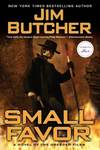
Review 68: Small Favor


Small Favor by Jim Butcher

“Hell’s Bells” count: 21

This is the tenth book in the series, and if Butcher’s own plan can be trusted, it marks about the halfway point for the series as a whole. Having made it this far with the series is a remarkable achievement, and if he can keep it up all the way to its projected end, I will be a very happy and impressed reader. So, a few words about the book itself, and then some thoughts on the series.

Honestly, if you’ve been following my reviews of this series, you can be pretty sure what I’m going to say about it – I devoured the book and enjoyed every minute of it. In this edition, Our Hero Harry is faced with death and danger on all sides, as usual. The everlasting Queen of the Winter Sidhe, Mab, wants Harry to rescue John Marcone, the boss of the biggest organized crime racket in the city, from the clutches of fallen angels who have immeasurable power and millennia of experience. What they want with Marcone – and other, more innocent and tragic characters – isn’t clear, but what we can be sure of is that the full extent of their plans will far exceed simple kidnapping.

Meanwhile, he’s being attacked by agents of Queen Titania, the queen of the Summer Sidhe, for reasons that are not all that clear to anyone, especially Harry. His attackers are beasts of legend – the Gruffs. You may have heard of them when you were a child – goatlike creatures with a talent for eliminating trolls. They are brothers, and if you manage to defeat one of them, you can be sure that his big brother will be along soon to take care of you. And you most certainly don’t want to get on the bad side of the eldest of the Gruffs, let me tell you that. Nice guy, but he’s clean your clock no matter who you are.

So, things aren’t so good for Harry Dresden. But, then, when are they ever? Going up against forces way over his head is pretty much a theme for Harry’s life, and while we can be reasonably certain that he will prevail (after all, there are about ten more books to go, and they’d be hard to write without him), we don’t know how much damage he will take in the doing so. Although if you guessed “a lot,” you’d be pretty well on the mark.

That goes for pretty much every book in the series. Harry is an underdog, or at least he starts out as one. By the time you get to this book, he has some measure of authority, responsibility and respect, as well as a serious reputation amongst people in this world and others. So, this makes it rather harder for him to be an underdog. Instead of simple vampires, werewolves and the occasional necromancer, we now have to deal with the Big Guns like Mab, Titania and The Fallen. Which brings me to my first prediction for the rest of the series.

Harry Laid Low. At some point, I figure all that he’s built up will have to come crashing down. Gross physical harm aside, he’s put himself in a much better position than the one he was in way back in Storm Front, and if he continues the way he has, he will cease to be the underdog and become the overdog, if there is such a thing. While it’ll be interesting to see how he handles being higher up on the food chain, I don’t think it’ll sit well with his character.

That would be unfortunate, because it’s Harry’s character that really make this book. I’ve talked to those who aren’t too keen on investing in this series because it’s not quite different enough from the other modern, urban fantasy out there. And in a way, they’re right. A lone wolf investigator with a mysterious past and unknowable potential who has a talent for making big enemies? That could either be this series or the Nightside books by Simon Green, and I’m sure there’s a few more that follow a similar pattern. Butcher isn’t breaking open new ground with this series, at least not as far as I can tell. And a main character who is a wizard named Harry with a mysterious destiny and a tragic past? Yeah, like I’m sure you haven’t thought of it already. I don’t think that’s Butcher’s fault, though. Harry seems to be the kind of character who shows up in a writer’s head long before the book gets published, and Gary Dresden or Fred Dresden doesn’t sound as good.

Though Christopher Dresden has a nice ring to it, I must say. Why aren’t there more fictional heroes named Chris, anyway? Weird.

Back on topic – what Butcher has done, and what makes me enjoy this series so much, is take the genre and populate it with really interesting people. One of the things I enjoy so much about Harry is that he seems to be someone I’d like to hang out with – he has a sense of humor that I enjoy, and seeing how many of my friends tend towards wise-assery, I think we’d get along well. Other characters, like Murphy, Michael, Molly (lots of M names), Thomas, Bob, Mouse…. They’re complex, they’re interesting and occasionally surprising. You really come to care about them, because Harry cares about them and you care about Harry.

Which reminds me: Predictions 2 and 3 – The Death of Karrin Murphy and The Corruption of Molly Carpenter. These are two people who are extremely close to Harry, and invoke his much-debated sense of male chauvinism. A few people seem to take issue with Harry’s desire to protect women, which appears hopelessly old-fashioned. Maybe it is, but Harry (and by extension Butcher) seems to be okay with that. Murphy is Harry’s best friend, the one character who’s stood by him since the first book, and has grown to be his closest ally. She has gained his trust and his faith through fire and trial, and in this book is actually able to assert her authority (in a wonderful, wonderful scene) to save Harry’s skin.

So, she has to die. It’s one of those Hero’s Journey things – the hero has to lose those things closest to him in order to come out the other side as a True Hero. He needs Murphy, he really does, and he needs to be able to stand without her. If that means that she’s taken out, well…. I don’t know if or when it’ll happen – I’d bet somewhere in the climactic final books.

As for Molly, she’s an interesting person. A young person who, after a very rocky start to her life as a magic-user, has been given a second chance by Harry. For his part, Harry’s job is to make sure she turns out right, to make sure she learns how to use her powers responsibly and wisely, for the betterment of others. As of this book, she’s doing very well – her powers are becoming more refined, and she’s got a good handle on what it means to be a responsible wizard.

But first, she has to see her dark side, look it in the eye, and face it down. So, at some point, Molly is going to slip. Whether through impatience, arrogance or circumstance, she’s going to risk both her and Harry’s lives by using her powers for Evil.

There you go, then. It’s a great series, very enjoyable, and I’ll be following it to the end. I highly recommend you do the same.

———————————————
“Let’s sum up: an unknown number of enemies with unknown capabilities, supported by a gang of madmen, packs of attack animals, and superhumanly intelligent pocket change.”
– Murphy, Small Favor
——————————————–

The Dresden Files on Wikipedia
Small Favor on Wikipedia
Small Favor on Amazon.com
Jim Butcher on Wikipedia
Harry Dresden on Wikipedia
Jim Butcher’s homepage

3 Comments

Filed under detective fiction, Dresden Files, fantasy, Jim Butcher, wizardry

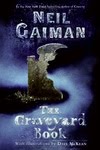
Review 67: The Graveyard Book


The Graveyard Book by Neil Gaiman

As I’ve said before, Neil Gaiman is one of the very few authors whose books I’ll pick up without reservation. I can always be sure that I’ll enjoy what he does, so I always look forward to new work. I am happy to say that this book is no exception. It’s even made news recently – it won the Newberry Medal for Children’s Literature, a very prestigious American literary prize. So good for you, Neil….

It’s a well-deserved medal for a book that follows in the footsteps of Kipling’s The Jungle Book. It’s a book that can appeal to young readers and adults alike, without being condescending or patronizing, something that many writers for young readers have trouble with. As can usually be expected from books aimed at young readers, it’s heavy on the themes of growing up, learning your place in the world, and eventually deciding who you want to be. The means by which this book does it, however, are slightly different.

The first line was enough to get me hooked: “There was a hand in the darkness, and it held a knife.”

Ooo. Shivers.

The story begins with a gruesome triple murder, as all good childrens’ books do. But the intended fourth victim, a young toddler, manages to escape the bloodbath and wander, quite innocently, up to the graveyard on the hill. There, amidst tombs and graves that had lain there for centuries, he is saved from certain death and given protection by a most unusual new family: ghosts.

The boy, rechristened as Nobody Owens, or Bod for short, is raised by the spirits of this tiny world through the intercession of Silas, a mysterious individual who straddles the boundary between the living and the dead. As far as places to grow up go, it’s not a bad one. He does end up learning some rather old-fashioned English from those who died half a millennium ago, and wanders around in a grey winding sheet instead of proper clothing, but he is safe there. He has the Freedom of the Graveyard, a gift from the ghosts that allows him the protection that only the dead can offer.

As Bod grows up, he learns the tricks that ghosts can do – how to fade from sight, or to rouse fear and terror, how to walk through walls. But he also learns that he’s very different from his adopted community. Their lives are ended, their stories are done. He is alive, and as he gets older, that difference becomes more and more vivid. While he may live among the ghosts, he is not one himself. Not yet, anyway.

But there are those who would like to make him one. The mysterious murderer who destroyed Bod’s family, a man named Jack, is one of many wicked men who would see Bod dead. He may have lost the boy once, but he and his confederates are determined to find him again. There is a prophecy, you see, and they mean to see that it’s stopped. And once Bod learns about his family’s fate, he becomes equally determined to see justice done.

The book is really good. It’s a bit simple for an adult audience, and there were a few plot points that I was able to predict pretty quickly. But the book isn’t really aimed at us – it’s aimed at the younger reader, around eleven or twelve years old. Such readers don’t quite have the experience to know that, say, when a new character is introduced two-thirds of the way through the book, that’s a character to be wary of. It’s the kind of book that’s best read to people,and that’s how Gaiman promoted the release of the book, by doing public readings of it.

As I said before, it dwells on the theme that most books of this genre do: growing up. As Bod gets older, as he starts to feel the pull of the outside world, he understands that he can’t stay with his family forever. The dead don’t grow, they don’t change, but young people do – often very radically in a very short span of time. While it is perhaps a stretch to compare parents to dead people, there is certainly a vague parallel to be drawn here. As adults, we don’t change very much, at least not unless we have to. We’re set in our ways and our beliefs. They’ve served us well, and if there’s no reason to go mucking about with them, then they’re better off left alone. Kids, however, are malleable and ever-changing. They go through phases and changes and switch from adorable little tyke to abominable little teenager with alacrity. Eventually, they have to discover who they are, and the only way to do that is to leave.

The nice thing about Bod is that, while he does get into trouble and disobey his guardians, he is, on the whole, obedient and self-aware. He understands that his freedom – indeed his very life – is a gift to him from the graveyard. The ghosts there taught him what he knows, and made sure that he lived through the traumas of childhood and the machinations of men who wanted him dead. He appreciates what his guardians have done for him, even as he prepares to leave them. It’s a good message, slipped in with the general motif of the challenges of growing up, and one that I hope young readers absorb.

It’s easy for a young person to look at the adults in his or her life and think of them like the ghosts in this book. Yes, their lives aren’t very exciting anymore, and yes they tend to be overprotective and kind of a pain in the ass. But it’s for a good reason, most of the time. Thanks to them, you have all the possibilities of life laid before you. And it won’t be easy, living. But you should do it while you have the chance….

————————————————
“You’re always you, and that don’t change, and you’re always changing, and there’s nothing you can do about it.”
– Mother Slaughter, The Graveyard Book
————————————————

Leave a comment

Filed under children, coming of age, death, family, fantasy, friendship, ghosts, identity, murder, Neil Gaiman, young adult

Review 66: Life of Pi


Life of Pi by Yann Martel

Every time I go back to the US to visit friends and family, I always make a visit to a bookstore or two. I can buy books here in Japan, but the prices are high and the selection isn’t nearly as good, so a trip to our local mega-bookstore is like a visit to Mecca for me.

The last time I was home, my father let me wander for a while, and then he came up and handed me this book. He was picking up copies for a few other people as well, but he gave me this and said, “I think you’d really like it.”

He was right.

It’s one of those books that you feel compelled to share with others once you’ve finished. It’s one of those books where people see you reading it and say, “I read that – it’s really good, isn’t it?” It’s one of those books which, the author promises, will make you believe in God. A pretty tall order, but there you go. And in a roundabout way, it makes good on its promise. But we’ll get to that….

It’s a story of layers, as the best stories often are. On one layer, it’s the tale of young Piscine Molitor Patel, an Indian boy with an insatiable curiosity about everything. The son of a zookeeper, Piscine – who re-christens himself Pi in order to clear up misunderstandings of his given name – develops a great interest in the world around him, especially religion. His part of India is home to people of all faiths, and he finds himself moving between Hinduism, Christianity and Islam, despite the protests of holy men of all three faiths.

He grows up in this world, between animals and gods, until his family decides to escape India’s political turmoil by moving to Canada. They sell what animals they can, keep the ones they must, board everything onto a freighter and head off for a trip around the world, destined for a new life.

Until the ship sinks.

Pi finds himself the only human survivor of the ship’s sinking, alone on a lifeboat in the middle of the Pacific Ocean. Alone except for the zebra. And the hyena. And the orangutan. And, of course, the tiger. Can’t forget the tiger.

Pi’s mini-zoo diminishes quickly, of course. There’s only so long such a diverse group of creatures can abide each other’s company in such terrible circumstances, so in time it comes down to two: Pi and the tiger, who had the unusual name of Richard Parker. You would think that there would be no winner in this contest – a diminished teenage boy against a full-grown tiger, with limited resources and a very stressful environment. But Pi is the son of a zookeeper, one whose job is to know how to control animals that don’t want to be controlled. Pi’s ability to survive in these circumstances would, by itself, be a fascinating story.

But the story is not just about Pi and the tiger. Not really. It’s also about our relationship with the world, with the universe, with God. It’s about who we are when everything we ever loved is stripped away from us. And it’s about how we can survive in even the most extraordinary circumstances. Pi does survive, and his survival makes sense, within the world of the story. Would he be able to do it out here in Real Life (TM)? I have no idea. But as you read, there is no point where you think, “The author is cheating,” and allowing his main character to survive when he really shouldn’t have.

The overriding theme of the book, however, is stories. The book itself is set up as a memoir, told by Patel to the author. It’s the story of a story, and it is a story which the author says will make you believe in God. And in a way, it does. But not in the way you think.

It’s kind of a modified version of Pascal’s Wager – the idea that it is better to believe in God than not to believe. Pascal’s idea is simple. If you disbelieve in God, and you’re right, then you’ll just wink out of existence when you die. No harm, no foul. But if you disbelieve and you’re wrong, then you end up suffering eternal damnation. Whereas if you believe in God and you’re wrong, again, no harm, no foul.

There are criticisms, and fair ones, of this philosophy, but I think this book offers a more reasonable alternative. You should believe in God because believing in God is the better story. Martel suggests (through Pi) that there is no mystery in facts and reason, no magic and no wonder. That the unrepentant atheist whose last thoughts are, “I believe I am losing brain function” lacks the imagination of the unrepentant atheist who has a deathbed conversion. In other words, by sticking only to what can be known and proven, one misses the better story.

I don’t necessarily agree with this. I think it’s an interesting point of view, and as long as one can remain aware that belief is not truth, I think I can let it go, but I don’t believe that the world of fact and reason is without brilliant stories. Look at the story of life on earth – a three and a half billion year epic of survival, death and rebirth. Look at the story of a lowly paperclip – born in the heart of an exploding star, and representing five thousand years of human progress towards extelligence. There are great stories, astounding stories out there in the world that don’t need to be believed because they are true. There is evidence for them, and their veracity can be proven.

But Martel’s isn’t about what is provably true.

Pi offers a choice: given two possible explanations for something, with no evidence to support either one, which explanation would you choose? The answer is, whichever explanation makes for the better story. Pi’s adventure is an example of that. As readers, we choose to believe Pi’s story, because it’s fascinating. We don’t sit there and think, “This is bull. A teenage boy taming a tiger? Puh-leeze.” We believe the story, while at the same time knowing that it is not, technically, “true.”

So it is with God. We believe in God, regardless of whether God is “true,” because it’s a more interesting story. And Pi’s adherence to three mutually exclusive religions suggests that the God of Pi isn’t to be found in a book or a church, in the words of a priest or a holy man. The God of Pi is everywhere, and doesn’t care if we believe or not. But we should believe, Pi suggests. Because that’s the better story.

The best books leave us thinking, and burrow into our brains to give us something to chew on for a while. So it is with this book. My rational part and my romantic part argue over the meaning of this story, and whether or not Pi’s conclusion is valid. Sometimes I agree, and sometimes I don’t. That’s just how it is. But one thing I can say with certainty is that this is a very good book. And you should read it.

—————————————————
“To choose doubt as a philosophy of life is akin to choosing immobility as a means of transportation.”
-Pi Patel, Life of Pi
—————————————————

Yann Martel on Wikipedia
Life of Pi on Wikipedia
Life of Pi on Amazon.com

Leave a comment

Filed under death, fiction, gods, memoir, story, survival, Yann Martel

Review 65: Mercury Falls


Mercury Falls by Robert Kroese

You all know I love apocalypses, if that is indeed the correct pluralization. There’s just something about the end of the world that really gets me going, and if it can be done with some sense of humor and insight, that’s even better.

Mercury Falls has the distinction of being the first full-length book I’ve read on my Kindle, and let me say that it was a good christening. While I’m not writing a Kindle review, I have to admit that the device works very well. It’s easy to read, easy to make notes and mark interesting passages, and it fits in my bag a lot better than a 352 page paperback would. So, score one for the Kindle.

This being the ADD Age of Twitter, I don’t exactly remember how I first ran across Robert Kroese. He may have been re-tweeted by someone, or popped up on a Facebook update, or implanted into my mind while I slept (thank you, Dreamr.com!) I don’t know. What I do know is that the man is relentless in promoting his work. He keeps up an excellent level of interactivity with his Twitter and Facebook followers and finds ways to increase the word-of-mouth marketing that he needs, since this book was self-published and can use all the marketing help it can get. Under his incessant barrage, I bought the book for the Kindle, and it turned out to be fortuitous. Divinely inspired, perhaps, as though it were part of a larger plan. Hmmm….

One of the central themes of the End of the World, whether it’s the Biblical Apocalypse or any other, is that it has to happen. There’s just no way around it – sooner or later the forces of Good and the forces of Evil will duke it out on the Earth to see who’s the baddest bunch around. When asked why they would bother, the usual answer is that it’s part of God’s Plan, and that’s all we need to know. So we imagine that while we miserable humans must be kept in the dark, there must be someone who knows what’s going on. A prophet, perhaps the angels who are doing the fighting – God, definitely, right?

Not really, Kroese suggests.

He presents the reader with a celestial bureaucracy that makes the U.S. Government look like a small-town McDonald’s on a slow day. There are levels within levels, rank upon rank of angelic bureaucrats and agents and paper-pushers, all working towards what they believe the Divine Plan involves. The problem is that no one is entirely sure what that plan actually is. But like all good bureaucrats everywhere, they don’t care. There are rules, there are regulations, and they must be followed. What happens, however, when the Plan breaks down? Well, that’s when things get messy.

The human woman Christine Temetri, a reporter on the apocalypse beat at a nationally-read newspaper, The Banner, is about to find out just how awry things can go when the Divine Plan gets all cocked up. On an assignment to cover the latest skirmish between Israel and Syria, Christine is entrusted with a Very Important MacGuffin Briefcase, which brings her to the enigmatic cult leader Galileo Mercury.

Only he’s not a cult leader, really. He’s an angel. A fallen one, yes, but an angel nonetheless, and he’s the only angel who plans to sit out the end of the world. He’s happy to do card tricks and play ping-pong, at least until Christine shows up and drags him back into the fray. Together, they have to not only figure out how to stop the apocalypse, but how to make sure they stop the right apocalypse, and see to it that it’s done with as little damage as possible. They don’t really succeed on that last part, but they certainly make a valiant effort.

The entertainment in this book is not so much in the plot, which is in the political thriller mode with twists and turns and reveals a-plenty, to say nothing of shootings, explosions and pillars of fire. There are two major things that make the book entertaining.

First is the cosmology that Kroese has built up. The idea of a Heavenly Bureaucracy is not a new one, but he takes it rather a step further. In one scene, a couple of angels are taking pity on humanity because we pitiful humans are running around, making decisions without knowing for sure whether they’re right or wrong. The angels believe they are superior in that they have a Plan to follow – but they freely admit that they aren’t entirely sure if the Plan they’re following is the right one. “We assume that we’re part of a system that ultimately makes sense to [the Archangel] Michael, or God, or someone. All the little details may not make sense to us, but we go along with it anyway.” In other words, the angels are just like us, except that they can fly, do miracles, and are immortal. The bastards. In a later section, the characters are given a look at how the whole celestial bureaucracy is set up, and discover that even the angels don’t know for sure who’s actually in charge of anything. They just do what the Plan tells them to do and hope for the best.

So what we have here is a bureaucratic cosmology. It works, but no one is entirely sure how it works. And as Christine discovers, the benefit to not knowing the actual plan is that you are then free to do what you think is right. While the book is obviously centered around the Judeo-Christian framework, it’s not a religious book. It doesn’t address whether there is or is not a God, or whether religion is a fundamental necessity to humanity or a primitive hang-up, or neither, or both. What it’s about is the idea of choice, a topic covered pretty explicitly in chapter thirteen. The boiled-down version is that we may or may not have free will, and we can never really know, so it’s best to just pretend that we do. What this means, then, is maintaining a healthy dose of skepticism about what you are told is the right or necessary thing to do.

This does lead to some editorializing at times, which is pretty obvious when you hit it. As soon as you get to a section where two characters are engaged in a Socratic dialogue with each other, you definitely get the feeling that it’s Kroese putting his two cents in. This would be annoying if I disagreed with him, or if it was written with less wit. As it stands, I read it with the kind of patience I reserve for my really funny friends when they hit a topic they actually care about – I’ll listen along, because I know it’ll be good, but at the same time I’ll feel a little uncomfortable that they’ve decided to be serious for once.

Which brings me to the second reason I enjoyed the book – it’s damned funny. It reminded me in various places of Douglas Adams’ Dirk Gently books, as well as the fine work of Christopher Moore. There was plenty of narrative commentary, which was sarcastic and biting, and the characters often matched wits with each other at lightning speed. There were many parts that I re-read because I was sure I had missed something in the exchange, and it turned out I was right – and what I had missed was worth going back for. I put my Kindle’s highlighting function to good use, let me just say that. While I have trained myself to hold in my guffaws, in accordance with social norms here in Japan, there were a few points where I just couldn’t help but draw the stares of my fellow train passengers.

On a tangent: there was a moment in the book that made me think of the infamous LJ RaceFail of ’09, something I had hoped to not have to think of again for a while. When Christine meets Mercury for the first time, we’re introduced to two people. One is a short, dumpy man of Chinese ancestry, and the other is a tall, handsome white guy, and they’re playing ping-pong. When Christine asks for Galileo Mercury, the tall, handsome white guy leads her to believe that his opponent is the one she wants. He then reveals, of course, that he’s just messing with her. “Is there some law,” he says, “that a Chinese dude can’t be named Galileo?” And then, “But you have to admit, it would be pretty funny if Galileo Mercury was a Chinese dude.” He then sends the Chinese dude out to get some sodas.

This made me ask myself, “Well… why not? Why couldn’t Galileo Mercury have been a dumpy Chinese guy?” It’s not really apropos of anything – the presumed ethnicity of the character (who is an angel, after all) is utterly irrelevant to the rest of the story – but I would have been very impressed if Kroese had made his celestial action hero a less obvious action hero. Just a thought. Tangent over.

So, a fine first novel from a clever new author. You really can’t ask for much more than that, in my opinion, and I look forward to seeing more of Kroese’s work in the future. As he improves his craft, he may become a force to be reckoned with in the fantasy/comedy genre, so keep your eyes on him.

——————————————-
“My philosophy is that if you can make one person laugh, you’re already doing better than John Calvin.”
– Mercury, Mercury Falls
——————————————-

Robert Kroese’s homepage
Mercury Falls on Amazon.com
Mattress Police – Robert Kroese’s blog

Leave a comment

Filed under angels, apocalypse, fantasy, humor, Robert Kroese

Review 64: Lamb


Lamb: The Gospel According to Biff, Christ’s Childhood Pal by Christopher Moore

If you’ve been following my reviews over the last few years, I don’t see any reason why I should have to put a caution into this, but here it is: if you’re not interested in speculative fiction, open to the reinterpretation of the life of Jesus, speculation on the gaps in the gospels and the possibility of pan-religious values having been vital to the formation of Christianity, then you should probably not read this book. Nor should you really be using the internet – there’s just too much nasty “Free Thinking” out there. Take your hands off the keyboard and back away slowly.

Okay, that’ll weed out the wusses. Although, as I think about it, perhaps those are exactly the people who should be reading this book. I’m sorry for all the nasty stuff I said – come on back!

Each time I read this, I love it more. For one thing it’s Moore’s best work, without question. Not only is it blindingly funny, which is a hallmark of Moore’s style, but it’s also thoughtful, philosophical, and is supported by obvious research. Because he’s dealing with real places and real people, Moore has made sure that his depiction of first-century Israel is as accurate as he can make it. It’s all there in the details about the lives of the characters, the struggles they go through and the understandings they come to. Without hours of research as its foundation, the book would have failed almost instantly. Moore didn’t have to do it, but it is a great sign of his character as an author that he did.

This is also by far my favorite interpretation of the life of Jesus. It is the Gospel According to Biff, the best friend of Joshua bar Joseph, the man who would one day be called Jesus Christ. Of course, when Biff met him, the young Son of God was occupying himself by resurrecting lizards after his brother smashed their heads in. But they grew to be fast friends, and everywhere that young Joshua went, so went his buddy Biff.

The best way to describe Biff would be Jesus’ Sidekick. He’s a troublemaker, sarcastic, and far too prone to succumb to temptations of the flesh. But he’s clever and resourceful, and mindful of his friend’s mission on this earth. He’s young Joshua’s best friend in every way, so when Josh goes searching for the three Magi who attended his birth, Biff knows he has to go with him. The way to finding Joshua’s destiny will be long and hard, and Biff knows that his friend needs him.

The main part of the book has to do with Biff and Josh’s search for the Magi, to learn from them how Josh can be the Messiah. On their way they face demons, death and certain temptation, but also wisdom and experience from the wisest men in Asia. From Balthazar in the rugged mountains of Afghanistan, Joshua learns of the Tao, contemplating its Three Jewels – compassion, moderation, and humility. He learns about suffering and mercy and kindness and the effects they bring.

Biff, on the other hand, learns about the ways in which eight Chinese concubines can make life a wonderful place, night after night. He learns how to make potions and explosives, how to cast metal and read Chinese. He learns vital skills that the Messiah cannot – or must not – know.

From there they go to China, to a monastery high in the cold mountains to study with Gaspar, a monk of the Zen school. From Gaspar, Josh learns stillness and mindful breath, compassion for all things and, oddly enough, how to turn invisible. He discovers the divine spark that exists in all things, a holiness that no one can claim or take from you. He also learns what it’s like to be the only one of his kind, and foreshadows the tragic end that can bring.

Biff, of course, is learning kung fu and how to break bricks with his head.

Finally, they go to India to seek out Melchior, an ascetic yogi and the last of the wise men. Joshua here learns about sacrifice and blood, and the horrors that are perpetrated in the name of religion. He discovers the injustice of denying the Kingdom of God to anyone, Jew or Gentile, and the futility of trying to teach yoga to an elephant.

Biff, for his part, manages to put together a truly spectacular version of the Kama Sutra.

Don’t get me wrong – while Biff is certainly more earthly than his friend, he is also devoted to both Joshua and his mission. He is Josh’s anchor to the real world, always reminding him of his mission and making sure he doesn’t take himself too seriously. Biff, in this rendition of Jesus’ story, is a necessary element in the ultimate teachings of Christ.

As he admits in his afterward, Moore has tackled a very tough subject here, one that he knows is likely to rile people up. Jesus is one of those characters that is very set in peoples’ minds – he is the tall, beatific figure with a gentle voice and blue eyes who glides around in robes followed by insightful and worshipful men.

He certainly never ate Chinese food on his birthday, nor did he get hopped up on coffee or learn kung-fu. He’s never had a sarcastic best friend who was willing to risk damnation to describe what sex was like to the young Messiah, who was pretty sure that he wasn’t allowed to Know women. We haven’s seen Jesus get frustrated and yell at his disciples because they didn’t get the message he was trying to send, or be torn between what he has to do and what he wants to do. The Jesus in this book is an excellent meld of the human and the divine. He has the miracles and the powers, but his mind is human. He knows that he’s the son of god, but he feels like just a regular guy who’s been tapped to save humanity from itself. It’s a very difficult situation to be in, and Moore does a really good job of getting us to understand that.

More importantly, the life of Jesus hasn’t been this funny before. This is the kind of book that will piss off your family or co-workers, because you’ll want to read out passages from the book every five minutes, but you won’t get it out right because you’ll be laughing too hard. The way the book is set up, Biff has been resurrected by the angel Raziel in order to write a new gospel. Unfortunately, he’s been resurrected in the modern age, about two thousand years too late to help his friend avoid the awful, horrible sacrifice that he knows he has to undergo. So he writes in the modern American vernacular, assuring us that while the words may not be a direct translation of first-century Hebrew, Latin, Aramaic, Chinese or any of the other languages they encounter, the tone is accurate. And the tone is comedy, all the way through.

Of course, the comedy kind of drops off as the book races towards its unpleasant end, which is where my troubles with Moore as a writer usually lie. He tends to write endings that are abrupt and unfulfilling, as though he just wants to finish writing the book so he can, perhaps, get on with the next one. Even though we know how this story ends, it still feels rushed. Biff’s attempts to save his friend from horrible death make sense, but I would like to have seen them drawn out a bit more. I have a feeling that Moore could have added another hundred pages without breaking a sweat – and I wish he had.

The best thing, though, is that Moore treats his characters with the utmost respect. Nothing that Jesus does in the book is out of character for him, insofar as we know his character. And Biff is more than just a goofy friend of the Messiah – he is the reminder and the anchor of Jesus’ humanity. I’m not a Christian – I don’t claim any religion, in fact – but this version of Jesus would be one that I might be willing to give some time to.

It’s a brilliant book, in my top ten….

—————————————————-
“Josh, faking demonic possession is like a mustard seed.”
“How is it like a mustard seed?”
“You don’t know, do you? Doesn’t seem at all like a mustard seed, does it? Now you see how we all feel when you liken things unto a mustard seed? Huh?”
– Biff and Josh, Lamb
—————————————————-

Christopher Moore on Wikipedia
Lamb on Wikipedia
Lamb on Amazon.com
Christopher Moore’s homepage

Leave a comment

Filed under angels, Christianity, Christopher Moore, coming of age, demons, friendship, good and evil, humor, Jesus, quest, religion, travel

Review 63: White Night


White Night by Jim Butcher

“Hell’s Bells” count: 12

We’re coming up to the theoretical midpoint of the series, since Butcher has suggested that he might take it to twenty books or so. Given that number, I’d say it’s time to look at the series-level story as well as the particular adventure for this book. It’s pretty clear that Butcher has a much larger story arc that he’s working on, moving us slowly away from the one-shot mysteries of the early volumes and into a larger world.

If we want, we could divide this series into thirds, and right now, I’d say we’re well into the second third. I would put the first from Storm Front to Blood Rites, with the scarring of Harry Dresden, the discoveries he makes about his mother, and the damage done to his relationship with his mentor. It’s Harry losing his lone wolf status and beginning to become a part of a larger community. He has friends now, something that was missing at the beginning, and people he truly cares about. In other words, he has much more to lose.

The second third began with Dead Beat and continues through this book. Harry becomes part of The Establishment, has something living in his head that could probably get him killed, and takes on a young apprentice, giving the former lone wolf a lot more responsibility. His decisions now have greater impact on both the mortal world and the world of the magic-users. He’s going up against far more powerful foes, and encountering moral dilemmas that prevent him from knowing when he’s actually doing the right thing.

This book is, in my opinion, a weaker sample than the ones that have come before it. Probably because it’s the one with the most convoluted and difficult to explain back-story, one that the reader has to piece together along with Harry and friends.

In simple terms: the White Court vampires – who feed on emotional energy rather than blood – are in the middle of a power struggle. Their King, of the Raith family (who feed on lust) is about to be toppled by the Malvora (who feed on fear) and Skavis (who feed on despair). The White Court despises open confrontation, and traditionally do their dirty deeds through proxies and cats-paws. This makes it nigh impossible to see any kind of action by the White Court in a straightforward and clearly understandable manner. It’s certainly more interesting than the standard vampire direct approach, but it creates additional challenges for the author and reader.

In the middle of this power struggle, someone is killing women of magical talent – not strong enough to be members of the White Council of Wizardry, but women with talent nonetheless. And there’s a guy who looks an awful lot like Harry Dresden who’s been seen sneaking about with these women. Given the rumors flying about, rumors that Harry has become darker, angrier, and considerably more powerful, well… people think the worst, as people often do.

It’s once again up to Harry to not only clear his own name, but to also clear his brother, Thomas of the White Court, who’s been very obviously keeping secrets. All the while, he has to keep from being seduced by the shadow of a Fallen angel in his head, make sure his young apprentice doesn’t stray from the straight and narrow, try to help his first love protect the women she’s sworn to help, and generally try not to get killed by any of the horrible things that want to kill him.

It’s a fun read, as they all are, with some great character moments in it – one of the true strengths of the series. Butcher’s characters behave, by and large, like real people, saying things that we could imagine saying to our real-people friends. His writing is, as usual, compelling and engaging (with the exception of some incredibly purple writing over on page 235 – “We’re all of us equally naked before the jaws of pain” – that stood out like a drag queen at a bake sale). The books are all very quick reads, but it isn’t because they’re simple – this book defies simplicity – but because they’re interesting to read, with very few wasted words and a good sense of what the reader needs to know.

As soon as it got to the White Court civil war, however, Butcher began front-loading a lot of information that probably should have been more liberally sprinkled throughout the previous books. I knew about the Raith family, and their penchant for Lust, and I knew that the White King wasn’t exactly the power on the throne. But I wasn’t prepared for the Byzantine levels of power-plays that go with White Court politics, and found it kind of rushed. It is possible that I was being a Lazy Reader, and indeed on the second read I found it easier to follow, but still – when you’re dealing with villains who disdain clear and obvious action, you need to make sure the readers can keep up with the story. It’s a fine line to walk, especially in a first-person narrative – the reader can’t know more than the protagonist does, so feeding those hints to the reader is difficult work. Putting another White Court storyline into the series before this one might have helped, but if we look at the series story arc, there may have been no good way to shoehorn that in.

There were far more interesting story points in there that I would like to have seen expanded upon: Molly Carpenter’s training, the evolution of Lash, the darkening of Harry’s reputation within the magical community…. They’re all interesting, and no doubt essential to the goings-on of the later books. And I’m pretty sure that what happened to the White Court will also be really, really important as well – I just hope Butcher remembers to make sure we have it all clear in our heads.

This is all just nitpicking, as the intrigues of the Vampires aren’t my favorite part of the series. I’m sure there are plenty of readers out there who would be perfectly happy if the rest of the series was just Harry the Vampire Slayer, and I can’t say I blame them. To each their own, right? Regardless of my preferences, I can say that the world of the Dresden Files is complex and ever-shifting, which is worth making time to read it.

—————————————–
“Life’s easier when you can write off others as monsters, as demons, as horrible threats that must be hated and feared. The thing is, you can’t do that without becoming them, just a little.”
– Harry Dresden, White Night
——————————————

The Dresden Files on Wikipedia
White Night on Wikipedia
White Night on Amazon.com
Jim Butcher on Wikipedia
Harry Dresden on Wikipedia
Jim Butcher’s homepage

Leave a comment

Filed under detective fiction, Dresden Files, fantasy, Jim Butcher, wizardry

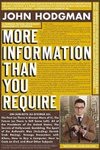
Review 62: More Information Than You Require


More Information Than You Require by John Hodgman

FACT: The Declaration of Independence was not the original creation of Thomas Jefferson, but was instead inspired by the work of Mole-Man declarationists.

FACT: The true sport of kings, and the only one of which a professional gambler will avail himself, is that of hermit crab racing.

FACT: Andrew Jackson was the first president to wear a necklace of human skulls at his inauguration.

FACT: The first moon landing was achieved in 1802, when Napoleon Bonaparte stepped onto the lunar surface with his conquering army. The horse skeletons are remarkably well-preserved.

WERE YOU AWARE OF IT?

Well, now you are.

In his first book, The Areas of my Expertise, John Hodgman claimed that he had provided us with “an almanac of complete world knowledge” that related matters historical, matters literary, matters cryptozoological, and of course, hobo matters, among many others. A read through this book, an almanac of interesting facts that were in no way, shape or form what is commonly known as “true,” was a demonstration of why fiction is inherently better than reality in that it is usually far more interesting. By the time you finished reading the book, he suggested, you truly would know everything you needed to know, regardless of whether it actually happened to be true.

So if the previous book was an almanac of complete world knowledge, why write another book? Surely complete world knowledge can’t be added to? Well, Hodgman addresses that question right away. What it comes down to is very simply that, in the few short years since the publication of The Areas of my Expertisenew things have happened. I know it’s hard to believe, and you may want to sit down and think about that for a moment.

Not the least of these new things is that Hodgman has become a famous minor television personality, which has gained him all the fame, riches and power you might expect. Following the publication of that book, Hodgman became a regular on The Daily Show and, of course, starred in the now-famous Mac/PC ads as the fuddy-duddy PC who puts up with the douchebaggery of the Mac.

Yeah, I really don’t like the Mac guy. But maybe that’s just because I really like Hodgman.

He has come down from the luxury zeppelin he bought from Emo Philips in order to provide us with more world knowledge – this time touching on what he has discovered about the okapi, the secret history of the Mole-Men, and the secret cult that lives in Park Slope, Brooklyn – an exclusive neighborhood that can be accessed only upon having reached the status of famous minor television celebrity. It’s a paradise, so long as you do not antagonize the children, who are allowed to kill you at their whim.

As with the previous book, this is a good piece of entertainment. Its jokes loop back and forth on themselves, referencing passages not only elsewhere in the book, but also on the pages of its predecessor (and for the sake of convenience, the page numbering for this book picks up where that of the previous book left off.) Its facts (or “facts”) are conveniently bolstered with handy charts and striking black and white photography that makes for a fascinating afternoon’s reading.

The intricate creativity that has been poured into building a bizarre alternate history of the United States is one that earns only the most sincere respect from me. Anyone with an imagination fertile enough to come up with things like Your Twelve Month Spleencast (a guide to telling the future using pig spleens (tip: it’s going to be pretty awful)), a Teddy Roosevelt List that puts Chuck Norris’ to shame, and a complete table of Brushes of Fame (with Hodgman as the famous person) deserves every cent I can give him.

One of his great regrets, as he tells us in this book, is that The Areas of my Expertise was never made into a page-a-day desk calendar. Such a mark of true success has only been reached by such luminaries as Gary Larson and the Secret Cabal of Crossword Puzzle Writers who are battling the Jumblemancers for control of the United States. In order that his second book might escape such ignominy, Hodgman has provided an interesting fact for each day of the year on each page. So, if you tear out the pages after reading them, voila! You have a page-a-day calendar. And some of the bits are truly inspired. The listing for September 11th, for example, shows why that day of all days is truly unforgettable.

But that is not all! Not yet, anyway. He is planning to continue his work into a third volume, due out whenever he manages to finish it. I assure you, Mr. Hodgman, I will be waiting eagerly for it.

It’s a strange type of humor, but then Hodgman is a strange type of guy. It’s the sort of thing that only he could pull off, lying in such earnest detail that you wish it were true only because it sounds just so much fun.

———————————————–
“Despite the conspiracy theories you may have read, the mole-men have never interbred with the British royal family or the Bush dynasty with the goal of infiltrating the highest reaches of government so as to harvest the blood of our babies to power the spaceliners that will bring them to the next planet they plan to pillage from within. You are thinking of the Belgians.”
– John Hodgman, More Information Than You Require
———————————————

More Information Than You Require on Wikipedia
John Hodgman on Wikipedia
More Information Than You Require on Amazon.com
TheAreasofmyExpertise.com

Leave a comment

Filed under almanac, humor, John Hodgman, satire

Review 61: Dave Barry Slept Here


Dave Barry Slept Here: A Sort of History of the United States by Dave Barry

Sometimes you just need a palate cleanser. Something to make you smile, that requires a minimum of thought for a maximum of entertainment. This is a dangerous thing to look for; it’s all too easy to find oneself wading through a sea of dross, looking for funny but just finding silly, childish nonsense of a mediocre caliber.

The nice thing about Dave Barry is that he is silly childish nonsense of the highest caliber.

My family has been Barry fans for a long time running. When I was a kid, the new Dave Barry book was an automatic Father’s Day present, and would migrate around the house as one or another of us picked it up for a few laughs. Fortunately for us, the laughs were more than a few – I remember laughing so hard I had to put the book down for a few minutes because just thinking “Hawley-Smoot Tariff” sent me into uncontrollable giggles.

This book is Barry’s tribute to not only American history, but to the whole concept of history books themselves. The fact that he’s covering everything from the initial human migration into North America to the Bush-Quayle administration (the book was published in 1989) in only 175 pages with fairly large font is a sign of his being a true master of history.

For example, he does what most public school textbooks do – he skips the boring parts. Teapot Dome? Who cares! The Federal Banking Crisis of 1837? Yawn…. We all remember high school, right? Pretty much nothing happened between the ratification of the Constitution in 1789 and the Civil War seventy-six years later. Right? He also saves time and space by skipping over those parts of history which are, to use a technical term from historiography, “bummers.” World War 2, for example – nothing fun to talk about there.

What Barry also does to make history easier is he standardizes the dates for us. No more do we have to remember what month and day something occurred (a feat that always kept me off the high score list in high school history class.) Now all the prospective student of history has to remember is October 8. When did the Mayflower arrive in New England? October 8. When was Kennedy assassinated? October 8. When was the very first Fourth of July? October 8.

See how easy it is? Why didn’t they do this when I was in school?

The style of the book is like someone writing about something barely remembered, with only the most cursory amount of research done. And this was in the pre-Wikipedia days, kids, when you had to look stuff up in books. Fortunately, while Barry’s history does indeed parallel our own, it is almost completely devoid of actual facts that you may be required to remember. All you really have to do is follow him along on the ride. Of course, if you actually do know something about American history, the book is even funnier. The fact that the book ends with the election of George Herbert Walker Norris Wainright Armoire Vestibule Pomegranate Bush IV and his vice-President Dan “Potatoe” Quayle does disappoint a bit, but, linear time being what it is, there’s not a whole lot one can do about it. All history books, serious and silly, are obsolete the moment they hit bookstores. The good news is that Barry maintained a prolific career as a columnist until he retired back in 2004, so you can read his thoughts on the large amount of history that did not end in 1989.

I will always have a warm place for Dave Barry in my heart, but I do have to confess something. When I was younger and read Dave Barry, I would laugh. A lot. Those good, hearty, soul-clearing laughs, and part of the best memories I have of Dave Barry is simply remembering laughing. I didn’t laugh very much reading this again. I don’t know if it’s because I knew where all the jokes were, if my head just wasn’t in the right place, or if my sense of humor has changed over the last twenty years.

Twenty years. Good lord.

Anyway, whatever the reason, I had far fewer of those laugh-out-loud moments than I used to. It’s still funny, don’t get me wrong. I just didn’t giggle, guffaw, cackle and try to read bits to my long-suffering co-workers. Whatever it is, I kind of miss it. I think I’ll have to dip into some of his other books to see if I can find it again.

If you haven’t read Barry, I definitely recommend checking him out. This book is a fine place to start….

——————————————-
“But as the old saying goes, “Time heals all wounds,” and in the more than 120 years since the Civil War ended, most of this bitterness gradually gave way to subdued loathing, which is where we stand today.”
– Dave Barry, Dave Barry Slept Here
——————————————-

Dave Barry on Wikipedia
Dave Barry Slept Here on Wikipedia
Dave Barry’s homepage
Dave Barry Slept Here on Amazon.com

Leave a comment

Filed under american history, Dave Barry, history, humor