Category Archives: nonfiction

Review 126: Supersense

Supersense by Bruce Hood

Like many of you who are reading this, I can’t throw books away. Even thinking about it makes me uncomfortable, so there is no way I could possibly hold a book over a garbage can and just let it drop. Ugh.

I don’t know why this should be, to be honest. I mean, they’re just books, right? Paper and ink that anyone can buy. And not even special books – first edition, author-signed, sold to me by my beloved grandmother on her deathbed.

NOOO!! Take it down, Jimmy, take it down!!

I would be hard-pressed to throw away even bad books. Mein Kampf, Dianetics, A Series of Unfortunate Events – I would save even these from the trashpile. Not because they’re worth reading, but because they’re books.

I’m not a squishy, sentimental man, either. I can tell dead baby jokes without flinching. I’ve participated in the burning of an American Flag. I’ve flipped off the White House (it was the Bush era – I couldn’t NOT flip it off), and if you give me a photo of the Pope, I’m pretty sure I can tear it up on live TV.

So what is it about these mass-produced blocks of paper that instills in me such reverence? This question is part of what Bruce Hood discusses in his book Supersense, appropriately subtitled, “Why we believe in the unbelievable.”

Hood is a psychologist by trade, and this book is an investigation into why we persistently believe in things for which we have no evidence. This can range from religious adherence and the firm belief in things like “holiness” and “sinfulness” all the way to haunted houses, superstitious behavior, and the belief that evil acts can somehow “taint” a physical object. In one demonstration that he refers to throughout the book, Hood offers a cardigan to his audience. It’s a nice enough sweater, perhaps a little out of date, but clean and it looks comfortable. It’s the kind of cardigan you might wear on a chilly autumn evening and think nothing of it.

The Wests? Naw, they're fine people. Perfectly normal.

Then Hood tells the audience that the sweater belonged to Fred West. For those of us who are not from England, Fred West is one of the most notorious serial killers of the last century. Over a span of twenty years, he and his wife tortured, raped and murdered at least twelve girls, two of whom were their own daughters. They’re very well-known in England, and as soon as people found out that the nice comfortable cardigan had belonged to Fred West, no one wanted to touch it, much less put it on. Even though there’s no rational basis to believe so, many people believed that there was some kind of contamination linked to the sweater, and feared that Fred West’s evil would somehow transfer to them.

As someone who tries to be rational as much as possible, I have found myself wondering why I hold on to beliefs that I know are fundamentally irrational. I wonder it even more when I watch the news or surf the internet and see how many people believe in things like “healing energy,” homeopathy, guardian angels, magic spells and the like. “What century are we living in?” I ask myself as I curl up into a ball and weep. The Enlightenment was only two hundred years ago – why are we backsliding?

Thinkers and scientists such as Richard Dawkins believe that this kind of fundamental irrationality is a learned trait. Parents pass it on to children, who then pass it on to theirs. Dawkins even goes so far as to consider bringing your child to church to be “child abuse,” and believes that if only we can break the chain of superstition, a new Age of Reason will emerge.
Waiting 200 years and counting....

Hood disagrees, and he makes a pretty compelling case. He doesn’t argue for the existence of the supernatural at all in this book, but rather the sense of the supernatural – the Supersense, as he calls it. This is the feeling that someone is watching us, the belief that one object is somehow more “special” than another, identical object. It is the reason we plead with our computers when they don’t work, why we anthropomorphise so many things is our world, and why we revere the remains of saints and shun the sweaters of murderers. It is a sense that there should be a supernatural world out there, even if we can’t prove it.

Hood believes that the origin of this supersense is in the way our early minds develop as infants. In that very early stage of life, we try to make sense of the world as best we can. Babies are little scientists, testing reality against their observations again and again, and coming up with hypotheses about how the world should work. This need to understand the world is hard-wired into our brains as part of our “mind design,” and not only can we never get rid of it, it may be essential to our development into fully-formed human beings.

A smiling sun is not always a good thing.

By testing children and how they observe the world, Hood tries to see how the mind develops from birth onwards, without the years of cultural indoctrination that Dawkins and those of similar opinion decry. These tests show how children expect reality to behave, and what happens when their expectations don’t match their observations. He looks at how children imbue the world with life and purpose – the Sun, always smiling in children’s drawings, exists to give us light, trees to shade us and the grass is there for us to play on. This endowment of purpose, or telos, if we’re going to be philosophical and pompous, is something we continue to do even into adulthood.

The more we learn about the world, the more we find out that it doesn’t follow the common-sense rules that we laid down in our infancy. It’s hard to accept, for example, that we aren’t the end product of evolution – even worse, evolution has no end product in mind. What’s more, after our brains went through years and years of classifying the world into neat little categories such as “living/non-living; intelligent/non-intelligent; plant/animal,” it’s jarring to know that we’re only 5% of the way off from chimpanzees and 50% off from being bananas!

Children intuit the world as they grow, and that is part of the mind-building process. This is the architecture of our minds. More often than not, it produces a rational picture of the world and how it works, but not always – the trade-off is that some supernatural ideas come along for the ride. While the mind-building process does prepare us to exist in the greater world, it also makes us fundamentally irrational beings. Some people are more able to overcome this irrationality than others, but even the hard-core skeptics may find it difficult to put on the sweater of Fred West, or have trouble not smiling when they’re in the presence of the sweater of Fred Rogers.

Ahhh... I feel better.

In a way, this book was both a disappointment and a relief. I have always hoped that one day humanity would rise above its irrationality and start appreciating the world for what it is, instead of wasting time looking for things that just aren’t there. But if Hood’s hypothesis is correct, that’s never going to happen. As long as we are human, there will always be a streak of the irrational in us. Try as we might, we will always have superstitions, strange beliefs, and we will always be looking for things that we cannot see.

And of course, perhaps this is a good thing. This irrationality is what gives us passion, it’s what connects us together as a species and as societies. This belief in the sacred, for example, is what gives rise to shared values in a community and a shared sense of what is important and what is forbidden. Without it, we’d be a species of Lex Luthors – fundamentally selfish, sociopathic and without the ability to connect to others.

NO.

On a personal note, it means that maybe I don’t have to be so hard on myself. I mean, being rational is great and all, but when you get to the point where you find yourself thinking something like, “Yeah, what is the big deal about incest?” then you know that it’s time to give the prefrontal cortex a break. And instead of beating myself up for not being able to completely disavow all the goofy little supernatural things that I cling to, perhaps I can just accept them as part of what makes me who I am. I know there’s nothing truly special about my books, but the supersense tells me otherwise. It may not be right, but at least it gives my life a little more color.

————————————————-
“If it’s true that our beliefs can be supernatural but unconnected to religion, then it must also be true that humans will not necessarily evolve into a rational species, because a mind designed for generating natural explanations also generates supernatural ones.”
– Bruce Hood, Supersense
————————————————-

Bruce Hood on Wikipedia
Supersense on Amazon.com
Bruce Hood’s blog

Leave a comment

Filed under Bruce Hood, children, nonfiction, pseudoscience, psychology, science

Review 125: Logicomix

Logicomix: An Epic Search for Truth by Apostolos Doxiadis and Christos Papadimitriou

I have a question for you. It’s a simple-sounding question, but hard to answer, so I really want you to put a good amount of thought into it before you do. Okay? Yes, I’m still in Teacher-mode, but that’s not important right now. My question is this:

What is truth?

Good luck with that whole "free will" thing.

It’s one of those unanswerable questions that has bugged us ever since we started being able to ask unanswerable questions. Along with “Why is there evil in the world?” and “Do we have free will or are our lives pre-determined from the beginning?” or “What’s the deal with that Justin Bieber kid? I mean really?” this question is one that people either ignore or obsess over.

Didn’t think I could do a pop-culture reference like that, did you? Shows how much you know….

This graphic novel is about one man’s pursuit of this question, and the ways in which it nearly destroyed his life. The man was Bertrand Russell, and we follow his life from his childhood to late adulthood as he searches for an unshakable foundation to mathematics and logic, and thus an absolute truth that he could rely on.

Bertrand Russell does not find the truth. He teaches it to come when it is called.

As a child, Russell lived with the question of why things are the way they are, and got no good answers from his domineering grandmother. It wasn’t until his introduction to geometry and the wonder of mathematical proofs that he could finally say there was something about which he could be absolutely sure in the universe. Mathematics, he thought, would be the answer to everything. Pure, unsullied and utterly, utterly reliable.

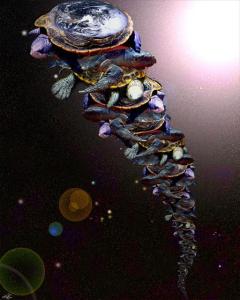
But there was a flaw in math – the Axioms. Mathematics in the 19th century was a direct descendant of Euclid’s work, and rested on a series of axioms in order to function. An axiom, then, is something that is assumed to be true so that you can go on to prove other things. For example, if you have a line, and a point not on that line, there can be only one line drawn through that point that is parallel to the first. Why is this true? Well… it just is. If you have to prove that, then you have to prove a thousand other things first, and you never end up being able to prove the thing you were trying to prove in the first place. It was like, he thought, the cosmological model of the world on the back of a turtle. Which stood on another turtle. Which stood on another, and another – turtles, all the way down.

The bottom turtle's name is "Jeff." (art courtesy of Kenneth Rougeau)

That didn’t satisfy young Russell, and he went off in search of the floor upon which the last turtle stood, as it were – new mathematics that would be able to define the foundations of math, and thereby give a concrete understanding of the universe. Along the way, his desire to apply the certainty of math to human thought and interaction led him to the discipline of logic, a strange chimera of mathematics and philosophy. By becoming a logician, he thought he might finally be able to pin down some absolute truths about not only abstract math but human nature itself.

Of course, he failed. Spectacularly. Broken marriages, broken friendships, ill health – his obsession with an absolute truth to the universe nearly destroyed everything he had. Fortunately for him, Russell pulled back from the abyss before it could swallow him whole, and became one of the early 20th century’s greatest philosophers in the process. His failure to find an ultimate foundation for logic and math was not entirely without fruit – thanks to work by Russell and others, these disciplines were pushed forward in ways that made our modern lives possible. New ways of understanding the universe, from the unfathomable depths of infinity to the simplicity of 1+1=2, everything was open to examination in those days. Because of men like Bertrand Russell, humanity advanced in great leaps and bounds.

1+1=2. Seriously. No more arguments.

In the end, it’s a compelling book. I read and re-read it, convinced each time that there was something else I had missed. I was very often right. Doxiadis and Papadimitriou have put together a compelling tale of a man often overlooked by the general public, and they did so in a medium that’s close to my heart – the graphic novel. The art, done by Alecos Papadatos and Annie Di Donna, is wonderful. It has a simplicity that belies the complexity of its topic, and shows an excellent sense of storytelling. Hats off to the two of them, without a doubt.

This book, it should be noted, is not a primer on logic. If you’re looking to know how logic works, or you want to know a bit more about higher mathematics and how to do them, then you’d best look for another book. As the authors tell us right in the beginning, this book is a story, a great tragedy that owes its inspiration to the ancient productions of the Greeks. It’s the story of a man who pitted himself against the universe and lost, but who did so in such a way that he – and the world – came out better for it. The book ends with a scene from The Oresteia, a classic Greek drama about another man who found himself in a no-win situation with no absolutes to rest upon.

"Stop asking me to prove beauty, dammit!"

Much like Orestes, when faced with two choices that could lead to his destruction, the only way forward for Russell was to compromise and to move forward. By doing so, he not only became a happier man, but became involved with humanity again, as a philosopher, a teacher, and an anti-war activist.

In the end, this book is about the compromises we all have to make as human beings. The world may be a logical place, but we are not. There is a limit to our logical understanding of ourselves, and sooner or later we have to accept that and deal with people as people, rather than as problems to be solved and equations to be balanced. Bertrand Russell’s quest, as interpreted by this novel, is an example of how far we can push the need to know exactly what’s at the bottom of it all. The fact that the foundations of our world appear to be unprovable and unknowable is, ultimately, unimportant. What is important is that we are here, now, and we need to make sense of our own lives.

—————————————————————
“The demand for certainty is one which is natural to man, but is nevertheless an intellectual vice. So long as men are not trained to withhold judgment in the absence of evidence, they will be led astray by cocksure prophets, and it is likely that their leaders will be either ignorant fanatics or dishonest charlatans. To endure uncertainty is difficult, but so are most of the other virtues.”
– Bertrand Russell, Unpopular Essays – Philosophy for Laymen
—————————————————————

Logicomix on Wikipedia
Apostolos Doxiadis on Wikipedia
Christos Papadimitriou on Wikipedia
Bertrand Russell on Wikipedia
Logicomix on Amazon.com

2 Comments

Filed under Apostolos Doxiadis, Bertrand Russell, biography, Christos Papadimitriou, graphic novel, logic, mathematics, nonfiction, quest

Review 118: Secret Lives of the First Ladies

Secret Lives of the First Ladies by Cormac O’Brien

This is a follow-up to O’Brien’s previous book, Secret Lives of the U.S. Presidents, which, while a fascinating book, is a topic that has been covered many times. I have, in fact, two books on this topic, and they both illuminate the hidden idiosyncrasies, character flaws, shining moments of virtue and petty humanity of the 43 Commanders-in-Chief.

The "non-Dowdy" version of Abigail Adams

It was Abagail Adams who exhorted her husband to, “Remember the ladies,” and it seems that O’Brien has done just that. He’s given us a nice concise look at the women of the White House, and it’s a hell of a read.

It’s very easy to forget the First Ladies, and kind of pigeonhole them into the space that reads “President’s wife,” but to do so would be a great disservice to an amazing group of women.

A lot of people remember Hillary Clinton as being a political powerhouse, a kind of “co-President.” But she wasn’t the first, by any means. When Woodrow Wilson suffered a debilitating stroke in 1919, all access to him was controlled by his wife, Edith. She would let no-one in to see him, on the grounds that he was very ill and needed absolute peace and quiet. So, when someone needed something signed by the President, Edith would take it, close the door, and come back a few minutes later with the signed document. The question very quickly arose: who’s really the President?

Helen Taft is another forgotten First Lady firebrand. Without her motivation, William Howard Taft might have been perfectly happy to be a judge, but that wasn’t good enough for Helen. From her teenage years, she knew that she wanted to live in the White House, and she pushed her husband to make damn sure that she did. Once there, even her husband called her the “co-Presidentress” for the amount of involvement she had in the day-to-day decision making that went on. She was a woman of boundless energy, who was never willing to sit still. Oh, and if you like the cherry trees that bloom in DC every spring, you can thank Helen Taft for that. Women like these – Eleanor Roosevelt and Jocelyn Carter are part of their ranks as well – left indelible impressions on the country.

No-one messed with Anna Harrison. No one.

Not every First Lady was so ambitious, though. Some were more populist idols, adored by the public not for their works but for their personality. The most recent example would probably be Jacqueline Kennedy, who became a media icon almost as soon as her husband was elected. But there were others before her.

Dolley Madison threw the best parties in Washington, and was vastly more beloved than her dour and stolid husband, James. It was said that she had no enemies, and even the people who loathed her husband adored her. She stayed in the White House right up until the British showed up at its doorstep and managed to save a few precious items. It’s even said that the British commander, Rear Admiral Sir George Cockburn, was more interested in capturing her than the executive mansion, and took her seat cushion from the dining room so that he could come away with something to remember her. Before he had the building torched, of course. After she left the White House and her husband passed away, it was customary for each new President to pay her a visit, gaining a kind of approval from the most loved woman in America.

Ida McKinley's hypnotic powers were well-known in Washington D.C. Only Theodore Roosevelt was able to break her spell....

Or take Frances Cleveland, wife of Grover. Her relationship with her husband would be considered scandalous in this day, and certainly was in hers – she was twenty-seven years younger than her husband, who had been her legal guardian when she was a child. Much to the nation’s surprise, he went from being “Uncle Cleve” to “Beloved Husband.” But that bit of creepiness didn’t stop the nation from loving her. Once in the White House, she became an early proponent of women’s accomplishments, willing to meet and talk to anyone, rich or poor. When Grover ran for re-election in 1892, Frances’ image was the one campaigners used, not his. And why shouldn’t they? In an age before byzantine copyright law, her name and image were already being used to sell all kinds of household goods. Ever eaten a Baby Ruth candy bar? It was named after the Clevelands’ daughter, who was, for her short life, the most popular baby in America.

And then there were the sad stories, the women whose lives in and out of the White House were full of misfortune. Jane Pierce is probably the saddest of these. She never wanted her husband to be President. Every step that he took forward seemed to result in pain for his family. Their first child died after a few days. When Franklin finally got out of national politics and opened up his own law firm, their second child died of typhus. With only one child left to them, Jane held on to him with a manic grip. His death – the only one in a train derailment a short time before Franklin’s inauguration, was the last straw. Jane became convinced that God had killed their children so that Franklin could have more time to devote to his Presidency, and spent her days writing letters to the dead boy, asking his forgiveness. She became known as the “shadow of the White House.”

Julia Dent Grant, who was the only person capable of keeping Ulysses from drinking himself to death.

No less tragic, of course, was the life of Mary Todd Lincoln, who is best known for being the wife of our first assassinated President. Even before that bad night at the theater, however, she had her share of sorrow. The animosity and hatred that was heaped upon her husband, the terrible strife of a civil war, and the untimely death of one of her sons turned a once vibrant, energetic woman into hysterical, morbid harridan. She held séances to try and talk to her deceased boy, harangued the White House staff, and almost had to be forcibly ejected once Andrew Johnson became the President. What’s worse, her own son, Robert, had her declared insane and had her committed. She won her freedom, but the animosity between mother and son after that was white-hot.

There’s so much more. The relationships these amazing women had with their husbands are also well-detailed, and also somewhat surprising. For all that Bill Clinton was a lecher, he was hardly the first.

Pat Nixon, who really must have loved Richard, though none of us knows why....

Hillary joined a group of long-suffering women who put up with blatant and repeated infidelities in and out of the White House. Some relationships were partnerships, like the Carters, the Hoovers and the Tafts. And some couples were just quietly devoted to each other, like the McKinleys and the Clevelands.

The First Lady is not an elected position. There’s nothing in the Constitution about her, what she can and cannot do, so the job, such as it is, is one that each wife makes for herself when her husband takes office. The effects that these women have had on this nation is immense, and should not be overlooked. So, if you’re interested in knowing more about our Presidents, you could do worse than to give a good look at the women who stood by them.

————————————————
“Well, Warren Harding, I have got you the Presidency. What are you going to do with it?”
-Florence Kling Harding

Cormac O’Brien on Wikipedia
Secret Lives of the First Ladies on Amazon.com
First Ladies on Wikipedia

Leave a comment

Filed under american history, biography, Cormac O'Brien, family, history, nonfiction, presidential history, wives, women

Review 109: The Origin of Satan

The Origin of Satan: How Christians Demonized Jews, Pagans, and Heretics by Elaine Pagels

Let me get this out of the way right up front: I can’t think of the title of this book without the Church Lady from the heyday of Saturday Night Live popping into my brain. And now she’s in yours, too. You’re welcome.

Well, isn't that SPECIAL?

So. Who is Satan? A fallen angel? The great adversary of God? Saddam Hussein’s bitch? If nothing else, Satan is the great scapegoat, the one on whom we tend to pile all our troubles. Your church is running out of money? Satan. Your kid is doing drugs and listening to that awful hip-hop music? Satan. Queers getting married? Definitely Satan.

For some, Satan is an actual being, a true agent of evil whose purpose is to ruin all that God has made. For others, Satan is a symbolic representation of the evil inherent in the human condition, an abstract form made real in order to better understand it. In other words, there are as many versions of Satan as there are people who invoke him.

But how did the whole Satan thing get started? Where did he come from and how did we get to the Satan that we all know and loathe today? That’s what Elaine Pagels was determined to find out when she wrote this book.

While most of the book focuses on the New Testament and a history of the early Christian church, it was the ancient history of Satan that I found most interesting, mainly because it concurred with a pet theory that I’ve had for a long time: Satan was never an enemy of God. Satan was God’s quality control guy. It was his job to look for weaknesses in the system, to probe Humanity for its faults and flaws so that it could be made better. Thus the serpent in the garden (which, just as a note, was never actually revealed to be Satan), and especially the story of Job, where God allows Job’s life to be ruined on a bet. My guess was that he won a nice, crisp one-dollar bill.

Employee of the Millennium (photo by Nathan Rupert)

The Satan of Olde was an agent of God, there to make sure that things went the way they were supposed to. He caused trouble, he stirred things up, yes, but that was his job. Much like the office manager that you despise because he always harps on you for checking your Facebook account during company time, even though you both know there’s nothing better to do right now, but he just enjoys watching you suffer and enforcing his stupid little rules…. That guy is, at least in his own mind, working for the greater good of the company. He may be a dick, you may wish great misfortune heaped on him and his progeny, but he’s doing the job he was given to do.

Sounds great, but Satan’s downfall from “annoying but necessary agent of God” to “vile and demonic enemy of god” was planted a long time ago, before Christianity was even on the horizon.

The Jewish religion, from whence our concept of Satan arose, has always been one of Otherness. Israelites and Enemies. Us and Them. From its earliest days, God made sure the Israelites knew that they were a small force against the world, with only Him to protect them. He told Abraham straight out that He would bless him and curse his enemies. Therefore, the descendants of Abraham had to be on constant guard from enemies both from without and within. With a Satan already set in their theology as a tester and troublemaker for God, it was not a far leap to look to him as the cause of the multiple troubles that the Jews had over the years. Around the time of Christ, the Essenes were a distillation of that concept. They were a small Jewish sect – a minority within a minority – which believed that they were the only true Jews and that everyone else had gone soft. The Jewish majority was corrupt, led astray from the true path to God, probably by Satan.

When the Christians showed up, a minority with an even more tenuous existence than the Essenes, they found this concept very useful. Telling their story from the point of view of an embattled minority, they found Satan to be a very useful opponent against whom their Messiah could fight. He was an excellent symbol that stood not only for the earthly conflict that was taking place between the Christians, Romans and Jews, but a greater spiritual conflict that involved all humankind in a battle between good and evil.

Really he just likes to watch

Pagels’ basic thesis is that the concept of Satan, whatever else it may be, was used to not only encourage persecution of The Other – Jews and pagans, to be precise – but to also keep the Christians themselves in line. The book is actually a history of the early Christian movement and how that history was reflected in the writing of the Gospels. In fact, just like in the Bible, Satan doesn’t really appear much in this book. Rather Pagels looks at how the early Christian movement fought for its survival against enemies without and within, and then how Satan became a spiritual catch-all for those who disagreed with them.

It’s a great analysis of the early days of the Church, and just how chaotic and tumultuous it was. There were so many churches with so many different interpretations of Jesus’ life and death, so many Gospels being written and so many opinions on the very nature of God’s universe that it’s surprising the whole thing managed to come together to be the world’s largest religion.

What’s more, it shed some light on something that’s always annoyed me: the persecution complex that so many Christians have. The best time to catch this is in December, when pundits in the States start going off about the War on Christmas as though the last twelve Christians in the country were holed up inside the Topeka Christmas Shanty with shotguns and eggnog. Every time a judge tells a town that they can’t have the Ten Commandments on the lawn of their town hall, or a Wal-Mart tells employees to say “Happy Holidays” instead of “Merry Christmas” there is always a vocal group of Christians who claim that they’re being persecuted and that they’re on the edge of extinction. All this despite the fact that Christianity is the most popular religion in the world, that there are more Christians in Congress than any other religion, and that every single President in US history has been Christian. Despite all that, there seems to be a knee-jerk need to feel persecuted.

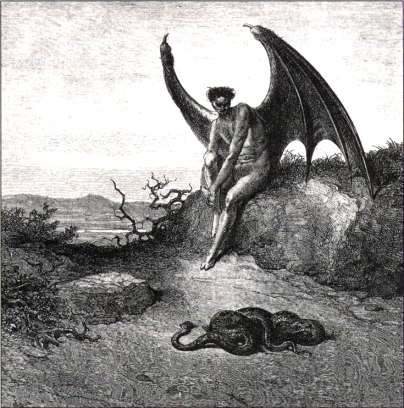
One of the Prince of Darkness

This book offered a very good reason why this is: because that was how the religion was founded, and it is the fundamental narrative of Jesus’ story. If Jesus had been part of the Jewish majority, his story would have ended very differently, no matter how radical his ideas. The early church was born of persecution, first from the Jews and Romans, and when they were no longer a danger, from pagans and heretics. And under all that, the hand that is always set against them, is Satan. As long as Satan is there, the Christians will always have someone there to persecute them. Without that cosmic, deathless opponent, Jesus becomes just another political rabblerouser executed by Rome. Certainly no Messiah would have allowed himself to die unless it was a gambit in a much greater game against a much more powerful opponent. Without Satan and the relentless threat attributed to him (and, by extension, those who are seen to ally with him), Jesus’s sacrifice becomes meaningless, and the whole religion follows with it.

It’s a fascinating book and a great look at the early days of the Church. If you’re into that kind of thing, go pick it up. Many thanks to my mom and stepdad, who pointed my attention towards it.

—————————————————–
“How, after all, could anyone claim that a man betrayed by one of his own followers, and brutally executed on charges of treason against Rome, not only was but still is God’s appointed Messiah, unless his capture and death were, as the gospels insist, not a final defeat but only a preliminary skirmish in a vast cosmic conflict now enveloping the universe?”
– Elaine Pagels, The Origin of Satan
—————————————————–

Elaine Pagels on Wikipedia
The Origin of Satan on Amazon.com

Leave a comment

Filed under Bible, Christianity, Elaine Pagels, good and evil, history, Jesus, Judaism, nonfiction, religion, Satan, theology

Review 108: Flim-Flam!

Flim-Flam! Psychics, ESP, Unicorns, and Other Delusions by James “The Amazing” Randi

((Now hold still while I read your aura. Yes, my spirit guide is telling me something, that you are experiencing some kind of pain or discomfort in your back, or perhaps your shoulders. And this is typical of someone born under your star sign, you know? Of course you do – your type is very insightful, even if you do sometimes let little things escape your notice from time to time. Here – I have a medicine that will help you, a special homeopathic formula that I mixed myself. It’s proof against all aches and pains. Yes, I have a spoon somewhere around – no, not that one, that one’s bent. I could tell you that I got the recipe from visiting aliens, but you would never believe me. Perhaps it was Atlanteans….

Ah, there is one other thing…. My spirit guide tells me that there is another spirit who would talk to you – someone you miss very much. I’m getting the letter P, or maybe G…. Does that mean something to you? Ah, good, good. My abilities have increased a hundredfold since I started transcendental meditation, and I credit the Master with my improved skills. Well, our time is almost up. I have to go charge my dowsing rod with the crystals that were given to me by my young daughters. They say that the fairies gave them to them, and who am I to say otherwise? But I will say this before we part – the numbers of your name, crossed against your biorhythms, tell me that you must not enter into any dealings of a financial nature this week.

You can leave your check on the table by the door.))

There is one truth that I have learned in my days, and that there is no idea so ridiculous, so implausible, so poorly-defined, that someone, somewhere won’t fall for it. Whether it’s psychic surgeons, aura readers, tellers of the future or viewers of past lives, UFO hunters, witch doctors, table-tippers, spoon-benders, mind-readers or water-dowsers, if you can figure out some simple slight of hand, the odds are good that you can convince someone you have supernatural powers. A few blurry photographs and some enthusiasm, and you can have aliens on our shores. Some clever guesses and a keen knowledge of human nature, and you’ll never have to work a day in your life.

If you’re like me, it’s enough to make you want to disavow humankind and just go live somewhere off in the woods. Thankfully, James Randi is not like me.

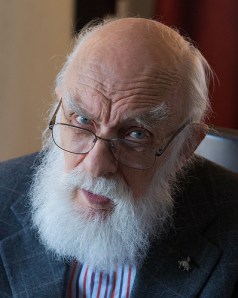
James "The Amazing" Randi (photo by Andy Ihnatko)

A longtime magician and skeptic, James Randi has been one of the driving forces of modern skepticism. Since his 1972 debunking of spoon-bender Uri Geller, he has been an authority on people who claim to have supernatural abilities. He has traveled the world in search of these people, revealing the methods by which they knowingly or unknowingly deceive people who want so desperately to believe. This book, written in 1982 and well in need of an updated and revised edition, documents many of Randi’s investigations in painstaking and unrelenting detail.

He tells us first of the hoax perpetrated by two young English girls, one which was good enough to capture not just a credulous nation of newspaper readers, but a man regarded as one of the greatest minds of his time – Sir Arthur Conan Doyle. In 1917, Elsie Wright and Frances Griffiths released several photographs which showed them surrounded by gossamer-winged fairies. The public went wild for their story. Experts were called in to examine the photographs, and they all pronounced them genuine. The girls were interviewed, their cameras and equipment checked out, and no evidence of trickery could be found. In any case, believers said, two young girls would have no incentive to lie to the entire nation like this, would they?

Well, they did. Perhaps it wasn’t their intention to deceive the world, but that’s how it turned out. As of Randi’s writing, they hadn’t admitted it outright, but a year after publication, they did. What started as simple fun with a camera and some paper cut-outs escalated into something uncontrollable by two young girls, and a legend was born.

Frances Griffiths with her "fairies"

Elsie and Frances may have been innocents overtaken by events, but there are far more people who are fully conscious of their deceptions. A Holy Man who promises everything up to and including the ability to fly if you just follow his word and his special meditation technique. Researchers so intent on discovering psychic powers that they disregard even the most basic of experimental controls. People who manufacture fake artifacts to support their belief in ancient alien astronauts. There are those who take money from the unwitting and those who don’t, some who treat the ability they believe they have with humility and those who don’t. The weird, the arrogant and the dangerous – Randi’s seen ’em all. And every time another one pops up, he knows what to look for.

Belief is a weird thing. Under careful examination, every claim that Randi has seen has fallen apart. He has listened to them carefully and asked a very simple question that seems to elude so many others: How else could this effect be achieved? As a lifetime magician (though he prefers the term “conjurer”), Randi is an expert at getting you to think you see something that really isn’t there, and he brings this expertise to bear when he investigates claims of the paranormal. What’s more, he has a very good grasp of experimental procedure and how to test for a specific effect, and he is ruthless in making sure they are adhered to.

Science Badges (photo by Ruth Ellison)

But – and this is important – Randi is fair. If you come up to him and say, “Randi, I can see auras which tell me who the all gay people are,” he won’t just laugh in your face and say that you’re crazy. He’ll listen to your story, how your power works and how you use it, and then propose a simple test to see if it really exists. The test is to be double-blind, so when the target people come in and check the “gay” or “straight” box, that information is kept from both the aura-reader and the person administering the test. What’s more, the psychic has to agree in advance on the conditions of the test, signing a promise (rarely kept) to accept the results. Tests are usually done multiple times, just to give the subject a chance. When the results come in as negative – as they always have thus far – Randi doesn’t gloat. He doesn’t laugh and say “I told you so.” In fact, in one chapter he mentions that he feels bad sometimes, telling people who honestly believe they have a unique gift that, in fact, they don’t.

I suspect that Randi really wants supernatural powers to exist. I think he wants to meet someone who can move objects with her mind, talk to the dead or find water just by concentrating hard. Why else, then, would he have his Million-Dollar Challenge? What is described in Flim-Flam as a $10,000 reward for proof of supernatural abilities has grown significantly. Not because Randi is richer, but because he feels that his money is absolutely safe. Yet I think he would be happy to be able to give it away one day.

This book should be required reading for everyone who has encountered what they believe to be the paranormal. It is detailed, it is harsh and it is unequivocal in its assertion that if you see someone doing something that logic demands cannot be done, chances are excellent that it’s a trick rather than super-powers.

Unfortunately, the True Believers will invariably be unaffected, and that is something else that Randi takes great pains to show. No matter how often someone was shown to be a liar, a fake or a fraud, there were always supporters ready to make excuses. The psychics themselves are also very good at inventing reasons why their powers cannot be tested – the wrong kind of weather, interference from the cameras that are recording the tests, or just bad energy from the skeptics in the room. All the logic and science in the world won’t convince those who don’t want to be convinced.

(photo by Thomas Hawk)

As much fun as it is to read about The Amazing Randi rushing about the globe to put hoaxers in their places, it’s also a little depressing. It was written in 1982, on the heels of Randi’s book The Truth About Uri Geller, which exposed the spoon-bending psychic as a fraud, so you would think the one-two punch of these books would be enough to put paid to ridiculous beliefs in ideas that were demonstrably false. Well, you’d be wrong. Newspapers still run horoscopes every day, you can get a biorhythm app for your iPhone, psychics and mediums still rake in tons of cash, and there still innumerable people who put their faith, money and lives in the hands of psychic healers – only to lose all three.

But Randi is undaunted. He started the James Randi Educational Foundation to support critical thinking and skepticism, he’s still active in the skeptical community, and he’s still accepting applications from people who want his million dollars. He may have hoped that this book would be a nail in the coffin of psuedoscience and woo, but even though that didn’t pan out, he never gave up. One by one, case by case, the Amazing Randi has stared down the wild-eyed stare of unreason, and he has never blinked.

For that, I will always be grateful.

——————————————–
The tinkling noises you will hear as these pages are turned are the scales falling from many eyes. The groans are from the charlatans who are here exposed to the light of reason and simple truth. It is a light that pains them greatly.
– James Randi, Flim-Flam!
——————————————–

James Randi on Wikipedia
Flim-Flam! on Wikipedia
Flim-Flam! on Amazon.com
James Randi Educational Foundation website

2 Comments

Filed under James Randi, nonfiction, pseudoscience, science, skepticism

Review 106: Eats, Shoots & Leaves


Eats, Shoots & Leaves by Lynne Truss

This is how I know I’m a real English teacher – I have a shelf dedicated to books just about English. The history of English, the uses and misuses of English, and even the history of the alphabet we use. This is something I never expected to have in my personal library, that’s for sure.

So has my brain. (photo by Nathan Harrison)

But that’s all to be expected; I’m an English teacher, and people like me are supposed to read books like this. It’s professional development, or something. The weird thing about this book, a book dedicated to punctuation, of all things, is that it was popular with people who weren’t English teachers. Everyone was shocked by how well it sold, the author included. A book written as kind of a primal stickler scream somehow struck a chord with the general reading population. Perhaps there is some hope for our species after all….

The reason it sold well, of course, is that it’s well-written and entertaining to read. Far too many books about language are written by dusty intellectual Linguists who exude smugness with their impenetrable jargon and are completely inaccessible to the general public. I have those books on my shelves as well, and nothing this side of a double shot of NyQuil is as good at getting me off into slumberland. Ms. Truss, however, writes like one of us. She’s an ordinary person who loves her language and who just snaps every time she sees a sign like, “Apple’s – $1”. I share her pain.

Can't use white-out on neon, can you? (photo by James McNally)

The book is a well-mixed combination of history, usage and style. The tiny marks that make the written English word behave the way it does have come to us along a remarkable number of paths. In the last millennium or so, marks have been added, changed and removed over time as necessity dictated. One of her fears (and the impetus to write this book) is that we may be changing English to a new form that requires less of that rigid, form-fixing punctuation.

Or people just haven’t bothered to learn.

As she notes throughout the book, punctuation is one of those things that few people ever really get to learn. Our English teachers give it a once-over in elementary school, and then we never get a review of it, so we spend most of our lives just throwing around commas and apostrophes and hoping we get it right. More often than not, we don’t. And we’re afraid to ask anyone, lest we look like ignorant yobs.

But to master punctuation means more than just being a pedant and a nerd. Heavens, no. Mastering punctuation means controlling your language, which is controlling your thoughts. The vast difference between a sentence like, “The convict said the judge is mad” and “The convict, said the judge, is mad” should be enough by itself to illustrate how important proper punctuation is. In a language like English, so dependent on rhythm, timing and stress, punctuation is the substitute for our voice. It tells us when to speed up and slow down, which points need to be stressed and given special attention, and which points (like this one) can be safely disregarded, if one so chooses.

Only one member, mind you.... (photo by Lobstar28)

It would be very easy for Ms. Truss’ obvious frustration with the misuse of punctuation to overwhelm her and poison the book. Admittedly, she does at one point put together a kit for those who would be punctuation guerrillas and risk prison to set the world straight, but by and large she stops short at advocating actual lawlessness.

Ms. Truss understands that punctuation abuse isn’t something that people do intentionally – it’s largely a matter of ignorance, and she wants to help. What’s more, she’s funny. For example:

In the family of punctuation, where the full stop is daddy and the comma is mummy, and the semicolon quietly practises the piano with crossed hands, the exclamation mark is the big attention-deficit brother who gets over-excited and breaks things and laughs too loudly.

Every section in the book has sharp and clever humor, a description of something as simple as a comma made in such a way that you find yourself laughing out loud on the train.

Of course, whenever you get into this topic, you run the risk of finding yourself forced to one side or the other of the “proscriptive” versus “descriptive” debate. You know, the people who want to tell everyone else how to use language versus the people who want the speakers to decide for themselves how it is used. The latter smacks of classical democracy, and as both an English Professional and a person with a healthy distrust of The People, I’m hesitant to sign up for it. I like rules in language. I like having a common set of guidelines we can turn to in order to make sure we’re all getting the meaning that the speaker or writer is trying to convey.

WHAT? The fabulous fur's WHAT?? (photo by Trevor Coultart)

Unfortunately, for people like Truss or myself, it’s all too easy to cross that line from being the person who appreciates a bit of order to that person who writes letters to the editor because some headline writer used a colon where a semicolon would do. And I’ve seen internet flame wars go wild over this pro- or de- divide. People who could politely disagree with each other about Sarah Palin’s international policy experience will find themselves screaming bloody murder over whether or not you should put two spaces after a period.

What has to be remembered is this: there are rules to language, like it or not. Those rules, however, change, and no single one of us has any power to impel or obstruct that change. The best we can do is to make sure we are writing with clarity and precision so that our intended audience understands our thoughts with the least amount of effort on their part. Regardless of what you think of the rules, if the reader has to stop and ask herself, “Wait, what did he say?” then you have failed. So learn the rules. Once you’ve learned them, you’re free to do what you wish, but make sure you have them down cold.

So, if you’ve always wanted to know about how to use a semicolon, or you’re not sure if your commas are in the right place, or if you’ve ever driven someone to madness by dropping an apostrophe into a possessive “its” – and you know who you are – then this book is the one you need. Enjoy.

——————————————
“Using the apostrophe correctly is a mere negative proof: it tells the world you are not a thicko.”
Lynne Truss, Eats, Shoots and Leaves

Lynne Truss on Wikipedia
Eats, Shoots & Leaves on Wikipedia
Eats, Shoots & Leaves on Amazon.com
Lynne Truss’ homepage

24 Comments

Filed under humor, language, Lynne Truss, nonfiction, punctuation

Review 84: Story


Story by Robert McKee

Why are there so many bad movies out there? I mean seriously – you and I both know that of all the films that are released every year, we probably get only one or two that are actually good. There’s some that are good enough to spend an afternoon watching, maybe enjoyable enough that we’ll want to watch it again on DVD later. But so many are just… bad.

It is my own fault, I think, for seeing Transformers 2. I have no one to blame but myself.

The really scary thing is that, in the summer of Transformers 2 and G.I. Joe, these were the best stories they had available. Seriously. If they had a better movie to make, one that would get a bigger audience and thereby bring in more money, don’t you think they would have made it? The only reason you put a piece of misery like TF2 together is because you have no better options available.

Why, then, should this be so? What happened to the great scripts of long ago? You know, back in my day, when we had good movies, dammit, and we didn’t need all this fancy See-Gee-Eye to fill up screen time. When we could go home quoting movie lines and we had characters that inspired us and stories that shaped our lives?

Well, it’s probably important to note that even in the Good Old Days, the good stories were still grossly outnumbered by the mediocre and bad ones, and there’s a very good reason for that: writing is hard.

If you take nothing else away from this book, you will remember that – writing a good story is work, and if you’re not willing to do the work that it takes, then you’re not going to write a good story. Oh, you might luck out and write a story that’s good enough, and there might be enough truly bad stuff out there that someone will be willing to publish or produce your “good enough” story. But that won’t make people like it, watch it, read it or care about it. If you want your work to have real resonance, to have an effect on people long after they’ve put it down or walked out of the theater, then you have to be willing to do more than just type a couple thousand words every day. You have to know your story from the inside out, know the characters better than they know themselves, and have a clear vision of what it is you want to say.

A good story, McKee believes, is the writer telling us “Life is like this.” And if it’s a good story, well-told, then we’ll believe him.

And that’s the reason for the title of this book – STORY. Everything serves the story, McKee says, including you. But if you know how the story works, and how to make the story serve your own ends, then you can create a piece that will live on in memory.

This book is not an instruction manual, and the things that McKee talks about are not rules or even guidelines. They are principles of storytelling, guiding ideas that underpin every good story ever told, and the lack of which are what leads to mediocre or even bad storytelling. If you follow these principles, McKee believes, keep them in your mind and be willing to work with them, then you’ll be able to produce work that will sell.

One of the examples that gets used throughout the book is the idea of the Gap. People who want something, you see, will usually do the minimum required to get that thing. So if I want to get into my friend’s home, I won’t bring my lockpicks and jimmy open the door. I’ll probably just knock on it and ask to be let in. If that happens, then I get what I expected to get, and that scene should therefore be cut from the manuscript.

What if, however, I knock on the door and my friend refuses to let me in? There is the Gap, a difference between what I expected to happen and what actually happened. Now I have to react to that, and his reaction to my reaction will drive the scene on. By asking yourself what the character expects, and then asking, “Okay – what’s the opposite of that,” you can drive the story along, make it interesting, and provide your characters with more to do than just knock on doors.

He also talks about the Controlling Idea of a story – what is the meaning of your story? It could be something like, “Love brings people together through adversity,” or “Those who use others lead meaningless lives,” or “The best life is one where challenges are overcome.” It is the spine of your story, the idea that holds everything together. By knowing what your story is really about, you can make sure that every scene, every chapter serves that end.

From the big ideas of characterization, symbolism and the Controlling Idea, McKee moves to structure and the true nuts and bolts of screenwriting – the beat/scene/sequence/act structure that governs a film and determines how the overall structure works. He looks at different movies and analyzes how the story is structured, both in regards to the main plot and any sub-plots (which are really good for propping up a slower second act), points out different ways to introduce the Inciting Incident of your story, where the climaxes and turning points might go, and how to get there and keep your audience interested.

There’s so much in the book, it really is like a handbook of story-writing. While it’s geared towards screenwriters, the principles of storytelling can apply to any medium. He does talk a little bit about other media as well, mainly in the section on adaptation. If you’re a playwright or a novelist, there’s lessons in this book that you can definitely use, while ignoring the exhortations not to try and put stage and camera directions into your screenplay.

I’ve had an on-again, off-again love of writing since I was a kid. There have been times when I wrote non-stop, putting out stories left and right. Not necessarily good ones, mind you, but writing nonetheless. And then there have been periods – like now, for example – where there are no stories that burn to be told. I miss it, honestly, but reading this book kind of stoked the flames a little. I got to thinking about old stories that I could revise, and a couple of ideas that I had consigned to the filing cabinet of my brain proved to be good guinea pigs for some of McKee’s principles.

Does that mean I’m on my way to literary superstardom? Not without a whole lot of hard work it doesn’t. Much like with Stephen King’s On Writing, one of the biggest lessons you get from this book is that creating a story of any quality requires hard, consistent work, and lots of it. McKee gives some good tips on the kind of writing process you should use to shorten the writing time – making more efficient use of your time and creativity, essentially – but at no time does he claim that making a good story is easy. What he does do, though, is make you believe that the hard work is worth doing.

As much as I would like to heap praise on McKee, though, there was something that stuck in my brain like a splinter when I read this. It’s a little thing, it’s a very nerdy thing, but it’s a thing nonetheless.

At various points in the book, in order to illustrate one principle of storytelling or another, McKee uses the scene in The Empire Strikes Back where Vader reveals that he is Luke’s father. McKee is right in that it’s an excellent example of a perfect storytelling moment. At that instant, we re-think everything we’ve seen before with regards to Luke and Vader. We understand that Yoda and Obi-Wan weren’t necessarily worried that Luke needed training just to be a good Force user – they were worried that he’d turn out like his father. Everything we thought we knew about those characters had to be re-evaluated, and in terms of simple storytelling, it was a brilliant moment.

Take the Gap principle I talked about earlier. There’s Luke, at Vader’s mercy. Luke expects that Vader is going to kill him, but what happens? He says, “I am your father.” And then what does Vader expect? He certainly doesn’t expect Luke to throw himself off the antenna, choosing death over giving in to the Dark Side. The viewer doesn’t have any idea what to expect either, and that’s what makes for a great movie moment.

The trouble is, I don’t think McKee has actually watched that movie in a very long time. He gets lines wrong (“You can’t kill me, Luke. I’m your father”) and gets entire sequences of events wrong – he has Vader reveal his paternity to Luke, who then attacks him, forcing Vader to cut off his son’s hand. Vader offers to let Luke rule by his side, in response to which Luke hurls himself to what he imagines is his death. And every time McKee brings up Star Wars as an example, I found myself wanting to scream, “Did you even see the movie? Or at least look up the script??” I mean, I know the book was published in 1997, but if he’s big in Hollywood, he should at least be able to get his hands on one precious copy. Or go to Blockbuster and rent the damn movie.

Anyway, that was my one little gripe with McKee, and it did make me wonder what else he might have gotten wrong in his details. I mean, his reading of the scene worked, and wouldn’t have been any different if he had gotten it right, but still – it’s a pretty big mistake to make. I can only hope that he managed to fix it in later editions.

That much aside, the principles he puts forward are sound, and it’s the kind of book that you want to keep close at hand while you’re putting your story together. If you find yourself hitting a wall, just start browsing through the book again and something will come to you. Whether you’re a writer of screenplays, stage plays, novels or short stories, this is a book you really should read. It’ll help you see what you’re doing in a whole new light.

——————————————————
“Story isn’t a flight from reality but a vehicle that carries us on our search for reality, our best effort to make sense out of the anarchy of existence.”
– Robert McKee, Story
——————————————————

Robert McKee on Wikipedia
Robert McKee’s homepage
Story on Amazon.com

Leave a comment

Filed under nonfiction, Robert McKee, story, writing

Review 70: Bad Astronomy


Bad Astronomy by Phil Plait

What do you think you know about astronomy? For example, what causes us to have seasons? If you said that it’s our distance from the sun – sorry, you’re wrong. Or how about why the sky is blue? If you think it’s that the sky reflects the sea, nope. Wrong again. Or perhaps you think that the moon’s tidal effect makes people crazy, or that an egg can only stand on end if it’s the Vernal Equinox or that an alignment of the planets will cause a terrible buildup of gravity that will kill us all!

All wrong. But you would not be alone. For a society as technologically advance as ours (and if you’re reading this, then chances are good that you live in a technologically advanced society), the general public has a big problem with science. People see it as being too hard to understand, or too removed from their daily lives. Politicians bemoan the fact that American schoolchildren are falling behind in science, but science funding is almost always on the list of cuts that can be made to save money. We love technology, but hate science, and that is a path to certain doom.

Of all the sciences, though, astronomy is perhaps the worst understood. A lot of people still confuse it with astrology, which is probably a huge part of the problem right there. For millennia, we have thought about the planets and stars as celestial things, unknown and unknowable by such base creatures as ourselves. It’s only in the last hundred years or so that we’ve been able to rapidly improve our understanding of the universe, and popular knowledge hasn’t caught up with that yet.

And so bad misconceptions of astronomy persist in the public imagination.

Fortunately, we have people like Phil Plait to set the record straight, and that is indeed what he does in this book.

While there are many educators out there who believe that a wrong idea, once implanted, is impossible to eradicate, Plait sees it as a teachable opportunity. Take, for example, the commonly held belief that on the Vernal Equinox – and only on the Vernal Equinox – you can balance an egg on its end. Many people believe this, and it’s an experiment that’s carried out in classrooms around the country every March. Teachers tell their students, and the local news media tell their viewers, but no one stops to ask Why. Why would this day, of all the days in the year, be so special? More importantly, how can we test that assertion?

Fortunately, that’s within the powers of any thinking individual, and it should be the first thing teachers do once they’ve finished having fun balancing eggs: try and do it again the next day. If you can balance an egg on April 3rd, or May 22nd or August 30th, or September 4th or any other day of the year, then you have successfully proven the Equinox Egg Hypothesis wrong. Congratulations! You’re doing science!!

Or perhaps you’ve heard the story that you can see stars from the bottom of a well, or a tall smokestack. This is because, the idea goes, the restricted amount of light will not wash out the stars so much, giving you a chance to do some daytime astronomy. Well, there’s an easy way to test this one too, if you have an old factory or something of that nature nearby. What you’ll discover is that no matter how much you try to restrict your view of the sky, it’ll still be washed out and you won’t see any stars at all.

One more good one that a lot of people believe – the moon is larger in the sky when it’s near the horizon than when it’s at its zenith. Again, this is something that’s very easy to test. Go out as the full moon is rising, looming large in the sky, and hold up an object at arm’s length – a pencil is usually recommended. Make a note of the moon’s apparent size as compared to the eraser. Then go out again when the moon is high in the sky and repeat your observation. The moon appears to be the same size, no matter how it may look to you.

Of course, there’s a lot of science into why these things are the way they are. The chicken egg thing is because there’s no singular force that is only acting on chicken eggs and only doing so on one day of the year (which is not even universally regarded as the first day of spring). As for the inability to see stars in the daytime, that’s because our pesky atmosphere scatters a lot of the light coming from the sun, so light appears to come from everywhere in the sky. The only thing you’re likely to see in a blue sky is the moon, and MAYBE Venus, if you’re really sharp-eyed and lucky.

The Moon Illusion is not well-understood, actually. It’s probably not the brain comparing the moon with objects on the horizon – the effect works at sea, too. It’s probably a combination of competing psychological effects that deal with distance, none of which can accurately deal with how far away the moon is.

Regardless, all of these things are easily testable by anyone. The problem is that so few people take that extra time to actually test them, or even think that they should.

There are some myths and misconceptions that take a little more expertise to explain, such as why tides and eclipses happen, how seasons occur and why the moon goes through phases. But these explanations aren’t very difficult and are well within the understanding of any intelligent adult. Unfortunately, there are a lot of myths that are stubborn, entrenched into the heads of people everywhere and very hard to get out. Not the least of these are the beliefs that UFOs are alien spacecraft and that we never went to the Moon.

Interestingly enough, both of these rest on the same basic problem: we can’t rely on our own brains to accurately interpret the data that we see. Plait recounts a story where he was mesmerized by some strange lights in the night sky while watching a 3 AM shuttle launch. They seemed to hover in place, making strange noises, and it wasn’t until they got much closer that he was able to see them for what they were: a group of ducks that were reflecting spotlights off their feathers.

Our brains believe things, and interpret the observations to fit those beliefs. So when the dust on the moon doesn’t behave the way we expect dust to behave, some people believe that to be evidence of fraud, rather than the natural behavior of dust on the moon. We are creatures of story, which is why we like conspiracy theories and astrology. We want the world to make a kind of narrative sense, so often the first explanation we come up with is a story that sounds good. Unfortunately, just because the story sounds good, that doesn’t make it true.

He also takes a swipe at bad movie science, but in a good-natured manner. Even he admits that movies are more likely to favor story over science, but there are some common errors that make it into so many science fiction films – sound in space, people dodging lasers, deadly asteroid fields – these things may be dramatically interesting, but they’re all bad science. And while it would be annoying and pedantic to pick out every example of how the rules are bent for sci-fi (“Please. Why would the aliens come all the way to Earth to steal water when it exists in abundance out in the Kuiper Belt? I scoff at your attempt!”), they do offer an excellent opportunity to teach people about how science works.

One of the things I’ve always liked about Plait is his obvious enthusiasm for not just astronomy but for science in general. Here we have this excellent system to cut through the lies our brains tell us and get closer to knowing what’s actually going on. Science forces us to question our assumptions, look at things from many points of view, and arrive at a conclusion that best describes the phenomenon we’re observing. When Plait talks about science, he is not condescending or dry or super-intellectual, the way so many people imagine scientists to be. He’s excited that he gets to use this amazing tool for understanding the universe, and he wants other people to use it.

If you’re an astronomy buff, like myself, you probably won’t learn much new information from this book. But hopefully you’ll be re-invigorated to go out there and look at the world through a scientific, skeptical eye, and you’ll be willing to confront these misconceptions when next you come across them. Even better, you might start thinking about what else you think you know, and how you can go about testing it.

—————————————————
“If a little kid ever asks you just why the sky is blue, you look him or her right in the eye and say, ‘It’s because of quantum effects involving Rayleigh scattering combined with a lack of violet photon receptors in our retinae.'”
– Phil Plait, Bad Astronomy
—————————————————

Phil Plait on Wikipedia
Bad Astronomy on Wikipedia
Bad Astronomy on Amazon.com
The Bad Astronomy Blog

Leave a comment

Filed under astronomy, education, media, nonfiction, Phil Plait, pseudoscience, science, skepticism

Review 44: Shutting Out the Sun


Shutting out the Sun – How Japan Created its own Lost Generation by Michael Zielenziger

One of the things you learn about Japan when you get here – and you learn it pretty quickly – is that there can be a vast difference between the appearance of Japan and the reality of it. The faces that people show you, or even that the city shows you, is not necessarily their true face.

Take Kyoto as an example: it prides itself on being a city of traditional culture, the touchstone of all that is Truly Japanese. When you first see it, though, you think, “Really? Because it looks like a big ol’ jumbled-up city to me.” And it does – aside from the temples, which remain more or less relegated to the edges of the city, the vestiges of Old Japan have been swept away in favor of concrete and glass. Kyoto Station is a glimmering lump in the middle of the city, and Kyoto Tower, as many have said, is a stake through its heart. But ask anyone and we’ll say, “Kyoto is a beautiful city.” Because that’s the way it’s supposed to be.

This is how it is to live in Japan. There is a gulf between the true nature of things and the way we want them to be. For someone born and raised here, this kind of thinking is taught from birth, and without the ability to divide oneself in twain, life in Japanese society can be very difficult. These two states have names, too – tatemae is the face that you present to the world, the one that everyone expects of you. Honne is your “true self,” the feelings and thoughts that you hold in reserve so as not to cause conflict with the greater society around you.

The origins of this dichotomy are unclear, although there are those who attribute it to a culture with roots in collective agriculture. If your life and the lives of everyone in your village depends on getting the rice crop in, you have to learn to hold back certain feelings or desires for the good of the group. You sublimate yourself into the group structure, because that’s what has to be done. So, tatemae isn’t a lie, or a deliberate performance designed to deceive people. It’s a bargain between oneself and society – “This is what society needs me to be? Fine. I can be that.” What remains is honne, the inner self that society cannot touch, but can never see.

So what happens when someone can’t hold up their end of this social contract? What happens when the modern world makes demands of people that this ancient compact can’t handle? Well, that’s when things start to go wrong….

For many years, this bargain between the individual and society worked, mainly because society kept up its end of the deal. People were protected, employed, and given a place in the world, whether it was the feudal culture of the Edo era, the wartime mobilization of the 30s and 40s, or the indomitable Japan Inc. of the post-war years. As the world progressed, however, it soon became evident that the old ways weren’t enough. Japan needed to change, or face stagnation and irrelevance.

In this book, Zielenziger tries to figure out how Japan got into the state it’s in – a decade and a half of stagnation, with no end in sight, and the very real possibility of a slide into graying irrelevance by the middle of the century. To do so, he looks first on the human scale, at the people who have given up on Japan’s social contract – the hikkikomori.

Like so many other things Japanese, the hikkikomori phenomenon is said to be unique to Japan. Not quite agoraphobics, not quite dropouts or depressives, the hikkikomori are people – usually men – who have given up on the world. They usually live in a single room, often in the homes of parents who enable their hermit lifestyle, and refuse to come out. They sit in there and read, or watch TV, or think. They see no place for themselves in the outside world, and so they give up on it. The men that Zielenziger interviewed suggested that the outside world was too much for them. In many cases they were bullied by others – a pattern of social control that is unfortunately ingrained here – or they simply looked at their parents and thought, “Is this what I will become?”

An American child, faced with the knowledge that he doesn’t fit with the rest of the world, will probably see it as an opportunity to shape his own identity. A hikkikomori sees it as a personal failure. He knows how Japanese society works, and rather than blame the world for not accepting him, he blames himself for not being able to fit in. Thus, retiring from the world is seen as the only option available, other than suicide. Some hikkikomori spend years in their rooms, refusing to speak even with their parents, who – often out of a sense of shame or the nurturing love known as amae – support their boys’ choice of lifestyle.

At the other end are the people who give their identity over to an outside source. In more dangerous cases, this outside source might be a cult, like the Aum Shinrinkyo group who carried out the deadly sarin attack against the Tokyo subway in 1995. A more benign manifestation, however, is brand mania. Zielenziger talks to women who identify themselves through the brands they buy. These people will spend money they don’t have in order to get a bag from Louis Vuitton or Gucci or Chanel. They distinguish themselves with their brand identity, willingly giving up their own in the process. In a country where one can no longer trust the government to look after your best interests, or the media to tell you the truth, or business to give you a job, putting all your faith in Louis Vuitton – with its worldwide reputation for quality – seems to be a good idea.

It’s a nation in crisis, according to Zielenziger. It’s a country that’s gone from feudalism to full modernity in only a century and a half, but the culture hasn’t changed nearly as much as the country has. It’s a bustling, 21st-century nation built on a foundation that was laid in the 17th century, and things are starting to fall apart. It’s a country that puts society before the individual, but that premise is cracking under the weight of a world that values individuality. It’s a place where responsibility is distributed and accountability doesn’t exist, where mistakes go unexamined lest they bring shame upon those who made them, and where the past is a thing that can be easily ignored if it troubles you. Zielenziger believes that the underlying social structure of Japan is holding it back, leading the entire country to another withdrawal from the world. Much like the hikkikomori that no one likes to talk about, Japan may one day find itself alone and isolated, not knowing its place in the world and not knowing how it can get back to what it used to be.

The book is quite a read, going from small one-on-one interviews to historical and sociological analyses, but it is overwhelmingly negative in tone. Zielenziger isn’t wrong, necessarily, but he is of the mind-set that Japan is irrevocably screwed and that only Western cultural intervention can save it.

He lays the hikkikomori problem – and the problem of parasite singles, NEETs, and all the other dysfunctional youth – at the foot of Japan’s collectivist culture, as well as the intense bond of amae that exists between the parent and child. While he doesn’t say it in so many words, he does imply that the traditional social structure of Japan is simply incapable of keeping Japan competitive in the modern era. He believes that Western values, especially those stemming from Christianity, are what Japan needs to survive.

The bit about Christianity seemed to come from left field, but he does make a case for it. Christianity, he believes, places the onus of salvation on the individual. It is a person’s works (or faith) that ensure his place in the afterlife. This focus on one’s personal responsibility, and ultimate judgment, fosters a Self that is harder to suppress. From that strong sense of individuality, a culture can foster more competition, thereby preventing stagnation.

There’s a long, not entirely interesting chapter on Korea that he uses to illustrate this point. Unlike Japan, Korea – once called “The Hermit Kingdom” – found itself facing economic turmoil and got themselves out of it. Not because Korean ways were better, but because they knew that if they stuck to their traditions they’d be screwed. Korea is a nation strongly influenced by Christianity, and the individuality that Christianity fosters, suggests Zielenziger, is what gave Korea the courage to risk social turmoil for the betterment of their nation.

There may be something to this, but I doubt that adopting Christianity en masse will save Japan from Zielenziger’s dire future. Honestly, it was tough to stay objective while reading this, mainly because of the gulf between what I see, having lived here for the better part of a decade, and how Zielenziger describes the place. If I didn’t know better, I would have read this and thought that Japan was a zombie nation, populated either by hermits or soulless consumers. From what I’ve seen, I know that this is not the case.

Granted, I haven’t completely immersed myself in the culture, mainly because that’s an extremely difficult thing for a non-Japanese to do. Most of the people I talk to are my students, and people with the desire and the resources to study English are probably not an accurate cross-section of the country. So I don’t claim to have any more insight into the Japanese mind than Mr. Zielenziger does, but from my experience it seems that all hope is not lost. Yes, the government is a faceless bureaucracy, the media is completely complacent and the corporate community that once offered jobs for life has vanished. But Japan has proved resilient in the past, adapting to great changes that were thrust upon it from the outside. And a quick look at Japanese history shows that, when the times need it, people emerge to challenge the established order.

That’s what Japan needs now. Someone – or, more effectively, a group of someones – to stand up, stick out and risk themselves for the betterment of their country. It won’t be easy – revolution never is – but it needs to be done. Perhaps one day, instead of shutting themselves in their rooms, there might be young men and women who take to the streets and show Japan that there is value in the individual. I hope I get to see it.

————————————–
“To survive in Japan, you have to kill off your own original voice.”
Kaz Ueyama, Shutting Out the Sun
————————————–

Michael Zielenziger on Wikipedia
Michael Zielenziger’s Homepage
Shutting Out the Sun on Amazon.com
Hikkikomori at Wikipedia
Amae at Wikipedia

Leave a comment

Filed under identity, Japan, Michael Zielenziger, nonfiction, psychology, society

Review 43: Underground

Underground – The Tokyo Gas Attack & the Japanese Psyche by Haruki Murakami

On March 20, 1995, in the middle of the morning rush hour, the Aum Shinrikyo cult unleashed a terrorist attack on the subways of Tokyo. Five men on five different trains unleashed sarin gas in the subway system, which shut down most of the city, injured at least 5,000 people, and left 12 dead. It was the single worst attack on Japan since the end of World War Two, and it gripped the nation.

I remember hearing about this, but I don’t remember giving it too much attention – I mean, when was I ever going to have to know much about Japan, right? In the light of our own terrorist woes in the US, I wish I had.

Haruki Murakami is best known for being a fiction writer. I’ve read a few of his books, and they’re all really interesting. He has a very strange mind, and he’s a good enough writer that he can often successfully avoid giving his characters names, something that still surprises me. This time, however, he decided to turn his hand to non-fiction, chronicling the events of what was a shocking blow to his home country.

In his introduction to this book, he explains why he decided to write it. Like many people, he heard about the attacks while he was living abroad, and thought, “Oh, that’s terrible.” And then he tried to put it out of his mind. But it wouldn’t stay there. A woman had written a letter to a magazine about her husband. He had been on the subway that morning, and had been injured by the sarin. His injuries had impaired him to the point where he had been forced to quit his job. Not only because of the physical effects of being gassed, but also because he had become an outcast at work. People would look at him and whisper about the “weirdo” who had been on the subway that day. He was, probably, a reminder of what people wanted to forget. He had, by no will of his own, become an outsider, and that pressure led him to quit his job – what Murakami calls a “double violence.” First by the sarin, then by Japan.

From that point, Murakami took to wondering what really happened to people that morning. Not what the newspapers and TV said, but the stories of the people who had actually been on the trains.

So he began taking interviews. Of the hundreds he contacted, he got a total of 60 people to agree to talk to him. This is definitely a huge difference between Japanese and Americans. After September 11th, I’m sure people were falling all over themselves to tell their stories, or to talk about their dead friends and relatives.

In Japan, people were eager to forget. They didn’t want this nosy journalist stirring things up again. It’s easier to put things in the past, to say, “It can’t be helped” and go on with one’s life.

Fortunately for us, Murakami got some people to talk, and for that we have this book.

He divides the stories into subway lines and stations, and it’s interesting to see how peoples’ stories are slightly different at times, where one interviewee and another interacted. He gives the histories of people, and provides a narrative of what was happening to people on that morning – where they were going, what they were doing and thinking, and how they felt. Some people thought they were sick, others thought that some kind of cleaning fluid had splashed. A few guessed that it was an attack.

Some of the best stories come from the station personnel. So far, my experience with the guys in the uniforms who run the stations is that they all say “Arigatou gozaimas” whenever you put your ticket through the gate. These guys, though, had to take charge of a subway system that was under attack by an odorless, invisible weapon, without knowing who had done it or why. Unlike firemen or policemen, these guys had to deal with a situation for which they had likely never been trained.

The civilian stories are also fascinating, as they tell how they tried to help, and they vented their frustration with the lack of help. They talked about what they were thinking as the symptoms set in – dimming of vision, nausea, lack of coordination…. One interesting commonality is how many people kept trying to go to work. They put down their symptoms to any number of garden-variety maladies – anemia, lack of a proper breakfast, general stress. Half-blind, unable to walk straight, many of them still made it to their workplaces, not knowing the danger they were in until they heard about sarin on the news.

Sarin is a nerve gas, originally designed by Nazis, it is one of the most powerful gasses out there. Iraq used it to great effect against Iran in the 80s, and could well still have some floating around. According to the translator’s notes, a drop of sarin the size of a pinhead is enough to kill a person.

The cult members who set this thing off had liters of the stuff. Fortunately, they cut it with another liquid (and even pure sarin doesn’t evaporate well) which cut its lethality. Somewhat.

Perhaps the tiny number of fatalities – 12 – were due to the lower potency of the gas. It certainly wasn’t because the Tokyo or Japanese governments were any good at dealing with disasters. Interviews with doctors at local hospitals talked about the utter confusion that ensued after the attacks. None of them were briefed on the situation, they didn’t know what kind of gas had been used, and therefore couldn’t treat it properly. Worse yet, in some cases, they didn’t even know it was a gas. In some hospitals, sarin victims were admitted to the emergency rooms, where the sarin in their clothes began affecting the ER nurses and doctors.

They figured it was probably cyanide. One doctor, who had happened to have been at a seminar on a previous sarin attack in Japan, recognized the symptoms of sarin poisoning and faxed the information around the city’s hospitals, apparently a very unusual act by a doctor in Japan. Like many organizations in Japan, hospitals are loathe to share information without going through the proper channels, even in an event such as this. But this fits into the Japanese mind-set as well: to take such initiative is to invite criticism. Should the decision be the wrong one, it would bring shame down on everyone involved. Thankfully there were some people whose minds were more concerned with saving lives than saving face. Not enough, though. The Tokyo Bureau of Health didn’t chime in until 5:00 PM, nearly eight hours after the attack.

One doctor claims that the only reason so few people died was because of the efforts of individual doctors and paramedics. The official organizations were more or less useless, much like they were after the Kobe earthquake in 1992.

However it happened, the death toll was kept low, but the effects lingered on. Sarin has long-lasting physical effects, weakening the victim for years to come. Even more, there were the psychological effects that come with any event of mass terrorism.

I saw an article in an Australian magazine which interviewed some people who had been photographed during the burning and destruction of the World Trade Center. None of them were happy, none of them were leading good lives. Months later, the attack still lingered in their minds and their lives, effectively continued on. The same was, and probably is, true in Japan after the Tokyo subway attack.

After the publication of the first edition, Murkami decided that he had a few more interviews to do. It’s one thing to know what happened to the victims, but one also has to wonder: Why would anyone do such a thing?

So he went to interview current and former members of the Aum cult, and find out why they joined, what attraction the cult held for them, and what they knew of the cult’s plans. After the attacks, most of the Japanese media were treating Aum simply as “The Enemy,” a faceless group whose members were, in the grand Japanese tradition, not individuals but simply facets of the whole.

Aum, under its leader, Asahara, worked like most cults do: They recruited people with doubts, misgivings and unreconciled views of the world. Many of the people Murakami interviewed were highly intelligent people who felt, from childhood, that the world they lived in made no sense to them. Others were lost, confused, who felt unhinged and disconnected. Such people are classic candidates for cults, and Aum took them in.

In Aum, they tell Murakami, there was no fear of responsibility, no worries about their choices for the future, because their future was preordained. If anything bad happened, it was just bad karma falling away. For some, Aum was just a new way to look at life, a new way to go through life that offered less uncertainty and pain than conventional life.

For others, though, it was a political movement. It was a group whose goals could be achieved by murder, both individual and mass. The interviews are interesting, because you can understand why the lifestyle of Aum might be attractive to people, if not very practical.

Murakami wanted to point out, by interviewing the Aum members, that this cult didn’t appear out of nowhere. It arose in Japan, made up of Japanese men and women. It was a reaction to Japanese society, a signal of the illnesses that permeate it. It was not, and should never have been treated as, something separate.

There’s not a lot of judgment in this book, as that was not Murakami’s goal. He did what he set out to do – tell the stories of people who had been there, who had experienced the terrors of the sarin attack. It’s always interesting to hear real stories, and always good.

One has to wonder, though…. Terrorism is not all bombs and airplanes and Arabs. These terrorists – and they do fit the bill – were people who looked like everyone else, men in suits, carrying briefcases and a newspaper-wrapped bundle each. No one would have given them a second thought.

Could this happen in America? Probably. We still haven’t found whoever was mailing the anthrax around, at least not at the writing of this review. It would be very possible for a group of men to board the subways in New York at rush hour, gather their resolve, and unleash an attack at least as destructive as the World Trade Center attack was. And the answer isn’t “More Security” – that’s closing the barn doors after the horses have not only left, but they’ve started their own fertilizer reprocessing plant and planned to blow up the Kentucky Derby. The interviews in this book suggest that terrorism is a societal issue, not a security one. If we want to stop people from doing violence to us, we need to find out what drives them to do so. Remember: the majority of terrorist acts carried out in the United States were not done by al-Qaeda. They were done by Americans, just as the Tokyo attacks were done by Japanese.

No matter what our politicians and police tell us, we’re never completely safe. Japan learned that in ’95. We need to learn it as well.

——————————————-
“We need to realize that most of the people who join cults are not abnormal; they’re not disadvantaged; they’re not eccentrics. They are the people who live average lives (and maybe, from the outside, more than average lives) who live in my neighborhood. And in yours.

“Maybe they think about things a little too seriously. Perhaps there’s some pain they’re carrying around inside. They’re not good at making their feelings known to others and are somewhat troubled. They can’t find a suitable means to express themselves, and bounce back and forth between feelings of pride and inadequacy. That might very well be me. It might be you.”
– Haruki Murakami, Underground
——————————————-

Haruki Murakami at Wikipedia
Underground at Wikipedia
Tokyo sarin gas attack on Wikipedia
Aum Shinrikyo on Wikipedia
Haruki Murakami’s website
Underground at Amazon.com

Leave a comment

Filed under cults, Haruki Murakami, history, Japan, nonfiction, society, terrorism, Tokyo