Tag Archives: history

Review 28: Confessions of an Economic Hit Man


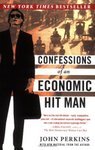
Confessions of an Economic Hit Man by John Perkins

This book probably would have enraged me if I hadn’t already more or less known what it was talking about. As it was, I was resigned and depressed.

The book is a short autobiography of an Economic Hit Man (EHM) who saw the error of his ways. The idea of the EHM, as he describes it, is to manipulate the governments of developing nations to accept huge loans from the IMF and the World Bank based on inflated projections of future income, under the theory that they would experience huge economic gains from the projects – things like electrical grid upgrades, roads, dams and the like. These nations would then become indebted to the United States and forced to give business to US corporations, thereby effectively putting that nation under US control. He calls it the Corporatocracy, and he was a part of it. He traveled around the world to manipulate cash-strapped world leaders into signing their nations over to the control of US corporate interests.

He describes himself as one of the earliest generations of EHM, the ones who knew exactly what they were doing. Perkins describes his entry and rise in the EHM world as a series of decisions inspired by coincidences, at least at first. His childhood was marked by clear class differences, growing up in a small New England town and going to school with the children of the super-rich. His family taught at the school, thus gaining him both entry into classes and a raging feeling of inferiority and anger.

After doing a stint in the Peace Corps, he was approached to work for the NSA. Following the NSA screening, he was tapped to work for MAIN, an engineering company who, in the 60s and 70s, was at the forefront of modernizing developing nations. At their expense, of course.

When Perkins was initiated into this world of money and power, he was explicitly aware of what he was doing: he would vastly overstate the economic potential of, say, a hydroelectric dam project, leading to the leaders of governments such as the Philippines, Columbia and Venezuela taking out massive loans based on expected future returns. When those returns didn’t come in – and they never did – they were forced to make concessions, which always, always benefited the interests of MAIN and other US corporations. By doing so, they became part of the American Economic Empire, without one politician ever laying a finger on it.

It’s considered the softest method of empire-building. Take a country that needs money to help its people, and arrange so that the government has to spend upwards of 50% of its GNP repaying loans. The people get nothing, a few rich leaders become richer, and US corporations spread further out into the world. All forwarding the cause of US economic interests. For Americans, it means cheaper gas, food and raw materials. For the corporations involved, it means higher and higher profits. For the people of the developing countries targeted, it means poverty and disenfranchisement.

The EHMs don’t always succeed, though – remember Panama? We had the canal, and made lots of money off it. Until the leader of Panama, in the 70’s, decided to take it back. Omar Torrijos was that rare breed of third world ruler who honestly wanted to help his people, and he knew that the best way to do that was to re-assert control over the Panama Canal. He knew what the EHMs were up to, and wouldn’t have any part of it. In his recollections of their meetings, Perkins sees him as the kind of leader every country should have, and it was his example that led him towards leaving this world. His example and, of course, his death.

When the EHMs fail, the jackals come in and people start dying in “mysterious” plane crashes. Torrijos was replaced by Manuel Noriega, who was in our pocket, but not quite far enough. He didn’t toe the line that Washington wanted, so we made him up to be the Hitler of South America, invaded Panama without cause (see, Iraq is not a new thing) and took him back to the US. The result? The canal is effectively back under US control, and any advances that Torrijos might have made are gone.

One of the reasons Perkins left the industry and wrote this book is because he’s worried about the future of the EHM. Not that it’s fading, but that it’s getting stronger. With the ever-increasing pace of globalization, governments are jockeying with corporations for power around the world, and the EHMs are coming with them. But the new breed is different. The people following in Perkins’ footsteps honestly believe that they are trying to help these beleagured countries They see themselves as part of a great march towards progress, never really noticing that the progress only really benefits them.

One thing I noticed about this book. While I don’t doubt Perkins’ honesty and intentions in writing this book, I do wonder how much of the “torn between two worlds” persona he adopts is honest. Throughout the book, he talks about his moments of indecision, of inner conflict as he tries to justify the things he’s doing. He talks about meeting dissidents in Iran, going to anti-American puppet shows in Bali, encountering supercilious Canal Zone residents in Panama, all of which serves to make him look like he’s much more thoughtful than the average corporate warrior.

Perhaps he’s representing himself sincerely as a person caught between his moral code and his pride. He did, after all, leave the business – and the vast amount of money and power that it offered him. But I kept thinking, how much of that conflicted feeling was real, and how much was remembered? It’s a small point, but one that kept nagging at me. It doesn’t add to or detract from his argument, however.

This is not a happy book, and it’s pretty likely to piss you off. It’s not about the US government, mind you – it’s about US corporations assisting the government in its imperial ambitions. It’s about the marriage of economics and governance and its dark, dark offspring….

—————————————————–
“Confessing a sin is the beginning of redemption.”
-John Perkins, Confessions of an Economic Hit Man
—————————————————–

Confessions of an Economic Hit Man on Wikipedia
John Perkins on Wikipedia
John Perkins’ website
Confessions of an Economic Hit Man on Amazon.com
Leave a comment

Filed under economics, ethics, history, John Perkins, memoir, nonfiction, politics

Review 13: Misquoting Jesus


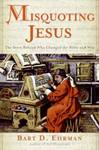
Misquoting Jesus by Bart D. Ehrman

I saw this guy on The Daily Show a few years ago, and his book sounded like a really interesting idea – study the ways in which, over the last two thousand years, the text of the Bible has been altered. Sometimes it has been altered by mistake and sometimes on purpose, but it has been altered nonetheless.

Now this is a claim that angers a certain section of Christianity – often known as the Biblical Literalists – who believe that every word of the Bible is true, the revealed Word of God. Unfortunately for them, once the text is analyzed, once source texts and translations are looked at carefully, there are too many discrepancies for that to be true.

What makes this book interesting is the author’s background, which he explains in detail in the introduction. Bart Ehrman is not an angry atheist, looking to tear down the New Testament. Quite the contrary – in his teens, Ehrman became Born Again, filling the void in his life with 100% Jesus. He threw his heart and soul into Bible study, convinced that the book was the inerrant, incontrovertible Word Of God. It was only when he began really studying the Bible that he started to get the feeling that something wasn’t quite right.

And when I say “studying the Bible,” I don’t mean just reading a few passages before he went to bed at night. Ehrman is the kind of person who learned Latin and ancient Greek and Aramaic so that he could read the oldest known manuscripts for the Gospels and the Epistles. He immersed himself in Biblical history, arming himself with every tool he would need for textual criticism and a better understanding of the text that meant so much to him.

An explanation of textual criticism takes up a great deal of the book, since it’s a branch of academia that most people aren’t all that familiar with. Textual criticism is the analyses of ancient manuscripts in an attempt to determine what the original text was. This is done by comparing manuscripts. It attempts to determine what changes were made and when. It’s very difficult, even worse so the older the work is, but it’s a task that has absorbed Biblical scholars for centuries. This brings up two questions: why is that difficult to do, and why is it important?

As to the first, it’s difficult because these manuscripts were, before the printing press got into full swing, copied by hand. By humans, to be specific and if you’re a human – and there’s a very good chance that you are – you know how hard it is for us to do things without making errors. A pen might slip, your eye might skip a line, or you just might be tired and misread a word. That error then gets around, and someone else copies it, probably adding their own errors as well. Many of the original copyists of the New Testament weren’t professional scribes, and even some of the pros were barely capable of actually reading the text they were copying.

What’s worse, there’s no guarantee that the “correct” text is the one that gets the most exposure. You might have fifty copies of, say, the Gospel of Luke that say one thing and five that say something else, but those fifty copies might all be wrong. It’s kind of counter-intuitive, but there you go. And age isn’t always reliable either. You might think that an 8th century text is more “correct” than one from the 10th century, but not if that 10th century text had been copied from a 4th century manuscript. You can see how problems emerge.

Ehrman lays out, as simply as he can, the criteria by which textual critics judge a manuscript. It can’t be called scientific, as there are a lot of judgment calls to be made, but within the field there are a lot of very good guidelines, and the peer review process is relentless.

The bigger question, then – why is it important? Well, the biggest reason is because there are over a billion people on the planet who live their lives, to one degree or another, by the words of the New Testament. They look at the Gospels and see the stories of Jesus and his miracles, they read the letters of John and his instructions to the newly-birthed churches of the first century to try and find out what Jesus would have wanted. And because Jesus himself never left us any notes, the words in the New Testament are all they have to go on. Isn’t it vital, therefore, to know what the writers originally wrote? If you’re basing your faith off of inaccurate writings, does that mean your faith is flawed? If you’re living your life based on ideas that were not inspired by Jesus, but by a third-century scribe who, for example, had certain ideas about a woman’s place in the church, does that mean you’re living wrong?

And if you are one of those who believe that God transmitted His words to the writers of the New Testament, what does the fact that we no longer have those original words mean to your faith?

That’s the big thing here – we don’t have Paul’s original letters to the early churches. We don’t have the notes that Matthew, Mark, Luke and John used when they were writing their Gospels. We don’t even have copies of copies of those notes. What we do have, and what Ehrman demonstrates in detail, are many manuscripts over many centuries that have thousands of points of divergence. Sometimes those differences are minor, but some of them affect the very foundations upon which Christianity is built.

Like the famous story of the adulteress, where Jesus gave his “Let he who is without sin” speech. It doesn’t show up in the earliest and best texts, but gets wedged in a few centuries later. Or the bit in Luke where Jesus sweats blood? That, too, appears to have been a later addition to an otherwise well-constructed section of that Gospel. Even the famous King James Bible is not immune – it was based off a Greek New Testament that was written earlier, parts of which were constructed by a man named Erasmus, who did it not by using original Greek writings, but by translating later Latin translations back into Greek. Why? Because those original Greek writings were lost, but they had to have something….

Ehrman tries to look at the possible motivations for these changes, and they are necessarily speculative. The early Church was a turbulent and unstable entity, with many different groups pushing their rendition of who Jesus was and what he wanted of his followers.

Was Jesus an emotionally turbulent rabblerouser or was he a calm and serene figure of peace? Was he the begotten son of God or just adopted? Did he die with quiet dignity, willingly surrendering his spirit up to God, or did he die in torment, forsaken? Was he entirely human, entirely divine, both or neither? Christians of the early Church knew these to be vital questions – with a variety of answers. The New Testament we have today is the result of who had the most power to enforce their interpretations of Jesus’ life, times and teachings.

This book covers a whole lot of ground in 218 pages – Biblical history, Christian history, textual criticism, politics, sociology…. The history of how the New Testament came to be the way it is today is a complicated and fascinating one, and Ehrman casts it in an interesting light.

You see, rather than spend 200 pages noting the history of alterations in the book, he doesn’t say, “And that’s why we should just throw it the hell out!” Rather, he encourages readers to look at the New Testament as an ornate human creation, a text (or, more accurately, a collection of texts) that has survived the millennia by being complex enough to survive interpretation after interpretation. The inerrant Word Of God? Sorry, but no. But it is still key to understanding human history in the last two thousand years, and is therefore worthy of study.

—————————————–
“What if God didn’t say it? What if the book you take as giving you God’s words instead contains human words? What if the Bible doesn’t give a foolproof answer to the questions of the modern age – abortion, women’s rights, gay rights, religious supremacy, Western-style democracy and the like? What if we have to figure out how to live and what to believe on our own, without setting up the Bible as a false idol – or an oracle that gives us a direct line of communication with the Almighty?”
– Brad Ehrman, Misquoting Jesus
———————————————

Misquoting Jesus at Wikipedia
Bart Ehrman at Wikipedia
Bart Ehrman’s homepage
Textual criticism at Wikipedia

1 Comment

Filed under Bart Ehrman, Bible, Christianity, criticism, history, Jesus, nonfiction, religion, textual criticism, theology