Category Archives: history

Books about or on the theme of History.

Review 228: The Rise and Fall of the Galactic Empire

The Rise and Fall of the Galactic Empire by Chris Kempshall

The best fictional worlds invite you to lose yourself in them. They get into your head, makes you wonder what else is there, between the words on the page and beyond the beginning and the end.

Star Wars, of course, is exactly that kind of fiction. What started with a fairly simple space adventure nearly fifty years ago has blossomed into an expansive, living universe, where every new story carries within it the seeds for another story and another one after that. Through the media of film and television, animation and comic books, novels and short stories, Star Wars has built up a world and a history that you could spend your entire life exploring.

Kempshall reflects in the afterward that, for the time he was working on it, it became his whole life. And I certainly can’t blame him for it.

The Rise and Fall of the Galactic Empire is a thorough, insightful history of the Empire from inside the Star Wars universe. Written by historian Beaumont Kin soon after the fall of the New Republic, the Battle of Exegol, and the (probably) final death of Emperor Palpatine, this book attempts to understand how the Empire arose, what its means and methods were, and why, even after the Battle of Endor, its ideology persisted and became the First Order.

It begins with an examination of Sheeve Palpatine and how he rose to power. With the advantage of time, and the testimony of people like Luke Skywalker and Leia Organa, Kin is able to see the Senator from Naboo for who he really was – a master of the Dark Side of the Force, apprentice to a terrible Sith lord, who had decided from his early years that he wanted only one thing: complete mastery of the Galaxy. It follows his career through the Clone Wars, a conflict in which Palpatine, acting as both the Supreme Chancellor and the malicious Darth Sidious, was controlling both sides.

With his power assured, the history then goes on to explore how the Empire functioned, how it expanded, and how it devoured everything in its way. An Empire which rewarded cruelty, blind loyalty, and rampant consumption was everything that Palpatine wanted, and its apotheosis was the Death Star.

Nevertheless, there was resistance, and the history explores that as well. How even with an Empire so comfortable with conflict and aggression might still miss the signs of organized rebellion and even encourage it with its unrepentant use of force and terror.

From there, the book chronicles the assumptions and errors that the Empire made in dealing with the Rebellion, how the loss of figures like Grand Moff Tarkin crippled the Empire’s efforts, and how even though battles like those at Hoth looked like Imperial victories, they did more damage to the Empire than to the Rebellion.

This book is a well-written, detailed, and satisfying look at the history of the stories that we know so well. It draws from not only the films, but also comics, books, and television – any source available that explains the events surrounding the rise of the Empire, the Galactic Civil War, and the Empire’s fall and rebirth.

What makes this book believable is not only that it was written with the full help of the lorekeepers and writers of the Star Wars universe, but that it was written by an actual historian. Kempshall has been writing on war, especially World War One, and found himself in the very enviable position of being able to write a history of one of the most popular fictional universes of our time.

One aspect of this book that is truly fascinating is to see the places where the narrator, Beaumont Kin, lacks information that we, fans of the stories, absolutely have. For example, we all saw the fateful meeting at the beginning of A New Hope where Vader nearly force-chokes Admiral Motti to death. Kin, however, relies only on Motti’s own paperwork, referring to “an almost entirely redacted incident report within the Imperial Archives submitted by Admiral Motti immediately after that summit took place, presumably about something that happened to him during it.”

There are plenty of other places and references that Kempshall includes where he knows that fans of Star Wars will be able o fill in the gaps, having read the books and watched the cartoons, movies, and TV shows. Even more interesting is what he leaves out. There is no mention, for example, of Obi-Wan Kenobi and his role in the rescue of Vader’s children, or Yoda’s training of Luke. Ahsoka Tano, despite her role as the mysterious Fulcrum, is barely mentioned. Dr. Aphra, despite her strange and constant relationship with Darth Vader, only shows up a couple of times, usually in footnotes.

If there is one point of irritation that I have with this book, it’s the way that citations are handled.

It is great that this book is heavily cited – a proper history book should reveal its sources, allowing a reader to go and investigate for themselves, should they want to. The problem is, all of these are in-universe citations. So you might be directed to “New Republic Archives, Section: Adelphi Base, File: Requisition Form #1837p—Subcontract for fulfillment of refuse collection” if you want to know more about how New Republic officers used bounty hunters to go after Imperial remnants.

Now I appreciate kayfabe as much as the next guy, but a lot of these footnotes seemed like they should be pointing at specific literary sources – a show or a comic or something like that – and I really wanted to know what those were. I was hoping that, at the end of the book, there might be a listing of all the sources that Kempshall went to, but alas, there is none. This is a great, but missed opportunity.

The most striking thing, though, was not so much how well it recontextualized the Star Wars universe (and brought more sense to the Sequel Trilogy), but how relevant it was to our world. The rise of fascism, cruelty disguised as order, the seduction of ideology are all familiar to us. The book’s exploration of power and its misuse is painfully on-point, from the terrors of Fascist Europe all the way to the present day. It holds up the grand, sweeping tale of Star Wars as not only an allegory for past conflicts, but as a mirror to our own lives, our own willingness, perhaps, to allow wickedness to be done in our names.

Where the fictional historian narrator becomes angry or sad or frustrated with the terrible works that the Empire performed, you can easily understand how perhaps Kempshall is feeling the same way about our world.

We may not have a Sith Lord running things out here, but we do have petty, power-hungry tyrants; we have people willing to do terrible things because they were told to do them; we have leaders willing to ignore tragedy after tragedy because doing something about it is inconvenient.

This book would be an excellent addition to the collection of any Star Wars fan, and is the perfect answer to those people online who wish, against all available evidence, that Star Wars hadn’t suddenly gotten “all political.” It hasn’t gotten political – it always has been.


“The role of a historian—my role as a historian—is to try to tell you not just how but why these things happened. To try to make you understand the importance of these past events and what they mean for us today and tomorrow.”

Chris Kempshall at Penguin Random House
The Rise and Fall of the Galactic Empire on Goodreads
Leave a comment

Filed under Chris Kempshall, history, politics, science fiction, Star Wars

Review 225: The Power Broker

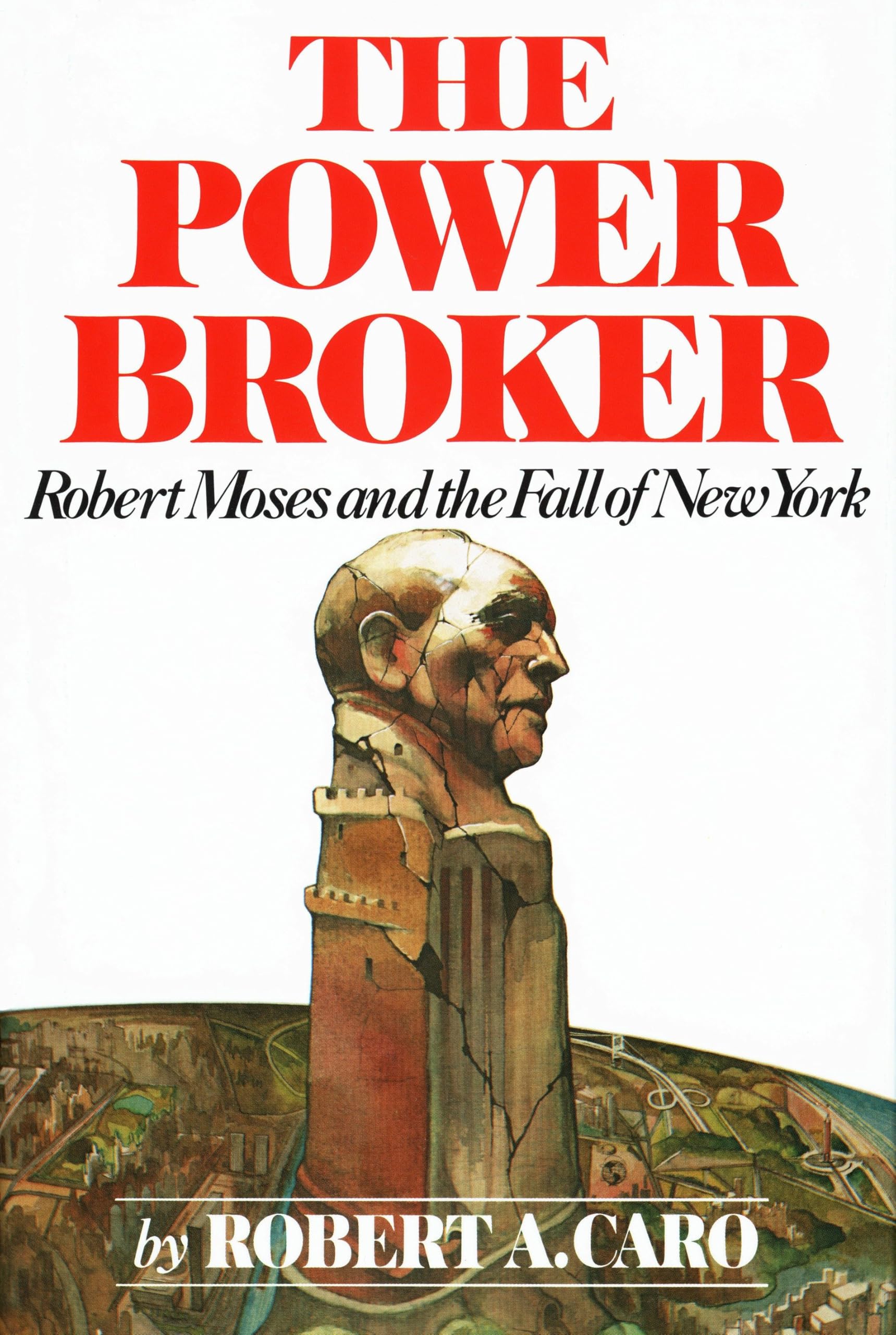
The Power Broker: Robert Moses and the Fall of New York by Robert Caro

Yes, it’s been a little while. Thank you for your patience.

I decided to read The Power Broker mainly because of the series “The Unsleeping City” over on Dropout, an actual play D&D game that’s set in a version of New York City that is steeped in magic and the supernatural, hidden from its normal inhabitants by an Umbral Arcana. In this game, the Big Bad Guy was a man named Robert Moses, a lich who tries to carve out New York as a magical realm all his own. On top of that, he tries to re-define the American Dream into something which fits his particular vision of what the ideal American should be: rich, male, and white.

Imagine my surprise when I found out the not only was Moses a real guy, but that he was just as bad – if not worse – than Brennan Lee Mulligan’s lich.

That’s an oversimplification, of course. If you want it in detail, read all 1300 pages or so of Caro’s book, and you’ll see that while yes, there were improvements done to New York City that were undoubtedly good in the long run, there were just as many that were harmful. And not just harmful in the moment, like tearing down neighborhoods to make room for expressways, but harmful for generations. Moses himself very likely believed that he was doing what was best for New York City. Unfortunately, he never allowed anyone to ever even suggest that he might be wrong.

Caro’s book starts with an understanding of where Moses came from – an affluent Northeast family with a fondness for civic matters and a certain patrician attitude towards helping poor Jewish immigrants from Eastern Europe learn how to be good Americans. Moses went to Yale and Oxford, and came back with a desire to get into civil service, with a focus on city improvement. What’s more, he wanted to break the hold that moneyed and special interest groups, such as the infamous Tammany Hall, had on city government by placing people not according to their connections, but according to how well-suited they were for the job.

Ironically, it was through strong personal connections that he had through people such as Governor Al Smith that Moses got a job that he had no experience in: managing parks. To be fair, I don’t think anyone had experience with this in the 1920s and 30s, so I can’t really fault him for that.

Moses turned out to be a man possessed of an amazing mind.

He was imaginative – he could look at a stretch of undeveloped land or a bend in a river or a set of hills and know immediately not only what he wanted to do with it, but how it could be done. To hear tell of it, it was like the vision of a finished improvement or project would simply spring to his mind, and he would be ready to go.

He was intelligent – he had an excellent memory for people and legislation, and was considered one of the best bill drafters in New York. He knew how to craft legislation in such a way that seemingly unrelated, yet wholly interlocked, pieces came together to allow him to get the result that he wanted.

He knew people – he was able to create almost cultlike loyalty in his “Moses Men,” the army of engineers, aides, secretaries and other professionals who worked for him over the years. These people were at his beck and call, obeying every order he gave, affirming every vision he had, and acting as his eyes, ears, and hands throughout the government and civil society of New York.

He was relentless – what Robert Moses wanted, he got. Full stop. Whether he used flattery and kickbacks and “gifts” to get it, or whether he utterly destroyed someone’s reputation in the press or in their industry, there were no lengths that Moses would not go to in order to accomplish his goals. He was almost incapable of taking “no” for an answer when it came to his projects.

And therein, I think, lies Moses’ real tragedy, and the reason why (to me) Caro’s book comes across as spectacularly angry.

With the skills and resources available to Robert Moses, he could have built a New York City that would have been a model for a humane, livable city for the ages. He could have built a place that would inspire better communities, better living, a model of how to make a city a place of growth and humanity.

He did not want that, though. Robert Moses loved parks and cars, and that was pretty much it. His answer to most problems of the city was either to build a park (whether or not one was needed) or to build a road. In his time with the city, he built more than a dozen major bridges and hundreds of miles of highways. He built out the highways that turned Long Island into a major New York suburb. He built the expressways that bracket Manhattan, and would have built more if he had been able to.

Unfortunately, a growing city does not need more roads. In fact, as Caro’s book points out, more roads actually make traffic problems worse. It is public transportation – busses and subways – which make a city really work, allowing so many people to live and work in such a densely packed place. But Moses hated public transportation.

Public transportation, you see, would allow poor people to get to his pretty parks. And he wanted none of that.

A very famous anecdote from the book is that, in designing the roads to his beloved Jones Beach, Moses had the overpasses designed at a height that would be too low for busses to access. So, if you had a car (i.e. money), then welcome to the beach! If you were a poor person, though, you’re out of luck. No busses for you. And Moses much later said that he knew he didn’t need to try and get legislation passed to ban busses and The Poor. Laws and regulations, after all, could be changed.

It’s really tough to rebuild a bridge. Or, more to the point, several hundred bridges.

Later, when he got himself involved in other areas of civic improvement, he tore down perfectly good neighborhoods in order to make room for his roads and public housing. These neighborhoods, like Tremont or Third Avenue might not have been wealthy neighborhoods, but they were good ones. Places where people knew each other, had businesses, raised families. Some of them were perfect places for new residents to prepare for living in a city such as New York – they could learn basic city living in Tremont, for example, and then, when ready, move elsewhere.

But Moses wanted that land. He wanted it to build his precious roads and bridges. He wanted it to build public housing that would enrich his political allies. He wanted it so that he could exert power over the city and over the people who made the city work. He, like the Robert Moses of “The Unsleeping City,” wanted to reshape New York in his image, to make it the place he felt it should be rather than the place its citizens needed.

All throughout this book, I could feel Caro walking a thin line. As a biographer, he clearly wanted to be as fair as he could to Moses, but with each passing chapter, I could see that being harder and harder to accomplish. In the chapter “One Mile,” which describes the destruction of Tremont for the Cross-Bronx Expressway, you can imagine Caro begging us, or someone, to tell him what the point of all this was. Why good people had to lose their homes and their lives just so a few other people could get stuck in a traffic jam in the Bronx.

The answer, of course, is because that’s what Robert Moses wanted. And what Moses wanted, he got.

Ultimately, as the title suggests, this is a book about power. About how power is wielded and how it reveals the true nature of people. Young Moses believed himself to be an anti-corruption reformer, the champion of good government and the people. But power revealed that he was anything but.

It’s a chillingly relevant book to read here in the Age of Trump, where we have another ambitious man who is very good at attaining and wielding power in order to fulfill his own selfish dreams of what the nation should be. I don’t think Moses and Trump are really comparable, though. Moses’ dreams for New York were ambitious and grand, and he had an encyclopedic knowledge of politics, infrastructure, and geography.

Trump barely pays attention to the world or facts or anything like that, and doesn’t have any interest in actually learning anything. But, just like Moses, he has power. And he knows very well how to gain and hold on to power.

So what do we do about it? Caro’s book won’t really make you feel any better about this – the only real reason Moses fell from grace is that he went up against someone who wasn’t awed or intimidated by him, and that was Governor Nelson Rockefeller. When Moses used one of his classic techniques to get what he wanted – threaten to resign and thereby throw all his public authorities and projects into disarray, where previous governors had caved, Rockefeller said, “Okay. Have your resignation on my desk in the morning.” That was the first real, substantial crack in Moses’ power and his ability to wield it in New York, and within a decade, he was out.

Maybe that’s the way to deal with people like him and Trump. Call their bluffs. Make them put up or shut up. Expose them for who they are, rather than who they pretend to be. Be willing to tell them that they’re wrong, and stand up for that.

If there’s any real, practical lesson to be taken from this book, I think that’s it. There will always be people who are good at moving the levers of power, and it’s up to the rest of us to watch them very closely. And, if necessary, have the courage to take them down.


“An idea was no good without power behind it, power to make people adopt it, power to reward them when they did, power to crush them when they didn’t.”

Robert Caro on Wikipedia
The Power Broker on Wikipedia
Robert Caro’s website
The Power Broker Book Club

Leave a comment

Filed under american history, history

Review 217: The Secret Life of Words

LL 217 - The Secret Life of WordsThe Secret Life of Words by Henry Hitchings

There are many ways to write human history. Most writers of history books tend to go the traditional way – following kings and queens, wars, revolutions and invasions. The history of the world is almost always written in military or political terms, and while that’s certainly a valid way to do it, it’s a little overdone. A truly creative historian might try to look at the progress of humankind through a different lens – the history of art, perhaps, or literature or science.

Hitchings has decided to look at history through the rise and spread of the English language – once an agglomeration of angry noises from a few small tribes in what would eventually become Europe, now a tongue that dominates the world. The English language is used by billions, studied by millions more. It’s the language of business, commerce, politics, law, entertainment and news, and has spread like no other language before it.

Hmmm... What other advantages does English have? It'll come to me...

Hmmm… What other advantages does English have? It’ll come to me…

The big question then becomes, How did this happen? How did English become what it has become? What is the history that led it to span the globe, and what qualities does it have that other languages don’t? In this book, Hitchings looks at the history of English – and by extension the Western world – through the growth of its vocabulary. Where did our words come from, and what does their journey into English tell us about our own history?

A modern English speaker, equipped with a time machine, could probably go back about four or five hundred years and still be confident that she would be able to converse with people. Maybe not with perfect clarity, and it would be an entertaining thing to watch, but it would certainly be possible. Before that, the conventions and lexis that we are all so familiar with will start to be more and more scarce, and by the time of Chaucer, our time traveler would have a hard time indeed. So, as far as languages go, modern English is a fairly young tongue. Over the last half-millennium or so, the sheer number of words available to English speakers has exploded, mainly due to what some would call the language’s “whorish” qualities – English will take up with any other language that comes along, accepting its words and making them its own. By following the spread of English, and the changes that it has made, we can see how people and cultures intermingled in the last thousand years or so.

Alcatraz also had Sean Connery, which should not be overlooked.

Alcatraz also had Sean Connery, which should not be overlooked.

Hitchings begins at, more or less, the beginning, with the Anglo-Saxon roots of English and its almost immediate conflicts with Norman French and the languages of the invading and pillaging Norsemen. He follows the political swings of English, as the rulers of the British Isles alternatingly embrace and shun the language, until it finally becomes the tongue that defines that tiny island on the edge of the North Atlantic. He looks into Arabic and Latin, Japanese and the languages of the Native Americans. We see the wellsprings of the language of food and music, science, military and law. He introduces us to words that came into English through long and winding roads (one of my favorites is Alcatraz – from the Spanish word for “pelican,” which in turn comes from Arabic’s al-qadus for “machine for drawing water,” which is turn comes from Greek’s kados, meaning “jar” – quite a journey for such a miserable place.) The history of the English language is a fractal history, meaning that in order to understand it you also have to understand the histories of a dozen other languages and then the languages that came before them. To try and put it all down on paper is a monumental task indeed.

The study of English words is fascinating, though. I have recently become enamored of the “Way With Words” podcast, which dedicates itself to unraveling questions about English usage. The hosts are funny and engaging, and manage to give a brief history of words and phrases and all the little tics of English that make you annoyed enough to have to call a radio show about it. It’s a pleasure to listen to, which is probably why I listened to that show a whole lot more than I read this book.

Another stellar example of English in use. Heh. I met a pronoun once. She totally wanted me.

Another stellar example of English in use. Heh. I met a pronoun once. She totally wanted me.

Mr. Hitchings has done an admirable job with this book, trying to cover all the different avenues by which words came into English. The paths that they followed are fascinating, and the stories behind them are the stories of Western culture and civilization. The trouble is that Hitchings doesn’t do all that good a job in making it interesting to the lay reader, i.e. me.

By and large, each chapter deals with a different source of vocabulary or a different time in history, but the narrative that he sets up tends to… wander about. There’s no real narrative to focus on, and while I know this isn’t supposed to be one, Hitchings is trying to tell us a story. It’s a long and complicated one, but it’s still a story, and as such needs to flow in order to keep the reader’s attention.

I can’t fault him for his research or his dedication, but I think he could have given more thought to the organization of the book. Instead of trying to cover as many sources as possible, perhaps he could have narrowed his focus. Instead of throwing out a dozen or so words at a time, he could have given us an in-depth narrative on just a few. Each chapter could probably have been expanded into its own book on the Arabic/Spanish/Latin/German/Greek/African origins of words, and so in reading it you get the feeling that there’s so much more that he’s glossing over. By trying to follow all the twisted paths of the history of English, it’s very easy for the reader to get lost.

WARNING: Do not read this book while operating heavy machinery.

WARNING: Do not read this book while operating heavy machinery.

All I kept thinking as I read this was that I had much more fun reading Bill Bryson’s book, Mother Tongue, which covers the same topic but is much more enjoyable to read, and perhaps that was my mistake. By the time I got to the end, and was more or less just scanning pages so that I could legitimately say I’d finished it, I realized that this is not the kind of book that you settle down with and read all the way through. It’s a piecemeal book – pick it up, read a chapter, put it down and leave it alone for a while. When you’re in the mood for more language history, pick it up again and read another chapter. Give yourself time to mull it over and digest, and finish it when you finish it.

However you decide to get through it, you will certainly have a greater appreciation for the richness and diversity of the English language, so regardless of how interesting it was narrative-wise, Hitchings has achieved his goal. English is an amazing language, and it behooves all its speakers to learn a little bit more about the amazing confluence of cultures that produced the sounds that you speak every day.

—————————————————–
“A new word is a solution to a problem. It answers a need – intellectual, experiential. Often the need is obvious, but sometimes it is unseen or barely felt, and then it is only in finding something to plug the gap that we actually realize the gap was there in the first place.”
– Henry Hitchings, The Secret Life of Words
—————————————————–

Leave a comment

Filed under English, Henry Hitchings, history, language

Review 208: A Canticle for Liebowitz

LL 208 - A Canticle for LiebowitzA Canticle for Liebowitz by Walter M. Miller, Jr.

This has probably been noted by many better thinkers than I, but the way I see it is this: history takes a long time to happen.

I know, I know. Mind: blown.

We are lucky in this day and age that we have so much information available to us about history. Go to any of your better museums and you’ll see artifacts of a bygone age, books and clothes and various objects carefully displayed under glass. Through the meticulous work of historians and scholars throughout the ages, we have created an unbroken chain of knowledge through the centuries that is so thorough and so strong that we feel like the days of Shakespeare, of Charlemagne, of Pericles all happened just the other day.

But what if that chain were broken? What if something so big, so terrible were to happen that we had to rebuild history from scratch, using oral tradition and whatever pathetic scraps of memorabilia we could find? Whom could we trust to keep it and put it all together, and then what should we do with it in the end?

Believe it or not, there is a Patron Saint of Technology, and we honor him by getting ridiculously drunk. Go figure.

Believe it or not, there is a Patron Saint of Technology, and we honor him by getting ridiculously drunk. Go figure.

These are the questions that humanity is forced to confront after the Flame Deluge – a nuclear inferno that claimed the great nations of the world near the end of the twentieth century. All would have been lost if not for the work of Isaac Liebowitz, an engineer-turned-monk who dedicated his life and the lives of his brothers to the preservation of knowledge. Over the centuries, his part of the Albertan order would become the caretakers of a bygone age, guardians of history itself, and would play a key role in the future of humanity, for good or for ill.

A Canticle for Liebowitz is a novel in three parts, spanning over a thousand years of future history. It begins in the 26th century, where the inhabitants of what was once the United States are bound into roving tribes and insular city-states. There, the young monk Francis makes a startling discovery from the life of his patron, the soon-to-be-sainted Liebowitz, a discovery which changes his life and the lives of everyone in his order. Through chance, or perhaps divine intervention, Francis finds an underground bunker, a shelter from the Fallout demons of old. He rummages around the cluttered remains of whomever had sealed themselves inside, and happens upon a strongbox, within which are handwritten pieces of paper, including a blueprint for an electrical circuit designed by Leibowitz himself. Suddenly, Francis’ vocation was clear. Or at least clearer than it had been before.

Then the story jumps forward to the 29th century, an age of discovery and renaissance. The learned both inside and outside the Church are beginning to rediscover science, and apply it to rebuilding some of the technology that was thought to be lost so long ago. At the same time, local leaders are vying for power, and trying to ensnare the monks of St. Liebowitz in their plots. The world is changing, progressing, and not everyone is comfortable with this change.

36th Century - so far in the future that these guys would be the subjects of Renfaires.

36th Century – so far in the future that these guys would be the subjects of Renfaires.

The third part of the story propels us into the 36th century, an age undreamed-of by even those who lived before the world was cleansed by fire. Humanity is traveling between the stars and giving life to their machines, making full use of knowledge both new and old. Unfortunately, mankind may succumb to the same pride, the same flaws that nearly destroyed it a thousand years before. On the eve of self-annihilation, a desperate group of pilgrims is sent out to the stars to try and keep some spark of humanity alive in the cosmos, despite humanity’s nearly unstoppable urge to destroy itself. And at the center of all of this is the Order of Leibowitz, holding on to old works and memorabilia, waiting for either the right hands or the wrong ones.

The book sounds depressing in its nature, but it isn’t. Yes, mankind makes the same stupid mistakes over and over again, not remembering the horror that befell them the last time. But despite that, there are still good people and there is still hope. You turn the last page knowing that the world, and humanity, will go on in one form or another. Even with our propensity for self-destruction, we are equally capable of brilliance and discovery.

In a larger sense, too, this book is one long journey into philosophy, bringing up some questions that are truly fundamental to who we are as a species. For example, the book addresses the topic of euthanasia in one section, with the Abbot of the order violently opposed to the Mercy Camps that the government is building. Is it better to make the sick and injured live in their sickness, or should we give them a way out? Is suicide – assisted or otherwise – ever permissible? The characters that debate this topic each have a clear and rational reason for thinking the way they do, and yet they come to no agreement. The characters, for the short time we get to see them, are fascinating. You feel sorry for them, hopeful for them, and afraid for them, because Miller has written them as human beings. We don’t have Interchangeable Scientist A and Interchangeable Scientist B arguing opposite points. We instead have scholars and religious, each desperately trying to protect his point of view.

Is the world truly ready for a better way to drink soda? The potential is unthinkable!

Is the world truly ready for a better way to drink soda? The potential is unthinkable!

Or what about the nature of technology itself? The monks are charged with being the memory of mankind, yet when people start trying to recover the lost sciences, the abbot feels uncomfortable with the whole idea. After all, their predecessors in civilization followed the path of science, and look where it got them. Might it not be better to just let things stay as they are? Hard, yes, and certainly not a perfect world, but when you don’t even have electricity, blowing up the world is hard to do.

What I also found interesting was how Miller placed the Catholic Church at the center of this story. In the world after the Deluge, the Church is the only organization left, and it fills the power vacuum nicely. Through its system of priesthoods and orders, it remains the last island of civilization in a world that’s turned to chaos. I’m not a big fan of the Catholic Church for many reasons, but he really made it into an establishment that I could appreciate. It represented continuity and caution, as well as taking up the guardianship of human history. For all its faults, if the Church could keep humanity from failing utterly, I would be grateful for it.

It’s intellectual science fiction at its best, really, exploring the kind of big ideas that science fiction is meant to do. Miller has sung a song – a canticle – not just for the fictional Liebowitz, but for humanity as a whole, and asks his readers to sing along with him.

——————-
“If you try to save wisdom until the world is wise, Father, the world will never have it.”
– Thon Taddeo, A Canticle for Liebowitz

Walter M. Miller, Jr. on Wikipedia
A Canticle for Liebowitz on Wikipedia
A Canticle for Liebowitz at Amazon.com

Leave a comment

Filed under apocalypse, history, religion, science fiction, technology, war

Review 204: Blackout & All Clear

LL 204 - Blackout-All Clear 1LL 204 - Blackout-All Clear 2Blackout and All Clear by Connie Willis

Reading one of Connie Willis’ time travel novels is like watching a master paper-folder perform a particularly difficult feat of origami. It seems simple at first, but then there are a few folds and twists, edges are forced together and bent apart, there’s a few points where you can’t even see exactly what her hands are doing, but when she’s finished, you have the pleasure of seeing something intricate and beautiful come into being right before your eyes.

The basic premise of her time travel works is pretty simple: in the future, we have time travel (but not cell phones, as you may recall from The Doomsday Book). The exact means by which it works is not revealed to us, which makes sense – the books aren’t about the mechanics of time travel but rather the results. On the other hand, the rules of time travel are vividly clear:

  1. You can only go to the past.
  2. You can’t bring back any souvenirs.
  3. You can’t change anything.

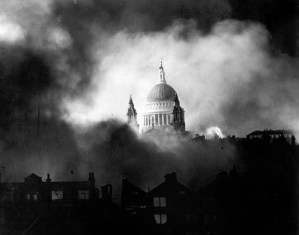
You just can't keep a good cathedral down...

No, you can’t bring back cathedrals either.

That last part is really important, and it is held as gospel by the historians who use the mechanism to go visit various eras in history. The space-time continuum will do its damnedest to keep a traveler from altering the natural flow of events. For example, in order to even get the machine to work, you have to be able to blend in – that means proper clothes and appearance, no hidden wristwatches or things like that. If you’re carrying a disease that the locals might not be prepared for, if you don’t know the language – hell, maybe if you’re just the wrong skin color, the system won’t open up and let you through.

Once you’re ready to go and fit in, there’s still the matter of being able to change events. Now it is true that simply by existing you have already changed things. You move air molecules that were moved differently before. You’re pouring heat into the environment that wasn’t there before. You’re making contact with the surfaces around you, shedding skin cells, making noises – and that’s before you even meet anyone. Once you’re out on the street (or country lane or agora or whatever), you’re interacting with people no matter what you do. They see you, you register in their consciousness to one degree or another – you’re changing things just by your very existence.

The continuum, it seems, is only concerned about big changes. You can’t get anywhere near Hitler, for example, or Kennedy on the day of his assassination. No matter how hard you try or how precisely you set the controls, you will end up displaced either in time or in space or both, unable to do a damned thing. The continuum protects itself, and historians can be assured that their actions in the past have no real consequence.

Or do they?

Dangerous? Nonsense. Now out of my way, I've milk to deliver.

Dangerous? Nonsense. Now out of my way, I’ve milk to deliver.

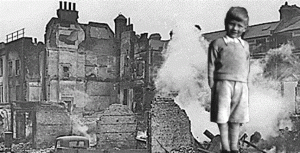
Three British historians have gone back in time to one of the most dramatic and dangerous eras in recent history – the Blitz of World War 2. This was a period of about eight months between 1940 and 1941 when German bombers tried to reduce England to a smoking pile of rubble. They dropped a hundred tons of bombs, cause immeasurable property damage, and killed thousands of people. Life in this time was dangerous, terrifying, and uncertain, and anyone who lived through it was aware that they could die on any one of the raids.

Despite this, the English showed a solidarity and a steadfastness that won the respect of the world (or at least the parts of the world that weren’t trying to bomb it). Everyone – soldiers and civilians – were encouraged to do their part during the war, and every action you took had to be considered in the greater scheme of keeping people safe and keeping London alive. A popular sentiment about the time is that there really were no civilians. Everyone played a hand in getting England through the Blitz, from the Prime Minister to the milkman. If you were an historian looking to see how ordinary people coped in extraordinary times, the Blitz would be the perfect scenario to observe.

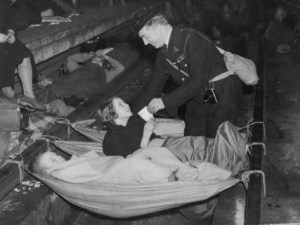
Polly Sebastian is in the thick of it. She has traveled to London, September 1940, with the intention of getting a job in a department store in the middle of town. She arrives during a bombing raid and is ushered into a shelter full of people who will change her life.

Mike Davis wanted to see some true citizen-heroes, so he posed as an American reporter in order to witness the Dunkirk Rescue in May of 1940. He ends up far from Dunkirk, however, and his efforts to get there end up in him becoming part of the action.

"Oy dinn't do nuffin'"

“Oy dinn’t do nuffin'”

Eileen O’Reilly has gone to witness the children’s evacuation of 1939-1940. She poses as a maid in a manor house in the country, there to watch over children who had been sent from London to keep them safe from the war. Eileen has to not only contend with dozens of city children, an outbreak of the measles, and learning to drive an ancient Bentley, but she also has two of the most terrible children in England under her care – Alf and Binnie Hodbin.

All of these assignments would be a major task for any historian, but these three soon discover that they are not in an ordinary situation. It becomes clear to them that their actions are having consequences – Mike saves a soldier who in turn helps hundreds more. Polly says a few words that changes a young woman’s life. Eileen gives medicine to a young girl that no one living at that time would have given, thus keeping her alive. The unbreakable rule about historians not being able to affect the continuum seems to be bending.

What’s worse, none of them are able to access their “drop points” to return to 2060. They’re stuck in a strange and dangerous time, and are now just as at risk as any contemporary person is.

This was originally meant to be only one book – All Clear – but it kept growing and expanding so much that Willis split it into two volumes. This allowed her to not only show off what must have been an immeasurable amount of research over the eight years it took to write the novels, but gave us more time to become immersed and invested in a story that is both funny and heart-wrenching in turns. Our time-travelers are in very real danger, of more than one sort, and you really do feel their desperation and hope for their success.

There, there now. Train tracks are much safer than what's going on up there.

There, there now. Train tracks are much safer than what’s going on up there.

It would be so hard to sum up this book, except to say that it reminds us that everything – and everyone – is significant. The fate of the future rests on the backs of not only generals and prime ministers, but on shopkeepers and children. Words can change the world just as much as bombs, and every action you take contributes to the vast, infinitely complex unfolding of history. As our characters learn, there is no such thing as a passive observer. We are all part of the history, the society, and the world around us, whether we like it or not.

We may not know how it’s all going to unfold in the end, for good or ill, and that’s unfortunate. So all we can do when faced with an uncertain future is what the British did when oblivion came flying over the Channel to their shores. Stand firm and do your bit, and let history take care of itself.

—————————————-
“TO ALL THE
ambulance drivers
firewatchers
air-raid wardens
nurses
canteen workers
airplane spotters
rescue workers
mathematicians
vicars
vergers
shopgirls
chorus girls
librarians
debutantes
spinsters
fishermen
retired sailors
servants
evacuees
Shakespearean actors
and mystery novelists
WHO WON THE WAR.”
― Connie Willis, All Clear – dedication

Connie Willis on Wikipedia
Blackout and All Clear on Wikipedia
Blackout and All Clear on Amazon.com
The Connie Willis Blog

1 Comment

Filed under Connie Willis, England, history, science fiction, time travel, war

Review 193: Origins of the Specious

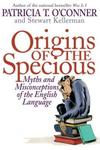
Origins of the Specious by Patricia T. O’Connor and Stewart Kellerman

I, for obvious reasons, have a great affection for the English Language. It’s a rich and exciting tongue, with a history as tangled and strange as they come. Over the last millennium or so, the language has gone through so many shifts and changes that people spend entire lifetimes trying to figure it out. Once they do, more often than not, they find that what once was true about their beloved mother tongue just doesn’t hold up today.

So there’s a choice to be made by lovers of language: deal with the ever-fluctuating nature of English, adapt yourself to its changes and go on with your life, or do your damnedest to hold back the tide of error that is slowly overtaking your beloved tongue.

For reasons that should be obvious, the former type of person is far less likely to write books like this. Their laid back, laissez faire attitude towards the world is less inclined to make them mad enough to sit down at a computer and pound out thousands of words on the state of the language today. The latter type of person – and I do occasionally count myself among them – are far more likely to sit up late at night and write scathing tracts about the utter and complete degeneration of today’s language – about split infinitives and buzzwords and the ungodly Frenchification of English. If you listen to the sticklers, you might be forgiven for thinking that the very fabric of the English Language is in a state of decay, rotten and putrescent, and ready to fall apart any moment.

Mind you, some mistakes are really entertaining…

Patricia O’Connor and Stewart Kellerman are here to give you some perspective, something in which language sticklers are usually lacking, and perhaps lessen the incandescent rage that overtakes you when you hear people use “infer” to mean “imply,” or “unique” to mean “special,” or say, “I could care less,” even though you know it’s supposed to be “I couldn’t care less,” because I mean my GOD, even a CHILD, even a half-trained, concussed MONKEY could see how that phrase works, what’s so hard about a simple word, you MORONS, you gibbering pack of….

****We are experiencing technical difficulties at the moment. Please stand by. We apologize for the inconvenience.****

And we’re back. Sorry about that.

This book is about errors in English, and not only the legitimate ones. It’s also about how some of those errors aren’t really errors, or how they used to be, but now they aren’t. O’Connor and Kellerman are looking to give us a historical sense of how the language has evolved and changed over the centuries, and let us know that the rules of language can’t be set by prim and stuffy grammarians from two hundred years ago.

Those Grammarians, for example, are often called The Latinists, and a great many of them come from the 18th century. In those days, Latin was held up as being some kind of “perfect tongue,” and there was a certain fetish for making English play under Latin rules. The authors wryly note that this would make “about as much sense as having the Chicago Cubs play by the same rules as the Green Bay Packers.” For those of you who are rusty on your linguistic history, Latin split off into what are called the Romance Languages, which includes Spanish, French and Italian. English, on the other hand, has its roots in the Germanic side of the great language tree, and so is more similar to German, Dutch and Frisian. The vast number of Latin-based words we have are, technically, imports, as English is merely a cousin to Latin, not its descendant.

TO GO BOLDLY, DAMMIT!! TO GO BOLDLY!!

But no, there were Those who wanted us to be more Latin-like, and so they imposed rules on English that made no sense whatsoever. Such as the Split Infinitive Rule (i.e. not putting a word between to and a verb – to boldly go would be considered an utter abomination to these people.) In Latin (and Spanish, and French, and Italian), the infinitive form of a verb is a single word – it is literally impossible to split. English, however, has two-word infinitives, and plenty of room to joyfully put in modifiers.

Another good example is using the word “none” as a plural – “None of the ninjas are dead.” The old grammarians would insist that the sentence be, “None of the ninjas is dead,” because “none” is a compressed form of “not one.” Even the venerable Stephen Fry can be caught pushing this one, in a rather hilarious outtake video from his wonderful quiz show QI. Fact is, people have been using “none” as a plural for centuries, and it was accepted language back then. The current fracas about it rose up in 1795 when a guy named Lindley Murray suggested that while “none” can be used as either a singular or plural, it is really best used as a singular. Which English sticklers all took as, “It really must be used as a singular.” A hundred years later, and it’s become an ironclad “RULE,” with no more foundation than one grammarian’s half-hearted opinion.

Ladies and gentlemen, Eugene the Jeep.

There’s also a great section on bad etymology – these are the stories about word origins that everybody knows, but which are most certainly wrong. For example, the origin of the word “Jeep” is usually attributed to a reading-aloud of “G.P.,” meaning “general purpose,” an appellation allegedly applied to these indestructible vehicles. Nope, sorry – it comes from Popeye comics. Or think about the Xmas season – whoops! I mean, Christmas season. Use “Xmas” today and you’ll get lambasted for taking the Christ out of Christmas. The abbreviated word is now looked upon as a Secular Humanist Plot to ruin Christmas for all the good god-fearing folks. Nope – the letter X has been representing Christ for more than a thousand years, and comes from the Greek letter X (chi), which is the first letter of Χριστός, which means, yes – Christ. The venerable Oxford English Dictionary can trace “Xmas” as far back as 1551, in fact.

One part of the book that really got my attention (other than Chapter 5 – the one on swearing) was the chapter on words that have fallen out of favor due to hyper-sensitive political correctness. Remember when Some People (they know who they are) started spelling the word for a female human as “womyn,” so as to remove it from the male-dominating “man”? Well, as it turns out, back in the good old Anglo-Saxon days, “man” referred to a person, regardless of their sex. Over time, distinctions began to emerge, giving us waepman for males (lit. “weapon-person”) and wifman for a married female. Change happens over time, and wifman became woman. Guys lost half their word and just ended up with “man.” Poor us.

The authors also touch on more charged language as well. For example, they recount the tale of a white city official who used the word “niggardly,” meaning “stingy” or “tight with money” in a conversation about expenses.

I’m in trouble, aren’t I?

This caused a massive media storm because the word “niggardly” sounds really close to “nigger,” a word that white people have to be really, really careful about using. For good reason, of course, but the fact is that “niggardly” and “nigger” are completely unrelated. The former goes back to old Scandinavian and the word “nygge,” which meant a miser. The latter is a corruption of the Latin niger, meaning “black,” which is turn gave us the Spanish and Portuguese “negro.” Long story short (too late), that city official used the right word in the right context, but it wasn’t a word that we let people use anymore. It’s a a Fallen Word, joining other words and phrases such as “Call a spade a spade,” “Rule of thumb,” and “shyster.” All of them have innocent origins, but have been inextricably linked with some of our worse human prejudices and practices.

I could go on. The point is that this book is a great pleasure to read, and will give you a fresh new perspective on the English language. It’s non-academic, so you have nothing to worry about there, well-organized and just plain entertaining. More importantly, while it may not be able to prevent you grinding your teeth when you see “Ten Items or Less” at the local supermarket, you may be less inclined to try and strangle the manager.

Maybe.

———————————————————————
“The truth is that English is all about change. It’s as absorbent as a sponge, as flexible as a rubber band, and it simply won’t stand still – no matter where it’s spoken.”
– Patricia T. O’Connor and Stewart Kellerman, Origins of the Specious
——————————————————————–

Patricia T. O’Connor on Wikipedia
Origins of the Specious on Amazon.com
Patricia T. O’Connor’s website

Leave a comment

Filed under history, language, nonfiction, Patricia T. O'Connor, Stewart Kellerman

Review 191: The Great Derangement

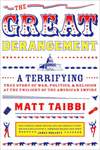
The Great Derangement by Matt Taibbi

There is an essential flaw in human nature that makes us think we’re special. It used to make us think that we were literally the center of the universe, which it turns out we aren’t. It makes us think that we’re all going to grow up to be movie stars and astronauts, which we aren’t; our children are all brilliant and well-behaved, which they aren’t; and that God is on our side, which It isn’t.

Oddly enough, though, there is one place where this boundless optimism is flipped on its head. Every generation is absolutely convinced that this is the nadir of human accomplishment, that we are well and truly screwed and that there has never been a more messed-up, terrible time to live. The past was better, we think, and we look back on the days gone by as a golden age when things were simpler and no one had the kind of troubles that we have today.

When you join us, all will be perfect. Join us. Join us.

Of course, that’s not true. We are healthier, freer, and generally better off than generations before us, who were healthier, freer, and generally better off than the ones before them, and so on. While things certainly aren’t perfect, they’re not nearly as bad as we like to think that they are. If people were able to look at their world with an unjaundiced eye and a fair heart, we would realize that and maybe start living our lives accordingly.

Of course, if we were able to do that, then Matt Taibbi wouldn’t be able to sell his books.

To be fair, the first decade of this century was messed up on a grand scale. Not the same way the 60s were, or the 30s, or the 1860s, but truly twisted and burdensome in their own special way. We had been attacked, seemingly out of nowhere, by a shadowy cabal of extremists who managed to make a laughingstock of our supposed invulnerability. We reacted by flipping out and invading the wrong country and passing reams of knee-jerk legislation designed to chip away at civil liberties wherever they could. Our government, when it wasn’t handing us lies that were about as transparent as a window where the glass has been removed and replaced with nothing but pure, spring-fresh air, was telling us that there was nothing to see here and that the best way to get involved was to go shopping. And if you did have to get involved, you’d better be with us.

Because we know who’s against us. The tehrists.

Overseeing all of this was a simplistic frat boy idiot manchild of a President and the band of Washington technocrats who had been itching to bomb the hell out of the Middle East since the 70s. The media, for its part, was playing along, doing what it was told, and making sure that the people, with whom sovereign power resides in the United States, had no way of knowing what its government was actually doing at any given time.

This could probably be a campaign sign for whatever politician is running near you.

Americans had been lied to over and over again for decades, starting with the post-ironic age of advertising (which Taibbi pinpoints as the Joe Isuzu ads) up to the utterly unswallowable “They hate us for our freedoms” line that we were supposed to believe when it slid, wet, horrible and putrescent from the mouth of George W. Bush. And then, if you raised your hand and asked questions about the story you were expected to buy into, people turned around and accused you of being a faithless traitor. So what are people to do when they can’t trust the narrative that their leaders are giving them?

Why, they turn inward, of course, and build their own narrative. Their own bubble, as it were – a space within which everything makes sense. Everything can be explained, people can be trusted, and all the rules work. It is utterly incomprehensible to outsiders, but that’s okay because outsiders are the whole reason the bubble exists in the first place. As Taibbi discovers, there is far more in common between the far right hyper-Christians and the far left conspiracists than you might expect, and that there are far more of them than you really want to know.

This book is basically two interwoven parts, with a few interludes to keep the story on track. In one part, Taibbi goes down to Texas, uses a fake name and gets involved with a Megachurch in San Antonio. He joins the church to find out what brings these people together in a time when the government and the media can’t be relied upon, and what attracts people to a life of fundamentalist Christianity in the first place. He goes to meetings where demons are cast out, to small group discussions in beautiful Texan homes, and listens to people explain why it is that they’ve given their lives to Christ, something that Taibbi would never do himself, were he not researching a book.

Woah.

He also finds himself drawn into the shadowy world of the 9/11 Truth movement, a group that believes that – to varying degrees – the Bush administration bears some of the blame for the attacks on New York and Washington D.C. Some believe they knew about it but chose to do nothing, so that they would have a reason to launch their war against Iraq. Others believe that they directly caused the attacks, mining the collapsed buildings and aiming the aircraft. The more elaborate theories involve holograms, missiles and a conspiracy of silence that is continually upheld by thousands of otherwise loyal Americans.

Much like the fundamentalist Christianity, Taibbi immerses himself in Truther culture, trying to find out what it is that keeps them going, even when they – like the Christians – have no real evidence to support what they believe. Even moreso for the Truthers, there is actually a lot of logical, circumstantial and physical evidence that outright debunks their theories, but they soldier on anyway, utterly convinced that they are the only ones in America who haven’t surrendered to the lies of the political and media machines.

So what do these two groups have in common, and what do they say about America?

American politics are, generally, about Us versus Them. All politics, really, but we do it really well. The parties in power do their best to say that they stand for Us against Them, regardless of which party you vote with, but it’s become increasingly evident that the parties in power are not really for Us – they’re for Themselves. They push the same canned platitudes and wedge the same minor issues every election cycle with the sole purpose of keeping their jobs, and that is finally becoming evident to the public. Rather than governing, which is ostensibly their jobs, Our Representatives in Congress are doing what they can to help themselves, their parties and their friends, and this is more and more evident the closer you look. To have them then turn around and say, without a trace of irony, that they’re doing their best for the country they love, that they actually care about the concerns of the voter, is enough to make even the most optimistic Pollyanna turn into a Grade-A cynic.

“A riot is an ungly thing… undt, I tink, that it is chust about time zat ve had vun!!” – Inspector Kemp, Young Frankenstein

But rather than rising up as one and kicking the bastards out, the public turned inwards and went into their bubbles. If the game we’re playing is Us versus Them, then let’s do it right. Now we’re not just one group of people with a certain set of political views, we are the anointed of God or, depending on where you are, the only intelligent people in a world of sheep. And who are They? They are not just corrupt politicians. They are agents of Satan, sent to bring about the end of the world. They are power-hungry chessmasters, bent on ruling with an iron fist.

It’s a world view that makes sense to the people who have chosen to live in it, more sense than the “real” world does.

Now this book was written back in 2006 and a lot has happened since then, so it is very much a book of its time. Since then, we have seen our political theater change in many interesting ways, not the least of which is the Tea Party, which is kind of the coming-out party for a lot of the people who felt they had been left out of the discussion for so long. They’ve had their chance to incubate in the churches and on the internet, and now they’re out in force and ready to change the way politics works. A later addition to the party is the Occupy movement, bound together in its view of a nation run by plutocrats and their puppet government. They’re what happens when the Left sits in the echo chamber for a while.

Whether they will ultimately be successful is still up for argument, but so far, well… They’re all kind of freaking me out.

The take-home message from the book is this: There have been far worse times to be in the United States, and our nation has seen its way through far greater trials. But each one is different, born of different causes and with different effects, and we do not have the benefit of being able to look back and see how everything works out. It is much easier these days to find people you agree with and isolate yourself with them, and every time Congress or the President or the Media lets us down, it’s more and more tempting to do so.

HAVE YOU ACCEPTED JESUS CHRIST AS YOUR PERSONAL SAVIOR?!?!

But that way lies madness. The madness of an evangelical movement that is anticipating the end of days, the madness of a conspiracy of vast and perfect proportions. The answer is not to isolate ourselves with the like-minded but to seek out those with whom we disagree and make sure that we’re all living in the same world, no matter what it’s like. Rather than dividing ourselves into two giant camps of Us and Them, pointed and aimed by people whose only interest is in seeing us rip each other to shreds, maybe we can finally see what it is that unifies everyone.

Once we can do that, once we can fight the derangement, perhaps we can see our way to making our country into the one we want it to be.

——————————————-
“Washington politicians basically view the People as a capricious and dangerous enemy, a dumb mob whose only interesting quality happens to be their power to take away politicians’ jobs… When the government sees its people as the enemy, sooner or later that feeling gets to be mutual. And that’s when the real weirdness begins.”
– Matt Taibbi, The Great Derangement

Matt Taibbi on Wikipedia
The Great Derangement on Amazon.com
Matt Taibbi’s blog at Rolling Stone

Leave a comment

Filed under american history, analysis, Christianity, culture, economics, Matt Taibbi, memoir, nonfiction, politics, religion, society

Review 181: The Shadow Rising (Wheel of Time 04)

Wheel of Time 04: The Shadow Rising

This one is all about history.

One of the things that makes the world of Wheel of Time so attractive is that it is clear from the outset that Robert Jordan put a lot of work into the world of his story before he actually started the story itself. I get the feeling, reading these books, that he could tell you everything that happened here for the last four thousand years, if not more. In detail, with names and dates and places, all off the top of his head. Or at least from his copious sheafs of notes.

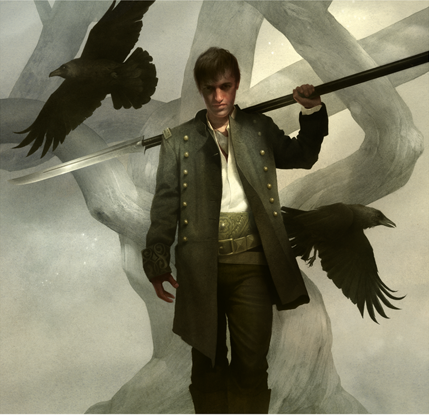
Your name is a killing word? Kinda hard to say your name with an arrow in your throat… (art by Jeremy Saliba)

In this book, the emphasis on history is most clear when Rand goes out to meet the Aiel. For those of you with a taste for classic sci-fi, the Aiel resemble the Fremen from Frank Herbert’s Dune books. They’re desert people, and unsurpassed warriors, with a complex system of honor and obligation. There’s where the similarities end, of course – in these books there is no Spice, there are no sandworms, and no one in this would would ever think they could conquer the Aiel. Twenty years prior to the start of the series, four of the twelve Aiel clans crossed the mountainous barrier into the “wetlands” with the singular purpose of killing King Laman of Cairhien. Those four clans alone broke every army that stood against them, and only returned to their desert because they got what they wanted – Laman’s head on a pike.

No one knew why they had done this. Prior to the Aiel War, the nation of Cairhien had exclusive rights of passage through the waste, a gift that they didn’t understand, and ultimately didn’t fully appreciate. But without those rights, and without the offense that King Laman caused, and without the Aiel retaliation, this story never would have begun.

Reading this book, you start to get a better view of the historical context in which it is placed, and nowhere is that clearer than in Rand al’Thor’s trip into Rhuidean, the forbidden city of the Aiel. Any man who wants to become a clan chief, or any woman who wants to become a Wise One, may go there, but only once and twice, respectively. What they learn is their final test – the true history of their people. Those who cannot face the truth do not come back. Stronger men and women go on to become leaders, but never speak of what they saw. In order to fulfill his destiny, Rand must learn the history of the people he was born from, and by doing so, change the world.

It’s a fascinating sequence, actually – it’s the history of the Aiel from the day the hole was bored into the Dark One’s prison, through fifteen generations of the Aiel as refugees until the establishment of the city of Rhuidean itself, only told backwards. We find out why they never touch swords, why they veil their faces, and why they believe they are punished for sinning against the Aes Sedai. We get to see the incredible changes that occurred in only three or four hundred years, and then reflect that the time span we see only covers a small portion of the time that has elapsed since the Breaking of the World. We truly begin to understand how broken the world was and how hard life became, once we compare the hardened warrior Aiel to their Da’shain Aiel ancestors. It’s a fascinating and moving story, and it serves as an excellent centerpiece to the novel.

He’s not all fun and laughs.

History rests in other places as well through the book. Mat gains the memories of two thousand years, in a surprising exchange with otherworldly entities in a land beyond a twisted red doorway. We learn that the Sea Folk are looking for their Chosen One, just like everyone else, and Elayne and Nynaeve are pretty sure it’s Rand. They’re off to Tanchico to look for an artifact that could prove Rand’s undoing if the Black Ajah or the Forsaken get their hands on it first.

In fact, speaking of history, there has been a lot of speculation over the years on how the world of this book is related to our world. There are clues scattered about that suggest it is our extreme future – fairy tales about Anla, the Wise Counselor, Materese, Mother of the Wondrous Ind, and Lenn who rode to the moon in the belly of a fiery eagle (who could be Ann Landers, Mother Theresa and John Glenn, respectively). Jordan never came right out and said whether this is our world’s future or not, but a short passage in this book dropped a pretty big hint. While looking around a palace in Tanchico for the artifact that could harm Rand, Nynaeve travels the Dream World into a museum of antiquities. There, she sees many things that amaze and baffle her – fossils of extinct animals, for example often with some kind of emotional resonance. In her search, she finds this:

A silvery thing in another cabinet, like a three-pointed star inside a circle, was made of no substance she knew; it was softer than metal, scratched and gouged, yet even older than any of the ancient bones. From ten paces, she could sense pride and vanity.

If that ain’t a Mercedes-Benz hood ornament, I’ll eat my library.

Over in the White Tower, history is being made as Siuan Sanche becomes only the third Amyrlin Seat in history to be deposed in a move orchestrated by the hardest of the Red Ajah, Elaida a’Roihan. And all around, the shadow is indeed rising – the Forsaken are out there, building their power and waiting for Rand so that they might defeat him before he battles their master, the Dark One.

But the best part of the book, in my opinion, is none of these. The best part centers around Perrin Aybara, the young blacksmith who was one of the original three young men to travel out of the Two Rivers on that spring night long ago.

Hi. We’re the forces of evil, pleased to meet you. Nice village you have here…

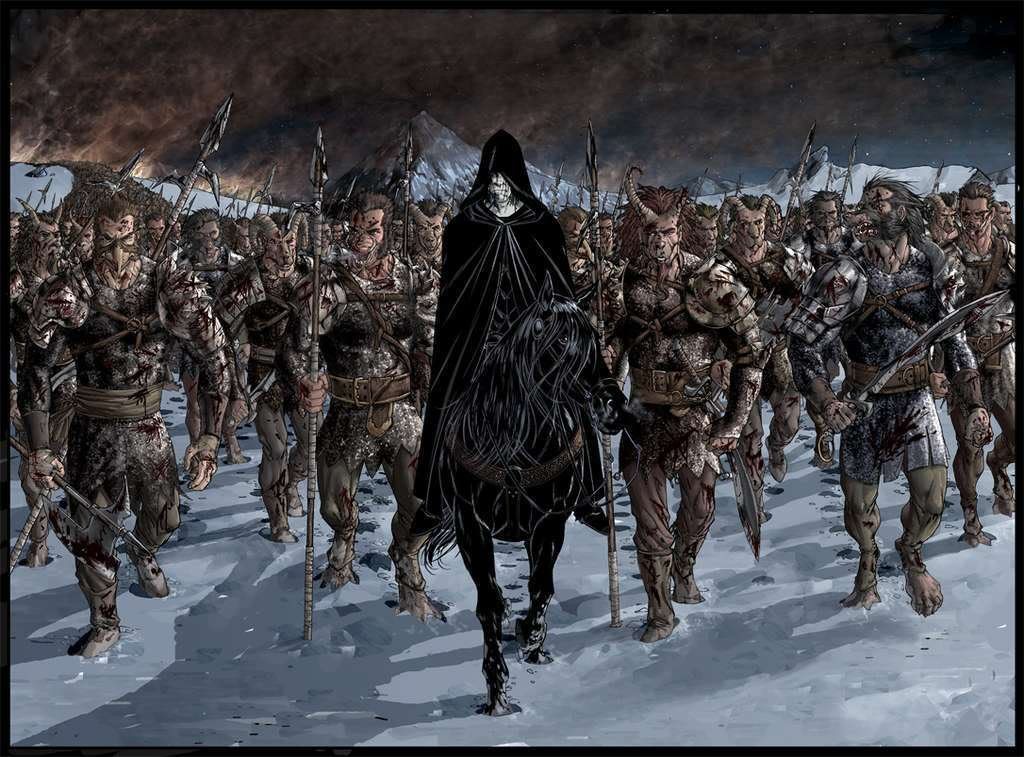
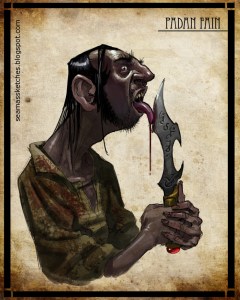
Back in The Great Hunt, the vile Darkfriend Padan Fain challenged Rand to meet him – failure to do so would result in pain and suffering brought down on all those whom he loved. Through circumstances not entirely under his control, Rand never got to meet Fain, though he did manage to cause him great inconvenience nonetheless. Fain meant to keep his promise, though, and in this book that promise is realized. The Two Rivers has been under siege by creatures from the Shadow – Trollocs and Myrddraal – and less Dark, though still not very nice Children of the Light, an army of zealots who sees Darkfriends in everyplace they look. Rand can’t go home to help – his destiny lies in the Aiel Waste – and Mat’s destiny lies with Rand. Egwene has to go to the Waste as well, to learn Dreamwalking from the Wise Ones, and Nynaeve is off to Tanchico to hunt the Black Ajah.

That leaves only Perrin, who goes back to his home to find it a very different place. He and Faile, the Hunter for the Horn whom he loves, along with Loial and three Aiel, travel back to the Two Rivers and Emond’s Field to put paid to the Trollocs and see that the people there are safe. In the process, Perrin the blacksmith’s apprentice finds himself becoming far more than he ever thought he would be.

This sequence is one of my favorites in the series thus far, and I’m including all the books that come after this one. It’s written with such depth of character, and the relationship between Perrin and Faile is built with such care that every scene between them resonates with emotion and meaning. In one book, Jordan has taken a character who had been the least interesting of all the protagonists, and made him into the one you care the most about. It’s not for nothing that Jordan gave Perrin an entire book off in The Fires of Heaven.

No matter which era we’re looking at, no one will be as creepy as Padan Fain. (art by Seamus Gallagher)

The historical insight we have gained here will help us along through the rest of the series, as we take a broader look at the world as it is in the present. Every character, not just Perrin, is changed and moved forward, if not always in likable ways, and we get the real sense that a new history is being made right now. We know that stories will be told of Perrin Goldeneyes for generations to come in the Two Rivers, that Elayne and Nynaeve will become legends among Aes Sedai, though whether as heroes or object lessons we can’t be sure yet, and that the fate of the future rests not on Rand’s back alone. He makes the Aiel face their past, and those who can survive the ordeal will be the shapers of the future.

The thousand or so pages of this volume can drag, if you’re not paying attention to what’s going on. The history of Rhuidean is a good example – the first time I read it, I was really confused and didn’t really see the point of the whole thing – I wished it had focused less on the post-Breaking history and more on the Age of Legends, with its jo-cars and hoverflies, the Nym and the Ogier and the Da’shain Aiel working together. But once you give it thought – why it was vital that the clan chiefs and Wise Ones remember, and how the events of nearly three thousand years ago directly led to the birth of Rand al’Thor and the very story we are reading, it goes from being a slog to an adventure.

Still, I recommend taking notes.

—————————————————-
“Rand al’Thor may be lucky if the next Age remembers his name correctly.”
– Thom Merrilin
—————————————————-

Robert Jordan at Wikipedia
Robert Jordan at Tor.com
The Shadow Rising at Wikipedia
Wheel of Time at Wikipedia
The Shadow Rising at Amazon.com

Wheel of Time discussion and resources (spoilers galore):
Theoryland
Dragonmount
The Wheel of Time Re-read at Tor.com
The Wheel of Time FAQ
Wheel of Time at TVTropes.com

1 Comment

Filed under adventure, epic fantasy, fantasy, good and evil, history, quest, Robert Jordan, war, Wheel of Time

Review 169: The Disappearing Spoon

The Disappearing Spoon by Sam Kean

One of the prettiest books I have on my shelves right now is Theodore Gray’s The Elements, a visual collection of all the elements that make up the physical universe. “Everything you can drop on your foot,” as he says. In it, he provides wonderful pictures and descriptions of the elements that we know, arranged as they would be in the periodic table. It’s a gorgeous book, one that everyone should have – especially if you have children. If you want your kids to become interested in science and investigating the world around them, you could do far worse than to have this book on your shelves.

Eventually, though, they’ll be old enough and canny enough to ask, “Well, how do we know all this? Where did we find these things, and how? And why are they in this order?” That’s the point where you hand them The Disappearing Spoon, sit back, and let Sam Kean take over.

Ytterby. By all accounts, a lovely place. Photo by Bertil Nelson on Flickr.

The story of the elements, and our understanding of them, is governed just as much by personality as by p-shells, as much by competition as by charge, as much by ego as by electrons. While the elements themselves don’t pay any attention to human affairs, the quest to understand the building blocks of matter have sent us to the hearts of stars, the depths of the earth and, for various reasons, Ytterby, Sweden. [1]

Kean starts with how he got into the elements, with a story that would horrify modern-day parents: mercury. When he was a kid, his mother would collect the mercury from broken thermometers and keep it in a little bottle on a high shelf. If they were lucky, she would let her children play with it for a while, swirling it around and watching while this shiny liquid metal split apart and fused back together perfectly, never leaving a bit of itself behind. It was a metal that flowed like water, and it was fascinating. If he had known at that age that ancient alchemists thought there were spirits living in mercury, he would not have been surprised.

Oh, mercury, How can anything so pretty be so dangerous? Photo by Len Gatey on Flickr.

Keeping an eye out for mercury, he learned that modern scientists are able to follow the expedition of Lewis and Clark using mercury. The explorers carried with them a good quantity of Dr. Benjamin Rush’s Bilious Pills, a “cure” for any illness that mainly contained mercury chloride. It was vile stuff, poisoning everyone who took it, but without an FDA around to stop this kind of nonsense, Rush made plenty of money. It probably didn’t hurt his credibility that he was one of the signers of the Declaration of Independence. In any case, he gave samples to the Lewis and Clark expedition, and their latrine sites can still be found today by the unusually high levels of mercury that were deposited there as the men’s bodies tried to get rid of the heavy metal as quickly as possible.

Mercury also taught Kean about mythology – the Roman god of communication, modeled on the Greek message-bearer. It taught him etymology – the chemical symbol for mercury is Hg, which is derived from the Latin hydragyrum, which means “silver water.” It informed him on literature, especially the Mad Hatter of Alice in Wonderland, who was based on the poor crazies who used to breathe in the fumes of mercury while setting felt for their hats.

This one weird, eerie element was a door into so many other topics that he figured there must be others. And so he started work on this book, a collection of histories and tales, gossip and hearsay, all centered around the 118 physical elements that make up our universe. “As we know,” he writes, “90 percent of particles in the universe are hydrogen, and the other 10 percent are helium. Everything else, including six million billion billion kilos of earth, is a cosmic rounding error.” Within that rounding error, though, some amazing things have been found.

One look from this bearded madman and the elements fell into place right quick.

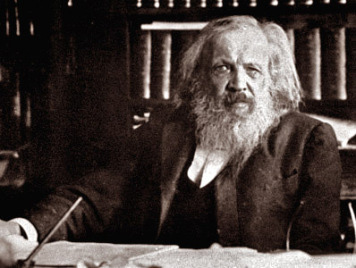
In the 19th century, the Russian Dimitri Mendeleev examined the common properties of different elements and was able to sort the elements in such a way that took advantage of their similarities. The violent alkalies along the far left, which will explode if given half a chance, and their cousins, the halogens on the far right, some of the most reactive elements in nature. Separating them are the noble gasses, which don’t react with anything unless pushed to extremes. Without knowing about electron shells and the weird quantum things that happen on the atomic level, Mendeleev managed to put together a table so good that he was able to leave gaps in it that corresponded to elements that hadn’t yet been found. And by telling the world that these gaps existed, the race to isolate and discover the elements was on.

Kean’s book is a great look at the way science works on a human level. How the search for high-quality porcelain led to the discovery of an entire class of elements, how Marie Curie would get into trouble by dragging her (male) colleagues into dark closets to show them how radium glowed, how nitrogen kills with kindness and lithium quiets an unsettled mind. The competition to not only find these elements but to name them and find uses for them has driven science forward in all fields, from geology to neurology, for the last two hundred years. Those 118 squares on the periodic table have driven men to travel the world, to create economic and political empires, to love, to hate, and to murder.

If this kind of thing were taught in high school chemistry class, there would probably be a lot more kids interested in science as a career.

A quantum jump is exactly like this, except in that it's nothing like this. Not even remotely. But otherwise, yes.

The book is very readable, even if it does drift from time to time into more technical areas. One of my colleagues, who doesn’t have an extensive background in science, said she was a little slowed down by talk of electron shells and quantum jumps, which I guess were not aided by Kean’s elevator similes. But it did get her asking the right questions – how do we know atoms exist if we can’t see them? How can we be sure that what is in this book is true?

Those are the questions that Kean tries to answer in the book, but it’s also the kind of book that may bring up more questions. It’s “gateway science,” one of those books that pulls away the cold, rational veneer of the scientist and his or her endeavors, and shows what an exciting, weird, messy and dramatic place science can be. What’s more, it shows how science is deeply ingrained not only into our technology, but our language, history and politics. An understanding of science, even at an amateur level, is a wonderful way to open your eyes to the great, complex and bizarre world in which we live.

———————————————————–
“We eat and breathe the periodic table; people bet and lose huge sums on it; philosophers use it to probe the meaning of science; it poisons people; it spawns wars. Between hydrogen at the top left and the man-made impossibilities lurking along the bottom, you can find bubbles, bombs, money, alchemy, petty politics, history, poison, crime, and love. Even some science.”
– Sam Kean, The Disappearing Spoon
————————————————————

[1] The town has the distinct honor of having four elements named after it: yttrium (Y), ytterbium (Yb), terbium (Tb), and erbium (Er). What has your hometown got?

Leave a comment

Filed under chemistry, history, nonfiction, Sam Kean, science, technology

Review 167: A People’s History of the United States

A People’s History of the United States by Howard Zinn

History is, in its way, a fiction.

While it is made up of facts, things that are verifiable or at least reliably accepted as being what really happened, our understanding of history rests on a certain assumption that doesn’t always hold up – that what we are reading or hearing is The Truth. It’s how we learn about history when we’re kids – that this happened and that happened, and that’s all we really need to know.

The problem, however, is that what we got in our history books wasn’t the entire story. Oh, it was true, for a given value of “true,” but the historian who wrote the book did so with a specific narrative in mind, one that fit his or her perception of the past and which – more importantly – would sell textbooks to hundreds of schools across the country. The history that we get from those books is designed to appeal to the sensibilities of a populace that is already inclined to think well of its nation, and rarely deviates from the theme. While they do try to note the excesses, injustices and impropriety of the past, they tend to bury it in the glorious achievements of governments and industry.

AMURRICUH!!

Unfortunately, doing so means that there’s a lot of history that gets left on the cutting room floor. Incidents, people, whole populations get brushed aside because either there’s not enough room for them or because telling their story in detail ruins the mood that the historian is trying to set – usually one of bright optimism for a good and just nation.

There is nothing inherently wrong with this approach, either. An historian cannot practically include all of the historical viewpoints, good and bad, into a book meant to be used for only 180 days out of the year. So out of expedience, if not a conscious desire to tell an uplifting tale, they write books that look upon our past as favorably as possible, while including just enough criticism of our failures to fend off any serious accusations of bias.

As Zinn tells us, though, there’s no such thing as an historian without bias. Every historian has a story to tell, and Zinn has decided that he doesn’t want to tell the one we’re all used to hearing.

He starts in much the same place as most American history books – with the coming of Christopher Columbus to the New World. Immediately he reminds us that Columbus’ mission was not one of exploration but of commerce, and that the first question he asked the natives of what he would label Hispanola was, “Where is your gold?”

It all went downhill from there.

Reading this book, it would be very easy to get depressed. I can see how those who were brought up with a healthy dose of American Exceptionalism (the idea that the United States obeys different rules from the rest of the world and, more importantly, cannot do wrong) would really dislike this book. It is page after page of lies, misdeeds, cruelty, greed and deception. It is the story of a nation built not on the principle that all men are created equal, but that all men must be leashed to the yoke of the capitalist overclass. It’s a tale of genocide and oppression, of revolts both peaceful and violent, and it never lets up for a moment.

To his credit, Zinn tells us right up front that he’s going to take the side of the oppressed, the dispossessed and the put-down, and there’s no way you can tell that story without it being really depressing. It’s pretty clear pretty quickly, though, where his sympathies lie:

My viewpoint, in telling the history of the United States, is different: that we must not accept the memory of states as our own. Nations are not communities and never have been. The history of any country, presented as the history of a family, conceals fierce conflicts of interest (sometimes exploding, most often repressed) between conquerors and conquered, masters and slaves, capitalists and workers, dominators and dominated in race and sex. And in such a world of conflict, a world of victims and executioners, it is the job of thinking people, as Albert Camus suggested, not to be on the side of the executioners.

Hey, even executioners got problems, buddy...

His portrayal of the underclass, rebellious or not, is one of suffering nobility, and the System as a deliberately malevolent entity. Any good that it does is simply whatever was necessary to maintain its power, and the above quote speaks to that. The parallel structure that he uses effectively groups all of the upper class into the “persecutor” role, and the lower class into the “victims.” And while there is some truth to that – human history, after all, is a long story of rich and powerful elites governing poor and powerless people – it is painting with too broad a brush, in my opinion. He seems to work from the premise that all those with power are bad, and so those without must therefore be good.

As much as I wish that admitting bias was an excuse for it, it isn’t. It does a disservice to all involved to flatten your view of the American class system into a two-dimensional shadow play. Not all of the populist agitators were good and noble people, nor were all politicians cunning manipulators. Just keep that in mind as you read.

It’s a sobering read, though, to say the least. The best simile I could come up with is that it’s like watching your parents have sex. It’s something that you always suspected went on, but you could have gone your whole life without being presented with the reality of it. So it is no surprise that, after reading this book, some people become absolutely insufferable, cynical and disillusioned.

If you’ve already gone through that stage of your political thinking, however, you find something else in this book – hope. It’s something you have to dig for, but it is there, buried in the larger narrative that Zinn is telling us.

Not sure he saw this coming...

Given the amount of detail he goes into, it’s very easy to lose sight of the larger picture at work. Zinn details slave rebellions, gives stories of workers pushed to the extremes of human existence, soldiers thrown away for nothing, and entire segments of the population ignored or actively persecuted. But alongside these horror stories come tales of resistance. Whether it’s the quiet contemplation by a poor white farmer over whether he might have more in common with his black neighbors than his white landlords, riots of prisoners and guards against a corrupt prison system, or the militant, city-wide shutdowns organized by the Wobblies, the people can only be pushed so far. And while the Powers That Be are very good at figuring out how to distract, scare or defy the people, they eventually do make changes for the better, and everyone benefits a little bit.

Inasmuch as this book is a chronicle of America’s misdeeds over the last few centuries, it is also a tale of Americans’ triumphs. It is a tribute to the will of the people who, no matter how difficult it may have been, decided to stand up and demand respect from the men who held the reins of power. It is a testament to the women who wanted equality, the socialists who wanted a better world, the workers who wanted safe jobs at living wages, the blacks who wanted to be full citizens, and the Indians who wanted the wrongs of the past redressed.

Not everybody has gotten what they wanted – America is still very much a work in progress, and there is bound to be some backsliding as we go. What Zinn shows in this book is that no matter how bad the American government can be or how greedy American business might become, the American people want what’s best for themselves and, when the time comes, will stand up and shout for it. Given enough time, and enough courage, The United States will continue to be a better and better nation, and perhaps someday – someday – it will finally fulfill our expectations for it.

——————————————-
“Power concedes nothing without a demand. It never did and it never will….”
– Frederick Douglass, 1857
——————————————-

1 Comment

Filed under american history, criticism, culture, history, Howard Zinn, nonfiction, revolution, society, The United States