Monthly Archives: January 2011

Lost in the Stacks 1: Reading Evangelism

Let me tell you about a good book I read. How much time do you have?

Here’s something new for you all – Lost in the Stacks, a companion podcast to the Labyrinth Library.

A few people in the listener survey said that they would like to hear more on general book and reading topics, and this is something that had been sitting in my head for a while, so here it is! The plan is to do this monthly, in the last weekend of the month, and hit topics that cover reading in general rather than focusing on one book.

To listen to the podcast, you can either download it directly by clicking the link, or subscribe in iTunes, in which case it will be delivered right to you.

To start us off, we’ll be talking about “Reading Evangelism,” or how to get other people to share what you love. How can you do it without coming off like a snob or a pedant or, *shudder* a high school English teacher? What I think it comes down to is the right mix of passion and understanding.

You love what you love, and there should never be any shame in that. Whether you love gardening or reading or collecting antebellum mustache combs, you should own your passions and be willing to share them with others. At the same time, you need to understand that no matter how hard you try, you won’t be able to convert everyone to your side. More’s the pity.

In this episode, I talk about my experience as a teacher of high school English and what I learned about trying to encourage others to read. I hope you’ll join in the conversation and we can all learn a little bit more about how to convince people to join us in our madness.

Leave a comment

Filed under Lost in the Stacks, reading, teaching

Review 107: Wizard and Glass

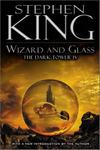
Wizard and Glass by Stephen King

So. Now that we’ve put three books behind us, and sit at the pivot of the series, it is time that we settle down and have ourselves a little palaver about Roland, the Gunslinger.

We know little about this man, the protagonist of our epic series. We know he’s a hard man, the kind of man who can cross deserts, brave oceans, and kill entire towns if need be. We know he’s a dedicated man, who will follow his quarry wherever they may flee to. We know he is single-minded, the kind of person who would allow an eleven year-old boy to fall to his death if that meant getting another foot closer to his precious Dark Tower. He is a hard man, Roland Deschain is. He is the Gunslinger.

But who is he really? Who was he before he started on this mad quest for something that may or may not exist? How did he get set on this path that could determine the fate of worlds, this quest that led to the deaths of everyone he ever loved? Who is he?

Blaine the Mono (art by Revenant42)

Well settle down, boys and girls, because this is where we get to find out. In between destroying a sentient monorail at a rigged game of riddles and facing off against the darkest Dark Man there is in a mock-up of the Palace of the Emerald City, Roland tells his ka-tet the tale that shaped him and set him on his path. It is a tale that begins with his entry into manhood – a trial by violence where he bested his teacher, Cort, in a duel to the pain, and ends with Roland’s soul nearly destroyed.

Roland and his companions, Alain and Cuthbert, have been sent by their fathers to the most out-of-the-way place they know – a small village called Hambry in the Barony of Meijis. Their alleged purpose is to count things, more as a punishment than a mission. They seem to be three boys who got into trouble, and who now must pay by spending their summer doing menial work. They don’t want any trouble, and they hope that no one will give them any.

They say there is a monster in the Citgo fields. Green, mayhap.... (photo by Cogito Ergo Imago)

That’s the story, anyway. In reality, they’re looking for evidence of the workings of John Farson, also known as The Good Man, who is leading a popular revolution against the established order in Roland’s home country, In-World. Hambry has an oil field, the work of the Great Old Ones, which is known to locals simply as “Citgo” Should Farson get enough oil – and the means to refine it – he will be able to revive ancient war machines and bring death to all of In-World. With Roland, Alain and Cuthbert as spies for the Affiliation, the Gunslingers in Gilead hope that they can stall, if not stop, Farson’s rebellion.

That would have been great if only Roland Deschain hadn’t met Susan Delgado, the daughter of a deceased horse-breeder and soon to be the promised girl of the mayor of Hambry. As soon as they meet, their destiny is clear: it is true love. No more able to stand against their fate than a tree in a whirlwind, Roland and Susan do as all young lovers have done, and risk discovery and death in the process. In every corner there are those who would stand against them: Susan’s spinster aunt, Cordelia, who hopes to make some money selling her niece off to the mayor; the Big Coffin Hunters, three mercenaries who work for Farson and who mean to see every last drop of oil gets in his hands; and Rhea of the Cöos, a horrible witch who possesses a crystal orb that lets her see all the malicious things that people do. Against these arrayed forces, Roland and his friends must not only foil the plans of John Farson, but also escape Meijis with their lives.

With the first, they are successful. With the second, not so much.

Dark Tower fans that I have talked to generally agree that this is the best book of the seven, for many reasons. First, we get to see Roland before he became all tall, gritty and scary. We see him as a callow youth, a boy of fourteen who is in way over his head, tackling responsibilities that would be better handled by a grown man. They’re on the losing side of a terrible war as it is, as they’re up against the combined cunning and guile of some very bad people. In many cases it is luck as much as skill that leads them to their eventual victory.

Roland and Susan (art by Jae Lee)

What’s more, we get to see Roland in love, and this is really where King shines in this book. He says in the afterward that he was dreading writing this book, mainly because he knew that he would have to portray teenage love – first love – in a realistic fashion, which can be hard to do when you’re several decades removed from being a teenager. All the madness that comes with teen love – the longing, the furtive trysts, the absolute certainty in what you are doing and that no one can stop you. The way that the person you’re in love with is all you can think about, and the only thing you want is to be with them again, if only for a moment. The way you freely and willingly lose your mind for love.

It’s something which, thankfully, we grow out of as adults. Frankly, if I ever felt like that again, I’d probably throw myself under a train.

King has done a fantastic job with the relationship between Susan and Roland – it’s as realistic as he can make it, without being mawkish and overly romantic. We are never allowed to forget that, like so many doomed lovers before them, they are risking everything with their love – their mission, their friends, and their lives – and we know that even the slightest misstep can mean disaster. Mixed with the other, more adventure-driven elements of the plot, it’s incredibly tense, and it’s handled very well.

The romance aside, there are some wonderful characters in this book, and as is the case with so many Stephen King novels, the best ones are the bad ones. Susan’s aunt Cordelia is a bundle of jealous paranoia, and you can feel her mainspring winding up every time she shows up on the page. Eldred Jonas is a laid-back killer, an old man who has buried countless young men, and means to bury Roland and his friends. And Rhea is just palpably foul. You can almost smell her when she shows up, which is a great accomplishment – and you can’t wait to see her again.
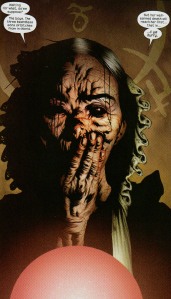
Rhea of the Cöos (art by Jae Lee)

As an aside, Marvel Comics has been doing comic book stories of Roland’s youth, and the first one re-tells this tale. It’s called The Gunslinger Born, and while it’s not bad, there is a certain emptiness to it. It’s not easy to compress hundreds of pages of character and plot development into a seven-issue comic series. I don’t know how it would read to someone who hasn’t read this book, but to me it looked like it was missing a whole hell of a lot….

As I said, this book is the pivot on which the series turns, and it is essential to understanding Roland. We have to know who he was and how he became who he is. While there are still questions to be answered, and stories to be told, the big story is out. Now he and his ka-tet can continue in their quest for the tower, confident that they know a little more about this man who yanked them from their worlds into his. For us, the character and his world become richer, more full of meaning. Things that we might not have thought about in the first few books become more meaningful, and we can better appreciate the history of his dying world. Most importantly, we can begin to understand why it is so important that he find the Dark Tower, and we pray that he knows what to do when he gets there.

—————————————————–
“I’ll pay ye back. By all the gods that ever were, I’ll pay ye back. When ye least expect it, there Rhea will be, and your screams will break your throats. Do you hear me? Your screams will break your throats!
– Rhea Dubativo of the Cöos, Wizard and Glass

Wizard and Glass on Wikipedia
The Dark Tower Portal on Wikipedia
Stephen King on Wikipedia
The Dark Tower homepage
Wizard and Glass on Amazon.com

2 Comments

Filed under adventure, coming of age, Dark Tower, death, fantasy, friendship, murder, quest, romance, sexuality, Stephen King, teenagers, witches, wizardry, world-crossing

More…. weight…

Okay, it probably says something about me that this was the first thing to pop into my mind when I head that I had been Freshly Pressed by WordPress while I was sleeping. This is for two reasons: I am a lit nerd and Arthur Miller knows how to write a good play.

Anyway, thank you, WordPress, for adding my review of Eats, Shoots & Leaves to their Freshly Pressed page! It was kind of a thrill to look at my site stats:

Tuesday: 3
Wednesday: 2
Thursday: 16
Friday: 256

So, welcome to all you new readers and listeners! Feel free to wander around and explore.

– Chris

Leave a comment

Filed under FYI

Review 106: Eats, Shoots & Leaves


Eats, Shoots & Leaves by Lynne Truss

This is how I know I’m a real English teacher – I have a shelf dedicated to books just about English. The history of English, the uses and misuses of English, and even the history of the alphabet we use. This is something I never expected to have in my personal library, that’s for sure.

So has my brain. (photo by Nathan Harrison)

But that’s all to be expected; I’m an English teacher, and people like me are supposed to read books like this. It’s professional development, or something. The weird thing about this book, a book dedicated to punctuation, of all things, is that it was popular with people who weren’t English teachers. Everyone was shocked by how well it sold, the author included. A book written as kind of a primal stickler scream somehow struck a chord with the general reading population. Perhaps there is some hope for our species after all….

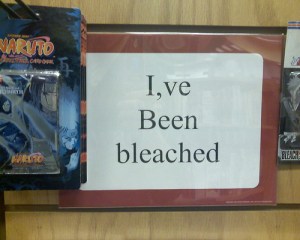
The reason it sold well, of course, is that it’s well-written and entertaining to read. Far too many books about language are written by dusty intellectual Linguists who exude smugness with their impenetrable jargon and are completely inaccessible to the general public. I have those books on my shelves as well, and nothing this side of a double shot of NyQuil is as good at getting me off into slumberland. Ms. Truss, however, writes like one of us. She’s an ordinary person who loves her language and who just snaps every time she sees a sign like, “Apple’s – $1”. I share her pain.

Can't use white-out on neon, can you? (photo by James McNally)

The book is a well-mixed combination of history, usage and style. The tiny marks that make the written English word behave the way it does have come to us along a remarkable number of paths. In the last millennium or so, marks have been added, changed and removed over time as necessity dictated. One of her fears (and the impetus to write this book) is that we may be changing English to a new form that requires less of that rigid, form-fixing punctuation.

Or people just haven’t bothered to learn.

As she notes throughout the book, punctuation is one of those things that few people ever really get to learn. Our English teachers give it a once-over in elementary school, and then we never get a review of it, so we spend most of our lives just throwing around commas and apostrophes and hoping we get it right. More often than not, we don’t. And we’re afraid to ask anyone, lest we look like ignorant yobs.

But to master punctuation means more than just being a pedant and a nerd. Heavens, no. Mastering punctuation means controlling your language, which is controlling your thoughts. The vast difference between a sentence like, “The convict said the judge is mad” and “The convict, said the judge, is mad” should be enough by itself to illustrate how important proper punctuation is. In a language like English, so dependent on rhythm, timing and stress, punctuation is the substitute for our voice. It tells us when to speed up and slow down, which points need to be stressed and given special attention, and which points (like this one) can be safely disregarded, if one so chooses.

Only one member, mind you.... (photo by Lobstar28)

It would be very easy for Ms. Truss’ obvious frustration with the misuse of punctuation to overwhelm her and poison the book. Admittedly, she does at one point put together a kit for those who would be punctuation guerrillas and risk prison to set the world straight, but by and large she stops short at advocating actual lawlessness.

Ms. Truss understands that punctuation abuse isn’t something that people do intentionally – it’s largely a matter of ignorance, and she wants to help. What’s more, she’s funny. For example:

In the family of punctuation, where the full stop is daddy and the comma is mummy, and the semicolon quietly practises the piano with crossed hands, the exclamation mark is the big attention-deficit brother who gets over-excited and breaks things and laughs too loudly.

Every section in the book has sharp and clever humor, a description of something as simple as a comma made in such a way that you find yourself laughing out loud on the train.

Of course, whenever you get into this topic, you run the risk of finding yourself forced to one side or the other of the “proscriptive” versus “descriptive” debate. You know, the people who want to tell everyone else how to use language versus the people who want the speakers to decide for themselves how it is used. The latter smacks of classical democracy, and as both an English Professional and a person with a healthy distrust of The People, I’m hesitant to sign up for it. I like rules in language. I like having a common set of guidelines we can turn to in order to make sure we’re all getting the meaning that the speaker or writer is trying to convey.

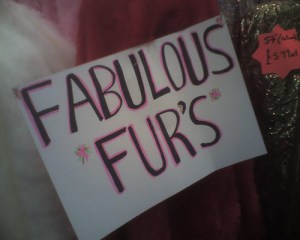
WHAT? The fabulous fur's WHAT?? (photo by Trevor Coultart)

Unfortunately, for people like Truss or myself, it’s all too easy to cross that line from being the person who appreciates a bit of order to that person who writes letters to the editor because some headline writer used a colon where a semicolon would do. And I’ve seen internet flame wars go wild over this pro- or de- divide. People who could politely disagree with each other about Sarah Palin’s international policy experience will find themselves screaming bloody murder over whether or not you should put two spaces after a period.

What has to be remembered is this: there are rules to language, like it or not. Those rules, however, change, and no single one of us has any power to impel or obstruct that change. The best we can do is to make sure we are writing with clarity and precision so that our intended audience understands our thoughts with the least amount of effort on their part. Regardless of what you think of the rules, if the reader has to stop and ask herself, “Wait, what did he say?” then you have failed. So learn the rules. Once you’ve learned them, you’re free to do what you wish, but make sure you have them down cold.

So, if you’ve always wanted to know about how to use a semicolon, or you’re not sure if your commas are in the right place, or if you’ve ever driven someone to madness by dropping an apostrophe into a possessive “its” – and you know who you are – then this book is the one you need. Enjoy.

——————————————
“Using the apostrophe correctly is a mere negative proof: it tells the world you are not a thicko.”
Lynne Truss, Eats, Shoots and Leaves

Lynne Truss on Wikipedia
Eats, Shoots & Leaves on Wikipedia
Eats, Shoots & Leaves on Amazon.com
Lynne Truss’ homepage

24 Comments

Filed under humor, language, Lynne Truss, nonfiction, punctuation

Review 105: Reaper Man

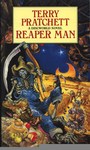
Reaper Man by Terry Pratchett

So. What are your thoughts on death?

Or rather, Death?

It’s a weird thing, death. I mean, you’re here one minute and then you’re… not. And while we all know intellectually that we’re going to die, there’s something in us that refuses to believe that the essential Person that we are could possibly cease to exist. We have personalities, unique aggregations of memory and experience and inborn preferences that all display themselves as a Person, as far as we know unique in all the world. Each human being is an entity that will never be seen again in this universe, and as far as we know, the cessation of life brings that entity to an end, reducing the person we knew to a mere insentiate object.

Is it any wonder we come up with stories for what happens… y’know, after?

Just about very culture that’s ever been has come up with some form of afterlife, be it an eternal feast for heroes, a paradise in which we can bask in God’s glory, a place of exquisite pain and torment, or a ticket back to Earth for another go ’round. There is no way of knowing if any of those are actually what happens to us when we die. At least not until we actually do it. So since we cannot know, we make stuff up, if only to make the whole thing easier to bear.

What often goes with that other world is someone to take us over. A ferryman or a guide, someone who knows the territory and knows where we need to go in what is very likely a rather confusing time. It’s another piece of comfort – knowing that there’s Someone out there who knows where we need to go and what we need to do.

Grim indeed.... (photo by provia_17)

Which brings us to Death.


He’s been portrayed many ways over the years – my favorite is the Death from Neil Gaiman’s Sandman series – a sort of older sister who’s known you all your life and loves you anyway. If she shows up for me when I die, I think I’ll be okay.

I would be just as happy with Pratchett’s Death, even though he is the more traditional robes-scythe-and-skeleton type. Fans of Discworld love Death, which I imagine was somewhat baffling for Pratchett early on. In the first few books, Death was a bit character – he showed up a couple of times to collect the recently deceased, and that was it. But his scenes were so memorable and so good that they sometimes stuck out above the rest of the book. He speaks entirely in capital letters, which lends him a voice that is probably reminiscent of James Earl Jones. He’s aloof, but not uncaring, and seems to take a rather curious interest in humanity. He likes cats, has a house off on the edge of nowhere, and rides a great white steed named Binky. Death has become, in short, an interesting person.

And it seems that’s a problem.

The Universe, you see, is a finely tuned instrument, one which needs monitoring and, occasionally, adjusting. There are… let’s call them Auditors, who make sure that reality stays real – no odd deviations or anomolies such as, for example, anthropomorphic personifications of natural forces. In all honesty, they would eliminate all life if they could, but that is, as yet, beyond their capabilities. So they settle for telling Death that it’s time for him to retire. He gets a little hourglass all his own, and time to kill until the new Death comes into being.

Heya Tom, it's Bob - from the office down the hall... (photo by Scott Beale)

In the interim, this time between Deaths, a new problem arises: nothing is dying. Or, to be more specific, things are dying, but the vital energies that empowered everything, from cabbages to clergymen, aren’t being taken away. Without a Death to handle this very vital – so to speak – function, the life energy is looking for a place to go, an outlet. As a result, things that shouldn’t be alive are up and moving around. In some cases this means objects running along of their own accord, and in others it means that the dead simply have nowhere to go.

Such is the case with the wizard Windle Poons. After 130 years at the Unseen University, he was rather looking forward to a nice rest and then a bit of reincarnation as a woman in a far more liberal society. What he got instead was nothingness. Given that option, he went back to his body and became Undead, much to the consternation of the rest of the UU faculty. Unfortunately for them, they have bigger things to worry about – the buildup of life force is having a rather larger and more dangerous effect on the city of Ankh-Morpork itself. The lack of a Death may well doom the city in a manner that will be horribly familiar to many of Pratchett’s readers.

And where is Death in all this, or at least the person who used to be Death? He has found a small farm below the famous Ramtop Mountains. An old maid, Miss Flitworth, needs a hand and Death needs a way to spend his time – something he’s never had to worry about before. He takes the alias Bill Door and starts to learn what it means to be alive, despite the short time he has left.

"What can the harvest hope for if not the care of the reaper man?" (art by Andrew Mar)

The book, as you might imagine, is all about being alive. What makes life special and precious and ultimately worth living. Windle Poons let life go past while he grew old behind the university walls, and it is only in death that he finds out all that fun he’d missed. Bill Door learns that it is the fragility of life, and its most certain end, which ultimately gives it meaning. In the middle, we see that everything that can live yearns to do so, from the mayflies to the great Counting Pines to cities to ideas.


While the book gives no answers to what may happen after death (the Discworld books rarely do), it does give us another way to look at life. And that, ultimately, is the goal of any great story.

——————————————————
“Huh! Priests! They’re all the same. Always telling you that you’re going to live again after you’re dead, but you just try it and see the look on their faces!”
Reg Shoe, Reaper Man

Discworld on Wikipedia
Reaper Man on Wikipedia
Death on Wikipedia
Terry Pratchett on Wikipedia
Reaper Man on Amazon.com
Terry Pratchett’s official site

1 Comment

Filed under afterlife, death, Discworld, existentialism, fantasy, finitude, humor, Terry Pratchett, wizardry, zombies

Review 104: The Long Dark Tea-Time of the Soul

Remember – go and take the listener survey! The gods command you!)

The Long Dark Tea-Time of the Soul by Douglas Adams

This is the second of the Dirk Gently books – and the final one – and is no easier to explain than the first. But I’ll try.

Ah, just like college.... (photo by Gene Han)

In this story, Dirk is contracted to meet a client one morning at 6 AM, and play bodyguard. The time is vital. The client has made it a point that Dirk absolutely, positively has to be there by six, and he’s willing to pay handsomely for it. So when Dirk wakes up at 11 AM, he suspects that he’s screwed up royally.

His suspicions are confirmed when he arrives at the home of his client, who is sitting quite comfortably in an armchair while his head is rotating slowly on a nearby turntable. The only clues to his grisly demise are his ravings about a green, scythe-wielding monster and a mysterious packet of papers, written in a language that Dirk cannot begin to understand. But he does know their shape – they’re a bill. But for what services, and rendered by whom? So now Dirk has to figure out who, or what, did this to his client and why.

But there’s more to this story (isn’t there always?) An American woman, Kate Schechter, is one of the survivors of the explosion of an airline ticket counter, something that everyone who knows about explosions is calling an “act of god.” But which god would do such a thing, and why? Lucky for her, Kate is about to find out, and she’s also about to find out why gods aren’t quite all they’re cracked up to be.

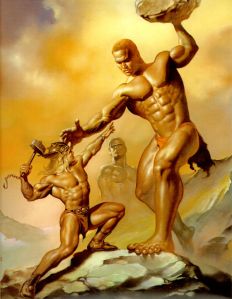
This, of course, does not happen in the book. I needed a picture of Thor that wasn't the super-hero.... (art by Boris Vallejo)

There aren’t a lot of greater themes in this book – it’s an adventure, of sorts, but as far as overarching messages go, it’s pretty thin other than watch out for eagles and be nice to homeless people. It’s entertainment as only Douglas Adams can deliver it. There is some thought given to gods, however, which is a topic I always enjoy. In Small Gods, Terry Pratchett asks where gods come from, and what sustains them. In American Gods, Neil Gaiman asked the question of what happened to gods who were brought to America by their believers. Adams asks what happens to gods once we don’t actually need them anymore.

We made them, after all, and most of the time we made them immortal. We needed gods to be bigger than we, stronger than we, and generally everything we weren’t. And then we went around infusing them with humanity – with jealousy, courage, rage and fear. When we were done with them, we let them go. But that didn’t mean they went away. An immortal is an immortal, and without work to do or followers to deal with, what is a god to do? In the case of Odin, the father of gods and the ruler of the Norse pantheon, the solution is very simple. What’s more, it keeps him pampered and cared for, which is all he ever really wanted.

While I love Hitchhiker’s Guide first and foremost among Adams’ works, I really wish he could have lived to write more Dirk Gently books. The character is a person of reprehensible ethics and somewhat tarnished morals, but you can’t help but love him. Lurking refrigerators, coffee-thievery and all, you find yourself wishing that you could hang out with Dirk, while at the same time knowing that he’d probably invite you out for lunch and somehow make you pay for the meal. He’s a bad person, but an excellent detective – and a great character.

So pick this one up and give it a read. It’s fast, it’s fun – you won’t regret it.

————————————————
“Nobleness was one word for making a fuss about the trivial inevitabilities of life, but there were others.”
Douglas Adams, The Long Dark Tea-Time of the Soul

The Long Dark Tea-Time of the Soul on Wikipedia
Douglas Adams on Wikipedia
The Long Dark Tea-Time of the Soul on Amazon.com
The Douglas Adams Homepage

1 Comment

Filed under detective fiction, Douglas Adams, fantasy, fiction, gods, humor

Best (and not-so-best) of 2010

You know, everyone else is doing lists, so now that the year is over, so am I. Here are the best books I read in 2010!

  • Howard Zinn – A People’s History of the United States. Either a long-overdue look at the disenfranchised and overlooked victims in America’s rise to power or a screed of anti-American socialist dogma. Take your pick, but I know which side I come down on.
  • Warren Ellis – Crooked Little Vein. A trip through Weird America, introducing you to the things people do that you didn’t know people did.
  • Max Brooks – World War Z. An oral history of the Zombie War. Enthralling, exciting, disturbing.
  • Apostolos Doxiadis & Christos Papadimitriou – Logicomix. A graphic novel involving the search for ultimate truth. So involving that I had to read it several times in a row.
  • Barry Hughart – Bridge of Birds. It’s rare that a book shoots right into the “favorite books” category, but this one did it.
  • James Randi – Flim-Flam! This book  is great to give to people who you want to be more skeptical in their lives. A harsh takedown of the ways we try to fool ourselves and others.
  • Elaine Pagels, The Origin of Satan. Reading this was like taking a trip back to the early Church, and realizing that they were all just making it up as they went along.
  • North, Bennardo, and Malki ! – Machine of Death. Personally, I’m hoping for HEAT DEATH OF THE UNIVERSE, but we can’t all get what we want.
  • Robert Kirkman – The Walking Dead, Compendium 1. A really good zombie comic, something I don’t usually find myself reading.
  • Christopher Ryan and Cacilda Jetha – Sex at Dawn. A funny and very compelling look at the nature of human sexuality, at least before we invented agriculture and screwed everything up.

I don’t really have a “worst” list, because my baseline for “worst” is The Bad Beginning by Lemony Snicket, so this is more like my “Meh List.”

  • Lois Gresh and Robert Weinberg – The Science of Supervillains. Much like their Science of Superheroes book, it focused more on why comic books get science wrong than what comics can teach us about science.
  • Robert Heinlein – Starship Troopers. A love letter to militarism, thinly disguised as a science fiction novel.
  • Terry Pratchett – Unseen Academicals. This isn’t Terry’s fault, it’s mine. The book is about soccer, and I really couldn’t care less about soccer.
  • Henry Hitchings – The Secret Life of Words. I like words, but this was every bit as boring as people who don’t like words think that books about words might be.
  • Robert Heinlein – I Will Fear no Evil. It would be a great story, if there was a story there. As it was, it was a memoir at best. A really weird memoir, but still….
  • John Scalzi – The God Engines. A really cool idea that didn’t seem to come to life for me. If he explores it further, though, I will happily read it.

That’s it! How about you – what were the best, worst, and meh-est books you read this year?

Have a happy New Year, and keep reading!

– Chris

3 Comments

Filed under Apostolos Doxiadis, Barry Hughart, Cacilda Jetha, Christopher Ryan, Christos Papadimitriou, David Malki !, Elaine Pagels, FYI, Henry Hitchings, Howard Zinn, James Randi, John Scalzi, Lois Gresh, Matthew Bennardo, Max Brooks, Robert Heinlein, Robert Kirkman, Robert Weinberg, Ryan North, Terry Pratchett, Warren Ellis