
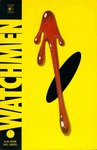
Watchmen by Alan Moore and Dave Gibbons
What with the movie on its way, I thought it’d be time to go through the book again. And, as always, it was a great pleasure to read.
This is a graphic novel that has an immense impact on comics history. It’s considered to be one of the most important works in the genre in, well, ever. Read any analysis of Watchmen and you’ll read that it revolutionized comics. It changed everything, they say.
They’re right.
Before I get to the actual story – and it’s a formidable story – I want to address the immense technical achievement that is evident in this book. Look at any panel, any page and you can spend a long time just admiring the artistry that has emerged from the Moore-Gibbons partnership. The words and the images fit together like the finest puzzle pieces, each one reinforcing and supporting the others. There are no unnecessary words, and there are no unnecessary pictures.
Goddamn it’s good. It’s a fantastic piece of work.
Just as much as the technical aspects of the book are a marvel, so is the story. It was written in – and set in – the mid-80s. It took the core genre of the comics industry, superheroes, and bent them to reality’s will. These were not the iconic, ageless figures of Batman and Superman, people whose hearts and intentions were pure and who never aged. The superheroes – or “costumed adventurers,” more appropriately – were very, very human. Not only did they age, but they made mistakes. They lied, they failed, they gave up. They were, with one notable exception, human, and their reasons for doing what they did were also very human.
It’s tempting to say, “These characters are us,” because they’re not, but they’re still a lot closer to us than traditional superheroes are. And this was especially true in the mid-80s. The Darkening of comics hadn’t begun yet, and it was probably Watchmen that kicked it off. Suddenly, after decades of two-dimensional storytelling and Manichean moral codes, the idea of heroes with ethical failings, personality problems and a faulty moral compass flooded the market. Unfortunately, they were inferior copies of an exceptional original.
Anyway, the story. The world in 1985 is a different place. The rise of the costumed adventurer had a big impact on the social fabric of the United States, and the Cold War has reached levels of tension that nearly break the world in two. America owns a superweapon in the person of Jonathan Osterman, also known as the nearly godlike Doctor Manhattan, but even he can’t stop the political super-powers from the intractable mess they have created. Everyone can feel it, the great burning and the end of the world. Everyone knows it’s coming.
And then someone kills The Comedian.
The death of this adventurer-turned-mercenary sets off a chain reaction that leads to the discovery of a horrific plan to save the world. People who believe themselves to be heroes have to decide what it means to do good when there are no good choices left to make.
It starts off as a murder mystery with hints of conspiracy and ends with a bang, as well as a deep moral quandary – do the ends justify the means, and if so, how far can we take that argument?
There are points to criticize the book, if you want to. One that my friend Joe mentioned is that, for all that the main characters are supposed to be heroes, they’re utterly un-heroic. They’re the antithesis of what a comic-book hero is supposed to be: morally sure and above reproach. Any mistakes that they make, even the ones that result in tragic consequences, should make them more heroic in the end. That’s what makes characters like Spider-Man and Superman such a pleasure to read. We know that, even if they screw up, they’ll ultimately do the right thing.
The same can’t be said for the people in this book. Rorschach is a homicidal existentialist, Ozymandias is a megalomaniac, Doctor Manhattan is a detached nihilist, sort of, and Nite Owl is a pudgy guy in an owl costume. These people are not, by and large, people that you can cheer for. They’re not people you can look up to, mainly because they’re just like us. They’re flawed, very deeply flawed, and we expect our heroes to be better than that.
So, it is possible that you will dislike each and every character in the book, and I can’t blame you for that. Still, it’s worth your time to read, even if it’s just to admire the technical ability of Moore and Gibbons. As for the movie, I can only pray that they do it right. I have a high tolerance for adaptation – and I know there’s no way the entire comic can be fit into a movie – so I will give the filmmakers some leeway. But I pray that they do it right….
—————————————–
“Somebody has to do it, don’t you see? Somebody has to save the world…”
– Captain Metropolis, Watchmen
—————————————–
Watchmen at Wikipedia
Watchmen at Wikiquote
Watchmen annotations
Watchmen movie website
Watchmen at Amazon.com

 The Labyrinth Library