Category Archives: history

Review 166: Sex at Dawn

Sex at Dawn by Christopher Ryan and Cacilda Jetha

Hey! Hey, baby, baby, waitwaitwaitwait. Wait. Wait! Baby, don’t… don’t freak out

Okay, okay, I know what this looks like, but I can explain! Quiet, Chad, let me handle this. I can explain! I’m just – please, stop crying and listen – I’m just fulfilling my evolutionary heritage and helping to cement social bonds with… um… the pizza boy, but that’snotthepoint!! That’s not the point! Look, before you do anything, y’know, drastic, you just need to read this book….

Image from wearscience.com - buy their stuff.

Humans are really good at figuring things out. As far as we go, we have a real knack for taking things apart and figuring out how they work. Though determined curiosity and perseverance, we know what’s happening at the center of the sun, we know how the continents slide across the surface of the earth, how plants turn sunlight into potatoes. We can smash atoms and cure disease and peer back to the moment of creation itself. There is almost nothing that humans cannot comprehend if we put our minds to it.

Except ourselves.

Don’t get me wrong – we have made great strides in philosophy and psychology, and come very far in understanding human origins and our spread across the planet. But there is a fundamental problem that we have when we study ourselves, and that is that we cannot do so objectively. Try as we might, it is impossible to completely put aside our own biases, judgments and backgrounds when we study how humans behave and try to understand why they do what they do. They are still there, if you look for them, and nowhere are they more evident than in the search for the origins or foundations of human sexuality.

The standard model, as it’s often called, goes something like this: ancient men and women established a pattern of monogamy based on mutual self-interest. The man would keep to one mate in order to be absolutely sure that he was dedicating his efforts towards raising his own kids and not someone else’s. If a man had multiple partners, he wouldn’t be able to provide for them all, and his genetic investment would die out. So, in terms of efficiency, it is much better for the man to keep himself to one woman, focusing all his attention on the children he knows he has fathered and making sure they live to have children of their own.

Not all women need the protection of a man, however.

As far as women are concerned, they require the resources that the men bring. When pregnant, a woman’s physical capacities are reduced and she is in a vulnerable state, so by staying monogamous, she is essentially purchasing security and resources that would otherwise be unavailable to her in a world that brought quick and merciless death. If she slept around, the man wouldn’t be sure that the child she bore was his, and would therefore have less interest in taking care of the both of them. Thus, monogamy is the best bet to assure the survival of herself and her child.

This is the story that’s been told for a long time, and it’s considered by most to be the truth. Christopher Ryan and Cacilda Jetha, however, disagree. Not only do they think the standard model is wrong, but they think it is nothing more than a relic of our own modern biases and hang-ups. The process, they say, can be referred to as “Flintstonization.”

As you know, the characters in “The Flintstones” were more or less just like us. They went to work, they had houses and appliances and domestic disputes. They had the same issues and amusements as we did, because we overlaid our own society onto a prehistoric setting. Now in cartoons, that’s good entertainment, and in the right hands it can be used as powerful satire and commentary. In science, though, it’s just no good.

Ladies...

Starting with Darwin, people have imagined prehistoric humans to have the same sexual values that we have: a demure, reluctant female who is very choosy in deciding which male she will mate with. A bond forms, and they are faithful to each other until the end of their days. Later researchers, looking at our ape cousins, have plenty of observational research to support the idea that very early humans were monogamous. They look at chimps and gorillas and baboons and confirm what they had always suspected – that our natural sexual state is one of monogamy.

The logical conclusion, then, is that our modern attitude towards sexuality, with the rising rates of divorce and teen sexuality, represents a deviation from the way things “should” be, and must therefore be fixed. A loveless marriage, a man’s roving eye, a woman who cuckolds her husband, serial monogamists, all of these, according to the standard model, result from our attempts to go against our nature.

Or is it the other way around?

Ryan and Jetha have put together a very compelling argument that the standard model of pre-agricultural human sexuality is not only wrong, but dangerously so. By looking at modern foraging tribes and the way they live, as well as doing a comparative analysis of humans against our nearest ape cousins, they have come to this conclusion: our “natural” sexual state is one of promiscuity. Back in the day, communities were small and tightly bonded, and sex was one of the things that held those bonds tight. Rather than one man and one woman struggling to protect their own genetic line, their entire community made sure that children were cared for and raised well. Everyone was everyone else’s responsibility, and in a world of plenty there was no reason to try and enforce any kind of sexual exclusivity.
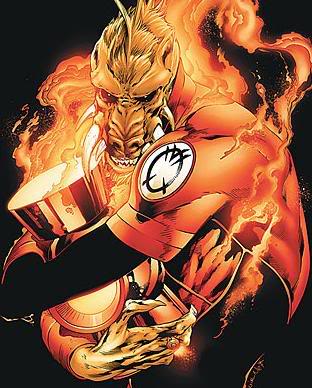
MINE!

It was only with the rise of agriculture that it became important to know what was yours, as opposed to someone else’s, and that quickly extended from fields and livestock to wives and children. Now that people were keeping their own food and making sure to divide their lands from their neighbor’s lands, sharing went out of style. With so much work put into growing crops, that’s where the standard model of economic monogamy settled in, and it’s been with us ever since. The advent of agriculture changed everything, and not everything for the better.

In addition, the very biology of humans, from the way sperm behaves to the shape of the penis, to the anatomy of the clitoris to the noises women make in the throes of orgasm – all of these point to an evolutionary history of sexual promiscuity. The evidence of our bodies tell us that being locked into a lifetime monogamous pair-bond is not what we evolved to do.

Ryan and Jetha know that their view of the fundamental nature of human sexuality will not be popular, mainly because it completely undermines our vision of who we are. So much law, tradition, education, entertainment and just plain common sense relies on humans being naturally monogamous. It’s something that seems so obvious to us that we cannot imagine a society built any other way. Unfortunately, if Ryan and Jetha are right, society is the problem. We have established a cultural norm that goes completely against our biological and evolutionary nature, and which makes people miserable on a daily basis.

I bought this book mainly to stop Dan Savage from nagging me about it. If you listen to Savage’s podcast – and you should – you will soon realize that monogamy is something that a lot of people aren’t good at. We look at other people with lust in our hearts, we cheat, we stay in relationships where we’re sexually miserable just because that’s what we “should” do. For most people, our sexual urges are to be fought against, with everything from self-restraint to social shame to law itself. It seems like staying monogamous is one of the hardest things for many people to do.

This, of course, raises the question: if it were natural, would it really be so hard?

My mother is a SAINT!!

It is a fascinating read, which covers a lot of ground and makes some very compelling arguments. It’s also quite funny in places, which was quite welcome. In discussing the standard model the authors note that this is, fundamentally, prostitution, wherein the woman uses sex for material resources. This sexual barter system has been assumed to be true for years, leading the authors to write, “Darwin says your mother’s a whore. Simple as that.” They also put in some special notes for adventurous grad students in the field of sexual research (especially genital to genital rubbing, something popular in bonobo apes, but which is rarely studied in humans) and re-titling the extremely popular song “When A Man Loves a Woman” as “When a Man Becomes Pathologically Obsessed and Sacrifices All Self-Respect and Dignity by Making a Complete Ass of Himself (and Losing the Woman Anyway Because Really, Who Wants a Boyfriend Who Sleeps Out in the Rain Because Someone Told Him To?)”

I don’t really know what can be made of the serious information proposed in this book. No matter how it may seem, the authors are not proposing a dissolution of marriage or compulsory orgies or anything like that, nor is this book a “Get Out of Cheating Free” card. We’ve spent thousands of years putting these restraints on human sexuality, and they’re not going to come off anytime soon. The best we can do right now is to be aware of where our ideas about relationships come from, and stop to think about the difference between what is true and what we wish were true. This understanding might help to save relationships that would otherwise fail. People cheat not because they’re scum or whores, but because they’re human. Being monogamous is really hard not because we’re weak or flawed, but because it’s not what our bodies want for us.

The search for a better understanding of human nature should lead us to being better humans, and nothing should be left out. Not even our most sacred beliefs. Not even sex.

————————————————
“Asking whether our species is naturally peaceful or warlike, generous or possessive, free-loving or jealous, is like asking whether H2O is naturally a solid, liquid or gas. The only meaningful answer to such a question is: It depends.”
– Christopher Ryan and Cacilda Jetha, Sex at Dawn
————————————————

Okay? Okay, baby? So you see, I wasn’t really cheating – okay, I was, but you can see why, right? I was just acting in accordance with my fundamental humanity, following the biological impulses as determined by millions of years of evolution when we… Hey, where are you going? Where are you? Oh, hell, he’s going for the shotgun. Run, Chad, leave your pants, you don’t have time, run!

Sex at Dawn on Wikipedia
sexatdawn.com
Sex at Dawn on Amazon.com
Leave a comment

Filed under anthropology, biology, Cacilda Jetha, Christopher Ryan, evolution, history, nonfiction, science, sexuality, society

Review 165: The Partly Cloudy Patriot

The Partly Cloudy Patriot by Sarah Vowell

Sarah Vowell is awesome. At first glance, you might not think so – she’s a short, squeaky-voiced New Yorker who has a driving phobia, gets motion sickness and is allergic to damn near everything. She fits into the category of “nerd” with remarkable appropriateness. So if you’re the kind of person who dismisses the Nerd as someone without consequence or someone you should just disregard, then, well, you’re missing out.

Vowell used to write rock music reviews, loves Abe Lincoln, and thinks that it’s the height of fun to go to Places of Historical Interest on her vacations. She’s an unapologetic nerd, deeply cynical and not afraid to assume that other people are as interested in esoteric matters of history as she is. She’s a self-confessed history nerd, and she makes you want to become one with her.

There's nothing about this man that doesn't say, "I'm nuts enough to shoot a President."

I read another of her works a while ago, Assassination Vacation, about her journey to learn more about our assassinated Presidents and the men who’d done them in. It was a fascinating trip through three out of the four major assassinations that happened in this country, and far more interesting than one would think. Especially with regards to the lesser-cared about presidents Garfield and McKinley.

This book is a little different – it’s a collection of essays on a wide variety of topics. It starts, of course, with Lincoln, but goes off in all kinds of directions from there. For example, she talks about her time working for one of the world’s foremost antique map collectors, Graham Arader, and the persistent myth, up until about the middle of the 18th century, that California was an island. As part of this job, she was able to look at how the way we saw the world changed over time, and how maps become a part of the historical record of a civilization.

In the essay, “Pop-A-Shot,” she talks about her uncanny ability to shoot baskets in the Pop-A-Shot arcade game. While most of us would scoff at someone taking pride in a game where all you have to do is shoot balls into a hoop for forty seconds, Vowell shows us why this peculiar talent means something important to her, ties her to a sense of greater meaning and accomplishment and, more importantly, gives her something to lord over her male friends.

She talks about why she thinks she’s secretly a Canadian, given how generally polite and non-confrontational she is. And then there’s how much she and her sister have in common with Johnny and Luther Htoo, the twins who were the child leaders of God’s Army in Thailand. She talks about the incredibly painful feeling in her gut while she attended the inauguration of George W. Bush and the irritation she feels whenever someone compares someone else to Rosa Parks. And then there’s the advice to Bill Clinton on how to handle his Presidential library.

"Look, I'm not being a nerd here, it's just that there is NO way Han didn't shoot first. None. Seriously."

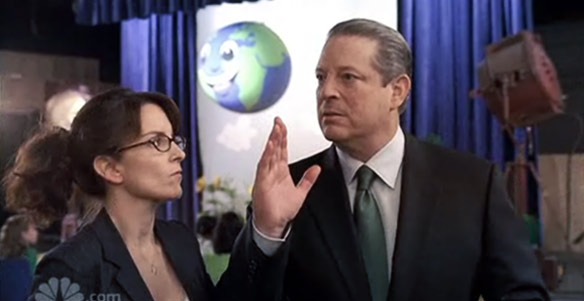
It’s a rather covert style of writing. She is funny enough and light enough that you don’t really think you’re in it for any useful information or heavy thought. But before you know it, you’re wondering to yourself, “Yeah, what is the media’s responsibility to the truth, and why do we let them charactature our leaders?” Not something you would normally think about, but the longer essay “The Nerd Voice” takes a look at the way Gore was misquoted and misrepresented during the 2000 campaign because the media had decided that he was the arrogant nerd and Bush was the homespun dummy. What’s more, she suggests that Gore might have had more success had he embraced his inner nerd and, like Willow on Buffy the Vampire Slayer, made the jokes about himself before anyone else could.

Vowell is a thinker, and most definitely a nerd, and she lets her thoughts go off into strange and interesting places. She has a kind of temporal persistence of vision, where she looks at how the past and the present intersect. “I can’t even use a cotton ball,” she says, “without spacing out about slavery’s favorite cash crop.” And, above all, she’s funny, which is a rarity in those who write about history. Check her out.

———————————————-
“I wish that in order to secure his party’s nomination, a presidential candidate would be required to point at the sky and name all the stars; have the periodic table of the elements memorized; rattle off the kings and queens of Spain; define the significance of the Gatling gun; joke around in Latin; interpret the symbolism in seventeenth-century Dutch painting; explain photosynthesis to a six-year-old; recite Emily Dickinson; bake a perfect popover; build a shortwave radio out of a coconut; and know all the words to Hoagy Carmichael’s ‘Two Sleepy People,’ Johnny Cash’s ‘Five Feet High and Rising,’ and ‘You Got the Silver’ by the Rolling Stones.”
– Sarah Vowell, The Partly Cloudy Patriot
———————————————–

Sarah Vowell on Wikipedia.com
The Partly Cloudy Patriot on Wikipedia.com
The Partly Cloudy Patriot on Amazon.com

Leave a comment

Filed under american history, autobiography, culture, history, humor, memoir, nonfiction, Sarah Vowell

Review 158: Secret Lives of the U.S. Presidents AND Hail to the Chiefs

Secret Lives of the U.S. Presidents by Cormac O’Brien

Yes, a double-header today, mainly because it’s what makes the most sense with these books.

As we come up to another Presidential election, we’re being asked to make a very important choice. We’re electing someone to join a very powerful and elite group of men who have shaped the history of the world in the last 200-odd years. It’s an important decision, to be sure, and not one to be taken lightly. Will our next President be a political powerhouse, a man who is able to take the reins of the country and lead it into a better and more just future? Will he be inept or corrupt, allowing his cronies and his pals to use the nation for their own personal gain? Or perhaps he’ll simply be a cipher, one of those Presidents who is forgotten by everyone except for over-achieving elementary school kids who think that everyone will be impressed that they know who Zachary Taylor was.

We don’t know, and we can’t know, and that’s one of the most interesting lessons of this book. Every President, from Washington to Obama, was elected by the people in the hopes that he was the right man to lead the country. Every President was praised and damned. Every President was, before the election, sold as the one man who could save the nation from ruin and despair. If not all of those Presidents lived up to their hype, well, therein lies the lesson….

This is the kind of history I like... (image by SharpWriter on DeviantArt)

For people who like their history to be amusing and bite-sized, this is the book for you. It’s a “gateway book” for Presidential history – you read this and then go on to read more serious treatments of the Presidents, hopefully becoming more appreciative of the vast spectrum of personalities that have guided our nation. And what an interesting group it’s been.

There are, of course, the heavy-hitters that everyone knows. Washington, Jefferson, Lincoln, both Roosevelts, Johnson (Lyndon, not Andrew), all men who made their marks on America. Washington, of course, set the entire tone of the Presidency. He demanded formality, and the acknowledgment that the office of President was one that should be treated with respect. At the same time, he didn’t want to be revered, or treated like American royalty. His decision to serve only two terms of office became unbreakable tradition, at least until FDR, and then law with the adoption of the 22nd Amendment. While the stories that are attributed to him are mostly apocryphal – chopping down the cherry tree, throwing a dollar across the Rappahannock, wooden teeth – the real stories are even better. He spent vast sums of money on alcohol, had a terrible temper, and probably wouldn’t even have been the President if he hadn’t married Martha Custis. In short, Washington was human, just like the other forty-two who followed him.

Then there are the infamous – the Presidents who are excoriated for their misdeeds and who are the ones we all wish never actually happened. Nixon, Hoover, Buchannan, Harding, Pierce…. These are the ones you tell your children about when they turn 18 and they’re wondering who to vote for. Warren G. Harding, for example, was only President for two years before his death, but manages to make the bottom of the “Best Presidents” list nearly every time. For one thing, he never wanted to be the President – it was all his wife’s idea. But Warren didn’t like to say no, didn’t like to stand up to people, so he let her railroad him into running for and winning the office. Once he was in the White House, he was perfectly happy to let Congress govern while he had sex with his mistresses and lost vast sums of money – and the occasional priceless White House tea set – to his poker buddies. It’s said that his father told him he was lucky not to have been born a girl, “because you’d be in the family way all the time. You can’t say no.” While he amused himself, his cabinet and his friends did their best to rob the government blind. He was lucky that his ineptitude wasn’t discovered until after his death in 1923.

There are, of course, the ciphers. These are the Presidents that no one really remembers much about. The middle-of-the-pack Presidents, neither good enough nor bad enough to be really memorable. James Polk, for example. Ever dress up as him for a history class skit? No, I didn’t think so. This is because he was a boring, humorless workaholic who had about as much personality as a table lamp. Still, he did get us into a war with Mexico, which resulted in the annexation of what we now know as the American Southwest, so there is that. How about Chester Arthur? He became President when Garfield was shot, and was most renowned for the fact that he was a very snappy dresser. He restricted Chinese immigration, so there’s a point against, but supported the Pendleton Act, which made it harder to appoint unqualified drinking buddies to important civil service posts. Other than that, he had parties, drank a lot and was kicked out after finishing his term.

Forty-three different men, forty-three different stories. It’s very easy to forget that these were Real People, complex human beings with incredible merits and flaws. Franklin Pierce was so despised that his own party came up with the slogan, “Anybody But Pierce.” John Tyler was so hated that he was burned in effigy and was the first President to receive a full-time bodyguard. On the other hand, Lincoln had a soft spot for pardoning soldiers who were to be shot for unmeritorious conduct, and Theodore Roosevelt once opened a speech with: “Friends, I shall ask you to be as quiet as possible. I don’t know whether you fully understand that I have just been shot.” Now THAT is hard-core….

It’s also hard to remember that, for all the mistakes made by Presidents in our lifetimes, they’re hardly new ones. Clinton was not the first guy to be unfaithful to his wife while President – in fact, compared to what some others got up to, a little hummer under the desk is practically innocent. And Bush is not the first dim bulb with delusions of grandeur either.

Bush has said, many times, that history will be the final judge of his administration, and I think he’s right about that. Very few people in President Monroe’s time would have known the horrors that would eventually emerge from the Missouri Compromise, and there were countless people who thought that FDR’s New Deal would spell the end of American capitalism. It’s hard to objectively judge the Presidents we still remember so vividly, but we can compare them to the ones who have gone before them.

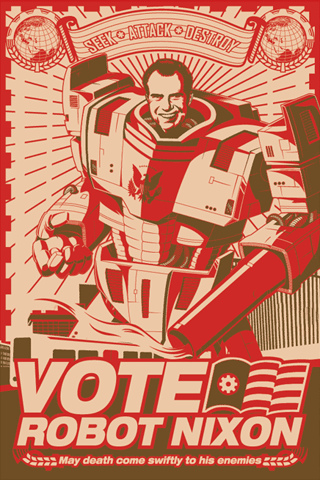
I'm sure this really happened. It must have. (art by SharpWriter on DeviantArt)

If you’re new to Presidential history, or if you want an easily accessible refresher, this is an excellent text to have. Mind you, it’s slightly incomplete – it was published prior to Bush’s second term, so there’s a little bit missing at the end, but I think we can all remember four years back. And maybe, just maybe, our next President will be so special that Mr. O’Brien will be moved to update and re-publish in, say, four to eight years.

————————————————
“As to the presidency, the two happiest days of my life were those of my entrance upon the office and my surrender of it.”
– Martin Van Buren
————————————————

Hail to the Chiefs by Barbara Holland

What was true for Secret Lives of the U.S. Presidents is just as true for this one: we’ve had 43 incredibly interesting and varied men in the White House in our 221 years as a nation. We’ve had men of passion and energy, men who were weak-willed and lazy, men who preferred golf to governance and men who worked themselves to death. Good men, bad men, tall men, short men – this book reminds us of something we need to recall from time to time:

The President is a human being, with all that goes with being one.

Being the President inevitably means becoming a larger-than-life figure. People despised Bush, people adore Obama, venerate Reagan, abhor Clinton, all for what they see as virtues or flaws that only they possess. As if being the President not only means you have to be better than everyone else, but that your failings must be that much deeper.

The point of this book, and of any book on the Presidents, is that they were human beings just like the rest of us. Being President doesn’t make you immune to the fundamental flaws of being human – greed, apathy, short-sightedness – nor does it bless you with any trans-human virtues. Learning about and humanizing these 43 men is a grounding and humbling experience, and can keep you from both setting your expectations too high and allowing your disappointments to overwhelm you when your President doesn’t live up to your expectations.

Having said all that – if you want to read a book on the Presidents, this is a very funny one to read. The style is more narrative than O’Brien’s, and exceptionally snarky. Holland wields her pen like a dagger, stabbing and poking as she goes. She’s not really mean, but she has no problem making fun of these men when it can get a good laugh. And I certainly laughed a lot while reading this, much to the dismay of my co-workers. They come in short shots: “[Clinton] was a big affable fellow who hugged total strangers and felt their pain, like some ancient Norse bear-god, probably named Potus, good-natured but with a weakness for milkmaids.” And they come in longer passages, i.e. the Spanish-American War and the rather clever means by which we got the Panama Canal.

"The Great Communicator" indeed...

It’s a hilarious, irreverent read… until she gets to Reagan, which is where either she’s being so sarcastic that it’s impossible to be sure what’s serious and what isn’t, or she’s absolutely gushing over the Great Communicator. She imbues him with the same invulnerability that he seemed to have while he was President – showing the complaints of his critics, but then deftly removing the sting. George W. Bush gets much the same treatment, which disturbs me a bit, although since the book was published in 2004, I might be willing to chalk that up to post 9/11 fervor. But it does seem that, from 1981 to the present, she’s not being quite as fair and balanced as she was to the other Commanders in Chief. Perhaps it’s harder to be objective when you actually had to decide whether to vote for the guy in office….

Anyway, the final four Presidents aside, it’s a fun book to read and another way to bone up on your Presidential history. They really all were interesting people, in their own ways. Even William Henry Harrison, who may have been too sick to be in interesting President, but still made for a fascinating person.

————————————————
“Many people consider James Buchanan the very worst President ever. I suppose they think they would have done better. I suppose they wouldn’t have let Dred Scott happen, or John Brown, or secession, and there wouldn’t have been any Civil War and everyone would have lived happily ever after. Too many Monday-morning quarterbacks, that’s what we’ve got.”
– Barbara Holland, Hail to the Chiefs
————————————————

Leave a comment

Filed under american history, Barbara Holland, biography, Cormac O'Brien, history, nonfiction, politics, presidential history

Review 118: Secret Lives of the First Ladies

Secret Lives of the First Ladies by Cormac O’Brien

This is a follow-up to O’Brien’s previous book, Secret Lives of the U.S. Presidents, which, while a fascinating book, is a topic that has been covered many times. I have, in fact, two books on this topic, and they both illuminate the hidden idiosyncrasies, character flaws, shining moments of virtue and petty humanity of the 43 Commanders-in-Chief.

The "non-Dowdy" version of Abigail Adams

It was Abagail Adams who exhorted her husband to, “Remember the ladies,” and it seems that O’Brien has done just that. He’s given us a nice concise look at the women of the White House, and it’s a hell of a read.

It’s very easy to forget the First Ladies, and kind of pigeonhole them into the space that reads “President’s wife,” but to do so would be a great disservice to an amazing group of women.

A lot of people remember Hillary Clinton as being a political powerhouse, a kind of “co-President.” But she wasn’t the first, by any means. When Woodrow Wilson suffered a debilitating stroke in 1919, all access to him was controlled by his wife, Edith. She would let no-one in to see him, on the grounds that he was very ill and needed absolute peace and quiet. So, when someone needed something signed by the President, Edith would take it, close the door, and come back a few minutes later with the signed document. The question very quickly arose: who’s really the President?

Helen Taft is another forgotten First Lady firebrand. Without her motivation, William Howard Taft might have been perfectly happy to be a judge, but that wasn’t good enough for Helen. From her teenage years, she knew that she wanted to live in the White House, and she pushed her husband to make damn sure that she did. Once there, even her husband called her the “co-Presidentress” for the amount of involvement she had in the day-to-day decision making that went on. She was a woman of boundless energy, who was never willing to sit still. Oh, and if you like the cherry trees that bloom in DC every spring, you can thank Helen Taft for that. Women like these – Eleanor Roosevelt and Jocelyn Carter are part of their ranks as well – left indelible impressions on the country.

No-one messed with Anna Harrison. No one.

Not every First Lady was so ambitious, though. Some were more populist idols, adored by the public not for their works but for their personality. The most recent example would probably be Jacqueline Kennedy, who became a media icon almost as soon as her husband was elected. But there were others before her.

Dolley Madison threw the best parties in Washington, and was vastly more beloved than her dour and stolid husband, James. It was said that she had no enemies, and even the people who loathed her husband adored her. She stayed in the White House right up until the British showed up at its doorstep and managed to save a few precious items. It’s even said that the British commander, Rear Admiral Sir George Cockburn, was more interested in capturing her than the executive mansion, and took her seat cushion from the dining room so that he could come away with something to remember her. Before he had the building torched, of course. After she left the White House and her husband passed away, it was customary for each new President to pay her a visit, gaining a kind of approval from the most loved woman in America.

Ida McKinley's hypnotic powers were well-known in Washington D.C. Only Theodore Roosevelt was able to break her spell....

Or take Frances Cleveland, wife of Grover. Her relationship with her husband would be considered scandalous in this day, and certainly was in hers – she was twenty-seven years younger than her husband, who had been her legal guardian when she was a child. Much to the nation’s surprise, he went from being “Uncle Cleve” to “Beloved Husband.” But that bit of creepiness didn’t stop the nation from loving her. Once in the White House, she became an early proponent of women’s accomplishments, willing to meet and talk to anyone, rich or poor. When Grover ran for re-election in 1892, Frances’ image was the one campaigners used, not his. And why shouldn’t they? In an age before byzantine copyright law, her name and image were already being used to sell all kinds of household goods. Ever eaten a Baby Ruth candy bar? It was named after the Clevelands’ daughter, who was, for her short life, the most popular baby in America.

And then there were the sad stories, the women whose lives in and out of the White House were full of misfortune. Jane Pierce is probably the saddest of these. She never wanted her husband to be President. Every step that he took forward seemed to result in pain for his family. Their first child died after a few days. When Franklin finally got out of national politics and opened up his own law firm, their second child died of typhus. With only one child left to them, Jane held on to him with a manic grip. His death – the only one in a train derailment a short time before Franklin’s inauguration, was the last straw. Jane became convinced that God had killed their children so that Franklin could have more time to devote to his Presidency, and spent her days writing letters to the dead boy, asking his forgiveness. She became known as the “shadow of the White House.”

Julia Dent Grant, who was the only person capable of keeping Ulysses from drinking himself to death.

No less tragic, of course, was the life of Mary Todd Lincoln, who is best known for being the wife of our first assassinated President. Even before that bad night at the theater, however, she had her share of sorrow. The animosity and hatred that was heaped upon her husband, the terrible strife of a civil war, and the untimely death of one of her sons turned a once vibrant, energetic woman into hysterical, morbid harridan. She held séances to try and talk to her deceased boy, harangued the White House staff, and almost had to be forcibly ejected once Andrew Johnson became the President. What’s worse, her own son, Robert, had her declared insane and had her committed. She won her freedom, but the animosity between mother and son after that was white-hot.

There’s so much more. The relationships these amazing women had with their husbands are also well-detailed, and also somewhat surprising. For all that Bill Clinton was a lecher, he was hardly the first.

Pat Nixon, who really must have loved Richard, though none of us knows why....

Hillary joined a group of long-suffering women who put up with blatant and repeated infidelities in and out of the White House. Some relationships were partnerships, like the Carters, the Hoovers and the Tafts. And some couples were just quietly devoted to each other, like the McKinleys and the Clevelands.

The First Lady is not an elected position. There’s nothing in the Constitution about her, what she can and cannot do, so the job, such as it is, is one that each wife makes for herself when her husband takes office. The effects that these women have had on this nation is immense, and should not be overlooked. So, if you’re interested in knowing more about our Presidents, you could do worse than to give a good look at the women who stood by them.

————————————————
“Well, Warren Harding, I have got you the Presidency. What are you going to do with it?”
-Florence Kling Harding

Cormac O’Brien on Wikipedia
Secret Lives of the First Ladies on Amazon.com
First Ladies on Wikipedia

Leave a comment

Filed under american history, biography, Cormac O'Brien, family, history, nonfiction, presidential history, wives, women

Review 109: The Origin of Satan

The Origin of Satan: How Christians Demonized Jews, Pagans, and Heretics by Elaine Pagels

Let me get this out of the way right up front: I can’t think of the title of this book without the Church Lady from the heyday of Saturday Night Live popping into my brain. And now she’s in yours, too. You’re welcome.

Well, isn't that SPECIAL?

So. Who is Satan? A fallen angel? The great adversary of God? Saddam Hussein’s bitch? If nothing else, Satan is the great scapegoat, the one on whom we tend to pile all our troubles. Your church is running out of money? Satan. Your kid is doing drugs and listening to that awful hip-hop music? Satan. Queers getting married? Definitely Satan.

For some, Satan is an actual being, a true agent of evil whose purpose is to ruin all that God has made. For others, Satan is a symbolic representation of the evil inherent in the human condition, an abstract form made real in order to better understand it. In other words, there are as many versions of Satan as there are people who invoke him.

But how did the whole Satan thing get started? Where did he come from and how did we get to the Satan that we all know and loathe today? That’s what Elaine Pagels was determined to find out when she wrote this book.

While most of the book focuses on the New Testament and a history of the early Christian church, it was the ancient history of Satan that I found most interesting, mainly because it concurred with a pet theory that I’ve had for a long time: Satan was never an enemy of God. Satan was God’s quality control guy. It was his job to look for weaknesses in the system, to probe Humanity for its faults and flaws so that it could be made better. Thus the serpent in the garden (which, just as a note, was never actually revealed to be Satan), and especially the story of Job, where God allows Job’s life to be ruined on a bet. My guess was that he won a nice, crisp one-dollar bill.

Employee of the Millennium (photo by Nathan Rupert)

The Satan of Olde was an agent of God, there to make sure that things went the way they were supposed to. He caused trouble, he stirred things up, yes, but that was his job. Much like the office manager that you despise because he always harps on you for checking your Facebook account during company time, even though you both know there’s nothing better to do right now, but he just enjoys watching you suffer and enforcing his stupid little rules…. That guy is, at least in his own mind, working for the greater good of the company. He may be a dick, you may wish great misfortune heaped on him and his progeny, but he’s doing the job he was given to do.

Sounds great, but Satan’s downfall from “annoying but necessary agent of God” to “vile and demonic enemy of god” was planted a long time ago, before Christianity was even on the horizon.

The Jewish religion, from whence our concept of Satan arose, has always been one of Otherness. Israelites and Enemies. Us and Them. From its earliest days, God made sure the Israelites knew that they were a small force against the world, with only Him to protect them. He told Abraham straight out that He would bless him and curse his enemies. Therefore, the descendants of Abraham had to be on constant guard from enemies both from without and within. With a Satan already set in their theology as a tester and troublemaker for God, it was not a far leap to look to him as the cause of the multiple troubles that the Jews had over the years. Around the time of Christ, the Essenes were a distillation of that concept. They were a small Jewish sect – a minority within a minority – which believed that they were the only true Jews and that everyone else had gone soft. The Jewish majority was corrupt, led astray from the true path to God, probably by Satan.

When the Christians showed up, a minority with an even more tenuous existence than the Essenes, they found this concept very useful. Telling their story from the point of view of an embattled minority, they found Satan to be a very useful opponent against whom their Messiah could fight. He was an excellent symbol that stood not only for the earthly conflict that was taking place between the Christians, Romans and Jews, but a greater spiritual conflict that involved all humankind in a battle between good and evil.

Really he just likes to watch

Pagels’ basic thesis is that the concept of Satan, whatever else it may be, was used to not only encourage persecution of The Other – Jews and pagans, to be precise – but to also keep the Christians themselves in line. The book is actually a history of the early Christian movement and how that history was reflected in the writing of the Gospels. In fact, just like in the Bible, Satan doesn’t really appear much in this book. Rather Pagels looks at how the early Christian movement fought for its survival against enemies without and within, and then how Satan became a spiritual catch-all for those who disagreed with them.

It’s a great analysis of the early days of the Church, and just how chaotic and tumultuous it was. There were so many churches with so many different interpretations of Jesus’ life and death, so many Gospels being written and so many opinions on the very nature of God’s universe that it’s surprising the whole thing managed to come together to be the world’s largest religion.

What’s more, it shed some light on something that’s always annoyed me: the persecution complex that so many Christians have. The best time to catch this is in December, when pundits in the States start going off about the War on Christmas as though the last twelve Christians in the country were holed up inside the Topeka Christmas Shanty with shotguns and eggnog. Every time a judge tells a town that they can’t have the Ten Commandments on the lawn of their town hall, or a Wal-Mart tells employees to say “Happy Holidays” instead of “Merry Christmas” there is always a vocal group of Christians who claim that they’re being persecuted and that they’re on the edge of extinction. All this despite the fact that Christianity is the most popular religion in the world, that there are more Christians in Congress than any other religion, and that every single President in US history has been Christian. Despite all that, there seems to be a knee-jerk need to feel persecuted.

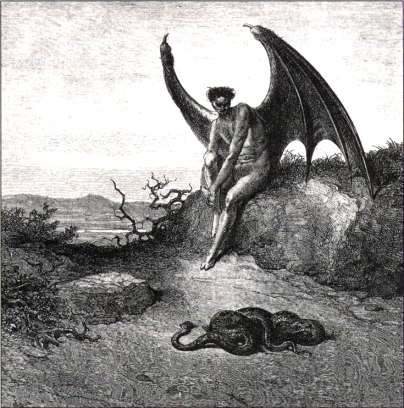
One of the Prince of Darkness

This book offered a very good reason why this is: because that was how the religion was founded, and it is the fundamental narrative of Jesus’ story. If Jesus had been part of the Jewish majority, his story would have ended very differently, no matter how radical his ideas. The early church was born of persecution, first from the Jews and Romans, and when they were no longer a danger, from pagans and heretics. And under all that, the hand that is always set against them, is Satan. As long as Satan is there, the Christians will always have someone there to persecute them. Without that cosmic, deathless opponent, Jesus becomes just another political rabblerouser executed by Rome. Certainly no Messiah would have allowed himself to die unless it was a gambit in a much greater game against a much more powerful opponent. Without Satan and the relentless threat attributed to him (and, by extension, those who are seen to ally with him), Jesus’s sacrifice becomes meaningless, and the whole religion follows with it.

It’s a fascinating book and a great look at the early days of the Church. If you’re into that kind of thing, go pick it up. Many thanks to my mom and stepdad, who pointed my attention towards it.

—————————————————–
“How, after all, could anyone claim that a man betrayed by one of his own followers, and brutally executed on charges of treason against Rome, not only was but still is God’s appointed Messiah, unless his capture and death were, as the gospels insist, not a final defeat but only a preliminary skirmish in a vast cosmic conflict now enveloping the universe?”
– Elaine Pagels, The Origin of Satan
—————————————————–

Elaine Pagels on Wikipedia
The Origin of Satan on Amazon.com

Leave a comment

Filed under Bible, Christianity, Elaine Pagels, good and evil, history, Jesus, Judaism, nonfiction, religion, Satan, theology

Review 99: Abraham Lincoln – Vampire Hunter


Abraham Lincoln: Vampire Hunter by Seth Grahame-Smith

History is like an exquisite jewel. It has many facets, and it will glitter differently depending on the point of view of the person looking at it. We see it change as we shift, as we shine the light differently upon it, but for the most part, we confine ourselves to a few simple views of history and convince ourselves that what we see is the truth of what the gem is.

But what happens when we remove the jewel from its setting and look at the faces we have never before seen? In that case, a whole new history may emerge, one that we find difficult to understand or even believe.

Take Abraham Lincoln, for example. We all think we know who he was: a hard-working, honest young man who pulled himself up by his bootstraps, became President, saved the Union, and was assassinated for his troubles. Perhaps no other President in American history has been as carefully scrutinized and examined as Lincoln. You would think we had nothing left to learn about him.

You would be wrong.

You don’t know about the vampires.

From the early days of the United States, the vampires have been there. They were there when the first ships pulled into Virginia, when the nation won its independence from Britain, and when the nation went west. They had their hands in the growth of the nation from day one, playing a long-term game to build a vampire paradise far from Europe, where the people there were wise to their evil and knew how to destroy them. Vampires were something that had always been talked about in the early days of American settlement. Strange tales of people dying mysteriously, sometimes their faces locked in a grim visage of fear. But no one really believed them of course. I mean really – vampires? Please.

The truth was, however, that they were out there. They were lurking in the shadows, waiting and planning and laying the groundwork for the land they would eventually come to rule.And from his youth, Abraham Lincoln was pulled into their nefarious scheme.

Born the son of Thomas and Nancy Lincoln, Abraham suffered from his share of the vicissitudes of 19th-century life. Rural poverty was rampant, and his father was not the most skilled of laborers or diligent of workers. But he loved his children, as did his wife. That made it all the harder when those children started dying of a strange wasting disease. When his wife followed suit, it was tragedy upon tragedy. For Abraham, it was the beginning of a need for vengeance that would drive his entire life.

As he grew up and discovered the existence of vampires, he became a skilled and terrifying vampire hunter. He was so good at his vocation that a dissident group of vampires, led by a man named Henry Sturges, chose him as their instrument against their own kind. With Henry’s guidance, Lincoln began to cut a swathe through the vampires in the United States.

But being the chosen one, as Buffy would attest, is not all it is cracked up to be. Plagued with doubts and depression, Lincoln tried many times to cast off the mantle that had been thrust upon him. He married, went into business, and did his best to live the normal life he thought he deserved. But destiny had other plans. The vampires were preparing their endgame – the establishment of a nation built on the backs of slaves, where humans would be cattle to the vampires. In time, they would take the United States and use it as a staging ground to spread their sickness around the world. They had to be stopped, and Henry and his fifth column knew only one man who could stop them.

Abraham Lincoln, the greatest vampire hunter the nation had ever known.

Written by the same author who did Pride and Prejudice and Zombies, this book was far more entertaining. Probably because I like Lincoln a whole lot more than I like Jane Austen, but probably because he did a much better job at integrating the Lincoln we know with the Lincoln he had created. He invents a vampire-system that would explain how they could manage to maintain influence over humans, and presents a reasonably plausible explanation for how vampires could be at the root of the Civil War.

More importantly, he keeps his Lincoln true to the character of the real Lincoln – a complex, driven man, beset by tragedy, lifted by hope, and motivated by a duty to a greater good. Perhaps a bit romanticized, of course, but we all romanticize Lincoln. It’s hard not to. What’s important is that we see a character who tries to fight his destiny, but in the end realizes that there are bigger things at stake than his own happiness. He has a nation to save and evil to defeat, and even if it should cost him his life, he will see that evil eradicated.

The only thing that bothered me was a bit of unfinished business in the book. The conceit of it was that Seth Grahame-Smith had been given the complete set of Lincoln Diaries – the real ones, mind you – by Sturges, so that he could tell the true tale. According to the introduction, this was a project that cost him his job, his marriage, and nearly his life, and after a fairly dramatic and mysterious introduction, we never hear anything from Smith as the author again. I would have liked for him to have explained some of the things he merely alluded to in the introduction – especially the eleven “individuals” he was instructed to talk to over the course of writing the book, but he didn’t. It’s a little detail, but one I wish he had taken care of.

It’s a fun read, good for any vampire/Lincoln lover, or aficionado of alternate history.

————————————————–
“I can see a man’s purpose, Abraham. It is my gift. I can see it as clearly as I see you standing before me now. Your purpose is to fight tyranny… and mine is to see that you win.”
– Henry Sturges

Abraham Lincoln, Vampire Hunter at Wikipedia
Seth Grahame-Smith at Wikipedia
Abraham Lincoln, Vampire Hunter on Amazon.com

The Trailer:

Leave a comment

Filed under Abraham Lincoln, alternate history, Civil War, horror, Seth Grahame-Smith, vampires

Review 97: The Civil War


The Civil War by Bruce Catton

When I was a kid, my grandparents thought they would do something that every grandparent should do – share what they love with the next generation. They bought me a subscription to the Time-Life series on The Civil War. Now for those of you too young to remember, Time-Life used to publish these monthly book series on various topics. The idea was that you would receive the books once a month, each book on a different topic in the series. My father had the Science Series, which I absolutely adored, and my grandparents thought that I would fall similarly in love with the Civil War series.

After all, they both were interested in this most unfortunate periods in U.S. history. It spanned five years, cost hundreds of thousands of lives, and permanently altered the face of our nation. What’s not to love?

Predictably, I found them kind of boring.

The pictures were all in black and white, static in composition and full of dead guys with beards. There were lots of dates that I couldn’t comprehend, talking about places I’d never been and full of names I’d never heard of. I got them, flipped through them and was just not interested.

Looking back, I know that I was a bad grandson and I feel bad that I can’t tell my grandparents that.

Now that I’m older, and I know some things about my country and its history, I can really appreciate the enormous change that the Civil War brought upon the United States. As horrible as it was – and it was horrible – without that war our nation would be a pale shadow of what it is today. If it were a nation at all….

We all know the facts: in 1860, following the election of Abraham Lincoln and years of arguing about slavery and its place in a modern nation, eleven states seceded from the United States and formed their own Confederate States of America. In response, Lincoln raised an army from the remaining states in the Union and launched it at the Rebels. After five years of relentless fighting, the war was won in favor of the Union. The rebel states were accepted back into the Union, and the nation has been putting itself back together ever since then.

That’s the big picture, and that’s basically what this book does. In less than 300 pages, Catton gives an interesting and dynamic overview of the War, from its origins in such decisions as Dred Scott and the Missouri Compromise up through the assassination of Lincoln and the failures of the Reconstruction. It follows the major battles of the war, listing the strikes and feints of each army and introducing all the major players. Between these, he talks about the political and social effects of the war – how the economies of the two states fared, how the international community viewed the conflict, and what the ultimate fate of the slaves was.

The pace of the book is very good, even if the blow-by-blow descriptions of the battles get a little soft in the middle. Catton acts as a narrator for the war, telling it as one might tell a story. He works up to climactic moments, then leaves us there to consider for a while before moving on to the next event. What’s more, he’s fair. It’s very easy for people to be unfair to the South – they were rebels, after all. Traitors, some might say. But Catton wants us to understand that the South was doing what it thought was in its best interests, as with the North. What’s more, he wants us to know that the South fought harder than any army has since, sacrificing countless men and an entire culture to a war that they really could not win. He does not demonize the South, nor does he praise the North. He is simply a storyteller, who knows from the beginning the tragic tale that he has in store for us.

So yes, I think this book is an excellent read, especially if you’re just getting into the Civil War. My one real complaint about it is that the book lacks adequate maps which would otherwise help a reader visualize what kind of maneuvers the armies of the North and the South are making. There are maps at the back of the book, but I wouldn’t call them “adequate.” They’re black and white where they really should be color – having both the Union and the Confederate advances marked with black arrows isn’t really helpful. Given the intricate interactions between armies, some kind of clear visual aid might have been useful.

If you have access to the internet, of course, you can get a slightly clearer view of what happened, where and when. Mind you, even the better maps that you can find on line still take some interpretation. Still, it would have been nice to have the book more accessible to those of us who don’t carry the maps in our heads.

The reason why this is important is that even though this book is kind of an index tour of the Civil War, it still gets into a lot of detail – which general moved which army across which river is vital to understanding how the war progressed. The reason the book can go into such detail is that this is one of the most extensively studied conflicts in our history. Every battle, the movement of every army has been studied and documented over the last century and a half, and there’s no sign of it slowing down. The Civil War is fundamental to how our nation became what it is, and as such it is an obsession for the United States.

That’s what this book really tries to understand – why, of all the wars that we have fought, are we so obsessed with this one? You don’t see people doing a lot of World War 2 re-enactments or dressing up to fight mock battles of our cute little war with Spain. I’m pretty sure there won’t be any kind of Afghan War Re-enactment Society a hundred and fifty years from now.

It was a horrible war. It took more lives in a single battle than we’ve seen in our current Middle East conflict so far. It was fought by untrained, inexperienced men who had no idea what they were in for when they signed up. It was a war fought not only for territory but for ideals – for the South’s ability to maintain its agrarian slave culture and for the North’s ability to keep the Union whole. It was a war that could have gone a thousand different ways, each more horrible than the last, and the fact that it ended as well as it did is completely due to the strength of character possessed by all the men involved in sealing that bloody peace. It was a war that was, perhaps, inevitable.

That was something I took away from this book. The Civil War had to happen. In order for our country to progress, it had to do away with the things that was holding it back, slavery being one of those things. It was a test to see if the union could balance its ideals of liberty and order, and to see if it was worthy of forging ahead. It was a war that settled who we are as a nation, at least for a little while, and put paid to the question of whether we were a bunch of congenial states or a true nation, ready to take its place in the world.

The Civil War is one of those topics that people spend their lives studying, and rightly so. Its effects can be felt even today, and the echoes from the shots fired at Fort Sumpter and Gettysburg and Shiloh won’t fade as long as this nation survives. For Americans, to know the Civil War is to know how grateful we should be that we have the country we do. It is often said that soldiers die to keep us free, but I would say than no army of the United States since then has done so more literally than the army of this conflict.

For those of you who aren’t American, this might give you a little insight into our character. Most nations wouldn’t survive such a conflict, with such immense losses of life and the utter destruction of an economy. But we did, somehow. The wounds from that war aren’t entirely healed – there are still scars. But we have stayed together since then, and I reckon that nothing is going to tear us apart again.

So Grandmom, Grandpop, I’m sorry. I really should have appreciated what you tried to teach me. But now I do, and I can pass it on to others….

————————————————
“A singular fact about modern war is that it takes charge. Once begun it has to be carried to its conclusion, and carrying it there sets in motion events that may be beyond men’s control. Doing what has to be done to win, men perform acts that alter the very soil in which society’s roots are nourished. They bring about infinite change, not because anyone especially wants it, but because all-out warfare destroys so much that things can never again be as they used to be.”
Bruce Catton, The Civil War
————————————————
Bruce Catton on Wikipedia
The Civil War on Amazon.com
The American Civil War on Wikipedia

1 Comment

Filed under american history, Bruce Catton, Civil War, history, war

Review 96: Ryoma – Life of a Renaissance Samurai


Ryoma – Life of a Renaissance Samurai by Romulus Hillsborough

If he had been born in the US, Sakamoto Ryoma would have been an ideal model of the American Dream. He was born to a poor family that had bought its way into samurai status only a couple of generations before. When he was a kid, people thought he was kind of slow and useless, and never thought he’d amount to anything. He was terrible in school, and so his father enrolled him in a school for sword fighting, where he found his passion.

He was a damn good swordsman, and quickly became qualified to open his own dojo. By this point, it looked like Sakamoto Ryoma would have been simply another famous name in the annals of Japanese swordsmanship.

And then the Americans came, and all hell broke loose.

The shogunate, knowing it was outgunned by the Americans, agreed to let them in, a decision that sent shockwaves around Japan. A political world that had been fairly simple to live in – a hierarchical system in which the Shogun was at the top of one’s loyalty chain and the Emperor was someone about whom one did not even think – became so complex that “Byzantine” doesn’t even begin to describe it. Webs were spun, and within instants, there were factions who wanted a thousand different things for the future. The simplest of these, and the one that Ryoma and other lower samurai from his home region latched on to at first, was simple: Throw out the foreigners and throw down the Shogun.

Luckily for Japan, Ryoma was not stupid enough to follow that path for too long. He was a bright guy, who quickly saw what needed to be done. With the help of other progressive thinkers, both within and outside the Shogunate, Ryoma decided that the survival of Japan was more important than that of the Shogunate or any individual clan or region. And in order to save Japan, they’d have to let the barbarians in.

His plan was simple, really: learn from the West, build a navy, buy weapons, and form a western-style democracy. Only then, with Japan standing as a strong modern nation, would it be able to deal with the outsiders, to say nothing of avoiding subjugation by them. Ryoma had learned from the lessons of China and India, and knew that infighting within the various factions was a sure road to being invaded and colonized by France or Britain.

A simple plan. The only problem was that no one wanted any part of it. And so it became Ryoma’s job to run across the country, cajoling, convincing and reasoning with the country’s great powers, all while staying one step ahead of the law – he was a fugitive from his region, an executable offense, and he rose to the top of the Shogun’s most wanted with undue haste….

It’s a neat story, if really long. Hillsborough has used an interesting style, though, that I’m still not sure I really like. It’s a kind of novelized biography. While I’m sure that his facts are solid – countless books have been written about Sakamoto Ryoma and he’s considered one of the founding fathers of modern Japan – he tries to make the story more… story-like by dramatizing events. Writing dialogue with action and inflection that he could only have known by being there. Ryoma roars and pounds the floor with his fist a lot. In fact, pre-Meiji Japan seems like a very noisy place, what with all the yelling and roaring and pounding and high officials shouting, “Impertinence!” every time someone set a foot wrong….

Like I said, I’m sure he didn’t make up anything important, but it still gives me a lingering feeling of doubt. By turning Ryoma into a character for his novel, Hillsborough displays his bias, and nothing is more deadly to history than bias. He portrays Ryoma as a kind of genius puppetmaster, twitching strings here and there until he got what he wanted, which kind of demeans the contributions of many other people without whom Sakamoto Ryoma would have died years before he was finally assassinated.

He was a very intelligent, very resourceful man, and without him Japan’s history would have been drastically different. So if you want to know more about this man, a statesman who should be held up with the great statesmen of the world, check out this book.

——————————————-
“A hero should go his own way!”
– Sakamoto Ryoma
——————————————-

Leave a comment

Filed under history, Japan, Romulus Hillsborough, Sakamoto Ryoma

Review 95: Shinsengumi – The Shogun’s Last Samurai Corps


Shinsengumi: The Shogun’s Last Samurai Corps by Romulus Hillsborough

A few years ago, Japan’s national TV network, NHK, aired a Sunday night drama about the Shinsengumi, a band of samurai who operated in Kyoto at the end of the Edo period. While I didn’t watch it, mainly because I was working and even if I had, I wouldn’t have understood, my students kept me updated and it sounds like NHK did a nice job of romanticizing the group. Indeed, if the sudden upswing in traffic around Mibu temple is any indication, NHK made them look positively heroic.

Romulus Hillsborough (which, for the record, is an awesome name) takes a different approach to the Shinsengumi story, proving once again that, in history as with so many other things, how you see things depends on where you stand.

The 1860s were a bad decade. Every American schoolchild can tell you that. But it was bad in Japan as well, on a similar level. You see, for the previous 250 years, Japan had pretty much shut itself off from the Western world. There was limited contact with China and Korea, but as for Europe and the Americas? Damn near nothing. Japan wanted nothing to do with the white devils, and did a fantastic job keeping us out.

But the march of progress is inescapable, and by the mid-1800s, word got round to the Shogun that Great Britain had been working its way across Asia, taking out India and China through treaty, deception and conquest. This, naturally, worried the Shogun, who although being the military head of the country, had not fought a significant military battle since Sekigahara in 1600 (well, not the same shogun, but you get what I mean). The Tokugawa family ruled over a peaceful land, the Emperors stayed out of the way in Kyoto, and everything was copacetic.

In other words, ripe for some rampaging foreign power to take over.

Lucky for Japan, the first rampaging foreign power to show up on their doorstep was the United States. Admiral Perry and his Black Ships arrived in Edo (now Tokyo) in 1853 with trade agreements and heavy cannon and announced that they would be happy to start trading with the Land of the Rising Sun. And if the Land of the Rising Sun wasn’t too keen on that, well, maybe a few well-placed shells would change their minds.

The shogun at the time, Tokugawa Iesada, was no idiot. In 1854, a “Treaty of Peace and Amity” was signed in Kanagawa, opening Japanese ports to western ships for the first time, and basically ending the era of seclusion.

That’s when all hell broke loose.

Most of the people living in Japan at the time had never seen a foreign person, and could rely only on rumor and misinformation to know what Westerners were like – pale-skinned, long-nosed blondes, as it turned out. No one knew what to expect from their new neighbors, and frankly, no one wanted to find out. Despite the “Amity” of the treaty, everyone knew that the only reason the American and British and Dutch had been let in was because they had better guns. Everyone, from the Shogun to the Emperor all the way down to the lowest burakumin wanted the foreigners kicked as far out of the country as they could get. With the possible exception of Sakamoto Ryoma, but we’ll get to him later.

Two factions opened up. There were the Imperial loyalists, who wanted to overthrow the Tokugawa bakufu and restore the Emperor to power, while kicking out the foreigners. And there were the Tokugawa loyalists, who stood behind their lord and master, and who would fight to the death to keep him in power. While kicking out the foreigners. The famed Samurai, who had really nothing to do for two and a half centuries but collect their stipends and harass commoners, finally had their chance to see some action. Many of them left their homes and became ronin, ready to fight for whomever would give them a chance.

The city of Kyoto was the Imperial city, and if Tokugawa Wosshisname (there were four Tokugawa shoguns between 1853 and 1868) were to keep the imperial loyalists in line, he would have to do it there. So, a man named Matsudaira Katamori – a close personal friend of the shogun’s, head of the Matsudaira clan and Lord of Aizu, and came up with an idea for keeping order in Kyoto. With the help of longtime friend and violence enthusiast Kiyokawa Hachiro, they got together the best of the wandering ronin and brought them to the village of Mibu, in Kyoto (where I used to live). They made quite an impact on the community, and were soon given the cute nickname of “Mibu Wolves.”

The Mibu Wolves were soon shaped and molded into the Shinsengumi, “The Newly Selected Group.” by three iron-willed men: Kondo Isami, Hijikata Toshizo, and Serizawa Kamo. Each of these men left lasting impressions on the Shinsengumi and on Japanese history.

So… what was the impression? Well, the Shinsengumi were a kind of police force for Kyoto, keeping the locals in line and watching for any threats against the shogunate. Unlike a regular police force, however, they had almost limitless power within the city. Their word was enough to arrest, convict and execute someone. There was no slight too small to provoke violence and murder, and no length they would not go to to destroy the enemies of Tokugawa. They fought to the end to keep the Shogun in power, even after Tokugawa Yoshinobu, the fifteenth and final Tokugawa shogun, abdicated control of the country to Emperor Meiji.

You could take the NHK view, that the Shinsengumi were on the wrong side of history, trying to uphold the virtues of their fathers and grandfathers, and that they were trying to keep the nation they loved from falling apart or changing irreparably.

Hillsborough takes the point of view that the Shinsengumi were deluded with the “germ of self-importance.” That they couldn’t see the broader picture of history unfolding around them and reacted to change the only way they knew how – with their swords. That they were thugs and bullies, relics of an age that should have ended long before it did. Perhaps the Shinsengumi were inevitable, perhaps they were even necessary for the Meiji Restoration to take place. But if even half the stories about them were true, they are not a group of men that I would really want to hang out with.

It’s a very informative book, if a little too short. Hillsborough says in the beginning that you’re reading a “historical narrative,” which should be taken carefully. Given the lack of primary sources, knowing exactly what happened when is difficult. Many texts on the Shinsengumi contradict each other, and for a long time, they were not a polite subject of research. Think about it – from the Meiji Restoration in 1868 through the surrender to the United States in 1945, the Emperor was a living god and a subject of reverence among the people of Japan. Who, then, would have the balls to do research into the group that actively opposed imperial rule?

Still, it’s a good read. It’s even better when you actually live in Kyoto. I used to be able to see Mibu temple from my balcony. I’ve walked past the site of the old Ikeda-ya (where the Shinsengumi foiled a plot to burn down Kyoto and kidnap a high-ranking Tokugawa ally) hundreds of times. I could walk to the site where Ito Kashitarou was assassinated for splitting from the group. History becomes much more fun when you’re right where it happened….

———————————–
“For all its worth, however, when the will to power is combined with the germ of self-importance – the conviction that one is of greater worth than his fellow human beings – it tends to transform into the stuff of tragedy, often lethal to the host.”
– Romulus Hillsborough, Shinsengumi
———————————–

The Shinsengumi on Wikipedia
The Shinsengumi: The Shogun’s Last Samurai Corps on Amazon.com

Leave a comment

Filed under history, Japan, Romulus Hillsborough, Shinsengumi

Review 87: A Short History of Nearly Everything


A Short History of Nearly Everything by Bill Bryson

This book absolutely lives up to its title, except possibly the “short” part. The hardcover clocks in at 544 pages, including notes and index, which makes it quite luggable. I suppose, however, when compared to the geologic ages that preceded our brief existence on this earth, the book and the years it took to write it are indeed quite short. In those 544 pages, however, we explore everything, from the dawn of time up until the dawn of human history, from the infinitely tiny hearts of quarks to the infinitely huge scale of the universe. Biology, chemistry, physics, astronomy, geology, paleontology – whatever your science of choice is, it’s in this book. And even if you’re thinking, “Science really isn’t my thing,” I have good news for you – it will be when you’re finished.

One of the things that makes Bryson an excellent writer is simply his ability to make you enjoy reading his work, no matter what the topic is. He’s most well known for his travel books, such as Notes from a Big Country and A Walk in the Woods, as well as his books on the English language, such as Mother Tongue. When I first read him, he struck me as a more literate version of Dave Barry – a very intelligent guy with a fantastic sense of humor. No matter what he writes, you can’t help but enjoy it.

This book, then, must have been a massive challenge for him. He admits right in the beginning that, before he started this book, he pretty much had no idea what he was going to find out. He wasn’t a scientist or a naturalist, and had no idea how it was that we knew, for example, that the Earth had an iron core, or how we knew that the universe was expanding or why uranium was so easy to split up. How do we know that the continents drift across the face of the globe, or that we really are cousins to chimpanzees? He started from a state of ignorance, and spent three years removing himself from that state.

That, in and of itself, is admirable. There seems to be an unfortunate trend in thinking that science is too hard for the normal person to understand. In some cases people believe that if it is indeed too hard for the normal person to understand then, why, it must be impossible to understand. This is the “argument from ignorance” fallacy, and it’s something that’s easy to fall prey to. After all, no one likes to admit that they don’t know things, and if your pride is bigger than your conscience it might be all too easy to assume that if you can’t understand it then no one can. Thus the whole Intelligent Designer nonsense and the continuing battles…. in the TWENTY-FIRST GODSDAMNED CENTURY…. over whether or not evolution is the process by which we can explain the fantastic diversity of life on this planet.

Sorry about that. The neurochemical processes that allowed my distant ancestors to fight off predators (AKA the famous “fight or flight reflex”) tends to manifest itself these days as blasphemy and shouting. I’ll try and keep it down from now on.

If you’re like me, and you’ve been a dabbler in science for a long time, you’ll still learn something new. Not the least of what you will learn is what the Greatest Scientific Minds of our Time were like as people. Bryson does his best to bring out the humanity of people like Newton, Lowell, Einstein, Kelvin and everyone else. There’s a whole lot of fighting, lying, deceiving and backstabbing that brought us to where we are today, and if they had taught me that in science class when I was a kid, I probably would have gotten better grades.

In fact, one of the most interesting things about this book is that it’s not so much a book about science as it’s a book about scientists. By looking at the people who figured out how the universe works, we learned about why science works the way it does – and sometimes doesn’t – and get a real sense of how human understanding progresses. There are flashes of insight and stubborn refusals to see what is plainly true. There are lost geniuses and shameless opportunists, missed chances and serendipitous discoveries. Science, in short, is a human endeavor, with all the glamor and tarnish that comes with it. By emphasizing the humanity of the men and women who have driven science forward, Bryson is able to let us see our own place in the process.

What’s more, Bryson takes great care to point out the areas where we have failed, or at least not yet succeeded. Cells, for example, are baffling organic machines that outperform human-made devices by an outlandish margin. We don’t know as much as we think about pre-history – our fossil record is far more spotty than the Natural History Museum would have you believe, mainly because fossilization requires very specific conditions, not the least of which is a bit of good luck. There could be entire branches of the tree of life that we don’t know because they had the misfortune to occupy an environment that didn’t promote fossilization. We don’t even know how many species of life are on Earth right now – or how many we’ve lost.

The history of humanity is twisted and confusing, with no clear answers as to where we came from, how we arose and how we spread across the globe. There are so many mysteries to be solved, and so few people available to solve them.

If you’re not a science nerd, you’ll still enjoy the book. Remember – up until he wrote it, Bryson was one of you. His style is very readable, and he guides you very deftly from one topic to the next, illustrating a very important point: all science is connected. There is no discrete boundary between, say, chemistry and biology (no matter what the chemists and biologists might tell you), just a fuzzy blur where we pass from one to the other. The greatest advances in our knowledge of how the universe works have come from the most unlikely places, and sometimes knowing why atoms behave the way they do can help understand why the universe behaves the way it does.

Yes, learning is hard. But when you’re done, you are rewarded with a new sense of understanding and awe about how the universe works. And that wins over ignorance any day.

———————————————–
“We live on a planet that has a more or less infinite capacity to surprise. What reasoning person could possibly want it any other way?”
– Bill Bryson, A Short History of Nearly Everything
———————————————–

Bill Bryson on Wikipedia
A Short History of Nearly Everything on Wikipedia
A Short History of Nearly Everything on Amazon.com
Bill Bryson’s website

3 Comments

Filed under Bill Bryson, history, science